EDUCATION
      CONNECTION
      Strategic Planning in the
      Region 14 Public Schools

      Planning for the
      Future of Your District

      Introduction and
      Overview Materials
      September 24th, 2012

© JPC Sr.                         2012
Planning Message

        Mission

          Focus

     Coherence
It Really Is Pretty Simple

               Now
                           What?
               What?


                      So
                     What?
© JPC Sr.                                2012
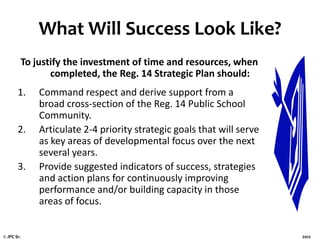
What Will Success Look Like?
        To justify the investment of time and resources, when
               completed, the Reg. 14 Strategic Plan should:
       1.   Command respect and derive support from a
            broad cross-section of the Reg. 14 Public School
            Community.
       2.   Articulate 2-4 priority strategic goals that will serve
            as key areas of developmental focus over the next
            several years.
       3.   Provide suggested indicators of success, strategies
            and action plans for continuously improving
            performance and/or building capacity in those
            areas of focus.


© JPC Sr.                                                             2012
Goals for
                                     Learning
               Teaching &                                Assessment
               Instruction                                 & Data


                                     Leadership
             Curriculum &
                                       Focus
                                                                 Resource
            Communication                                       Deployment


                            Professional         Professional
                             Evaluation            Support


© JPC Sr.                                                                    2012
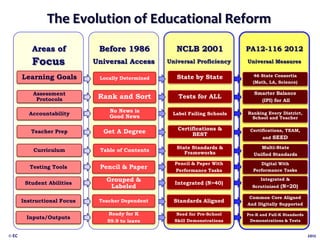
The Evolution of Educational Reform
          Areas of            Before 1986             NCLB 2001             PA12-116 2012
          Focus              Universal Access      Universal Proficiency    Universal Measures


       Learning Goals         Locally Determined      State by State          46 State Consortia
                                                                              (Math, LA, Science)

           Assessment                                                          Smarter Balance
            Protocols         Rank and Sort           Tests for ALL
                                                                                 (IPI) for All

                                 No News is
         Accountability                             Label Failing Schools   Ranking Every District,
                                 Good News                                   School and Teacher

                                                      Certifications &
          Teacher Prep         Get A Degree                BEST
                                                                             Certifications, TEAM,
                                                                                   and   SEED
                                                      State Standards &           Multi-State
           Curriculum         Table of Contents          Frameworks            Unified Standards
                                                     Pencil & Paper With         Digital With
         Testing Tools        Pencil & Paper         Performance Tasks        Performance Tasks

        Student Abilities
                                Grouped &            Integrated (N=40)
                                                                                  Integrated &
                                 Labeled                                      Scrutinized   (N=20)

                                                                             Common Core Aligned
       Instructional Focus    Teacher Dependent      Standards Aligned
                                                                            And Digitally Supported

                                Ready for K           Need for Pre-School   Pre-K and Full-K Standards
        Inputs/Outputs
                                59.9 to leave        Skill Demonstrations    Demonstrations & Tests


© EC                                                                                                     2012
Common Core
     State Standards
    - Organized by the
      Governors Association
      (not the USDOE)

    - 46 States have adopted
      the CCSS (Language Arts
      and Math)

    - They are the official
      state standards in
      Connecticut and have
      been since July 2010.

© JPC Sr.                       2012
SMARTER BALANCE
     Assessment Consortia
    - Starting in 2014-2015 these
      adaptive online assessments will
      change the game for 36
      participating states.
    - 2015-2016 use of tablets will also
      be required for portions of the
      math assessment.
    - They are INTENDED to impact
      instruction. Teaching to the test
      is not a bad thing... if it’s a good
      test.

© JPC Sr.                                    2012
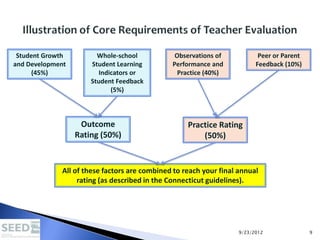
Student Growth         Whole-school           Observations of            Peer or Parent
and Development       Student Learning        Performance and            Feedback (10%)
      (45%)              Indicators or          Practice (40%)
                      Student Feedback
                             (5%)


                   Outcome                         Practice Rating
                  Rating (50%)                         (50%)


             All of these factors are combined to reach your final annual
                  rating (as described in the Connecticut guidelines).


                                                                   9/23/2012               9
Teacher Practice Related Indicators Rating

                                                     Exemplary            Proficient             Developing       Below Standard


                                                                                                                  Gather further
                                    Exemplary        Exemplary            Exemplary              Proficient
                                                                                                                  information
Student Related Indicators Rating


                                                                                                                  Gather further
                                    Proficient       Exemplary             Proficient            Proficient
                                                                                                                  information


                                    Developing       Proficient           Developing             Developing       Below Standard


                                                      Gather further
                                    Below Standard                        Below Standard         Below Standard   Below Standard
                                                       information
Teaching & Instruction                 Goals for Learning                            Assessment & Data
      •        CCSS instructional shifts           •   Common Core State Standards        •       K-3 reading performance
      •        Text/content dependency practices                                          •       Student data sets for use in TEM
      •        SBAC alignment and integration                                             •       SBAC aligned strategies,
                                                                                                  instructional implementation and
                                                                                                  daily analysis for improved practice


                                                        Leadership Focus
                                                   •   DPI/SPI/IPI rankings                          Resource Deployment
          Curriculum & Communication               •   DIP/SIP planning                       •    Unified chart of accounts
  •        CCSS Integration and alignment for      •   Evaluation, tenure and support         •    Charter school funding process (29-31)
           ELA and math                                processes                              •    MBR and small district guidelines
  •        Posting of choice options on website    •   Governance Councils (if needed)


                           Professional Evaluation                                       Professional Support
           •      K-3 reading instruction test (every year)              •   Reading instruction
           •      New Teacher/Administrator Evaluation Model             •   Elimination of CEU requirements
                  implementation (SBOE Guidelines)                       •   Professional Development Committee
           •      Rate every teacher every year                          •   Individual and small group coaching sessions
           •      Tenure and termination process changes.                    (preponderance of 18 hours focused on priorities) and
           •      Validator practices                                        instructional practices
                                                                         •   Evaluation and support training by 7/1/14


Red = 12-116 (CSDE)
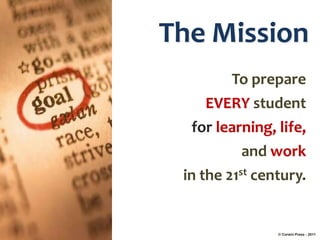
The Mission
         To prepare
     EVERY student
  for learning, life,
           and work
 in the 21st century.


                © Corwin Press - 2011
What’s Your Motivation?


© JPC Sr.                       2012
Mission
        Long View
        The future of
        learning and
        work
        is digital.

© Corwin Press - 2011
Yes, It’s Happened Before Our Eyes


© Corwin Press - 2011
In Less Than
       A Generation…
    • From isolation to
      communication as the
      norm.
    • From going out of your
      way to communicate to
      going out of your way
      not to.

© Corwin Press - 2011
The World is One
   Information Sharing Network
                         6. Baidu.com
1. Google                    (A Chinese language search engine)


2. Facebook              7. Blogger.com
3. YouTube               8. Wikipedia
4. Yahoo!                9. QQ.COM                 (A Chinese
                            language IM program)
5. Windows Live
    (Microsoft search)
                         10. Twitter


                                                         © Corwin Press - 2011
How Would
 You Answer?
 What happens
    to learning
when everyone
        can get
 anything from
    anywhere?
            © Corwin Press - 2011
Life

            Work      Learning


© JPC Sr.                        2012
Life
                   Common
                     Core

            Work     25%
                            School/Tests


© JPC Sr.                                  2012
Remember
      the Mission…                      Communicate

      is about                           Effectively

                        Independent
                                                          Adaptable
      more                   &
                        Collaborative
                                                          & Creative
                                          21st
      than                              Century
      just              Information
                                         Skills
                                                         Higher-Order

      School.             Literacy                         Thinking


                                          Personal
                                        Responsibility


© Corwin Press - 2011
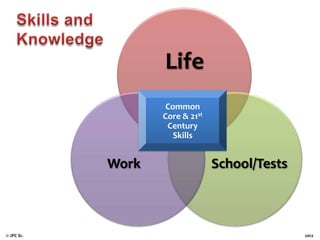
Life
                    Common
                   Core & 21st
                    Century
                      Skills


            Work                 School/Tests


© JPC Sr.                                       2012
Teaching & Instruction                     Goals for Learning                               Assessment & Data
      •        CCSS instructional shifts               •   Common Core State Standards           •       K-3 reading performance
      •        Text/content dependency practices       •   21st century skill identification     •       Student data sets for use in TEM
      •        SBAC alignment and integration              (academic/civic & social)             •       SBAC aligned strategies,
                                                       •   Non-tested curriculum with
      •        21st century skills practice                                                              instructional implementation and
                                                           CCSS/21CS integration
      •        Information literacy integration                                                          daily analysis for improved practice
                                                       •   Balance between mandated and local
      •        Instructional practices for a digital       values                                •       21st century skill and performance
               learning environment                                                                      task assessments
      •        Independent and collaborative                                                     •       Real world digital skill and
               practices and support
                                                            Leadership Focus                             attribute assessment
                                                       •   DPI/SPI/IPI rankings                             Resource Deployment
          Curriculum & Communication                   •   DIP/SIP planning                          •    Unified chart of accounts
  •        CCSS Integration and alignment for          •   Evaluation, tenure and support            •    Charter school funding process (29-31)
           ELA and math                                    processes                                 •    MBR and small district guidelines
  •        Posting of choice options on website        •   Governance Councils (if needed)           •    Allocation of time and schedules to align
  •        21st century skill integration              •   Mission and community-wide                     with priorities and needs
  •        Non-tested curriculum renewal with              expectations                              •    Alignment of resource allocations with
           CCSS/21CS integration and                   •   Coherence and systems approaches               digital learning processes
           readiness                                   •   Planning for digital transitions


                            Professional Evaluation                                             Professional Support
           •      K-3 reading instruction test (every year)                    •   Reading instruction
           •      New Teacher/Administrator Evaluation Model                   •   Elimination of CEU requirements
                  implementation (SBOE Guidelines)                             •   Professional Development Committee
           •      Rate every teacher every year                                •   Individual and small group coaching sessions
           •      Tenure and termination process changes.                          (preponderance of 18 hours focused on priorities) and
           •      Validator practices                                              instructional practices
           •      Alignment of teaching practice with 21 CS                    •   Evaluation and support training by 7/1/14
           •      Beyond CT Framework of reference- strengths and              •   Providing professional learning opportunities
                  weaknesses - ensuring that TEM values what it                •   Rethinking the expectations of professional learning –
                  measures and measures what it values.                            impact on TEM – alignment with TEAM

Red = 12-116 (CSDE)                                                Green = NEASC                                            Blue = Digital Learning
Philosophy "Pride Through Excellence"

WHAT WE EXPECT OF EVERY STUDENT AT REGION 14
Every student is responsible for his/her own language, manners, and behavior as we are all affected by them. Every student should help in keeping the school and
grounds clean and safe.

VISION STATEMENT
The Region 14 School District will rank in the top ten of school districts in the State of Connecticut on all current measures of school effectiveness.

MISSION STATEMENT
We, the educational community of the Region 14 School District, are dedicated to creating a quality, dynamic learning environment so that each individual learner
becomes a respected contributing member of the community with values, skills and resources that promote the advancement of society.

REGION 14 COMMON CORE OF BELIEFS
AUTHENTIC ASSESSMENT: We believe that the assessment of learning is multi-dimensional in nature and designed to provide insights to the processes,
understandings and outcomes of genuine learning of an individual. We believe that assessment should be ongoing, systematic and reflect the multifaceted growth
of the individual.
COLLABORATION: We believe in the importance of the energy and enjoyment that comes from working with others. We encourage teaming and are dedicated to
finding the time it takes to make decisions by means of consensus. We believe that learning is built upon strong relationships that foster self esteem.
COMMUNICATION: We believe that processing effective communication skills is imperative for the enrichment of the learning process and to satisfy the demands
of daily interaction. For optimal growth, we believe an individual must possess skills that allow them to access external resources and demonstrate his/her internal
wealth.
COMMUNITY: We believe that building a sense of community can only be accomplished if the learners have a sense of ownership in their schools. We believe that
this sense of ownership will be engendered in learners when a measure of control is entrusted to them. We believe that learners will accept responsibility for the
well being and success of a school that is "theirs."
FLEXIBILITY: We believe that our world is changing at an extraordinary rate and we must work to expect and accept that change. We believe that effective
learners welcome the exploration of alternatives and can adapt to new situations. We believe that the educational process itself requires ongoing evaluation and
adjustments in response to the manifestations of constant change.
INCLUSION: We believe that the opportunity to learn is an entitlement that will not be determined by individual differences. We believe that all students have the
right to a quality education to develop their own unique gifts and unrealized potential. We believe that sustaining these expectations will dictate high standards for
all members of the institution.
INTEGRATING THE CURRICULUM: The world is an integrated whole and schools should reflect that orientation. We believe that individual subject areas are
merely perspectives or ways of knowing, and that learning becomes more meaningful when these "parts" are interconnected with a common theme for the purpose
of fusing them into a web of real understanding.
We wish to develop in the child a mind to think and a heart to love. To this end we will teach students graduating from Region 14 to demonstrate:
The skills and confidence necessary to be life-long learners and risk takers, with the ability to adapt and cope in an ever changing world.
The ability to understand and to use effectively language, mathematics, science, social science and technology as tools of the 21st century.
The ability to identify a problem and to utilize decision-making, reasoning and problem solving skills, thereby working through the problem to arrive at viable
alternative solutions.
An understanding of the artistic accomplishments of the world and explore, develop and express their own uniqueness and creativity.
The ability to understand and develop the skills necessary to function as a responsible individual and/or group member in the multiple roles of citizen, family
member, parent, worker and consumer in a democratic society.
A personal, social and moral responsibility in dealing with health, global and environmental issues, recognizing the necessity for moral and ethical conduct.
An understanding and respect for, appreciation of, and sensitivity to a multi-cultural and world view, thereby enabling them to interact effectively and to work
cooperatively with diverse ethnic and cultural groups.
An understanding of the benefits of proper nutrition and lifetime fitness, enabling them to pursue a future which incorporates good health practices and a variety of
leisure time activities.
Focus
       What are
         the key
leverage points
  that will drive
        mission
  sustainability?
            © Corwin Press - 2011
The Pareto
  Principle
 Focus - the law of the


      Vital
      Few
                  © Corwin Press - 2011
Alignment is A Coherence Imperative


            Aligned With


                           Aligned With


© JPC Sr.                                         2012
Common and Special Causes
                   One of Deming’s most significant insights.

                                                    Mission
                        Common     Systemic
                                   Predictable
                                                    Driven
                         Causes    Controllable    Decision
                                                    Making


                        Special    Random          In-Context
                                   Unpredictable   Problem
                        Causes     Beyond
                                    Control         Solving

© Corwin Press - 2011
Coherence
  Connecting the
            dots
   in the midst of
tumult, stress and
       confusion.
             © Corwin Press - 2011
Goals for
                                 Learning
Teaching & Instruction                             Assessment & Data
                          • Common Core State
                                  Standards
                           • 21st Century Skills

                         Leadership Focus

    Curriculum &                                            Resource
   Communication                                           Deployment


       Professional Evaluation               Professional Support
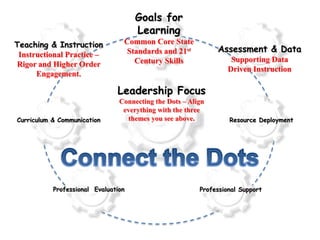
Goals for
                                     Learning
Teaching & Instruction           Common Core State
                                  Standards and 21st          Assessment & Data
 Instructional Practice –
                                    Century Skills                 Supporting Data
Rigor and Higher Order
                                                                  Driven Instruction
      Engagement.

                               Leadership Focus
                                Connecting the Dots – Align
                                 everything with the three
Curriculum & Communication         themes you see above.          Resource Deployment


           Professional Evaluation                       Professional Support
Goals for
                              Learning
                               How do our
                             curricular and
    Teaching &                                    Assessment &
                              instructional
    Instruction
                           support materials          Data
How do our teaching                              How do our assessment
practices, improvement          align with       and measurement
mechanisms and             Common Core and       systems align with our
evaluation systems align    21st Century Skill   goals for learning,
with our goals for              Priorities?      teaching practices, and
learning?                                        the demands of data
                                                 driven instruction?
What we
                 have to do.


            What we       What we
            want to      are already
              do.          doing.

© JPC Sr.                              2012
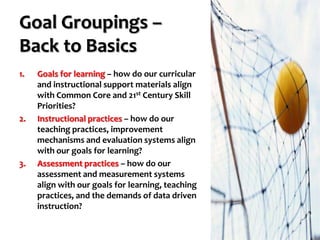
Goal Groupings –
Back to Basics
1.   Goals for learning – how do our curricular
     and instructional support materials align
     with Common Core and 21st Century Skill
     Priorities?
2.   Instructional practices – how do our
     teaching practices, improvement
     mechanisms and evaluation systems align
     with our goals for learning?
3.   Assessment practices – how do our
     assessment and measurement systems
     align with our goals for learning, teaching
     practices, and the demands of data driven
     instruction?
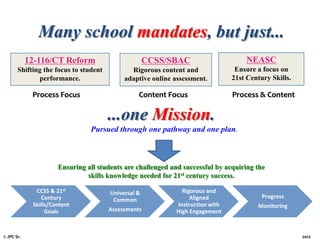
Many school mandates, but just...
            12-116/CT Reform                         CCSS/SBAC                      NEASC
       Shifting the focus to student          Rigorous content and               Ensure a focus on
              performance.                  adaptive online assessment.         21st Century Skills.

             Process Focus                       Content Focus                  Process & Content

                                       ...one Mission.
                                Pursued through one pathway and one plan.


                      Ensuring all students are challenged and successful by acquiring the
                               skills knowledge needed for 21st century success.

              CCSS & 21st              Universal &             Rigorous and
                Century                                           Aligned                 Progress
                                        Common
             Skills/Content                                  Instruction with           Monitoring
                  Goals                Assessments          High Engagement


© JPC Sr.                                                                                              2012
Resource
Deployment
…and you will need to
 do it all with just the
  resources you have
now, or perhaps even
        less than that.
          Choices will
     need to be made.
Dates & Outcomes
Tuesday, September 24, 2:00-6:00 PM
    – Kickoff
    – Overview of Process
    – Form Goal Groups
Friday, October 22, 12:00-6:00 PM
    – Mission Statement Discussion, Revision and
       Redevelopment (Add/Enhance/Delete)
Thursday, October 29, 3:30-6:30 PM
    – Develop Language for Goal Statements
Thursday, November 19, 3:30-5:30 PM
    – Goal Group Data Collection Assignment
Monday, December 14, 8:00 AM-2:00 PM
    – Goal Group Data Presentation and Analysis
    – Strategies Evaluation (Start/Stop/Continue)
Monday, January 17, 3:30-7:30 PM
    – Finalize Goals
    – Strategy Framework/Template
Next Steps…
(before 10/22/12)
1.   Last chance to jump ship….
2.   Do your research… review the resources
     (see next slide) and become familiar
     with what is required.
3.   Examine the mission and beliefs
     statement. Do they still reflect the most
     important vision and beliefs for the
     Region 14 Public Schools – what you
     add/enhance/delete from that document
     to bring it into greater alignment with
     the current context?
4.   Think about which question you would
     like to be associated with.
5.   Give us your preferred email contact
     address for future communications.
Planning Resources
Common Core State Standards
http://www.corestandards.org/


Connecticut SEED (Educator Evaluation)
http://www.connecticutseed.org


NEASC Standards
http://cpss.neasc.org/selfstudy_onsite_visit/selfstudy_materials_for_2012_schools/


Public Act 12-116
http://www.cga.ct.gov/2012/act/pa/pdf/2012PA-00116-R00SB-00458-PA.pdf


Smarter Balanced Assessment Consortium
http://www.smarterbalanced.org/smarter-balanced-assessments/


To view these slides and access these links:
www.slideshare.net/jpcostasr
Contact Information

  Jonathan P. Costa, Sr.
            Director, School/Program Services

 EDUCATION CONNECTION
costa@educationconnection.org
                 860-567-0863

                 To view slides:
     www.slideshare.net/jpcostasr
                  Book Questions:
info@digitallearningforallnow.com
                  Book Web Page:
 www.digitallearningforallnow.com
                         Book Order:
 www.sagepub.com/books/Book237875


                                 © Corwin Press - 2011

Region 14 Planning Opening Presentation

  • 1.
    EDUCATION CONNECTION Strategic Planning in the Region 14 Public Schools Planning for the Future of Your District Introduction and Overview Materials September 24th, 2012 © JPC Sr. 2012
  • 2.
    Planning Message Mission Focus Coherence
  • 3.
    It Really IsPretty Simple Now What? What? So What? © JPC Sr. 2012
  • 4.
    What Will SuccessLook Like? To justify the investment of time and resources, when completed, the Reg. 14 Strategic Plan should: 1. Command respect and derive support from a broad cross-section of the Reg. 14 Public School Community. 2. Articulate 2-4 priority strategic goals that will serve as key areas of developmental focus over the next several years. 3. Provide suggested indicators of success, strategies and action plans for continuously improving performance and/or building capacity in those areas of focus. © JPC Sr. 2012
  • 5.
    Goals for Learning Teaching & Assessment Instruction & Data Leadership Curriculum & Focus Resource Communication Deployment Professional Professional Evaluation Support © JPC Sr. 2012
  • 6.
    The Evolution ofEducational Reform Areas of Before 1986 NCLB 2001 PA12-116 2012 Focus Universal Access Universal Proficiency Universal Measures Learning Goals Locally Determined State by State 46 State Consortia (Math, LA, Science) Assessment Smarter Balance Protocols Rank and Sort Tests for ALL (IPI) for All No News is Accountability Label Failing Schools Ranking Every District, Good News School and Teacher Certifications & Teacher Prep Get A Degree BEST Certifications, TEAM, and SEED State Standards & Multi-State Curriculum Table of Contents Frameworks Unified Standards Pencil & Paper With Digital With Testing Tools Pencil & Paper Performance Tasks Performance Tasks Student Abilities Grouped & Integrated (N=40) Integrated & Labeled Scrutinized (N=20) Common Core Aligned Instructional Focus Teacher Dependent Standards Aligned And Digitally Supported Ready for K Need for Pre-School Pre-K and Full-K Standards Inputs/Outputs 59.9 to leave Skill Demonstrations Demonstrations & Tests © EC 2012
  • 7.
    Common Core State Standards - Organized by the Governors Association (not the USDOE) - 46 States have adopted the CCSS (Language Arts and Math) - They are the official state standards in Connecticut and have been since July 2010. © JPC Sr. 2012
  • 8.
    SMARTER BALANCE Assessment Consortia - Starting in 2014-2015 these adaptive online assessments will change the game for 36 participating states. - 2015-2016 use of tablets will also be required for portions of the math assessment. - They are INTENDED to impact instruction. Teaching to the test is not a bad thing... if it’s a good test. © JPC Sr. 2012
  • 9.
    Student Growth Whole-school Observations of Peer or Parent and Development Student Learning Performance and Feedback (10%) (45%) Indicators or Practice (40%) Student Feedback (5%) Outcome Practice Rating Rating (50%) (50%) All of these factors are combined to reach your final annual rating (as described in the Connecticut guidelines). 9/23/2012 9
  • 10.
    Teacher Practice RelatedIndicators Rating Exemplary Proficient Developing Below Standard Gather further Exemplary Exemplary Exemplary Proficient information Student Related Indicators Rating Gather further Proficient Exemplary Proficient Proficient information Developing Proficient Developing Developing Below Standard Gather further Below Standard Below Standard Below Standard Below Standard information
  • 11.
    Teaching & Instruction Goals for Learning Assessment & Data • CCSS instructional shifts • Common Core State Standards • K-3 reading performance • Text/content dependency practices • Student data sets for use in TEM • SBAC alignment and integration • SBAC aligned strategies, instructional implementation and daily analysis for improved practice Leadership Focus • DPI/SPI/IPI rankings Resource Deployment Curriculum & Communication • DIP/SIP planning • Unified chart of accounts • CCSS Integration and alignment for • Evaluation, tenure and support • Charter school funding process (29-31) ELA and math processes • MBR and small district guidelines • Posting of choice options on website • Governance Councils (if needed) Professional Evaluation Professional Support • K-3 reading instruction test (every year) • Reading instruction • New Teacher/Administrator Evaluation Model • Elimination of CEU requirements implementation (SBOE Guidelines) • Professional Development Committee • Rate every teacher every year • Individual and small group coaching sessions • Tenure and termination process changes. (preponderance of 18 hours focused on priorities) and • Validator practices instructional practices • Evaluation and support training by 7/1/14 Red = 12-116 (CSDE)
  • 12.
    The Mission To prepare EVERY student for learning, life, and work in the 21st century. © Corwin Press - 2011
  • 13.
  • 14.
    Mission Long View The future of learning and work is digital. © Corwin Press - 2011
  • 15.
    Yes, It’s HappenedBefore Our Eyes © Corwin Press - 2011
  • 16.
    In Less Than A Generation… • From isolation to communication as the norm. • From going out of your way to communicate to going out of your way not to. © Corwin Press - 2011
  • 17.
    The World isOne Information Sharing Network 6. Baidu.com 1. Google (A Chinese language search engine) 2. Facebook 7. Blogger.com 3. YouTube 8. Wikipedia 4. Yahoo! 9. QQ.COM (A Chinese language IM program) 5. Windows Live (Microsoft search) 10. Twitter © Corwin Press - 2011
  • 18.
    How Would YouAnswer? What happens to learning when everyone can get anything from anywhere? © Corwin Press - 2011
  • 19.
    Life Work Learning © JPC Sr. 2012
  • 20.
    Life Common Core Work 25% School/Tests © JPC Sr. 2012
  • 21.
    Remember the Mission… Communicate is about Effectively Independent Adaptable more & Collaborative & Creative 21st than Century just Information Skills Higher-Order School. Literacy Thinking Personal Responsibility © Corwin Press - 2011
  • 22.
    Life Common Core & 21st Century Skills Work School/Tests © JPC Sr. 2012
  • 23.
    Teaching & Instruction Goals for Learning Assessment & Data • CCSS instructional shifts • Common Core State Standards • K-3 reading performance • Text/content dependency practices • 21st century skill identification • Student data sets for use in TEM • SBAC alignment and integration (academic/civic & social) • SBAC aligned strategies, • Non-tested curriculum with • 21st century skills practice instructional implementation and CCSS/21CS integration • Information literacy integration daily analysis for improved practice • Balance between mandated and local • Instructional practices for a digital values • 21st century skill and performance learning environment task assessments • Independent and collaborative • Real world digital skill and practices and support Leadership Focus attribute assessment • DPI/SPI/IPI rankings Resource Deployment Curriculum & Communication • DIP/SIP planning • Unified chart of accounts • CCSS Integration and alignment for • Evaluation, tenure and support • Charter school funding process (29-31) ELA and math processes • MBR and small district guidelines • Posting of choice options on website • Governance Councils (if needed) • Allocation of time and schedules to align • 21st century skill integration • Mission and community-wide with priorities and needs • Non-tested curriculum renewal with expectations • Alignment of resource allocations with CCSS/21CS integration and • Coherence and systems approaches digital learning processes readiness • Planning for digital transitions Professional Evaluation Professional Support • K-3 reading instruction test (every year) • Reading instruction • New Teacher/Administrator Evaluation Model • Elimination of CEU requirements implementation (SBOE Guidelines) • Professional Development Committee • Rate every teacher every year • Individual and small group coaching sessions • Tenure and termination process changes. (preponderance of 18 hours focused on priorities) and • Validator practices instructional practices • Alignment of teaching practice with 21 CS • Evaluation and support training by 7/1/14 • Beyond CT Framework of reference- strengths and • Providing professional learning opportunities weaknesses - ensuring that TEM values what it • Rethinking the expectations of professional learning – measures and measures what it values. impact on TEM – alignment with TEAM Red = 12-116 (CSDE) Green = NEASC Blue = Digital Learning
  • 24.
    Philosophy "Pride ThroughExcellence" WHAT WE EXPECT OF EVERY STUDENT AT REGION 14 Every student is responsible for his/her own language, manners, and behavior as we are all affected by them. Every student should help in keeping the school and grounds clean and safe. VISION STATEMENT The Region 14 School District will rank in the top ten of school districts in the State of Connecticut on all current measures of school effectiveness. MISSION STATEMENT We, the educational community of the Region 14 School District, are dedicated to creating a quality, dynamic learning environment so that each individual learner becomes a respected contributing member of the community with values, skills and resources that promote the advancement of society. REGION 14 COMMON CORE OF BELIEFS AUTHENTIC ASSESSMENT: We believe that the assessment of learning is multi-dimensional in nature and designed to provide insights to the processes, understandings and outcomes of genuine learning of an individual. We believe that assessment should be ongoing, systematic and reflect the multifaceted growth of the individual. COLLABORATION: We believe in the importance of the energy and enjoyment that comes from working with others. We encourage teaming and are dedicated to finding the time it takes to make decisions by means of consensus. We believe that learning is built upon strong relationships that foster self esteem. COMMUNICATION: We believe that processing effective communication skills is imperative for the enrichment of the learning process and to satisfy the demands of daily interaction. For optimal growth, we believe an individual must possess skills that allow them to access external resources and demonstrate his/her internal wealth. COMMUNITY: We believe that building a sense of community can only be accomplished if the learners have a sense of ownership in their schools. We believe that this sense of ownership will be engendered in learners when a measure of control is entrusted to them. We believe that learners will accept responsibility for the well being and success of a school that is "theirs." FLEXIBILITY: We believe that our world is changing at an extraordinary rate and we must work to expect and accept that change. We believe that effective learners welcome the exploration of alternatives and can adapt to new situations. We believe that the educational process itself requires ongoing evaluation and adjustments in response to the manifestations of constant change. INCLUSION: We believe that the opportunity to learn is an entitlement that will not be determined by individual differences. We believe that all students have the right to a quality education to develop their own unique gifts and unrealized potential. We believe that sustaining these expectations will dictate high standards for all members of the institution. INTEGRATING THE CURRICULUM: The world is an integrated whole and schools should reflect that orientation. We believe that individual subject areas are merely perspectives or ways of knowing, and that learning becomes more meaningful when these "parts" are interconnected with a common theme for the purpose of fusing them into a web of real understanding. We wish to develop in the child a mind to think and a heart to love. To this end we will teach students graduating from Region 14 to demonstrate: The skills and confidence necessary to be life-long learners and risk takers, with the ability to adapt and cope in an ever changing world. The ability to understand and to use effectively language, mathematics, science, social science and technology as tools of the 21st century. The ability to identify a problem and to utilize decision-making, reasoning and problem solving skills, thereby working through the problem to arrive at viable alternative solutions. An understanding of the artistic accomplishments of the world and explore, develop and express their own uniqueness and creativity. The ability to understand and develop the skills necessary to function as a responsible individual and/or group member in the multiple roles of citizen, family member, parent, worker and consumer in a democratic society. A personal, social and moral responsibility in dealing with health, global and environmental issues, recognizing the necessity for moral and ethical conduct. An understanding and respect for, appreciation of, and sensitivity to a multi-cultural and world view, thereby enabling them to interact effectively and to work cooperatively with diverse ethnic and cultural groups. An understanding of the benefits of proper nutrition and lifetime fitness, enabling them to pursue a future which incorporates good health practices and a variety of leisure time activities.
  • 25.
    Focus What are the key leverage points that will drive mission sustainability? © Corwin Press - 2011
  • 26.
    The Pareto Principle Focus - the law of the Vital Few © Corwin Press - 2011
  • 27.
    Alignment is ACoherence Imperative Aligned With Aligned With © JPC Sr. 2012
  • 28.
    Common and SpecialCauses One of Deming’s most significant insights. Mission Common  Systemic  Predictable Driven Causes  Controllable Decision Making Special  Random In-Context  Unpredictable Problem Causes  Beyond Control Solving © Corwin Press - 2011
  • 29.
    Coherence Connectingthe dots in the midst of tumult, stress and confusion. © Corwin Press - 2011
  • 30.
    Goals for Learning Teaching & Instruction Assessment & Data • Common Core State Standards • 21st Century Skills Leadership Focus Curriculum & Resource Communication Deployment Professional Evaluation Professional Support
  • 31.
    Goals for Learning Teaching & Instruction Common Core State Standards and 21st Assessment & Data Instructional Practice – Century Skills Supporting Data Rigor and Higher Order Driven Instruction Engagement. Leadership Focus Connecting the Dots – Align everything with the three Curriculum & Communication themes you see above. Resource Deployment Professional Evaluation Professional Support
  • 32.
    Goals for Learning How do our curricular and Teaching & Assessment & instructional Instruction support materials Data How do our teaching How do our assessment practices, improvement align with and measurement mechanisms and Common Core and systems align with our evaluation systems align 21st Century Skill goals for learning, with our goals for Priorities? teaching practices, and learning? the demands of data driven instruction?
  • 33.
    What we have to do. What we What we want to are already do. doing. © JPC Sr. 2012
  • 34.
    Goal Groupings – Backto Basics 1. Goals for learning – how do our curricular and instructional support materials align with Common Core and 21st Century Skill Priorities? 2. Instructional practices – how do our teaching practices, improvement mechanisms and evaluation systems align with our goals for learning? 3. Assessment practices – how do our assessment and measurement systems align with our goals for learning, teaching practices, and the demands of data driven instruction?
  • 35.
    Many school mandates,but just... 12-116/CT Reform CCSS/SBAC NEASC Shifting the focus to student Rigorous content and Ensure a focus on performance. adaptive online assessment. 21st Century Skills. Process Focus Content Focus Process & Content ...one Mission. Pursued through one pathway and one plan. Ensuring all students are challenged and successful by acquiring the skills knowledge needed for 21st century success. CCSS & 21st Universal & Rigorous and Century Aligned Progress Common Skills/Content Instruction with Monitoring Goals Assessments High Engagement © JPC Sr. 2012
  • 36.
    Resource Deployment …and you willneed to do it all with just the resources you have now, or perhaps even less than that. Choices will need to be made.
  • 37.
    Dates & Outcomes Tuesday,September 24, 2:00-6:00 PM – Kickoff – Overview of Process – Form Goal Groups Friday, October 22, 12:00-6:00 PM – Mission Statement Discussion, Revision and Redevelopment (Add/Enhance/Delete) Thursday, October 29, 3:30-6:30 PM – Develop Language for Goal Statements Thursday, November 19, 3:30-5:30 PM – Goal Group Data Collection Assignment Monday, December 14, 8:00 AM-2:00 PM – Goal Group Data Presentation and Analysis – Strategies Evaluation (Start/Stop/Continue) Monday, January 17, 3:30-7:30 PM – Finalize Goals – Strategy Framework/Template
  • 38.
    Next Steps… (before 10/22/12) 1. Last chance to jump ship…. 2. Do your research… review the resources (see next slide) and become familiar with what is required. 3. Examine the mission and beliefs statement. Do they still reflect the most important vision and beliefs for the Region 14 Public Schools – what you add/enhance/delete from that document to bring it into greater alignment with the current context? 4. Think about which question you would like to be associated with. 5. Give us your preferred email contact address for future communications.
  • 39.
    Planning Resources Common CoreState Standards http://www.corestandards.org/ Connecticut SEED (Educator Evaluation) http://www.connecticutseed.org NEASC Standards http://cpss.neasc.org/selfstudy_onsite_visit/selfstudy_materials_for_2012_schools/ Public Act 12-116 http://www.cga.ct.gov/2012/act/pa/pdf/2012PA-00116-R00SB-00458-PA.pdf Smarter Balanced Assessment Consortium http://www.smarterbalanced.org/smarter-balanced-assessments/ To view these slides and access these links: www.slideshare.net/jpcostasr
  • 40.
    Contact Information Jonathan P. Costa, Sr. Director, School/Program Services EDUCATION CONNECTION costa@educationconnection.org 860-567-0863 To view slides: www.slideshare.net/jpcostasr Book Questions: info@digitallearningforallnow.com Book Web Page: www.digitallearningforallnow.com Book Order: www.sagepub.com/books/Book237875 © Corwin Press - 2011

Editor's Notes

  • #3 This is the defining challenge of our times in public school.
  • #11 Must have a rating by June 30th- can be changed if necessary- p. 107
  • #13 This is the defining challenge of our times in public school.
  • #14 Continued investment in a print-based infrastructure and the lack of strategic transitional planning for a complete move to digital are ultimately counter-productiveboth educationally and fiscally.
  • #15 This inescapable truth sets the direction
  • #26 This is the defining challenge of our times in public school.
  • #30 This is the defining challenge of our times in public school.