


Not Another Paper!: Technology Approaches to Final ProjectsNathan Whitley-Grassi & Patricia HetuEmpire State College
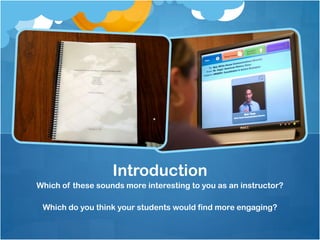
Which of these sounds more interesting to you as an instructor?Which do you think your students would find more engaging?Introduction
Who Are We?Nathan Whitley-GrassiFaculty Instructional Technologist & Adjunct Faculty – Empire State CollegeSenior Lecturer – Niagara UniversityResearch Instructor – University at BuffaloPatricia HetuFaculty Instructional Technologist – Empire State CollegeOnline Instructor – University of Phoenix
Pedagogy – Educational TechFosters critical thinking skills Makes learners move past the basic concept memorization and fully engage with the material in a multi-modal approachStudent generated knowledge requires a higher order of understanding and leads to higher levels of learning and longer lasting retention of information
AdvantagesTIMEStudents who are technology proficient may find an online project easier to create Need to take into account technology needs of entire classEngage students Studies suggest that multimedia and web enhanced activities are more engaging to todays learners
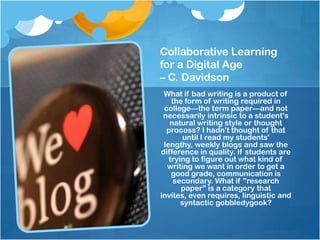
Collaborative Learning for a Digital Age – C. DavidsonWhat if bad writing is a product of the form of writing required in college—the term paper—and not necessarily intrinsic to a student's natural writing style or thought process? I hadn't thought of that until I read my students' lengthy, weekly blogs and saw the difference in quality. If students are trying to figure out what kind of writing we want in order to get a good grade, communication is secondary. What if "research paper" is a category that invites, even requires, linguistic and syntactic gobbledygook?
CreativityStudents are able  to think in different ways Multiple IntelligencesStudents who are more visual learners have more options to express themselves Technology extends/adds layers to assignments Goes beyond the 2 dimensional research paperWikis/Blogs: Can include videos, links to other sitesTimeline tools: Again, can link to videos
21st Century LiteracyStudents in college today should develop skills necessary to learn new technology skills and master new applications.Students who work on technology-oriented assignment can now include presentation in their resume portfolio“Literacy today depends on understanding the multiple media that make up our high-tech reality and developing the skills to use them effectively “– Educause Quarterly
Example: VideoTitus Andronicus project for Theatre History Course
Example: Video
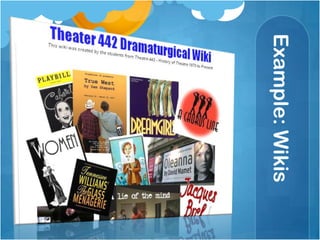
Example: Wikis
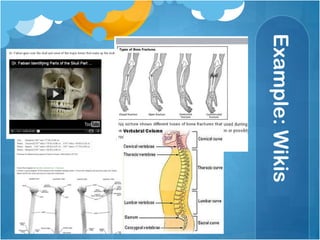
Example: Wikis
Example: Podcasts
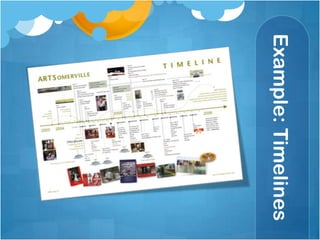
Example: Timelines
Example: Animation
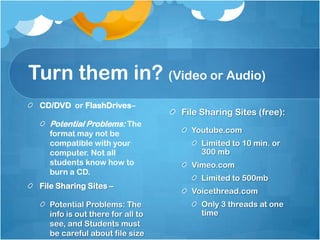
Turn them in? (Video or Audio)CD/DVD  or FlashDrives– Potential Problems: The format may not be compatible with your computer. Not all students know how to burn a CD.  File Sharing Sites – Potential Problems: The info is out there for all to see, and Students must be careful about file sizeFile Sharing Sites (free):Youtube.comLimited to 10 min. or 300 mbVimeo.comLimited to 500mbVoicethread.comOnly 3 threads at one time
Assessment: Learning Outcomes & GoalsClearly defined learning objectives/goals will allow both students and instructor to consider the “end game” of this assignment and how it fits into the whole picture of the courseUse of wikis for writing or project assembly allows for: Formative assessmentPeer ReviewCollaboration
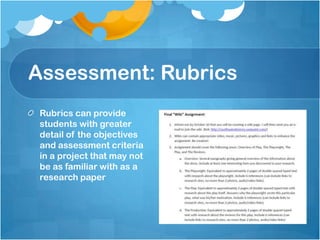
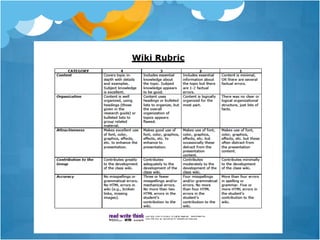
Assessment: RubricsRubrics can provide students with greater detail of the objectives and assessment criteria in a project that may not be as familiar with as a research paper
Assessment: Sizing up the AssignmentTranslating Pages to other units of measurementThis depends on the requirements of the assignmentDefining the scope and size of the projectDetermining due dates for each stepBe sure your project does not outgrow your submission plan!!!
Tip for Adoption:Allow for at least one day to thoroughly review the technologyShow examples from other studentsOffer a chance to try it outHave a tutorial/instruction materials availableOffer to work one-on-oneSee if the college offers training sessions on these tools
Opt out:Offer research paper as back up (for those who may be completely uncomfortable with technology)Creating a backdoor can help student feel more comfortable knowing that other options exist.Even students who are wary of the technology often try it out knowing the have a fail-safe just in case.
References:Akpinar, Y. (2008). Validation of a Learning Object Review Instrument: Relationship between Ratings of Learning Objects and Actual Learning Outcomes. Interdisciplinary Journal of Knowledge & Learning Objects, 4291-302. Retrieved from EBSCOhost.Armstrong, G. R., Tucker, J. M., & Massad, V. J. (2009). Achieving Learning Goals with Student-Created Podcasts. Decision Sciences Journal of Innovative Education, 7(1), 149-154. doi:10.1111/j.1540-4609.2008.00209.xArmstrong, G. R., Tucker, J. M., & Massad, V. J. (2009). Interviewing the Experts: Student Produced Podcast. Journal of Information Technology Education, 8IIP-79-IIP-90. Retrieved from EBSCOhost.Buzzetto-More, N. A., & Alade, A. (2006). Best Practices in e-Assessment. Journal of Information Technology Education, 5251-269. Retrieved from EBSCOhost.Davidson, C. (2011). Collaborative Learning for the Digital Age. Chronicle for Higher Education. Retrieved from http://chronicle.com/article/Collaborative-Learning-for-the/128789/Lee, M. W., McLoughlin, C., & Chan, A. (2008). Talk the talk: Learner-generated podcasts as catalysts for knowledge creation. British Journal of Educational Technology, 39(3), 501-521. doi:10.1111/j.1467-8535.2007.00746.xMorrisette, S. (2007). Web-Based Inquiry Projects that use "New Media" and Some Ideas on using Technology in the Elementary Classroom. International Journal of Learning, 14(2), 1-9. Retrieved from EBSCOhost.Slotter, E. B. (2010). Using Wiki Contributions to Induce Collaborative Learning in a Psychology Course. International Journal of Technology in Teaching & Learning, 6(1), 33-42. Retrieved from EBSCOhost.Tarasiuk, T. J. (2010). Combining Traditional and Contemporary Texts: Moving My English Class to the Computer Lab. Journal of Adolescent & Adult Literacy, 53(7), 543-552. Retrieved from EBSCOhost.Wentworth, N., Graham, C. R., & Tripp, T. (2008). Development of Teaching and Technology Integration: Focus on Pedagogy. Computers in the Schools, 25(1/2), 64-80. doi:10.1080/07380560802157782
Time to hear your thought!What kinds of projects can you come up with for your classes?Questions?

Not another paper presentation

  • 1.
    Not Another Paper!:Technology Approaches to Final ProjectsNathan Whitley-Grassi & Patricia HetuEmpire State College
  • 2.
    Which of thesesounds more interesting to you as an instructor?Which do you think your students would find more engaging?Introduction
  • 3.
    Who Are We?NathanWhitley-GrassiFaculty Instructional Technologist & Adjunct Faculty – Empire State CollegeSenior Lecturer – Niagara UniversityResearch Instructor – University at BuffaloPatricia HetuFaculty Instructional Technologist – Empire State CollegeOnline Instructor – University of Phoenix
  • 4.
    Pedagogy – EducationalTechFosters critical thinking skills Makes learners move past the basic concept memorization and fully engage with the material in a multi-modal approachStudent generated knowledge requires a higher order of understanding and leads to higher levels of learning and longer lasting retention of information
  • 5.
    AdvantagesTIMEStudents who aretechnology proficient may find an online project easier to create Need to take into account technology needs of entire classEngage students Studies suggest that multimedia and web enhanced activities are more engaging to todays learners
  • 6.
    Collaborative Learning fora Digital Age – C. DavidsonWhat if bad writing is a product of the form of writing required in college—the term paper—and not necessarily intrinsic to a student's natural writing style or thought process? I hadn't thought of that until I read my students' lengthy, weekly blogs and saw the difference in quality. If students are trying to figure out what kind of writing we want in order to get a good grade, communication is secondary. What if "research paper" is a category that invites, even requires, linguistic and syntactic gobbledygook?
  • 7.
    CreativityStudents are able to think in different ways Multiple IntelligencesStudents who are more visual learners have more options to express themselves Technology extends/adds layers to assignments Goes beyond the 2 dimensional research paperWikis/Blogs: Can include videos, links to other sitesTimeline tools: Again, can link to videos
  • 8.
    21st Century LiteracyStudentsin college today should develop skills necessary to learn new technology skills and master new applications.Students who work on technology-oriented assignment can now include presentation in their resume portfolio“Literacy today depends on understanding the multiple media that make up our high-tech reality and developing the skills to use them effectively “– Educause Quarterly
  • 9.
    Example: VideoTitus Andronicusproject for Theatre History Course
  • 10.
  • 11.
  • 12.
  • 13.
  • 14.
  • 15.
  • 16.
    Turn them in?(Video or Audio)CD/DVD  or FlashDrives– Potential Problems: The format may not be compatible with your computer. Not all students know how to burn a CD.  File Sharing Sites – Potential Problems: The info is out there for all to see, and Students must be careful about file sizeFile Sharing Sites (free):Youtube.comLimited to 10 min. or 300 mbVimeo.comLimited to 500mbVoicethread.comOnly 3 threads at one time
  • 17.
    Assessment: Learning Outcomes& GoalsClearly defined learning objectives/goals will allow both students and instructor to consider the “end game” of this assignment and how it fits into the whole picture of the courseUse of wikis for writing or project assembly allows for: Formative assessmentPeer ReviewCollaboration
  • 18.
    Assessment: RubricsRubrics canprovide students with greater detail of the objectives and assessment criteria in a project that may not be as familiar with as a research paper
  • 20.
    Assessment: Sizing upthe AssignmentTranslating Pages to other units of measurementThis depends on the requirements of the assignmentDefining the scope and size of the projectDetermining due dates for each stepBe sure your project does not outgrow your submission plan!!!
  • 21.
    Tip for Adoption:Allowfor at least one day to thoroughly review the technologyShow examples from other studentsOffer a chance to try it outHave a tutorial/instruction materials availableOffer to work one-on-oneSee if the college offers training sessions on these tools
  • 22.
    Opt out:Offer researchpaper as back up (for those who may be completely uncomfortable with technology)Creating a backdoor can help student feel more comfortable knowing that other options exist.Even students who are wary of the technology often try it out knowing the have a fail-safe just in case.
  • 23.
    References:Akpinar, Y. (2008).Validation of a Learning Object Review Instrument: Relationship between Ratings of Learning Objects and Actual Learning Outcomes. Interdisciplinary Journal of Knowledge & Learning Objects, 4291-302. Retrieved from EBSCOhost.Armstrong, G. R., Tucker, J. M., & Massad, V. J. (2009). Achieving Learning Goals with Student-Created Podcasts. Decision Sciences Journal of Innovative Education, 7(1), 149-154. doi:10.1111/j.1540-4609.2008.00209.xArmstrong, G. R., Tucker, J. M., & Massad, V. J. (2009). Interviewing the Experts: Student Produced Podcast. Journal of Information Technology Education, 8IIP-79-IIP-90. Retrieved from EBSCOhost.Buzzetto-More, N. A., & Alade, A. (2006). Best Practices in e-Assessment. Journal of Information Technology Education, 5251-269. Retrieved from EBSCOhost.Davidson, C. (2011). Collaborative Learning for the Digital Age. Chronicle for Higher Education. Retrieved from http://chronicle.com/article/Collaborative-Learning-for-the/128789/Lee, M. W., McLoughlin, C., & Chan, A. (2008). Talk the talk: Learner-generated podcasts as catalysts for knowledge creation. British Journal of Educational Technology, 39(3), 501-521. doi:10.1111/j.1467-8535.2007.00746.xMorrisette, S. (2007). Web-Based Inquiry Projects that use "New Media" and Some Ideas on using Technology in the Elementary Classroom. International Journal of Learning, 14(2), 1-9. Retrieved from EBSCOhost.Slotter, E. B. (2010). Using Wiki Contributions to Induce Collaborative Learning in a Psychology Course. International Journal of Technology in Teaching & Learning, 6(1), 33-42. Retrieved from EBSCOhost.Tarasiuk, T. J. (2010). Combining Traditional and Contemporary Texts: Moving My English Class to the Computer Lab. Journal of Adolescent & Adult Literacy, 53(7), 543-552. Retrieved from EBSCOhost.Wentworth, N., Graham, C. R., & Tripp, T. (2008). Development of Teaching and Technology Integration: Focus on Pedagogy. Computers in the Schools, 25(1/2), 64-80. doi:10.1080/07380560802157782
  • 24.
    Time to hearyour thought!What kinds of projects can you come up with for your classes?Questions?

Editor's Notes

  • #4 Both
  • #5 Nathan
  • #6 Pat?
  • #7 Pat
  • #8 Pat
  • #9 Pat
  • #10 PatVideo created by student for final dramaturg project for Theatre History courseOriginally, project required student to research and write about one play, including history of play, information on the playwright, and information on the production. All is covered in the video.
  • #11 Nathan
  • #12 PatStudents were given the option of either writing the final dramaturgical assignment or creating a wiki page (I started the wiki); nearly ¾ of the class chose the wiki
  • #13 Nathan
  • #14 Nathan
  • #15 Nathan
  • #16 Nathan
  • #17 Pat?
  • #18 Nathan
  • #19 Nathan
  • #20 Nathan
  • #21 Nathan
  • #22 Pat
  • #23 Pat