EDUCATION CONNECTION

     21st Century Skills
             Change Is In
               The Air
             Key Concepts

            Jonathan P. Costa
              May 27th, 2011
© JPC Sr.                          2011
Truth Number One
               There is no escape…


          The future of
             work and
             learning
            processes/
          resources are
              digital.
© EC/JC                              2011
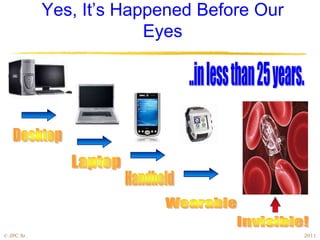
Yes, It’s Happened Before Our
                         Eyes


© JPC Sr.                                   2011
Think About Exponential
                  Growth
   Since 1994 the number of web sites
    has grown from 5,000 to 250,000,000
    (50,000 % increase)
   Distinct content pages now number
    in the trillions…
   Every day, Google handles about
    6,200,000,000 page views and
    processes 20 petabytes of data.
   275,000 words are typed every
    minute onto blogger
   And then there is the newest internet
    monster Facebook...
© EC/JC                                     2011
Facebook as the New
                Internet
    o In October 2007, FB had a mere
         20 million US users.
    o Today (as of 1/4/11) it has over
         146 million US based users.
    o That accounts for 70% of all US
         based internet users.


© EC/JC                                  2011
The World is One
              Network
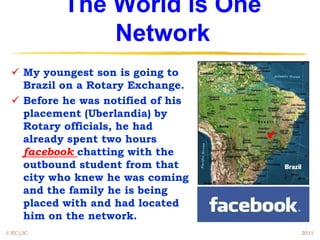
  My youngest son is going to
   Brazil on a Rotary Exchange.
  Before he was notified of his
   placement (Uberlandia) by
   Rotary officials, he had
   already spent two hours
   facebook chatting with the
   outbound student from that
   city who knew he was coming
   and the family he is being
   placed with and had located
   him on the network.
© EC/JC                            2011
Information Sharing
                      Network
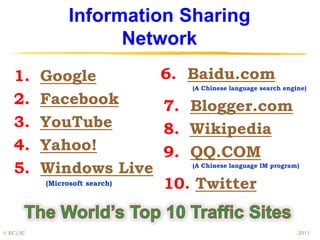
   1.     Google               6. Baidu.com
                                  (A Chinese language search engine)

   2.     Facebook             7. Blogger.com
   3.     YouTube              8. Wikipedia
   4.     Yahoo!               9. QQ.COM
   5.     Windows Live            (A Chinese language IM program)

          (Microsoft search)   10. Twitter

© EC/JC                                                          2011
From Passive to
                   Empowered
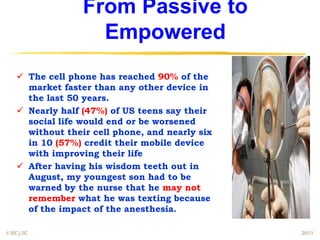
    The cell phone has reached 90% of the
     market faster than any other device in
     the last 50 years.
    Nearly half (47%) of US teens say their
     social life would end or be worsened
     without their cell phone, and nearly six
     in 10 (57%) credit their mobile device
     with improving their life
    After having his wisdom teeth out in
     August, my youngest son had to be
     warned by the nurse that he may not
     remember what he was texting because
     of the impact of the anesthesia.

© EC/JC                                         2011
The King Is Dead, LLTK
  More content hours
   were uploaded to
   YouTube in 2010…
  …than have been
   broadcast by the
   three major networks
   in their entire
   history.
          http://www.youtube.com/create
© EC/JC                                   2010
From Turn the Page to Hit The
                     Button

     In the second quarter of 2010,
      Amazon sold 180 Kindle
      Edition Books for every 100
      hard-covers sold.
     In the fourth quarter, Kindle
      editions outsold paperbacks as
      well.
     Amazon has been selling
      books for 16 years and Kindle
      books for 3 years.
© EC/JC                                   2011
How Would You Answer?
   What would an “open
    phone test” look like?
   What would your
    district/school iPhone
    app have in it?
   What happens when
    everyone can get
    anything from anywhere?
© EC/JC                           2010
Truth Number Two
          You Can’t Learn Without Access

           Adequate
          preparation
      for a higher order
        thinking digital
         environment
       requires one-one
      access by staff and
© EC/JC
           students.                       2011
It Just Makes Sense
         One cannot prepare
       students to master skills
          and be information
      literate, independent, hig
      her-order thinkers if they
      are not consistently doing
      meaningful work with the
      tools that will help define
             their success.
© EC/JC                             2011
Truth Number Three
          Further Print Investment is a Waste


     Continued investment in a
      print-based infrastructure
       and the lack of strategic
       transitional planning for
          a complete move to
         digital are ultimately
       counterproductive both
      educationally and fiscally.

© EC/JC                                         2011
A Definition of
             Waste
  Waste is any action you take in an
   organization that does not move
   someone/something in the
   direction you want to go.
  Aligned action is the key to
   organizational success… the more
   you invest in materials, strategies
   and systems that are counter to the
   creation of a 21st century learning
   environment, the longer the
   transition will take.
  Every printed page is a waste.
© EC/JC                                  2011
The Goal
            To prepare EVERY
          student for learning,
           life and work in the
               21 st century.

          I believe achieving this goal is the
             defining challenge of our time.
© EC/JC                                          2011
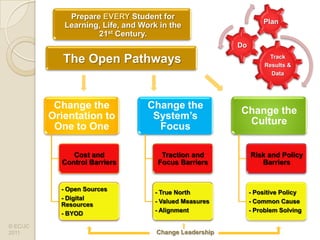
Prepare EVERY Student for
                                                                  Plan
             Learning, Life, and Work in the
                     21st Century.
                                                         Do

             The Open Pathways                                       Track
                                                                   Results &
                                                                     Data


           Change the              Change the
                                                         Change the
          Orientation to            System’s
                                                          Culture
           One to One                Focus

               Cost and               Traction and            Risk and Policy
            Control Barriers         Focus Barriers              Barriers


            - Open Sources
                                     - True North             - Positive Policy
            - Digital
                                     - Valued Measures        - Common Cause
            Resources
                                     - Alignment              - Problem Solving
            - BYOD

© EC/JC
2011                                 Change Leadership
The Resource
            Equation
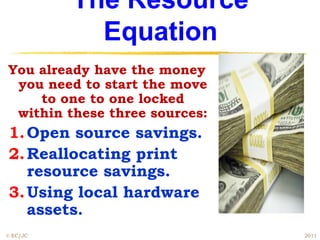
You already have the money
 you need to start the move
    to one to one locked
 within these three sources:
1. Open source savings.
2. Reallocating print
   resource savings.
3. Using local hardware
   assets.
© EC/JC                        2011
Open Source Savings
           Five Factors of Convergence

   1.Open source energy.
   2.Moore’s Law
    unabated.
   3.Apple effect.
   4.Google effect.
   5.Growth of the cloud
    and browser.
© EC/JC                                  2011
Putting It All Together
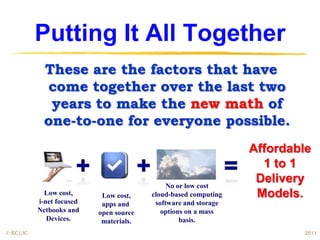
            These are the factors that have
            come together over the last two
             years to make the new math of
            one-to-one for everyone possible.
                                                                Affordable
                                                                  1 to 1
                                             No or low cost
                                                                 Delivery
            Low cost,      Low cost,    cloud-based computing    Models.
          i-net focused    apps and      software and storage
          Netbooks and    open source      options on a mass
             Devices.      materials.            basis.
© EC/JC                                                                 2011
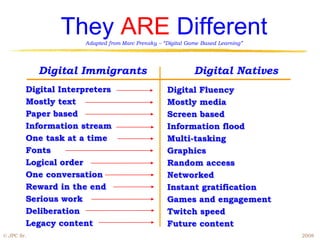
They ARE Different
                     Adapted from Marc Prensky – “Digital Game Based Learning”


            Digital Immigrants                              Digital Natives
        Digital Interpreters                      Digital Fluency
        Mostly text                               Mostly media
        Paper based                               Screen based
        Information stream                        Information flood
        One task at a time                        Multi-tasking
        Fonts                                     Graphics
        Logical order                             Random access
        One conversation                          Networked
        Reward in the end                         Instant gratification
        Serious work                              Games and engagement
        Deliberation                              Twitch speed
        Legacy content                            Future content
© JPC Sr.                                                                        2008
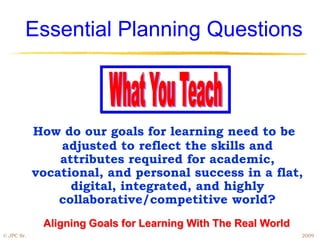
Essential Planning Questions


            How do our goals for learning need to be
                adjusted to reflect the skills and
                attributes required for academic,
            vocational, and personal success in a flat,
                  digital, integrated, and highly
                collaborative/competitive world?
             Aligning Goals for Learning With The Real World
© JPC Sr.                                                      2009
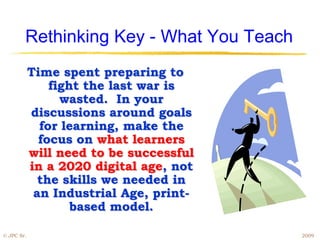
Rethinking Key - What You Teach
            Time spent preparing to
                fight the last war is
                  wasted. In your
            discussions around goals
              for learning, make the
              focus on what learners
            will need to be successful
            in a 2020 digital age, not
              the skills we needed in
             an Industrial Age, print-
                    based model.

© JPC Sr.                                 2009
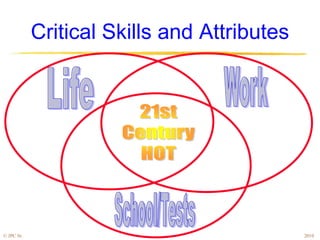
Critical Skills and Attributes


© JPC Sr.                                    2010
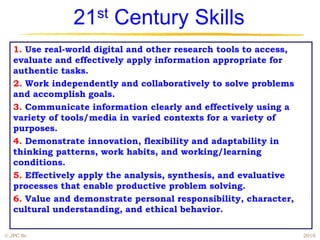
21st Century Skills
   1. Use real-world digital and other research tools to access,
   evaluate and effectively apply information appropriate for
   authentic tasks.
   2. Work independently and collaboratively to solve problems
   and accomplish goals.
   3. Communicate information clearly and effectively using a
   variety of tools/media in varied contexts for a variety of
   purposes.
   4. Demonstrate innovation, flexibility and adaptability in
   thinking patterns, work habits, and working/learning
   conditions.
   5. Effectively apply the analysis, synthesis, and evaluative
   processes that enable productive problem solving.
   6. Value and demonstrate personal responsibility, character,
   cultural understanding, and ethical behavior.

© JPC Sr.                                                          2010
Essential Planning Questions
                         How should we adjust our
                           teaching and delivery
                              methods to both
                           leverage the power of
                              Information Age
                            technologies and to
                           meet a new generation
                          of learners in their own
                          learning environment?
            Leveraging Information Age Tools and Strategies
© JPC Sr.                                                     2009
Rethinking Key - How You Teach

             You cannot prepare
              students to master
             skills and be literate,
             independent, higher-
             order thinkers if they
                 are not doing
             meaningful work with
            the tools that will help
             define their success.
© JPC Sr.                                     2009
Essential Planning Questions
               How must our
                  methods of
             assessing student
             learning evolve so
              that we can meet
             the twin demands
               of feedback and
             accountability in a
             skill based world?
            Feedback and Accountability in a Skill Based World
© JPC Sr.                                                        2009
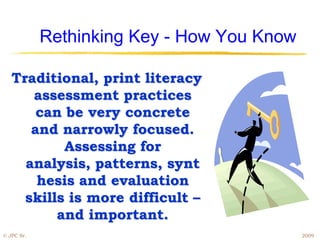
Rethinking Key - How You Know

   Traditional, print literacy
      assessment practices
       can be very concrete
      and narrowly focused.
           Assessing for
     analysis, patterns, synt
       hesis and evaluation
     skills is more difficult –
          and important.
© JPC Sr.                                   2009
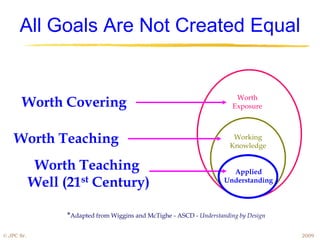
All Goals Are Not Created Equal


                                                                          Worth
       Worth Covering                                                    Exposure


    Worth Teaching                                                       Working
                                                                        Knowledge


            Worth Teaching                                              Applied
            Well (21st Century)                                       Understanding


                  *Adapted from Wiggins and McTighe - ASCD - Understanding by Design

© JPC Sr.                                                                              2009
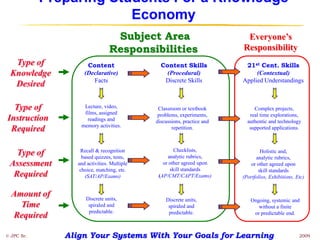
Preparing Students For a Knowledge
                         Economy
                                 Subject Area                            Everyone’s
                                Responsibilities                        Responsibility
  Type of            Content                  Content Skills             21st Cent. Skills
 Knowledge          (Declarative)               (Procedural)                 (Contextual)
                       Facts                   Discrete Skills          Applied Understandings
  Desired

  Type of          Lecture, video,           Classroom or textbook           Complex projects,
                   films, assigned           problems, experiments,        real time explorations,
Instruction         readings and            discussions, practice and     authentic and technology
                  memory activities.
 Required                                          repetition.             supported applications.


                  Recall & recognition              Checklists,
   Type of         based quizzes, tests,         analytic rubrics,
                                                                                Holistic and,
                                                                              analytic rubrics,
 Assessment      and activities. Multiple      or other agreed upon         or other agreed upon
                  choice, matching, etc.          skill standards              skill standards
  Required          (SAT/AP/Exams)           (AP/CMT/CAPT/Exams)        (Portfolios, Exhibitions, Etc)


  Amount of         Discrete units,             Discrete units,            Ongoing, systemic and
    Time             spiraled and                spiraled and                 without a finite
                     predictable.                predictable.               or predictable end.
  Required

© JPC Sr.      Align Your Systems With Your Goals for Learning                                     2009
The Rules of
                           Engagement
       Engagement + Purpose = Learning
            1. Each student has learning experiences at
               intermediate difficulty for that student.
            2. Expectations for the student are high but
               achievable for that student.
            3. Students make decisions about their own
               learning that lead them to be autonomous
               learners.
            4. Students’ perspectives are valued.
            5. There is both a sense of community and
               individuality.
            6. Instruction is tied to student interests (and
               is culturally relevant).
                 From Powerful Learning by Ron Brandt, ASCD, Alexandria, VA: ASCD
© JPC Sr.                                                                           2009
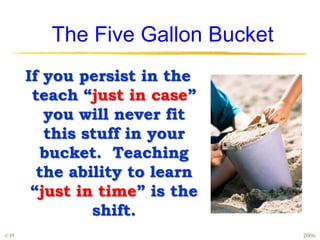
The Five Gallon Bucket
       If you persist in the
        teach “just in case”
          you will never fit
          this stuff in your
          bucket. Teaching
         the ability to learn
        “just in time” is the
                shift.
© PI                               2006
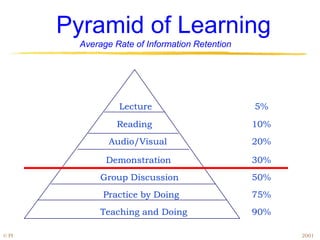
Pyramid of Learning
         Average Rate of Information Retention


                  Lecture                        5%
                  Reading                        10%
                Audio/Visual                     20%

               Demonstration                     30%
              Group Discussion                   50%
              Practice by Doing                  75%
              Teaching and Doing                 90%

© PI                                                   2001
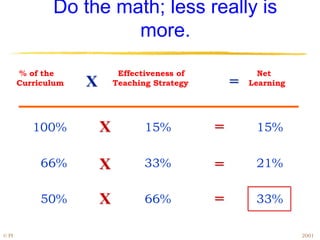
Do the math; less really is
                       more.

       % of the              Effectiveness of             Net
       Curriculum   X       Teaching Strategy       =   Learning


          100%          X          15%          =        15%

            66%         X          33%          =        21%

            50%         X          66%          =        33%

© PI                                                               2001
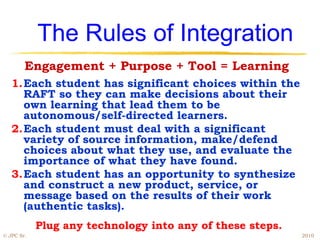
The Rules of Integration
        Engagement + Purpose + Tool = Learning
   1.Each student has significant choices within the
     RAFT so they can make decisions about their
     own learning that lead them to be
     autonomous/self-directed learners.
   2.Each student must deal with a significant
     variety of source information, make/defend
     choices about what they use, and evaluate the
     importance of what they have found.
   3.Each student has an opportunity to synthesize
     and construct a new product, service, or
     message based on the results of their work
     (authentic tasks).
            Plug any technology into any of these steps.
© JPC Sr.                                                  2010
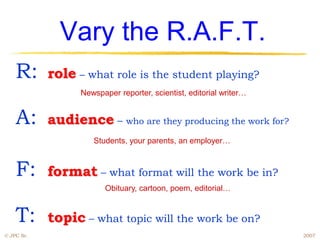
Vary the R.A.F.T.
    R:      role – what role is the student playing?
                  Newspaper reporter, scientist, editorial writer…


    A:      audience – who are they producing the work for?
                     Students, your parents, an employer…


    F:      format – what format will the work be in?
                         Obituary, cartoon, poem, editorial…


    T:      topic – what topic will the work be on?
© JPC Sr.                                                            2007
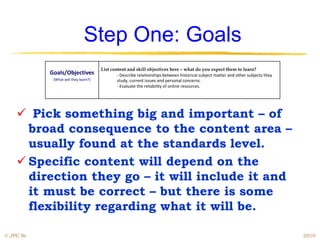
Step One: Goals
                                       List content and skill objectives here – what do you expect them to learn?
            Goals/Objectives                   - Describe relationships between historical subject matter and other subjects they
             (What will they learn?)           study, current issues and personal concerns.
                                               - Evaluate the reliability of online resources.


     Pick something big and important – of
      broad consequence to the content area –
      usually found at the standards level.
     Specific content will depend on the
      direction they go – it will include it and
      it must be correct – but there is some
      flexibility regarding what it will be.

© JPC Sr.                                                                                                                           2010
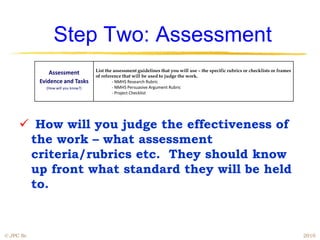
Step Two: Assessment
                                     List the assessment guidelines that you will use – the specific rubrics or checklists or frames
                Assessment           of reference that will be used to judge the work.
            Evidence and Tasks               - NMHS Research Rubric
              (How will you know?)           - NMHS Persuasive Argument Rubric
                                             - Project Checklist


      How will you judge the effectiveness of
      the work – what assessment
      criteria/rubrics etc. They should know
      up front what standard they will be held
      to.


© JPC Sr.                                                                                                                              2010
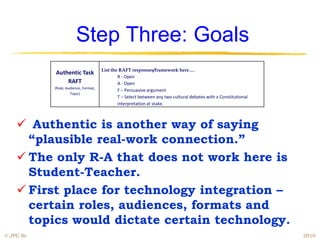
Step Three: Goals
                                       List the RAFT responses/framework here….
            Authentic Task
                                               R - Open
                RAFT                           A - Open
            (Role, Audience, Format,
                                               F – Persuasive argument
                     Topic)
                                               T – Select between any two cultural debates with a Constitutional
                                               interpretation at stake.


     Authentic is another way of saying
      “plausible real-work connection.”
     The only R-A that does not work here is
      Student-Teacher.
     First place for technology integration –
      certain roles, audiences, formats and
      topics would dictate certain technology.
© JPC Sr.                                                                                                          2010
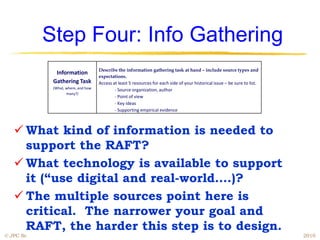
Step Four: Info Gathering
                                     Describe the information gathering task at hand – include source types and
              Information
                                     expectations.
             Gathering Task          Access at least 5 resources for each side of your historical issue – be sure to list.
             (What, where, and how           - Source organization, author
                    many?)
                                             - Point of view
                                             - Key ideas
                                             - Supporting empirical evidence


    What kind of information is needed to
     support the RAFT?
    What technology is available to support
     it (“use digital and real-world….)?
    The multiple sources point here is
     critical. The narrower your goal and
     RAFT, the harder this step is to design.
© JPC Sr.                                                                                                                    2010
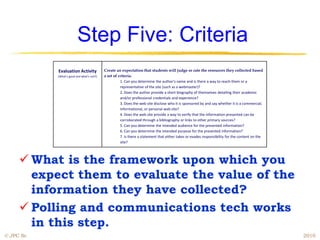
Step Five: Criteria
            Evaluation Activity             Create an expectation that students will judge or rate the resources they collected based
            (What’s good and what’s not?)   a set of criteria.
                                                      1. Can you determine the author’s name and is there a way to reach them or a
                                                      representative of the site (such as a webmaster)?
                                                      2. Does the author provide a short biography of themselves detailing their academic
                                                      and/or professional credentials and experience?
                                                      3. Does the web site disclose who it is sponsored by and say whether it is a commercial,
                                                      informational, or personal web site?
                                                      4. Does the web site provide a way to verify that the information presented can be
                                                      corroborated through a bibliography or links to other primary sources?
                                                      5. Can you determine the intended audience for the presented information?
                                                      6. Can you determine the intended purpose for the presented information?
                                                      7. Is there a statement that either takes or evades responsibility for the content on the
                                                      site?


      What is the framework upon which you
       expect them to evaluate the value of the
       information they have collected?
      Polling and communications tech works
       in this step.
© JPC Sr.                                                                                                                                         2010
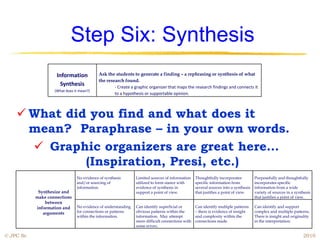
Step Six: Synthesis
                     Information           Ask the students to generate a finding – a rephrasing or synthesis of what
                                           the research found.
                       Synthesis                   - Create a graphic organizer that maps the research findings and connects it
                    (What does it mean?)
                                                   to a hypothesis or supportable opinion.


     What did you find and what does it
      mean? Paraphrase – in your own words.
       Graphic organizers are great here…
              (Inspiration, Presi, etc.)
                                No evidence of synthesis       Limited sources of information    Thoughtfully incorporates          Purposefully and thoughtfully
                                and/or sourcing of             utilized to form stance with      specific information from          incorporates specific
                                information.                   evidence of synthesis in          several sources into a synthesis   information from a wide
             Synthesize and                                    support a point of view.          that justifies a point of view.    variety of sources in a synthesis
            make connections                                                                                                        that justifies a point of view.
                between
            information and     No evidence of understanding   Can identify superficial or       Can identify multiple patterns     Can identify and support
               arguments        for connections or patterns    obvious patterns within the       – there is evidence of insight     complex and multiple patterns.
                                within the information.        information. May attempt          and complexity within the          There is insight and originality
                                                               more difficult connections with   connections made.                  in the interpretation.
                                                               some errors.

© JPC Sr.                                                                                                                                                       2010
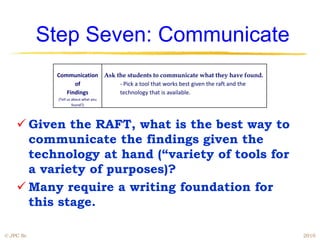
Step Seven: Communicate
             Communication Ask the students to communicate what they have found.
                   of           - Pick a tool that works best given the raft and the
                Findings        technology that is available.
              (Tell us about what you
                       found?)


     Given the RAFT, what is the best way to
      communicate the findings given the
      technology at hand (“variety of tools for
      a variety of purposes)?
     Many require a writing foundation for
      this stage.

© JPC Sr.                                                                              2010
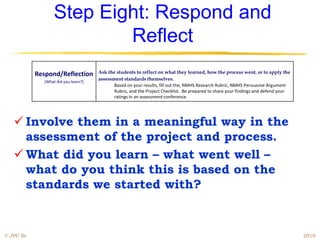
Step Eight: Respond and
                           Reflect
            Respond/Reflection        Ask the students to reflect on what they learned, how the process went, or to apply the
                                      assessment standards themselves.
              (What did you learn?)
                                             Based on your results, fill out the, NMHS Research Rubric, NMHS Persuasive Argument
                                             Rubric, and the Project Checklist. Be prepared to share your findings and defend your
                                             ratings in an assessment conference.


    Involve them in a meaningful way in the
     assessment of the project and process.
    What did you learn – what went well –
     what do you think this is based on the
     standards we started with?


© JPC Sr.                                                                                                                            2010
Reference
                      Points/Resources
     Online reference to most of the
           slides you saw today…

            Jonathan P. Costa, Sr.
             Director, School/Program Services

      EDUCATION CONNECTION
            costa@educationconnection.org
                      860-567-0863


     http://www.slideshare.net/jpcostasr


© JPC Sr.                                        2011

Old lyme hs 52711 share

  • 1.
    EDUCATION CONNECTION 21st Century Skills Change Is In The Air Key Concepts Jonathan P. Costa May 27th, 2011 © JPC Sr. 2011
  • 2.
    Truth Number One There is no escape… The future of work and learning processes/ resources are digital. © EC/JC 2011
  • 3.
    Yes, It’s HappenedBefore Our Eyes © JPC Sr. 2011
  • 4.
    Think About Exponential Growth  Since 1994 the number of web sites has grown from 5,000 to 250,000,000 (50,000 % increase)  Distinct content pages now number in the trillions…  Every day, Google handles about 6,200,000,000 page views and processes 20 petabytes of data.  275,000 words are typed every minute onto blogger  And then there is the newest internet monster Facebook... © EC/JC 2011
  • 5.
    Facebook as theNew Internet o In October 2007, FB had a mere 20 million US users. o Today (as of 1/4/11) it has over 146 million US based users. o That accounts for 70% of all US based internet users. © EC/JC 2011
  • 6.
    The World isOne Network  My youngest son is going to Brazil on a Rotary Exchange.  Before he was notified of his placement (Uberlandia) by Rotary officials, he had already spent two hours facebook chatting with the outbound student from that city who knew he was coming and the family he is being placed with and had located him on the network. © EC/JC 2011
  • 7.
    Information Sharing Network 1. Google 6. Baidu.com (A Chinese language search engine) 2. Facebook 7. Blogger.com 3. YouTube 8. Wikipedia 4. Yahoo! 9. QQ.COM 5. Windows Live (A Chinese language IM program) (Microsoft search) 10. Twitter © EC/JC 2011
  • 8.
    From Passive to Empowered  The cell phone has reached 90% of the market faster than any other device in the last 50 years.  Nearly half (47%) of US teens say their social life would end or be worsened without their cell phone, and nearly six in 10 (57%) credit their mobile device with improving their life  After having his wisdom teeth out in August, my youngest son had to be warned by the nurse that he may not remember what he was texting because of the impact of the anesthesia. © EC/JC 2011
  • 9.
    The King IsDead, LLTK More content hours were uploaded to YouTube in 2010… …than have been broadcast by the three major networks in their entire history. http://www.youtube.com/create © EC/JC 2010
  • 10.
    From Turn thePage to Hit The Button  In the second quarter of 2010, Amazon sold 180 Kindle Edition Books for every 100 hard-covers sold.  In the fourth quarter, Kindle editions outsold paperbacks as well.  Amazon has been selling books for 16 years and Kindle books for 3 years. © EC/JC 2011
  • 11.
    How Would YouAnswer? What would an “open phone test” look like? What would your district/school iPhone app have in it? What happens when everyone can get anything from anywhere? © EC/JC 2010
  • 12.
    Truth Number Two You Can’t Learn Without Access Adequate preparation for a higher order thinking digital environment requires one-one access by staff and © EC/JC students. 2011
  • 13.
    It Just MakesSense One cannot prepare students to master skills and be information literate, independent, hig her-order thinkers if they are not consistently doing meaningful work with the tools that will help define their success. © EC/JC 2011
  • 14.
    Truth Number Three Further Print Investment is a Waste Continued investment in a print-based infrastructure and the lack of strategic transitional planning for a complete move to digital are ultimately counterproductive both educationally and fiscally. © EC/JC 2011
  • 15.
    A Definition of Waste  Waste is any action you take in an organization that does not move someone/something in the direction you want to go.  Aligned action is the key to organizational success… the more you invest in materials, strategies and systems that are counter to the creation of a 21st century learning environment, the longer the transition will take.  Every printed page is a waste. © EC/JC 2011
  • 16.
    The Goal To prepare EVERY student for learning, life and work in the 21 st century. I believe achieving this goal is the defining challenge of our time. © EC/JC 2011
  • 17.
    Prepare EVERY Studentfor Plan Learning, Life, and Work in the 21st Century. Do The Open Pathways Track Results & Data Change the Change the Change the Orientation to System’s Culture One to One Focus Cost and Traction and Risk and Policy Control Barriers Focus Barriers Barriers - Open Sources - True North - Positive Policy - Digital - Valued Measures - Common Cause Resources - Alignment - Problem Solving - BYOD © EC/JC 2011 Change Leadership
  • 18.
    The Resource Equation You already have the money you need to start the move to one to one locked within these three sources: 1. Open source savings. 2. Reallocating print resource savings. 3. Using local hardware assets. © EC/JC 2011
  • 19.
    Open Source Savings Five Factors of Convergence 1.Open source energy. 2.Moore’s Law unabated. 3.Apple effect. 4.Google effect. 5.Growth of the cloud and browser. © EC/JC 2011
  • 20.
    Putting It AllTogether These are the factors that have come together over the last two years to make the new math of one-to-one for everyone possible. Affordable 1 to 1 No or low cost Delivery Low cost, Low cost, cloud-based computing Models. i-net focused apps and software and storage Netbooks and open source options on a mass Devices. materials. basis. © EC/JC 2011
  • 21.
    They ARE Different Adapted from Marc Prensky – “Digital Game Based Learning” Digital Immigrants Digital Natives Digital Interpreters Digital Fluency Mostly text Mostly media Paper based Screen based Information stream Information flood One task at a time Multi-tasking Fonts Graphics Logical order Random access One conversation Networked Reward in the end Instant gratification Serious work Games and engagement Deliberation Twitch speed Legacy content Future content © JPC Sr. 2008
  • 22.
    Essential Planning Questions How do our goals for learning need to be adjusted to reflect the skills and attributes required for academic, vocational, and personal success in a flat, digital, integrated, and highly collaborative/competitive world? Aligning Goals for Learning With The Real World © JPC Sr. 2009
  • 23.
    Rethinking Key -What You Teach Time spent preparing to fight the last war is wasted. In your discussions around goals for learning, make the focus on what learners will need to be successful in a 2020 digital age, not the skills we needed in an Industrial Age, print- based model. © JPC Sr. 2009
  • 24.
    Critical Skills andAttributes © JPC Sr. 2010
  • 25.
    21st Century Skills 1. Use real-world digital and other research tools to access, evaluate and effectively apply information appropriate for authentic tasks. 2. Work independently and collaboratively to solve problems and accomplish goals. 3. Communicate information clearly and effectively using a variety of tools/media in varied contexts for a variety of purposes. 4. Demonstrate innovation, flexibility and adaptability in thinking patterns, work habits, and working/learning conditions. 5. Effectively apply the analysis, synthesis, and evaluative processes that enable productive problem solving. 6. Value and demonstrate personal responsibility, character, cultural understanding, and ethical behavior. © JPC Sr. 2010
  • 26.
    Essential Planning Questions How should we adjust our teaching and delivery methods to both leverage the power of Information Age technologies and to meet a new generation of learners in their own learning environment? Leveraging Information Age Tools and Strategies © JPC Sr. 2009
  • 27.
    Rethinking Key -How You Teach You cannot prepare students to master skills and be literate, independent, higher- order thinkers if they are not doing meaningful work with the tools that will help define their success. © JPC Sr. 2009
  • 28.
    Essential Planning Questions How must our methods of assessing student learning evolve so that we can meet the twin demands of feedback and accountability in a skill based world? Feedback and Accountability in a Skill Based World © JPC Sr. 2009
  • 29.
    Rethinking Key -How You Know Traditional, print literacy assessment practices can be very concrete and narrowly focused. Assessing for analysis, patterns, synt hesis and evaluation skills is more difficult – and important. © JPC Sr. 2009
  • 30.
    All Goals AreNot Created Equal Worth Worth Covering Exposure Worth Teaching Working Knowledge Worth Teaching Applied Well (21st Century) Understanding *Adapted from Wiggins and McTighe - ASCD - Understanding by Design © JPC Sr. 2009
  • 31.
    Preparing Students Fora Knowledge Economy Subject Area Everyone’s Responsibilities Responsibility Type of Content Content Skills 21st Cent. Skills Knowledge (Declarative) (Procedural) (Contextual) Facts Discrete Skills Applied Understandings Desired Type of Lecture, video, Classroom or textbook Complex projects, films, assigned problems, experiments, real time explorations, Instruction readings and discussions, practice and authentic and technology memory activities. Required repetition. supported applications. Recall & recognition Checklists, Type of based quizzes, tests, analytic rubrics, Holistic and, analytic rubrics, Assessment and activities. Multiple or other agreed upon or other agreed upon choice, matching, etc. skill standards skill standards Required (SAT/AP/Exams) (AP/CMT/CAPT/Exams) (Portfolios, Exhibitions, Etc) Amount of Discrete units, Discrete units, Ongoing, systemic and Time spiraled and spiraled and without a finite predictable. predictable. or predictable end. Required © JPC Sr. Align Your Systems With Your Goals for Learning 2009
  • 32.
    The Rules of Engagement Engagement + Purpose = Learning 1. Each student has learning experiences at intermediate difficulty for that student. 2. Expectations for the student are high but achievable for that student. 3. Students make decisions about their own learning that lead them to be autonomous learners. 4. Students’ perspectives are valued. 5. There is both a sense of community and individuality. 6. Instruction is tied to student interests (and is culturally relevant). From Powerful Learning by Ron Brandt, ASCD, Alexandria, VA: ASCD © JPC Sr. 2009
  • 33.
    The Five GallonBucket If you persist in the teach “just in case” you will never fit this stuff in your bucket. Teaching the ability to learn “just in time” is the shift. © PI 2006
  • 34.
    Pyramid of Learning Average Rate of Information Retention Lecture 5% Reading 10% Audio/Visual 20% Demonstration 30% Group Discussion 50% Practice by Doing 75% Teaching and Doing 90% © PI 2001
  • 35.
    Do the math;less really is more. % of the Effectiveness of Net Curriculum X Teaching Strategy = Learning 100% X 15% = 15% 66% X 33% = 21% 50% X 66% = 33% © PI 2001
  • 36.
    The Rules ofIntegration Engagement + Purpose + Tool = Learning 1.Each student has significant choices within the RAFT so they can make decisions about their own learning that lead them to be autonomous/self-directed learners. 2.Each student must deal with a significant variety of source information, make/defend choices about what they use, and evaluate the importance of what they have found. 3.Each student has an opportunity to synthesize and construct a new product, service, or message based on the results of their work (authentic tasks). Plug any technology into any of these steps. © JPC Sr. 2010
  • 37.
    Vary the R.A.F.T. R: role – what role is the student playing? Newspaper reporter, scientist, editorial writer… A: audience – who are they producing the work for? Students, your parents, an employer… F: format – what format will the work be in? Obituary, cartoon, poem, editorial… T: topic – what topic will the work be on? © JPC Sr. 2007
  • 38.
    Step One: Goals List content and skill objectives here – what do you expect them to learn? Goals/Objectives - Describe relationships between historical subject matter and other subjects they (What will they learn?) study, current issues and personal concerns. - Evaluate the reliability of online resources.  Pick something big and important – of broad consequence to the content area – usually found at the standards level.  Specific content will depend on the direction they go – it will include it and it must be correct – but there is some flexibility regarding what it will be. © JPC Sr. 2010
  • 39.
    Step Two: Assessment List the assessment guidelines that you will use – the specific rubrics or checklists or frames Assessment of reference that will be used to judge the work. Evidence and Tasks - NMHS Research Rubric (How will you know?) - NMHS Persuasive Argument Rubric - Project Checklist  How will you judge the effectiveness of the work – what assessment criteria/rubrics etc. They should know up front what standard they will be held to. © JPC Sr. 2010
  • 40.
    Step Three: Goals List the RAFT responses/framework here…. Authentic Task R - Open RAFT A - Open (Role, Audience, Format, F – Persuasive argument Topic) T – Select between any two cultural debates with a Constitutional interpretation at stake.  Authentic is another way of saying “plausible real-work connection.”  The only R-A that does not work here is Student-Teacher.  First place for technology integration – certain roles, audiences, formats and topics would dictate certain technology. © JPC Sr. 2010
  • 41.
    Step Four: InfoGathering Describe the information gathering task at hand – include source types and Information expectations. Gathering Task Access at least 5 resources for each side of your historical issue – be sure to list. (What, where, and how - Source organization, author many?) - Point of view - Key ideas - Supporting empirical evidence  What kind of information is needed to support the RAFT?  What technology is available to support it (“use digital and real-world….)?  The multiple sources point here is critical. The narrower your goal and RAFT, the harder this step is to design. © JPC Sr. 2010
  • 42.
    Step Five: Criteria Evaluation Activity Create an expectation that students will judge or rate the resources they collected based (What’s good and what’s not?) a set of criteria. 1. Can you determine the author’s name and is there a way to reach them or a representative of the site (such as a webmaster)? 2. Does the author provide a short biography of themselves detailing their academic and/or professional credentials and experience? 3. Does the web site disclose who it is sponsored by and say whether it is a commercial, informational, or personal web site? 4. Does the web site provide a way to verify that the information presented can be corroborated through a bibliography or links to other primary sources? 5. Can you determine the intended audience for the presented information? 6. Can you determine the intended purpose for the presented information? 7. Is there a statement that either takes or evades responsibility for the content on the site?  What is the framework upon which you expect them to evaluate the value of the information they have collected?  Polling and communications tech works in this step. © JPC Sr. 2010
  • 43.
    Step Six: Synthesis Information Ask the students to generate a finding – a rephrasing or synthesis of what the research found. Synthesis - Create a graphic organizer that maps the research findings and connects it (What does it mean?) to a hypothesis or supportable opinion.  What did you find and what does it mean? Paraphrase – in your own words.  Graphic organizers are great here… (Inspiration, Presi, etc.) No evidence of synthesis Limited sources of information Thoughtfully incorporates Purposefully and thoughtfully and/or sourcing of utilized to form stance with specific information from incorporates specific information. evidence of synthesis in several sources into a synthesis information from a wide Synthesize and support a point of view. that justifies a point of view. variety of sources in a synthesis make connections that justifies a point of view. between information and No evidence of understanding Can identify superficial or Can identify multiple patterns Can identify and support arguments for connections or patterns obvious patterns within the – there is evidence of insight complex and multiple patterns. within the information. information. May attempt and complexity within the There is insight and originality more difficult connections with connections made. in the interpretation. some errors. © JPC Sr. 2010
  • 44.
    Step Seven: Communicate Communication Ask the students to communicate what they have found. of - Pick a tool that works best given the raft and the Findings technology that is available. (Tell us about what you found?)  Given the RAFT, what is the best way to communicate the findings given the technology at hand (“variety of tools for a variety of purposes)?  Many require a writing foundation for this stage. © JPC Sr. 2010
  • 45.
    Step Eight: Respondand Reflect Respond/Reflection Ask the students to reflect on what they learned, how the process went, or to apply the assessment standards themselves. (What did you learn?) Based on your results, fill out the, NMHS Research Rubric, NMHS Persuasive Argument Rubric, and the Project Checklist. Be prepared to share your findings and defend your ratings in an assessment conference.  Involve them in a meaningful way in the assessment of the project and process.  What did you learn – what went well – what do you think this is based on the standards we started with? © JPC Sr. 2010
  • 46.
    Reference Points/Resources Online reference to most of the slides you saw today… Jonathan P. Costa, Sr. Director, School/Program Services EDUCATION CONNECTION costa@educationconnection.org 860-567-0863 http://www.slideshare.net/jpcostasr © JPC Sr. 2011