INTRODUCTION
 South America and North America are named after the
Italian navigator Amerigo Vespucci.
 Cape Horn in South America is its southernmost tip.
 Portuguese and Spanish are the most spoken
languages in South America. Spanish is the official
Language in South america.
Location And Boundaries
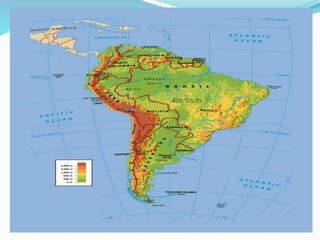
 South America is bounded by the Caribbean Sea to
the northwest and north, the Atlantic Ocean to
the northeast, east, and southeast, and the Pacific
Ocean to the west. In the northwest it is joined to
North America by the Isthmus of Panama, a land
bridge narrowing to about 50 miles (80 km) at one
point.
 The Tropic of Capricorn lies in the centre of the
continent.
Physical Features
South America can be divided into three main
regions.
The Eastern Highlands
The Andes Mountains
The Central lowlands
Angel Falls,the world’s highest waterfall (979m)
The Andes,is also the world’s longest mountain
range.
South America highest peak in mount Aconcagua.
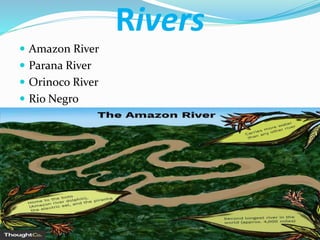
Rivers
 Amazon River
 Parana River
 Orinoco River
 Rio Negro
Lakes
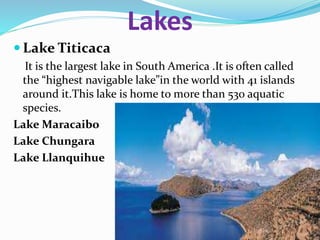
 Lake Titicaca
It is the largest lake in South America .It is often called
the “highest navigable lake”in the world with 41 islands
around it.This lake is home to more than 530 aquatic
species.
Lake Maracaibo
Lake Chungara
Lake Llanquihue
Gulfs and Straits of south America
 Gulf of Guayaquil
 Gulf of penas
 Gulf of san jorge
 Gulf of san Matias
 Taitao Peninsula
 Valdes Peninsula
 Magellan’s Strait
 Drake Passage

south America 6th.pptx

  • 2.
    INTRODUCTION  South Americaand North America are named after the Italian navigator Amerigo Vespucci.  Cape Horn in South America is its southernmost tip.  Portuguese and Spanish are the most spoken languages in South America. Spanish is the official Language in South america.
  • 3.
    Location And Boundaries South America is bounded by the Caribbean Sea to the northwest and north, the Atlantic Ocean to the northeast, east, and southeast, and the Pacific Ocean to the west. In the northwest it is joined to North America by the Isthmus of Panama, a land bridge narrowing to about 50 miles (80 km) at one point.  The Tropic of Capricorn lies in the centre of the continent.
  • 5.
    Physical Features South Americacan be divided into three main regions. The Eastern Highlands The Andes Mountains The Central lowlands Angel Falls,the world’s highest waterfall (979m) The Andes,is also the world’s longest mountain range. South America highest peak in mount Aconcagua.
  • 6.
    Rivers  Amazon River Parana River  Orinoco River  Rio Negro
  • 7.
    Lakes  Lake Titicaca Itis the largest lake in South America .It is often called the “highest navigable lake”in the world with 41 islands around it.This lake is home to more than 530 aquatic species. Lake Maracaibo Lake Chungara Lake Llanquihue
  • 8.
    Gulfs and Straitsof south America  Gulf of Guayaquil  Gulf of penas  Gulf of san jorge  Gulf of san Matias  Taitao Peninsula  Valdes Peninsula  Magellan’s Strait  Drake Passage