PERU
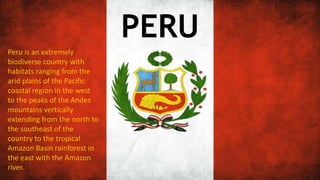
Peru is an extremely
biodiverse country with
habitats ranging from the
arid plains of the Pacific
coastal region in the west
to the peaks of the Andes
mountains vertically
extending from the north to
the southeast of the
country to the tropical
Amazon Basin rainforest in
the east with the Amazon
river.
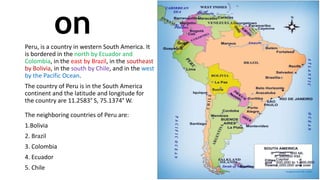
onPeru, is a country in western South America. It
is bordered in the north by Ecuador and
Colombia, in the east by Brazil, in the southeast
by Bolivia, in the south by Chile, and in the west
by the Pacific Ocean.
The country of Peru is in the South America
continent and the latitude and longitude for
the country are 11.2583° S, 75.1374° W.
The neighboring countries of Peru are:
1.Bolivia
2. Brazil
3. Colombia
4. Ecuador
5. Chile
Capital City of Peru
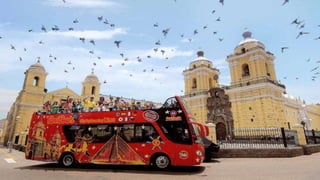
•Lima, city in west central Peru, capital and largest city of the country,
located on the Pacific Ocean and adjacent to the Rímac River in Peru’s arid coastal
region.
• Lima is the political, economic, and cultural center of Peru. Its importance within
the nation is so overwhelming that some scholars suggest there are two Perus:
Lima and the rest of the country. Lima’s metropolitan area has a population of 6.4
million, accounting for close to one-third of the nation’s total and a similar
proportion of the country’s workforce. The concentration of wealth and power in
Lima is even more intense: The city accounts for more than two-thirds of the
nation’s gross domestic product, tax collections, bank deposits, private
investment, physicians, and university students. Despite recent efforts at
decentralization, Lima is still the base for almost all government agencies.
POPULATION
• With about 31.2 million inhabitants, Peru is the fifth most populous country in
South America. Its demographic growth rate declined from 2.6% to 1.6% between
1950 and 2000; population is expected to reach approximately 42 million in 2050.
As of 2015, 75.9% lived in urban areas and 24.1% in rural areas. Major cities
include the Lima Metropolitan Area (home to over 9.8 million people), Arequipa,
Trujillo, Chiclayo, Piura, Iquitos, Cusco, Chimbote, and Huancayo; all reported
more than 250,000 inhabitants in the 2007 census.There are 15 uncontacted
Amerindian tribes in Peru.
• According to a 2015 genealogical DNA testing, the average Peruvian is estimated
to be 79.1% Native American, 19.8% European, and 1.1% Sub-Saharan African
overall.
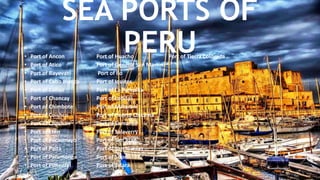
SEA PORTS OF
PERU• Port of Ancon Port of Huacho Port of Tierra Colorada
• Port of Atico Port of General San Martin
• Port of Bayovar Port of Ilo
• Port of Cabo Blanco Port of Iquitos
• Port of Callao Port of La Pampilla
• Port of Chancay Port of Lobitos
• Port of Chimbote Port of Matarani
• Port of Coishco Port of Puerto Chicama
• Port of Conchan Port of Samanco
• Port of Eten Port of Salaverry
• Port of Pacasmayo Port of San Juan
• Port of Paita Port of San Nicolas
• Port of Paramonga Port of Supe
• Port of Pimentel Port of Talara
HIGHEST PEAKHuascarán (Spanish
pronunciation: [waskaˈɾan]) or Nevado
Huascarán is a mountain in the Peruvian
province of Yungay (Ancash
Departament), situated in the Cordillera
Blanca range of the western Andes. The
highest southern summit of Huascarán
(Huascarán Sur) is the highest point in
Peru, northern part of Andes (north of
Lake Titicaca) and in all of the Earth's
Tropics. Huascarán is the fourth highest
mountain in the Western Hemisphere
after Aconcagua, Ojos del Salado, and
Monte Pissis. The mountain was named
after Huáscar, a 16th-century Inca
emperor who was the Sapa Inca of the
Inca empire.
Elevation 6,768 m (22,205 ft) 
[1]
Prominence 2,776 m (9,108 ft) 
[2]
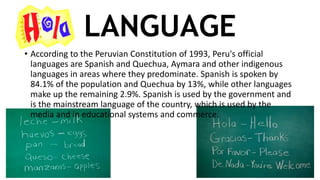
LANGUAGE
• According to the Peruvian Constitution of 1993, Peru's official
languages are Spanish and Quechua, Aymara and other indigenous
languages in areas where they predominate. Spanish is spoken by
84.1% of the population and Quechua by 13%, while other languages
make up the remaining 2.9%. Spanish is used by the government and
is the mainstream language of the country, which is used by the
media and in educational systems and commerce.
DELICACIES
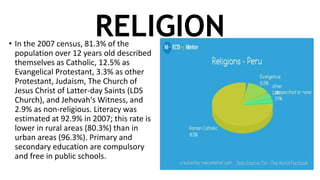
RELIGION• In the 2007 census, 81.3% of the
population over 12 years old described
themselves as Catholic, 12.5% as
Evangelical Protestant, 3.3% as other
Protestant, Judaism, The Church of
Jesus Christ of Latter-day Saints (LDS
Church), and Jehovah's Witness, and
2.9% as non-religious. Literacy was
estimated at 92.9% in 2007; this rate is
lower in rural areas (80.3%) than in
urban areas (96.3%). Primary and
secondary education are compulsory
and free in public schools.
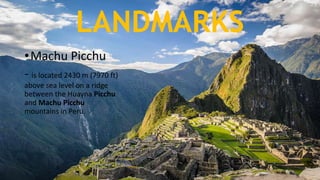
LANDMARKS
•Machu Picchu
- is located 2430 m (7970 ft)
above sea level on a ridge
between the Huayna Picchu
and Machu Picchu
mountains in Peru.
GOVERNMENT
• Peru is a republic governed by a constitution promulgated in 1993.
This constitution replaced the 1980 constitution, which was
suspended in 1992. The new constitution increased the power of the
executive and allowed for the reelection of the president to a second
term. It also unified the formerly bicameral legislature.
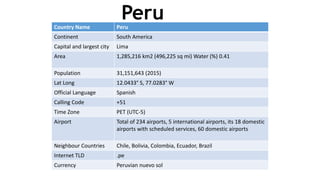
Country Name Peru
Continent South America
Capital and largest city Lima
Area 1,285,216 km2 (496,225 sq mi) Water (%) 0.41
Population 31,151,643 (2015)
Lat Long 12.0433° S, 77.0283° W
Official Language Spanish
Calling Code +51
Time Zone PET (UTC-5)
Airport Total of 234 airports, 5 international airports, its 18 domestic
airports with scheduled services, 60 domestic airports
Neighbour Countries Chile, Bolivia, Colombia, Ecuador, Brazil
Internet TLD .pe
Currency Peruvian nuevo sol
Peru
By: Bryan M. Tabefranca

Peru

  • 1.
    PERU Peru is anextremely biodiverse country with habitats ranging from the arid plains of the Pacific coastal region in the west to the peaks of the Andes mountains vertically extending from the north to the southeast of the country to the tropical Amazon Basin rainforest in the east with the Amazon river.
  • 2.
    onPeru, is acountry in western South America. It is bordered in the north by Ecuador and Colombia, in the east by Brazil, in the southeast by Bolivia, in the south by Chile, and in the west by the Pacific Ocean. The country of Peru is in the South America continent and the latitude and longitude for the country are 11.2583° S, 75.1374° W. The neighboring countries of Peru are: 1.Bolivia 2. Brazil 3. Colombia 4. Ecuador 5. Chile
  • 3.
    Capital City ofPeru •Lima, city in west central Peru, capital and largest city of the country, located on the Pacific Ocean and adjacent to the Rímac River in Peru’s arid coastal region. • Lima is the political, economic, and cultural center of Peru. Its importance within the nation is so overwhelming that some scholars suggest there are two Perus: Lima and the rest of the country. Lima’s metropolitan area has a population of 6.4 million, accounting for close to one-third of the nation’s total and a similar proportion of the country’s workforce. The concentration of wealth and power in Lima is even more intense: The city accounts for more than two-thirds of the nation’s gross domestic product, tax collections, bank deposits, private investment, physicians, and university students. Despite recent efforts at decentralization, Lima is still the base for almost all government agencies.
  • 6.
    POPULATION • With about31.2 million inhabitants, Peru is the fifth most populous country in South America. Its demographic growth rate declined from 2.6% to 1.6% between 1950 and 2000; population is expected to reach approximately 42 million in 2050. As of 2015, 75.9% lived in urban areas and 24.1% in rural areas. Major cities include the Lima Metropolitan Area (home to over 9.8 million people), Arequipa, Trujillo, Chiclayo, Piura, Iquitos, Cusco, Chimbote, and Huancayo; all reported more than 250,000 inhabitants in the 2007 census.There are 15 uncontacted Amerindian tribes in Peru. • According to a 2015 genealogical DNA testing, the average Peruvian is estimated to be 79.1% Native American, 19.8% European, and 1.1% Sub-Saharan African overall.
  • 8.
    SEA PORTS OF PERU•Port of Ancon Port of Huacho Port of Tierra Colorada • Port of Atico Port of General San Martin • Port of Bayovar Port of Ilo • Port of Cabo Blanco Port of Iquitos • Port of Callao Port of La Pampilla • Port of Chancay Port of Lobitos • Port of Chimbote Port of Matarani • Port of Coishco Port of Puerto Chicama • Port of Conchan Port of Samanco • Port of Eten Port of Salaverry • Port of Pacasmayo Port of San Juan • Port of Paita Port of San Nicolas • Port of Paramonga Port of Supe • Port of Pimentel Port of Talara
  • 9.
    HIGHEST PEAKHuascarán (Spanish pronunciation:[waskaˈɾan]) or Nevado Huascarán is a mountain in the Peruvian province of Yungay (Ancash Departament), situated in the Cordillera Blanca range of the western Andes. The highest southern summit of Huascarán (Huascarán Sur) is the highest point in Peru, northern part of Andes (north of Lake Titicaca) and in all of the Earth's Tropics. Huascarán is the fourth highest mountain in the Western Hemisphere after Aconcagua, Ojos del Salado, and Monte Pissis. The mountain was named after Huáscar, a 16th-century Inca emperor who was the Sapa Inca of the Inca empire. Elevation 6,768 m (22,205 ft)  [1] Prominence 2,776 m (9,108 ft)  [2]
  • 10.
    LANGUAGE • According tothe Peruvian Constitution of 1993, Peru's official languages are Spanish and Quechua, Aymara and other indigenous languages in areas where they predominate. Spanish is spoken by 84.1% of the population and Quechua by 13%, while other languages make up the remaining 2.9%. Spanish is used by the government and is the mainstream language of the country, which is used by the media and in educational systems and commerce.
  • 11.
  • 12.
    RELIGION• In the2007 census, 81.3% of the population over 12 years old described themselves as Catholic, 12.5% as Evangelical Protestant, 3.3% as other Protestant, Judaism, The Church of Jesus Christ of Latter-day Saints (LDS Church), and Jehovah's Witness, and 2.9% as non-religious. Literacy was estimated at 92.9% in 2007; this rate is lower in rural areas (80.3%) than in urban areas (96.3%). Primary and secondary education are compulsory and free in public schools.
  • 13.
    LANDMARKS •Machu Picchu - islocated 2430 m (7970 ft) above sea level on a ridge between the Huayna Picchu and Machu Picchu mountains in Peru.
  • 14.
    GOVERNMENT • Peru isa republic governed by a constitution promulgated in 1993. This constitution replaced the 1980 constitution, which was suspended in 1992. The new constitution increased the power of the executive and allowed for the reelection of the president to a second term. It also unified the formerly bicameral legislature.
  • 15.
    Country Name Peru ContinentSouth America Capital and largest city Lima Area 1,285,216 km2 (496,225 sq mi) Water (%) 0.41 Population 31,151,643 (2015) Lat Long 12.0433° S, 77.0283° W Official Language Spanish Calling Code +51 Time Zone PET (UTC-5) Airport Total of 234 airports, 5 international airports, its 18 domestic airports with scheduled services, 60 domestic airports Neighbour Countries Chile, Bolivia, Colombia, Ecuador, Brazil Internet TLD .pe Currency Peruvian nuevo sol Peru
  • 16.
    By: Bryan M.Tabefranca