 Australia is the sixth biggest country and the
smallest continent in the world
 Australia is one of the largest producers of
wool and meat .
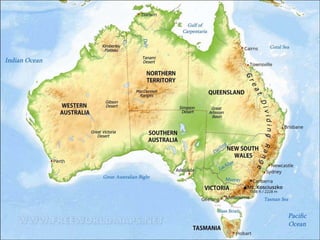
The Australia continent is entirely
surrounded by water . To the east and
north-east, lies the pacific ocean. To
the west and north-west lies the
Indian ocean. The Timor sea, the Gulf
of Carpentaria and Arafura sea lie to
the north of Australia.
 The landmass has been divided into three
main land area.
 The Eastern Highlands
 The Central Lowlands
 The Western Plateau ( outback)
 These mountain are the highest peacks on
the cintinent and mount kosciuszko is the
highest at2,228 meters.
 Lake Eyre Basin
 Lake Eyre which is about 15 meter below sea
level ,is the lowest point on the continent.
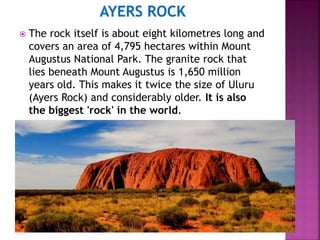
 The rock itself is about eight kilometres long and
covers an area of 4,795 hectares within Mount
Augustus National Park. The granite rock that
lies beneath Mount Augustus is 1,650 million
years old. This makes it twice the size of Uluru
(Ayers Rock) and considerably older. It is also
the biggest 'rock' in the world.
 The five major rivers in Australia.
 The murray – longest River in Australia(2,508)
 The Murrumbidgee
 The Darling
 The Lachlan
 The Cooper Creek
 Great Victoria desert ( the biggest Australian
desert)
 Great Sandy desert
 The coastal plains of Australia are divided
into three
 Eastern Coastal Plain
 Western Costal Plain
 Nullarbor Plain
 The Great Barrier Reef is the biggest group of
coral reefs in the world (2000 km )
 The coral that forms the reef is made up of
skeletons of dead water animals called
polyps.
 The largest lake in Australia is Lake Eyre

Australia ppt 2.pptx

  • 2.
     Australia isthe sixth biggest country and the smallest continent in the world  Australia is one of the largest producers of wool and meat .
  • 4.
    The Australia continentis entirely surrounded by water . To the east and north-east, lies the pacific ocean. To the west and north-west lies the Indian ocean. The Timor sea, the Gulf of Carpentaria and Arafura sea lie to the north of Australia.
  • 5.
     The landmasshas been divided into three main land area.  The Eastern Highlands  The Central Lowlands  The Western Plateau ( outback)
  • 7.
     These mountainare the highest peacks on the cintinent and mount kosciuszko is the highest at2,228 meters.  Lake Eyre Basin  Lake Eyre which is about 15 meter below sea level ,is the lowest point on the continent.
  • 8.
     The rockitself is about eight kilometres long and covers an area of 4,795 hectares within Mount Augustus National Park. The granite rock that lies beneath Mount Augustus is 1,650 million years old. This makes it twice the size of Uluru (Ayers Rock) and considerably older. It is also the biggest 'rock' in the world.
  • 9.
     The fivemajor rivers in Australia.  The murray – longest River in Australia(2,508)  The Murrumbidgee  The Darling  The Lachlan  The Cooper Creek
  • 10.
     Great Victoriadesert ( the biggest Australian desert)  Great Sandy desert
  • 11.
     The coastalplains of Australia are divided into three  Eastern Coastal Plain  Western Costal Plain  Nullarbor Plain
  • 12.
     The GreatBarrier Reef is the biggest group of coral reefs in the world (2000 km )  The coral that forms the reef is made up of skeletons of dead water animals called polyps.  The largest lake in Australia is Lake Eyre