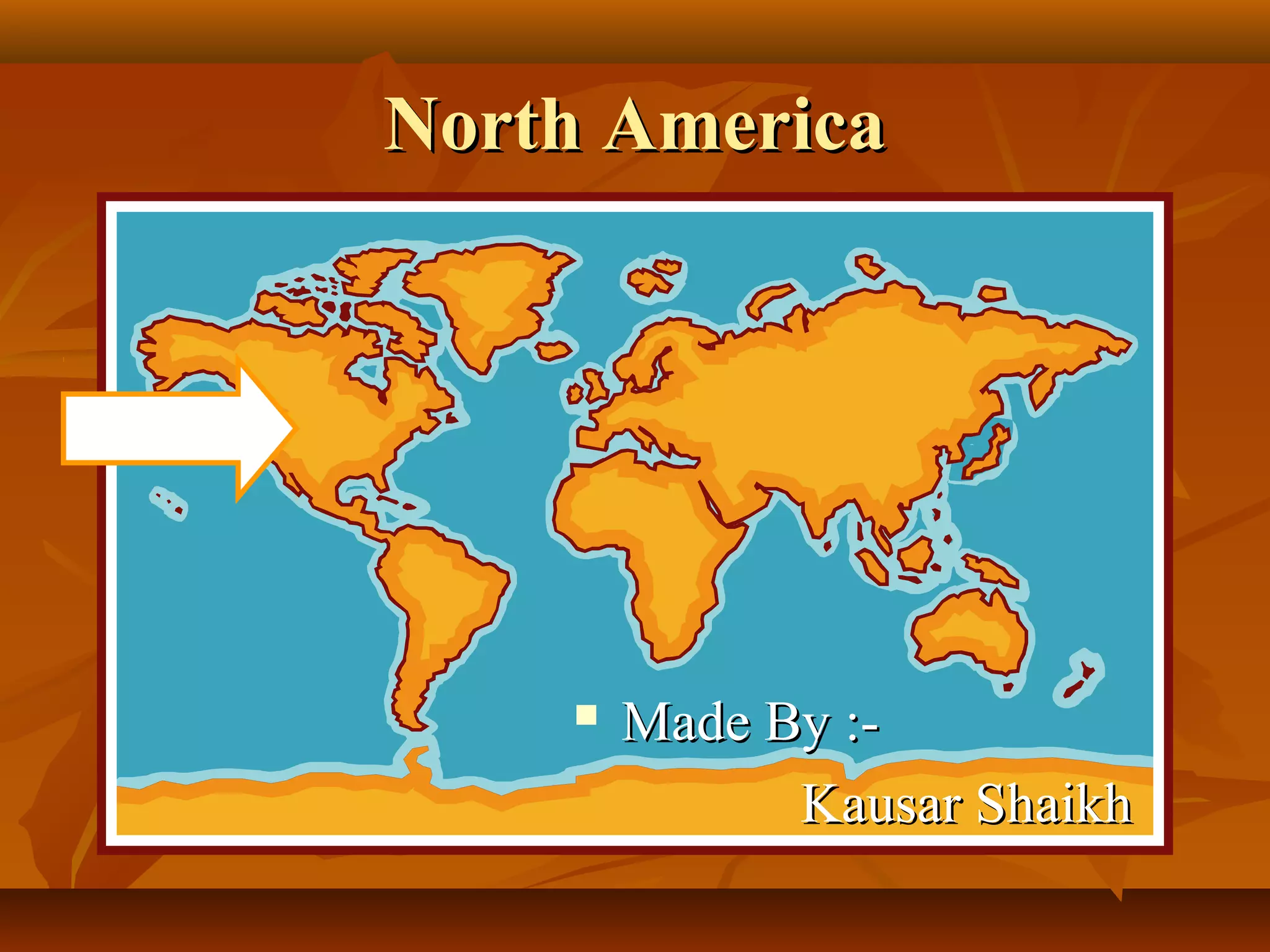
North America



Made By :Kausar Shaikh
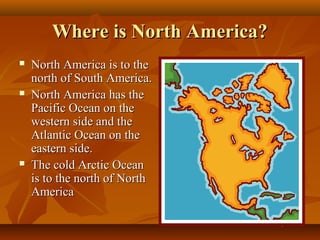
Where is North America?






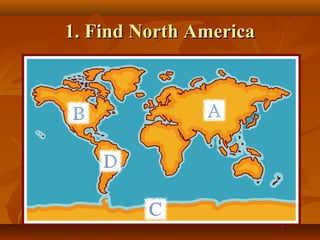
North America is to the
north of South America.
North America has the
Pacific Ocean on the
western side and the
Atlantic Ocean on the
eastern side.
The cold Arctic Ocean
is to the north of North
America
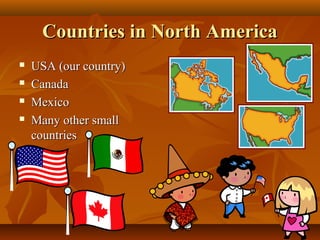
Countries in North America





USA (our country)
Canada
Mexico
Many other small
countries
People in North America







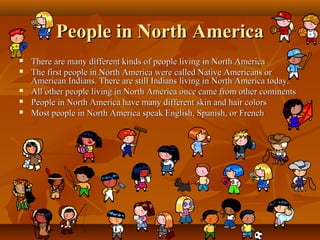
There are many different kinds of people living in North America
The first people in North America were called Native Americans or
American Indians. There are still Indians living in North America today.
All other people living in North America once came from other continents
People in North America have many different skin and hair colors
Most people in North America speak English, Spanish, or French
Weather in North America




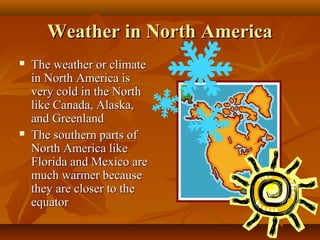
The weather or climate
in North America is
very cold in the North
like Canada, Alaska,
and Greenland
The southern parts of
North America like
Florida and Mexico are
much warmer because
they are closer to the
equator
Animals in North America


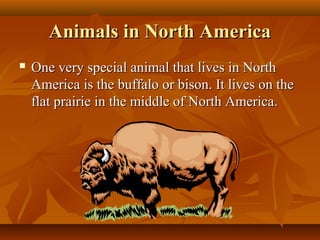
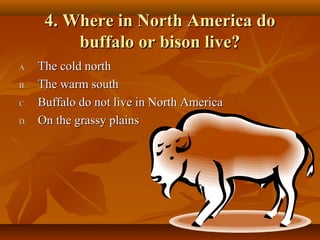
One very special animal that lives in North
America is the buffalo or bison. It lives on the
flat prairie in the middle of North America.
Climate map
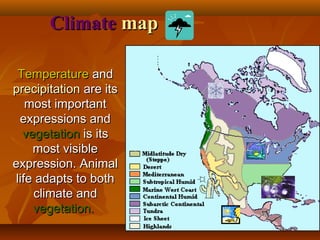
Temperature and
precipitation are its
most important
expressions and
vegetation is its
most visible
expression. Animal
life adapts to both
climate and
vegetation.
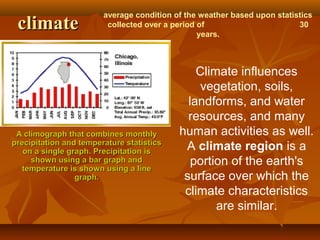
climate

average condition of the weather based upon statistics
collected over a period of
30
years.

A climograph that combines monthly
precipitation and temperature statistics
on a single graph. Precipitation is
shown using a bar graph and
temperature is shown using a line
graph.

Climate influences
vegetation, soils,
landforms, and water
resources, and many
human activities as well.
A climate region is a
portion of the earth's
surface over which the
climate characteristics
are similar.
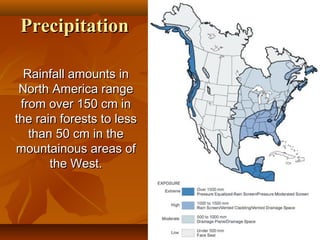
Precipitation
Rainfall amounts in
North America range
from over 150 cm in
the rain forests to less
than 50 cm in the
mountainous areas of
the West.
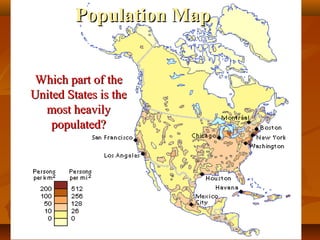
Population Map
Which part of the
United States is the
most heavily
populated?
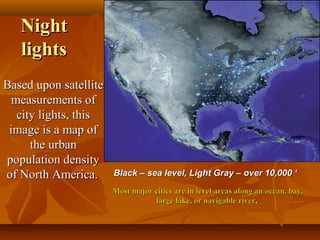
Night
lights
Based upon satellite
measurements of
city lights, this
image is a map of
the urban
population density
of North America.

Black – sea level, Light Gray – over 10,000 ‘
Most major cities are in level areas along an ocean, bay,
large lake, or navigable river.
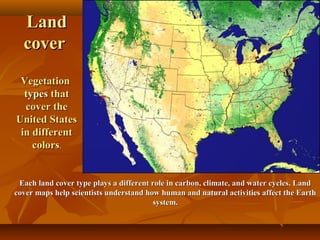
Land
cover
Vegetation
types that
cover the
United States
in different
colors.

Each land cover type plays a different role in carbon, climate, and water cycles. Land
cover maps help scientists understand how human and natural activities affect the Earth
system.
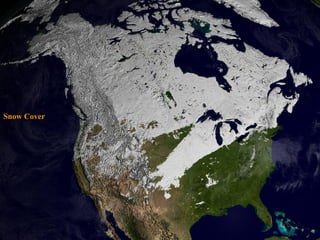
Snow Cover
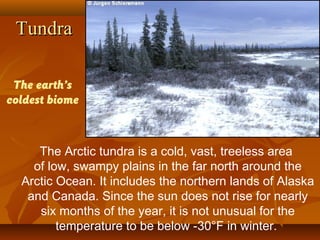
Tundra
The earth’s
coldest biome

The Arctic tundra is a cold, vast, treeless area
of low, swampy plains in the far north around the
Arctic Ocean. It includes the northern lands of Alaska
and Canada. Since the sun does not rise for nearly
six months of the year, it is not unusual for the
temperature to be below -30°F in winter.
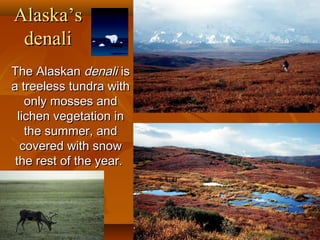
Alaska’s
denali
The Alaskan denali is
a treeless tundra with
only mosses and
lichen vegetation in
the summer, and
covered with snow
the rest of the year.
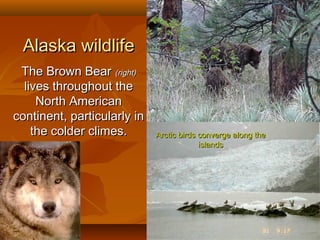
Alaska wildlife
The Brown Bear (right)
lives throughout the
North American
continent, particularly in
the colder climes.

Arctic birds converge along the
islands
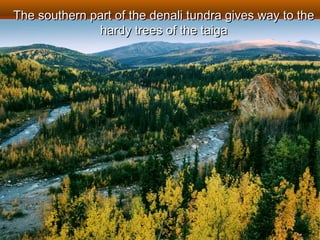
The southern part of the denali tundra gives way to the
hardy trees of the taiga
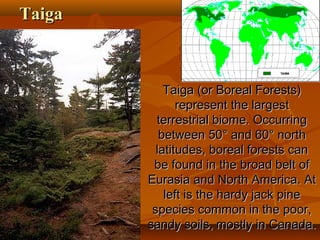
Taiga

Taiga (or Boreal Forests)
represent the largest
terrestrial biome. Occurring
between 50° and 60° north
latitudes, boreal forests can
be found in the broad belt of
Eurasia and North America. At
left is the hardy jack pine
species common in the poor,
sandy soils, mostly in Canada.
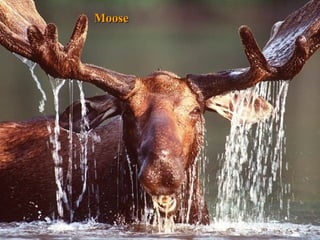
Moose

Moose
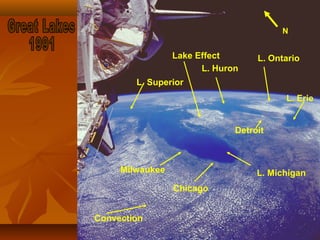
N

Lake Effect
L. Huron

L. Ontario

L. Superior
L. Erie
Detroit

Milwaukee

L. Michigan
Chicago

Convection
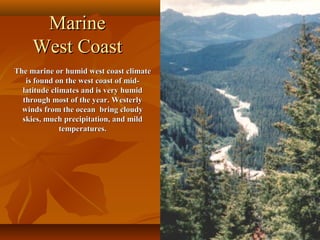
Marine
West Coast
The marine or humid west coast climate
is found on the west coast of midlatitude climates and is very humid
through most of the year. Westerly
winds from the ocean bring cloudy
skies, much precipitation, and mild
temperatures.
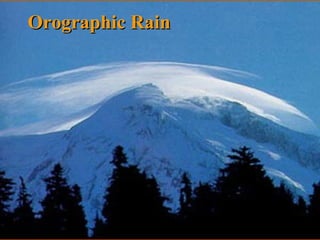
Orographic Rain
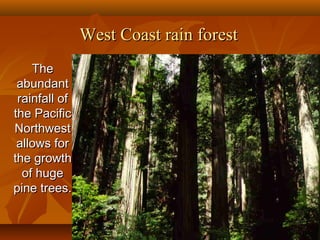
West Coast rain forest
The
abundant
rainfall of
the Pacific
Northwest
allows for
the growth
of huge
pine trees.
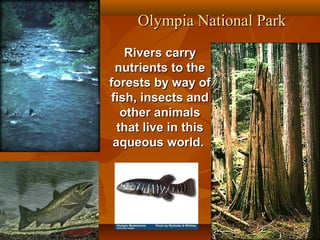
Olympia National Park
Rivers carry
nutrients to the
forests by way of
fish, insects and
other animals
that live in this
aqueous world.
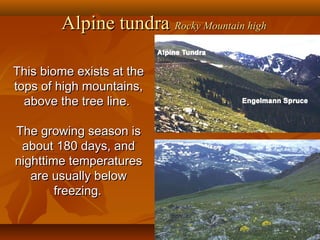
Alpine tundra Rocky Mountain high
This biome exists at the
tops of high mountains,
above the tree line.
The growing season is
about 180 days, and
nighttime temperatures
are usually below
freezing.
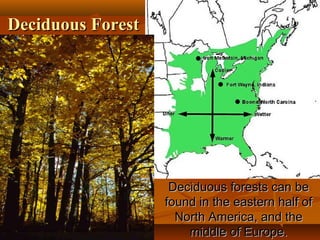
Deciduous Forest

Deciduous forests can be
found in the eastern half of
North America, and the
middle of Europe.
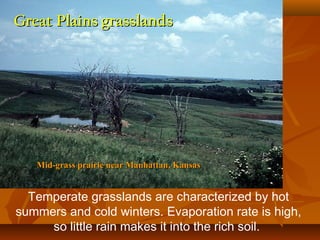
Great Plains grasslands

Mid-grass prairie near Manhattan, Kansas

Temperate grasslands are characterized by hot
summers and cold winters. Evaporation rate is high,
so little rain makes it into the rich soil.
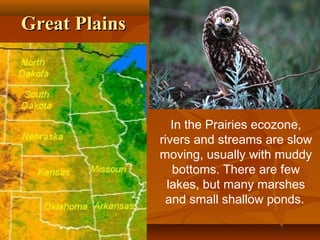
Great Plains

In the Prairies ecozone,
rivers and streams are slow
moving, usually with muddy
bottoms. There are few
lakes, but many marshes
and small shallow ponds.
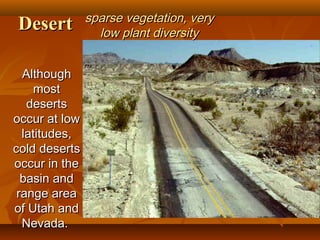
Desert
Although
most
deserts
occur at low
latitudes,
cold deserts
occur in the
basin and
range area
of Utah and
Nevada.

sparse vegetation, very
low plant diversity
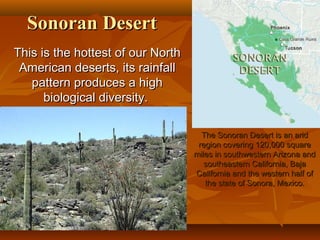
Sonoran Desert
This is the hottest of our North
American deserts, its rainfall
pattern produces a high
biological diversity.
The Sonoran Desert is an arid
region covering 120,000 square
miles in southwestern Arizona and
southeastern California, Baja
California and the western half of
the state of Sonora, Mexico.
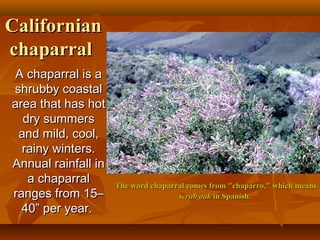
Californian
chaparral
A chaparral is a
shrubby coastal
area that has hot
dry summers
and mild, cool,
rainy winters.
Annual rainfall in
a chaparral
ranges from 15–
40” per year.

The word chaparral comes from "chaparro," which means
scrub oak in Spanish.
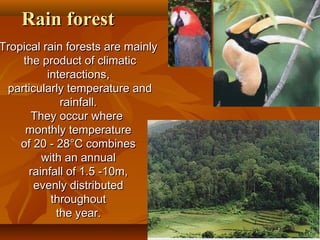
Rain forest

Tropical rain forests are mainly
the product of climatic
interactions,
particularly temperature and
rainfall.
They occur where
monthly temperature
of 20 - 28°C combines
with an annual
rainfall of 1.5 -10m,
evenly distributed
throughout
the year.
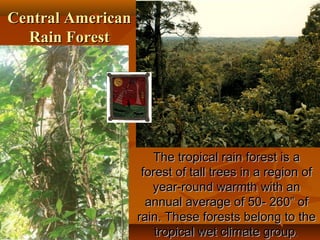
Central American
Rain Forest

The tropical rain forest is a
forest of tall trees in a region of
year-round warmth with an
annual average of 50- 260” of
rain. These forests belong to the
tropical wet climate group.
Are you ready for a quiz?
1. Find North America
2. What makes North America
special?
A.
B.

C.
D.

It is hot all the time
It is a very big
continent
We live there
Nobody lives there
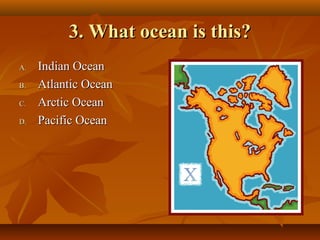
3. What ocean is this?
A.
B.
C.
D.

Indian Ocean
Atlantic Ocean
Arctic Ocean
Pacific Ocean
4. Where in North America do
buffalo or bison live?
A.
B.
C.
D.

The cold north
The warm south
Buffalo do not live in North America
On the grassy plains
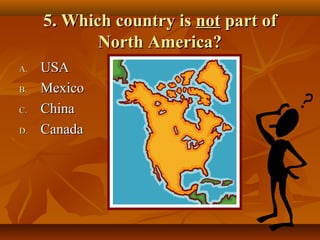
5. Which country is not part of
North America?
A.
B.
C.
D.

USA
Mexico
China
Canada
Thank You

North america

  • 1.
  • 2.
    Where is NorthAmerica?    North America is to the north of South America. North America has the Pacific Ocean on the western side and the Atlantic Ocean on the eastern side. The cold Arctic Ocean is to the north of North America
  • 3.
    Countries in NorthAmerica     USA (our country) Canada Mexico Many other small countries
  • 4.
    People in NorthAmerica      There are many different kinds of people living in North America The first people in North America were called Native Americans or American Indians. There are still Indians living in North America today. All other people living in North America once came from other continents People in North America have many different skin and hair colors Most people in North America speak English, Spanish, or French
  • 5.
    Weather in NorthAmerica   The weather or climate in North America is very cold in the North like Canada, Alaska, and Greenland The southern parts of North America like Florida and Mexico are much warmer because they are closer to the equator
  • 6.
    Animals in NorthAmerica  One very special animal that lives in North America is the buffalo or bison. It lives on the flat prairie in the middle of North America.
  • 7.
    Climate map Temperature and precipitationare its most important expressions and vegetation is its most visible expression. Animal life adapts to both climate and vegetation.
  • 8.
    climate average condition ofthe weather based upon statistics collected over a period of 30 years. A climograph that combines monthly precipitation and temperature statistics on a single graph. Precipitation is shown using a bar graph and temperature is shown using a line graph. Climate influences vegetation, soils, landforms, and water resources, and many human activities as well. A climate region is a portion of the earth's surface over which the climate characteristics are similar.
  • 10.
    Precipitation Rainfall amounts in NorthAmerica range from over 150 cm in the rain forests to less than 50 cm in the mountainous areas of the West.
  • 11.
    Population Map Which partof the United States is the most heavily populated?
  • 12.
    Night lights Based upon satellite measurementsof city lights, this image is a map of the urban population density of North America. Black – sea level, Light Gray – over 10,000 ‘ Most major cities are in level areas along an ocean, bay, large lake, or navigable river.
  • 13.
    Land cover Vegetation types that cover the UnitedStates in different colors. Each land cover type plays a different role in carbon, climate, and water cycles. Land cover maps help scientists understand how human and natural activities affect the Earth system.
  • 14.
  • 15.
    Tundra The earth’s coldest biome TheArctic tundra is a cold, vast, treeless area of low, swampy plains in the far north around the Arctic Ocean. It includes the northern lands of Alaska and Canada. Since the sun does not rise for nearly six months of the year, it is not unusual for the temperature to be below -30°F in winter.
  • 16.
    Alaska’s denali The Alaskan denaliis a treeless tundra with only mosses and lichen vegetation in the summer, and covered with snow the rest of the year.
  • 17.
    Alaska wildlife The BrownBear (right) lives throughout the North American continent, particularly in the colder climes. Arctic birds converge along the islands
  • 18.
    The southern partof the denali tundra gives way to the hardy trees of the taiga
  • 19.
    Taiga Taiga (or BorealForests) represent the largest terrestrial biome. Occurring between 50° and 60° north latitudes, boreal forests can be found in the broad belt of Eurasia and North America. At left is the hardy jack pine species common in the poor, sandy soils, mostly in Canada.
  • 20.
  • 21.
    N Lake Effect L. Huron L.Ontario L. Superior L. Erie Detroit Milwaukee L. Michigan Chicago Convection
  • 22.
    Marine West Coast The marineor humid west coast climate is found on the west coast of midlatitude climates and is very humid through most of the year. Westerly winds from the ocean bring cloudy skies, much precipitation, and mild temperatures.
  • 23.
  • 24.
    West Coast rainforest The abundant rainfall of the Pacific Northwest allows for the growth of huge pine trees.
  • 25.
    Olympia National Park Riverscarry nutrients to the forests by way of fish, insects and other animals that live in this aqueous world.
  • 26.
    Alpine tundra RockyMountain high This biome exists at the tops of high mountains, above the tree line. The growing season is about 180 days, and nighttime temperatures are usually below freezing.
  • 27.
    Deciduous Forest Deciduous forestscan be found in the eastern half of North America, and the middle of Europe.
  • 28.
    Great Plains grasslands Mid-grassprairie near Manhattan, Kansas Temperate grasslands are characterized by hot summers and cold winters. Evaporation rate is high, so little rain makes it into the rich soil.
  • 29.
    Great Plains In thePrairies ecozone, rivers and streams are slow moving, usually with muddy bottoms. There are few lakes, but many marshes and small shallow ponds.
  • 30.
    Desert Although most deserts occur at low latitudes, colddeserts occur in the basin and range area of Utah and Nevada. sparse vegetation, very low plant diversity
  • 31.
    Sonoran Desert This isthe hottest of our North American deserts, its rainfall pattern produces a high biological diversity. The Sonoran Desert is an arid region covering 120,000 square miles in southwestern Arizona and southeastern California, Baja California and the western half of the state of Sonora, Mexico.
  • 32.
    Californian chaparral A chaparral isa shrubby coastal area that has hot dry summers and mild, cool, rainy winters. Annual rainfall in a chaparral ranges from 15– 40” per year. The word chaparral comes from "chaparro," which means scrub oak in Spanish.
  • 33.
    Rain forest Tropical rainforests are mainly the product of climatic interactions, particularly temperature and rainfall. They occur where monthly temperature of 20 - 28°C combines with an annual rainfall of 1.5 -10m, evenly distributed throughout the year.
  • 34.
    Central American Rain Forest Thetropical rain forest is a forest of tall trees in a region of year-round warmth with an annual average of 50- 260” of rain. These forests belong to the tropical wet climate group.
  • 35.
    Are you readyfor a quiz?
  • 36.
  • 37.
    2. What makesNorth America special? A. B. C. D. It is hot all the time It is a very big continent We live there Nobody lives there
  • 38.
    3. What oceanis this? A. B. C. D. Indian Ocean Atlantic Ocean Arctic Ocean Pacific Ocean
  • 39.
    4. Where inNorth America do buffalo or bison live? A. B. C. D. The cold north The warm south Buffalo do not live in North America On the grassy plains
  • 40.
    5. Which countryis not part of North America? A. B. C. D. USA Mexico China Canada
  • 41.

Editor's Notes

  • #8 Soils develop in response to climate and vegetation.
  • #17 Glaciers and a sub-arctic ecosystem are found in Denali National Park and Preserve.
  • #27 The soil is well-drained (unlike the Arctic tundra).
  • #32 Winter storms from the Pacific nourish many West Coast annuals, while well-developed summer monsoons host both annuals and woody plants originating from the south.
  • #33 These coastal regions have cold ocean currents offshore.