Waves and Wave Properties
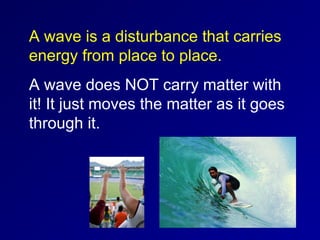
A wave is a disturbance that carries
energy from place to place.
A wave does NOT carry matter with
it! It just moves the matter as it goes
through it.
Some waves do not need matter
(called a “medium”) to be able to
move (for example, through space).
These are called electromagnetic
waves (or EM waves).
Some waves MUST have a medium
in order to move. These are called
mechanical waves.
Wave Types
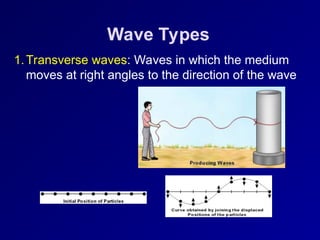
1.Transverse waves: Waves in which the medium
moves at right angles to the direction of the wave
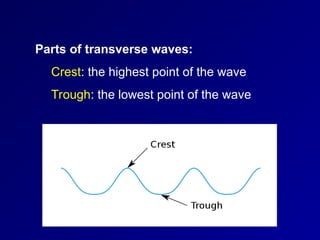
Parts of transverse waves:
Crest: the highest point of the wave
Trough: the lowest point of the wave
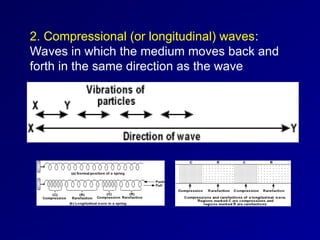
2. Compressional (or longitudinal) waves:
Waves in which the medium moves back and
forth in the same direction as the wave
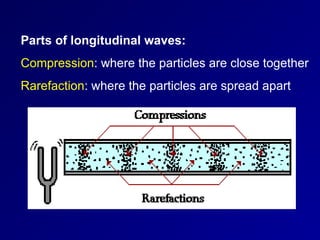
Parts of longitudinal waves:
Compression: where the particles are close together
Rarefaction: where the particles are spread apart
NSF North Mississippi GK-8
NSF North Mississippi GK-8 8
8
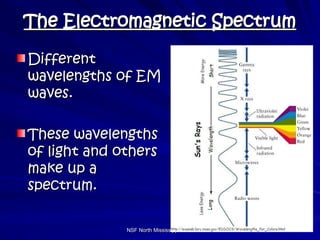
The Electromagnetic Spectrum
Different
Different
wavelengths of EM
wavelengths of EM
waves.
waves.
These wavelengths
These wavelengths
of light and others
of light and others
make up a
make up a
spectrum.
spectrum.
Wave Properties
Wave properties depend on what
(type of energy) is making the waves.
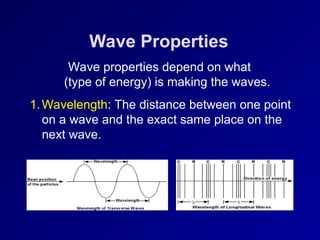
1.Wavelength: The distance between one point
on a wave and the exact same place on the
next wave.
2. Frequency: How many waves go past a point in
one second; unit of measurement is hertz (Hz).
The higher the frequency, the more energy in the
wave.
10 waves going past in 1 second = 10 Hz
1,000 waves go past in 1 second = 1,000 Hz
1 million waves going past = 1 million Hz
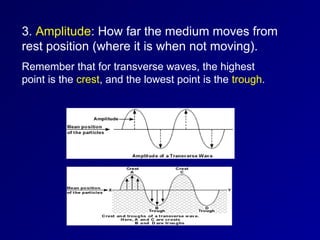
3. Amplitude: How far the medium moves from
rest position (where it is when not moving).
Remember that for transverse waves, the highest
point is the crest, and the lowest point is the trough.
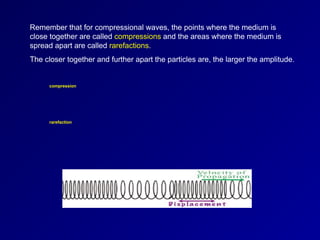
Remember that for compressional waves, the points where the medium is
close together are called compressions and the areas where the medium is
spread apart are called rarefactions.
The closer together and further apart the particles are, the larger the amplitude.
compression
rarefaction
Properties of Sound
Properties of Sound
〉What are the characteristics of sound
What are the characteristics of sound
waves?
waves?
〉sound wave:
sound wave: a longitudinal wave that is
a longitudinal wave that is
caused by vibrations and that travels through
a material medium
a material medium
In air, sound waves spread out in all
directions away from the source.
Properties of Sound,
continued
continued
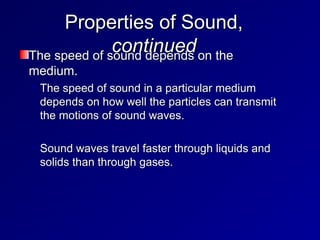
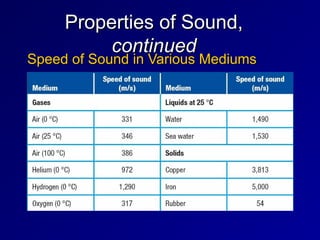
The speed of sound depends on the
medium.
medium.
‱ The speed of sound in a particular medium
The speed of sound in a particular medium
depends on how well the particles can transmit
the motions of sound waves.
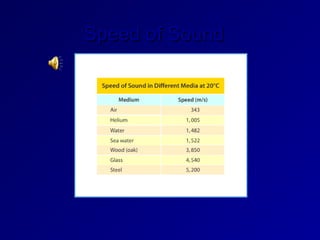
‱ Sound waves travel faster through liquids and
Sound waves travel faster through liquids and
solids than through gases.
Properties of Sound,
continued
continued
Speed of Sound in Various Mediums
Speed of Sound
Speed of Sound
Properties of Sound,
continued
continued
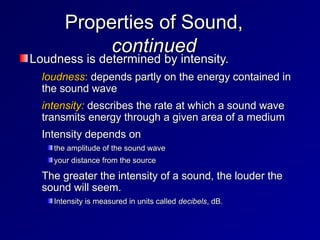
Loudness is determined by intensity.
– loudness
loudness:
: depends partly on the energy contained in
depends partly on the energy contained in
the sound wave
the sound wave
– intensity:
intensity: describes the rate at which a sound wave
describes the rate at which a sound wave
transmits energy through a given area of a medium
– Intensity depends on
Intensity depends on
the amplitude of the sound wave
your distance from the source
– The greater the intensity of a sound, the louder the
The greater the intensity of a sound, the louder the
sound will seem.
sound will seem.
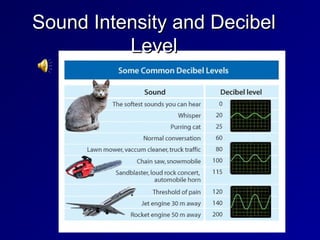
Intensity is measured in units called
Intensity is measured in units called decibels
decibels, dB.
, dB.
Sound Intensity and Decibel
Level
Level
Properties of Sound,
continued
continued
Pitch is determined by frequency.
‱ pitch:
pitch: a measure of how high or low a sound is
a measure of how high or low a sound is
perceived to be, depending on the frequency of the
sound wave
sound wave
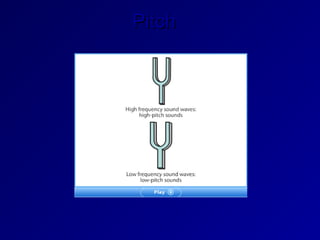
‱ A high-pitched sound corresponds to a high
A high-pitched sound corresponds to a high
frequency.
frequency.
‱ A low-pitched sound corresponds to a low
A low-pitched sound corresponds to a low
frequency.
frequency.
THANK YOU
Pitch
Pitch
Properties of Sound,
continued
continued
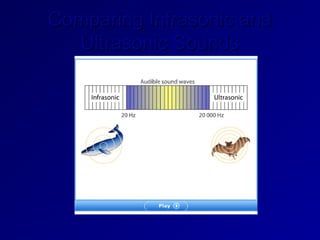
Humans hear sound waves in a limited
frequency range.
frequency range.
– Any sound with a frequency below the range of
Any sound with a frequency below the range of
human hearing is known as an infrasound.
infrasound:
infrasound: slow vibrations of frequencies lower than
slow vibrations of frequencies lower than
20 Hz
20 Hz
– Any sound with a frequency above human
Any sound with a frequency above human
hearing range is known as an ultrasound.
ultrasound:
ultrasound: any sound wave with frequencies higher
any sound wave with frequencies higher
than 20,000 Hz
than 20,000 Hz
Comparing Infrasonic and
Ultrasonic Sounds
Ultrasonic Sounds
Musical Instruments
Musical Instruments
〉How do musical instruments
How do musical instruments
make sound?
make sound?
〉Most instruments produce sound
Most instruments produce sound
through the vibration of strings,
air columns, or membranes.
Musical Instruments
Musical Instruments
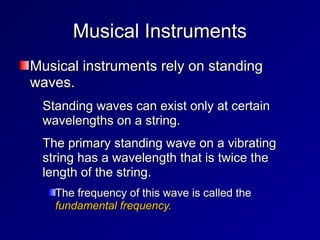
Musical instruments rely on standing
waves.
waves.
– Standing waves can exist only at certain
Standing waves can exist only at certain
wavelengths on a string.
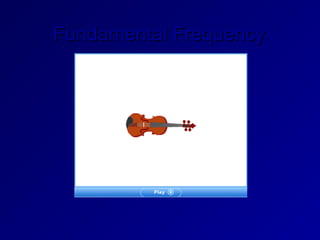
– The primary standing wave on a vibrating
The primary standing wave on a vibrating
string has a wavelength that is twice the
length of the string.
The frequency of this wave is called the
fundamental frequency.
Fundamental Frequency
Musical Instruments,
continued
continued
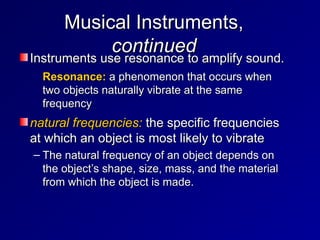
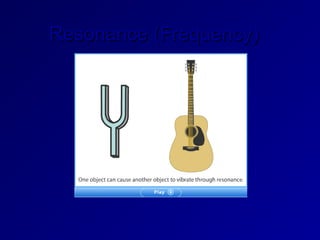
Instruments use resonance to amplify sound.
– Resonance:
Resonance: a phenomenon that occurs when
a phenomenon that occurs when
two objects naturally vibrate at the same
frequency
frequency
natural frequencies:
natural frequencies: the specific frequencies
the specific frequencies
at which an object is most likely to vibrate
– The natural frequency of an object depends on
The natural frequency of an object depends on
the object’s shape, size, mass, and the material
from which the object is made.
Resonance (Frequency)
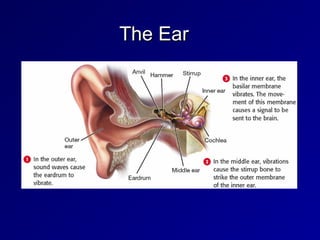
〉How do ears help humans hear sound waves?
How do ears help humans hear sound waves?
〉The human ear is a sensitive organ that
The human ear is a sensitive organ that
senses vibrations in the air, amplifies them,
and then transmits signals to the brain.
Vibrations pass through three regions in the ear.
– Your ear is divided into three regions—outer, middle, and
Your ear is divided into three regions—outer, middle, and
inner.
inner.
Hearing and the Ear
Hearing and the Ear
Resonance occurs in the inner ear.
– A wave of a particular frequency causes a
A wave of a particular frequency causes a
specific part of the basilar membrane to vibrate.
– Hair cells near the part of the membrane that
Hair cells near the part of the membrane that
vibrates then stimulate nerve fibers that send an
impulse to the brain.
Hearing and the Ear,
continued
continued
The Ear
The Ear
〉How are the reflections of sound waves
How are the reflections of sound waves
used?
used?
〉Reflected sound waves are used to
Reflected sound waves are used to
determine distances and to create images.
Some ultrasound waves are reflected at
boundaries.
boundaries.
Ultrasound and Sonar

clem_waves_lesson02_presentation properties.ppt

  • 1.
    Waves and WaveProperties Waves and Wave Properties
  • 2.
    A wave isa disturbance that carries energy from place to place. A wave does NOT carry matter with it! It just moves the matter as it goes through it.
  • 3.
    Some waves donot need matter (called a “medium”) to be able to move (for example, through space). These are called electromagnetic waves (or EM waves). Some waves MUST have a medium in order to move. These are called mechanical waves.
  • 4.
    Wave Types 1.Transverse waves:Waves in which the medium moves at right angles to the direction of the wave
  • 5.
    Parts of transversewaves: Crest: the highest point of the wave Trough: the lowest point of the wave
  • 6.
    2. Compressional (orlongitudinal) waves: Waves in which the medium moves back and forth in the same direction as the wave
  • 7.
    Parts of longitudinalwaves: Compression: where the particles are close together Rarefaction: where the particles are spread apart
  • 8.
    NSF North MississippiGK-8 NSF North Mississippi GK-8 8 8 The Electromagnetic Spectrum The Electromagnetic Spectrum Different Different wavelengths of EM wavelengths of EM waves. waves. These wavelengths These wavelengths of light and others of light and others make up a make up a spectrum. spectrum.
  • 9.
    Wave Properties Wave propertiesdepend on what (type of energy) is making the waves. 1.Wavelength: The distance between one point on a wave and the exact same place on the next wave.
  • 10.
    2. Frequency: Howmany waves go past a point in one second; unit of measurement is hertz (Hz). The higher the frequency, the more energy in the wave. 10 waves going past in 1 second = 10 Hz 1,000 waves go past in 1 second = 1,000 Hz 1 million waves going past = 1 million Hz
  • 11.
    3. Amplitude: Howfar the medium moves from rest position (where it is when not moving). Remember that for transverse waves, the highest point is the crest, and the lowest point is the trough.
  • 12.
    Remember that forcompressional waves, the points where the medium is close together are called compressions and the areas where the medium is spread apart are called rarefactions. The closer together and further apart the particles are, the larger the amplitude. compression rarefaction
  • 13.
    Properties of Sound Propertiesof Sound 〉What are the characteristics of sound What are the characteristics of sound waves? waves? 〉sound wave: sound wave: a longitudinal wave that is a longitudinal wave that is caused by vibrations and that travels through caused by vibrations and that travels through a material medium a material medium In air, sound waves spread out in all In air, sound waves spread out in all directions away from the source. directions away from the source.
  • 14.
    Properties of Sound, Propertiesof Sound, continued continued The speed of sound depends on the The speed of sound depends on the medium. medium. ‱ The speed of sound in a particular medium The speed of sound in a particular medium depends on how well the particles can transmit depends on how well the particles can transmit the motions of sound waves. the motions of sound waves. ‱ Sound waves travel faster through liquids and Sound waves travel faster through liquids and solids than through gases. solids than through gases.
  • 15.
    Properties of Sound, Propertiesof Sound, continued continued Speed of Sound in Various Mediums Speed of Sound in Various Mediums
  • 16.
  • 17.
    Properties of Sound, Propertiesof Sound, continued continued Loudness is determined by intensity. Loudness is determined by intensity. – loudness loudness: : depends partly on the energy contained in depends partly on the energy contained in the sound wave the sound wave – intensity: intensity: describes the rate at which a sound wave describes the rate at which a sound wave transmits energy through a given area of a medium transmits energy through a given area of a medium – Intensity depends on Intensity depends on the amplitude of the sound wave the amplitude of the sound wave your distance from the source your distance from the source – The greater the intensity of a sound, the louder the The greater the intensity of a sound, the louder the sound will seem. sound will seem. Intensity is measured in units called Intensity is measured in units called decibels decibels, dB. , dB.
  • 18.
    Sound Intensity andDecibel Sound Intensity and Decibel Level Level
  • 19.
    Properties of Sound, Propertiesof Sound, continued continued Pitch is determined by frequency. Pitch is determined by frequency. ‱ pitch: pitch: a measure of how high or low a sound is a measure of how high or low a sound is perceived to be, depending on the frequency of the perceived to be, depending on the frequency of the sound wave sound wave ‱ A high-pitched sound corresponds to a high A high-pitched sound corresponds to a high frequency. frequency. ‱ A low-pitched sound corresponds to a low A low-pitched sound corresponds to a low frequency. frequency.
  • 20.
  • 21.
  • 22.
    Properties of Sound, Propertiesof Sound, continued continued Humans hear sound waves in a limited Humans hear sound waves in a limited frequency range. frequency range. – Any sound with a frequency below the range of Any sound with a frequency below the range of human hearing is known as an infrasound. human hearing is known as an infrasound. infrasound: infrasound: slow vibrations of frequencies lower than slow vibrations of frequencies lower than 20 Hz 20 Hz – Any sound with a frequency above human Any sound with a frequency above human hearing range is known as an ultrasound. hearing range is known as an ultrasound. ultrasound: ultrasound: any sound wave with frequencies higher any sound wave with frequencies higher than 20,000 Hz than 20,000 Hz
  • 23.
    Comparing Infrasonic and ComparingInfrasonic and Ultrasonic Sounds Ultrasonic Sounds
  • 24.
    Musical Instruments Musical Instruments 〉Howdo musical instruments How do musical instruments make sound? make sound? 〉Most instruments produce sound Most instruments produce sound through the vibration of strings, through the vibration of strings, air columns, or membranes. air columns, or membranes.
  • 25.
    Musical Instruments Musical Instruments Musicalinstruments rely on standing Musical instruments rely on standing waves. waves. – Standing waves can exist only at certain Standing waves can exist only at certain wavelengths on a string. wavelengths on a string. – The primary standing wave on a vibrating The primary standing wave on a vibrating string has a wavelength that is twice the string has a wavelength that is twice the length of the string. length of the string. The frequency of this wave is called the The frequency of this wave is called the fundamental frequency. fundamental frequency.
  • 26.
  • 27.
    Musical Instruments, Musical Instruments, continued continued Instrumentsuse resonance to amplify sound. Instruments use resonance to amplify sound. – Resonance: Resonance: a phenomenon that occurs when a phenomenon that occurs when two objects naturally vibrate at the same two objects naturally vibrate at the same frequency frequency natural frequencies: natural frequencies: the specific frequencies the specific frequencies at which an object is most likely to vibrate at which an object is most likely to vibrate – The natural frequency of an object depends on The natural frequency of an object depends on the object’s shape, size, mass, and the material the object’s shape, size, mass, and the material from which the object is made. from which the object is made.
  • 28.
  • 29.
    〉How do earshelp humans hear sound waves? How do ears help humans hear sound waves? 〉The human ear is a sensitive organ that The human ear is a sensitive organ that senses vibrations in the air, amplifies them, senses vibrations in the air, amplifies them, and then transmits signals to the brain. and then transmits signals to the brain. Vibrations pass through three regions in the ear. Vibrations pass through three regions in the ear. – Your ear is divided into three regions—outer, middle, and Your ear is divided into three regions—outer, middle, and inner. inner. Hearing and the Ear Hearing and the Ear
  • 30.
    Resonance occurs inthe inner ear. Resonance occurs in the inner ear. – A wave of a particular frequency causes a A wave of a particular frequency causes a specific part of the basilar membrane to vibrate. specific part of the basilar membrane to vibrate. – Hair cells near the part of the membrane that Hair cells near the part of the membrane that vibrates then stimulate nerve fibers that send an vibrates then stimulate nerve fibers that send an impulse to the brain. impulse to the brain. Hearing and the Ear, Hearing and the Ear, continued continued
  • 31.
  • 32.
    〉How are thereflections of sound waves How are the reflections of sound waves used? used? 〉Reflected sound waves are used to Reflected sound waves are used to determine distances and to create images. determine distances and to create images. Some ultrasound waves are reflected at Some ultrasound waves are reflected at boundaries. boundaries. Ultrasound and Sonar Ultrasound and Sonar

Editor's Notes

  • #1 Presentation for lesson 2: Waves and Wave Properties, in the Waves: The Three Color Mystery unit The slides are animated so you can click (space bar, mouse, etc.) to show the next item when the class is ready.
  • #2 Think of a stadium wave: the people are moving up and down, but the wave goes around the stadium

  • #15 Table 1, p.491
  • #23 Pick up Visual Concepts: Chapter 15, Section 1, # 70526, Comparing Infrasonic and Ultrasonic Sound
  • #31 Teaching Transparency