Chapter 14: Sound
Sound is…
Watch the video and take down 3 key
points about sound

O http://www.youtube.com/watch?v=MFLeG
 JclQiI&feature=related
Longitudinal Waves and guitar
Watch the video and answer the questions:

(1) How did the air layers get into vibration?
(2)Did the air layers move with the sound wave?
(3) How did the air particles move relative to the
direction of the sound wave?
 O http://www.physicsclassroom.com/mmedia/waves/gsl.cf
   m
 O http://illuminations.nctm.org/ActivityDetail.aspx?ID=37
Production and
   Propagation of Sound
O Sound is produced by vibrating sources
  in a medium.
O The source cause the air particles to
  vibrate and the sound wave will
  propagate outwards in the form of a
  longitudinal wave.
O When air particles are pulled together, a
  region of compression is formed. When
  they are pushed apart, a region of
  rarefaction is formed.
Bell Jar experiment
What does the video tell you about how sound travel?

    O http://www.youtube.com/watch?v=ce7AMJ
      dq0Gw
15.1 Sound Waves
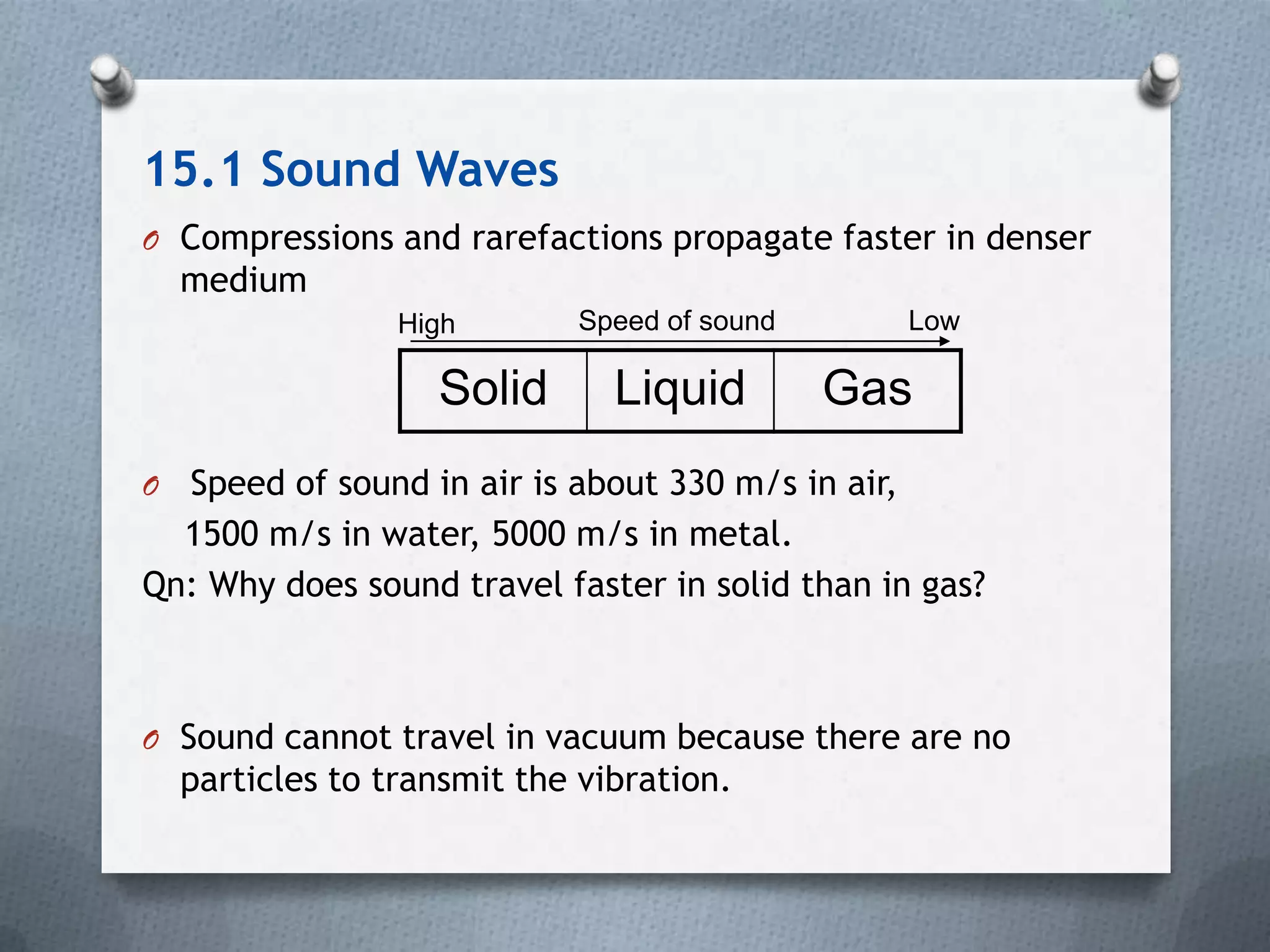
O Compressions and rarefactions propagate faster in denser
    medium
                  High       Speed of sound      Low

                    Solid       Liquid        Gas
O Speed of sound in air is about 330 m/s in air,
  1500 m/s in water, 5000 m/s in metal.
Qn: Why does sound travel faster in solid than in gas?


O Sound cannot travel in vacuum because there are no
    particles to transmit the vibration.
Pitch of Sound
O Watch the video and answer the
 questions below
O (1) how does the pitch change when the
 frequency of the sound wave change?
O (2) what is the maximum frequency you
 can detect?
    http://www.youtube.com/watch?v=4nUkNvl8mQw
O    Human audible frequency is between 20
    Hz to 20 000 Hz (or 20 kHz)
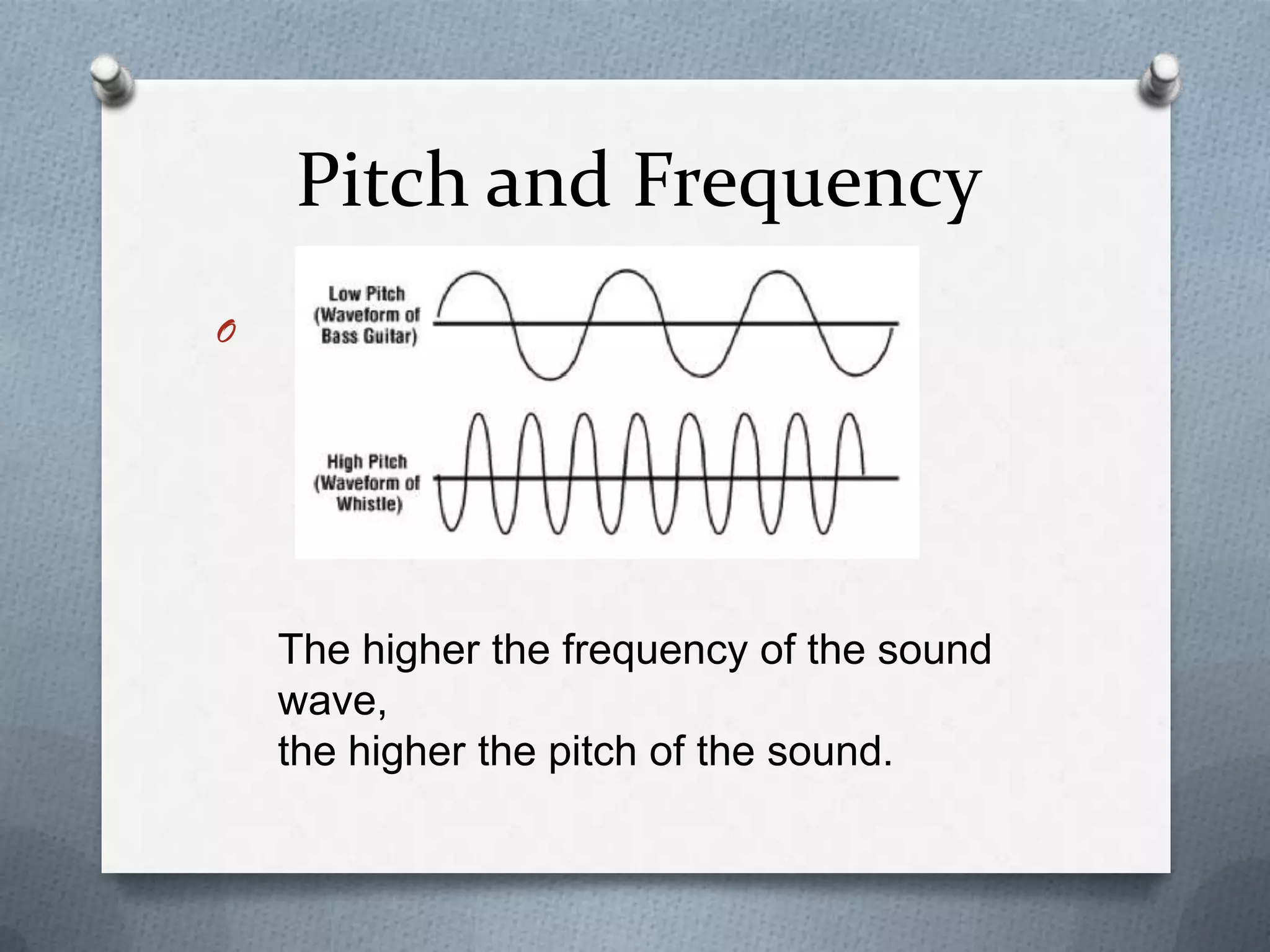
Pitch and Frequency
O


    The higher the frequency of the sound
    wave,
    the higher the pitch of the sound.
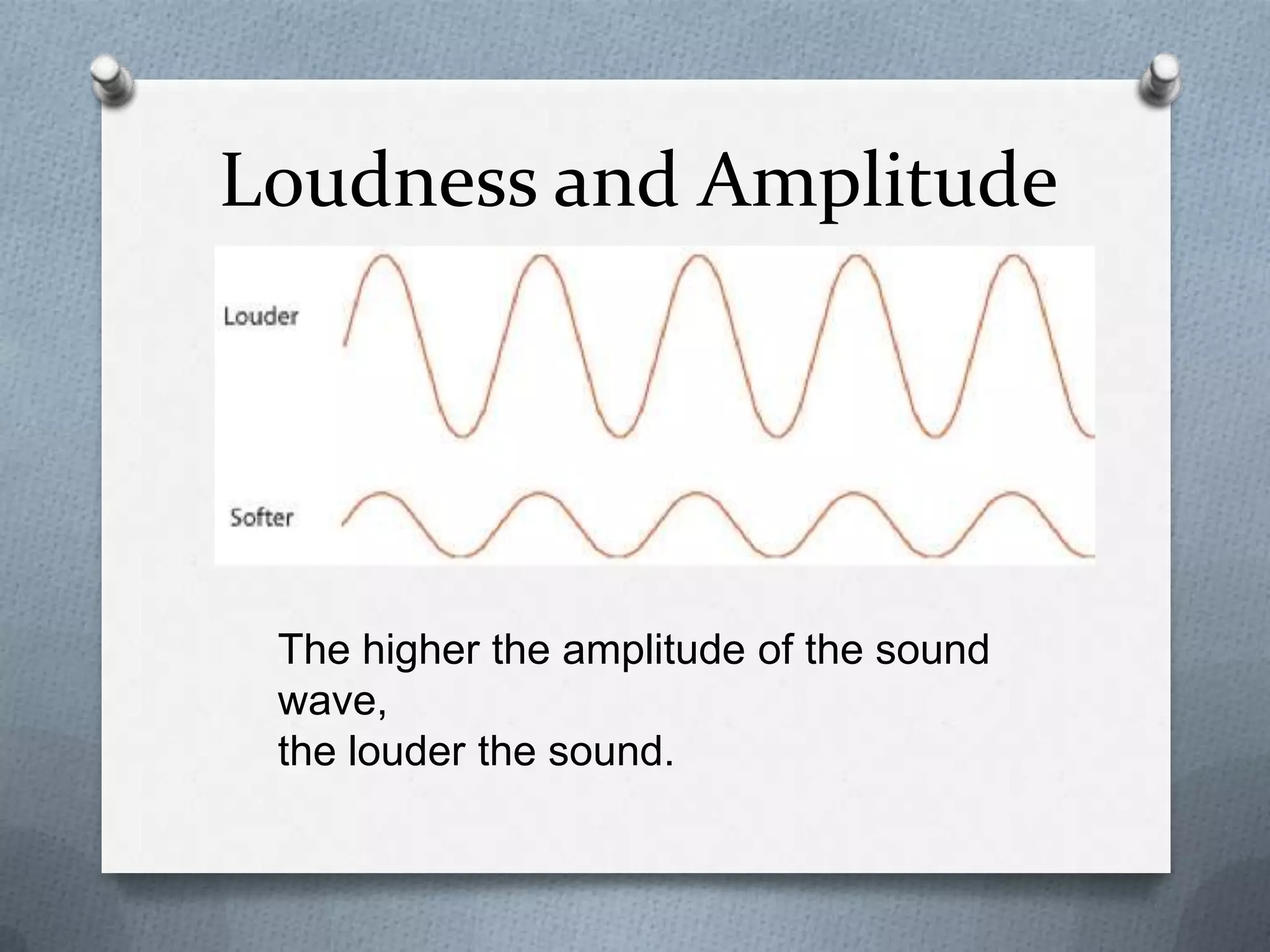
Loudness and Amplitude
O


    The higher the amplitude of the sound
    wave,
    the louder the sound.
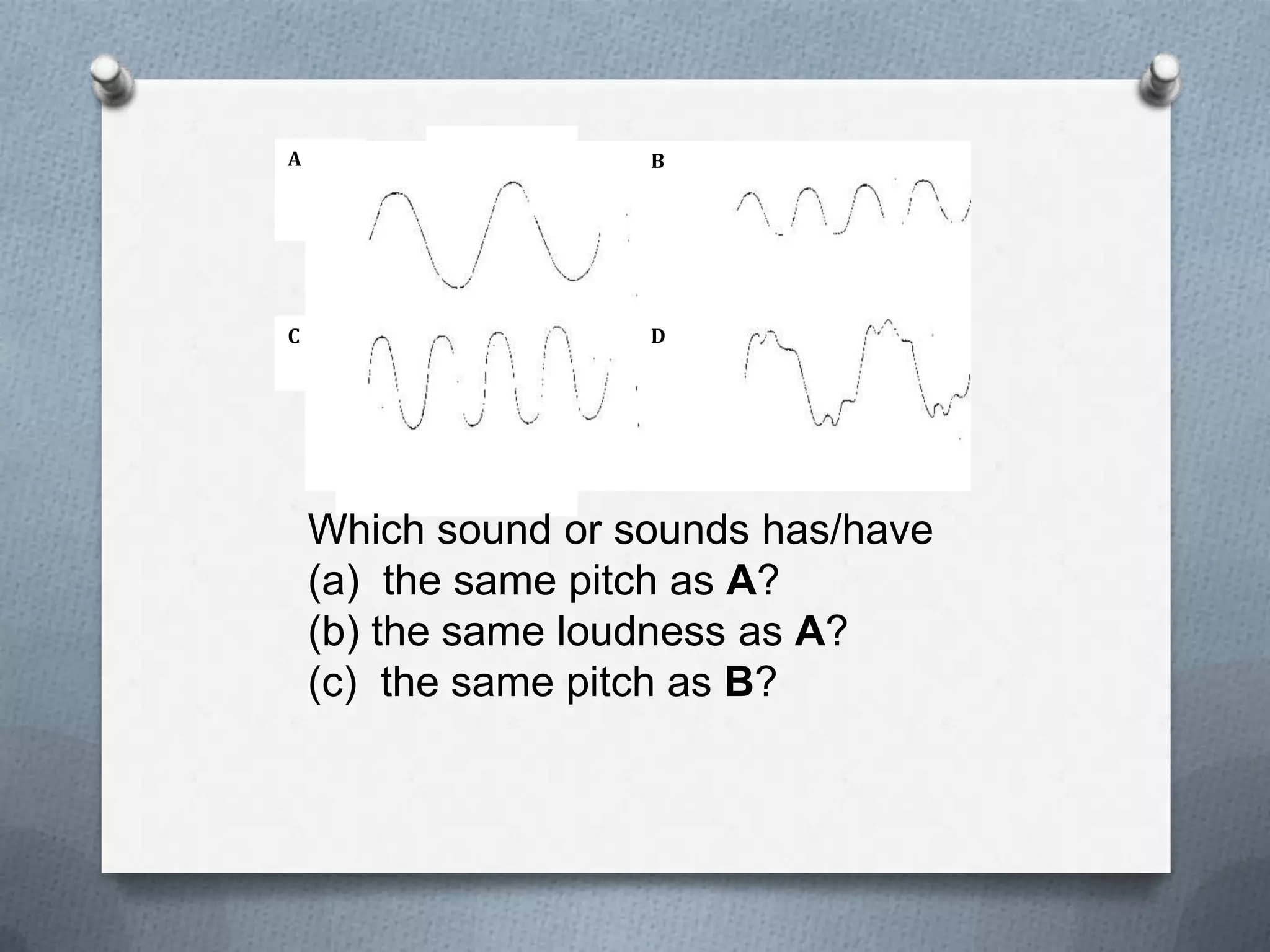
A                   B


C                   D


    Which sound or sounds has/have
    (a) the same pitch as A?
    (b) the same loudness as A?
    (c) the same pitch as B?
Echo
O Echo is caused by the reflection of sound from
 a hard and flat surface like a wall or cliff.

O Why can’t you hear the echo when you clap
 your hands next to a high wall?
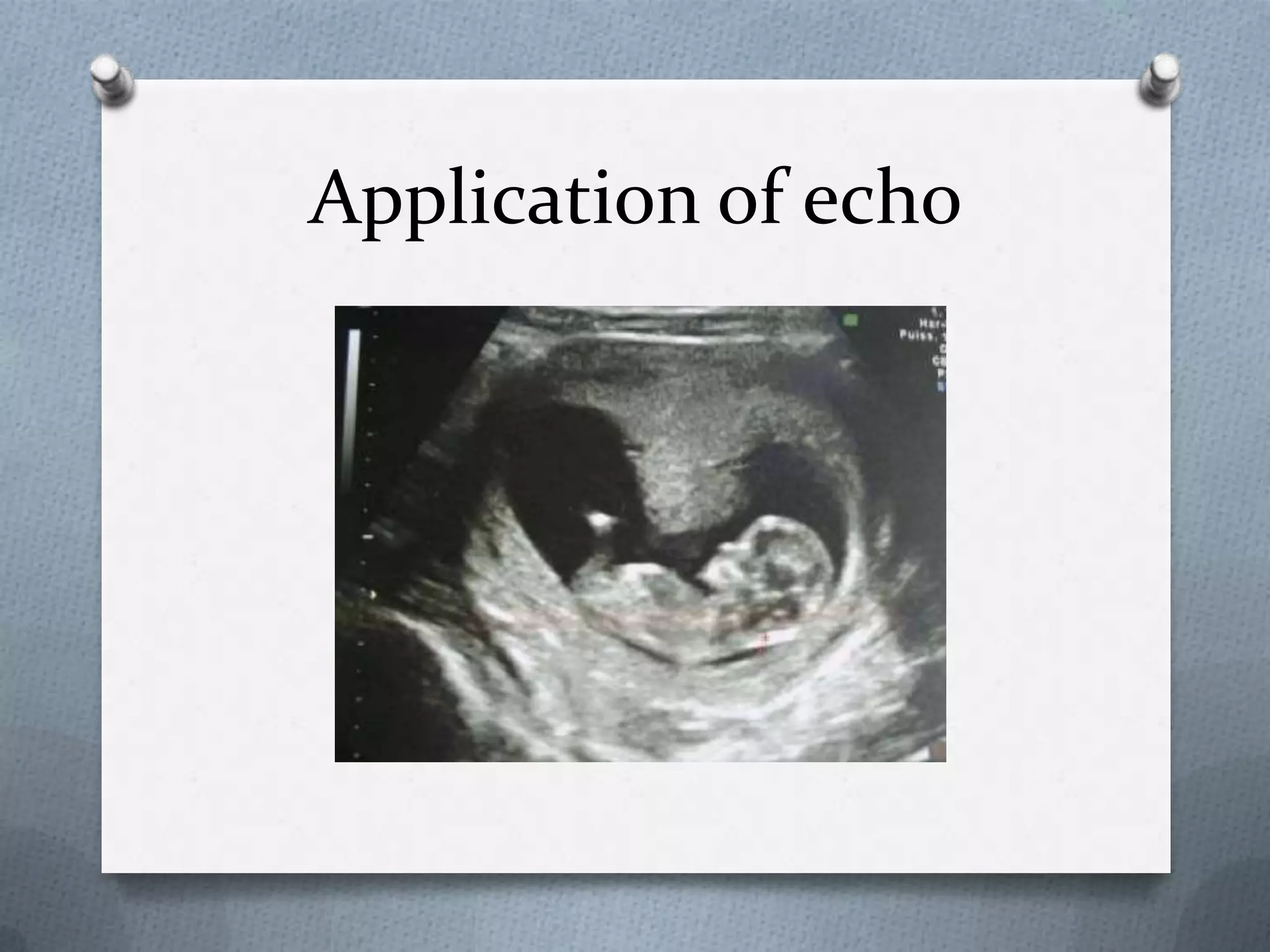
Application of echo
Use of Echo to determine distance
O A man stands at the end of a long wall
  and claps his hands. If he hears his echo
  after 2 seconds, what is the length of the
  hall? (Take the speed of sound in air to be
  300 m/s)
Use of Echo to determine distance
O A ship transmits a pulse of sound into the
  water and the receiver receives the
  reflection of the sound by a shoal of fish
  after 0.15 seconds. If the speed of sound
  in water is 1200 m/s, how far is the shoal
  of fish from the ship?
Slides sound-2012

Slides sound-2012

  • 1.
  • 2.
    Sound is… Watch thevideo and take down 3 key points about sound O http://www.youtube.com/watch?v=MFLeG JclQiI&feature=related
  • 3.
    Longitudinal Waves andguitar Watch the video and answer the questions: (1) How did the air layers get into vibration? (2)Did the air layers move with the sound wave? (3) How did the air particles move relative to the direction of the sound wave? O http://www.physicsclassroom.com/mmedia/waves/gsl.cf m O http://illuminations.nctm.org/ActivityDetail.aspx?ID=37
  • 4.
    Production and Propagation of Sound O Sound is produced by vibrating sources in a medium. O The source cause the air particles to vibrate and the sound wave will propagate outwards in the form of a longitudinal wave. O When air particles are pulled together, a region of compression is formed. When they are pushed apart, a region of rarefaction is formed.
  • 5.
    Bell Jar experiment Whatdoes the video tell you about how sound travel? O http://www.youtube.com/watch?v=ce7AMJ dq0Gw
  • 6.
    15.1 Sound Waves OCompressions and rarefactions propagate faster in denser medium High Speed of sound Low Solid Liquid Gas O Speed of sound in air is about 330 m/s in air, 1500 m/s in water, 5000 m/s in metal. Qn: Why does sound travel faster in solid than in gas? O Sound cannot travel in vacuum because there are no particles to transmit the vibration.
  • 7.
    Pitch of Sound OWatch the video and answer the questions below O (1) how does the pitch change when the frequency of the sound wave change? O (2) what is the maximum frequency you can detect? http://www.youtube.com/watch?v=4nUkNvl8mQw O Human audible frequency is between 20 Hz to 20 000 Hz (or 20 kHz)
  • 8.
    Pitch and Frequency O The higher the frequency of the sound wave, the higher the pitch of the sound.
  • 9.
    Loudness and Amplitude O The higher the amplitude of the sound wave, the louder the sound.
  • 10.
    A B C D Which sound or sounds has/have (a) the same pitch as A? (b) the same loudness as A? (c) the same pitch as B?
  • 11.
    Echo O Echo iscaused by the reflection of sound from a hard and flat surface like a wall or cliff. O Why can’t you hear the echo when you clap your hands next to a high wall?
  • 12.
  • 13.
    Use of Echoto determine distance O A man stands at the end of a long wall and claps his hands. If he hears his echo after 2 seconds, what is the length of the hall? (Take the speed of sound in air to be 300 m/s)
  • 14.
    Use of Echoto determine distance O A ship transmits a pulse of sound into the water and the receiver receives the reflection of the sound by a shoal of fish after 0.15 seconds. If the speed of sound in water is 1200 m/s, how far is the shoal of fish from the ship?