Downloaded 54 times
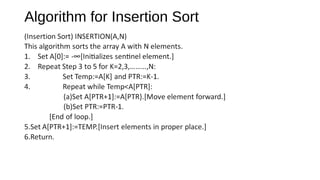
![Example: An array contain 8 elements as follows:
77,33,44,11,88,22,66,55
Table given below show illustration of the insertion algorithm . The marked elements
indicates the A[K] in each pass of the algorithm , and arrow indicates the proper place for
A[K].
PASS A[0] A[1] A[2] A[3] A[4] A[5] A[6] A[7]
K=1 77 33 44 11 88 22 66 55
K=2 77 33 44 11 88 22 66 55
K=3 33 77 44 11 88 22 66 55
K=4 11 44 77 11 88 22 66 55
K=5 11 33 44 77 88 22 66 55
K=6 11 33 44 77 88 22 66 55
K=7 11 22 33 44 77 88 66 55
K=8 11 22 33 44 66 77 88 55
SORTED 11 22 33 44 55 66 77 88](https://image.slidesharecdn.com/insertionsort-170708003201/85/Insertion-sort-4-320.jpg)
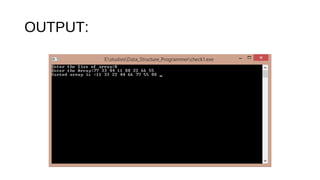
![Code showing insertion sort
implementation:
#include<stdio.h>
#include<conio.h>
int main()
{
int n;
printf("Enter the Size of array:");
scanf("%d",&n);
int i,arr[n],temp=0,j;
printf("Enter the Array:");
for(i=0;i<n;i++)
{ scanf("%d",&arr[i]);
for(j=1;j<=i;j++)
if(arr[j-1]>arr[j]&&j>0)
{
temp=arr[j-1];
arr[j-1]=arr[j];
arr[j]=temp;}
}
printf("Sorted array is :");
for(i=0;i<n;i++)
printf("%d ",arr[i]);
getch();
return 0;
}](https://image.slidesharecdn.com/insertionsort-170708003201/85/Insertion-sort-5-320.jpg)
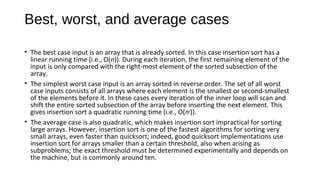
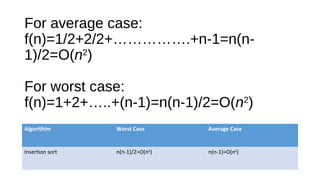

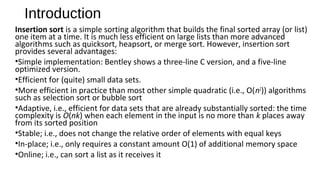
Insertion sort is a simple and adaptive sorting algorithm that builds a sorted array one element at a time, being efficient for small datasets and already sorted data. While it is less efficient for larger arrays when compared to advanced algorithms like quicksort, its implementation is straightforward and it retains element stability. The algorithm runs in linear time for best-case scenarios and quadratic time for worst and average cases, making it impractical for larger arrays but efficient for small subsets.


![Data Structures - Lecture 8 [Sorting Algorithms]](https://cdn.slidesharecdn.com/ss_thumbnails/lecture-8sortingalgorithms-150205105023-conversion-gate02-thumbnail.jpg?width=640&height=640&fit=bounds)


