Sore throat
Prepared By
Arpita Chandra
Medical Microbiology
Sore Throat
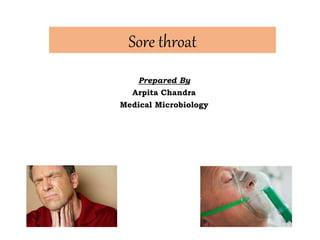
• Sore throat is essentially an acute tonsillitis and/or pharyngitis. It is
characterised by redness and oedema of mucosa, pseudo membrane
formation, and enlargement of cervical lymph nodes.
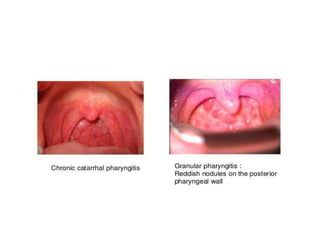
Pseudomembrane
Inflammation of tonsils
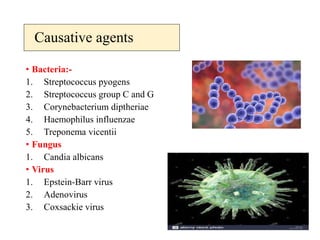
Causative agents
• Bacteria:-
1. Streptococcus pyogens
2. Streptococcus group C and G
3. Corynebacterium diptheriae
4. Haemophilus influenzae
5. Treponema vicentii
• Fungus
1. Candia albicans
• Virus
1. Epstein-Barr virus
2. Adenovirus
3. Coxsackie virus
Symptoms:-
Pain on swallowing Congested tonsils and pharynx Enlarged lymphnodes Pyrexia
• If untreated, streptococcal tonsillitis may give rise to complication such as
peritonsillar abscess, sinusitis or immune complex diseases (rheumatic fever,
glomerulonephritis)
Viral vs Bacterial Sore Throat
• The most common cause of a sore throat (pharyngitis) is a
viral infection, such as a cold or the flu. A sore throat caused
by a virus resolves on its own.
• Strep Throat (streptococcal infection- about 15%), less
common type of sore throat caused by bacteria, requires
treatment with antibiotics to prevent complications
Laboratory Diagnosis
• Specimen:-
Throat swab
• Collection:-
Two sterile Swabs should be used, one for direct microscopy and another
one for culture. These swabs should include exudate present in the throat.
• Direct microscopy:-
Gram staining and Albert staining may be used for staining the smears.
• Culture:-
Culture media are selected according to the organism suspected to be the
causative agent of sore throat.
Following media may be used for culture:-
-Blood agar
-Crystal violet blood agar
-loeffler’s serum slope
-Potassium tellurite blood agar
-Sabourd’s dextrose agar
• Identification:-
1. Colony Morphology
2. Gram Staining or Albert Staining
3. Other test for confirmation:
 For β-haemolytic streptococci
(a) Bacitracin sensitivity test for Str. Pyogens
(b) Lancefield grouping for all β-haemolytic streptococci
 For C.diptheriae
(a) Biochemical test
(b) Toxigenicity test
 Elek’s gel precipitation test
 Animal inoculation test
 For Candida albicans
(a) Germ tube test
(b) Carbohydrate fermentation assimilation test
• Antibiotic Sensitivity:-
All β-haemolytic group A Streptococci are sensitive to penicillin G, and
most are sensitive to erythromycin.
C.diptheriae is sensitive to penicillin
COVID-19
• If you have COVID, Its more common to have other symptoms in
addition to a sore throat.
“Only about 5-10% of COVID -19 patients will have an isolated
sore throat. Usually, they will have a touch of fever. Loss of taste
and smell and difficulty breathing.”
Thank
you

Sore Throat. ppt

  • 1.
    Sore throat Prepared By ArpitaChandra Medical Microbiology
  • 2.
    Sore Throat • Sorethroat is essentially an acute tonsillitis and/or pharyngitis. It is characterised by redness and oedema of mucosa, pseudo membrane formation, and enlargement of cervical lymph nodes. Pseudomembrane Inflammation of tonsils
  • 4.
    Causative agents • Bacteria:- 1.Streptococcus pyogens 2. Streptococcus group C and G 3. Corynebacterium diptheriae 4. Haemophilus influenzae 5. Treponema vicentii • Fungus 1. Candia albicans • Virus 1. Epstein-Barr virus 2. Adenovirus 3. Coxsackie virus
  • 5.
    Symptoms:- Pain on swallowingCongested tonsils and pharynx Enlarged lymphnodes Pyrexia • If untreated, streptococcal tonsillitis may give rise to complication such as peritonsillar abscess, sinusitis or immune complex diseases (rheumatic fever, glomerulonephritis)
  • 6.
    Viral vs BacterialSore Throat • The most common cause of a sore throat (pharyngitis) is a viral infection, such as a cold or the flu. A sore throat caused by a virus resolves on its own. • Strep Throat (streptococcal infection- about 15%), less common type of sore throat caused by bacteria, requires treatment with antibiotics to prevent complications
  • 7.
    Laboratory Diagnosis • Specimen:- Throatswab • Collection:- Two sterile Swabs should be used, one for direct microscopy and another one for culture. These swabs should include exudate present in the throat. • Direct microscopy:- Gram staining and Albert staining may be used for staining the smears.
  • 8.
    • Culture:- Culture mediaare selected according to the organism suspected to be the causative agent of sore throat. Following media may be used for culture:- -Blood agar -Crystal violet blood agar -loeffler’s serum slope -Potassium tellurite blood agar -Sabourd’s dextrose agar
  • 10.
    • Identification:- 1. ColonyMorphology 2. Gram Staining or Albert Staining 3. Other test for confirmation:  For β-haemolytic streptococci (a) Bacitracin sensitivity test for Str. Pyogens (b) Lancefield grouping for all β-haemolytic streptococci  For C.diptheriae (a) Biochemical test (b) Toxigenicity test  Elek’s gel precipitation test  Animal inoculation test
  • 11.
     For Candidaalbicans (a) Germ tube test (b) Carbohydrate fermentation assimilation test • Antibiotic Sensitivity:- All β-haemolytic group A Streptococci are sensitive to penicillin G, and most are sensitive to erythromycin. C.diptheriae is sensitive to penicillin
  • 12.
    COVID-19 • If youhave COVID, Its more common to have other symptoms in addition to a sore throat. “Only about 5-10% of COVID -19 patients will have an isolated sore throat. Usually, they will have a touch of fever. Loss of taste and smell and difficulty breathing.”
  • 13.