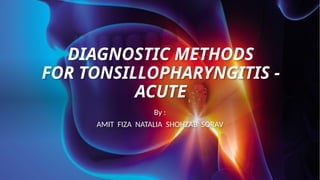
DIAGNOSTIC METHODS
FOR TONSILLOPHARYNGITIS -
ACUTE
By :
AMIT FIZA NATALIA SHOHZAB SORAV
TONSILLOPHARYNGITIS
• Tonsillopharyngitis is the acute infection of the pharynx,
palatine tonsils, or both
• Also called strep throat, acute tonsillitis, pharyngitis or
adenotonsillitis.
• One of the most common diseases seen in primary care
Etiology
• Viral
• Main cause of acute tonsillopharyngitis
• Double-stranded DNA viruses (human adenovirus,
Epstein-Barr virus), single-stranded RNA viruses
(influenza, para-influenza, rhinovirus, enteroviruses,
Coxsackie virus, coronaviruses, respiratory syncytial virus
[RSV], human meta-pneumo-virus), and retroviruses
(human immunodeficiency virus [HIV]) are among the
viral causes
• Bacterial
• Responsible for about 5-15% of clinic consultations for
acute sore throat in adults
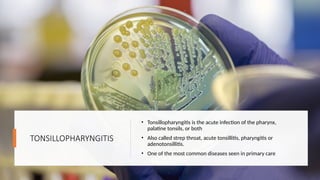
• Most commonly caused by Gram-positive cocci known
as S pyogenes
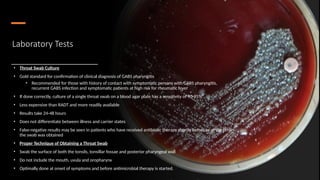
• This organism exhibits beta-hemolysis on blood
agar plates
• Belongs to group A Lancefield classification system
for beta-hemolytic strep infection
• Other bacterial causes include group C and
G Streptococci, Hemophilus
influenzae, Nocardia, Corynebacteria and Neisseria
gonorrhoeae
Mode of
Transmission
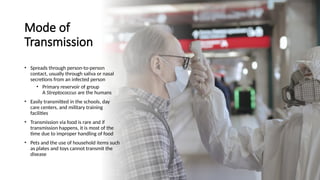
• Spreads through person-to-person
contact, usually through saliva or nasal
secretions from an infected person
• Primary reservoir of group
A Streptococcus are the humans
• Easily transmitted in the schools, day
care centers, and military training
facilities
• Transmission via food is rare and if
transmission happens, it is most of the
time due to improper handling of food
• Pets and the use of household items such
as plates and toys cannot transmit the
disease
Signs Symptoms
• Absence of fever
• Conjunctivitis
• Coryza
• Cough
• Diarrhea
• Hoarseness
• Malaise or fatigue
• Rhinorrhea
• Tonsillar swelling/exudates
• Tender anterior cervical lymphadenopathy
• Absence of cough
• Fever >38°C
Risk Factors
• Commonly infects children aged 5-15
years old and rare in <3 years old;
parents of school-aged children and
other adults who are in close contact
with the infected individual
• Crowded places like day care centers,
schools and military barracks
Diagnosis
• GABS Pharyngitis Testing
• Clinical presentation of GABS and viral pharyngitis
greatly overlap
• Patients who have clinical and epidemiological findings
suggestive of GABS pharyngitis should be tested for the
presence of group A Streptococci in the pharynx
• Diagnostic testing of contacts of infected patients is not
routinely recommended
Differential Diagnosis
• Retropharyngeal abscess
• Epiglottitis
• Ludwig angina
• Lemierre’s syndrome
• Kawasaki disease
• Coxsackie virus
• Primary HIV
• Epstein-Barr virus/infectious mononucleosis
• Oral candidiasis
• Coronavirus disease 2019 (COVID-19)
• Dengue
• Influenza
Conditions Where Lab Tests for GABS are Not
Available or Not Practical
Antibiotics will not be needed for every patient that presents with sore throat
Antibiotics should not be withheld if the clinical condition is severe or GABS is suspected
Modified Centor score or FeverPAIN can be used to decide
on which patients need no testing, lab tests (throat swab or
rapid antigen detection test [RADT]) or empiric antibiotic
therapy
Score of 0 to 1 does not require testing or antibiotic therapy
Patients with score of 2 or 3 require testing, positive results warrant
empiric therapy
Score of ≥4 is at high risk of GABS and empiric therapy is considered
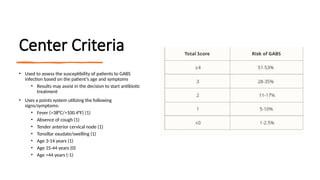
Center Criteria
• Used to assess the susceptibility of patients to GABS
infection based on the patient’s age and symptoms
• Results may assist in the decision to start antibiotic
treatment
• Uses a points system utilizing the following
signs/symptoms:
• Fever (>38°C/>100.4°F) (1)
• Absence of cough (1)
• Tender anterior cervical node (1)
• Tonsillar exudate/swelling (1)
• Age 3-14 years (1)
• Age 15-44 years (0)
• Age >44 years (-1)
Laboratory Tests
• Throat Swab Culture
• Gold standard for confirmation of clinical diagnosis of GABS pharyngitis
• Recommended for those with history of contact with symptomatic persons with GABS pharyngitis,
recurrent GABS infection and symptomatic patients at high risk for rheumatic fever
• If done correctly, culture of a single throat swab on a blood agar plate has a sensitivity of 90-95%
• Less expensive than RADT and more readily available
• Results take 24-48 hours
• Does not differentiate between illness and carrier states
• False-negative results may be seen in patients who have received antibiotic therapy shortly before or at the time
the swab was obtained
• Proper Technique of Obtaining a Throat Swab
• Swab the surface of both the tonsils, tonsillar fossae and posterior pharyngeal wall
• Do not include the mouth, uvula and oropharynx
• Optimally done at onset of symptoms and before antimicrobial therapy is started.
Rapid Antigen Detection
Test (RADT)
• Developed for the identification of GABS directly from throat swabs
• May be considered in patients with modified Center criteria scores ≥3 or when 2 viral features
(e.g. fever, tonsillar exudate/swelling, swollen anterior cervical nodes, absence of cough) are
present
• More expensive than throat swab cultures, but results are available faster (within minutes)
• With sensitivity of 80-90% and specificity of 90-99%
• Does not differentiate between illness and carrier states
• A rapid test can lead to earlier initiation of definitive therapy with the following advantages:
• Reduced risk of spread of GABS
• Reduced acute morbidity associated with illness
• Earlier return of patient to work or school
• A negative RADT result for an adult patient does not need to be confirmed with a throat culture
because of the low incidence of streptococcal infection and low risk of rheumatic fever in this age
group.
Principles of Therapy
- Pharmacotherapy
Symptomatic Therapy
• Maintain adequate fluid intake
• Warm salt water
• Soft foods
• Warm liquids (eg soup)
• Throat lozenges/sprays
Antipyretics and Analgesics
• Patient may take Paracetamol for relief of fever and/or pain
• Paracetamol is the drug of choice for analgesia in sore throat
 Nonsteroidal Anti-inflammatory Drugs (NSAIDs)
• Systemic NSAIDs (e.g. Ibuprofen, Diclofenac) are safe and effective alternatives
for analgesia and antipyrexia
• Diclofenac may also be used for pain caused by acute tonsillopharyngitis
• NSAIDs in the form of lozenges and throat sprays are available (e.g.
Flurbiprofen, Benzylamines)
• As systemic NSAIDs are associated with significant risk of gastrointestinal
bleeding, their routine use is not recommended
Mouth/Throat Preparations
• May provide symptomatic relief of throat pain
• Antiseptic/antibacterial preparations may be used to prevent viral and bacterial
infection
• Further studies are needed to prove the efficacy of mouth/throat preparations
in tonsillopharyngitis.
• Antibiotic Therapy - Indicated only if with high suspicion of or clinically proven GABS infection
Penicillin
• Drug of choice due to its proven efficacy, safety, low cost, appropriately narrow spectrum of activity and very low rates of
resistance of GABS to Penicillin
• Amoxicillin, Ampicillin, or Amoxicillin/Clavulanic Acid
• Efficacy appears to be equal to that of Penicillin
• Spectrum is relatively narrow, cost is also low
• The suspension form is considerably more palatable than Penicillin V suspension
• Aminopenicillins should be avoided if mononucleosis is suspected since a macular rash may develop
• Clindamycin
• Used in rare patients with Penicillin allergy and an Erythromycin-resistant strain of Streptococcus sp
• Macrolides
• Macrolide resistance may be an issue depending on local resistance patterns
• Erythromycin
• Suitable alternative for patients with Penicillin allergy
• Azithromycin, Clarithromycin, Roxithromycin
• Offers no microbiologic advantage over Erythromycin, but may be better tolerated
• Both may be used in patients allergic to penicillins
• Azithromycin has a higher concentration in pharyngeal tissue
This Photo by Unknown author is licensed under CC BY.
Duration of Therapy
• A patient should receive an antimicrobial
agent at a dose and for a duration that is
likely to eradicate the infecting organism
from the pharynx
• 10 days of antibiotic therapy is
recommended to achieve maximal rates of
pharyngeal Streptococcus sp eradication
• Some antibiotics will achieve eradication
in <10 days (eg Azithromycin)
Patient Education
• If common respiratory virus is thought to be the likely cause, then provide educational material about non-streptococcal causes of sore
throats and home remedies that the patient may use
• Patient should be instructed to follow up if the symptoms worsen or if they persist beyond 5-7 days
• Advise patient to eliminate close contact with other people to minimize transmission of the disease
• Patients are infectious 2-5 days before symptom onset, during the illness, and for a week after if untreated
• If GABS is Suspected or Confirmed
• Instruct the patient to remain at home until at least 24 hours of antimicrobial therapy has been received to minimize transmission of disease
• Emphasize the importance of adhering to the prescribed medication regimen
• Hygiene
• Washing of the hands especially after coughing or sneezing and before preparing or eating the food prevents other people from getting
infected with group A Streptococcus
• Other practices of good hygiene:
• Masking
• Cover the nose and mouth with tissue while coughing or sneezing
• Proper disposal of the used tissue in a waste basket
• If there is no tissue, use the upper sleeve of the cloth or the elbow while coughing or sneezing
• Wash hands with soap and water for at least 20 seconds
• If soap is not available, use an alcohol-based hand rub instead.
THANK YOU !!

DIAGNOSTIC METHODS FOR TONSILLOPHARYNGITIS - ACUTE.pptx

  • 1.
    DIAGNOSTIC METHODS FOR TONSILLOPHARYNGITIS- ACUTE By : AMIT FIZA NATALIA SHOHZAB SORAV
  • 2.
    TONSILLOPHARYNGITIS • Tonsillopharyngitis isthe acute infection of the pharynx, palatine tonsils, or both • Also called strep throat, acute tonsillitis, pharyngitis or adenotonsillitis. • One of the most common diseases seen in primary care
  • 3.
    Etiology • Viral • Maincause of acute tonsillopharyngitis • Double-stranded DNA viruses (human adenovirus, Epstein-Barr virus), single-stranded RNA viruses (influenza, para-influenza, rhinovirus, enteroviruses, Coxsackie virus, coronaviruses, respiratory syncytial virus [RSV], human meta-pneumo-virus), and retroviruses (human immunodeficiency virus [HIV]) are among the viral causes • Bacterial • Responsible for about 5-15% of clinic consultations for acute sore throat in adults • Most commonly caused by Gram-positive cocci known as S pyogenes • This organism exhibits beta-hemolysis on blood agar plates • Belongs to group A Lancefield classification system for beta-hemolytic strep infection • Other bacterial causes include group C and G Streptococci, Hemophilus influenzae, Nocardia, Corynebacteria and Neisseria gonorrhoeae
  • 4.
    Mode of Transmission • Spreadsthrough person-to-person contact, usually through saliva or nasal secretions from an infected person • Primary reservoir of group A Streptococcus are the humans • Easily transmitted in the schools, day care centers, and military training facilities • Transmission via food is rare and if transmission happens, it is most of the time due to improper handling of food • Pets and the use of household items such as plates and toys cannot transmit the disease
  • 5.
    Signs Symptoms • Absenceof fever • Conjunctivitis • Coryza • Cough • Diarrhea • Hoarseness • Malaise or fatigue • Rhinorrhea • Tonsillar swelling/exudates • Tender anterior cervical lymphadenopathy • Absence of cough • Fever >38°C
  • 6.
    Risk Factors • Commonlyinfects children aged 5-15 years old and rare in <3 years old; parents of school-aged children and other adults who are in close contact with the infected individual • Crowded places like day care centers, schools and military barracks
  • 7.
    Diagnosis • GABS PharyngitisTesting • Clinical presentation of GABS and viral pharyngitis greatly overlap • Patients who have clinical and epidemiological findings suggestive of GABS pharyngitis should be tested for the presence of group A Streptococci in the pharynx • Diagnostic testing of contacts of infected patients is not routinely recommended
  • 8.
    Differential Diagnosis • Retropharyngealabscess • Epiglottitis • Ludwig angina • Lemierre’s syndrome • Kawasaki disease • Coxsackie virus • Primary HIV • Epstein-Barr virus/infectious mononucleosis • Oral candidiasis • Coronavirus disease 2019 (COVID-19) • Dengue • Influenza
  • 9.
    Conditions Where LabTests for GABS are Not Available or Not Practical Antibiotics will not be needed for every patient that presents with sore throat Antibiotics should not be withheld if the clinical condition is severe or GABS is suspected Modified Centor score or FeverPAIN can be used to decide on which patients need no testing, lab tests (throat swab or rapid antigen detection test [RADT]) or empiric antibiotic therapy Score of 0 to 1 does not require testing or antibiotic therapy Patients with score of 2 or 3 require testing, positive results warrant empiric therapy Score of ≥4 is at high risk of GABS and empiric therapy is considered
  • 10.
    Center Criteria • Usedto assess the susceptibility of patients to GABS infection based on the patient’s age and symptoms • Results may assist in the decision to start antibiotic treatment • Uses a points system utilizing the following signs/symptoms: • Fever (>38°C/>100.4°F) (1) • Absence of cough (1) • Tender anterior cervical node (1) • Tonsillar exudate/swelling (1) • Age 3-14 years (1) • Age 15-44 years (0) • Age >44 years (-1)
  • 11.
    Laboratory Tests • ThroatSwab Culture • Gold standard for confirmation of clinical diagnosis of GABS pharyngitis • Recommended for those with history of contact with symptomatic persons with GABS pharyngitis, recurrent GABS infection and symptomatic patients at high risk for rheumatic fever • If done correctly, culture of a single throat swab on a blood agar plate has a sensitivity of 90-95% • Less expensive than RADT and more readily available • Results take 24-48 hours • Does not differentiate between illness and carrier states • False-negative results may be seen in patients who have received antibiotic therapy shortly before or at the time the swab was obtained • Proper Technique of Obtaining a Throat Swab • Swab the surface of both the tonsils, tonsillar fossae and posterior pharyngeal wall • Do not include the mouth, uvula and oropharynx • Optimally done at onset of symptoms and before antimicrobial therapy is started.
  • 12.
    Rapid Antigen Detection Test(RADT) • Developed for the identification of GABS directly from throat swabs • May be considered in patients with modified Center criteria scores ≥3 or when 2 viral features (e.g. fever, tonsillar exudate/swelling, swollen anterior cervical nodes, absence of cough) are present • More expensive than throat swab cultures, but results are available faster (within minutes) • With sensitivity of 80-90% and specificity of 90-99% • Does not differentiate between illness and carrier states • A rapid test can lead to earlier initiation of definitive therapy with the following advantages: • Reduced risk of spread of GABS • Reduced acute morbidity associated with illness • Earlier return of patient to work or school • A negative RADT result for an adult patient does not need to be confirmed with a throat culture because of the low incidence of streptococcal infection and low risk of rheumatic fever in this age group.
  • 13.
    Principles of Therapy -Pharmacotherapy Symptomatic Therapy • Maintain adequate fluid intake • Warm salt water • Soft foods • Warm liquids (eg soup) • Throat lozenges/sprays Antipyretics and Analgesics • Patient may take Paracetamol for relief of fever and/or pain • Paracetamol is the drug of choice for analgesia in sore throat  Nonsteroidal Anti-inflammatory Drugs (NSAIDs) • Systemic NSAIDs (e.g. Ibuprofen, Diclofenac) are safe and effective alternatives for analgesia and antipyrexia • Diclofenac may also be used for pain caused by acute tonsillopharyngitis • NSAIDs in the form of lozenges and throat sprays are available (e.g. Flurbiprofen, Benzylamines) • As systemic NSAIDs are associated with significant risk of gastrointestinal bleeding, their routine use is not recommended Mouth/Throat Preparations • May provide symptomatic relief of throat pain • Antiseptic/antibacterial preparations may be used to prevent viral and bacterial infection • Further studies are needed to prove the efficacy of mouth/throat preparations in tonsillopharyngitis.
  • 14.
    • Antibiotic Therapy- Indicated only if with high suspicion of or clinically proven GABS infection Penicillin • Drug of choice due to its proven efficacy, safety, low cost, appropriately narrow spectrum of activity and very low rates of resistance of GABS to Penicillin • Amoxicillin, Ampicillin, or Amoxicillin/Clavulanic Acid • Efficacy appears to be equal to that of Penicillin • Spectrum is relatively narrow, cost is also low • The suspension form is considerably more palatable than Penicillin V suspension • Aminopenicillins should be avoided if mononucleosis is suspected since a macular rash may develop • Clindamycin • Used in rare patients with Penicillin allergy and an Erythromycin-resistant strain of Streptococcus sp • Macrolides • Macrolide resistance may be an issue depending on local resistance patterns • Erythromycin • Suitable alternative for patients with Penicillin allergy • Azithromycin, Clarithromycin, Roxithromycin • Offers no microbiologic advantage over Erythromycin, but may be better tolerated • Both may be used in patients allergic to penicillins • Azithromycin has a higher concentration in pharyngeal tissue This Photo by Unknown author is licensed under CC BY.
  • 15.
    Duration of Therapy •A patient should receive an antimicrobial agent at a dose and for a duration that is likely to eradicate the infecting organism from the pharynx • 10 days of antibiotic therapy is recommended to achieve maximal rates of pharyngeal Streptococcus sp eradication • Some antibiotics will achieve eradication in <10 days (eg Azithromycin)
  • 16.
    Patient Education • Ifcommon respiratory virus is thought to be the likely cause, then provide educational material about non-streptococcal causes of sore throats and home remedies that the patient may use • Patient should be instructed to follow up if the symptoms worsen or if they persist beyond 5-7 days • Advise patient to eliminate close contact with other people to minimize transmission of the disease • Patients are infectious 2-5 days before symptom onset, during the illness, and for a week after if untreated • If GABS is Suspected or Confirmed • Instruct the patient to remain at home until at least 24 hours of antimicrobial therapy has been received to minimize transmission of disease • Emphasize the importance of adhering to the prescribed medication regimen • Hygiene • Washing of the hands especially after coughing or sneezing and before preparing or eating the food prevents other people from getting infected with group A Streptococcus • Other practices of good hygiene: • Masking • Cover the nose and mouth with tissue while coughing or sneezing • Proper disposal of the used tissue in a waste basket • If there is no tissue, use the upper sleeve of the cloth or the elbow while coughing or sneezing • Wash hands with soap and water for at least 20 seconds • If soap is not available, use an alcohol-based hand rub instead.
  • 17.