SORE THROAT
Dr. Amiri
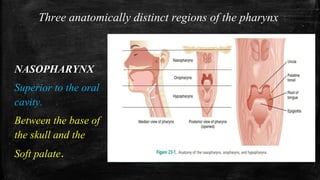
Three anatomically distinct regions of the pharynx
NASOPHARYNX
Superior to the oral
cavity.
Between the base of
the skull and the
Soft palate.
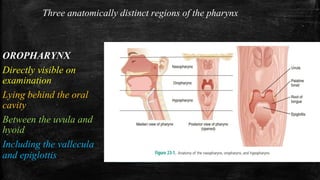
Three anatomically distinct regions of the pharynx
OROPHARYNX
Directly visible on
examination
Lying behind the oral
cavity
Between the uvula and
hyoid
Including the vallecula
and epiglottis
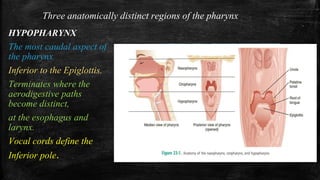
Three anatomically distinct regions of the pharynx
HYPOPHARYNX
The most caudal aspect of
the pharynx
Inferior to the Epiglottis.
Terminates where the
aerodigestive paths
become distinct,
at the esophagus and
larynx.
Vocal cords define the
Inferior pole.
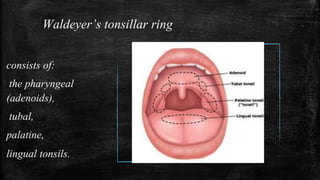
Waldeyer’s tonsillar ring
consists of:
the pharyngeal
(adenoids),
tubal,
palatine,
lingual tonsils.
DIAGNOSTIC APPROACH
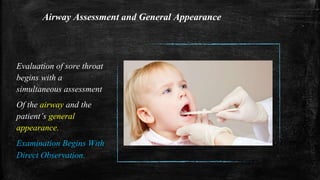
Airway Assessment and General Appearance
Evaluation of sore throat
begins with a
simultaneous assessment
Of the airway and the
patient’s general
appearance.
Examination Begins With
Direct Observation.
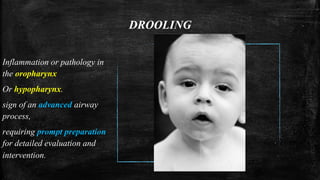
DROOLING
Inflammation or pathology in
the oropharynx
Or hypopharynx.
sign of an advanced airway
process,
requiring prompt preparation
for detailed evaluation and
intervention.
MUFFLED VOICE
Prompts consideration of a
supraglottic threat to airway patency.
The floor of the mouth should be visualized
, and the submental region palpated as
“brawny” induration or tenderness in this area is classically associated
with Ludwig’s angina.
Stridor
High-pitched noise heard on inspiration
indicates a process involving the glottis or infraglottic structures.
Stridor indicates a true airway emergency,
except when occurring in young children (<10 years old) with croup
Stridor is associated with ominous conditions such as:
Epiglottitis, Retropharyngeal Abscess, and Angioedema
General Appearance
Patients, particularly children, with
significant pain
from uncomplicated pharyngitis
often have difficulty
with oral intake and may become
dehydrated.
A prolonged fever (greater than 5-7
days)
in children may be associated with
Kawasaki disease.
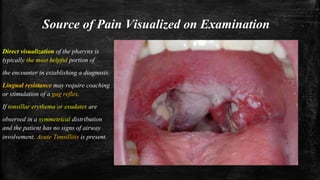
Source of Pain Visualized on Examination
Direct visualization of the pharynx is
typically the most helpful portion of
the encounter in establishing a diagnosis.
Lingual resistance may require coaching
or stimulation of a gag reflex.
If tonsillar erythema or exudates are
observed in a symmetrical distribution
and the patient has no signs of airway
involvement, Acute Tonsillitis is present.
Viral versus Bacterial Pharyngitis
Centor Criteria System
incorporate components of the history and physical examination
to generate an estimate of group A streptococcus (GAS) infection.
FEVER,
TENDER ANTERIOR CERVICAL ADENOPATHY,
TONSILLAR EXUDATES
ABSENCE OF COUGH
Viral versus Bacterial Pharyngitis
Modified Centor Score
(If Age Was Greater Than 45 Years, 1 Point Subtracted)
prevalence of GAS was
1% with a score of −1 to 0,
10% with a score of 1,
17% with a score of 2,
35% with a score of 3,
and 51% when the score was 4 or more.
Viral versus Bacterial Pharyngitis
The Distinction Between
Viral And Bacterial Disease Is, However, Largely Academic.
With Increasing Emphasis On Symptomatic Relief
And Decreasing Emphasis On Eradication Of The Infecting Agent,
Treatment, Prognosis, And Follow-up Are
Virtually Identical Regardless Of Microbiologic Cause
Special Considerations on History
Patients with human immunodeficiency virus (HIV)
are at risk for oral candidiasis or thrush.
In addition, primary HIV infection can manifest with
upper respiratory infection (URI)–like symptoms,
including acute pharyngitisin up to 75% of cases
Special Considerations on History
Angiotensin-converting
enzyme inhibitors
predispose patients to
Angioedema, and although
the lips and face
are often visibly edematous,
the process can be
limited to the tongue,
oropharynx, or hypopharynx.
Special Considerations on History
Dental procedures,
particularly
involving the lower third
molars , can be
complicated
by postoperative infections,
the most potentially serious
of which is Ludwig’s
angina.
Special Considerations on History
Pharyngitis in teenagers or young adults
with significant cervical lymphadenopathy and fatigue
suggests Infectious Mononucleosis caused by
the Epstein-Barr virus.
Ancillary Testing
Laboratory testing is of very limited use in the context of acute pharyngitis.
Treatment of proven GAS pharyngitis with antibiotics
confers only a modest reduction in the duration of symptoms,
and most western nations have abandoned this approach
because the inaccuracy and risks of testing and treatment for GAS
seem to outweigh the benefits in industrialized settings where
rheumatic fever tends to be exceedingly rare.
Ancillary Testing
Heterophile antibody testing for Mononucleosis may be considered
in patients with an extended clinical course or treatment failure;
however, confirmation of this disease is important only to
exclude “treatable” causes of pharyngitis and to ensure appropriate
advice regarding contagion, limitations of activity, and so on.
Imaging
Although radiographic imaging has long been recommended for
evaluation of the epiglottis and structures in the hypopharynx,
Direct Visualization of the structures of interest by examination is
preferable, providing:
definitive diagnosis,
assessment of the extent of the threat to the airway,
and the ability to either plan for or perform intubation.
Imaging
In adults with possible epiglottitis, particularly those with
severe symptoms such as Drooling, Distress, or Muffled voice,
examination via Nasopharyngoscopy at the bedside
or via in the operating room setting
is the best approach.
Examination of this sort, however, should occur under a “Double Setup,”
with availability of and preparation for an emergent rescue airway,
usually Cricothyrotomy
.
Imaging
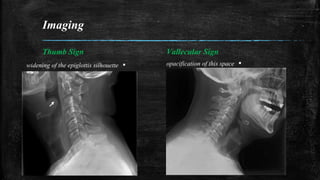
plain film radiography can be used for screening purposes.
Findings on plain film suggestive of Epiglottitis include
the “Thumb Sign” (widening of the epiglottis silhouette)
and the “Vallecular Sign” (opacification of this space).
Imaging
Thumb Sign
▪widening of the epiglottis silhouette
Vallecular Sign
▪opacification of this space
Imaging
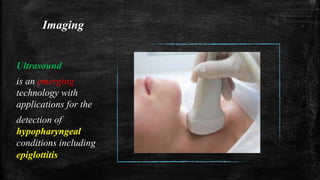
Ultrasound
is an emerging
technology with
applications for the
detection of
hypopharyngeal
conditions including
epiglottitis
Imaging
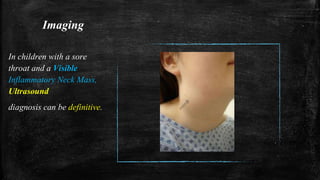
In children with a sore
throat and a Visible
Inflammatory Neck Mass,
Ultrasound
diagnosis can be definitive.
Imaging
In a child or adult with signs and symptoms of
a Deep Neck Infection, such as Retropharyngeal Abscess
the most useful imaging modality is
Computed Tomography of the neck.
CT IS THE DEFINITIVE EVALUATION FOR DEEP NECK INFECTION.
in lower-risk patients a normal film
(no widening of the prevertebral space, normal lordotic curve of the spine, and
absence of soft tissue air)
can be a useful risk stratification tool.
EMPIRICAL MANAGEMENT
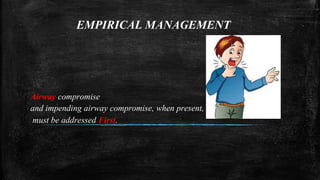
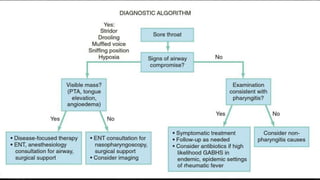
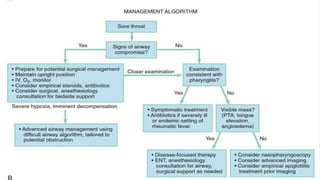
Airway compromise
and impending airway compromise, when present,
must be addressed First.
EMPIRICAL MANAGEMENT
PAIN MANAGEMENT with Acetaminophen or
Nonsteroidal Anti-inflammatory Drugs (NSAIDs) is the mainstay
of care and the Most Important initial step in empirical management.
Regimented administration of these agents, rather than
use of As-needed approaches.
Antibiotics have not been shown to be
superior to NSAIDs for symptom reduction and therefore should
not be used for this purpose.
EMPIRICAL MANAGEMENT
CORTICOSTEROID therapy reduces pain and duration of pain,
0.6 mg/kg (maximum dose 10 mg) of DEXAMETHASONE, orally or parenterally,
in a single dose.
OPIOID
is appropriate in select cases of more severe pain,
but the consideration of opioid analgesia may also indicate
a more severe syndrome requiring additional evaluation.
EMPIRICAL MANAGEMENT
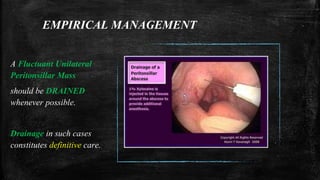
A Fluctuant Unilateral
Peritonsillar Mass
should be DRAINED
whenever possible.
Drainage in such cases
constitutes definitive care.
EMPIRICAL MANAGEMENT
ANTIBIOTICS often are used in cases of
unilateral swelling and redness that appears
not to be fluctuant (i.e., “Peritonsillar Cellulitis”)
For patients with manifestations of Severe, Systemic illness
(i.e., those requiring hospitalization or those with impending airway
compromise),
ANTIBIOTIC coverage for streptococcal and anaerobic
bacteria may theoretically be helpful, and therefore we recommend
antibiotic administration in this setting.
EMPIRICAL MANAGEMENT
Acute pharyngitis should not typically be treated with Antibiotics.
The great majority of cases are viral in origin,
and suppurative complications following streptococcal infection
are both easily treated and too rare
to justify routine use of antibiotics.
Antibiotics should therefore be used
to prevent rheumatic fever and other nonsuppurative complications
only in endemic and epidemic settings.
EMPIRICAL MANAGEMENT
It is important to note that adverse events caused by antibiotics are common.
Thus for both public health reasons
and the prevention of unnecessary harm to individual patients,
Antibiotics should be avoided in the management of
this common, mostly self-limited condition.
Education Of Patients :
(1) the self-limited nature of infectious pharyngitis,
(2) the lack of symptomatic benefit with antibiotics,
(3) the potential harm of antibiotics (individual and population resistance ,
fungal infections in women, rashes, gastrointestinal effects,
recurrence of pharyngitis, and occasionally dangerousallergic reactions).
Sore throat
Sore throat
Sore throat

Sore throat

  • 2.
  • 3.
    Three anatomically distinctregions of the pharynx NASOPHARYNX Superior to the oral cavity. Between the base of the skull and the Soft palate.
  • 4.
    Three anatomically distinctregions of the pharynx OROPHARYNX Directly visible on examination Lying behind the oral cavity Between the uvula and hyoid Including the vallecula and epiglottis
  • 5.
    Three anatomically distinctregions of the pharynx HYPOPHARYNX The most caudal aspect of the pharynx Inferior to the Epiglottis. Terminates where the aerodigestive paths become distinct, at the esophagus and larynx. Vocal cords define the Inferior pole.
  • 6.
    Waldeyer’s tonsillar ring consistsof: the pharyngeal (adenoids), tubal, palatine, lingual tonsils.
  • 7.
  • 8.
    Airway Assessment andGeneral Appearance Evaluation of sore throat begins with a simultaneous assessment Of the airway and the patient’s general appearance. Examination Begins With Direct Observation.
  • 9.
    DROOLING Inflammation or pathologyin the oropharynx Or hypopharynx. sign of an advanced airway process, requiring prompt preparation for detailed evaluation and intervention.
  • 10.
    MUFFLED VOICE Prompts considerationof a supraglottic threat to airway patency. The floor of the mouth should be visualized , and the submental region palpated as “brawny” induration or tenderness in this area is classically associated with Ludwig’s angina.
  • 11.
    Stridor High-pitched noise heardon inspiration indicates a process involving the glottis or infraglottic structures. Stridor indicates a true airway emergency, except when occurring in young children (<10 years old) with croup Stridor is associated with ominous conditions such as: Epiglottitis, Retropharyngeal Abscess, and Angioedema
  • 12.
    General Appearance Patients, particularlychildren, with significant pain from uncomplicated pharyngitis often have difficulty with oral intake and may become dehydrated. A prolonged fever (greater than 5-7 days) in children may be associated with Kawasaki disease.
  • 13.
    Source of PainVisualized on Examination Direct visualization of the pharynx is typically the most helpful portion of the encounter in establishing a diagnosis. Lingual resistance may require coaching or stimulation of a gag reflex. If tonsillar erythema or exudates are observed in a symmetrical distribution and the patient has no signs of airway involvement, Acute Tonsillitis is present.
  • 14.
    Viral versus BacterialPharyngitis Centor Criteria System incorporate components of the history and physical examination to generate an estimate of group A streptococcus (GAS) infection. FEVER, TENDER ANTERIOR CERVICAL ADENOPATHY, TONSILLAR EXUDATES ABSENCE OF COUGH
  • 15.
    Viral versus BacterialPharyngitis Modified Centor Score (If Age Was Greater Than 45 Years, 1 Point Subtracted) prevalence of GAS was 1% with a score of −1 to 0, 10% with a score of 1, 17% with a score of 2, 35% with a score of 3, and 51% when the score was 4 or more.
  • 16.
    Viral versus BacterialPharyngitis The Distinction Between Viral And Bacterial Disease Is, However, Largely Academic. With Increasing Emphasis On Symptomatic Relief And Decreasing Emphasis On Eradication Of The Infecting Agent, Treatment, Prognosis, And Follow-up Are Virtually Identical Regardless Of Microbiologic Cause
  • 17.
    Special Considerations onHistory Patients with human immunodeficiency virus (HIV) are at risk for oral candidiasis or thrush. In addition, primary HIV infection can manifest with upper respiratory infection (URI)–like symptoms, including acute pharyngitisin up to 75% of cases
  • 18.
    Special Considerations onHistory Angiotensin-converting enzyme inhibitors predispose patients to Angioedema, and although the lips and face are often visibly edematous, the process can be limited to the tongue, oropharynx, or hypopharynx.
  • 19.
    Special Considerations onHistory Dental procedures, particularly involving the lower third molars , can be complicated by postoperative infections, the most potentially serious of which is Ludwig’s angina.
  • 20.
    Special Considerations onHistory Pharyngitis in teenagers or young adults with significant cervical lymphadenopathy and fatigue suggests Infectious Mononucleosis caused by the Epstein-Barr virus.
  • 21.
    Ancillary Testing Laboratory testingis of very limited use in the context of acute pharyngitis. Treatment of proven GAS pharyngitis with antibiotics confers only a modest reduction in the duration of symptoms, and most western nations have abandoned this approach because the inaccuracy and risks of testing and treatment for GAS seem to outweigh the benefits in industrialized settings where rheumatic fever tends to be exceedingly rare.
  • 22.
    Ancillary Testing Heterophile antibodytesting for Mononucleosis may be considered in patients with an extended clinical course or treatment failure; however, confirmation of this disease is important only to exclude “treatable” causes of pharyngitis and to ensure appropriate advice regarding contagion, limitations of activity, and so on.
  • 23.
    Imaging Although radiographic imaginghas long been recommended for evaluation of the epiglottis and structures in the hypopharynx, Direct Visualization of the structures of interest by examination is preferable, providing: definitive diagnosis, assessment of the extent of the threat to the airway, and the ability to either plan for or perform intubation.
  • 24.
    Imaging In adults withpossible epiglottitis, particularly those with severe symptoms such as Drooling, Distress, or Muffled voice, examination via Nasopharyngoscopy at the bedside or via in the operating room setting is the best approach. Examination of this sort, however, should occur under a “Double Setup,” with availability of and preparation for an emergent rescue airway, usually Cricothyrotomy .
  • 25.
    Imaging plain film radiographycan be used for screening purposes. Findings on plain film suggestive of Epiglottitis include the “Thumb Sign” (widening of the epiglottis silhouette) and the “Vallecular Sign” (opacification of this space).
  • 26.
    Imaging Thumb Sign ▪widening ofthe epiglottis silhouette Vallecular Sign ▪opacification of this space
  • 27.
    Imaging Ultrasound is an emerging technologywith applications for the detection of hypopharyngeal conditions including epiglottitis
  • 28.
    Imaging In children witha sore throat and a Visible Inflammatory Neck Mass, Ultrasound diagnosis can be definitive.
  • 29.
    Imaging In a childor adult with signs and symptoms of a Deep Neck Infection, such as Retropharyngeal Abscess the most useful imaging modality is Computed Tomography of the neck. CT IS THE DEFINITIVE EVALUATION FOR DEEP NECK INFECTION. in lower-risk patients a normal film (no widening of the prevertebral space, normal lordotic curve of the spine, and absence of soft tissue air) can be a useful risk stratification tool.
  • 30.
  • 31.
    EMPIRICAL MANAGEMENT Airway compromise andimpending airway compromise, when present, must be addressed First.
  • 32.
    EMPIRICAL MANAGEMENT PAIN MANAGEMENTwith Acetaminophen or Nonsteroidal Anti-inflammatory Drugs (NSAIDs) is the mainstay of care and the Most Important initial step in empirical management. Regimented administration of these agents, rather than use of As-needed approaches. Antibiotics have not been shown to be superior to NSAIDs for symptom reduction and therefore should not be used for this purpose.
  • 33.
    EMPIRICAL MANAGEMENT CORTICOSTEROID therapyreduces pain and duration of pain, 0.6 mg/kg (maximum dose 10 mg) of DEXAMETHASONE, orally or parenterally, in a single dose. OPIOID is appropriate in select cases of more severe pain, but the consideration of opioid analgesia may also indicate a more severe syndrome requiring additional evaluation.
  • 34.
    EMPIRICAL MANAGEMENT A FluctuantUnilateral Peritonsillar Mass should be DRAINED whenever possible. Drainage in such cases constitutes definitive care.
  • 35.
    EMPIRICAL MANAGEMENT ANTIBIOTICS oftenare used in cases of unilateral swelling and redness that appears not to be fluctuant (i.e., “Peritonsillar Cellulitis”) For patients with manifestations of Severe, Systemic illness (i.e., those requiring hospitalization or those with impending airway compromise), ANTIBIOTIC coverage for streptococcal and anaerobic bacteria may theoretically be helpful, and therefore we recommend antibiotic administration in this setting.
  • 36.
    EMPIRICAL MANAGEMENT Acute pharyngitisshould not typically be treated with Antibiotics. The great majority of cases are viral in origin, and suppurative complications following streptococcal infection are both easily treated and too rare to justify routine use of antibiotics. Antibiotics should therefore be used to prevent rheumatic fever and other nonsuppurative complications only in endemic and epidemic settings.
  • 37.
    EMPIRICAL MANAGEMENT It isimportant to note that adverse events caused by antibiotics are common. Thus for both public health reasons and the prevention of unnecessary harm to individual patients, Antibiotics should be avoided in the management of this common, mostly self-limited condition. Education Of Patients : (1) the self-limited nature of infectious pharyngitis, (2) the lack of symptomatic benefit with antibiotics, (3) the potential harm of antibiotics (individual and population resistance , fungal infections in women, rashes, gastrointestinal effects, recurrence of pharyngitis, and occasionally dangerousallergic reactions).

Editor's Notes