Brand Valuation
Praxis Business School


                               A Project report
                                     for

                   Product Brand Management
                         On Brand Value Measurement
                                 Submitted to
                          Prof. Srinivas Govindrajan
           In partial fulfilment of the requirements of the course
              Post Graduate Program in Business Management
                            On September 18th ‘2011
                                     By
                                Nahid Anjum
                              Diya Mazumder
                              Abhishek Dujari
                                  Ankit Jain
                              Ashwin Agarwal
                            Praxis Business School
                                   Kolkata
                                 (2010-2012)

                                                                     2
Praxis Business School

                                    Contents

         1. Executive summary

         2. Concept of Brand Valuation

         3. Rationale for choosing the method of brand valuation

         4. Different methods of brand valuation

                a. Book to market

                b. Price premia

                c. Discounted cash flow

         5. Recommendation

         6. References


                                                                   3
Praxis Business School

EXECUTIVE SUMMARY

The motive of this project was to calculate the brand value of Sony. We went about doing so by choosing
the three most applicable methods keeping our chosen brand in mind. These three methods were the
Discounted Cash Flow method, the Price Primia method and the Book to Market method.

The Discounted Cash Flow method calculates the brand value by taking into consideration the future
generation of cash flows by the brand. For calculating these discounted cash flows we found out the cost of
equity using the CAPM Model and determined the WACC (weighted average cost of capital) which has
been used as the discounting rate on the estimated future cash flows to arrive at their present value giving
the brand Value of Sony. The brand value of Sony comes to be ¥ 6, 73,46,42,54,034.51

The Price Premia model indicates how much more are consumers willing to pay for a product of a known
brand as compared to a product which is unbranded. This difference between these two values is the brand
value as this willingness to pay a premium is due to the brand name attached to the product. We asked
twenty respondents how much they are willing to pay for Sony and its known competitors and also for an
unbranded product. We then found out the average price that all the respondents were willing to pay for
those brands and unbranded products. We then calculated the premium percentage by subtracting the
average of the price that consumers were willing to pay for an unbranded product from the price for a Sony
product. This difference was divided by the price for a Sony product and multiplied by hundred to arrive at
the percentage figure. The brand value of Sony comes to be ¥38, 05,95,50,86,529.11

In the Book to Market method we calculated the market capitalisation of the brand by multiplying the
number of outstanding shares in the market with the average of the share prices for five years (annually).
We then calculated the book value by adding the reserves and surpluses and equity in the books of the
company and then subtracted it from the market capitalisation. This difference gives us the brand value of
Sony. The brand value of Sony comes to be ¥ 4, 50,43,79,63,600.00

Having calculated the brand value of Sony by three different methods we now had to choose the best
method for Sony. The best method according to us is the Price premia method for reasons such as,
meaningful and limited assumptions for calculating the brand value, usage of proper weights based on
revenue generated by all the brands, segregated and detailed calculation for each brand separately.

Sony is treading a very thin line when it comes to charging a very high premium and justifying the same
despite giving quality products. Therefore it needs to be careful as to stay on the positive side of this
perception of the consumers and since all of its products are highly technologically driven it is exposed to a
very high risk of obsolescence. To counter this risk it either needs to keep innovating and improving its
existing products or keep coming up with something new. It can do so by allocating a high budget to the
research and development team of the company.


                                                                                                           4
Praxis Business School

Brand Valuation

    What is a brand?

    A brand is a name, term, design, symbol, or any other feature that identifies a seller’s good or
    service as distinct from those of other sellers. A brand may identify one item, a family of
    items, or all items of that seller. A brand can take many forms, including
    a name, sign, symbol, colour combination or slogan. Brand is the personality that identifies a
    product, service or company. Brand recognition and other reactions are created by the
    accumulation of experiences with the specific product or service, both directly relating to its
    use, and through the influence of advertising, design, and media commentary. Brand is the
    proprietary visual, emotional, rational, and cultural image that one associates with a company
    or a product. It is the future generator of cash flow.


    Brand Valuation

    Brand valuation is the process used to calculate the value of brands. Historically, most of a
    company’s value was in tangible assets such as property, stock, machinery or land. This has
    now changed and the majority of most company’s value is in intangible assets, such as their
    brand name or names.

    The value of brand has been recognised for over a hundred years. John Stuart, Chairman of
    Quaker said in about 1900, "If this business were split up, I would give you the land and
    bricks and mortar, and I would take the brands and trade marks, and I would fair better than
    you." However, techniques to quantify brand value have become more sophisticated with the
    advent of computerised software such as Excel in the mid 1980s. Brand valuations hit the
    financial headlines when they were tabled to defend Rank Hovis McDougall (RHM) from a
    hostile takeover from Goodman Fielder Wattie (GFW).

    Since 1988, brand valuation methods have improved and consolidated, this was due to their
    acceptance in 2005 under International Financial Reporting Standards (IFRS). IFRS stated
    that, for the first time brands and other acquired intangible assets could be reported on a
    company’s balance sheet. The past 20 years have witnessed a dramatic shift in the sources of
    value creation from tangible assets (such as property, plant, equipment and inventory) to
    intangible assets (such as skilled employees, patents, business systems and brands). This is
    reflected in the growing divergence between the net asset value of companies and their market
    capitalisation.

    There are a number of recognised methods for valuing trademarks or brands as defined here.
    We can look at historic costs – what did it cost to create? In the case of a brand one can look
    at what it costs to design, register, and promote the trademarks and associated rights.
    Alternatively, one can address what they might cost to replace. Both the historic cost method
    and the replacement cost method are subjective but we are often asked to value this way


                                                                                                       5
Praxis Business School

   because courts may want to know what a brand might cost to create. It is also possible to
   consider market value, though frequently there is no market value for intangibles, particularly
   trademarks and brands. First there is the price premium or gross margin approach that
   considers price premiums or superior margins versus a generic business as the metric for
   quantifying the value that the brand contributes. However, the rise of private label means that
   it is often hard to identify a generic against which the price or margin differential should be
   measured.

   Ten years ago Interbrand conducted the first ever brand valuation for Rank Hovis McDougal.
   This exercise succeeded in putting the worth of the company's brands as a figure on the
   balance sheet. RHM's management wanted this information to fight a hostile takeover bid.
   With the brand value information, the RHM board was able to go back to investors and argue
   that the bid was too low, and eventually repel it.

   Brands are valued for many different reasons, such as for legal disputes, strategic
   management, internal communications, business management, brand securitisation and M&A.
   Brand valuation models follow standard guidelines. Models for valuing brands follow the
   same principles of valuation that are used for valuing other tangible assets – economic income
   approach, market approach and cost approach.

   The term brand value can often confuse. Brand value in some contexts can mean the financial
   value of a brand – its actual value. In other circumstances brand value means one of the
   intangible measures that contribute to the brand’s financial value. Such brand value attributes
   can include brand awareness, familiarity, relevance, heritage or understanding. These brand
   values all contribute towards the financial value of the brand.

   An important part of valuing brands is identifying what these values are that drive the brand’s
   financial value. One could collate an exhaustive list of values but the shorter the list of brand
   values the easier it is to monitor and manage. The second step when using these brand values
   to value brands is to calculate how important each one is for the particular brand. For instance,
   whilst awareness is clearly an important brand value measure, without consumer
   understanding of what your brand stands for it is wasted. Market research is carried out within
   defined market segments to determine what brand values are most important to the brand’s
   customers.


   Why are brands valued?

   There are many reasons to put brand in a balance sheet. The advantage of brand valuation is
   that it is extremely comprehensive and uses proven statistical techniques to reach its
   conclusions. Some other main advantages are mentioned here:

      The inclusion of brand value in balance sheet gives a better picture of the company as
       having good assets and good brand value.
      At the same time apparent return on assets (without inclusion of brands) will be brought
       down to more realistic figures.


                                                                                                       6
Praxis Business School

      In many of the takeovers, goodwill element in the price of the net assets has been
       increasing. Sometimes the price paid for goodwill is greater than the acquiring
       company’s net worth with the result that the consolidated accounts show negative
       shareholders equity. This looks preposterous. Some of the companies have reassessed the
       assets acquired in take overs and reclassified the goodwill as brands.
      Company’s brand management will certainly be sharpened up (e.g. brand P&L accounts)
      The Company’s debt equity ratio is improved i.e. it reduces the gearing ratio and so
       increases the Company’s borrowing capacity.
      It particularly helps service sector companies where there are low assets levels, but
       strong cash flow and customer bases.
      The company is more expensive to acquire which may deter hostile bids.
      The asset value does not come down as long as it is maintained by proper promotional
       and advertising efforts. There is no depreciation and thus no impact on P&L.
      The goodwill arising from an acquisition can be reduced.
      Recognising the value of brands separately at the time of acquisition reduces the amount
       of goodwill that must be written off either directly to reserves or by amortisation over a
       number of years. Immediate write off has detrimental effect on consolidated reserves and
       confuses the real value of acquisition of the business whereas amortisation has a
       continuous adverse and unrealistic effect on future profits.
      It helps better comparison between companies operating in similar markets, or between
       companies with varying mixes of acquired and home grown brands.
      Many creditors have found in an insolvency situation that some current assets such as
       inventory are relatively worthless even though classified as current asset. Also, we
       cannot recover goodwill but brands can be transferred and can be converted into cash.
      For the businessmen brands are often the most important competitive advantage. It is the
       success or failure of brands that so often determines the manager’s success or failure.
       This concept will be translated into reality if brands are included in the balance sheet.


   Methods used to measure brand value

   The different methods used to measure the brand value are as follows-

       1. Price premia model

   In the price premia method, the ability of a brand to charge a premium over an unbranded or
   generic equivalent can be tracked. The major advantage of this approach is that it is
   transparent and easy to understand. It is possible to determine the market share for a given
   product at a given price level. The relationship between brand equity and price is easily
   explained. For a brand, the model gives the percentage of premium it can charge its consumers
   over the generic substitutes. The brands can even compare their value of the brand vis-à-vis
   competition.


                                                                                                    7
Praxis Business School

         2. Book to market model

     Book to market model embraces the intangible asset that the company possesses as Brand
     Value, is calculated by deducting Market Value of company with the Book Value. In this
     method the book value of the company is deducted from its market capitalisation, to arrive at
     the value of the intangible asset, i.e. the brand.
     For most of the century, tangible assets were regarded as the main source of business value.
     These included manufacturing assets, land and buildings or financial assets such as
     receivables and investments. They would be valued at cost or outstanding value as shown in
     the balance sheet. Categories of Intangible asset that support the superior market performance
     of business are-

          Knowledge Intangibles: For example patents, software, recipes, specific know how,
           including manufacturing and operating guides and manuals, product research etc.
          Business Process Intangibles: These include unique ways of organizing the business
           including business models, technology, R&D, patents, flexible manufacturing
           techniques etc.
          Brand and Relationship intangibles: These includes trade names, trademarks and
           trade symbols, domain name, design rights, logotypes, associated Goodwill general
           predisposition of individuals to do business with brands are included.
          Market position intangibles: For example, retail listings and contracts, distribution
           rights, licenses such as landing slots, production or import quotas, third generation
           telecom licenses, government permits and authorizations and raw materials sourcing
           contracts.

         3. Discounted cash flow method
     In this method, the cash flows are estimated and discounted to come at the Present Value of
     the firm. The discounted cash flow (or DCF) approach describes a method of valuing a
     project, company, or asset using the concepts of the time value of money. All future cash
     flows are estimated and discounted to give them a present value. Discounted cash flow
     method helps us at arriving at the present value of the future cash flows. From the DCF
     method we have tried to arrive at the present value of Sony and from the present value of the
     company we will attribute a share to brand value, which will be the earnings from the brand
     value and derive the brand value of Sony.


Rationale for choosing the above methods:

   1. Book to market
      The reason for choosing this method is that Sony is company which has been into existence for a
      long period now. The market is well aware of its policies, strategies and the overall trend that the
      company’s growth history has shown. Therefore, the market has got Sony figured out very well and
      therefore, it will value Sony very close to what its true or correct value should be.


                                                                                                       8
Praxis Business School

 2. Price Premia
    The reason for choosing this method originated from the previous two phases of the project. It was
    seen that Sony is known to charge a high premium for its products and is justified by doing so by
    giving an equally quality product. Therefore, we could not ignore this factor and decided to use this
    method.
 3. Discounted Cash Flow
    The reason for choosing this method is it takes into account the cash flows which will be generated
    in the future and it was extremely important to calculate Sony’s brand value using this method as it
    is a technology driven brand and therefore is exposed to a high risk of obsolescence. This means its
    duration of cash flows from a particular brand/product category is likely to be shorter. We have
    factored in this particular point.


                                                                                                      9
Praxis Business School


                         Book to Market


                                          10
Praxis Business School

Book to Market:

METHODOLOGY

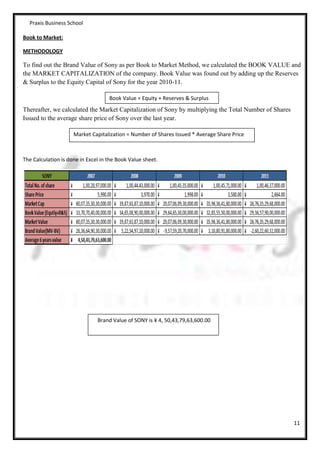
To find out the Brand Value of Sony as per Book to Market Method, we calculated the BOOK VALUE and
the MARKET CAPITALIZATION of the company. Book Value was found out by adding up the Reserves
& Surplus to the Equity Capital of Sony for the year 2010-11.

                                    Book Value = Equity + Reserves & Surplus
Thereafter, we calculated the Market Capitalization of Sony by multiplying the Total Number of Shares
Issued to the average share price of Sony over the last year.

                     Market Capitalization = Number of Shares Issued * Average Share Price


The Calculation is done in Excel in the Book Value sheet.


                               Brand Value of SONY is ¥ 4, 50,43,79,63,600.00


                                                                                                        11
Praxis Business School


                         Price Premia


                                        12
Praxis Business School

Price Premia Model

In the price premium method, the ability of a brand to charge a premium over an unbranded or generic
equivalent can be tracked. Transparency and easy to comprehend are some of the main advantages of this
method. It is possible to determine the market share for a given product at a given price level. The
relationship between brand equity and price is easily explained. For a brand, the model gives the
percentage of premium it can charge its consumers over generic substitutes. The brands can even compare
their value of the brand vis-à-vis competition.

Limitations of Price Premia Model
The disadvantages are where a branded product does not command a price premium; the benefit arises on
the cost and market share dimensions. The model may bear little evidence to economic reality or serve
other useful purpose. This method is flawed because there are generic equivalents to which the premium
price of a branded product can be compared. The price difference between a brand and competing products
can be an indicator of its strength, but it does not represent the only and most important value contribution
a brand makes to the underlying business.

Objective:

To measure the brand value of Sony using Price premia model.

Methodology:

A sample size of 20 was taken for evaluation. The respondents were asked to state the price which they are
willing to pay for an unbranded LCD, Digital camera, Music system and laptop. Thereafter, they were
asked to quote an amount which they are willing to pay for an LCD, digital camera, music system and
laptop if a brand name is attached to it. The brands we chose as competitors of Sony are Samsung, Philips,
and LG for the category of LCD and Music system. We chose Nikon and Canon as competitors of Sony in
the category of digital cameras and HP, Dell and Acer in the category of laptops. The difference between
the amount which a consumer is willing to pay for a branded product and an unbranded product is the price
premium which a brand commands.

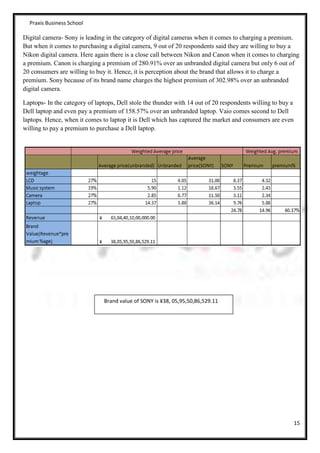
The weightages assigned to each product category was based on the revenue generated by them whose
source was the company website. The site showed a break up of all the product categories Sony was into
but we have ignored a few of them and then raised the ones we wanted to a sum total of hundred by
proportionately increasing their percentage figures.


                                                                                                          13
Praxis Business School

Findings-

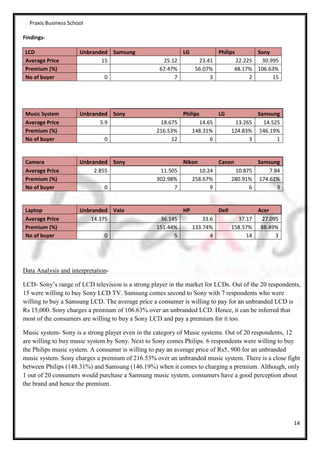
LCD                   Unbranded Samsung                     LG              Philips        Sony
Average Price                15                     25.12          23.41            22.225  30.995
Premium (%)                                        67.47%         56.07%            48.17% 106.63%
No of buyer                    0                        7              3                 2      15


Music System          Unbranded Sony                      Philips      LG                  Samsung
Average Price                5.9                   18.675        14.65              13.265   14.525
Premium (%)                                       216.53%     148.31%              124.83% 146.19%
No of buyer                    0                       12            6                   3        1


Camera                Unbranded Sony                        Nikon           Canon          Samsung
Average Price              2.855                   11.505          10.24            10.875     7.84
Premium (%)                                       302.98%        258.67%           280.91% 174.61%
No of buyer                    0                        7              9                 6        3


Laptop                Unbranded Vaio                        HP              Dell           Acer
Average Price             14.375                   36.145            33.6            37.17  27.095
Premium (%)                                       151.44%        133.74%           158.57% 88.49%
No of buyer                    0                        5               4               14       3


Data Analysis and interpretation-

LCD- Sony’s range of LCD television is a strong player in the market for LCDs. Out of the 20 respondents,
15 were willing to buy Sony LCD TV. Samsung comes second to Sony with 7 respondents who were
willing to buy a Samsung LCD. The average price a consumer is willing to pay for an unbranded LCD is
Rs 15,000. Sony charges a premium of 106.63% over an unbranded LCD. Hence, it can be inferred that
most of the consumers are willing to buy a Sony LCD and pay a premium for it too.

Music system- Sony is a strong player even in the category of Music systems. Out of 20 respondents, 12
are willing to buy music system by Sony. Next to Sony comes Philips. 6 respondents were willing to buy
the Philips music system. A consumer is willing to pay an average price of Rs5, 900 for an unbranded
music system. Sony charges a premium of 216.53% over an unbranded music system. There is a close fight
between Philips (148.31%) and Samsung (146.19%) when it comes to charging a premium. Although, only
1 out of 20 consumers would purchase a Samsung music system, consumers have a good perception about
the brand and hence the premium.


                                                                                                      14
Praxis Business School

Digital camera- Sony is leading in the category of digital cameras when it comes to charging a premium.
But when it comes to purchasing a digital camera, 9 out of 20 respondents said they are willing to buy a
Nikon digital camera. Here again there is a close call between Nikon and Canon when it comes to charging
a premium. Canon is charging a premium of 280.91% over an unbranded digital camera but only 6 out of
20 consumers are willing to buy it. Hence, it is perception about the brand that allows it to charge a
premium. Sony because of its brand name charges the highest premium of 302.98% over an unbranded
digital camera.

Laptops- In the category of laptops, Dell stole the thunder with 14 out of 20 respondents willing to buy a
Dell laptop and even pay a premium of 158.57% over an unbranded laptop. Vaio comes second to Dell
laptops. Hence, when it comes to laptop it is Dell which has captured the market and consumers are even
willing to pay a premium to purchase a Dell laptop.


                               Brand value of SONY is ¥38, 05,95,50,86,529.11


                                                                                                             15
Praxis Business School


                   Discounted Cash Flow


                                          16
Praxis Business School

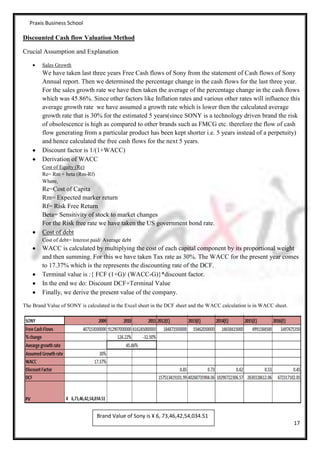
Discounted Cash flow Valuation Method

Crucial Assumption and Explanation

        Sales Growth
        We have taken last three years Free Cash flows of Sony from the statement of Cash flows of Sony
        Annual report. Then we determined the percentage change in the cash flows for the last three year.
        For the sales growth rate we have then taken the average of the percentage change in the cash flows
        which was 45.86%. Since other factors like Inflation rates and various other rates will influence this
        average growth rate we have assumed a growth rate which is lower then the calculated average
        growth rate that is 30% for the estimated 5 years(since SONY is a technology driven brand the risk
        of obsolescence is high as compared to other brands such as FMCG etc. therefore the flow of cash
        flow generating from a particular product has been kept shorter i.e. 5 years instead of a perpetuity)
        and hence calculated the free cash flows for the next 5 years.
        Discount factor is 1/(1+WACC)
        Derivation of WACC
        Cost of Equity (Re)
        Re= Rm + beta (Rm-Rf)
        Where,
        Re=Cost of Capita
        Rm= Expected marker return
        Rf= Risk Free Return
        Beta= Sensitivity of stock to market changes
        For the Risk free rate we have taken the US government bond rate.
        Cost of debt
        Cost of debt= Interest paid/ Average debt
        WACC is calculated by multiplying the cost of each capital component by its proportional weight
        and then summing. For this we have taken Tax rate as 30%. The WACC for the present year comes
        to 17.37% which is the represents the discounting rate of the DCF.
        Terminal value is :{ FCF (1+G)/ (WACC-G)}*discount factor.
        In the end we do: Discount DCF+Terminal Value
        Finally, we derive the present value of the company.

The Brand Value of SONY is calculated in the Excel sheet in the DCF sheet and the WACC calculation is in WACC sheet.


                                 Brand Value of Sony is ¥ 6, 73,46,42,54,034.51
                                                                                                                       17
Praxis Business School


RECOMMENDATION

       Having calculated the brand Value of Sony by three completely different methods we got varied
       values of the brand. We then had to decide which method was the one that had gotten the closest to
       depicting the true value of the chosen brand.

       The Discounted Cash Flow method and the Market to Book Value method threw up rather similar
       values of the brand Sony whereas the Price Primia method’s value was huge as compared to the
       other two methods.
       Despite the brand value calculated through the Price Premia method being so different we would go
       ahead and say that this is the best method amongst the three. The reasons for this are:
               Minimum number of assumptions as compared to the other two methods
               Detailed calculations by segregating each product category and assigning appropriate
               weightages to the same
               The method uses the matrix of premium which at the end of the day is perhaps the most
               important matrix for a brand as a brand is nothing but an ability to charge premium.


The brand Sony has a very high brand value which is nothing but a reflection of most of the things that it
has got right. It is the market leader in most of the product categories it is present in. It is perceived to be
offering cutting edge technology products which are of high quality and expensive. Sony is treading a tight
rope here and has to watch out from overdoing it here giving the customers the feeling that despite the high
quality of the products they r still being overcharged comparatively.

Since all Sony’s products are technology driven they are exposed to high risk of obsolescence and therefore
need to ensure continuous innovation either within the particular products or keep coming out with new
ones replacing the obsolete ones. This can be ensured by setting aside a bigger budget for the research and
development department.


                                                                                                             18
Praxis Business School


Reference

       http://www.sony.net/SonyInfo/IR/financial/ar/2011/
       http://www.bloomberg.com/markets/rates-bonds/government-bonds/us/


                                                                           19

Sony Brand Valuation

  • 1.
  • 2.
    Praxis Business School A Project report for Product Brand Management On Brand Value Measurement Submitted to Prof. Srinivas Govindrajan In partial fulfilment of the requirements of the course Post Graduate Program in Business Management On September 18th ‘2011 By Nahid Anjum Diya Mazumder Abhishek Dujari Ankit Jain Ashwin Agarwal Praxis Business School Kolkata (2010-2012) 2
  • 3.
    Praxis Business School Contents 1. Executive summary 2. Concept of Brand Valuation 3. Rationale for choosing the method of brand valuation 4. Different methods of brand valuation a. Book to market b. Price premia c. Discounted cash flow 5. Recommendation 6. References 3
  • 4.
    Praxis Business School EXECUTIVESUMMARY The motive of this project was to calculate the brand value of Sony. We went about doing so by choosing the three most applicable methods keeping our chosen brand in mind. These three methods were the Discounted Cash Flow method, the Price Primia method and the Book to Market method. The Discounted Cash Flow method calculates the brand value by taking into consideration the future generation of cash flows by the brand. For calculating these discounted cash flows we found out the cost of equity using the CAPM Model and determined the WACC (weighted average cost of capital) which has been used as the discounting rate on the estimated future cash flows to arrive at their present value giving the brand Value of Sony. The brand value of Sony comes to be ¥ 6, 73,46,42,54,034.51 The Price Premia model indicates how much more are consumers willing to pay for a product of a known brand as compared to a product which is unbranded. This difference between these two values is the brand value as this willingness to pay a premium is due to the brand name attached to the product. We asked twenty respondents how much they are willing to pay for Sony and its known competitors and also for an unbranded product. We then found out the average price that all the respondents were willing to pay for those brands and unbranded products. We then calculated the premium percentage by subtracting the average of the price that consumers were willing to pay for an unbranded product from the price for a Sony product. This difference was divided by the price for a Sony product and multiplied by hundred to arrive at the percentage figure. The brand value of Sony comes to be ¥38, 05,95,50,86,529.11 In the Book to Market method we calculated the market capitalisation of the brand by multiplying the number of outstanding shares in the market with the average of the share prices for five years (annually). We then calculated the book value by adding the reserves and surpluses and equity in the books of the company and then subtracted it from the market capitalisation. This difference gives us the brand value of Sony. The brand value of Sony comes to be ¥ 4, 50,43,79,63,600.00 Having calculated the brand value of Sony by three different methods we now had to choose the best method for Sony. The best method according to us is the Price premia method for reasons such as, meaningful and limited assumptions for calculating the brand value, usage of proper weights based on revenue generated by all the brands, segregated and detailed calculation for each brand separately. Sony is treading a very thin line when it comes to charging a very high premium and justifying the same despite giving quality products. Therefore it needs to be careful as to stay on the positive side of this perception of the consumers and since all of its products are highly technologically driven it is exposed to a very high risk of obsolescence. To counter this risk it either needs to keep innovating and improving its existing products or keep coming up with something new. It can do so by allocating a high budget to the research and development team of the company. 4
  • 5.
    Praxis Business School BrandValuation What is a brand? A brand is a name, term, design, symbol, or any other feature that identifies a seller’s good or service as distinct from those of other sellers. A brand may identify one item, a family of items, or all items of that seller. A brand can take many forms, including a name, sign, symbol, colour combination or slogan. Brand is the personality that identifies a product, service or company. Brand recognition and other reactions are created by the accumulation of experiences with the specific product or service, both directly relating to its use, and through the influence of advertising, design, and media commentary. Brand is the proprietary visual, emotional, rational, and cultural image that one associates with a company or a product. It is the future generator of cash flow. Brand Valuation Brand valuation is the process used to calculate the value of brands. Historically, most of a company’s value was in tangible assets such as property, stock, machinery or land. This has now changed and the majority of most company’s value is in intangible assets, such as their brand name or names. The value of brand has been recognised for over a hundred years. John Stuart, Chairman of Quaker said in about 1900, "If this business were split up, I would give you the land and bricks and mortar, and I would take the brands and trade marks, and I would fair better than you." However, techniques to quantify brand value have become more sophisticated with the advent of computerised software such as Excel in the mid 1980s. Brand valuations hit the financial headlines when they were tabled to defend Rank Hovis McDougall (RHM) from a hostile takeover from Goodman Fielder Wattie (GFW). Since 1988, brand valuation methods have improved and consolidated, this was due to their acceptance in 2005 under International Financial Reporting Standards (IFRS). IFRS stated that, for the first time brands and other acquired intangible assets could be reported on a company’s balance sheet. The past 20 years have witnessed a dramatic shift in the sources of value creation from tangible assets (such as property, plant, equipment and inventory) to intangible assets (such as skilled employees, patents, business systems and brands). This is reflected in the growing divergence between the net asset value of companies and their market capitalisation. There are a number of recognised methods for valuing trademarks or brands as defined here. We can look at historic costs – what did it cost to create? In the case of a brand one can look at what it costs to design, register, and promote the trademarks and associated rights. Alternatively, one can address what they might cost to replace. Both the historic cost method and the replacement cost method are subjective but we are often asked to value this way 5
  • 6.
    Praxis Business School because courts may want to know what a brand might cost to create. It is also possible to consider market value, though frequently there is no market value for intangibles, particularly trademarks and brands. First there is the price premium or gross margin approach that considers price premiums or superior margins versus a generic business as the metric for quantifying the value that the brand contributes. However, the rise of private label means that it is often hard to identify a generic against which the price or margin differential should be measured. Ten years ago Interbrand conducted the first ever brand valuation for Rank Hovis McDougal. This exercise succeeded in putting the worth of the company's brands as a figure on the balance sheet. RHM's management wanted this information to fight a hostile takeover bid. With the brand value information, the RHM board was able to go back to investors and argue that the bid was too low, and eventually repel it. Brands are valued for many different reasons, such as for legal disputes, strategic management, internal communications, business management, brand securitisation and M&A. Brand valuation models follow standard guidelines. Models for valuing brands follow the same principles of valuation that are used for valuing other tangible assets – economic income approach, market approach and cost approach. The term brand value can often confuse. Brand value in some contexts can mean the financial value of a brand – its actual value. In other circumstances brand value means one of the intangible measures that contribute to the brand’s financial value. Such brand value attributes can include brand awareness, familiarity, relevance, heritage or understanding. These brand values all contribute towards the financial value of the brand. An important part of valuing brands is identifying what these values are that drive the brand’s financial value. One could collate an exhaustive list of values but the shorter the list of brand values the easier it is to monitor and manage. The second step when using these brand values to value brands is to calculate how important each one is for the particular brand. For instance, whilst awareness is clearly an important brand value measure, without consumer understanding of what your brand stands for it is wasted. Market research is carried out within defined market segments to determine what brand values are most important to the brand’s customers. Why are brands valued? There are many reasons to put brand in a balance sheet. The advantage of brand valuation is that it is extremely comprehensive and uses proven statistical techniques to reach its conclusions. Some other main advantages are mentioned here:  The inclusion of brand value in balance sheet gives a better picture of the company as having good assets and good brand value.  At the same time apparent return on assets (without inclusion of brands) will be brought down to more realistic figures. 6
  • 7.
    Praxis Business School  In many of the takeovers, goodwill element in the price of the net assets has been increasing. Sometimes the price paid for goodwill is greater than the acquiring company’s net worth with the result that the consolidated accounts show negative shareholders equity. This looks preposterous. Some of the companies have reassessed the assets acquired in take overs and reclassified the goodwill as brands.  Company’s brand management will certainly be sharpened up (e.g. brand P&L accounts)  The Company’s debt equity ratio is improved i.e. it reduces the gearing ratio and so increases the Company’s borrowing capacity.  It particularly helps service sector companies where there are low assets levels, but strong cash flow and customer bases.  The company is more expensive to acquire which may deter hostile bids.  The asset value does not come down as long as it is maintained by proper promotional and advertising efforts. There is no depreciation and thus no impact on P&L.  The goodwill arising from an acquisition can be reduced.  Recognising the value of brands separately at the time of acquisition reduces the amount of goodwill that must be written off either directly to reserves or by amortisation over a number of years. Immediate write off has detrimental effect on consolidated reserves and confuses the real value of acquisition of the business whereas amortisation has a continuous adverse and unrealistic effect on future profits.  It helps better comparison between companies operating in similar markets, or between companies with varying mixes of acquired and home grown brands.  Many creditors have found in an insolvency situation that some current assets such as inventory are relatively worthless even though classified as current asset. Also, we cannot recover goodwill but brands can be transferred and can be converted into cash.  For the businessmen brands are often the most important competitive advantage. It is the success or failure of brands that so often determines the manager’s success or failure. This concept will be translated into reality if brands are included in the balance sheet. Methods used to measure brand value The different methods used to measure the brand value are as follows- 1. Price premia model In the price premia method, the ability of a brand to charge a premium over an unbranded or generic equivalent can be tracked. The major advantage of this approach is that it is transparent and easy to understand. It is possible to determine the market share for a given product at a given price level. The relationship between brand equity and price is easily explained. For a brand, the model gives the percentage of premium it can charge its consumers over the generic substitutes. The brands can even compare their value of the brand vis-à-vis competition. 7
  • 8.
    Praxis Business School 2. Book to market model Book to market model embraces the intangible asset that the company possesses as Brand Value, is calculated by deducting Market Value of company with the Book Value. In this method the book value of the company is deducted from its market capitalisation, to arrive at the value of the intangible asset, i.e. the brand. For most of the century, tangible assets were regarded as the main source of business value. These included manufacturing assets, land and buildings or financial assets such as receivables and investments. They would be valued at cost or outstanding value as shown in the balance sheet. Categories of Intangible asset that support the superior market performance of business are-  Knowledge Intangibles: For example patents, software, recipes, specific know how, including manufacturing and operating guides and manuals, product research etc.  Business Process Intangibles: These include unique ways of organizing the business including business models, technology, R&D, patents, flexible manufacturing techniques etc.  Brand and Relationship intangibles: These includes trade names, trademarks and trade symbols, domain name, design rights, logotypes, associated Goodwill general predisposition of individuals to do business with brands are included.  Market position intangibles: For example, retail listings and contracts, distribution rights, licenses such as landing slots, production or import quotas, third generation telecom licenses, government permits and authorizations and raw materials sourcing contracts. 3. Discounted cash flow method In this method, the cash flows are estimated and discounted to come at the Present Value of the firm. The discounted cash flow (or DCF) approach describes a method of valuing a project, company, or asset using the concepts of the time value of money. All future cash flows are estimated and discounted to give them a present value. Discounted cash flow method helps us at arriving at the present value of the future cash flows. From the DCF method we have tried to arrive at the present value of Sony and from the present value of the company we will attribute a share to brand value, which will be the earnings from the brand value and derive the brand value of Sony. Rationale for choosing the above methods: 1. Book to market The reason for choosing this method is that Sony is company which has been into existence for a long period now. The market is well aware of its policies, strategies and the overall trend that the company’s growth history has shown. Therefore, the market has got Sony figured out very well and therefore, it will value Sony very close to what its true or correct value should be. 8
  • 9.
    Praxis Business School 2. Price Premia The reason for choosing this method originated from the previous two phases of the project. It was seen that Sony is known to charge a high premium for its products and is justified by doing so by giving an equally quality product. Therefore, we could not ignore this factor and decided to use this method. 3. Discounted Cash Flow The reason for choosing this method is it takes into account the cash flows which will be generated in the future and it was extremely important to calculate Sony’s brand value using this method as it is a technology driven brand and therefore is exposed to a high risk of obsolescence. This means its duration of cash flows from a particular brand/product category is likely to be shorter. We have factored in this particular point. 9
  • 10.
    Praxis Business School Book to Market 10
  • 11.
    Praxis Business School Bookto Market: METHODOLOGY To find out the Brand Value of Sony as per Book to Market Method, we calculated the BOOK VALUE and the MARKET CAPITALIZATION of the company. Book Value was found out by adding up the Reserves & Surplus to the Equity Capital of Sony for the year 2010-11. Book Value = Equity + Reserves & Surplus Thereafter, we calculated the Market Capitalization of Sony by multiplying the Total Number of Shares Issued to the average share price of Sony over the last year. Market Capitalization = Number of Shares Issued * Average Share Price The Calculation is done in Excel in the Book Value sheet. Brand Value of SONY is ¥ 4, 50,43,79,63,600.00 11
  • 12.
    Praxis Business School Price Premia 12
  • 13.
    Praxis Business School PricePremia Model In the price premium method, the ability of a brand to charge a premium over an unbranded or generic equivalent can be tracked. Transparency and easy to comprehend are some of the main advantages of this method. It is possible to determine the market share for a given product at a given price level. The relationship between brand equity and price is easily explained. For a brand, the model gives the percentage of premium it can charge its consumers over generic substitutes. The brands can even compare their value of the brand vis-à-vis competition. Limitations of Price Premia Model The disadvantages are where a branded product does not command a price premium; the benefit arises on the cost and market share dimensions. The model may bear little evidence to economic reality or serve other useful purpose. This method is flawed because there are generic equivalents to which the premium price of a branded product can be compared. The price difference between a brand and competing products can be an indicator of its strength, but it does not represent the only and most important value contribution a brand makes to the underlying business. Objective: To measure the brand value of Sony using Price premia model. Methodology: A sample size of 20 was taken for evaluation. The respondents were asked to state the price which they are willing to pay for an unbranded LCD, Digital camera, Music system and laptop. Thereafter, they were asked to quote an amount which they are willing to pay for an LCD, digital camera, music system and laptop if a brand name is attached to it. The brands we chose as competitors of Sony are Samsung, Philips, and LG for the category of LCD and Music system. We chose Nikon and Canon as competitors of Sony in the category of digital cameras and HP, Dell and Acer in the category of laptops. The difference between the amount which a consumer is willing to pay for a branded product and an unbranded product is the price premium which a brand commands. The weightages assigned to each product category was based on the revenue generated by them whose source was the company website. The site showed a break up of all the product categories Sony was into but we have ignored a few of them and then raised the ones we wanted to a sum total of hundred by proportionately increasing their percentage figures. 13
  • 14.
    Praxis Business School Findings- LCD Unbranded Samsung LG Philips Sony Average Price 15 25.12 23.41 22.225 30.995 Premium (%) 67.47% 56.07% 48.17% 106.63% No of buyer 0 7 3 2 15 Music System Unbranded Sony Philips LG Samsung Average Price 5.9 18.675 14.65 13.265 14.525 Premium (%) 216.53% 148.31% 124.83% 146.19% No of buyer 0 12 6 3 1 Camera Unbranded Sony Nikon Canon Samsung Average Price 2.855 11.505 10.24 10.875 7.84 Premium (%) 302.98% 258.67% 280.91% 174.61% No of buyer 0 7 9 6 3 Laptop Unbranded Vaio HP Dell Acer Average Price 14.375 36.145 33.6 37.17 27.095 Premium (%) 151.44% 133.74% 158.57% 88.49% No of buyer 0 5 4 14 3 Data Analysis and interpretation- LCD- Sony’s range of LCD television is a strong player in the market for LCDs. Out of the 20 respondents, 15 were willing to buy Sony LCD TV. Samsung comes second to Sony with 7 respondents who were willing to buy a Samsung LCD. The average price a consumer is willing to pay for an unbranded LCD is Rs 15,000. Sony charges a premium of 106.63% over an unbranded LCD. Hence, it can be inferred that most of the consumers are willing to buy a Sony LCD and pay a premium for it too. Music system- Sony is a strong player even in the category of Music systems. Out of 20 respondents, 12 are willing to buy music system by Sony. Next to Sony comes Philips. 6 respondents were willing to buy the Philips music system. A consumer is willing to pay an average price of Rs5, 900 for an unbranded music system. Sony charges a premium of 216.53% over an unbranded music system. There is a close fight between Philips (148.31%) and Samsung (146.19%) when it comes to charging a premium. Although, only 1 out of 20 consumers would purchase a Samsung music system, consumers have a good perception about the brand and hence the premium. 14
  • 15.
    Praxis Business School Digitalcamera- Sony is leading in the category of digital cameras when it comes to charging a premium. But when it comes to purchasing a digital camera, 9 out of 20 respondents said they are willing to buy a Nikon digital camera. Here again there is a close call between Nikon and Canon when it comes to charging a premium. Canon is charging a premium of 280.91% over an unbranded digital camera but only 6 out of 20 consumers are willing to buy it. Hence, it is perception about the brand that allows it to charge a premium. Sony because of its brand name charges the highest premium of 302.98% over an unbranded digital camera. Laptops- In the category of laptops, Dell stole the thunder with 14 out of 20 respondents willing to buy a Dell laptop and even pay a premium of 158.57% over an unbranded laptop. Vaio comes second to Dell laptops. Hence, when it comes to laptop it is Dell which has captured the market and consumers are even willing to pay a premium to purchase a Dell laptop. Brand value of SONY is ¥38, 05,95,50,86,529.11 15
  • 16.
    Praxis Business School Discounted Cash Flow 16
  • 17.
    Praxis Business School DiscountedCash flow Valuation Method Crucial Assumption and Explanation Sales Growth We have taken last three years Free Cash flows of Sony from the statement of Cash flows of Sony Annual report. Then we determined the percentage change in the cash flows for the last three year. For the sales growth rate we have then taken the average of the percentage change in the cash flows which was 45.86%. Since other factors like Inflation rates and various other rates will influence this average growth rate we have assumed a growth rate which is lower then the calculated average growth rate that is 30% for the estimated 5 years(since SONY is a technology driven brand the risk of obsolescence is high as compared to other brands such as FMCG etc. therefore the flow of cash flow generating from a particular product has been kept shorter i.e. 5 years instead of a perpetuity) and hence calculated the free cash flows for the next 5 years. Discount factor is 1/(1+WACC) Derivation of WACC Cost of Equity (Re) Re= Rm + beta (Rm-Rf) Where, Re=Cost of Capita Rm= Expected marker return Rf= Risk Free Return Beta= Sensitivity of stock to market changes For the Risk free rate we have taken the US government bond rate. Cost of debt Cost of debt= Interest paid/ Average debt WACC is calculated by multiplying the cost of each capital component by its proportional weight and then summing. For this we have taken Tax rate as 30%. The WACC for the present year comes to 17.37% which is the represents the discounting rate of the DCF. Terminal value is :{ FCF (1+G)/ (WACC-G)}*discount factor. In the end we do: Discount DCF+Terminal Value Finally, we derive the present value of the company. The Brand Value of SONY is calculated in the Excel sheet in the DCF sheet and the WACC calculation is in WACC sheet. Brand Value of Sony is ¥ 6, 73,46,42,54,034.51 17
  • 18.
    Praxis Business School RECOMMENDATION Having calculated the brand Value of Sony by three completely different methods we got varied values of the brand. We then had to decide which method was the one that had gotten the closest to depicting the true value of the chosen brand. The Discounted Cash Flow method and the Market to Book Value method threw up rather similar values of the brand Sony whereas the Price Primia method’s value was huge as compared to the other two methods. Despite the brand value calculated through the Price Premia method being so different we would go ahead and say that this is the best method amongst the three. The reasons for this are: Minimum number of assumptions as compared to the other two methods Detailed calculations by segregating each product category and assigning appropriate weightages to the same The method uses the matrix of premium which at the end of the day is perhaps the most important matrix for a brand as a brand is nothing but an ability to charge premium. The brand Sony has a very high brand value which is nothing but a reflection of most of the things that it has got right. It is the market leader in most of the product categories it is present in. It is perceived to be offering cutting edge technology products which are of high quality and expensive. Sony is treading a tight rope here and has to watch out from overdoing it here giving the customers the feeling that despite the high quality of the products they r still being overcharged comparatively. Since all Sony’s products are technology driven they are exposed to high risk of obsolescence and therefore need to ensure continuous innovation either within the particular products or keep coming out with new ones replacing the obsolete ones. This can be ensured by setting aside a bigger budget for the research and development department. 18
  • 19.
    Praxis Business School Reference http://www.sony.net/SonyInfo/IR/financial/ar/2011/ http://www.bloomberg.com/markets/rates-bonds/government-bonds/us/ 19