Brand Concepts
Brand Experience
 A brand experience is a brand’s action perceived
by a person. Every interaction between an
individual and a tangible or intangible brand
artefact can be seen as a brand experience.
 Such interaction might be the opening of a bottle
of lemonade, the visit of a website or branch as
well as a glimpse on a billboard in the public
space. Those places of interaction are called
→touchpoints.
 Hence a brand experience can include one or
more of a recipient’s five senses and cause any
kind of response.
 In addition to a direct interaction an indirect one –
such as friends, experts or celebrities sharing
their perception of a product or service – can be
considered as a brand experience as well.
 A person’s perception of brand, her or his brand
image, is often determined by a number of brand
experiences over a period of time including one
or more →touchpoints.
Touchpoint
 A touchpoint is a place, artefact or interface
where a person experiences a brand.
 Other definitions:
 “Touchpoint: any place where people come in
contact with a brand, including product use,
packaging, advertising, editorial, movies, store,
environments, company employees, and casual
conversation”
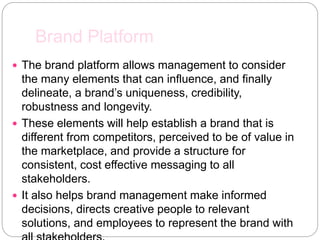
Brand Platform
 The brand platform allows management to consider
the many elements that can influence, and finally
delineate, a brand’s uniqueness, credibility,
robustness and longevity.
 These elements will help establish a brand that is
different from competitors, perceived to be of value in
the marketplace, and provide a structure for
consistent, cost effective messaging to all
stakeholders.
 It also helps brand management make informed
decisions, directs creative people to relevant
solutions, and employees to represent the brand with
Brand Platform
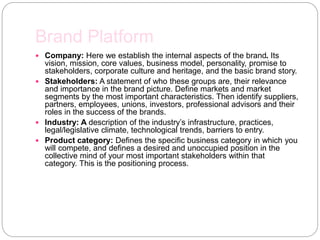
 Company: Here we establish the internal aspects of the brand. Its
vision, mission, core values, business model, personality, promise to
stakeholders, corporate culture and heritage, and the basic brand story.
 Stakeholders: A statement of who these groups are, their relevance
and importance in the brand picture. Define markets and market
segments by the most important characteristics. Then identify suppliers,
partners, employees, unions, investors, professional advisors and their
roles in the success of the brands.
 Industry: A description of the industry’s infrastructure, practices,
legal/legislative climate, technological trends, barriers to entry.
 Product category: Defines the specific business category in which you
will compete, and defines a desired and unoccupied position in the
collective mind of your most important stakeholders within that
category. This is the positioning process.
Brand Platform
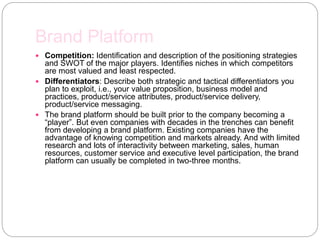
 Competition: Identification and description of the positioning strategies
and SWOT of the major players. Identifies niches in which competitors
are most valued and least respected.
 Differentiators: Describe both strategic and tactical differentiators you
plan to exploit, i.e., your value proposition, business model and
practices, product/service attributes, product/service delivery,
product/service messaging.
 The brand platform should be built prior to the company becoming a
“player”. But even companies with decades in the trenches can benefit
from developing a brand platform. Existing companies have the
advantage of knowing competition and markets already. And with limited
research and lots of interactivity between marketing, sales, human
resources, customer service and executive level participation, the brand
platform can usually be completed in two-three months.
BRAND VALUATION METHODS
These can be broadly classified into:
 Cost based
 Income based
 Market based
COST BASED METHODS
 Book value
 Replacement value
 Liquidation value
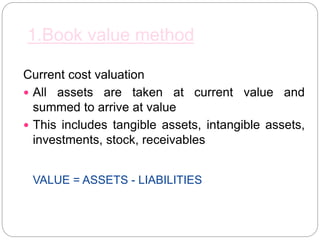
1.Book value method
Current cost valuation
 All assets are taken at current value and
summed to arrive at value
 This includes tangible assets, intangible assets,
investments, stock, receivables
VALUE = ASSETS - LIABILITIES
2. Replacement value method
 Cost of replacing existing business is taken as the
value of the business
3. Liquidation value method
 Value if company is not a going concern
 Based on net assets or piecemeal value of net
assets
INCOME BASED METHODS
 Excess-earnings method: this brand valuation methodology calculates the
earnings above the profits required to attract an investor – which uses the
estimated rate of return based on the current value of the assets employed.
These excess earnings are assumed to be attributable to the intellectual
property, or brand.
 Price premium method: this brand valuation method is based on a
capitalisation of future profit stream premiums attributable to a business’ brand
above the revenues of a generic business, without a brand.
 Capitalisation of historic profits method: the brand valuation method is
based on the capitalisation of profits earned by the brand.
 Discounted cash flow method (DCF)
 Relief from royalty method: this brand valuation method is based on how
much the brand owner would have to pay to use its brand if it licensed the brand
from a third party. It uses discounted cash flow analysis (DCF) to capitalise
future branded cash flows
Applicability of DCF method
 Cash flow to equity
 Discount rate reflects cost of equity
 Cash flow to firm
 Discount rate reflects weighted average cost of
capital
Limitations
 Companies in difficulty
 Negative earnings
 May expect to lose money for some time in future
 Possibility of bankruptcy
MARKET BASED METHOD
 Also known as relative method
 Assumption is that other firms in industry are
comparable to firm being valued
 Standard parameters used like earnings, profit,
book value
 Adjustments made for variances from standard
firms, these can be negative or positive
MARKET BASED METHOD
 P/E ratios method: the P/E (price to earnings)
brand valuation method multiples the brand’s
profits by a multiple derived from similar
transactions of profits to price paid based on the
value of reported brand values.
 Turnover multiples method: this brand valuation
method multiplies the brand’s turnover by a
multiple derived from similar transactions.
Applicability
 Simple and easy to use
 Useful when data of comparable firms and assets
are available
Limitations
 Easy to misuse
 Selection of comparable can be subjective
 Errors in comparable firms get factored into
valuation model
Global brands
 Global brands are brands that are recognized throughout much of
the world.
 Companies intending to create global brands need to do the
following: ·
 Identify the relative attractiveness of each market for the brand.
 Conduct attitude and usage studies in each country considering
entering
 Identify the sequence of brand launch by country/region of the world
 Know the category and brand indices in each country in which the
brand operates
 Establish a branding scorecard that can be applied country by country
 Agree to which decisions are made centrally and which ones are
made locally
Challenger brand
 A challenger brand is a company or
product brand in an industry that is not the
category leader.
 The term denotes the fact that such companies
have to play from a position behind the dominant
player or leader in an industry.
 This makes the process of marketing significant
to attracting customers.
Brand Revitalization
Strategy employed when a brand has reached maturity
and profits begin to decline; approaches to
revitalisation may include one or all of market
expansion, product modification or brand
repositioning.
OR
A strategy to recapture lost sources of brand equity and
identify and establish new sources of brand equity.
This may include product modification or brand
repositioning.
Brand Revitalization Measures
1. Increasing Usage.
2. New Markets.
3. Image Change.
4. Brand Enhancement

Brand concepts

  • 1.
  • 2.
    Brand Experience  Abrand experience is a brand’s action perceived by a person. Every interaction between an individual and a tangible or intangible brand artefact can be seen as a brand experience.  Such interaction might be the opening of a bottle of lemonade, the visit of a website or branch as well as a glimpse on a billboard in the public space. Those places of interaction are called →touchpoints.  Hence a brand experience can include one or more of a recipient’s five senses and cause any kind of response.
  • 3.
     In additionto a direct interaction an indirect one – such as friends, experts or celebrities sharing their perception of a product or service – can be considered as a brand experience as well.  A person’s perception of brand, her or his brand image, is often determined by a number of brand experiences over a period of time including one or more →touchpoints.
  • 4.
    Touchpoint  A touchpointis a place, artefact or interface where a person experiences a brand.  Other definitions:  “Touchpoint: any place where people come in contact with a brand, including product use, packaging, advertising, editorial, movies, store, environments, company employees, and casual conversation”
  • 6.
    Brand Platform  Thebrand platform allows management to consider the many elements that can influence, and finally delineate, a brand’s uniqueness, credibility, robustness and longevity.  These elements will help establish a brand that is different from competitors, perceived to be of value in the marketplace, and provide a structure for consistent, cost effective messaging to all stakeholders.  It also helps brand management make informed decisions, directs creative people to relevant solutions, and employees to represent the brand with
  • 7.
    Brand Platform  Company:Here we establish the internal aspects of the brand. Its vision, mission, core values, business model, personality, promise to stakeholders, corporate culture and heritage, and the basic brand story.  Stakeholders: A statement of who these groups are, their relevance and importance in the brand picture. Define markets and market segments by the most important characteristics. Then identify suppliers, partners, employees, unions, investors, professional advisors and their roles in the success of the brands.  Industry: A description of the industry’s infrastructure, practices, legal/legislative climate, technological trends, barriers to entry.  Product category: Defines the specific business category in which you will compete, and defines a desired and unoccupied position in the collective mind of your most important stakeholders within that category. This is the positioning process.
  • 8.
    Brand Platform  Competition:Identification and description of the positioning strategies and SWOT of the major players. Identifies niches in which competitors are most valued and least respected.  Differentiators: Describe both strategic and tactical differentiators you plan to exploit, i.e., your value proposition, business model and practices, product/service attributes, product/service delivery, product/service messaging.  The brand platform should be built prior to the company becoming a “player”. But even companies with decades in the trenches can benefit from developing a brand platform. Existing companies have the advantage of knowing competition and markets already. And with limited research and lots of interactivity between marketing, sales, human resources, customer service and executive level participation, the brand platform can usually be completed in two-three months.
  • 9.
    BRAND VALUATION METHODS Thesecan be broadly classified into:  Cost based  Income based  Market based
  • 10.
    COST BASED METHODS Book value  Replacement value  Liquidation value
  • 11.
    1.Book value method Currentcost valuation  All assets are taken at current value and summed to arrive at value  This includes tangible assets, intangible assets, investments, stock, receivables VALUE = ASSETS - LIABILITIES
  • 12.
    2. Replacement valuemethod  Cost of replacing existing business is taken as the value of the business
  • 13.
    3. Liquidation valuemethod  Value if company is not a going concern  Based on net assets or piecemeal value of net assets
  • 14.
    INCOME BASED METHODS Excess-earnings method: this brand valuation methodology calculates the earnings above the profits required to attract an investor – which uses the estimated rate of return based on the current value of the assets employed. These excess earnings are assumed to be attributable to the intellectual property, or brand.  Price premium method: this brand valuation method is based on a capitalisation of future profit stream premiums attributable to a business’ brand above the revenues of a generic business, without a brand.  Capitalisation of historic profits method: the brand valuation method is based on the capitalisation of profits earned by the brand.  Discounted cash flow method (DCF)  Relief from royalty method: this brand valuation method is based on how much the brand owner would have to pay to use its brand if it licensed the brand from a third party. It uses discounted cash flow analysis (DCF) to capitalise future branded cash flows
  • 15.
    Applicability of DCFmethod  Cash flow to equity  Discount rate reflects cost of equity  Cash flow to firm  Discount rate reflects weighted average cost of capital
  • 16.
    Limitations  Companies indifficulty  Negative earnings  May expect to lose money for some time in future  Possibility of bankruptcy
  • 17.
    MARKET BASED METHOD Also known as relative method  Assumption is that other firms in industry are comparable to firm being valued  Standard parameters used like earnings, profit, book value  Adjustments made for variances from standard firms, these can be negative or positive
  • 18.
    MARKET BASED METHOD P/E ratios method: the P/E (price to earnings) brand valuation method multiples the brand’s profits by a multiple derived from similar transactions of profits to price paid based on the value of reported brand values.  Turnover multiples method: this brand valuation method multiplies the brand’s turnover by a multiple derived from similar transactions.
  • 19.
    Applicability  Simple andeasy to use  Useful when data of comparable firms and assets are available
  • 20.
    Limitations  Easy tomisuse  Selection of comparable can be subjective  Errors in comparable firms get factored into valuation model
  • 21.
    Global brands  Globalbrands are brands that are recognized throughout much of the world.  Companies intending to create global brands need to do the following: ·  Identify the relative attractiveness of each market for the brand.  Conduct attitude and usage studies in each country considering entering  Identify the sequence of brand launch by country/region of the world  Know the category and brand indices in each country in which the brand operates  Establish a branding scorecard that can be applied country by country  Agree to which decisions are made centrally and which ones are made locally
  • 22.
    Challenger brand  Achallenger brand is a company or product brand in an industry that is not the category leader.  The term denotes the fact that such companies have to play from a position behind the dominant player or leader in an industry.  This makes the process of marketing significant to attracting customers.
  • 23.
    Brand Revitalization Strategy employedwhen a brand has reached maturity and profits begin to decline; approaches to revitalisation may include one or all of market expansion, product modification or brand repositioning. OR A strategy to recapture lost sources of brand equity and identify and establish new sources of brand equity. This may include product modification or brand repositioning.
  • 24.
    Brand Revitalization Measures 1.Increasing Usage. 2. New Markets. 3. Image Change. 4. Brand Enhancement