Unit 2
Introduction to Physical
Layer and Data-Link
Layer:
Syllabus
 Digital Transmission -digital-to-digital conversion
 Line Coding
 Line Coding Schemes
 analog-to-digital conversion
 Pulse Code Modulation (PCM)
 Transmission Modes
 Parallel Transmission
 Serial Transmission
 Analog Transmission
 digital-to-analog Conversion
 Aspects of Digital-to-Analog Conversion
 Amplitude Shift Keying, Frequency Shift Keying, Phase
Shift Keying
 analog-to-analog Conversion, Amplitude Modulation (AM),
Frequency Modulation (FM), Phase Modulation (PM)
 Multiplexing, Frequency-Division Multiplexing, Wavelength-
Division Multiplexing, Time-Division Multiplexing.
Syllabus cont
 Transmission Media-Guided Media, Twisted-Pair
Cable, Coaxial Cable, Fiber-Optic Cable
 Switching, Three Methods of Switching , Circuit
Switched Networks, Packet Switching
 Introduction to Data-Link Layer-Nodes and Links
 Services
 Two Sub-layers
 Three Types of addresses
 Address Resolution Protocol (ARP)
 Error Detection and Correction introduction
 Types of Errors
 Redundancy
 Detection versus Correction
DIGITAL-TO-DIGITAL CONVERSION
The conversion involves three techniques:
The conversion involves three techniques: line coding
line coding,
,
block coding
block coding, and
, and scrambling
scrambling.
.
Line coding is always needed; block coding and
scrambling may or may not be needed.
 Line Coding
 Line Coding Schemes
 Block Coding
 Scrambling
Topics discussed in this section:
Line Coding
 Converting a string of 1’s and
0’s (digital data) into a
sequence of signals that
denote the 1’s and 0’s.
 For example a high voltage
level (+V) could represent a
“1” and a low voltage level (0
or -V) could represent a “0”.
Figure 1 Line coding and decoding
Mapping Data symbols
onto Signal levels
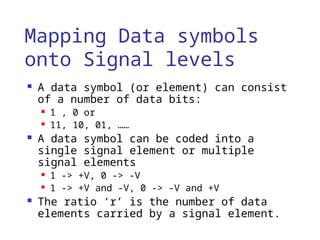
 A data symbol (or element) can consist
of a number of data bits:
 1 , 0 or
 11, 10, 01, ……
 A data symbol can be coded into a
single signal element or multiple
signal elements
 1 -> +V, 0 -> -V
 1 -> +V and -V, 0 -> -V and +V
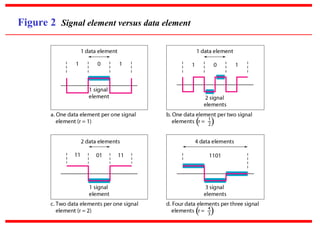
 The ratio ‘r’ is the number of data
elements carried by a signal element.
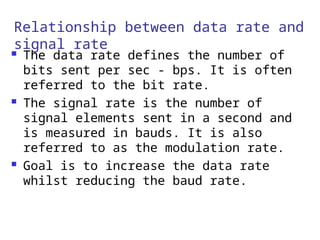
Relationship between data rate and
signal rate
 The data rate defines the number of
bits sent per sec - bps. It is often
referred to the bit rate.
 The signal rate is the number of
signal elements sent in a second and
is measured in bauds. It is also
referred to as the modulation rate.
 Goal is to increase the data rate
whilst reducing the baud rate.
Figure 2 Signal element versus data element
Data rate and Baud
rate
 The baud or signal rate can be
expressed as:
S = c x N x 1/r bauds
where N is data rate
c is the case factor (worst, best
& avg.)
r is the ratio between data
element & signal element
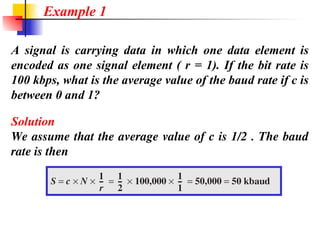
A signal is carrying data in which one data element is
encoded as one signal element ( r = 1). If the bit rate is
100 kbps, what is the average value of the baud rate if c is
between 0 and 1?
Solution
We assume that the average value of c is 1/2 . The baud
rate is then
Example 1
Although the actual bandwidth of a
digital signal is infinite, the effective
bandwidth is finite.
Note
Considerations for choosing a
good signal element referred to
as line encoding
line encoding
 Baseline wandering - a receiver will
evaluate the average power of the
received signal (called the baseline) and
use that to determine the value of the
incoming data elements.
-If the incoming signal does not vary
over a long period of time, the baseline
will drift and thus cause errors in
detection of incoming data elements.
 A good line encoding scheme will prevent
long runs of fixed amplitude.
Line encoding C/Cs
 DC components - when the voltage
level remains constant for long
periods of time, there is an
increase in the low frequencies of
the signal. Most channels are
bandpass and may not support the low
frequencies.
 This will require the removal of the
dc component of a transmitted
signal.
Line encoding C/Cs
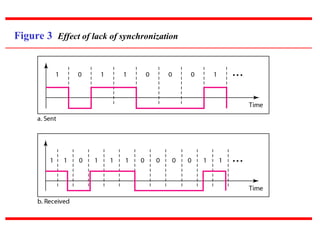
 Self synchronization - the
clocks at the sender and the
receiver must have the same
bit interval.
 If the receiver clock is
faster or slower it will
misinterpret the incoming bit
stream.
Figure 3 Effect of lack of synchronization
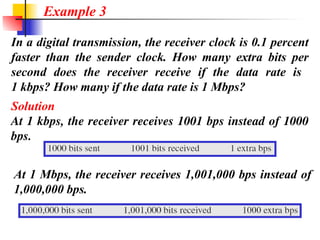
In a digital transmission, the receiver clock is 0.1 percent
faster than the sender clock. How many extra bits per
second does the receiver receive if the data rate is
1 kbps? How many if the data rate is 1 Mbps?
Solution
At 1 kbps, the receiver receives 1001 bps instead of 1000
bps.
Example 3
At 1 Mbps, the receiver receives 1,001,000 bps instead of
1,000,000 bps.
Line encoding C/Cs
 Error detection - errors occur during
transmission due to line impairments.
 Some codes are constructed such that
when an error occurs it can be
detected.
 For example: a particular signal
transition is not part of the code.
When it occurs, the receiver will know
that a symbol error has occurred.
Line encoding C/Cs
 Noise and interference - there
are line encoding techniques
that make the transmitted
signal “immune” to noise and
interference.
 This means that the signal
cannot be corrupted, it is
stronger than error detection.
Line encoding C/Cs
 Complexity - the more robust
and resilient the code, the
more complex it is to
implement and the price is
often paid in baud rate or
required bandwidth.
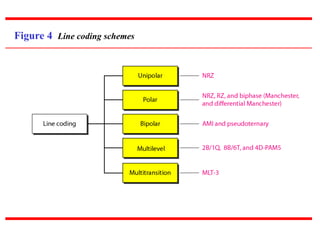
Figure 4 Line coding schemes
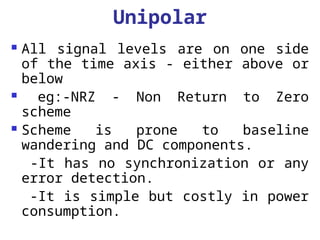
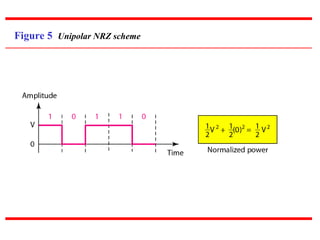
Unipolar
 All signal levels are on one side
of the time axis - either above or
below
 eg:-NRZ - Non Return to Zero
scheme
 Scheme is prone to baseline
wandering and DC components.
-It has no synchronization or any
error detection.
-It is simple but costly in power
consumption.
Figure 5 Unipolar NRZ scheme
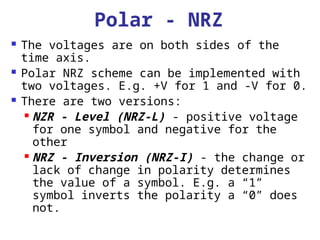
Polar - NRZ
 The voltages are on both sides of the
time axis.
 Polar NRZ scheme can be implemented with
two voltages. E.g. +V for 1 and -V for 0.
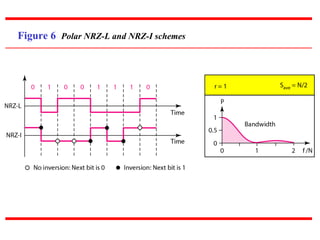
 There are two versions:
 NZR - Level (NRZ-L) - positive voltage
for one symbol and negative for the
other
 NRZ - Inversion (NRZ-I) - the change or
lack of change in polarity determines
the value of a symbol. E.g. a “1”
symbol inverts the polarity a “0” does
not.
Figure 6 Polar NRZ-L and NRZ-I schemes
In NRZ-L the level of the voltage
determines the value of the bit.
In NRZ-I the inversion
or the lack of inversion
determines the value of the bit.
Note
NRZ-L and NRZ-I both have an average
signal rate of N/2 Bd.
Note
NRZ-L and NRZ-I both have a DC
component problem and baseline
wandering, it is worse for NRZ-L. Both
have no self synchronization &no error
detection. Both are relatively simple to
implement.
Note
A system is using NRZ-I to transfer 1-Mbps data. What
are the average signal rate and minimum bandwidth?
Solution
The average signal rate is S= c x N x R = 1/2 x N x 1 =
500 kbaud. The minimum bandwidth for this average
baud rate is Bmin = S = 500 kHz.
Note c = 1/2 for the avg. case as worst case is 1 and best
case is 0
Example 4
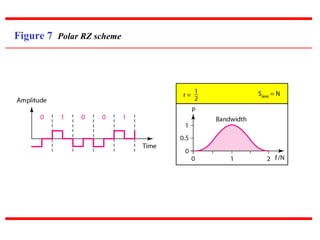
Polar - RZ
 The Return to Zero (RZ) scheme uses three
voltage values. +, 0, -.
 Each symbol has a transition in the middle.
Either from high to zero or from low to
zero.
 This scheme has more signal transitions (two
per symbol) and therefore requires a wider
bandwidth.
 No DC components or baseline wandering.
 Self synchronization - transition indicates
symbol value.
 More complex as it uses three voltage level.
It has no error detection capability.
Figure 7 Polar RZ scheme
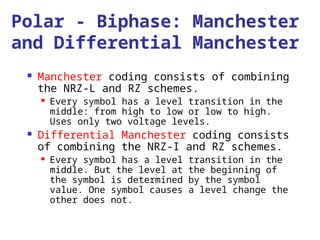
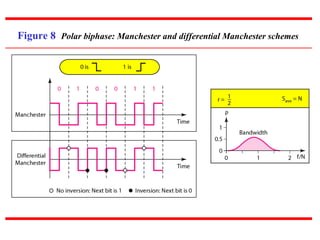
Polar - Biphase: Manchester
and Differential Manchester
 Manchester coding consists of combining
the NRZ-L and RZ schemes.
 Every symbol has a level transition in the
middle: from high to low or low to high.
Uses only two voltage levels.
 Differential Manchester coding consists
of combining the NRZ-I and RZ schemes.
 Every symbol has a level transition in the
middle. But the level at the beginning of
the symbol is determined by the symbol
value. One symbol causes a level change the
other does not.
Figure 8 Polar biphase: Manchester and differential Manchester schemes
In Manchester and differential
Manchester encoding, the transition
at the middle of the bit is used for
synchronization.
Note
The minimum bandwidth of Manchester
and differential Manchester is 2 times
that of NRZ. The is no DC component
and no baseline wandering. None of
these codes has error detection.
Note
Bipolar - AMI and
Pseudoternary
 Code uses 3 voltage levels: - +, 0,
-, to represent the symbols (note not
transitions to zero as in RZ).
 Voltage level for one symbol is at
“0” and the other alternates between
+ & -.
 Bipolar Alternate Mark Inversion
(AMI) - the “0” symbol is represented
by zero voltage and the “1” symbol
alternates between +V and -V.
 Pseudoternary is the reverse of AMI.
Figure 9 Bipolar schemes: AMI and pseudoternary
Bipolar C/Cs
 It is a better alternative to
NRZ.
 Has no DC component or baseline
wandering.
 Has no self synchronization
because long runs of “0”s results
in no signal transitions.
 No error detection.
Multilevel Schemes
 In these schemes we increase the number
of data bits per symbol thereby
increasing the bit rate.
 Since we are dealing with binary data
we only have 2 types of data element a
1 or a 0.
 We can combine the 2 data elements into
a pattern of “m” elements to create
“2m
” symbols.
 If we have L signal levels, we can use
“n” signal elements to create Ln
signal
elements.
Code C/Cs
 Now we have 2m
symbols and Ln
signals.
 If 2m
> Ln
then we cannot represent the
data elements, we don’t have enough
signals.
 If 2m
= Ln
then we have an exact mapping
of one symbol on one signal.
 If 2m
< Ln
then we have more signals than
symbols and we can choose the signals
that are more distinct to represent the
symbols and therefore have better noise
immunity and error detection as some
signals are not valid.
In mBnL schemes, a pattern of m data
elements is encoded as a pattern of n
signal elements in which 2m
≤ Ln
.
Note
Representing
Multilevel Codes
 We use the notation mBnL, where
m is the length of the binary
pattern, B represents binary
data, n represents the length of
the signal pattern and L the
number of levels.
 L = B binary, L = T for 3
ternary, L = Q for 4 quaternary.
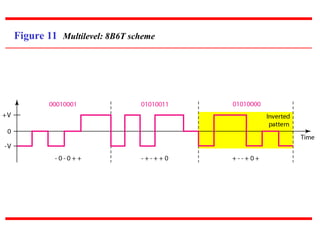
Figure 10 Multilevel: 2B1Q scheme
Redundancy
 In the 2B1Q scheme we have no redundancy
and we see that a DC component is present.
 If we use a code with redundancy we can
decide to use only “0” or “+” weighted
codes (more +’s than -’s in the signal
element) and invert any code that would
create a DC component. E.g. ‘+00++-’ -> ‘-
00--+’
 Receiver will know when it receives a “-”
weighted code that it should invert it as
it doesn’t represent any valid symbol.
Figure 11 Multilevel: 8B6T scheme
Multilevel using
multiple channels
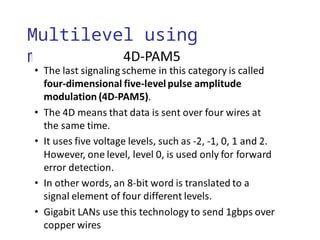
Figure 12 Multilevel: 4D-PAM5 scheme
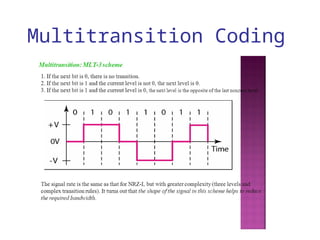
Multitransition Coding
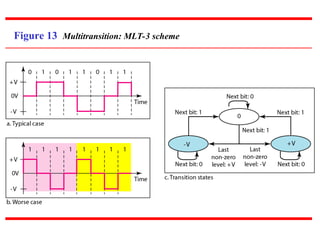
Figure 13 Multitransition: MLT-3 scheme
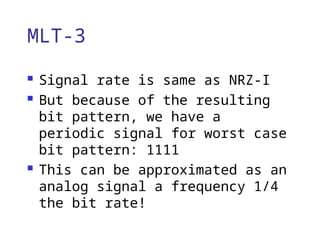
MLT-3
 Signal rate is same as NRZ-I
 But because of the resulting
bit pattern, we have a
periodic signal for worst case
bit pattern: 1111
 This can be approximated as an
analog signal a frequency 1/4
the bit rate!
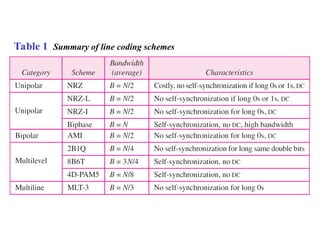
Table 1 Summary of line coding schemes
Block Coding
 For a code to be capable of error
detection, we need to add redundancy, i.e.,
extra bits to the data bits.
 Synchronization also requires redundancy -
transitions are important in the signal
flow and must occur frequently.
 Block coding is done in three steps:
division, substitution and combination.
 It is distinguished from multilevel coding
by use of the slash - xB/yB.
 The resulting bit stream prevents certain
bit combinations that when used with line
encoding would result in DC components or
poor sync. quality.
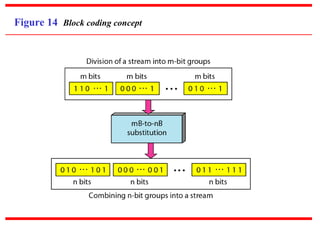
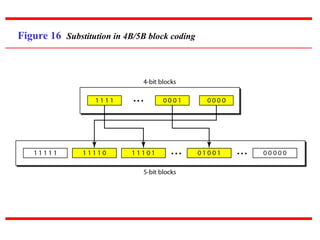
Block coding is normally referred to as
mB/nB coding;
it replaces each m-bit group with an
n-bit group.
Note
Figure 14 Block coding concept
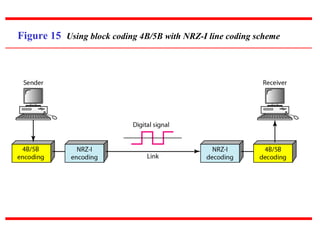
Figure 15 Using block coding 4B/5B with NRZ-I line coding scheme
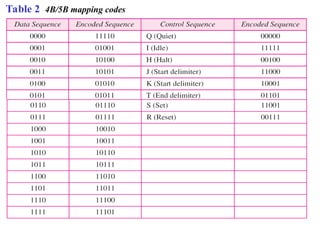
Table 2 4B/5B mapping codes
Figure 16 Substitution in 4B/5B block coding
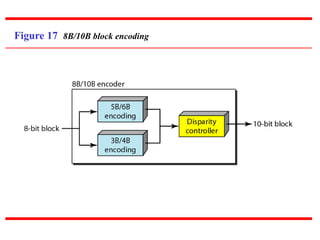
Figure 17 8B/10B block encoding
More bits - better error
detection
 The 8B10B block code adds
more redundant bits and can
thereby choose code words
that would prevent a long run
of a voltage level that would
cause DC components.
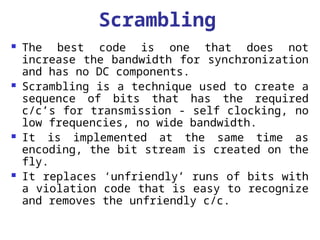
Scrambling
 The best code is one that does not
increase the bandwidth for synchronization
and has no DC components.
 Scrambling is a technique used to create a
sequence of bits that has the required
c/c’s for transmission - self clocking, no
low frequencies, no wide bandwidth.
 It is implemented at the same time as
encoding, the bit stream is created on the
fly.
 It replaces ‘unfriendly’ runs of bits with
a violation code that is easy to recognize
and removes the unfriendly c/c.
Figure 18 AMI used with scrambling
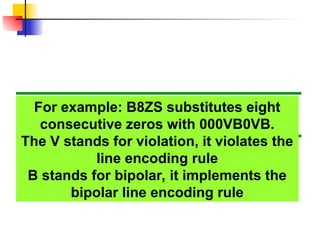
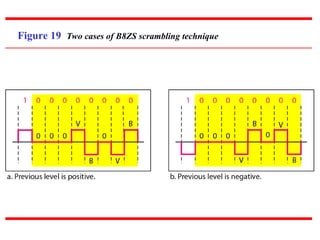
For example: B8ZS substitutes eight
consecutive zeros with 000VB0VB.
The V stands for violation, it violates the
line encoding rule
B stands for bipolar, it implements the
bipolar line encoding rule
Figure 19 Two cases of B8ZS scrambling technique
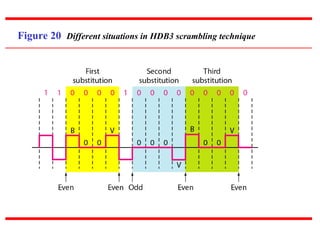
HDB3 substitutes four consecutive
zeros with 000V or B00V depending
on the number of nonzero pulses after
the last substitution.
If # of non zero pulses is even the
substitution is B00V to make total # of
non zero pulse even.
If # of non zero pulses is odd the
substitution is 000V to make total # of
non zero pulses even.
Figure 20 Different situations in HDB3 scrambling technique

unit 2 intr to phy layer part 1.pptcvcvcv

  • 1.
    Unit 2 Introduction toPhysical Layer and Data-Link Layer:
  • 2.
    Syllabus  Digital Transmission-digital-to-digital conversion  Line Coding  Line Coding Schemes  analog-to-digital conversion  Pulse Code Modulation (PCM)  Transmission Modes  Parallel Transmission  Serial Transmission  Analog Transmission  digital-to-analog Conversion  Aspects of Digital-to-Analog Conversion  Amplitude Shift Keying, Frequency Shift Keying, Phase Shift Keying  analog-to-analog Conversion, Amplitude Modulation (AM), Frequency Modulation (FM), Phase Modulation (PM)  Multiplexing, Frequency-Division Multiplexing, Wavelength- Division Multiplexing, Time-Division Multiplexing.
  • 3.
    Syllabus cont  TransmissionMedia-Guided Media, Twisted-Pair Cable, Coaxial Cable, Fiber-Optic Cable  Switching, Three Methods of Switching , Circuit Switched Networks, Packet Switching  Introduction to Data-Link Layer-Nodes and Links  Services  Two Sub-layers  Three Types of addresses  Address Resolution Protocol (ARP)  Error Detection and Correction introduction  Types of Errors  Redundancy  Detection versus Correction
  • 4.
    DIGITAL-TO-DIGITAL CONVERSION DIGITAL-TO-DIGITAL CONVERSION Theconversion involves three techniques: The conversion involves three techniques: line coding line coding, , block coding block coding, and , and scrambling scrambling. . Line coding is always needed; block coding and Line coding is always needed; block coding and scrambling may or may not be needed. scrambling may or may not be needed.  Line Coding  Line Coding Schemes  Block Coding  Scrambling Topics discussed in this section: Topics discussed in this section:
  • 5.
    Line Coding  Convertinga string of 1’s and 0’s (digital data) into a sequence of signals that denote the 1’s and 0’s.  For example a high voltage level (+V) could represent a “1” and a low voltage level (0 or -V) could represent a “0”.
  • 6.
    Figure 1 Linecoding and decoding
  • 7.
    Mapping Data symbols ontoSignal levels  A data symbol (or element) can consist of a number of data bits:  1 , 0 or  11, 10, 01, ……  A data symbol can be coded into a single signal element or multiple signal elements  1 -> +V, 0 -> -V  1 -> +V and -V, 0 -> -V and +V  The ratio ‘r’ is the number of data elements carried by a signal element.
  • 8.
    Relationship between datarate and signal rate  The data rate defines the number of bits sent per sec - bps. It is often referred to the bit rate.  The signal rate is the number of signal elements sent in a second and is measured in bauds. It is also referred to as the modulation rate.  Goal is to increase the data rate whilst reducing the baud rate.
  • 9.
    Figure 2 Signalelement versus data element
  • 10.
    Data rate andBaud rate  The baud or signal rate can be expressed as: S = c x N x 1/r bauds S = c x N x 1/r bauds where N is data rate c is the case factor (worst, best & avg.) r is the ratio between data element & signal element
  • 11.
    A signal iscarrying data in which one data element is encoded as one signal element ( r = 1). If the bit rate is 100 kbps, what is the average value of the baud rate if c is between 0 and 1? Solution We assume that the average value of c is 1/2 . The baud rate is then Example 1
  • 12.
    Although the actualbandwidth of a digital signal is infinite, the effective bandwidth is finite. Note
  • 13.
    Considerations for choosinga good signal element referred to as line encoding line encoding  Baseline wandering - a receiver will evaluate the average power of the received signal (called the baseline) and use that to determine the value of the incoming data elements. -If the incoming signal does not vary over a long period of time, the baseline will drift and thus cause errors in detection of incoming data elements.  A good line encoding scheme will prevent long runs of fixed amplitude.
  • 14.
    Line encoding C/Cs DC components - when the voltage level remains constant for long periods of time, there is an increase in the low frequencies of the signal. Most channels are bandpass and may not support the low frequencies.  This will require the removal of the dc component of a transmitted signal.
  • 15.
    Line encoding C/Cs Self synchronization - the clocks at the sender and the receiver must have the same bit interval.  If the receiver clock is faster or slower it will misinterpret the incoming bit stream.
  • 16.
    Figure 3 Effectof lack of synchronization
  • 17.
    In a digitaltransmission, the receiver clock is 0.1 percent faster than the sender clock. How many extra bits per second does the receiver receive if the data rate is 1 kbps? How many if the data rate is 1 Mbps? Solution At 1 kbps, the receiver receives 1001 bps instead of 1000 bps. Example 3 At 1 Mbps, the receiver receives 1,001,000 bps instead of 1,000,000 bps.
  • 18.
    Line encoding C/Cs Error detection - errors occur during transmission due to line impairments.  Some codes are constructed such that when an error occurs it can be detected.  For example: a particular signal transition is not part of the code. When it occurs, the receiver will know that a symbol error has occurred.
  • 19.
    Line encoding C/Cs Noise and interference - there are line encoding techniques that make the transmitted signal “immune” to noise and interference.  This means that the signal cannot be corrupted, it is stronger than error detection.
  • 20.
    Line encoding C/Cs Complexity - the more robust and resilient the code, the more complex it is to implement and the price is often paid in baud rate or required bandwidth.
  • 21.
    Figure 4 Linecoding schemes
  • 22.
    Unipolar  All signallevels are on one side of the time axis - either above or below  eg:-NRZ - Non Return to Zero scheme  Scheme is prone to baseline wandering and DC components. -It has no synchronization or any error detection. -It is simple but costly in power consumption.
  • 23.
  • 24.
    Polar - NRZ The voltages are on both sides of the time axis.  Polar NRZ scheme can be implemented with two voltages. E.g. +V for 1 and -V for 0.  There are two versions:  NZR - Level (NRZ-L) - positive voltage for one symbol and negative for the other  NRZ - Inversion (NRZ-I) - the change or lack of change in polarity determines the value of a symbol. E.g. a “1” symbol inverts the polarity a “0” does not.
  • 25.
    Figure 6 PolarNRZ-L and NRZ-I schemes
  • 26.
    In NRZ-L thelevel of the voltage determines the value of the bit. In NRZ-I the inversion or the lack of inversion determines the value of the bit. Note
  • 27.
    NRZ-L and NRZ-Iboth have an average signal rate of N/2 Bd. Note
  • 28.
    NRZ-L and NRZ-Iboth have a DC component problem and baseline wandering, it is worse for NRZ-L. Both have no self synchronization &no error detection. Both are relatively simple to implement. Note
  • 29.
    A system isusing NRZ-I to transfer 1-Mbps data. What are the average signal rate and minimum bandwidth? Solution The average signal rate is S= c x N x R = 1/2 x N x 1 = 500 kbaud. The minimum bandwidth for this average baud rate is Bmin = S = 500 kHz. Note c = 1/2 for the avg. case as worst case is 1 and best case is 0 Example 4
  • 30.
    Polar - RZ The Return to Zero (RZ) scheme uses three voltage values. +, 0, -.  Each symbol has a transition in the middle. Either from high to zero or from low to zero.  This scheme has more signal transitions (two per symbol) and therefore requires a wider bandwidth.  No DC components or baseline wandering.  Self synchronization - transition indicates symbol value.  More complex as it uses three voltage level. It has no error detection capability.
  • 31.
    Figure 7 PolarRZ scheme
  • 32.
    Polar - Biphase:Manchester and Differential Manchester  Manchester coding consists of combining the NRZ-L and RZ schemes.  Every symbol has a level transition in the middle: from high to low or low to high. Uses only two voltage levels.  Differential Manchester coding consists of combining the NRZ-I and RZ schemes.  Every symbol has a level transition in the middle. But the level at the beginning of the symbol is determined by the symbol value. One symbol causes a level change the other does not.
  • 33.
    Figure 8 Polarbiphase: Manchester and differential Manchester schemes
  • 34.
    In Manchester anddifferential Manchester encoding, the transition at the middle of the bit is used for synchronization. Note
  • 35.
    The minimum bandwidthof Manchester and differential Manchester is 2 times that of NRZ. The is no DC component and no baseline wandering. None of these codes has error detection. Note
  • 36.
    Bipolar - AMIand Pseudoternary  Code uses 3 voltage levels: - +, 0, -, to represent the symbols (note not transitions to zero as in RZ).  Voltage level for one symbol is at “0” and the other alternates between + & -.  Bipolar Alternate Mark Inversion (AMI) - the “0” symbol is represented by zero voltage and the “1” symbol alternates between +V and -V.  Pseudoternary is the reverse of AMI.
  • 37.
    Figure 9 Bipolarschemes: AMI and pseudoternary
  • 38.
    Bipolar C/Cs  Itis a better alternative to NRZ.  Has no DC component or baseline wandering.  Has no self synchronization because long runs of “0”s results in no signal transitions.  No error detection.
  • 39.
    Multilevel Schemes  Inthese schemes we increase the number of data bits per symbol thereby increasing the bit rate.  Since we are dealing with binary data we only have 2 types of data element a 1 or a 0.  We can combine the 2 data elements into a pattern of “m” elements to create “2m ” symbols.  If we have L signal levels, we can use “n” signal elements to create Ln signal elements.
  • 40.
    Code C/Cs  Nowwe have 2m symbols and Ln signals.  If 2m > Ln then we cannot represent the data elements, we don’t have enough signals.  If 2m = Ln then we have an exact mapping of one symbol on one signal.  If 2m < Ln then we have more signals than symbols and we can choose the signals that are more distinct to represent the symbols and therefore have better noise immunity and error detection as some signals are not valid.
  • 41.
    In mBnL schemes,a pattern of m data elements is encoded as a pattern of n signal elements in which 2m ≤ Ln . Note
  • 42.
    Representing Multilevel Codes  Weuse the notation mBnL, where m is the length of the binary pattern, B represents binary data, n represents the length of the signal pattern and L the number of levels.  L = B binary, L = T for 3 ternary, L = Q for 4 quaternary.
  • 43.
  • 44.
    Redundancy  In the2B1Q scheme we have no redundancy and we see that a DC component is present.  If we use a code with redundancy we can decide to use only “0” or “+” weighted codes (more +’s than -’s in the signal element) and invert any code that would create a DC component. E.g. ‘+00++-’ -> ‘- 00--+’  Receiver will know when it receives a “-” weighted code that it should invert it as it doesn’t represent any valid symbol.
  • 45.
  • 46.
  • 47.
    Figure 12 Multilevel:4D-PAM5 scheme
  • 48.
  • 49.
  • 50.
    MLT-3  Signal rateis same as NRZ-I  But because of the resulting bit pattern, we have a periodic signal for worst case bit pattern: 1111  This can be approximated as an analog signal a frequency 1/4 the bit rate!
  • 51.
    Table 1 Summaryof line coding schemes
  • 52.
    Block Coding  Fora code to be capable of error detection, we need to add redundancy, i.e., extra bits to the data bits.  Synchronization also requires redundancy - transitions are important in the signal flow and must occur frequently.  Block coding is done in three steps: division, substitution and combination.  It is distinguished from multilevel coding by use of the slash - xB/yB.  The resulting bit stream prevents certain bit combinations that when used with line encoding would result in DC components or poor sync. quality.
  • 53.
    Block coding isnormally referred to as mB/nB coding; it replaces each m-bit group with an n-bit group. Note
  • 54.
    Figure 14 Blockcoding concept
  • 55.
    Figure 15 Usingblock coding 4B/5B with NRZ-I line coding scheme
  • 56.
    Table 2 4B/5Bmapping codes
  • 57.
    Figure 16 Substitutionin 4B/5B block coding
  • 58.
    Figure 17 8B/10Bblock encoding
  • 59.
    More bits -better error detection  The 8B10B block code adds more redundant bits and can thereby choose code words that would prevent a long run of a voltage level that would cause DC components.
  • 60.
    Scrambling  The bestcode is one that does not increase the bandwidth for synchronization and has no DC components.  Scrambling is a technique used to create a sequence of bits that has the required c/c’s for transmission - self clocking, no low frequencies, no wide bandwidth.  It is implemented at the same time as encoding, the bit stream is created on the fly.  It replaces ‘unfriendly’ runs of bits with a violation code that is easy to recognize and removes the unfriendly c/c.
  • 61.
    Figure 18 AMIused with scrambling
  • 62.
    For example: B8ZSsubstitutes eight consecutive zeros with 000VB0VB. The V stands for violation, it violates the line encoding rule B stands for bipolar, it implements the bipolar line encoding rule
  • 63.
    Figure 19 Twocases of B8ZS scrambling technique
  • 64.
    HDB3 substitutes fourconsecutive zeros with 000V or B00V depending on the number of nonzero pulses after the last substitution. If # of non zero pulses is even the substitution is B00V to make total # of non zero pulse even. If # of non zero pulses is odd the substitution is 000V to make total # of non zero pulses even.
  • 65.
    Figure 20 Differentsituations in HDB3 scrambling technique