Line Coding
• Aline code is the code used for data transmission of a
digital signal over a transmission line. This process of
coding is chosen so as to avoid overlap and distortion of
signal such as inter-symbol interference.
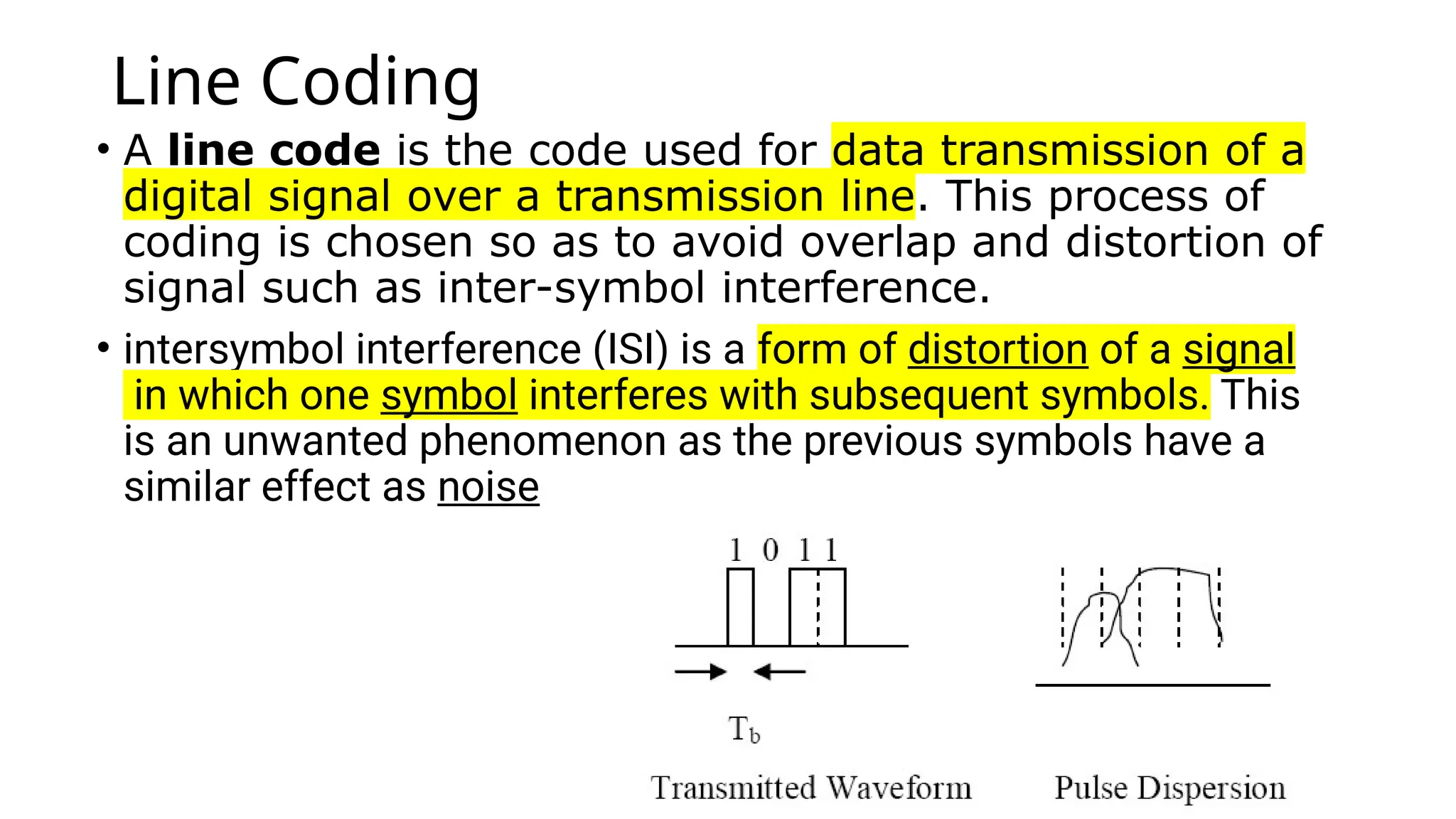
• intersymbol interference (ISI) is a form of distortion of a signal
in which one symbol interferes with subsequent symbols. This
is an unwanted phenomenon as the previous symbols have a
similar effect as noise
3.
Properties of LineCoding
• As the coding is done to make more bits transmit on a single
signal, the bandwidth used is much reduced.
• For a given bandwidth, the power is efficiently used.
• The probability of error is much reduced.
• Error detection is done and the bipolar too has a correction
capability.
• Power density is much favorable.
• The timing content is adequate.
• Long strings of 1s and 0s is avoided to maintain
transparency.
Unipolar Signaling
Unipolar signalingis also called as On-Off Keying or
simply OOK.
The presence of pulse represents a 1 and the absence of
pulse represents a 0.
There are two variations in Unipolar signaling −
• Non Return to Zero (NRZ)
• Return to Zero (RZ)
6.
Unipolar Non-Return toZero (NRZ)
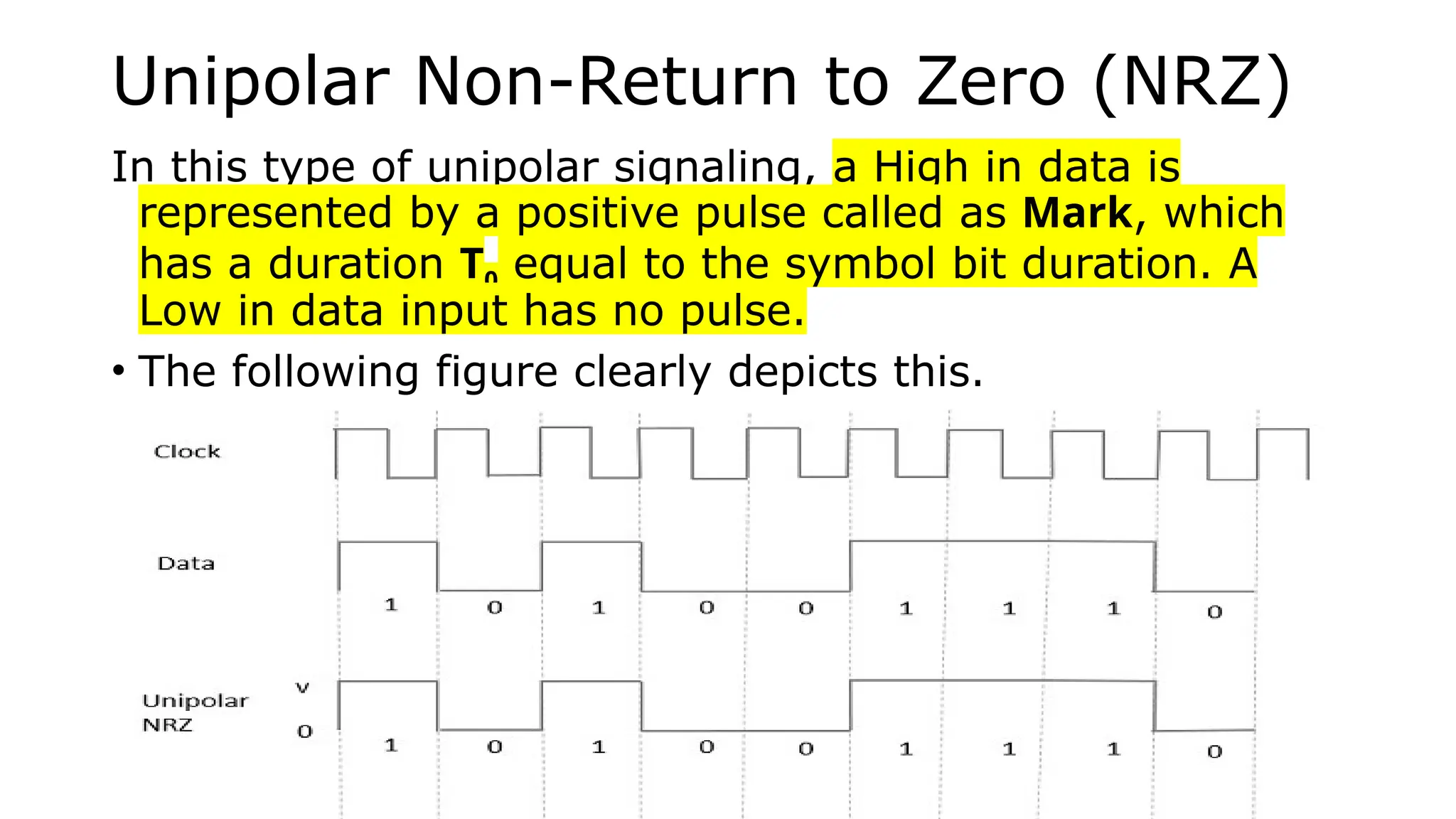
In this type of unipolar signaling, a High in data is
represented by a positive pulse called as Mark, which
has a duration T0 equal to the symbol bit duration. A
Low in data input has no pulse.
• The following figure clearly depicts this.
7.
Unipolar Return toZero (RZ)
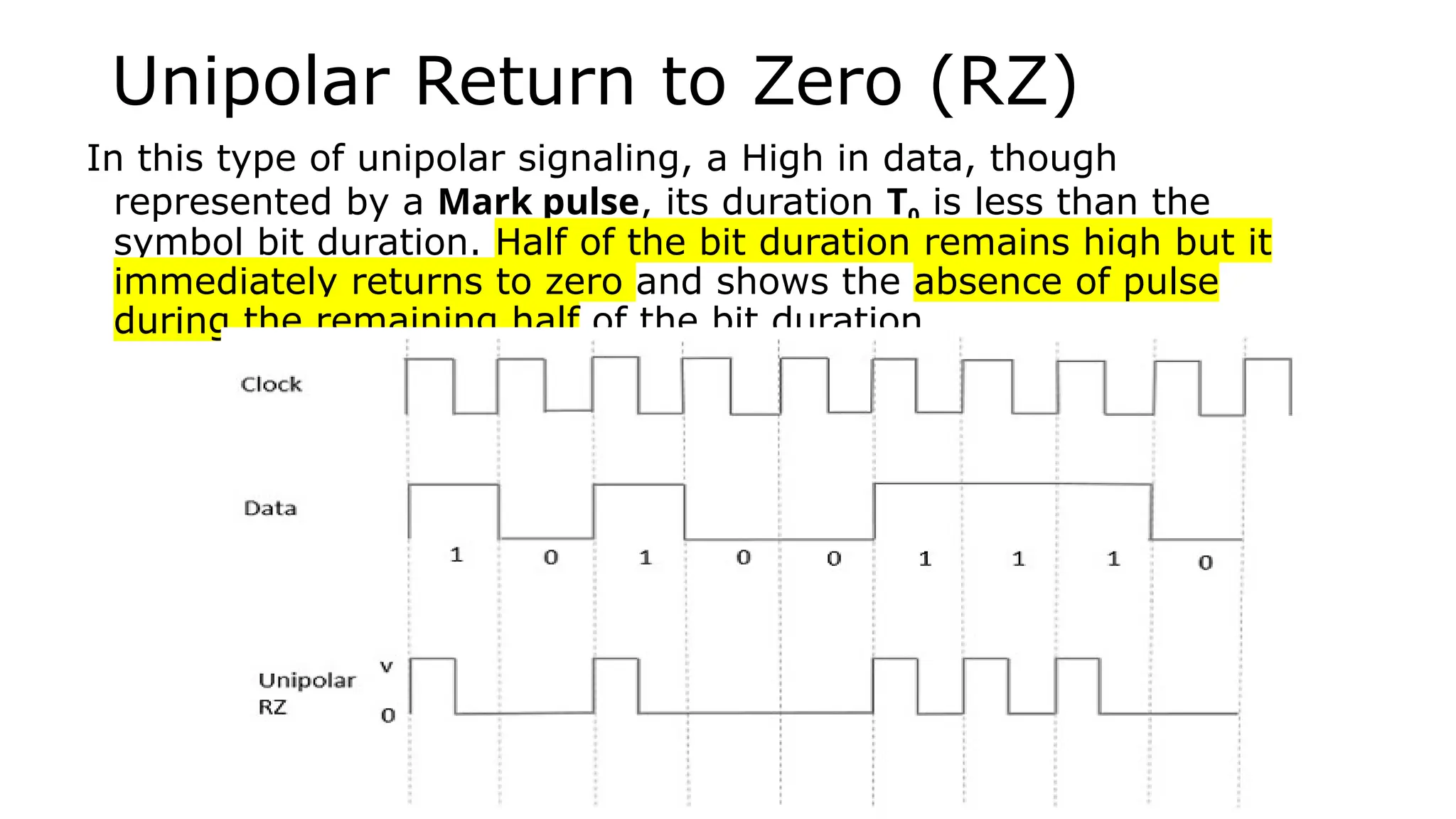
In this type of unipolar signaling, a High in data, though
represented by a Mark pulse, its duration T0 is less than the
symbol bit duration. Half of the bit duration remains high but it
immediately returns to zero and shows the absence of pulse
during the remaining half of the bit duration.
•Polar NRZ
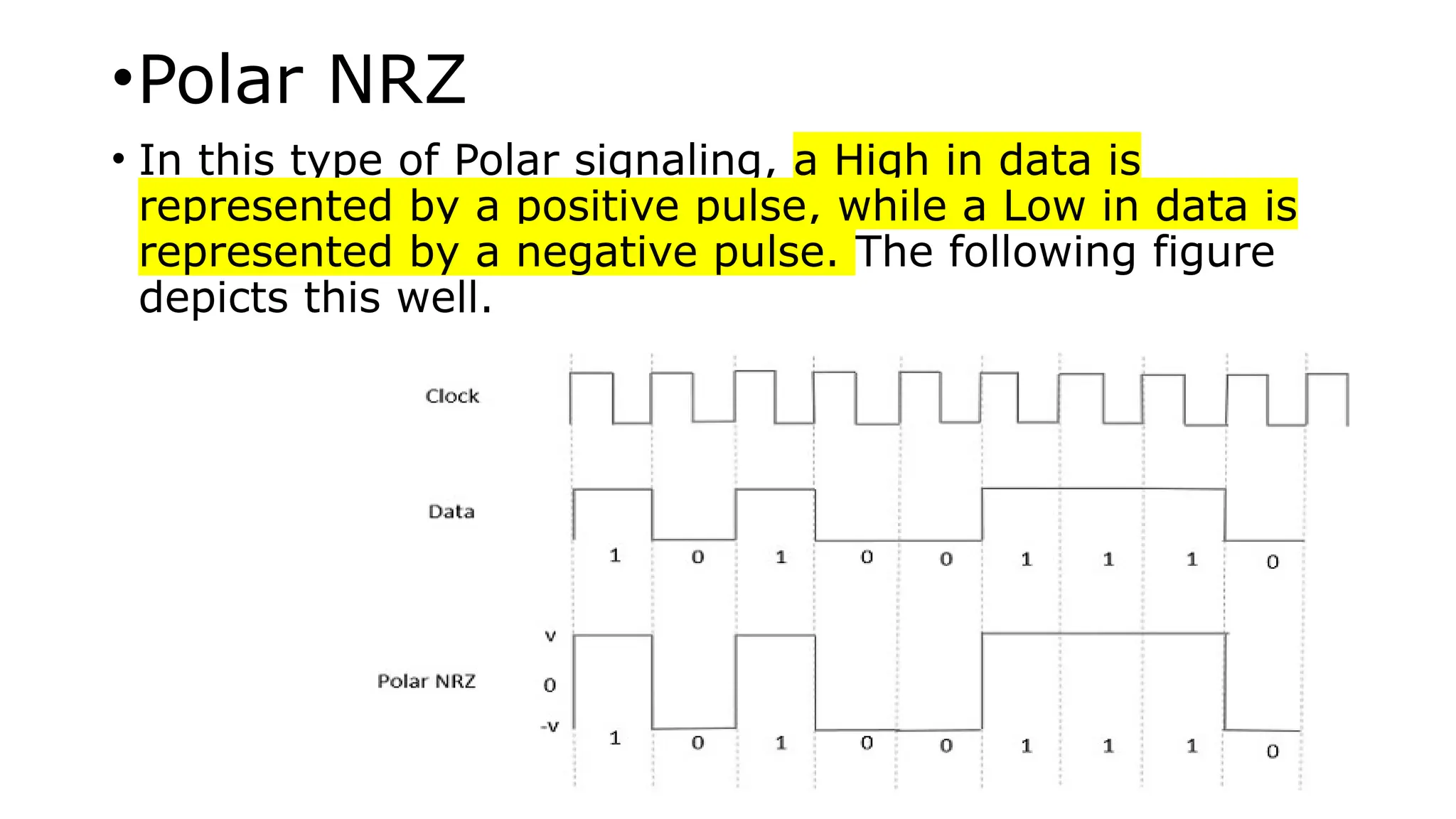
• Inthis type of Polar signaling, a High in data is
represented by a positive pulse, while a Low in data is
represented by a negative pulse. The following figure
depicts this well.
10.
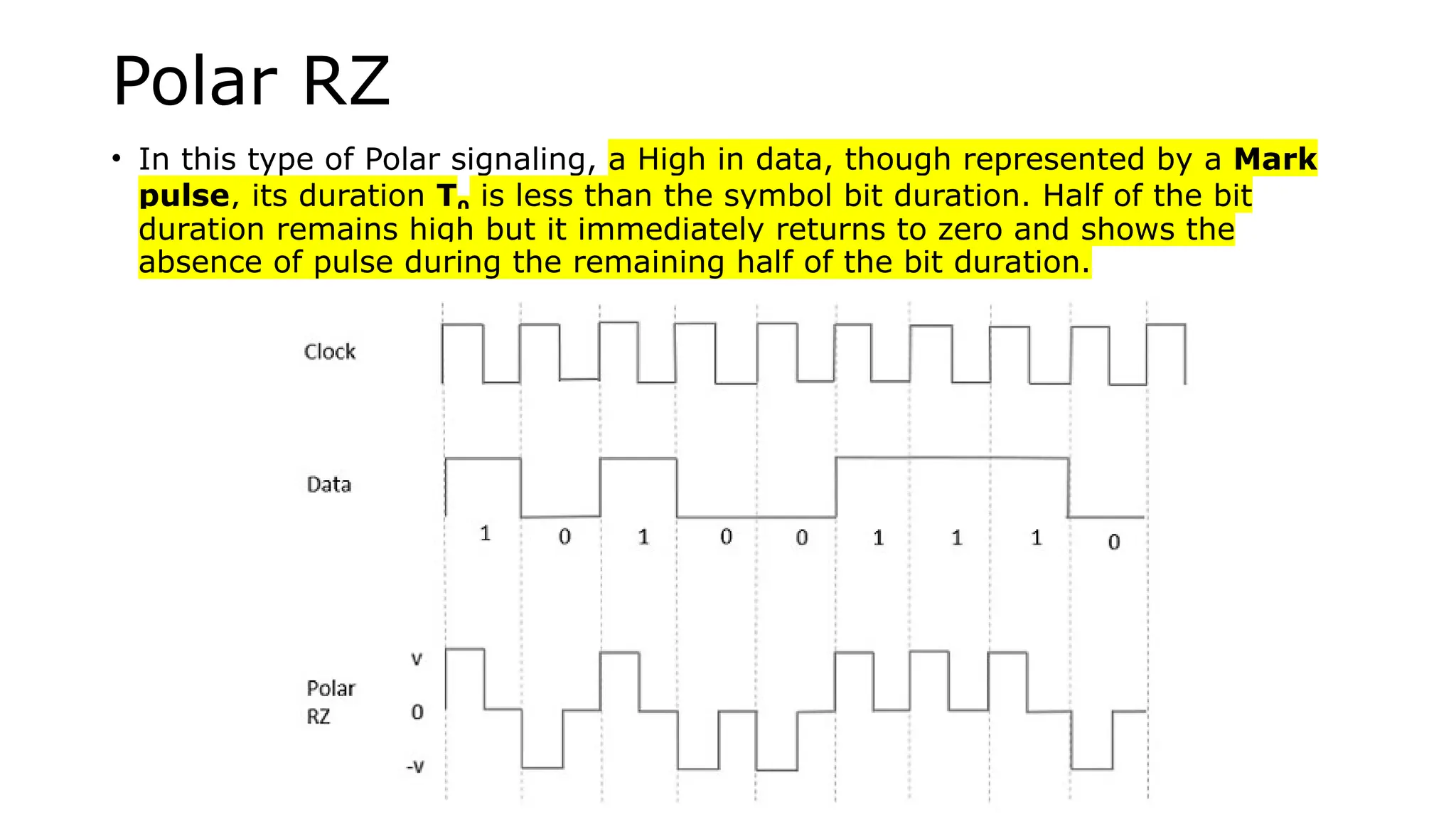
Polar RZ
• Inthis type of Polar signaling, a High in data, though represented by a Mark
pulse, its duration T0 is less than the symbol bit duration. Half of the bit
duration remains high but it immediately returns to zero and shows the
absence of pulse during the remaining half of the bit duration.
11.
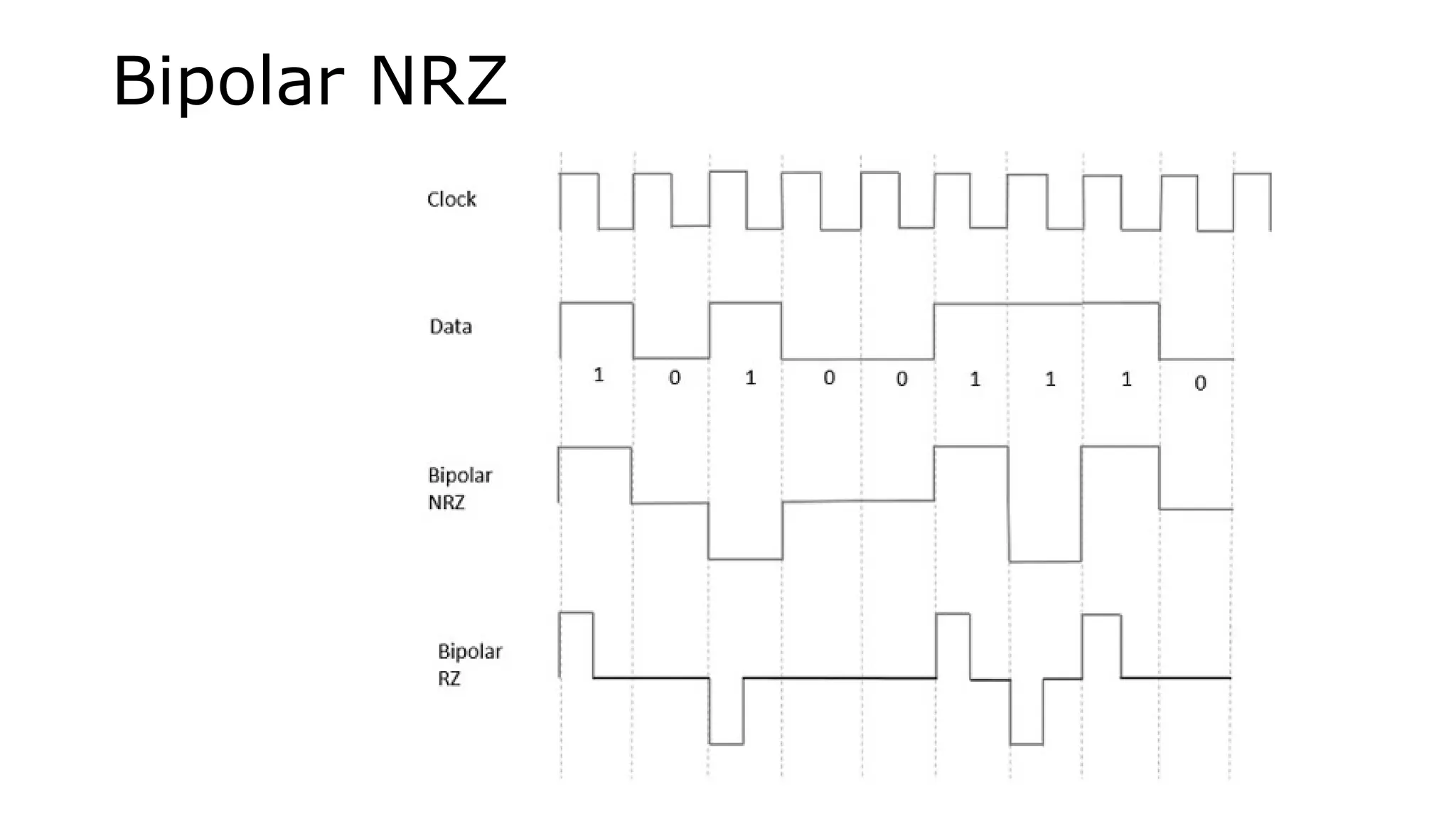
Bipolar Signaling
This isan encoding technique which has three voltage
levels namely +, - and 0. Such a signal is called as duo-
binary signal.
An example of this type is Alternate Mark Inversion (AMI).
For a 1, the voltage level gets a transition from + to – or
from – to +, having alternate 1s to be of equal polarity.
A 0 will have a zero voltage level.
Even in this method, we have two types.
• Bipolar NRZ
• Bipolar RZ
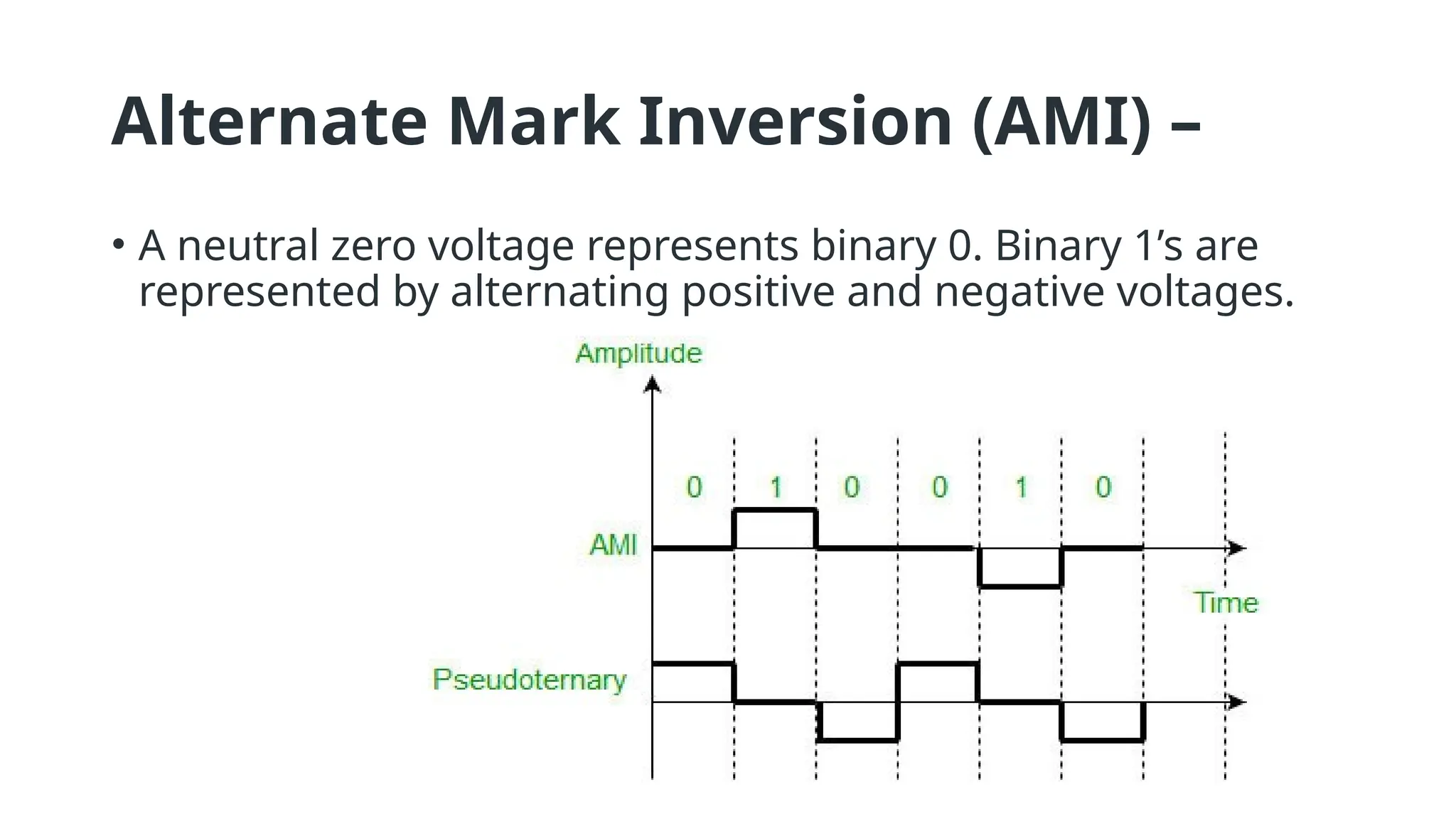
Alternate Mark Inversion(AMI) –
• A neutral zero voltage represents binary 0. Binary 1’s are
represented by alternating positive and negative voltages.
14.
Biphase (Manchester and
DifferentialManchester )
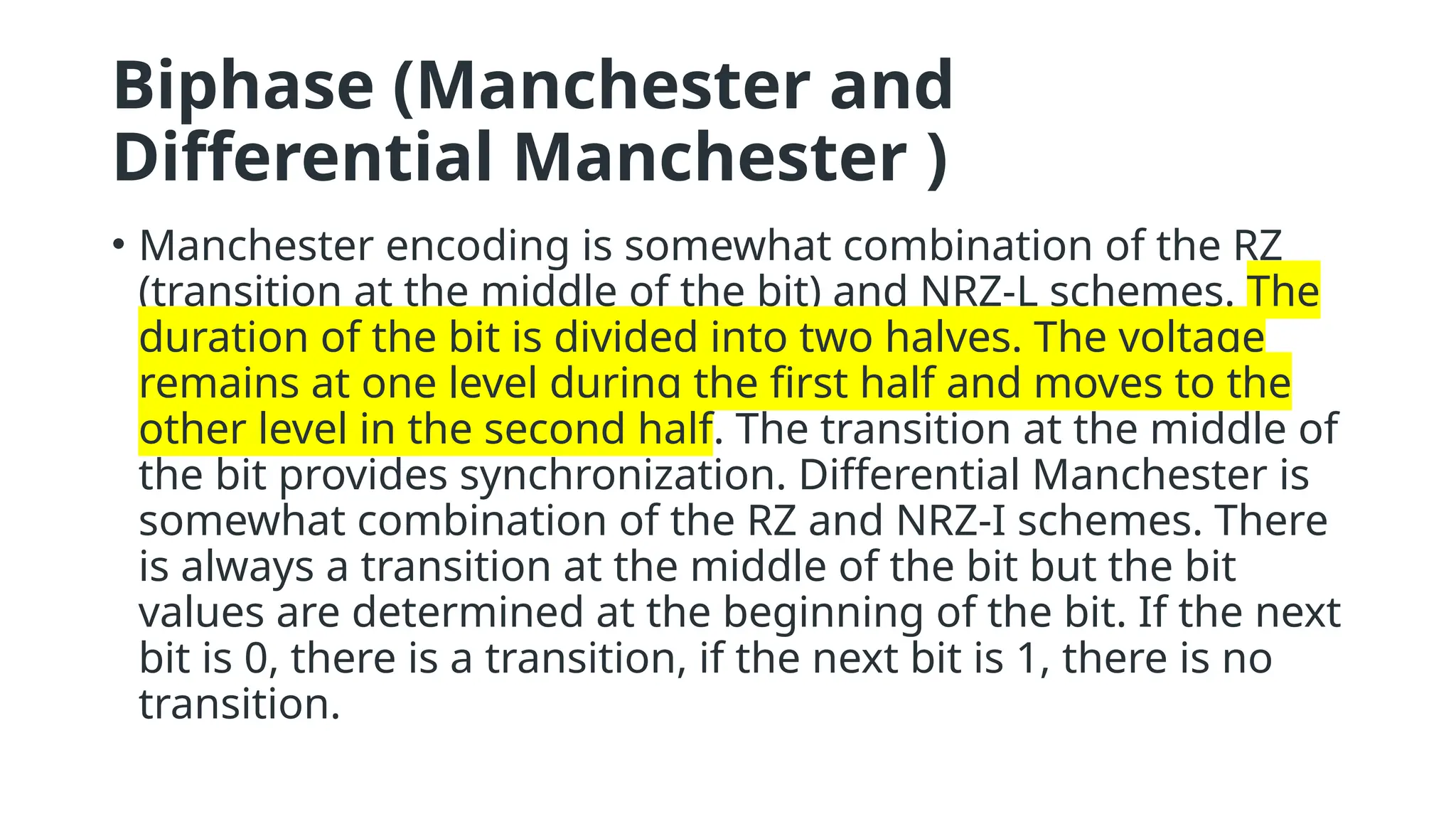
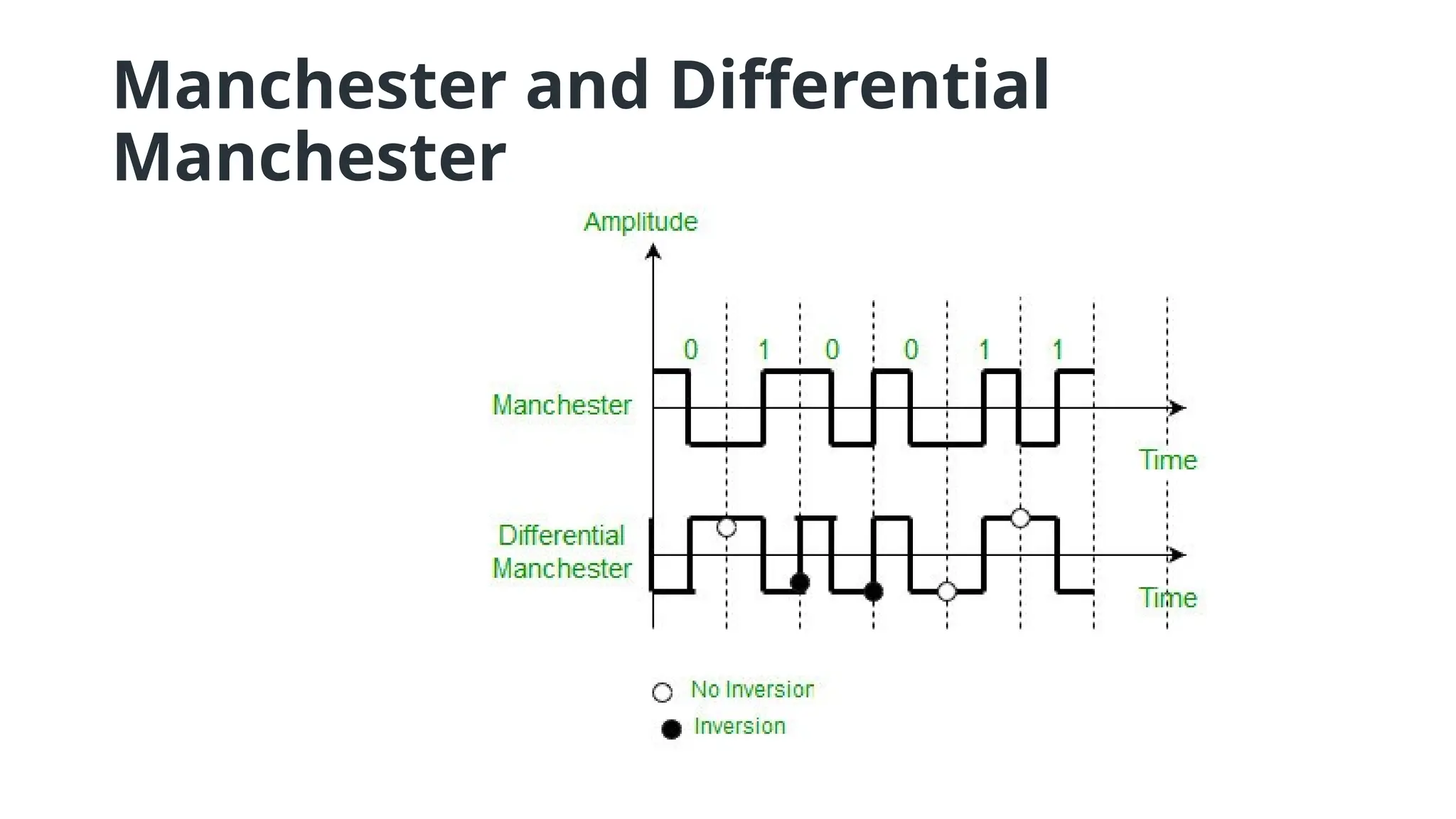
• Manchester encoding is somewhat combination of the RZ
(transition at the middle of the bit) and NRZ-L schemes. The
duration of the bit is divided into two halves. The voltage
remains at one level during the first half and moves to the
other level in the second half. The transition at the middle of
the bit provides synchronization. Differential Manchester is
somewhat combination of the RZ and NRZ-I schemes. There
is always a transition at the middle of the bit but the bit
values are determined at the beginning of the bit. If the next
bit is 0, there is a transition, if the next bit is 1, there is no
transition.
M-ary Encoding
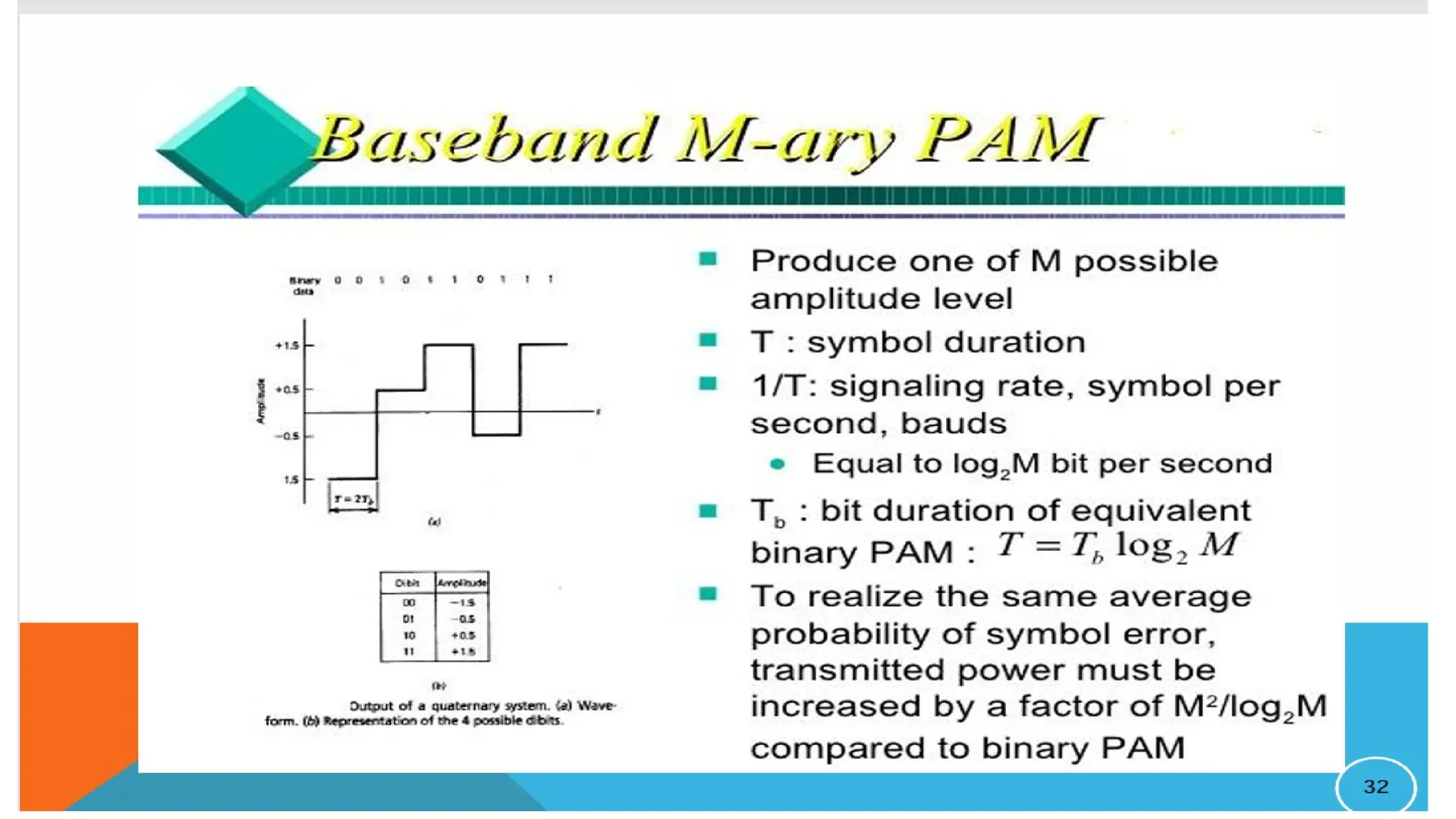
The wordbinary represents two bits. M represents a digit
that corresponds to the number of conditions, levels, or
combinations possible for a given number of binary
variables.
• This is the type of digital modulation technique used for
data transmission in which instead of one bit, two or
more bits are transmitted at a time. As a single signal is
used for multiple bit transmission, the channel
bandwidth is reduced.