
Some Developments in Climate Science
          Since IPCC AR4
Prepared for the Climate Change Science Symposium


                  John Merrill,
                   URI GSO


                  May 6, 2011
Talk organization
I’ll zoom over several topics from jet stream altitude, and then
cover one finding in some detail.
There’s little rationale for this inhomogeneity.
Multiple topics


   Since 1979, the Arctic sea ice extent has been declining at a rate
   of 11% per decade. Not only did the ice extent reduce but so did
   the average thickness of the sea ice, which decreased strongly; this
   increases the vulnerability to further decreases.
   Winter ice has decreased in thickness, and the February, 2011 the
   Arctic sea ice extent was a record low.
   Periods of rapid Arctic sea ice loss lead to faster warming over land
   in polar regions. The exposure of low-albedo ocean waters results
   in warming; the release of this heat into the atmosphere and its
   transport onshore allow an extended season of microbial
   decomposition of thawing peat and other organic matter.
Multiple topics


   In AR4 the IPCC concluded that Antarctica was the only continent
   where no global warming had been observed. Recent work
   indicates that there has been a positive surface temperature trend
   from 1957-2006 in West and East Antarctica.
   The airborne fraction of CO2 may have increased recently, the
   expected decrease in buffering capacity. Conflicting results from
   estimates over differing time periods complicate the picture.
Multiple topics


   The Ocean Heat Content Anomaly, OHCA, has shown a gradual
   increase over the past 50 years, but analyses included substantial
   decadal scale fluctuations that are larger than those seen in
   model most simulations.
   Recent work detecting systematic errors in the treatment of the
   data have led to revised estimates, with reduced interdecadal
   variability. Also, parallel analyses by different groups yield similar
   results, providing corroboration.
   The linear trends in the Ocean Heat Content of the upper 700 m
   are 0.27± 0.04 ×10²² J/yr for the period 1955 - 2008 and 0.40±
   0.05 ×10²² J/yr for the period 1969 - 2008.
Acceleration of mass loss from ice sheets


   Rignot et al. (GRL, 2011), present mass balance observations for
   Greenland and Antarctica ice sheets over two decades. The
   observations are corroborated by comparison of two techniques
   over the most recent 8 years.
   The ice data are Surface Mass Balance estimates (snowfall minus
   ablation), combined with perimeter loss (ice discharge) estimates.
   Satellite data are a time series of monthly time-resolved gravity
   data from the Gravity Recovery and Climate Experiment (GRACE).
Acceleration of mass loss from ice sheets

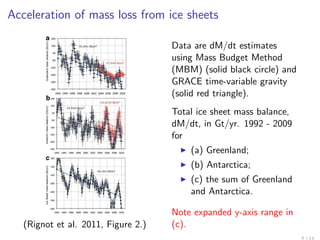
                                     Data are dM/dt estimates
                                     using Mass Budget Method
                                     (MBM) (solid black circle) and
                                     GRACE time-variable gravity
                                     (solid red triangle).
                                     Total ice sheet mass balance,
                                     dM/dt, in Gt/yr. 1992 - 2009
                                     for
                                         (a) Greenland;
                                         (b) Antarctica;
                                         (c) the sum of Greenland
                                         and Antarctica.

                                     Note expanded y-axis range in
   (Rignot et al. 2011, Figure 2.)   (c).
Acceleration of mass loss from ice sheets


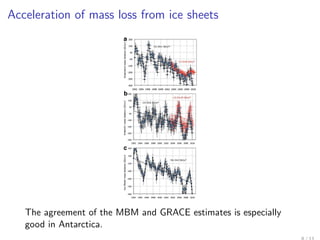
   The agreement of the MBM and GRACE estimates is especially
   good in Antarctica.
The acceleration rate in ice sheet mass balance, in Gt/yr2 , is
determined from a linear fit of MBM over 18 yr (black line) and
GRACE over 8 yr (red line).
The combined acceleration of ice sheet mass loss totals over 36
Gt/yr2 . This acceleration is over 3 times that for mountain glaciers
and ice caps.
The estimated contribution to sea level rise over the next 50 years
would be 15±2 cm, exceeding the impact of melting of individual
glaciers and ice caps, 8±4 cm, and thermal expansion of the
ocean, 9±3 cm.
If continued, this trend would make ice sheet loss the dominant
source of sea level rise in the upcoming century.
Final notes
Recall that findings published after March, 2006 are not cited or
used substantively in AR4.
Numerical models of sea ice extent significantly underestimate the
observed downward trend. I have concluded that these models will
remain unreliable until significant advances can be made.
Some sources
Peter Good, et al., An updated review of developments in climate
science research since the IPCC Fourth Assessment Report. [An
extended (177 page) analysis by British Met Office and affiliated
analysts, up to date to November, 2010.]
Kelly Levin and D. Tirpak, Climate Science 2008 - Major New
Discoveries. World Resource Institute “Issue Brief”, 28 pp, July,
2009.
R. vanDorland et al.,News in Climate Science since IPCC 2007:
Topics of interest in the scientific basis of climate change, KNMI,
de Bilt, November, 2009.

Some Developments in Climate Science Since IPCC AR4 Prepared for the Climate Change Science Symposium

  • 1.
    Some Developments inClimate Science Since IPCC AR4 Prepared for the Climate Change Science Symposium John Merrill, URI GSO May 6, 2011
  • 2.
    Talk organization I’ll zoomover several topics from jet stream altitude, and then cover one finding in some detail. There’s little rationale for this inhomogeneity.
  • 3.
    Multiple topics Since 1979, the Arctic sea ice extent has been declining at a rate of 11% per decade. Not only did the ice extent reduce but so did the average thickness of the sea ice, which decreased strongly; this increases the vulnerability to further decreases. Winter ice has decreased in thickness, and the February, 2011 the Arctic sea ice extent was a record low. Periods of rapid Arctic sea ice loss lead to faster warming over land in polar regions. The exposure of low-albedo ocean waters results in warming; the release of this heat into the atmosphere and its transport onshore allow an extended season of microbial decomposition of thawing peat and other organic matter.
  • 4.
    Multiple topics In AR4 the IPCC concluded that Antarctica was the only continent where no global warming had been observed. Recent work indicates that there has been a positive surface temperature trend from 1957-2006 in West and East Antarctica. The airborne fraction of CO2 may have increased recently, the expected decrease in buffering capacity. Conflicting results from estimates over differing time periods complicate the picture.
  • 5.
    Multiple topics The Ocean Heat Content Anomaly, OHCA, has shown a gradual increase over the past 50 years, but analyses included substantial decadal scale fluctuations that are larger than those seen in model most simulations. Recent work detecting systematic errors in the treatment of the data have led to revised estimates, with reduced interdecadal variability. Also, parallel analyses by different groups yield similar results, providing corroboration. The linear trends in the Ocean Heat Content of the upper 700 m are 0.27± 0.04 ×10²² J/yr for the period 1955 - 2008 and 0.40± 0.05 ×10²² J/yr for the period 1969 - 2008.
  • 6.
    Acceleration of massloss from ice sheets Rignot et al. (GRL, 2011), present mass balance observations for Greenland and Antarctica ice sheets over two decades. The observations are corroborated by comparison of two techniques over the most recent 8 years. The ice data are Surface Mass Balance estimates (snowfall minus ablation), combined with perimeter loss (ice discharge) estimates. Satellite data are a time series of monthly time-resolved gravity data from the Gravity Recovery and Climate Experiment (GRACE).
  • 7.
    Acceleration of massloss from ice sheets Data are dM/dt estimates using Mass Budget Method (MBM) (solid black circle) and GRACE time-variable gravity (solid red triangle). Total ice sheet mass balance, dM/dt, in Gt/yr. 1992 - 2009 for (a) Greenland; (b) Antarctica; (c) the sum of Greenland and Antarctica. Note expanded y-axis range in (Rignot et al. 2011, Figure 2.) (c).
  • 8.
    Acceleration of massloss from ice sheets The agreement of the MBM and GRACE estimates is especially good in Antarctica.
  • 9.
    The acceleration ratein ice sheet mass balance, in Gt/yr2 , is determined from a linear fit of MBM over 18 yr (black line) and GRACE over 8 yr (red line). The combined acceleration of ice sheet mass loss totals over 36 Gt/yr2 . This acceleration is over 3 times that for mountain glaciers and ice caps. The estimated contribution to sea level rise over the next 50 years would be 15±2 cm, exceeding the impact of melting of individual glaciers and ice caps, 8±4 cm, and thermal expansion of the ocean, 9±3 cm. If continued, this trend would make ice sheet loss the dominant source of sea level rise in the upcoming century.
  • 10.
    Final notes Recall thatfindings published after March, 2006 are not cited or used substantively in AR4. Numerical models of sea ice extent significantly underestimate the observed downward trend. I have concluded that these models will remain unreliable until significant advances can be made.
  • 11.
    Some sources Peter Good,et al., An updated review of developments in climate science research since the IPCC Fourth Assessment Report. [An extended (177 page) analysis by British Met Office and affiliated analysts, up to date to November, 2010.] Kelly Levin and D. Tirpak, Climate Science 2008 - Major New Discoveries. World Resource Institute “Issue Brief”, 28 pp, July, 2009. R. vanDorland et al.,News in Climate Science since IPCC 2007: Topics of interest in the scientific basis of climate change, KNMI, de Bilt, November, 2009.