ASSESSMENT OF ALBEDO CHANGES AND THEIR DRIVING FACTORS  OVER THE QINGHAI-TIBETAN PLATEAU B. Zhang, L. Lei,  Hao Zhang,  L. Zhang and Z. Zen WE4.T06.4 - Geology and Solid Earth V  Location: Room 12 Sension Time: July 27, 15:20 - 17:00 Presentation Time: July 27, 16:20 - 16:40 Vancouver, July 27
Outlines 1. Studying area 2. Scientific problems 3. Data collected  4. Results and discussion  5. Conclusion
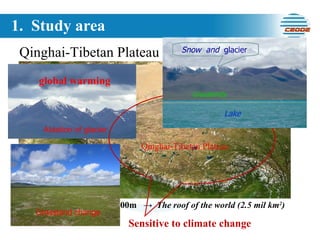
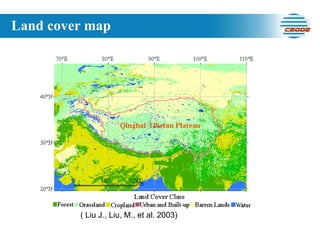
1.  Study area Average elevation :  4500m   ->  The roof of the world (2.5 mil km 2 )  Qinghai-Tibetan Plateau Qinghai-Tibetan Plateau global warming Ablation of glacier Grassland change  Sensitive to climate change Lake Grasslands Snow  and  glacier
Land cover map  ( Liu J., Liu, M., et al. 2003)
Assessed the spatial-temporal change of land surface albedo  2.  Scientific problems Variation of surface factors driving albedo variations:  snow cover, vegetation cover (NDVI) as albedo variation is one of the key factors to impose the radiative forcing on the climate  Ten year: 2000~2009 using the datasets derived from satellite observations Albedo variations responding to the change of snow and vegetation  What Happens?  And  Why?  And How?
3.  Data and Methodology MODIS datasets included MODIS/Terra+Aqua  Albedo  16-Day L3 Global 500m SIN Grid V005 ( MCD43A3 )  (NASA)   ( Albedo-ρ) (that is available every 8-day )  (2) MODIS/Terra  Vegetation Indices  16-Day L3 Global 500m SIN Grid V005 ( MOD13A2 )  (3) MODIS/Terra  Snow Cover  8-day L3 Global 500m Grid ( MOD10A2 )  (http://lpdaac.usgs.gov/) (4)  land use  map of China in 2005 ( produced by Landsat images)  (5)  Temperature and precipitation  data  ( measured from 2000 to 2009 on 48 meteorological stations in the Qinghai-Tibetan plateau ) Periods: from  2000 to 2009  (ten years); coverage:  12 tiles  of MODIS
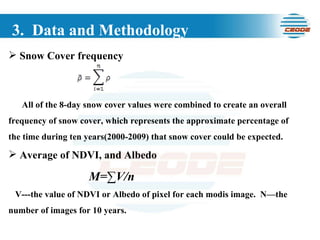
3.  Data and Methodology Snow Cover frequency All of the 8-day snow cover values were combined to create an overall frequency of snow cover, which represents the approximate percentage of the time during ten years(2000-2009) that snow cover could be expected. Average of NDVI, and Albedo M=∑V/n V---the value of NDVI or Albedo of pixel for each modis image.  N—the number of images for 10 years.
3.  Data and Methodology Inter-annal Trends of Albedo or NDVI (2000-2009) j: for values of different MODIS data within a year; j: certain year, such as 2000, 2001 V---the value of NDVI or Albedo of pixel for each modis image Correlation coefficients COV(X, Y ) =E([X-E(X)][Y-E(Y)])
4.  Results and discussion Spatial variation of general average albedo, average NDVI and frequency of snow cover Inter-annual albedo change driven by snow cover Inter-annual summer albedo change driven by vegetation
1) average albedo, average NDVI and frequency of snow cover from 2000 to 2009 Albedo Frequency of snow cover NDVI greater average albedo are corresponding to high frequency snow cover except the desert areas lesser values is corresponding to larger NDVI over alpine grassland and meadow, and forests (larger than 0.4) correlation coefficient of albedo with snow cover is up to 0.60; with NDVI is 0. 57 for the whole area of Qinghai-Tibetan plateau
2) Inter-annual albedo change driven by snow cover Maduo Maduo Variation  of albedo consistently coincided with the snow cover  changes Change trend of albedo Changes trends of snow cover
Changes trends of snow cover Temperature increasing trend Precipitation decreasing trend
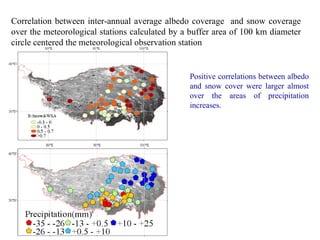
Correlation between inter-annual average albedo coverage  and snow coverage over the meteorological stations calculated  by a buffer area of 100 km diameter circle centered the meteorological observation station Positive correlations between albedo and snow cover were larger almost over the areas of precipitation increases.
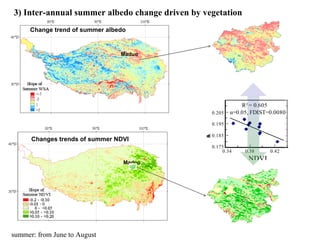
Maduo Maduo Change trend of summer albedo Changes trends of summer NDVI summer: from June to August 3) Inter-annual summer albedo change driven by vegetation
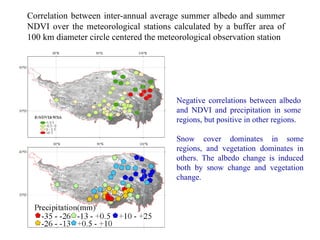
Correlation between inter-annual average  summer  albedo and summer NDVI over the meteorological stations calculated  by a buffer area of 100 km diameter circle centered the meteorological observation station Negative correlations between albedo and NDVI and precipitation in some regions, but positive in other regions. Snow cover dominates in some regions, and vegetation dominates in others. The albedo change is induced both by snow change and vegetation change.
5.  Conclusions Albedo sensitively change with snow cover since the albedo of  snow is greatest. Increasing snow cover will increase albedo.  (2)  Dual effects  of  decreasing snow cover  and  increasing temperature   which strength the snow melting resulted in the  albedo rising (red color) over the areas of permanent snow cover and glacier in the southern Qinghai-Tibetan plateau .  Climate warming effects in the studying area: If the temperature is rising simultaneously without greater snowfall increasing but with rainfall increase in summer, albedo will  be decreased by the change of surface condition (snow cover, vegetation, soil moisture etc.), which will weaken the known cooling effects of Qinghai-Tibetan plateau.
 

IGARSSoral_Zhang_July.ppt

  • 1.
    ASSESSMENT OF ALBEDOCHANGES AND THEIR DRIVING FACTORS OVER THE QINGHAI-TIBETAN PLATEAU B. Zhang, L. Lei, Hao Zhang, L. Zhang and Z. Zen WE4.T06.4 - Geology and Solid Earth V Location: Room 12 Sension Time: July 27, 15:20 - 17:00 Presentation Time: July 27, 16:20 - 16:40 Vancouver, July 27
  • 2.
    Outlines 1. Studyingarea 2. Scientific problems 3. Data collected 4. Results and discussion 5. Conclusion
  • 3.
    1. Studyarea Average elevation : 4500m -> The roof of the world (2.5 mil km 2 ) Qinghai-Tibetan Plateau Qinghai-Tibetan Plateau global warming Ablation of glacier Grassland change Sensitive to climate change Lake Grasslands Snow and glacier
  • 4.
    Land cover map ( Liu J., Liu, M., et al. 2003)
  • 5.
    Assessed the spatial-temporalchange of land surface albedo 2. Scientific problems Variation of surface factors driving albedo variations: snow cover, vegetation cover (NDVI) as albedo variation is one of the key factors to impose the radiative forcing on the climate Ten year: 2000~2009 using the datasets derived from satellite observations Albedo variations responding to the change of snow and vegetation What Happens? And Why? And How?
  • 6.
    3. Dataand Methodology MODIS datasets included MODIS/Terra+Aqua Albedo 16-Day L3 Global 500m SIN Grid V005 ( MCD43A3 ) (NASA) ( Albedo-ρ) (that is available every 8-day ) (2) MODIS/Terra Vegetation Indices 16-Day L3 Global 500m SIN Grid V005 ( MOD13A2 ) (3) MODIS/Terra Snow Cover 8-day L3 Global 500m Grid ( MOD10A2 ) (http://lpdaac.usgs.gov/) (4) land use map of China in 2005 ( produced by Landsat images) (5) Temperature and precipitation data ( measured from 2000 to 2009 on 48 meteorological stations in the Qinghai-Tibetan plateau ) Periods: from 2000 to 2009 (ten years); coverage: 12 tiles of MODIS
  • 7.
    3. Dataand Methodology Snow Cover frequency All of the 8-day snow cover values were combined to create an overall frequency of snow cover, which represents the approximate percentage of the time during ten years(2000-2009) that snow cover could be expected. Average of NDVI, and Albedo M=∑V/n V---the value of NDVI or Albedo of pixel for each modis image. N—the number of images for 10 years.
  • 8.
    3. Dataand Methodology Inter-annal Trends of Albedo or NDVI (2000-2009) j: for values of different MODIS data within a year; j: certain year, such as 2000, 2001 V---the value of NDVI or Albedo of pixel for each modis image Correlation coefficients COV(X, Y ) =E([X-E(X)][Y-E(Y)])
  • 9.
    4. Resultsand discussion Spatial variation of general average albedo, average NDVI and frequency of snow cover Inter-annual albedo change driven by snow cover Inter-annual summer albedo change driven by vegetation
  • 10.
    1) average albedo,average NDVI and frequency of snow cover from 2000 to 2009 Albedo Frequency of snow cover NDVI greater average albedo are corresponding to high frequency snow cover except the desert areas lesser values is corresponding to larger NDVI over alpine grassland and meadow, and forests (larger than 0.4) correlation coefficient of albedo with snow cover is up to 0.60; with NDVI is 0. 57 for the whole area of Qinghai-Tibetan plateau
  • 11.
    2) Inter-annual albedochange driven by snow cover Maduo Maduo Variation of albedo consistently coincided with the snow cover changes Change trend of albedo Changes trends of snow cover
  • 12.
    Changes trends ofsnow cover Temperature increasing trend Precipitation decreasing trend
  • 13.
    Correlation between inter-annualaverage albedo coverage and snow coverage over the meteorological stations calculated by a buffer area of 100 km diameter circle centered the meteorological observation station Positive correlations between albedo and snow cover were larger almost over the areas of precipitation increases.
  • 14.
    Maduo Maduo Changetrend of summer albedo Changes trends of summer NDVI summer: from June to August 3) Inter-annual summer albedo change driven by vegetation
  • 15.
    Correlation between inter-annualaverage summer albedo and summer NDVI over the meteorological stations calculated by a buffer area of 100 km diameter circle centered the meteorological observation station Negative correlations between albedo and NDVI and precipitation in some regions, but positive in other regions. Snow cover dominates in some regions, and vegetation dominates in others. The albedo change is induced both by snow change and vegetation change.
  • 16.
    5. ConclusionsAlbedo sensitively change with snow cover since the albedo of snow is greatest. Increasing snow cover will increase albedo. (2) Dual effects of decreasing snow cover and increasing temperature which strength the snow melting resulted in the albedo rising (red color) over the areas of permanent snow cover and glacier in the southern Qinghai-Tibetan plateau . Climate warming effects in the studying area: If the temperature is rising simultaneously without greater snowfall increasing but with rainfall increase in summer, albedo will be decreased by the change of surface condition (snow cover, vegetation, soil moisture etc.), which will weaken the known cooling effects of Qinghai-Tibetan plateau.
  • 17.