Somatometric measurements
generally used for identification
INTRODUCTION:
Anthropometry refers to the measurements of the human body.
Anthropometry is categorized into three groups for convenience. They are
somatometry (measurement on living human body), osteometry
(measurement on skeletal long and short bones) and craniometry
(measurement on the skull). Measurements on the living human is made
using well defined anatomical landmarks. Somatometry is useful to compare
different populations, designing aircrafts, space ships, furniture and uniforms
to defense and paramilitary personnel; assessment of nutritional status; to
study the effect of interventions; developing non-invasive markers for
diagnosis; to formulate policy and; to understand micro-evolutionary process
as they are reflected in genetic and morphological traits in human
populations (Bhasin, 2006). Variations in human body dimensions are
hypothesized to be due to interaction of environment with biological,
nutritional, economic and cultural factors.
• Guidelines for measurements of somatometric parameters:
Measurements are recorded in a standing position with minimal
clothing without shoes and the head should be in the ear-eye plane
(Frankfurt plane). Measurements are generally made on the right side
of the body unless there is evidence of extra musculature in which
case, measurements should be made on the left side. In the case of
infants or children, measurements can be made by advising them to
sit on a stool of 40 cm in height. The allowed personal errors for
various measurements are of the following: head measurement (0.5-
1.0mm); head height (2.0 mm); most of the body measurements (3.0-
5.0mm)
• Anatomical landmarks: These may be defined as any anatomic feature
present in a tissue that serves to indicate a specific structure or
position. There are several landmarks used in Somatometry. Some of
the landmarks are given below:
• Acropodion: Distal point on the toe-cap of the first or second toe
• Alare: Lateral point on the nasal wing
• Euryon: Lateral point on the sides of the head
• Glabella: Point between the eyebrow ridges above the nasal root
• Gnathion: Point on the lower margin of the lower jaw at midsagittal plane
• Gonion: Lowest posterior and most lateral point on the angle of the lower jaw
• Inion: Point on tuberculum linear on posterior protuberance in midsagittal plane
• Nasion: Point on the nasal root in the midsagittal plane
• Pronasale: Anterior point on the tip of the nose
• Prosthion: Point on the lower margin of the gums of the upper jaw in the midsagittal plane
• Pternion: Hind most point on the heel of the stretched foot
• Subnasale: Point at the lower margin of the nasal septum meets the integument of upper lip
• Tragion: Point on the upper margin of tragus 1-2 cm below the helix spine
• Zygion: Lateral point on the zygomatic arch
• Vertex Highest point on the head
• Acromion Lateral point on the lateral margin of the acromial process
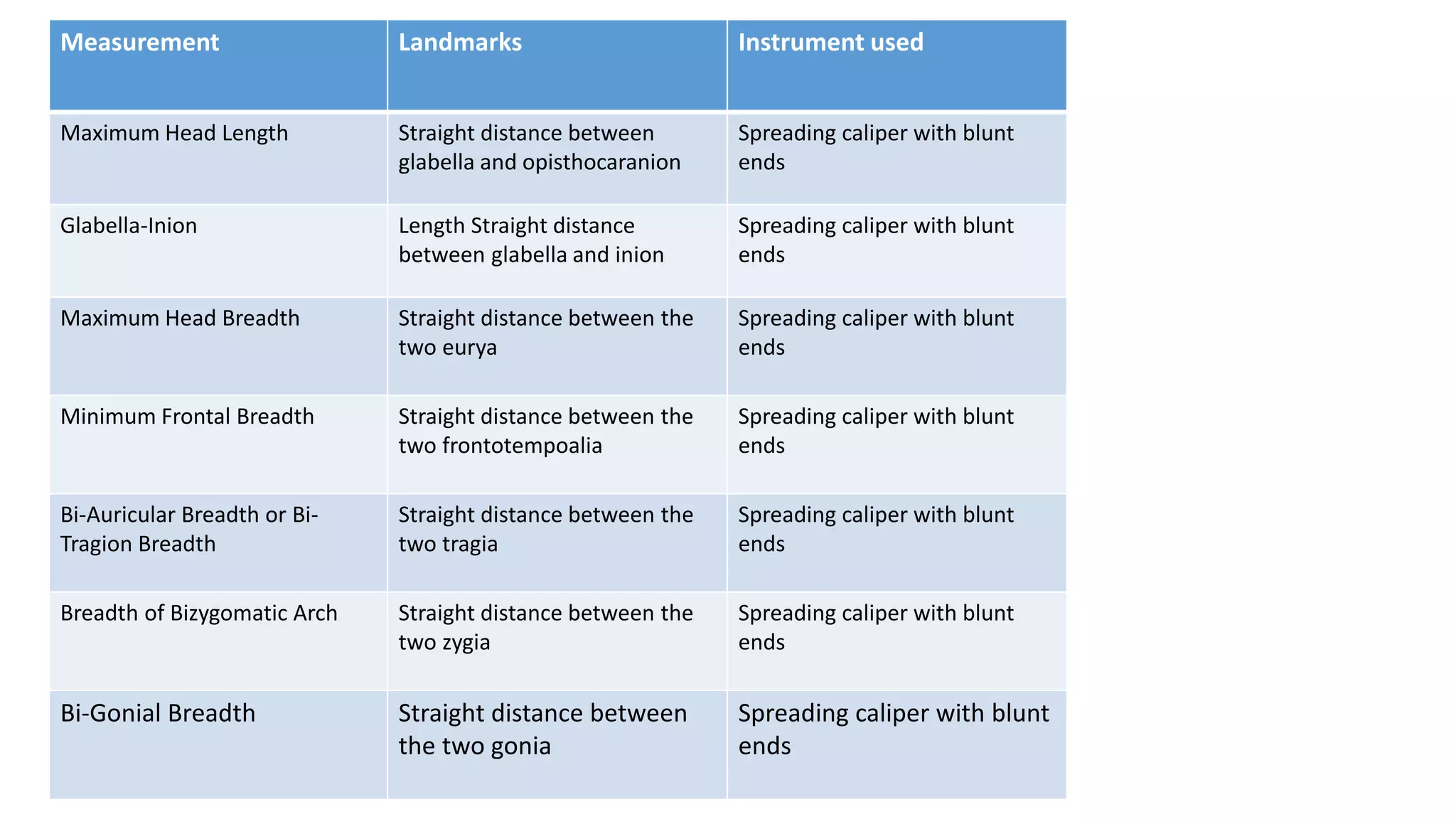
Measurement Landmarks Instrument used
Maximum Head Length Straight distance between
glabella and opisthocaranion
Spreading caliper with blunt
ends
Glabella-Inion Length Straight distance
between glabella and inion
Spreading caliper with blunt
ends
Maximum Head Breadth Straight distance between the
two eurya
Spreading caliper with blunt
ends
Minimum Frontal Breadth Straight distance between the
two frontotempoalia
Spreading caliper with blunt
ends
Bi-Auricular Breadth or Bi-
Tragion Breadth
Straight distance between the
two tragia
Spreading caliper with blunt
ends
Breadth of Bizygomatic Arch Straight distance between the
two zygia
Spreading caliper with blunt
ends
Bi-Gonial Breadth Straight distance between
the two gonia
Spreading caliper with blunt
ends
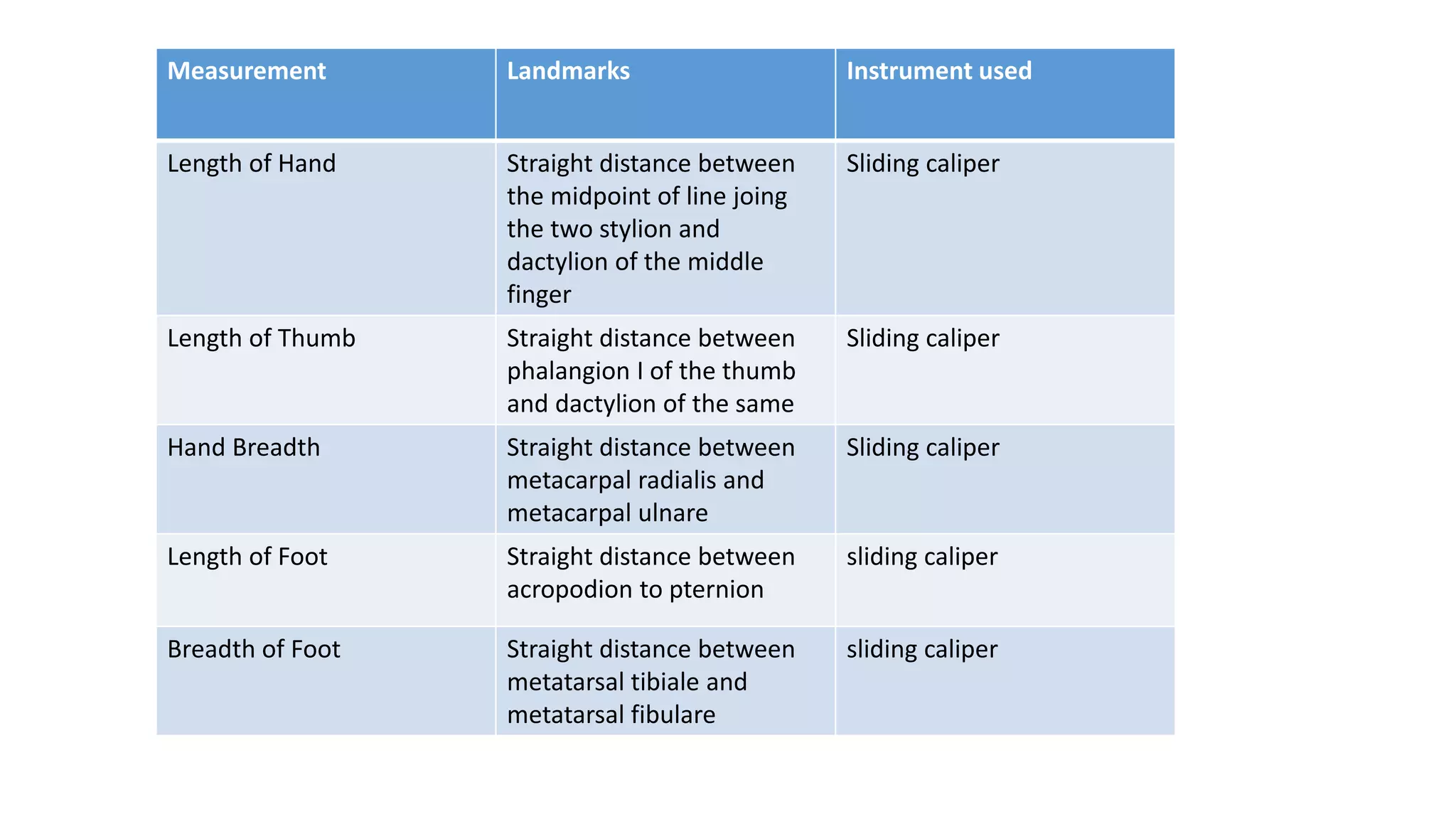
Measurement Landmarks Instrument used
Length of Hand Straight distance between
the midpoint of line joing
the two stylion and
dactylion of the middle
finger
Sliding caliper
Length of Thumb Straight distance between
phalangion I of the thumb
and dactylion of the same
Sliding caliper
Hand Breadth Straight distance between
metacarpal radialis and
metacarpal ulnare
Sliding caliper
Length of Foot Straight distance between
acropodion to pternion
sliding caliper
Breadth of Foot Straight distance between
metatarsal tibiale and
metatarsal fibulare
sliding caliper
Measurement Landmarks Instrument used
Chest Girth
1.Chest Girth Inspiration 2.Chest
Girth Expiration
Circumference of the chest when breathing
normally. Recorded at both inspiration and
expiration.
Tape
Waist Girth Circumference of the abdomen at the most lateral
contour of the body between the ribs and intestine
Tape
Hip Girth Circumference of the hips at their widest portion Tape
Maximum Girth of the Upper
arm
Circumference of the upper arm at the maximal
development of biceps muscles
Tape
Maximum Girth of Forearm Maximum circumference of the lower arm under
the elbow joint
Tape
Least Girth of the Forearm or
Girth of wrist
Least cricumferne of the forearm proximal to the
styloid process
Tape
Maximum Girth of Thigh Circumference at the lowest point in the gluteal
furrow and horizontal to the thigh
Tape
Maximum Calf Girth Circumference where calf muscles are most
developed
Tape
Mesurement Landmarks Instrument used
Nasal Breadth Straight distance between
the two alaria
Sliding caliper with flat arm
Nasal Height Straight distance between
nasion and subnasale
Sliding caliper with flat arm
Nasal Depth Projective distance between
tip of th Nasal Depth
Projective distance between
tip of the nose and hind-
most of the nasal septum
Sliding caliper with flat arm
Nasal Length or Length of
Nose
Straight distance between
nasion and pronasale
Sliding caliper with flat arm
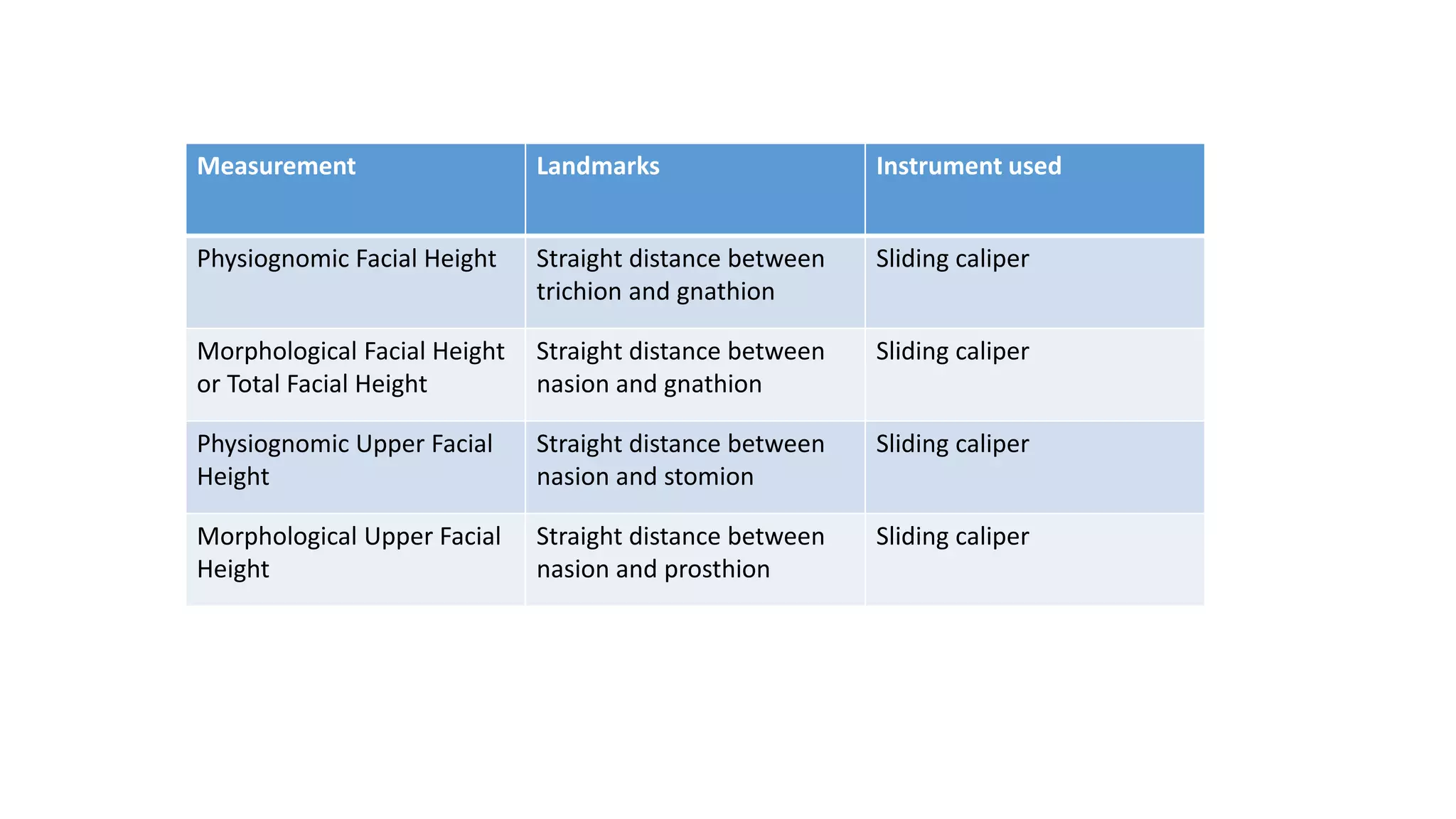
Measurement Landmarks Instrument used
Physiognomic Facial Height Straight distance between
trichion and gnathion
Sliding caliper
Morphological Facial Height
or Total Facial Height
Straight distance between
nasion and gnathion
Sliding caliper
Physiognomic Upper Facial
Height
Straight distance between
nasion and stomion
Sliding caliper
Morphological Upper Facial
Height
Straight distance between
nasion and prosthion
Sliding caliper
• 29 measurements ( head, face, nose, hand, feet, girth)
A list of some of the somatometric measurements
with land marks and instruments
Measurement Landmarks Instrument used
Height Vertex or
Stature
Vertex-Floor Anthropometer
Sitting Height Vertex Vertex-Sitting surface
of the subject
Anthropometer
Sitting Height
Acromion or Shoulder
Height Sitting
Acromion-Sitting
surface of the subject
Anthropometer
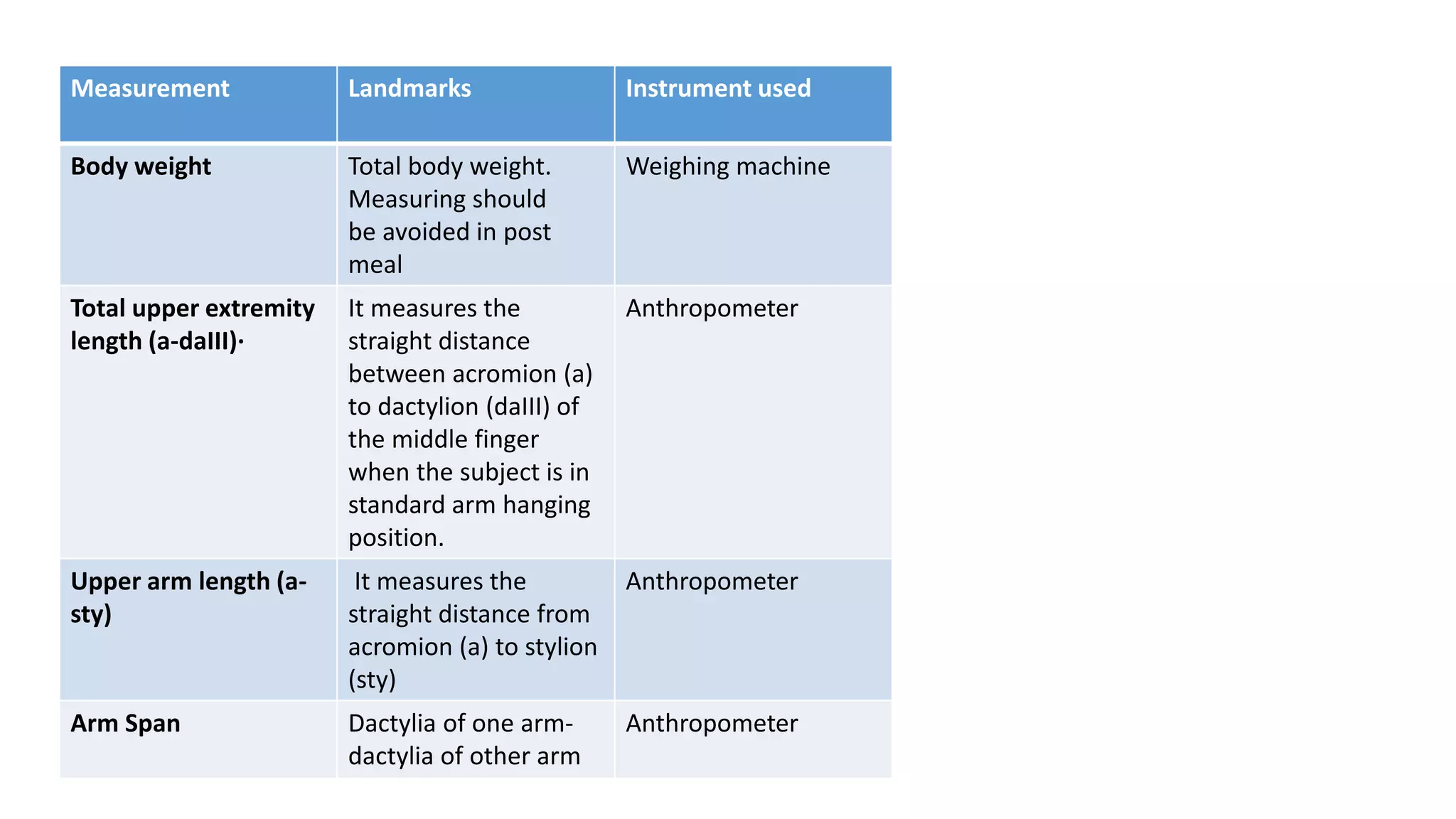
Measurement Landmarks Instrument used
Body weight Total body weight.
Measuring should
be avoided in post
meal
Weighing machine
Total upper extremity
length (a-daIII)·
It measures the
straight distance
between acromion (a)
to dactylion (daIII) of
the middle finger
when the subject is in
standard arm hanging
position.
Anthropometer
Upper arm length (a-
sty)
It measures the
straight distance from
acromion (a) to stylion
(sty)
Anthropometer
Arm Span Dactylia of one arm-
dactylia of other arm
Anthropometer
Somatometric indices generally used for
identification
• Relative sitting height
index: It is calculated by
dividing sitting height
vertex with height vertex
and then multiplied by
100
• Cephalic index =
[(Maximum head breadth
(eu-eu))/(Maximum head
length (g-op))] x 100
Somatometric indices generally used for
identification
• Morphological facial index =
[(Morphological Facial Height
(n-gn))/(Bi-zygomatic breadth
(zy-zy)) ] x 100
• Morphological Upper facial index : It is calculated by dividing the
upper morphological facial height (nasion-prosthion height) by
bizygomatic breadth and multiplying the quotient by 100.
• Nasal index = [(Nasal breadth (al-al))/(Nasal Height (n-sn ))] x 100
Somatometric measurements generally used for identification.pptx

Somatometric measurements generally used for identification.pptx

  • 1.
  • 2.
    INTRODUCTION: Anthropometry refers tothe measurements of the human body. Anthropometry is categorized into three groups for convenience. They are somatometry (measurement on living human body), osteometry (measurement on skeletal long and short bones) and craniometry (measurement on the skull). Measurements on the living human is made using well defined anatomical landmarks. Somatometry is useful to compare different populations, designing aircrafts, space ships, furniture and uniforms to defense and paramilitary personnel; assessment of nutritional status; to study the effect of interventions; developing non-invasive markers for diagnosis; to formulate policy and; to understand micro-evolutionary process as they are reflected in genetic and morphological traits in human populations (Bhasin, 2006). Variations in human body dimensions are hypothesized to be due to interaction of environment with biological, nutritional, economic and cultural factors.
  • 3.
    • Guidelines formeasurements of somatometric parameters: Measurements are recorded in a standing position with minimal clothing without shoes and the head should be in the ear-eye plane (Frankfurt plane). Measurements are generally made on the right side of the body unless there is evidence of extra musculature in which case, measurements should be made on the left side. In the case of infants or children, measurements can be made by advising them to sit on a stool of 40 cm in height. The allowed personal errors for various measurements are of the following: head measurement (0.5- 1.0mm); head height (2.0 mm); most of the body measurements (3.0- 5.0mm)
  • 4.
    • Anatomical landmarks:These may be defined as any anatomic feature present in a tissue that serves to indicate a specific structure or position. There are several landmarks used in Somatometry. Some of the landmarks are given below: • Acropodion: Distal point on the toe-cap of the first or second toe • Alare: Lateral point on the nasal wing • Euryon: Lateral point on the sides of the head • Glabella: Point between the eyebrow ridges above the nasal root • Gnathion: Point on the lower margin of the lower jaw at midsagittal plane • Gonion: Lowest posterior and most lateral point on the angle of the lower jaw • Inion: Point on tuberculum linear on posterior protuberance in midsagittal plane • Nasion: Point on the nasal root in the midsagittal plane • Pronasale: Anterior point on the tip of the nose • Prosthion: Point on the lower margin of the gums of the upper jaw in the midsagittal plane • Pternion: Hind most point on the heel of the stretched foot • Subnasale: Point at the lower margin of the nasal septum meets the integument of upper lip • Tragion: Point on the upper margin of tragus 1-2 cm below the helix spine • Zygion: Lateral point on the zygomatic arch • Vertex Highest point on the head • Acromion Lateral point on the lateral margin of the acromial process
  • 5.
    Measurement Landmarks Instrumentused Maximum Head Length Straight distance between glabella and opisthocaranion Spreading caliper with blunt ends Glabella-Inion Length Straight distance between glabella and inion Spreading caliper with blunt ends Maximum Head Breadth Straight distance between the two eurya Spreading caliper with blunt ends Minimum Frontal Breadth Straight distance between the two frontotempoalia Spreading caliper with blunt ends Bi-Auricular Breadth or Bi- Tragion Breadth Straight distance between the two tragia Spreading caliper with blunt ends Breadth of Bizygomatic Arch Straight distance between the two zygia Spreading caliper with blunt ends Bi-Gonial Breadth Straight distance between the two gonia Spreading caliper with blunt ends
  • 6.
    Measurement Landmarks Instrumentused Length of Hand Straight distance between the midpoint of line joing the two stylion and dactylion of the middle finger Sliding caliper Length of Thumb Straight distance between phalangion I of the thumb and dactylion of the same Sliding caliper Hand Breadth Straight distance between metacarpal radialis and metacarpal ulnare Sliding caliper Length of Foot Straight distance between acropodion to pternion sliding caliper Breadth of Foot Straight distance between metatarsal tibiale and metatarsal fibulare sliding caliper
  • 7.
    Measurement Landmarks Instrumentused Chest Girth 1.Chest Girth Inspiration 2.Chest Girth Expiration Circumference of the chest when breathing normally. Recorded at both inspiration and expiration. Tape Waist Girth Circumference of the abdomen at the most lateral contour of the body between the ribs and intestine Tape Hip Girth Circumference of the hips at their widest portion Tape Maximum Girth of the Upper arm Circumference of the upper arm at the maximal development of biceps muscles Tape Maximum Girth of Forearm Maximum circumference of the lower arm under the elbow joint Tape Least Girth of the Forearm or Girth of wrist Least cricumferne of the forearm proximal to the styloid process Tape Maximum Girth of Thigh Circumference at the lowest point in the gluteal furrow and horizontal to the thigh Tape Maximum Calf Girth Circumference where calf muscles are most developed Tape
  • 8.
    Mesurement Landmarks Instrumentused Nasal Breadth Straight distance between the two alaria Sliding caliper with flat arm Nasal Height Straight distance between nasion and subnasale Sliding caliper with flat arm Nasal Depth Projective distance between tip of th Nasal Depth Projective distance between tip of the nose and hind- most of the nasal septum Sliding caliper with flat arm Nasal Length or Length of Nose Straight distance between nasion and pronasale Sliding caliper with flat arm
  • 9.
    Measurement Landmarks Instrumentused Physiognomic Facial Height Straight distance between trichion and gnathion Sliding caliper Morphological Facial Height or Total Facial Height Straight distance between nasion and gnathion Sliding caliper Physiognomic Upper Facial Height Straight distance between nasion and stomion Sliding caliper Morphological Upper Facial Height Straight distance between nasion and prosthion Sliding caliper
  • 10.
    • 29 measurements( head, face, nose, hand, feet, girth)
  • 11.
    A list ofsome of the somatometric measurements with land marks and instruments Measurement Landmarks Instrument used Height Vertex or Stature Vertex-Floor Anthropometer Sitting Height Vertex Vertex-Sitting surface of the subject Anthropometer Sitting Height Acromion or Shoulder Height Sitting Acromion-Sitting surface of the subject Anthropometer
  • 12.
    Measurement Landmarks Instrumentused Body weight Total body weight. Measuring should be avoided in post meal Weighing machine Total upper extremity length (a-daIII)· It measures the straight distance between acromion (a) to dactylion (daIII) of the middle finger when the subject is in standard arm hanging position. Anthropometer Upper arm length (a- sty) It measures the straight distance from acromion (a) to stylion (sty) Anthropometer Arm Span Dactylia of one arm- dactylia of other arm Anthropometer
  • 13.
    Somatometric indices generallyused for identification • Relative sitting height index: It is calculated by dividing sitting height vertex with height vertex and then multiplied by 100 • Cephalic index = [(Maximum head breadth (eu-eu))/(Maximum head length (g-op))] x 100
  • 14.
    Somatometric indices generallyused for identification • Morphological facial index = [(Morphological Facial Height (n-gn))/(Bi-zygomatic breadth (zy-zy)) ] x 100
  • 15.
    • Morphological Upperfacial index : It is calculated by dividing the upper morphological facial height (nasion-prosthion height) by bizygomatic breadth and multiplying the quotient by 100.
  • 16.
    • Nasal index= [(Nasal breadth (al-al))/(Nasal Height (n-sn ))] x 100