DNA Profiling
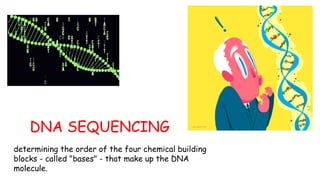
DNA SEQUENCING
determining the order of the four chemical building
blocks - called "bases" - that make up the DNA
molecule.
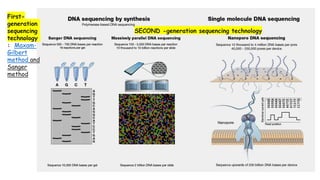
First-
generation
sequencing
technology
: Maxam-
Gilbert
method and
Sanger
method
SECOND -generation sequencing technology
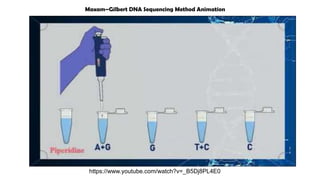
https://www.youtube.com/watch?v=_B5Dj8PL4E0
Maxam–Gilbert DNA Sequencing Method Animation
VAC course: Basics of Bioinformatics 23rd-26th August, 20223
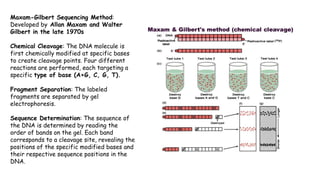
Maxam-Gilbert Sequencing Method:
Developed by Allan Maxam and Walter
Gilbert in the late 1970s
Chemical Cleavage: The DNA molecule is
first chemically modified at specific bases
to create cleavage points. Four different
reactions are performed, each targeting a
specific type of base (A+G, C, G, T).
Fragment Separation: The labeled
fragments are separated by gel
electrophoresis.
Sequence Determination: The sequence of
the DNA is determined by reading the
order of bands on the gel. Each band
corresponds to a cleavage site, revealing the
positions of the specific modified bases and
their respective sequence positions in the
DNA.
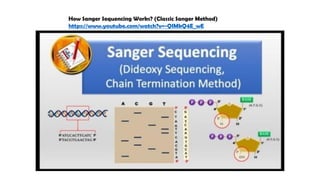
How Sanger Sequencing Works? (Classic Sanger Method)
https://www.youtube.com/watch?v=-QIMkQ4E_wE
VAC course: Basics of Bioinformatics 23rd-26th August, 20223
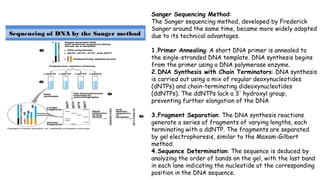
Sanger Sequencing Method:
The Sanger sequencing method, developed by Frederick
Sanger around the same time, became more widely adopted
due to its technical advantages.
1.Primer Annealing: A short DNA primer is annealed to
the single-stranded DNA template. DNA synthesis begins
from the primer using a DNA polymerase enzyme.
2.DNA Synthesis with Chain Terminators: DNA synthesis
is carried out using a mix of regular deoxynucleotides
(dNTPs) and chain-terminating dideoxynucleotides
(ddNTPs). The ddNTPs lack a 3' hydroxyl group,
preventing further elongation of the DNA
3.Fragment Separation: The DNA synthesis reactions
generate a series of fragments of varying lengths, each
terminating with a ddNTP. The fragments are separated
by gel electrophoresis, similar to the Maxam-Gilbert
method.
4.Sequence Determination: The sequence is deduced by
analyzing the order of bands on the gel, with the last band
in each lane indicating the nucleotide at the corresponding
position in the DNA sequence.
VAC course: Basics of Bioinformatics 23rd-26th August, 20223
•Principle: Both methods rely on chemical modifications and
subsequent separation to determine DNA sequence.
•Read Length: Sanger sequencing generally provided longer read
lengths compared to Maxam-Gilbert sequencing.
•Throughput: Sanger sequencing was more amenable to automation and
higher throughput due to the use of a single reaction mix with chain-
terminating nucleotides.
•Labor Intensity: Maxam-Gilbert sequencing involved more complex
chemical reactions and separate reactions for each base type, making it
more labor-intensive.
•Widespread Adoption: Sanger sequencing gained wider adoption due to
its simpler reaction setup and more streamlined process.
•Advancement: Both methods laid the groundwork for DNA sequencing
but have been largely replaced by high-throughput Next-Generation
Sequencing (NGS) methods due to their speed, scalability, and lower c
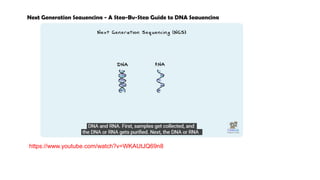
Next Generation Sequencing - A Step-By-Step Guide to DNA Sequencing
https://www.youtube.com/watch?v=WKAUtJQ69n8
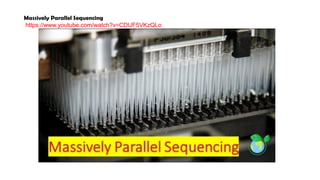
Massively Parallel Sequencing
https://www.youtube.com/watch?v=CDUF5VKzQLo
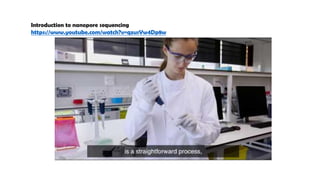
Introduction to nanopore sequencing
https://www.youtube.com/watch?v=qzusVw4Dp8w
Unit 4: DNA database and quality assurance
• NDNAD, CODIS, and other databases,
• DNA Lab Quality Assurance and Quality Control, Forensic DNA
Advisory Groups: US DOJ, SWGDAM, AAFS, ENFSI DNA WG, and
ISFG DNA. National and International accredited bodies, quality
standards, certification, and legal Admissibility of DNA Evidence.
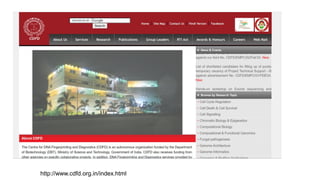
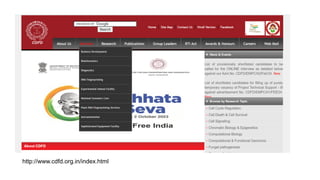
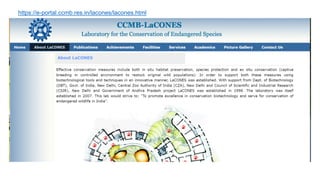
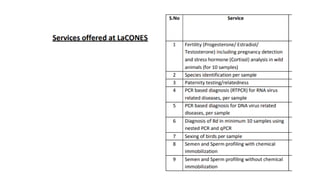
• National bodies for DNA profiling: CDFD, CCMB, LaCONES.
http://www.cdfd.org.in/index.html
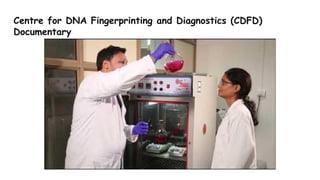
Centre for DNA Fingerprinting and Diagnostics (CDFD)
Documentary
https://www.ccmb.res.in/
https://www.ccmb.res.in/Service/Molecular-Diagnosis
https://e-portal.ccmb.res.in/lacones/lacones.html
VAC course: Basics of Bioinformatics 23rd-26th August, 20223
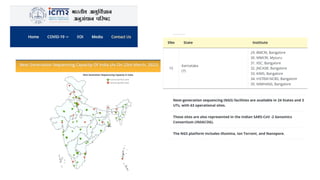
https://www.icmr.gov.in/cnextgenseq.html
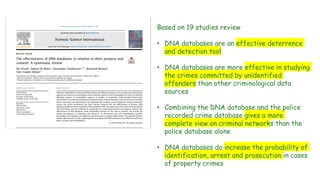
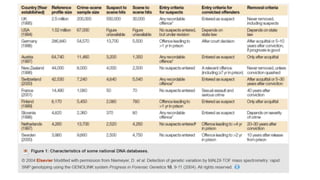
Based on 19 studies review
• DNA databases are an effective deterrence
and detection tool
• DNA databases are more effective in studying
the crimes committed by unidentified
offenders than other criminological data
sources
• Combining the DNA database and the police
recorded crime database gives a more
complete view on criminal networks than the
police database alone
• DNA databases do increase the probability of
identification, arrest and prosecution in cases
of property crimes
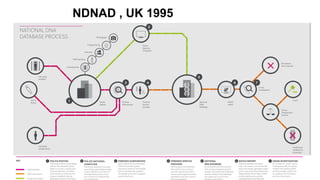
NDNAD , UK 1995
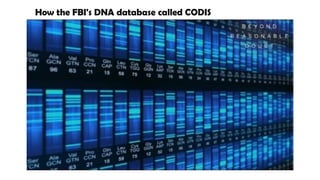
How the FBI's DNA database called CODIS
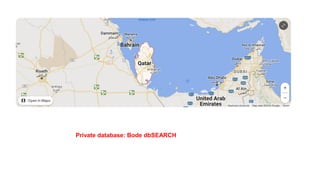
Private database: Bode dbSEARCH
direct matching between known
and unknown sample profiles
profiles from missing persons
and their relatives
unidentified human remains
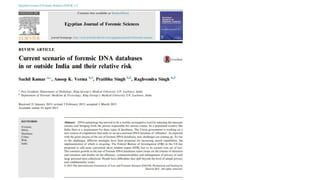
Current scenario in India
• huge requirement for these types of
databases which may help in stopping
different types of fraud like ration
card fraud, voter identity card fraud,
driving license fraud etc
• The database may help the Indian
police to differentiate the criminals
and non criminals.
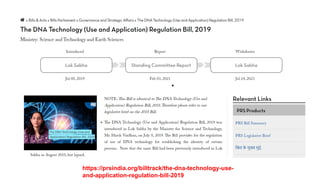
https://prsindia.org/billtrack/the-dna-technology-use-
and-application-regulation-bill-2019
• The DNA Technology (Use and
Application) Regulation Bill, 2019
was introduced in Lok Sabha by the
Minister for Science and
Technology, Mr. Harsh Vardhan, on
July 8, 2019.
• Use of DNA Data: offences under
the Indian Penal Code, 1860, and
for civil matters such as paternity
suits.
• DNA testing for matters related
to establishment of individual
identity.
Collection of DNA
arrested persons: written consent if the offence carries a
punishment of up to seven years
more than seven years of imprisonment or death,
consent is not required
person is a victim, or relative of a missing person, or a
minor or disabled person, the authorities are required
to obtain the written consent.
Magistrate who may order
DNA Data Bank
National DNA Data Bank and Regional DNA Data
Banks, for every state, or two or more states
maintain indices for the following categories of
data: (i) a crime scene index, (ii) a suspects’ or
undertrials’ index, (iii) an offenders’ index, (iv)
a missing persons’ index, and (v) an unknown
deceased persons’ index.
Removal of DNA profiles
(i) of a suspect if a police report is filed or
court order given
(ii) of an undertrial if a court order is given
iii)on written request, for persons who are
not a suspect, offender or undertrial, from
the crime scene or missing persons’ index.
This Photo by Unknown Author is licensed under CC BY-SA

MSC IV SEMESTER_DNA Profiling - DNA Sequencing.pdf

  • 1.
  • 2.
    DNA SEQUENCING determining theorder of the four chemical building blocks - called "bases" - that make up the DNA molecule.
  • 3.
  • 4.
  • 5.
    VAC course: Basicsof Bioinformatics 23rd-26th August, 20223 Maxam-Gilbert Sequencing Method: Developed by Allan Maxam and Walter Gilbert in the late 1970s Chemical Cleavage: The DNA molecule is first chemically modified at specific bases to create cleavage points. Four different reactions are performed, each targeting a specific type of base (A+G, C, G, T). Fragment Separation: The labeled fragments are separated by gel electrophoresis. Sequence Determination: The sequence of the DNA is determined by reading the order of bands on the gel. Each band corresponds to a cleavage site, revealing the positions of the specific modified bases and their respective sequence positions in the DNA.
  • 6.
    How Sanger SequencingWorks? (Classic Sanger Method) https://www.youtube.com/watch?v=-QIMkQ4E_wE
  • 7.
    VAC course: Basicsof Bioinformatics 23rd-26th August, 20223 Sanger Sequencing Method: The Sanger sequencing method, developed by Frederick Sanger around the same time, became more widely adopted due to its technical advantages. 1.Primer Annealing: A short DNA primer is annealed to the single-stranded DNA template. DNA synthesis begins from the primer using a DNA polymerase enzyme. 2.DNA Synthesis with Chain Terminators: DNA synthesis is carried out using a mix of regular deoxynucleotides (dNTPs) and chain-terminating dideoxynucleotides (ddNTPs). The ddNTPs lack a 3' hydroxyl group, preventing further elongation of the DNA 3.Fragment Separation: The DNA synthesis reactions generate a series of fragments of varying lengths, each terminating with a ddNTP. The fragments are separated by gel electrophoresis, similar to the Maxam-Gilbert method. 4.Sequence Determination: The sequence is deduced by analyzing the order of bands on the gel, with the last band in each lane indicating the nucleotide at the corresponding position in the DNA sequence.
  • 8.
    VAC course: Basicsof Bioinformatics 23rd-26th August, 20223 •Principle: Both methods rely on chemical modifications and subsequent separation to determine DNA sequence. •Read Length: Sanger sequencing generally provided longer read lengths compared to Maxam-Gilbert sequencing. •Throughput: Sanger sequencing was more amenable to automation and higher throughput due to the use of a single reaction mix with chain- terminating nucleotides. •Labor Intensity: Maxam-Gilbert sequencing involved more complex chemical reactions and separate reactions for each base type, making it more labor-intensive. •Widespread Adoption: Sanger sequencing gained wider adoption due to its simpler reaction setup and more streamlined process. •Advancement: Both methods laid the groundwork for DNA sequencing but have been largely replaced by high-throughput Next-Generation Sequencing (NGS) methods due to their speed, scalability, and lower c
  • 9.
    Next Generation Sequencing- A Step-By-Step Guide to DNA Sequencing https://www.youtube.com/watch?v=WKAUtJQ69n8
  • 10.
  • 11.
    Introduction to nanoporesequencing https://www.youtube.com/watch?v=qzusVw4Dp8w
  • 12.
    Unit 4: DNAdatabase and quality assurance • NDNAD, CODIS, and other databases, • DNA Lab Quality Assurance and Quality Control, Forensic DNA Advisory Groups: US DOJ, SWGDAM, AAFS, ENFSI DNA WG, and ISFG DNA. National and International accredited bodies, quality standards, certification, and legal Admissibility of DNA Evidence. • National bodies for DNA profiling: CDFD, CCMB, LaCONES.
  • 13.
  • 14.
  • 16.
    Centre for DNAFingerprinting and Diagnostics (CDFD) Documentary
  • 17.
  • 19.
  • 20.
  • 23.
    VAC course: Basicsof Bioinformatics 23rd-26th August, 20223 https://www.icmr.gov.in/cnextgenseq.html
  • 26.
    Based on 19studies review • DNA databases are an effective deterrence and detection tool • DNA databases are more effective in studying the crimes committed by unidentified offenders than other criminological data sources • Combining the DNA database and the police recorded crime database gives a more complete view on criminal networks than the police database alone • DNA databases do increase the probability of identification, arrest and prosecution in cases of property crimes
  • 27.
  • 30.
    How the FBI'sDNA database called CODIS
  • 32.
  • 33.
    direct matching betweenknown and unknown sample profiles profiles from missing persons and their relatives unidentified human remains
  • 34.
    Current scenario inIndia • huge requirement for these types of databases which may help in stopping different types of fraud like ration card fraud, voter identity card fraud, driving license fraud etc • The database may help the Indian police to differentiate the criminals and non criminals.
  • 35.
  • 36.
    • The DNATechnology (Use and Application) Regulation Bill, 2019 was introduced in Lok Sabha by the Minister for Science and Technology, Mr. Harsh Vardhan, on July 8, 2019. • Use of DNA Data: offences under the Indian Penal Code, 1860, and for civil matters such as paternity suits. • DNA testing for matters related to establishment of individual identity.
  • 37.
    Collection of DNA arrestedpersons: written consent if the offence carries a punishment of up to seven years more than seven years of imprisonment or death, consent is not required person is a victim, or relative of a missing person, or a minor or disabled person, the authorities are required to obtain the written consent. Magistrate who may order
  • 38.
    DNA Data Bank NationalDNA Data Bank and Regional DNA Data Banks, for every state, or two or more states maintain indices for the following categories of data: (i) a crime scene index, (ii) a suspects’ or undertrials’ index, (iii) an offenders’ index, (iv) a missing persons’ index, and (v) an unknown deceased persons’ index.
  • 39.
    Removal of DNAprofiles (i) of a suspect if a police report is filed or court order given (ii) of an undertrial if a court order is given iii)on written request, for persons who are not a suspect, offender or undertrial, from the crime scene or missing persons’ index.
  • 41.
    This Photo byUnknown Author is licensed under CC BY-SA