Mood disordersare characterized by a
disturbance of mood, accompanied by a full or
partial manic or depressive syndrome, which is
not due to any other physical or mental disorder .
Mood disorders are a group of clinical
conditions(syndrome) which are characterized by
a sense of loss of control over one’s mood
and subjective sense of distress, impaired
interpersonal, social and occupational
functioning.
The prevalence rate of mood disorder is 1.5 %,
and it is uniform throughout the world.
4.
HISTORY
Hippocrates (400B.C.) used the terms
mania and melancholia to describe mental
disturbances, it was Aretaeus who first
described mania and depression.
Roman physician (30 A.D.) described
melancholia as depression caused by black
bile
5.
In 1854,Jules Farlet described a
condition called folie circulaire:
alternating moods of depression and
mania
In 1899, Emil Kraepelin described
manic-depressive psychosis using most of
the criteria that psychiatrists use now.
MANIC EPISODE
Introduction:
Lifetime risk – 0.8-1%
Occurs in episodes- lasting usually 3-4 months, followed by clinical recovery.
Future episodes can be manic, depressive or mixed.
The manic episode is characterized by the following features( which should last for at least 1 week and
cause disruption in occupational and social functioning)
Definition:
Mania refers to a syndrome in which the central features are over-activity, mood change( which may be
towards elation or irritability)and self- important ideas.
Mania : an alteration in mood that is expressed by feelings of elation, inflated self- esteem, grandiosity,
hyperactivity, agitation, and accelerated thinking and speaking.
9.
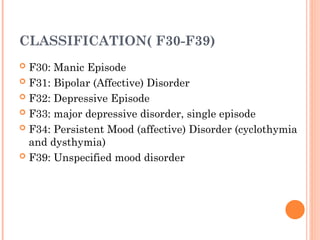
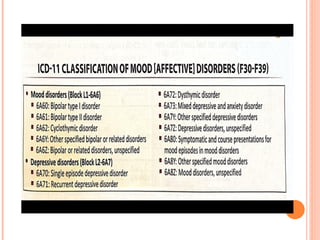
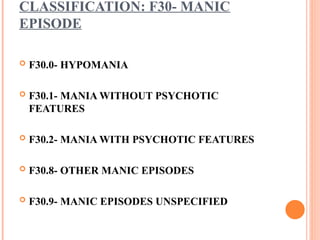
CLASSIFICATION: F30- MANIC
EPISODE
F30.0- HYPOMANIA
F30.1- MANIA WITHOUT PSYCHOTIC
FEATURES
F30.2- MANIA WITH PSYCHOTIC FEATURES
F30.8- OTHER MANIC EPISODES
F30.9- MANIC EPISODES UNSPECIFIED
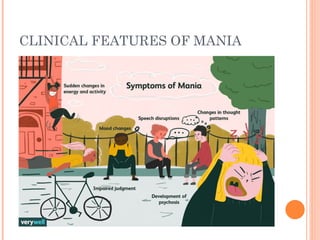
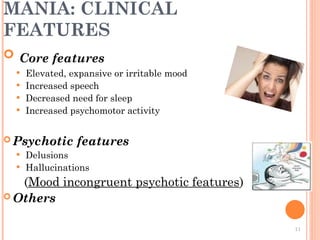
MANIA: CLINICAL
FEATURES
Corefeatures
Elevated, expansive or irritable mood
Increased speech
Decreased need for sleep
Increased psychomotor activity
Psychotic features
Delusions
Hallucinations
(Mood incongruent psychotic features)
Others
11
12.
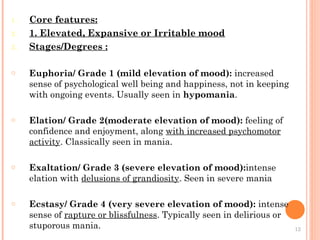
1. Core features:
2.1. Elevated, Expansive or Irritable mood
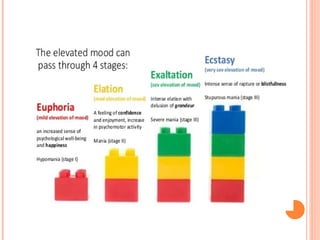
3. Stages/Degrees :
o Euphoria/ Grade 1 (mild elevation of mood): increased
sense of psychological well being and happiness, not in keeping
with ongoing events. Usually seen in hypomania.
o Elation/ Grade 2(moderate elevation of mood): feeling of
confidence and enjoyment, along with increased psychomotor
activity. Classically seen in mania.
o Exaltation/ Grade 3 (severe elevation of mood):intense
elation with delusions of grandiosity. Seen in severe mania
o Ecstasy/ Grade 4 (very severe elevation of mood): intense
sense of rapture or blissfulness. Typically seen in delirious or
stuporous mania. 12
14.
2. Increased speechand thought
o Volubility
o Acceleration
o Pressured speech- difficult to interrupt
o Flight of ideas- shift from topic to topic with cues
o Clang association
o Delusion of grandeur
o Delusion of persecution
o Distractibility
3. Increased psychomotor activity
Increased psychomotor activity ranging from
over activeness and restlessness to manic
excitement. The activities are goal oriented.
o Over activity/ restlessness
o Excitement
o Stupor ( rarely) 14
15.
4. PSYCHOTIC SYMPTOMS
Delusions: grandiose, love( Erotomania), persecutory.
Hallucinations.
5. GOAL-DRECTED ACTIVITY:
- The person is unusually alert, trying to do many
things at one time.
- In hypomania, the ability to function becomes much
better and there is marked increase in productivity
and creativity.
-In mania, there is marked increase in activity with
excessive planning and, at times, execution of
multiple activities.
16.
6. OTHER SYMPTOMS
oOver religiosity
o Over spending/ expansive ideas
o Over familiarity/ disinhibition
o Dressed up in gaudy and flamboyant cloths but poor
self care.
o Appetite may be increased, but decreased food intake
due to over-activity
o Decreased need for sleep
o Impulsive behavior
o Increased sociability
o Poor judgement
o Absent insight
17.
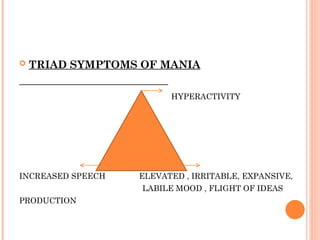
TRIAD SYMPTOMSOF MANIA
HYPERACTIVITY
INCREASED SPEECH ELEVATED , IRRITABLE, EXPANSIVE,
LABILE MOOD , FLIGHT OF IDEAS
PRODUCTION
18.
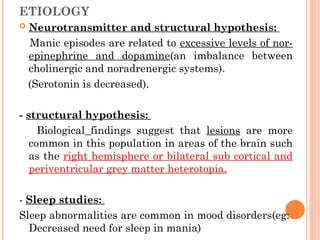
ETIOLOGY
Neurotransmitter andstructural hypothesis:
Manic episodes are related to excessive levels of nor-
epinephrine and dopamine(an imbalance between
cholinergic and noradrenergic systems).
(Serotonin is decreased).
- structural hypothesis:
Biological findings suggest that lesions are more
common in this population in areas of the brain such
as the right hemisphere or bilateral sub cortical and
periventricular grey matter heterotopia.
- Sleep studies:
Sleep abnormalities are common in mood disorders(eg:
Decreased need for sleep in mania)
19.
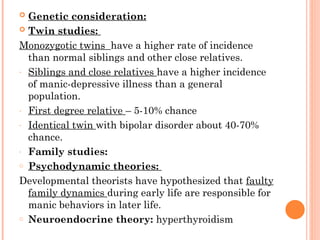
Genetic consideration:
Twin studies:
Monozygotic twins have a higher rate of incidence
than normal siblings and other close relatives.
- Siblings and close relatives have a higher incidence
of manic-depressive illness than a general
population.
- First degree relative – 5-10% chance
- Identical twin with bipolar disorder about 40-70%
chance.
- Family studies:
o Psychodynamic theories:
Developmental theorists have hypothesized that faulty
family dynamics during early life are responsible for
manic behaviors in later life.
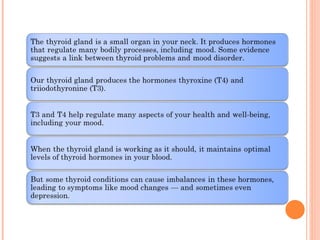
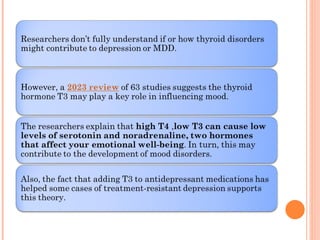
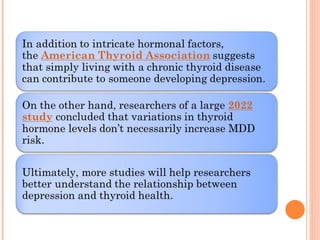
o Neuroendocrine theory: hyperthyroidism
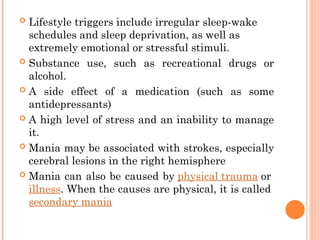
23.
Lifestyle triggersinclude irregular sleep-wake
schedules and sleep deprivation, as well as
extremely emotional or stressful stimuli.
Substance use, such as recreational drugs or
alcohol.
A side effect of a medication (such as some
antidepressants)
A high level of stress and an inability to manage
it.
Mania may be associated with strokes, especially
cerebral lesions in the right hemisphere
Mania can also be caused by physical trauma or
illness. When the causes are physical, it is called
secondary mania
24.
THE DYNAMICSOF MANIA, USING THE
TRANSACTIONAL MODEL OF
STRESS/ADAPTATION
25.
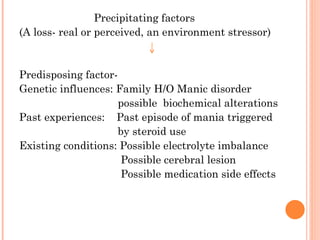
Precipitating factors
(A loss-real or perceived, an environment stressor)
Predisposing factor-
Genetic influences: Family H/O Manic disorder
possible biochemical alterations
Past experiences: Past episode of mania triggered
by steroid use
Existing conditions: Possible electrolyte imbalance
Possible cerebral lesion
Possible medication side effects
26.
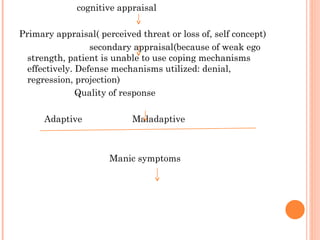
cognitive appraisal
Primary appraisal(perceived threat or loss of, self concept)
secondary appraisal(because of weak ego
strength, patient is unable to use coping mechanisms
effectively. Defense mechanisms utilized: denial,
regression, projection)
Quality of response
Adaptive Maladaptive
Manic symptoms
27.
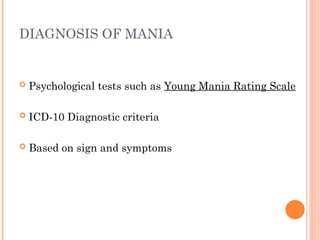
DIAGNOSIS OF MANIA
Psychological tests such as Young Mania Rating Scale
ICD-10 Diagnostic criteria
Based on sign and symptoms
ECT
It canbe used for acute cases of mania if not
responding to mood stabilizer and antipsychotic.
PSYCHOSOCIAL TREATMENT
Family therapy and Marital therapy is used to
decrease interfamilial and interpersonal
difficulties and reduce or modify stressor.
Talk therapy
CBT
30.
NURSING MANAGEMENT OF
MANIA
Nursingassessment
Assessing the severity of the disorder
Forming an opinion about the causes
Assessing the patients resources and judging the
effects of patient’s behavior on other people.
31.
Assess formood and affect
Thinking and perceptual ability
Sleep disturbance
Changes in energy level
Speech pattern
Motor activity
Speech production
32.
NURSING DIAGNOSIS-1
Highrisk for injury R/T hyperactivity and impulsive
behavior as evidence by lack of control over purposeful
and injurious movements.
Nursing intervention
Keep environmental stimuli to minimum; assign single
room, limit interaction, keep lighting and noise level low
Remove hazardous objects
Engage patient in activities such as drawing, writing and
physical exercise
Stay with patient as hyperactivity increases
Administer medication as prescribed by physician
33.
NURSING DIAGNOSIS- 2
High risk for violence ; self directed or directed at others
R/T manic excitement, delusional thinking and
hallucinations
Nursing intervention
Maintain low of stimuli
Observe patient’s behavior every 15 minutes
Ensure all sharps, glasses or mirrors, belts, ties have been
removed from patients environment
Avoid arguing with patient
Encourage verbal expression of feeling
Maintain and convey a calm attitude to the patient
Have sufficient staffs to control the patient
Administer tranquilizers
Follow application of restrain
Remove restrain gradually once at a time
34.
NURSING DIAGNOSIS- 3
Imbalanced nutritional pattern less than
body requirement R/T hyperactivity as evidenced
by weight loss , refusal or inability to sit still
enough to eat .
Nursing intervention
Assess the nutritional pattern of patient
Find out patient’s likes and dislikes
Provide high protein, calorie, nutritious foods and
drinks
Provide 6-8 glasses of fluids per day
Maintain accurate records of intake and output.
Supplement with vitamins and minerals
Walk or sit with patient while he eats
Finger foods
35.
NURSING DIAGNOSIS-4
Impairedsocial interaction R/T egocentric and
narcissistic behavior as evidenced by inability to
develop satisfying relationship and manipulation
of others for own desires
Nursing intervention
Recognize that manipulative behavior helps to
decrease feeling of insecurity by increasing the
feeling of power and control
Set limits on manipulative behavior. Explain the
consequences if limits are violated.
Ignore attempts by patient to argue or bargain his
way-out of setting limits.
Give reinforcement for non- manipulative
behaviors.
Helps patient identify positive aspects about self
36.
OTHER DIAGNOSIS
Disturbedsleep pattern related to hyperactivity
as evidenced by lack of sleep(hrs)
Altered family process R/T euphoric mood,
manipulative behaviors
37.
DEPRESSIVE EPISODE
Lifetime risk in males is 8-12% and in
females is 20-26%.
However, the life time risk- 8%
Typical depressive episode is
characterized by the following features
(which would last for at least 2 weeks
for the diagnosis to be made)
38.
DEFINITION
An alterationin mood that is expressed by feelings of
sadness, despair, and pessimism. There is a loss of interest
in usual activities, and somatic symptoms may be evident.
Changes in appetite and sleep patterns are common.
Classification of Depression:
F32: Depressive episode
F32.0: Mild Depressive episode
F32.1: Moderate Depressive episode
F32.2: severe Depressive episode without psychotic
symptoms
F32.3: severe Depressive episode with psychotic
symptoms
F32.8: other depressive episode- Atypical depression
F32.9: depressive episode, unspecified
F33: recurrent Depressive episode.
39.
TYPES OF DEPRESSIVEDISORDER
Major depressive disorder(MDD):
MDD is characterized by depressed mood or loss of interest or
pleasure in usual activities.
Impaired social and occupational functioning that has been
existed for at least 2 weeks.
o Dysthymic Disorder/ chronic or long term
depression:
Chronically depressed mood (possibly an irritable mood) for
most of the day, more days than not, for at least 2 years.
o Others:
- Mood disorder (depression) due to a general medical
condition.
- Substance-induced mood disorder.
40.
CLINICAL FEATURES
1. DepressedMood:
Pervasive and persistent sadness of mood
Pervasive sadness: loss of interest / pleasure in almost all
activities leads to social withdrawal, decreased ability to
function in occupational and interpersonal functioning.
Persistent sadness: sadness present throughout the day.
This sadness of mood is Quantitatively as well as
qualitatively different from sadness encountered in
‘normal’ depression or grief
Sadness of mood varies little from day to day and is
often unresponsive to environmental stimuli.
In severe depression, there may be complete
Anhedonia.
41.
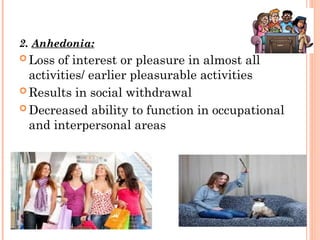
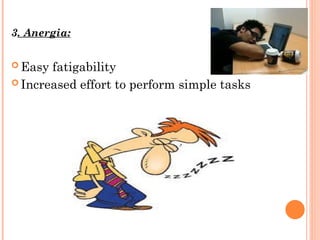
2. Anhedonia:
Lossof interest or pleasure in almost all
activities/ earlier pleasurable activities
Results in social withdrawal
Decreased ability to function in occupational
and interpersonal areas
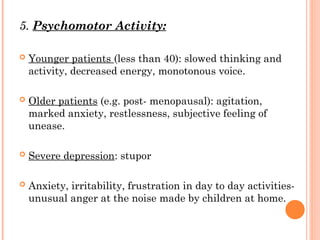
4. Depressive ideation/Cognition:
Hopelessness (There is no hope in the future)
Helplessness( no help is possible now) TRIAD
Worthlessness( feeling of inadequacy and inferiority)
Feelings of guilt
Death wishes
Suicidal ideas
In severe cases, delusions of nihilism.(e.g.: ‘world is coming to an end, ‘there is
no brain in my head, my intestines have rotted away’) may occur.
44.
5. Psychomotor Activity:
Younger patients (less than 40): slowed thinking and
activity, decreased energy, monotonous voice.
Older patients (e.g. post- menopausal): agitation,
marked anxiety, restlessness, subjective feeling of
unease.
Severe depression: stupor
Anxiety, irritability, frustration in day to day activities-
unusual anger at the noise made by children at home.
45.
6. PHYSICAL SYMPTOMS
Multiple physical symptoms:
Heaviness of head
Vague multiple aches
General aches and pains
Hypochondriacal features.
46.
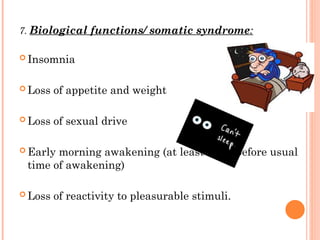
7. Biological functions/somatic syndrome:
Insomnia
Loss of appetite and weight
Loss of sexual drive
Early morning awakening (at least 2 hrs before usual
time of awakening)
Loss of reactivity to pleasurable stimuli.
47.
8. Psychotic Symptoms:
Delusions of guilt, Nihilism
Hallucinations
9. suicide:
suicidal ideas in depression should always be
taken very seriously.
48.
SUICIDAL RISKS: SOMEIMPORTANT
FACTORS
Suicidal risk is much more in the presence of following factors:
a)Presence of marked hopelessness
b)Males ; age > 40; unmarried, divorced/widowed
c)Written/verbal communication of suicidal intent/or plan
d)Early stages of depression
e)Recovering from depression
f)Period of 3 months of recovery
50
ETIOLOGY
Biological theories
1.Genetic factors
-Twin studies
- Family studies
- Adoption studies
2. Neurotransmitter theories-
o Serotonin- decreased in depression and vice versa
3. Neuroendocrine theories:
Mood symptoms are prominently seen in disorder like,
hypothyroidism, Cushing’s disease and Addison’s disease.
Hypothalamic-Pitutory- Adrenocortical Axis:
Endocrine function is often disturbed in depression, with cortisol
hypersecretion.
51.
HYPOTHALAMIC-PITUTORY- THYROID
AXIS:
Thyrotropin-releasing factor (TRF) from the hypothalamus
stimulates the release of thyroid –stimulating hormone
(TSH) from the anterior pituitary. Diminished TSH
response is observed in approximately 25 % of depressed
persons.
4. Physiological influences:
Secondary depression: depressive symptoms that occur
as a consequence of a non-mood disorder or as an adverse
effect of certain medications are called secondary
depression.
Secondary depression may be related to medication side
effects, neurological disorders, electrolyte or hormonal
disturbances, nutritional deficiencies and other
physiological or psychological conditions.
52.
5. Neuroimaging andanatomy
Ventricular dilatation, white matter hyper- intensifies
and changes in blood flow & metabolism in several
parts of brain( prefrontal cortex).
6. Sleep studies:
Insomnia and frequent awakenings in depression).
7. Circadian Rhythm Theories:
Circadian rhythm are responsible for the daily
regulation of wake-sleep cycles, arousal and activity
patterns and hormonal secretions. Individual
experiencing circadian rhythm changes are at increased
risk for developing depressive symptoms and other
mood symptoms.
These changes might be caused by medications,
nutritional deficiencies, physical or psychological
illnesses, hormonal fluctuations.
53.
53
CONTD-
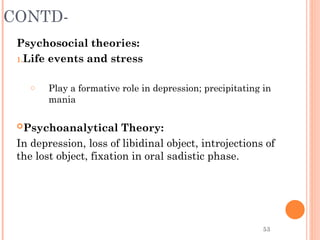
Psychosocial theories:
1.Life eventsand stress
o Play a formative role in depression; precipitating in
mania
Psychoanalytical Theory:
In depression, loss of libidinal object, introjections of
the lost object, fixation in oral sadistic phase.
54.
THE DYNAMICSOF DEPRESSION, USING
THE TRANSACTIONAL MODEL OF
STRESS/ADAPTATION
55.
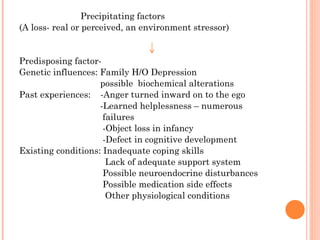
Precipitating factors
(A loss-real or perceived, an environment stressor)
Predisposing factor-
Genetic influences: Family H/O Depression
possible biochemical alterations
Past experiences: -Anger turned inward on to the ego
-Learned helplessness – numerous
failures
-Object loss in infancy
-Defect in cognitive development
Existing conditions: Inadequate coping skills
Lack of adequate support system
Possible neuroendocrine disturbances
Possible medication side effects
Other physiological conditions
56.
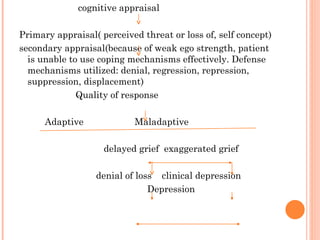
cognitive appraisal
Primary appraisal(perceived threat or loss of, self concept)
secondary appraisal(because of weak ego strength, patient
is unable to use coping mechanisms effectively. Defense
mechanisms utilized: denial, regression, repression,
suppression, displacement)
Quality of response
Adaptive Maladaptive
delayed grief exaggerated grief
denial of loss clinical depression
Depression
57.
DIAGNOSIS FOR DEPRESSION
Psychological tests- Beck depression inventory,
Hamilton rating depression scale to assess severity and
prognosis
Dexamethasone suppression test showing failure to
suppress cortisol secretion in depressed patient.
Based on ICD- 10
Toxicology screening suggesting drug induced
depression(e.g anticonvulsive drugs, hormonal
agents, antipsychotics)
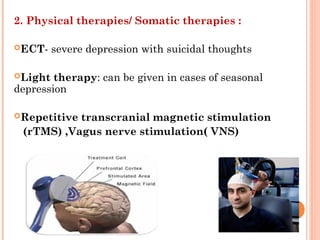
2. Physical therapies/Somatic therapies :
ECT- severe depression with suicidal thoughts
Light therapy: can be given in cases of seasonal
depression
Repetitive transcranial magnetic stimulation
(rTMS) ,Vagus nerve stimulation( VNS)
NURSING MANANAGEMENT OFMAJOR
DEPRESSIVE DISORDER
Nursing assessment:
Judging the severity of the disorder i.e.
1. Risk for suicide
2. Identifying the possible cause
3. Social resources available to the patient
4. Effect on other people
5. Assess the sign and symptoms like: hopelessness,
helplessness, worthlessness, decreased appetite,
sleep, decreased motor activity etc.
62.
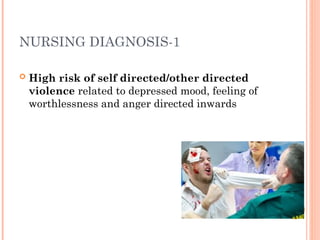
NURSING DIAGNOSIS-1
Highrisk of self directed/other directed
violence related to depressed mood, feeling of
worthlessness and anger directed inwards
63.
NURSING INTERVENTION
Askthe patient directly ‘ have you thought of
harming yourself in any way’? If so, what do you
plan to do? Do you have the means to carry it out?
Create safe environment for patient
Formulate a short term verbal or written contract
that the patient will not harm himself.
64.
It maybe desirable to place the patient near the
nursing station
Close observation is specially required
Do not allow the patient to bolt the room
If the patient becomes unusually happy or gives
clues of suicide, immediately inform
Encourage to express feelings including anger.
65.
NURSING DIAGNOSIS-2
Dysfunctionalgrieving R/T real or perceived
loss, as evidenced by denial of loss, inappropriate
expression of anger, inability to carry out
activities of daily living
Nursing intervention
Assess the stage of fixation in grief process
Be accepting to the patient and spend time with
him. Show sympathy, care and unconditional
love, positive regard
Explore feelings of anger and help patient direct
them towards the intended object or person
Provide simple activities.
66.
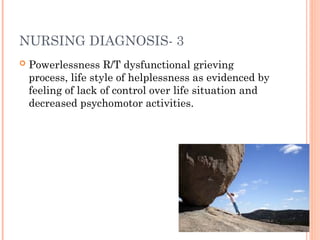
NURSING DIAGNOSIS- 3
Powerlessness R/T dysfunctional grieving
process, life style of helplessness as evidenced by
feeling of lack of control over life situation and
decreased psychomotor activities.
67.
NURSING INTERVENTION
Allowpatient to take decisions regarding own care.
Ensure that the goals are realistic and the patient is
able to identify life situation.
Encourage the patient to verbalize feelings about
areas that are not in his ability to control.
Family therapy
68.
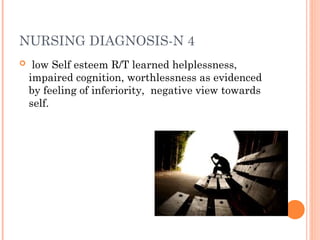
NURSING DIAGNOSIS-N 4
low Self esteem R/T learned helplessness,
impaired cognition, worthlessness as evidenced
by feeling of inferiority, negative view towards
self.
69.
NURSING INTERVENTION
Beaccepting to the patient and spend time with him/her
Focus on strengths and accomplishments and minimize failure.
Provide him with simple and easily achievable activity.
Encourage patients to recognize areas of change and provide
assistance towards effort.
Teach assertiveness and coping skills
70.
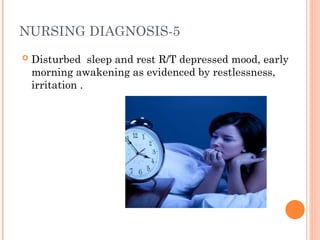
NURSING DIAGNOSIS-5
Disturbedsleep and rest R/T depressed mood, early
morning awakening as evidenced by restlessness,
irritation .
71.
NURSING INTERVENTION
Plandaytime activities according to the patients interest, do not
allow him to sit idle
Ensure a quiet and peaceful environment when patient is
preparing to sleep
Provide comfort measures ( back rub, warm milk, tipid bath)
Do not allow patient to sleep for long time during day
Give medicine as prescribed
72.
OTHER DIAGNOSIS
Imbalancednutritional status less than body
requirement R/T depressed mood, lack of interest
in food as evidenced by weight loss.
Self care deficit R/T depressed mood, feeling of
worthlessness as evidenced by poor hygiene and
grooming.
73.
73
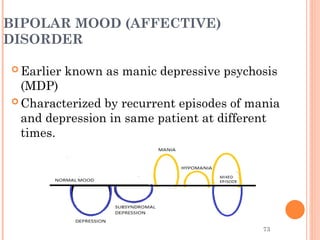
BIPOLAR MOOD (AFFECTIVE)
DISORDER
Earlier known as manic depressive psychosis
(MDP)
Characterized by recurrent episodes of mania
and depression in same patient at different
times.
74.
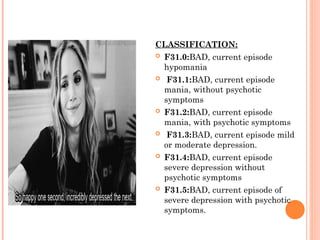
CLASSIFICATION:
F31.0:BAD, currentepisode
hypomania
F31.1:BAD, current episode
mania, without psychotic
symptoms
F31.2:BAD, current episode
mania, with psychotic symptoms
F31.3:BAD, current episode mild
or moderate depression.
F31.4:BAD, current episode
severe depression without
psychotic symptoms
F31.5:BAD, current episode of
severe depression with psychotic
symptoms.
75.
The currentepisode in bipolar mood
disorder is specified as one of the following:
Hypomania
Mania without psychotic symptoms
Mania with psychotic symptoms
Mild or moderate depression
Severe depression, without psychotic symptoms
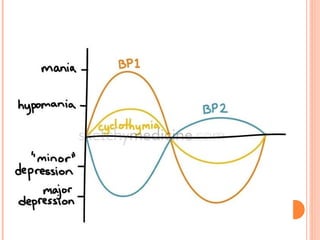
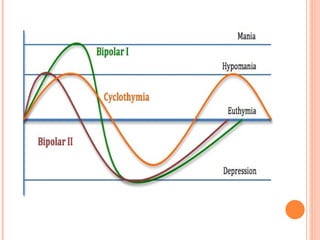
SUBTYPES OF BIPOLAR
DISORDER
Bipolar I
Characterized by episodes of severe mania and
severe depression
Bipolar II
Characterized by episodes of hypomania ( not
requiring hospitalization) and severe depression
79.
Others :
Cyclothymia orcyclothymic disorder -- is a
relatively mild mood disorder. In cyclothymic
disorder, moods swing between short periods of mild
depression and hypomania, an elevated mood. It
involve numerous episodes of hypomania and
depressed mood of insufficient severity ( means no
full manic episodes or full major depressive episodes).
Bipolar disorder NOS : sometimes called "sub-
threshold" bipolar, indicates that the patient suffers
from some symptoms in the bipolar spectrum (e.g.,
manic and depressive symptoms) but does not fully
qualify for any of the formal bipolar
81.
OTHER BIPOLAR DISORDER
Bipolar disorder due to a general medical
condition
Substance- induced bipolar disorder
82.
ETIOLOGY
Precise unknowncause
Genetics, biochemical and psychological factors
Stressful life events, antidepressant use chronically
Sleep deprivation and hypothyroidism
DIAGNOSIS:
Based on sign and symptoms
ICD-10 classification
TREATMENT:
- Lithium
- Valporic acid
- Carbamazepines
- Antidepressants
- Antipsychotics
83.
4. RECURRENT DEPRESSIVE
DISORDER
Recurrent (at least 2 )depressive episodes
(unipolar depression)
Episodes last between 3 to 12 months
Recovery is usually complete
Often precipitated by stressful life events
84.
5. PERSISTENT MOODDISORDERS
Persistent mood symptoms lasting for more than
2 years
Chronic/ long term depression: Dysthymia
Persistent instability of mood between mild
depression and elation: Cyclothymia
85.
COURSE AND PROGNOSIS
Average manic episode lasts for 3-4
months
Average depressive episode lasts for 4-6
months
Unipolar depression is usually longer than
bipolar depression
As age advances, intervals between 2
episodes shorten; duration and frequency
increases
86.
86
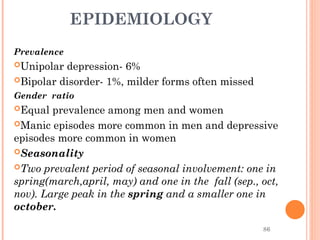
EPIDEMIOLOGY
Prevalence
Unipolar depression- 6%
Bipolardisorder- 1%, milder forms often missed
Gender ratio
Equal prevalence among men and women
Manic episodes more common in men and depressive
episodes more common in women
Seasonality
Two prevalent period of seasonal involvement: one in
spring(march,april, may) and one in the fall (sep., oct,
nov). Large peak in the spring and a smaller one in
october.
87.
87
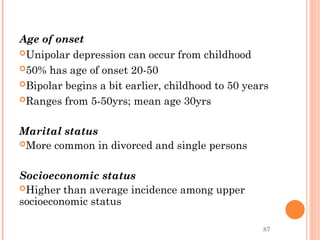
Age of onset
Unipolardepression can occur from childhood
50% has age of onset 20-50
Bipolar begins a bit earlier, childhood to 50 years
Ranges from 5-50yrs; mean age 30yrs
Marital status
More common in divorced and single persons
Socioeconomic status
Higher than average incidence among upper
socioeconomic status
88.
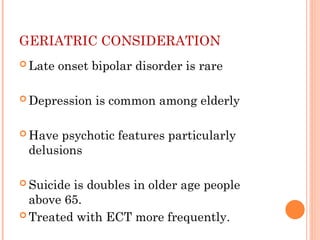
GERIATRIC CONSIDERATION
Lateonset bipolar disorder is rare
Depression is common among elderly
Have psychotic features particularly
delusions
Suicide is doubles in older age people
above 65.
Treated with ECT more frequently.
89.
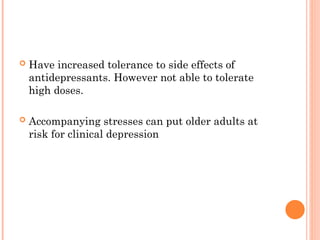
Have increasedtolerance to side effects of
antidepressants. However not able to tolerate
high doses.
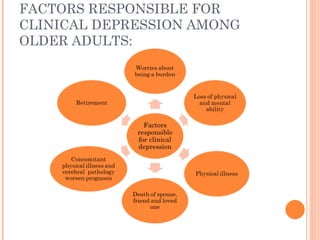
Accompanying stresses can put older adults at
risk for clinical depression
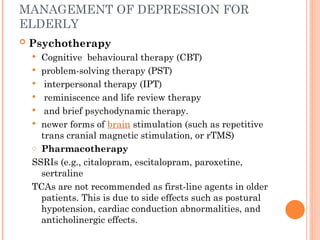
MANAGEMENT OF DEPRESSIONFOR
ELDERLY
Psychotherapy
Cognitive behavioural therapy (CBT)
problem-solving therapy (PST)
interpersonal therapy (IPT)
reminiscence and life review therapy
and brief psychodynamic therapy.
newer forms of brain stimulation (such as repetitive
trans cranial magnetic stimulation, or rTMS)
o Pharmacotherapy
SSRIs (e.g., citalopram, escitalopram, paroxetine,
sertraline
TCAs are not recommended as first-line agents in older
patients. This is due to side effects such as postural
hypotension, cardiac conduction abnormalities, and
anticholinergic effects.




![Revised Topic- Schizophrenia [Autosaved].pptx](https://cdn.slidesharecdn.com/ss_thumbnails/schizophreniaautosaved-250310073514-5d1607b2-thumbnail.jpg?width=640&height=640&fit=bounds)


![Neurocognitive Disorders [2020]](https://cdn.slidesharecdn.com/ss_thumbnails/ncd2020v2-200526001756-thumbnail.jpg?width=640&height=640&fit=bounds)


![Revised -ppt of child psychiatric problems [Autosaved].pptx](https://cdn.slidesharecdn.com/ss_thumbnails/pptofchildpsychiatricproblemsautosaved-240926091227-d0592556-thumbnail.jpg?width=640&height=640&fit=bounds)


