WELCOME
3/27/2015 Deptt of Plant Biotechnology 1
In vitro Regeneration System for
Indirect Somatic Embryogenesis of
Cereals Crops.
3/27/2015 Deptt of Plant Biotechnology 2
AVINASH SHARMA
ID. No:- PALB 3235
Sr. M.Sc. (Plant Biotech)
EMBRYOGENESIS:-
 Plant embryogenesis refers to the process of development
of plant embryos, being either a sexual or asexual
reproductive process that forms new plants.
 Embryogenesis may occur naturally in the plant as a result
of sexual fertilization, and those embryo are called zygotic
embryos and develop into seeds, which can germinate and
give rise to seedlings.
 Plant cells can also be induced to form embryos in plant
tissue culture; these embryo are called somatic embryos.
3/27/2015 Deptt of Plant Biotechnology 3
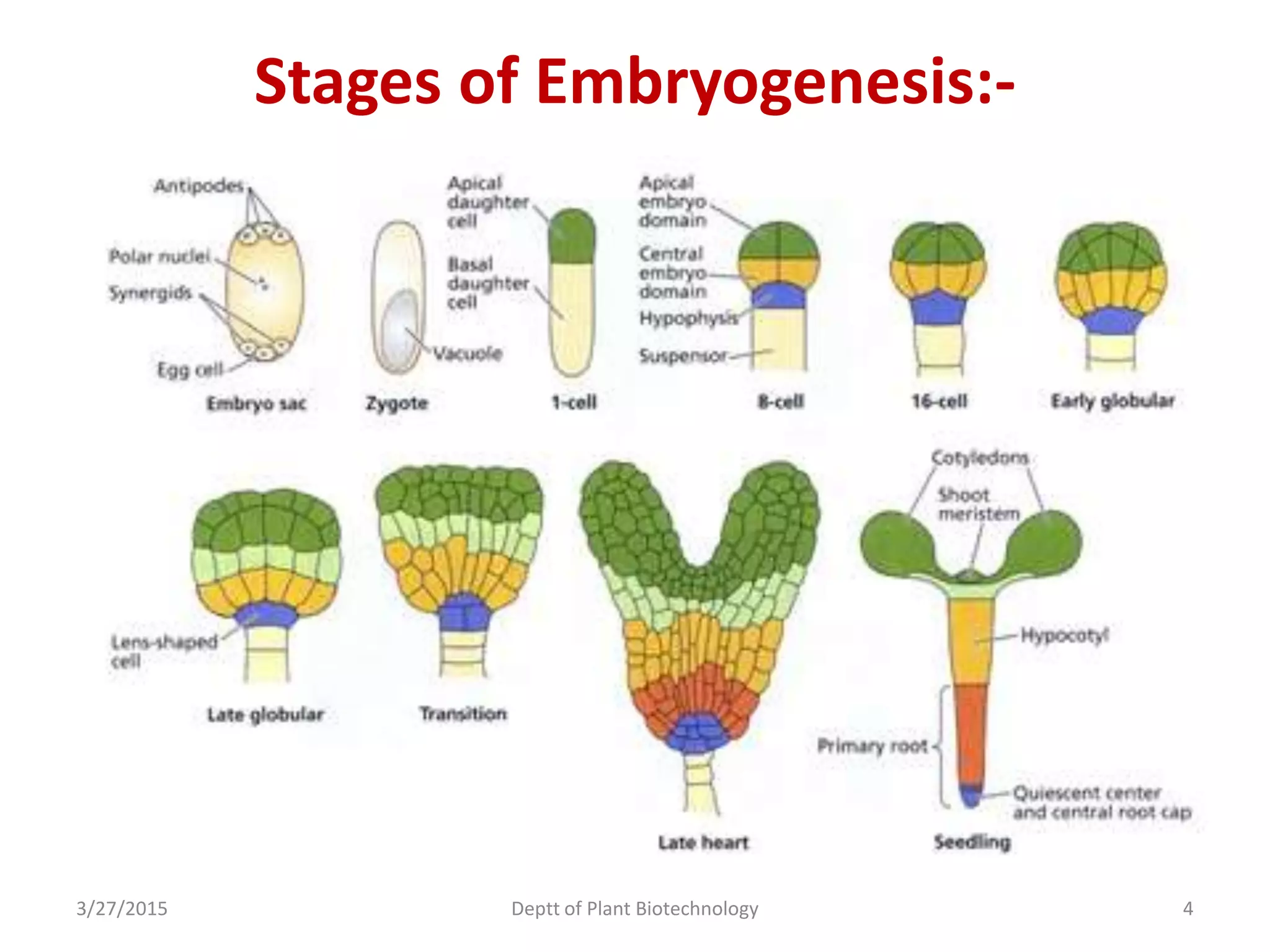
Stages of Embryogenesis:-
3/27/2015 Deptt of Plant Biotechnology 4
Types of Embryogenesis:-
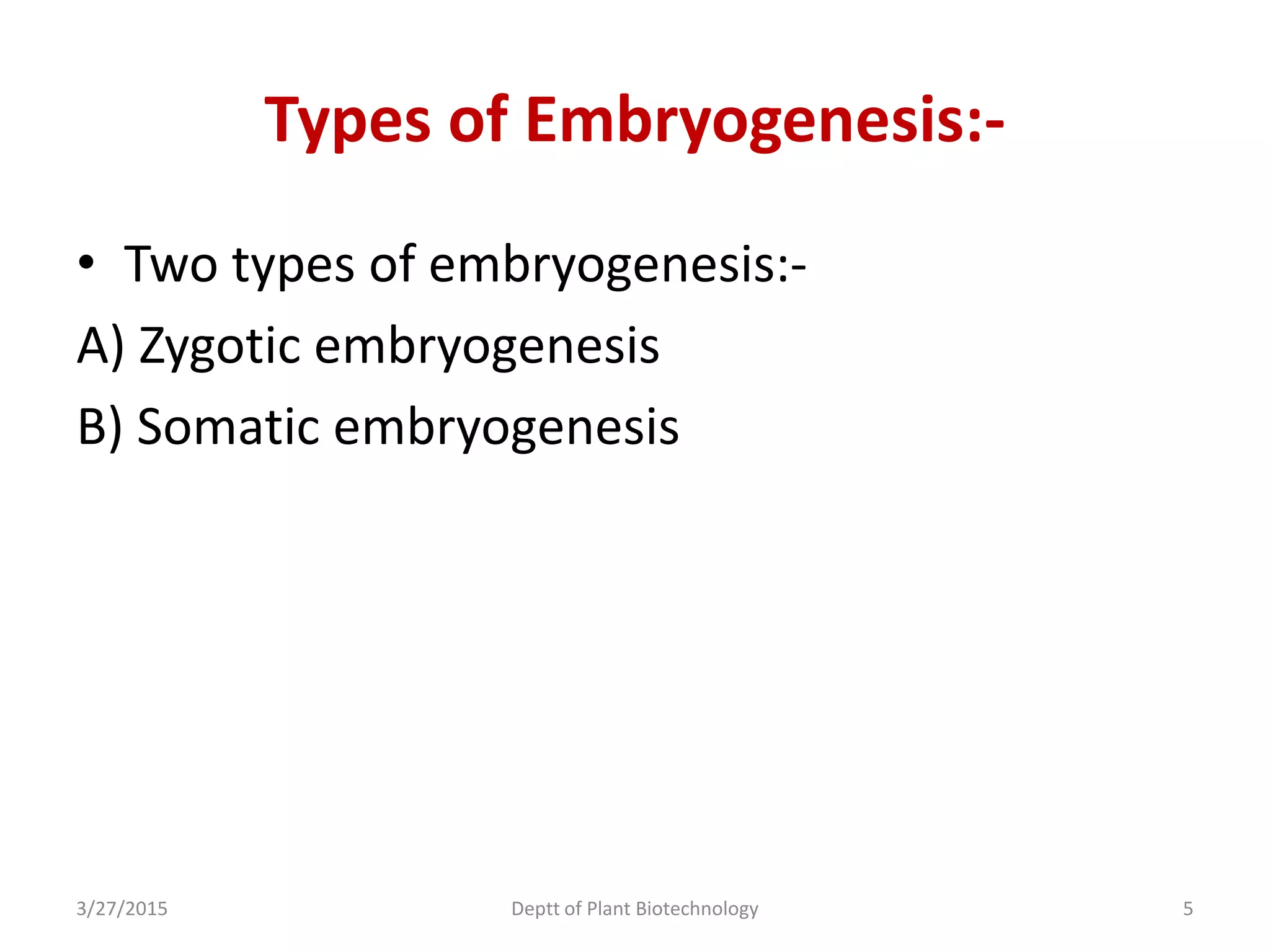
• Two types of embryogenesis:-
A) Zygotic embryogenesis
B) Somatic embryogenesis
3/27/2015 Deptt of Plant Biotechnology 5
Zygotic Embryogenesis:-
The zygotic embryo is formed following double
fertilization of the ovule, forming the plant
embryo and the endosperm which together go
into the seed, this process is known as zygotic
embryogenesis.
Seeds may also develop without fertilization
through pathways referred to as apomixis.
3/27/2015 Deptt of Plant Biotechnology 6
Somatic Embryogenesis:-
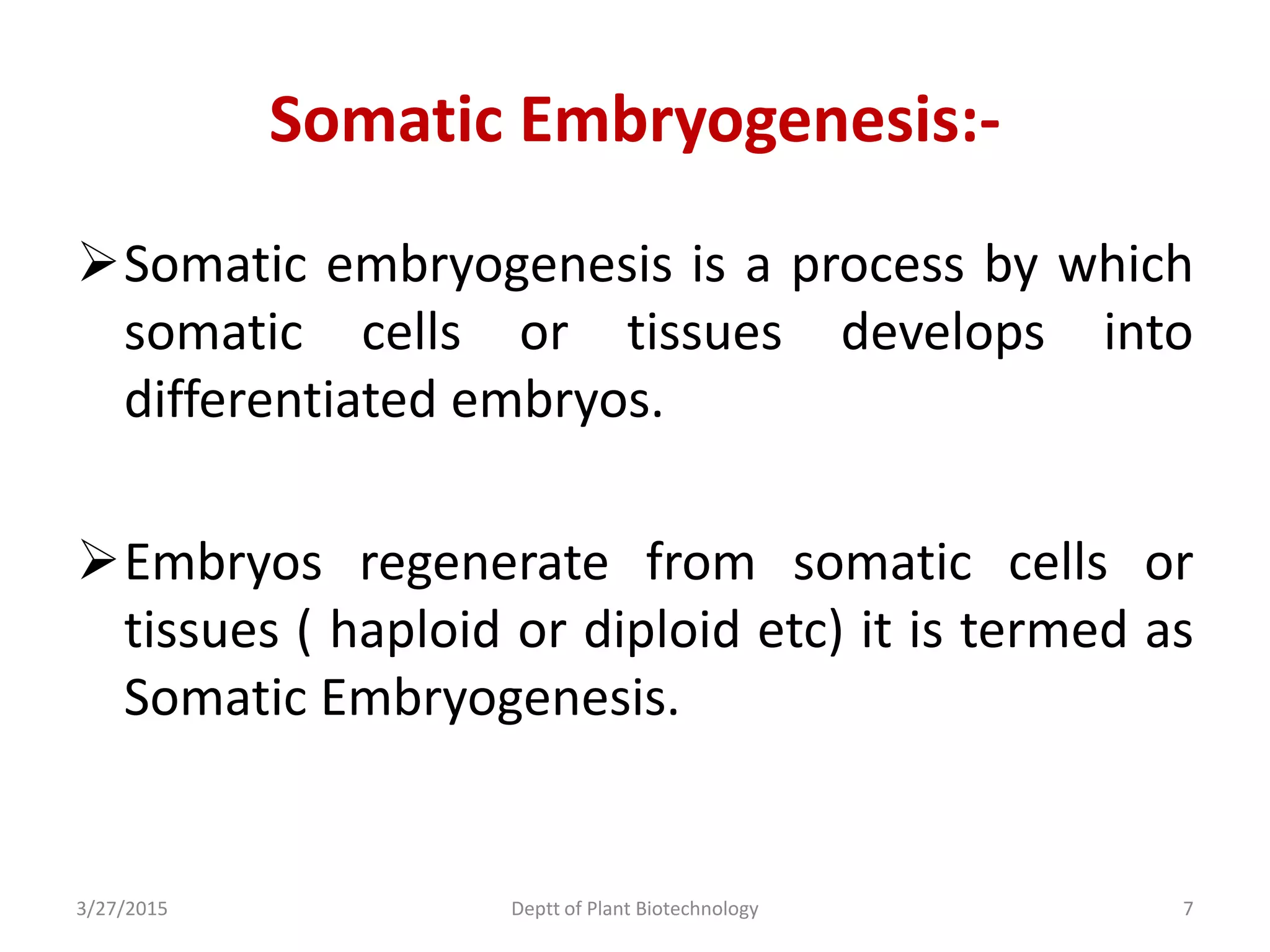
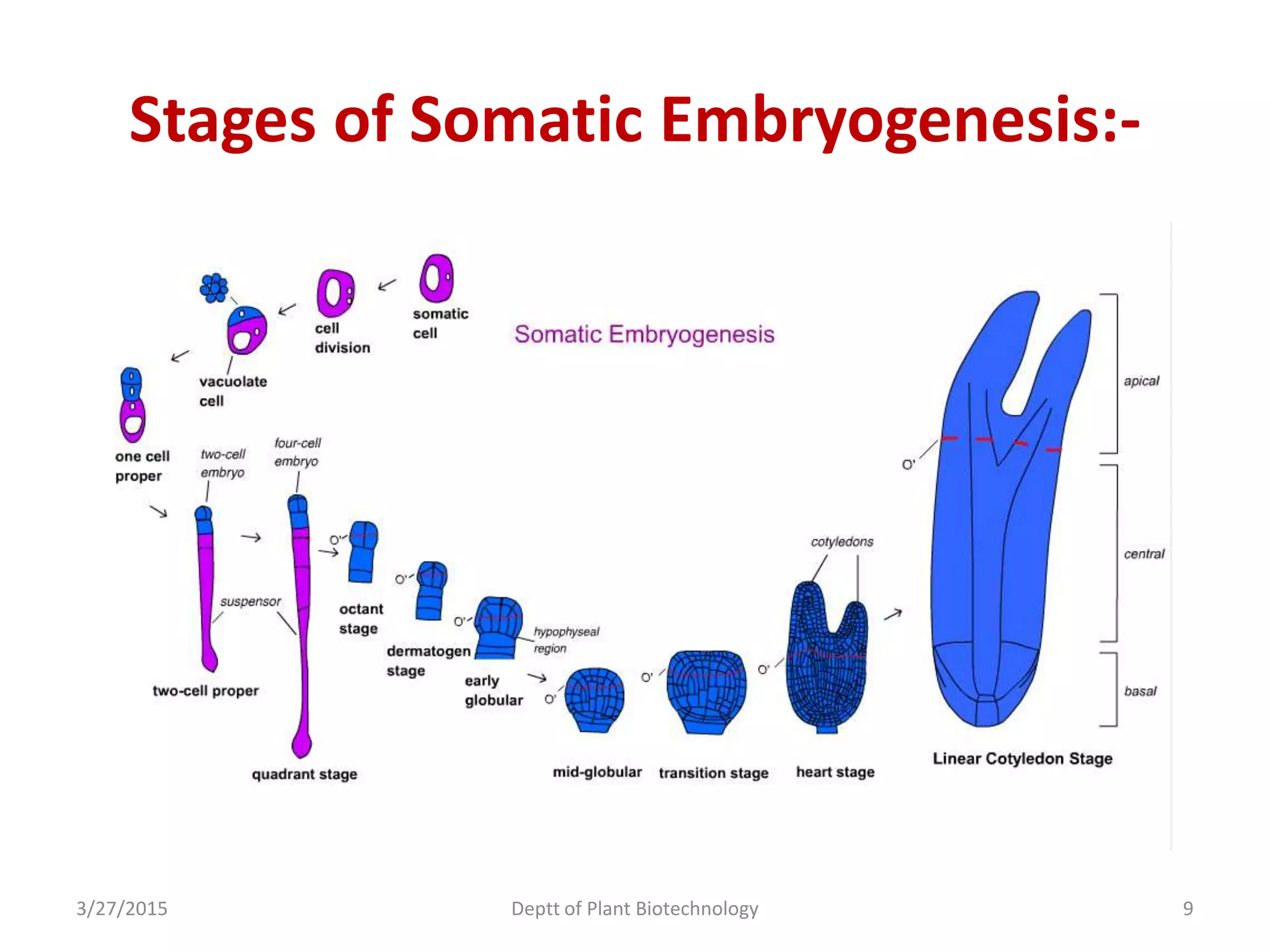
Somatic embryogenesis is a process by which
somatic cells or tissues develops into
differentiated embryos.
Embryos regenerate from somatic cells or
tissues ( haploid or diploid etc) it is termed as
Somatic Embryogenesis.
3/27/2015 Deptt of Plant Biotechnology 7
3/27/2015 Deptt of Plant Biotechnology 8
 Somatic embryogenesis was first induced in suspension culture
(Stewart et al, 1958) and in callus culture (Reinert, 1959) of carrot,
Umbelliferae and Solanaceae dicotyledonous families have
produced somatic embryos.
 SE occur most frequently in tissue culture as an alternative
organogenesis for regeneration of whole plant.
 In literature, somatic embryos are referred to by many names such
as embryo like structures, adventitious or vegetative embryos,
Embryoids; and the process is termed as adventitious , asexual or
somatic embryogenesis.
Stages of Somatic Embryogenesis:-
3/27/2015 Deptt of Plant Biotechnology 9
Stages of Somatic Embryogenesis:-
3/27/2015 Deptt of Plant Biotechnology 10
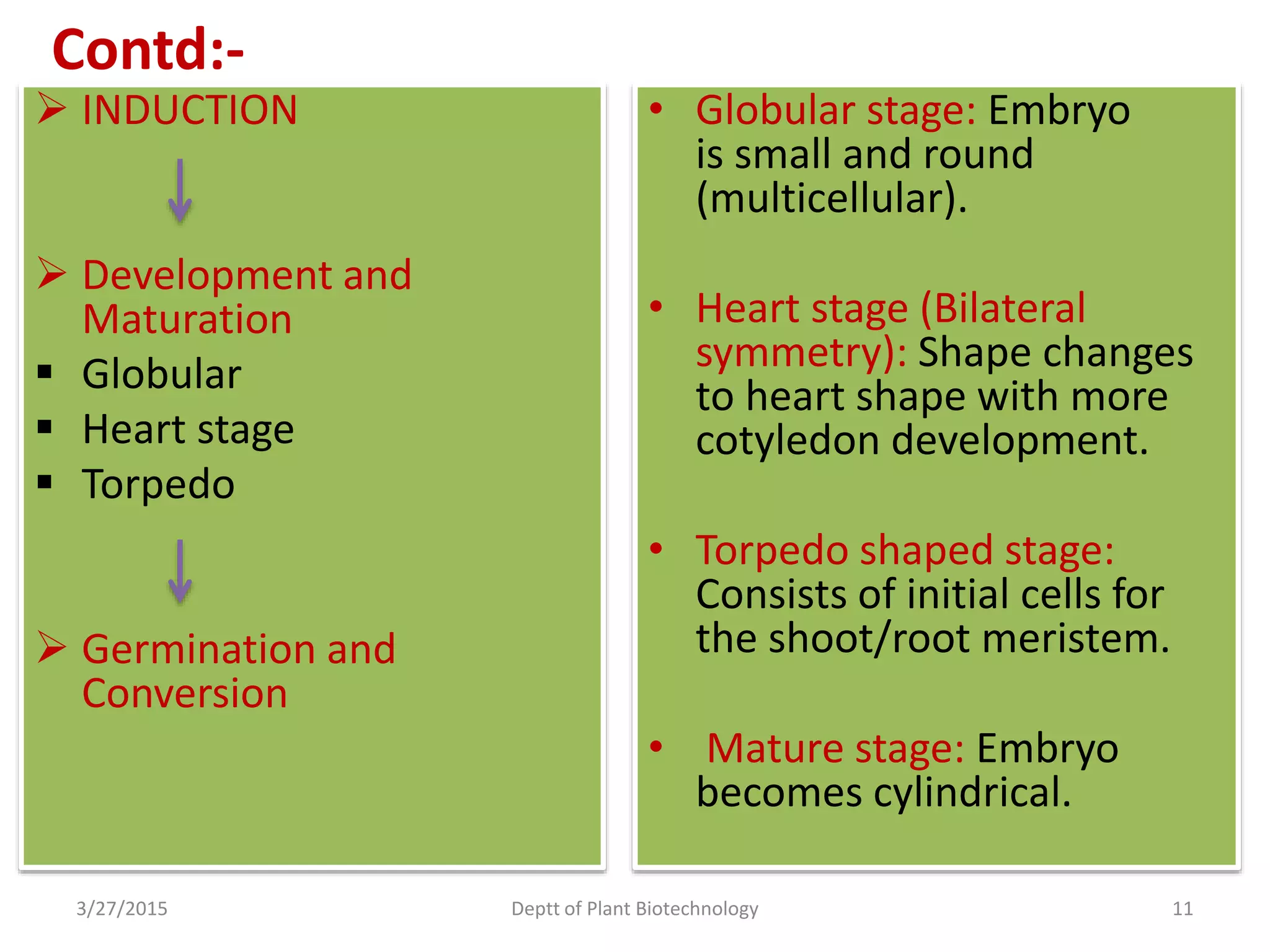
Contd:-
 INDUCTION
 Development and
Maturation
 Globular
 Heart stage
 Torpedo
 Germination and
Conversion
• Globular stage: Embryo
is small and round
(multicellular).
• Heart stage (Bilateral
symmetry): Shape changes
to heart shape with more
cotyledon development.
• Torpedo shaped stage:
Consists of initial cells for
the shoot/root meristem.
• Mature stage: Embryo
becomes cylindrical.
3/27/2015 Deptt of Plant Biotechnology 11
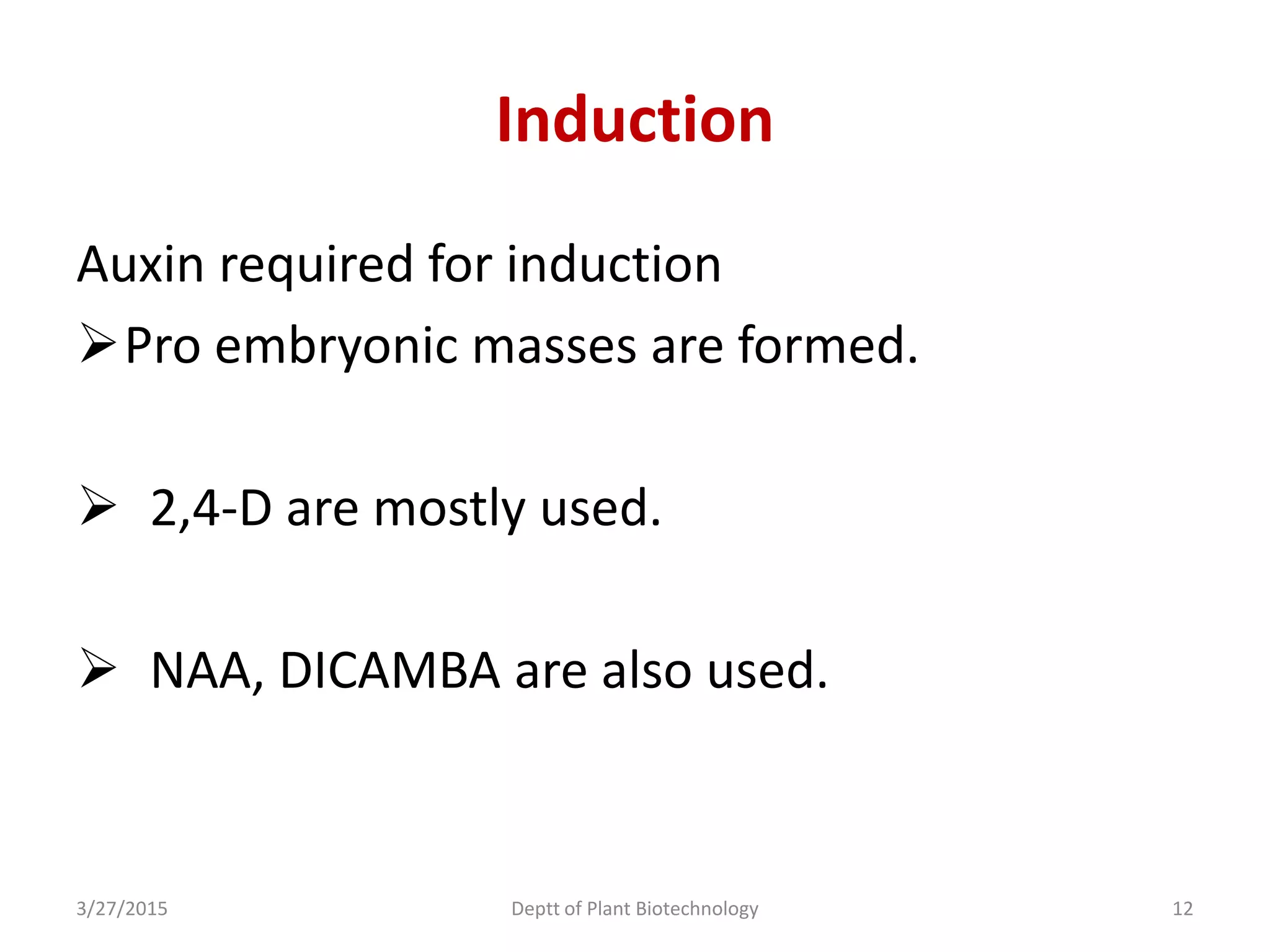
Induction
Auxin required for induction
Pro embryonic masses are formed.
 2,4-D are mostly used.
 NAA, DICAMBA are also used.
3/27/2015 Deptt of Plant Biotechnology 12
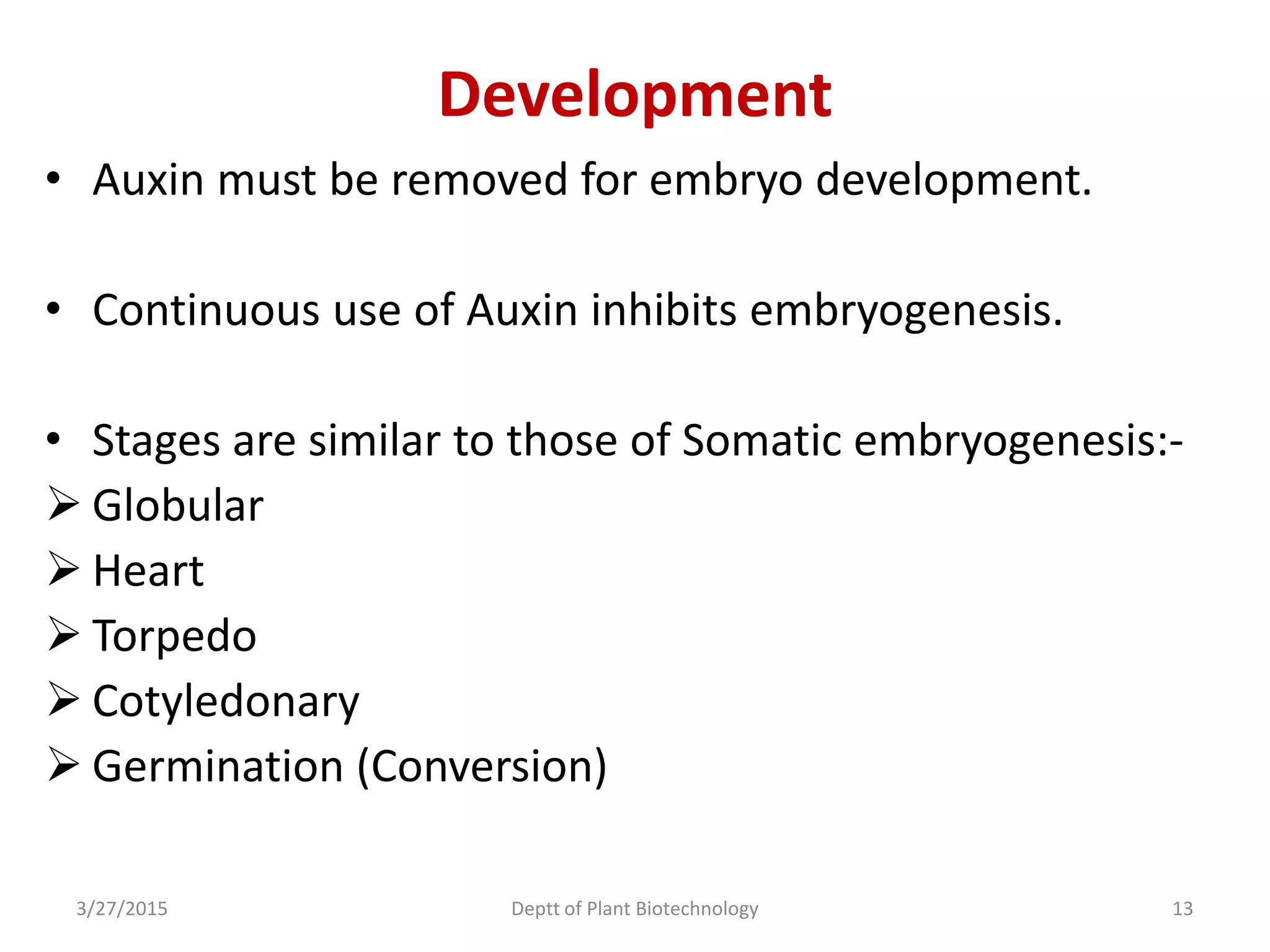
Development
• Auxin must be removed for embryo development.
• Continuous use of Auxin inhibits embryogenesis.
• Stages are similar to those of Somatic embryogenesis:-
 Globular
 Heart
 Torpedo
 Cotyledonary
 Germination (Conversion)
3/27/2015 Deptt of Plant Biotechnology 13
Maturation
Require complete maturation with apical meristem,
radicle and cotyledons.
Often obtained repetitive embryony.
Storage protein production necessary.
Often require ABA for complete maturation.
ABA often required for normal morphology.
3/27/2015 Deptt of Plant Biotechnology 14
Morphological Stages of Maize cv. Gaurav
3/27/2015 Deptt of Plant Biotechnology 15
Routes of Somatic Embryogenesis:-
Two routes to somatic embryogenesis
 Direct somatic embryogenesis
 The embryos initiate directly from explants in the
absence of callus formation. Embryos are formed
due to PEDCs cell.
 Indirect somatic embryogenesis
 Callus from explants takes place from which
embryos are developed. Embryos are formed due to
IEDCs cells.
3/27/2015 Deptt of Plant Biotechnology 16
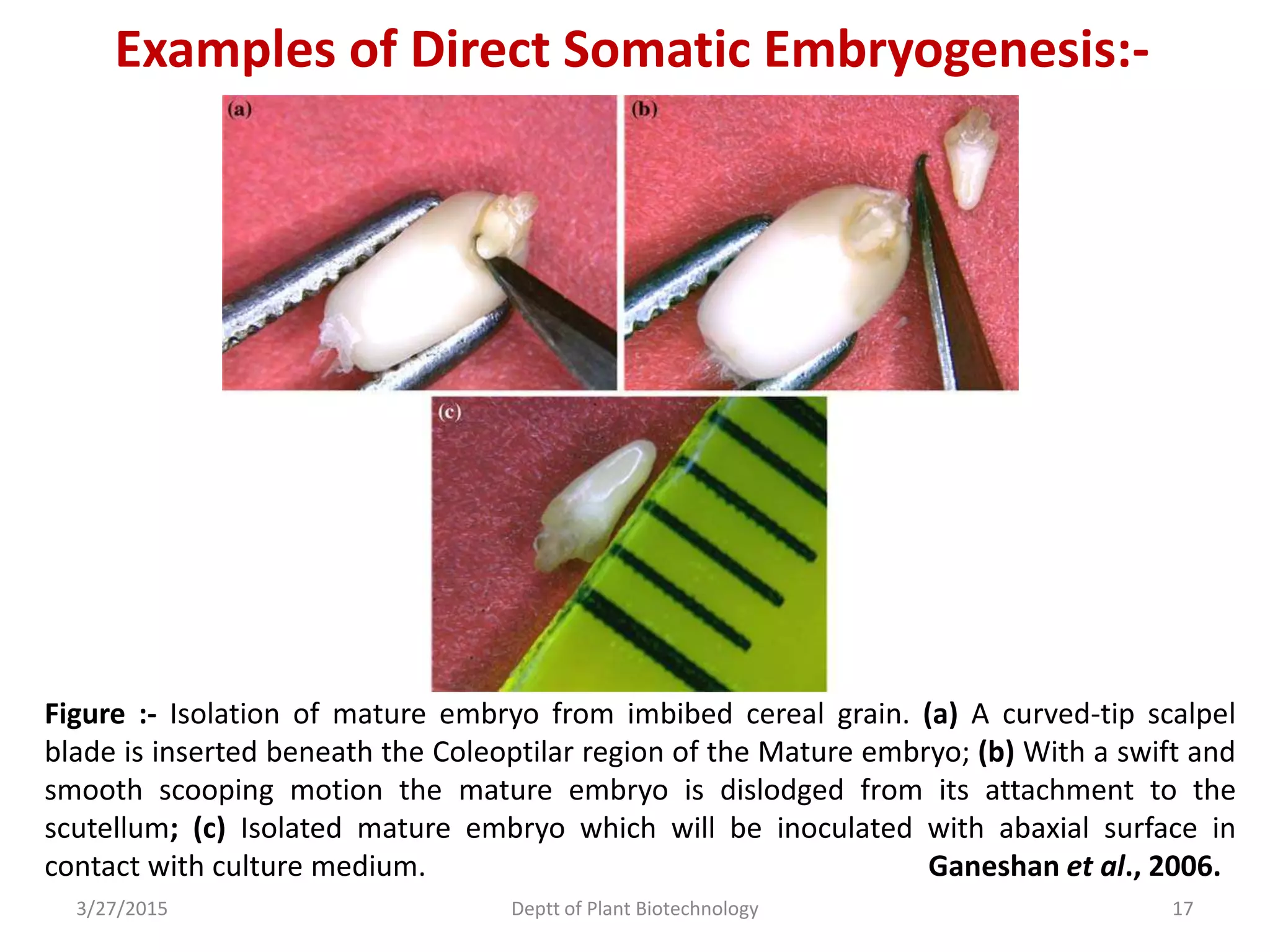
Examples of Direct Somatic Embryogenesis:-
3/27/2015 Deptt of Plant Biotechnology 17
Figure :- Isolation of mature embryo from imbibed cereal grain. (a) A curved-tip scalpel
blade is inserted beneath the Coleoptilar region of the Mature embryo; (b) With a swift and
smooth scooping motion the mature embryo is dislodged from its attachment to the
scutellum; (c) Isolated mature embryo which will be inoculated with abaxial surface in
contact with culture medium. Ganeshan et al., 2006.
Contd:-
 Mature embryos culture in the Murashige and Skoog, 1962
medium with supplements 1gm/l enzymatic casein
hydrolysate, 0.7 gm/l L-proline.
 4.5 µM of TDZ and 4.4 µM of BAP are best combination of
growth regulators in which Durum Wheat produces 35
number of shoots per explant and Mature embryos of CDC
Dancer oat produces 16 shoots per explant.
 Explants for direct embryogenesis include microspores,
ovules, scutellum, endosperm, embryos and seedlings.
3/27/2015 Deptt of Plant Biotechnology 18
Indirect Somatic Embryogenesis:-
In Indirect SE, callus is produced from explants.
Embryoids(suspensory cell to cotyledon) are
produced from callus tissue.
Explants are roots, shoots, leaf cells, anthers, seeds
etc.
Steps involved in Plant regeneration of Rice variety
through Indirect SE:-
3/27/2015 Deptt of Plant Biotechnology 19
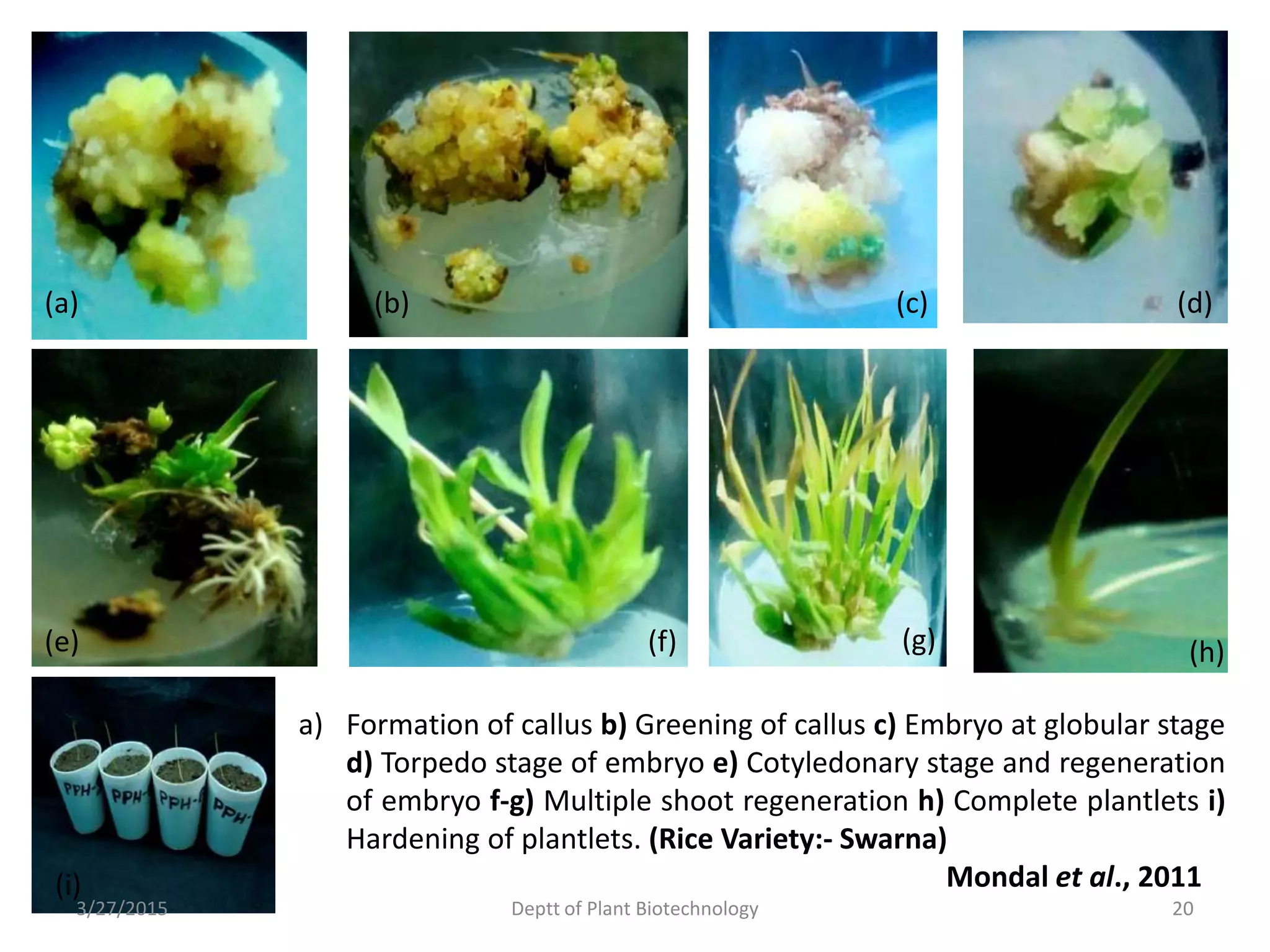
a) Formation of callus b) Greening of callus c) Embryo at globular stage
d) Torpedo stage of embryo e) Cotyledonary stage and regeneration
of embryo f-g) Multiple shoot regeneration h) Complete plantlets i)
Hardening of plantlets. (Rice Variety:- Swarna)
Mondal et al., 2011
(a) (b) (c) (d)
(e) (f) (g) (h)
(i)
3/27/2015 Deptt of Plant Biotechnology 20
3/27/2015 Deptt of Plant Biotechnology 21
3/27/2015 Deptt of Plant Biotechnology 22
Factors affecting Somatic Embryogenesis:-
1) Genotype:-
 Genetically engineered / transgenic plant
does not regenerate through SE because due
to variation.
 Methylation occurs in the DNA during mitosis
then SE occurs. If Methylation occur in the
cytosine bases or H3 protein then SE get
stop.
3/27/2015 Deptt of Plant Biotechnology 23
3/27/2015 Deptt of Plant Biotechnology 24
2) Explant:-
Totipotent somatic cell are used.
Immature inflorescence and Scutellar tissue of
immature seeds are used for the research. Ex:-
Triticum aestivum .
Epidermis, Procambial tissue are also produced
somatic embryo.
3/27/2015 Deptt of Plant Biotechnology 25
During Proembryonic
phase, 2,4-D generates
DNA Hyper methylation
so that cells in a highly
active mitotic stage.
High concentration of
auxin produces root in
somatic embryo.
2,4-D is one of the growth
regulator that produces
callus from cereals and
conc. of 2,4-D 0.1-10µM
3) Auxin:-
Polar transport of auxin
produces somatic
embryo.
Auxin concentration
will be more then
somatic embryogenesis
get stop. Ex:- Maize.
Auxin induces indirect
somatic embryogenesis
in monocots.
3/27/2015 Deptt of Plant Biotechnology 26
4) Cytokinins:-
Cytokinin promote axial growth.
Cytokinin produces globular embryo from initial
embryo.
Cytokinin combination with auxin, induces somatic
embryogenesis and produce callus in cereals.
Cytokinin ratio more than auxin then it produces
Shoots.
3/27/2015 Deptt of Plant Biotechnology 27
5) Gibberellic acid:-
 GA promote
elongations of embryo
axis, cell division.
It synthesized of
photosynthetic
pigments in developing
somatic embryo.
It improve
photosynthetic activity,
Extra storage reserves in
vitro germination.
Hypo cotyledon are used
as explant then GA inhibit
somatic embryogenesis.
Addition of Uniconazole,
Paclobutrazol inhibit
somatic embryogenesis.
GA higher in suspensory
embryo than the proper
embryo. So GA requires
early embryo
development.
3/27/2015 Deptt of Plant Biotechnology 28
6) Abscisic acid (ABA):-
 ABA control tolerance and seed dormancy during
later stage of embryogenesis.
ABA induced somatic embryogenesis in high osmotic
stress and high temperature in auxin free medium.
Primary embryo contain more conc. of ABA than
secondary embryo.
Treatment of Fluridone inhibit ABA synthesis and
primary embryo does not produce secondary
embryo.
7) Polyamines:-
 Spermidine, Spermine and
Putrescine are added as
growth regulators and
secondary messenger.
 Polyamines serve as nitrogen
source for plants.
 It act as a free radical
scavengers by protecting
senescing membranes
against lipid per oxidation.
 In Maize, Putrescine are
most effective with varying
concentration of GA3.
 Spermine act as a
antioxidant in a medium.
 It help in vegetative
growth, pollen
development, regulation of
DNA duplication,
transcription of genes, cell
division, development of
organs.
3/27/2015 Deptt of Plant Biotechnology 29
8) Phytosulfokine
 It modulate the culture media.
 It promote somatic
embryogenesis by activating
cell division of embryogenic
cells, in presence auxin.
 Phytosulfokine increases the
cell through differentiation
process.
9) Phenolic compounds:-
 Phenolic compounds are inhibit
somatic embryogenesis.
 4hydroxy benzyl alcohol inhibits
the globular stages.
 Vanillyl benzyl ether are inhibit
the suspensor development.
 Recently identification of 4
[(phenyl methoxy) methyl]
phenol involves in seed
development stills unknown.
3/27/2015 Deptt of Plant Biotechnology 30
Differences between Zygotic and Somatic embryo:-
Zygotic embryo
 Fertilized egg or zygote.
 Contain seed coat.
 Produce seed.
 Plantlets are healthy.
 Not like to mother plant.
 Propagation is low.
Somatic embryo
 Sporophytic cells.
 Did not contain seed coat.
 Only form embryo.
 Plantlets are weaker
 Like to mother plant.
 Propagation is high.
3/27/2015 Deptt of Plant Biotechnology 31
Advantages and Disadvantages of Somatic
Embryogenesis:-
 Higher propagation rate.
 Suitable for Suspension
culture.
 Artificial seed production.
 Somaclonal variation.
 Germplasm
conservation.
 Labour savings.
3/27/2015 Deptt of Plant Biotechnology 32
Disadvantages
Response tissue
specific (explants).
Low frequency embryo
production.
Incomplete embryo
production.
May create unwanted
genetic variation
(Somaclonal variation).
Inability to generate
large numbers of
normal, free living
plantlets.
Plantlets are weaker.
3/27/2015 Deptt of Plant Biotechnology 33
3/27/2015 Deptt of Plant Biotechnology 34
3/27/2015 Deptt of Plant Biotechnology 35
Introduction
 Rice is the staple diet for two
billion people world wide .
 It is the major food for over
half of those living Asia.
 It is feared that world
population would be around
10 billion by 2050.
 Diminishing of cultivated
land.
 Attack of pests and insects
are responsible for
decrease in production.
 There is a constant need to
improve crops to overcome
all these hazards.
 Somatic embryogenesis in
rice has been reported
culture of leaf tissue, root
tissue, inflorescence and
protoplast.
3/27/2015 Deptt of Plant Biotechnology 36
Materials and method:-
 Explant collection:-
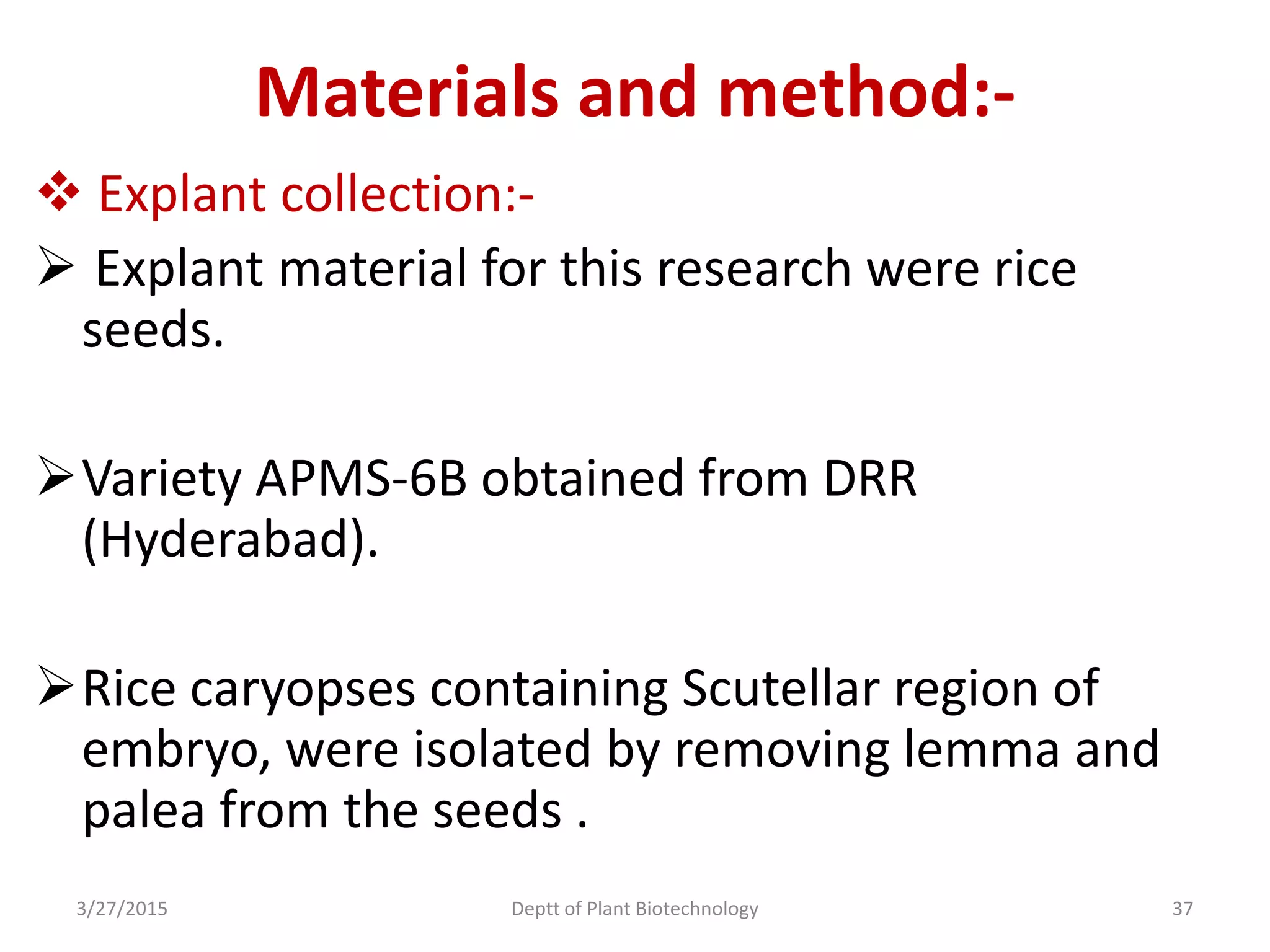
 Explant material for this research were rice
seeds.
Variety APMS-6B obtained from DRR
(Hyderabad).
Rice caryopses containing Scutellar region of
embryo, were isolated by removing lemma and
palea from the seeds .
3/27/2015 Deptt of Plant Biotechnology 37
Surface sterilization of Seeds:-
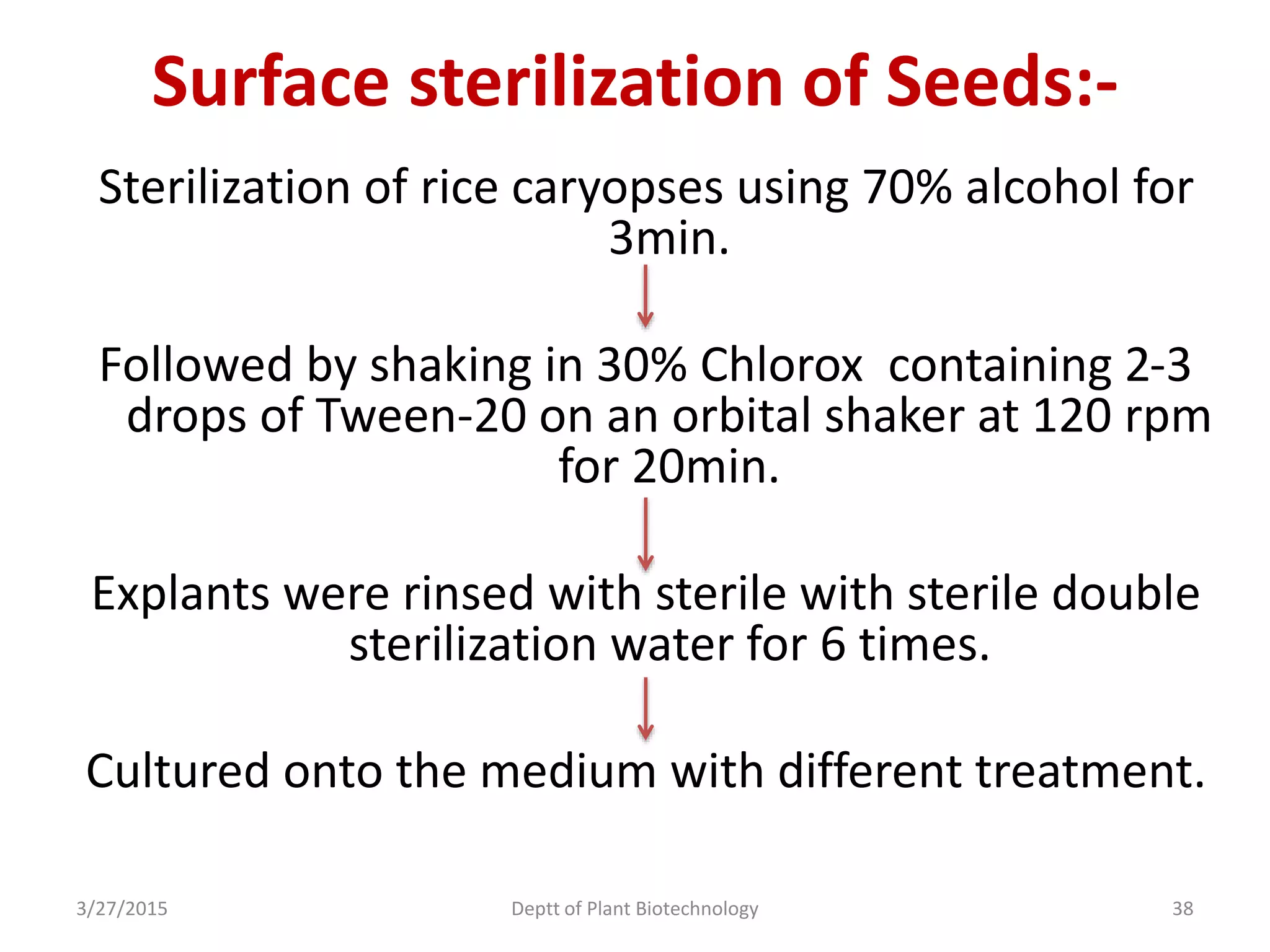
Sterilization of rice caryopses using 70% alcohol for
3min.
Followed by shaking in 30% Chlorox containing 2-3
drops of Tween-20 on an orbital shaker at 120 rpm
for 20min.
Explants were rinsed with sterile with sterile double
sterilization water for 6 times.
Cultured onto the medium with different treatment.
3/27/2015 Deptt of Plant Biotechnology 38
Preparation of Media:-
 Two basic media used in this study:-
 First one was:- half MS (Murashige & Skoog, 1962)
supplements with 500mg/l glutamine, 100 mg/l
proline.
Second one was:- N6 media supplemented with
500mg/l L-Glutamine.
Both media were solidified with 0.2% agar.
pH adjusted with 5.8.
3/27/2015 Deptt of Plant Biotechnology 39
Callus Induction Media:-
Different concentrations of 2, 4-D [0.1, 1.5, 2.5,3.5
and 5 mgL-1 (w/v)] were used as the treatments for
embryogenic callus induction.
Media were kept in dark condition for 1 week,
25±2°C at room temperature.
After 1 week transferred the cultures under 16 hrs
lighting , provided by fluorescent bulbs with 15.75
µmolm-²s-¹ for eight weeks.
3/27/2015 Deptt of Plant Biotechnology 40
Somatic Embryo Germination Media:-
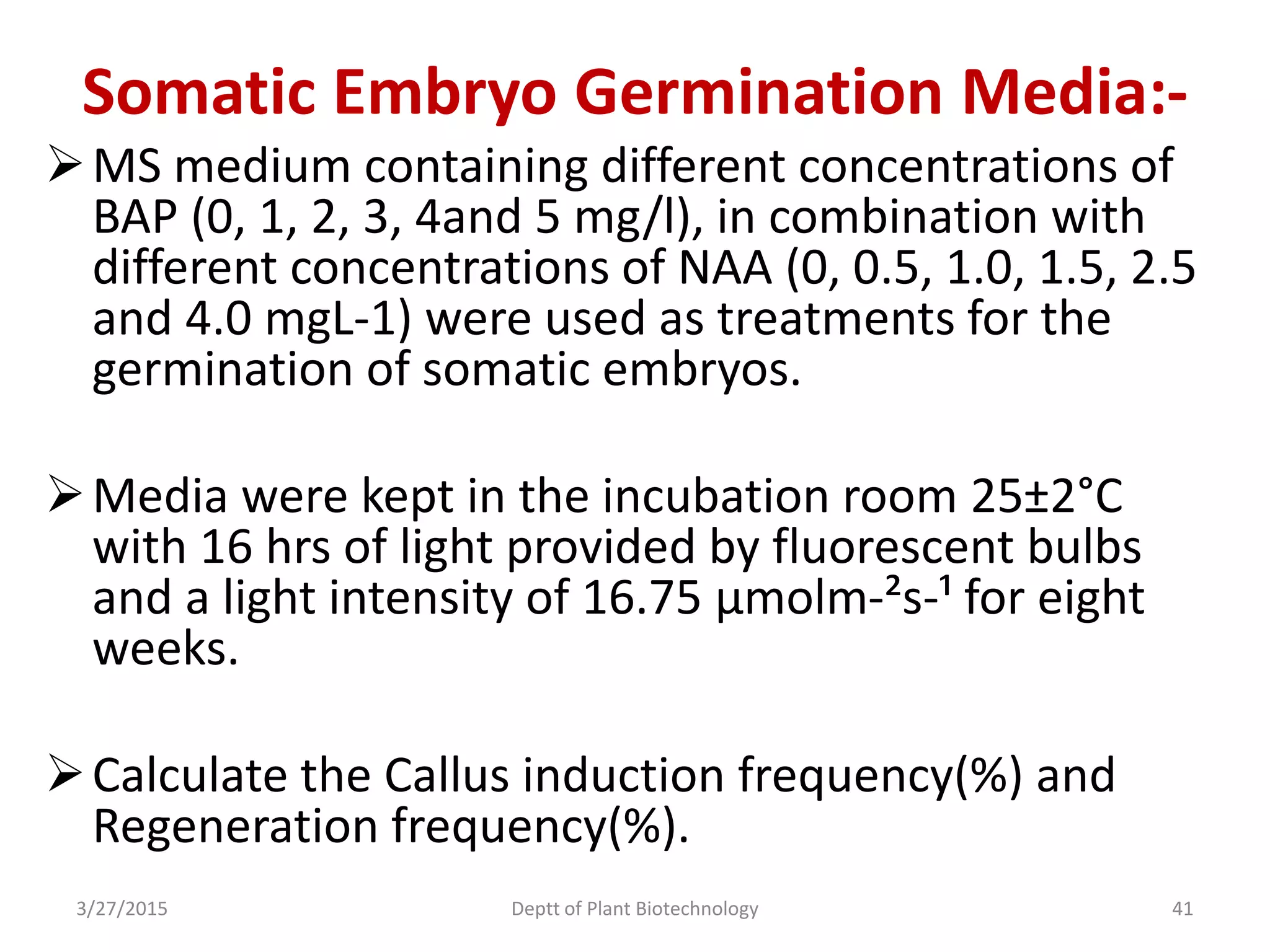
MS medium containing different concentrations of
BAP (0, 1, 2, 3, 4and 5 mg/l), in combination with
different concentrations of NAA (0, 0.5, 1.0, 1.5, 2.5
and 4.0 mgL-1) were used as treatments for the
germination of somatic embryos.
Media were kept in the incubation room 25±2°C
with 16 hrs of light provided by fluorescent bulbs
and a light intensity of 16.75 µmolm-²s-¹ for eight
weeks.
Calculate the Callus induction frequency(%) and
Regeneration frequency(%).
3/27/2015 Deptt of Plant Biotechnology 41
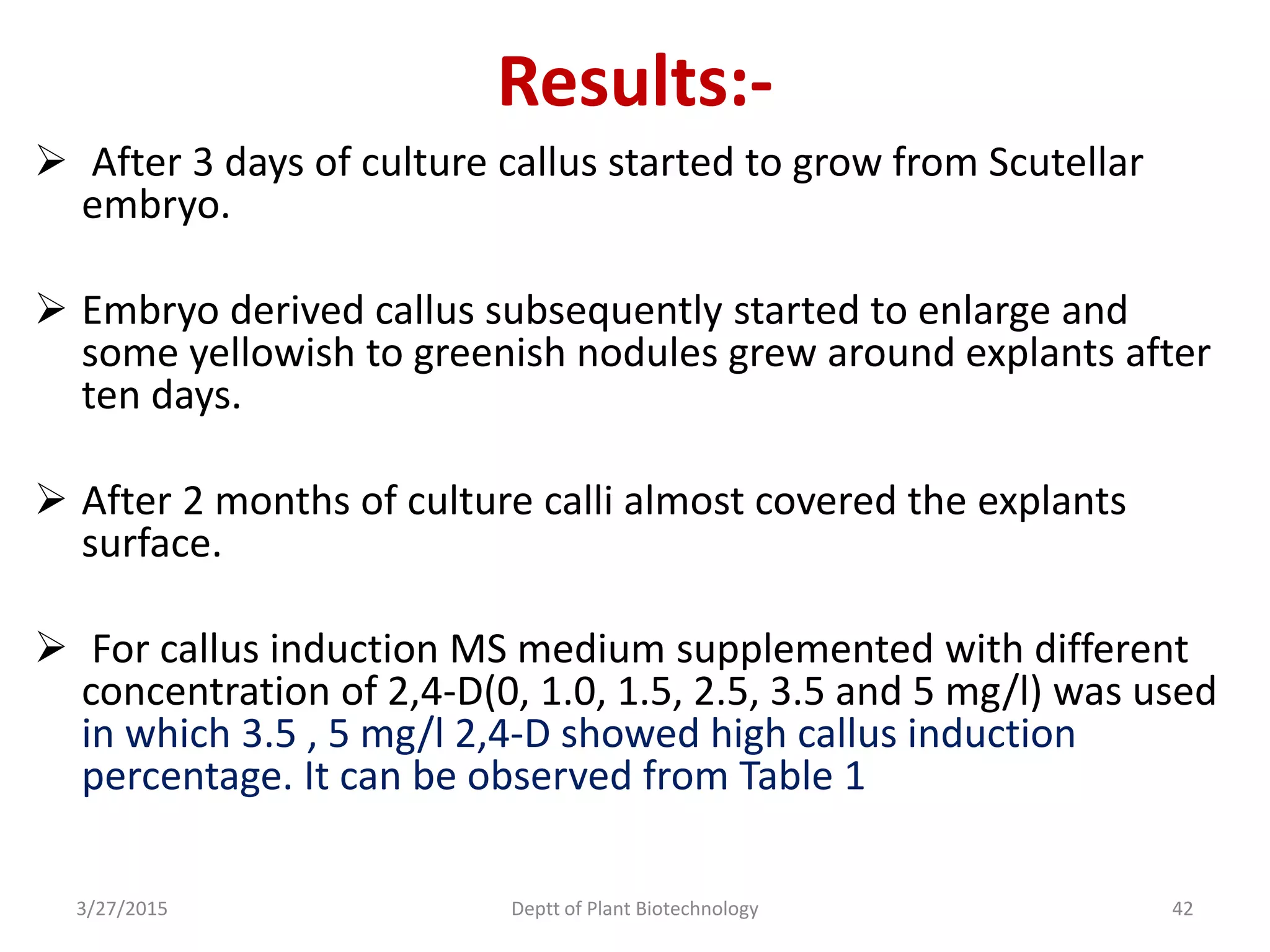
Results:-
 After 3 days of culture callus started to grow from Scutellar
embryo.
 Embryo derived callus subsequently started to enlarge and
some yellowish to greenish nodules grew around explants after
ten days.
 After 2 months of culture calli almost covered the explants
surface.
 For callus induction MS medium supplemented with different
concentration of 2,4-D(0, 1.0, 1.5, 2.5, 3.5 and 5 mg/l) was used
in which 3.5 , 5 mg/l 2,4-D showed high callus induction
percentage. It can be observed from Table 1
3/27/2015 Deptt of Plant Biotechnology 42
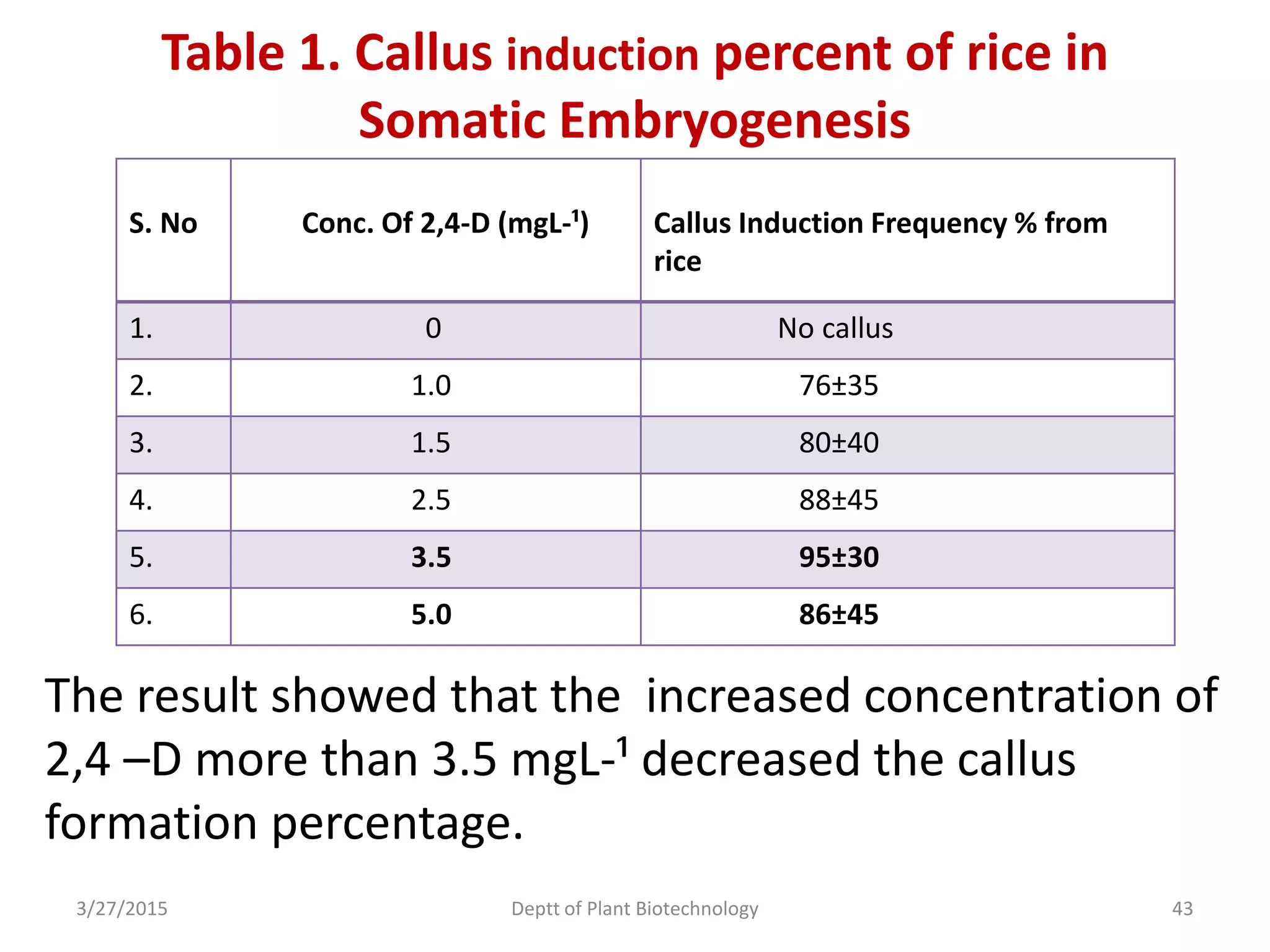
Table 1. Callus induction percent of rice in
Somatic Embryogenesis
S. No Conc. Of 2,4-D (mgL-¹) Callus Induction Frequency % from
rice
1. 0 No callus
2. 1.0 76±35
3. 1.5 80±40
4. 2.5 88±45
5. 3.5 95±30
6. 5.0 86±45
3/27/2015 Deptt of Plant Biotechnology 43
The result showed that the increased concentration of
2,4 –D more than 3.5 mgL-¹ decreased the callus
formation percentage.
Contd:-
MS media supplemented with 0.8% agar, 70gm/l
sucrose, 4gm/l Casein, 3mg/l BAP and 4 mg/l
NAA was used for derived calli. 3 mg/l BAP
concentration showed good results in Shoot
induction, it can be observed from Table 3.
4 mg/l NAA concentration showed good results
in Shoot induction, it can be observed from
Table 2.
3/27/2015 Deptt of Plant Biotechnology 44
S.No. Conc. Of NAA
(mg/l)
Shoot Induction % No. of Shoots
1. 0 31.33 2.6±0.48
2. 0.5 25.65 2.5± 0.64
3. 1 33.45 3.0± 0.54
4. 1.5 41.60 3.5± 0.64
5. 2.5 45.60 4.0± 0.59
6. 4.0 48.55 4.5± 0.60
Table 2. Effect of Transplantation PGRs in rice
Table 3. Effect of Transplantation PGRs in rice
S.No. Conc. Of BAP (mg/l) Shoot Induction % No. of Shoots
1. 0 30.33 2.0±0.87
2. 1 23.45 1.8±0.48
3. 2 31.85 2.2±0.16
4. 3 40.68 3.0±0.18
5. 4 38.67 2.5±0.64
6. 5 35.45 2.4±0.35
3/27/2015 Deptt of Plant Biotechnology 45
Contd:-
MS medium supplements with different
concentrations of NAA (0, 0.5, 1.0, 1.5, 2.0 mg/l)
in combination with different concentrations of
BAP (0, 1, 2, 3, 4, and 5 mg/l). Result showed that
combination of 3mg/l BAP + 1.5 mg/l NAA
showed highest result.
Further combination increases cause the
decrement of percent of Shoot induction. It can
be observed from Table 4.
3/27/2015 Deptt of Plant Biotechnology 46
Table 4. Effect of BAP + NAA
3/27/2015 Deptt of Plant Biotechnology 47
S.No. BAP + NAA (mg/l) Shoot Induction % No. Of Shoots
1. 1 + 0.5 26.85 2.1± 0.63
2. 2 + 1.0 29.65 2.5 ±0.83
3. 3 + 1.5 39.60 3.5± 0.54
4. 4 + 2.0 35.45 3.2± 0.45
5. 5 + 4.0 30.40 3.0± 0.54
APMS -6B Variety Seeds Regenerate
through Indirect Somatic Embryogenesis
3/27/2015 Deptt of Plant Biotechnology 48
Fig 1. Seed inoculation in MS medium Fig 2. Callus formation by 2, 4-D
Fig 3. Shoot induction by differ. Conc. Of
BAP and NAA
Fig -4 Transplantation
Conclusion
Somatic embryogenesis is an efficient plant
regeneration system.
It is potentially useful tool for genetic transformation.
Cross linking between hormone and transcription
factors is likely to play an important part in SE.
But mechanism of plant embryogenesis is unclear
and comphrensive work in future it by studying the
interaction of various factors thereby entire picture of
regulatory mechanism of embryogenesis would be
transparent.
3/27/2015 Deptt of Plant Biotechnology 49
Conclusion
 Indirect Somatic embryogenesis reduces the breeding
cycle.
 Indirect somatic embryogenesis are used in the crop
improvement.
 Indirect somatic embryogenesis are produce virus free
plants.
 Indirect somatic embryogenesis are better than the
Direct somatic embryogenesis.
3/27/2015 Deptt of Plant Biotechnology 50
References:-
Joshi, R., KUMAR, P., 2013, Regulation of Somatic
Embryogenesis in Crops: A Review, Agri. Reviews, 34 (1): 1-
21, 2013.
DHLLION, N. K., GOSAL, S. S., 2013, Analysis of Maize
Inbred Lines for their response to Somatic Embryogenesis,
J. Cell and Tiss. Res, 13(1): 3557-3563.
SAH, SK., KAUR, A., SANDHU, JS., 2014, High Frequency
Embryogenic Callus Induction and Whole Plant
Regeneration in Japonica Rice Cv. Kitaake, J. Rice Res., 2:
125.
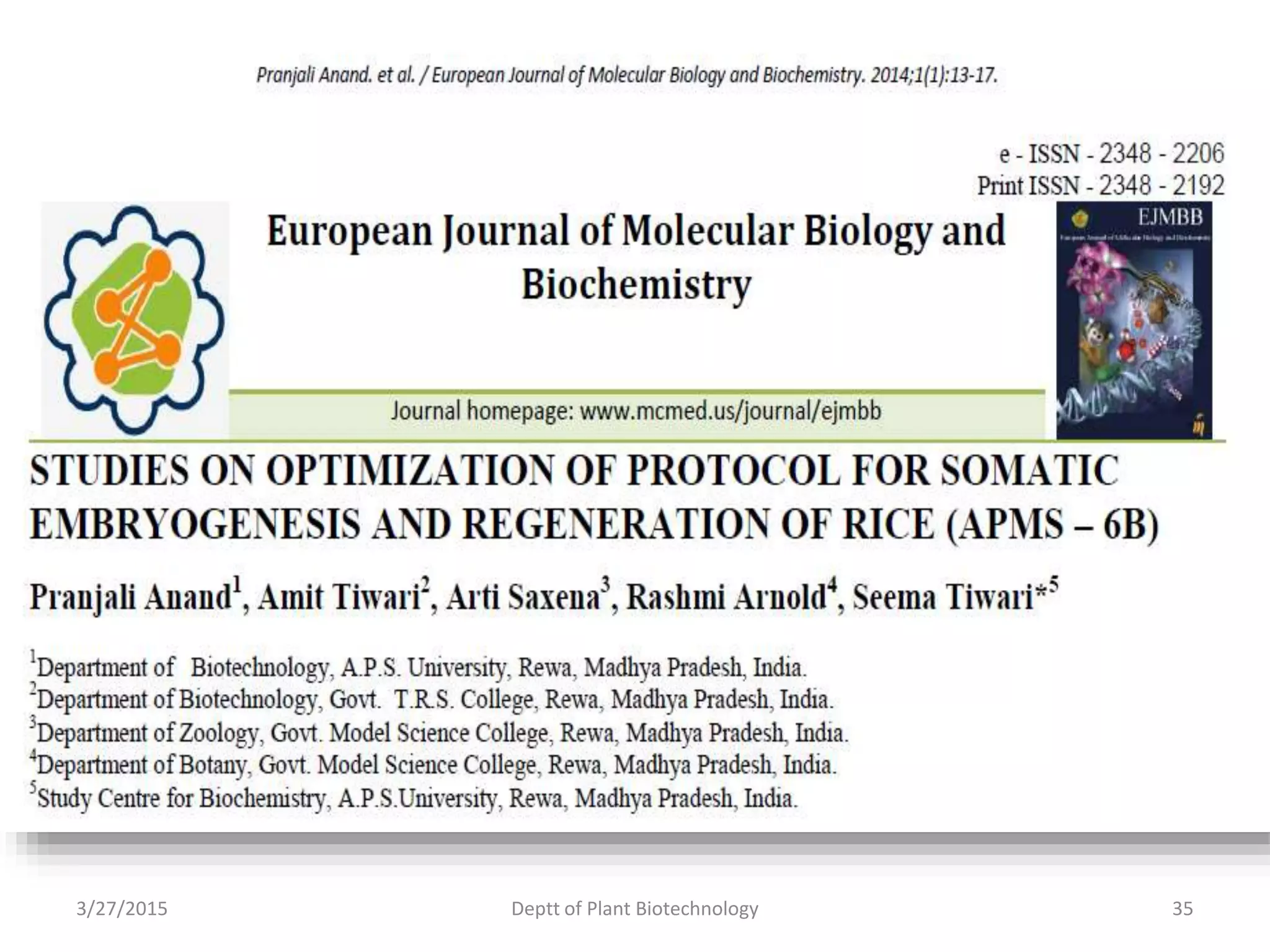
ANAND, P., TIWARI, A., SAXENA, A., ARNOLD, R., TIWARI,
S., 2014, Studies on Optimization OF Protocol for Somatic
Embryogenesis and Regeneration of Rice (APMS – 6B),
Euro. J. Mol. Biol. Biochem., 1(1):13-17.
3/27/2015 Deptt of Plant Biotechnology 51
3/27/2015 Deptt of Plant Biotechnology 52

Embryogenesis 27 mar 15

  • 1.
    WELCOME 3/27/2015 Deptt ofPlant Biotechnology 1
  • 2.
    In vitro RegenerationSystem for Indirect Somatic Embryogenesis of Cereals Crops. 3/27/2015 Deptt of Plant Biotechnology 2 AVINASH SHARMA ID. No:- PALB 3235 Sr. M.Sc. (Plant Biotech)
  • 3.
    EMBRYOGENESIS:-  Plant embryogenesisrefers to the process of development of plant embryos, being either a sexual or asexual reproductive process that forms new plants.  Embryogenesis may occur naturally in the plant as a result of sexual fertilization, and those embryo are called zygotic embryos and develop into seeds, which can germinate and give rise to seedlings.  Plant cells can also be induced to form embryos in plant tissue culture; these embryo are called somatic embryos. 3/27/2015 Deptt of Plant Biotechnology 3
  • 4.
    Stages of Embryogenesis:- 3/27/2015Deptt of Plant Biotechnology 4
  • 5.
    Types of Embryogenesis:- •Two types of embryogenesis:- A) Zygotic embryogenesis B) Somatic embryogenesis 3/27/2015 Deptt of Plant Biotechnology 5
  • 6.
    Zygotic Embryogenesis:- The zygoticembryo is formed following double fertilization of the ovule, forming the plant embryo and the endosperm which together go into the seed, this process is known as zygotic embryogenesis. Seeds may also develop without fertilization through pathways referred to as apomixis. 3/27/2015 Deptt of Plant Biotechnology 6
  • 7.
    Somatic Embryogenesis:- Somatic embryogenesisis a process by which somatic cells or tissues develops into differentiated embryos. Embryos regenerate from somatic cells or tissues ( haploid or diploid etc) it is termed as Somatic Embryogenesis. 3/27/2015 Deptt of Plant Biotechnology 7
  • 8.
    3/27/2015 Deptt ofPlant Biotechnology 8  Somatic embryogenesis was first induced in suspension culture (Stewart et al, 1958) and in callus culture (Reinert, 1959) of carrot, Umbelliferae and Solanaceae dicotyledonous families have produced somatic embryos.  SE occur most frequently in tissue culture as an alternative organogenesis for regeneration of whole plant.  In literature, somatic embryos are referred to by many names such as embryo like structures, adventitious or vegetative embryos, Embryoids; and the process is termed as adventitious , asexual or somatic embryogenesis.
  • 9.
    Stages of SomaticEmbryogenesis:- 3/27/2015 Deptt of Plant Biotechnology 9
  • 10.
    Stages of SomaticEmbryogenesis:- 3/27/2015 Deptt of Plant Biotechnology 10
  • 11.
    Contd:-  INDUCTION  Developmentand Maturation  Globular  Heart stage  Torpedo  Germination and Conversion • Globular stage: Embryo is small and round (multicellular). • Heart stage (Bilateral symmetry): Shape changes to heart shape with more cotyledon development. • Torpedo shaped stage: Consists of initial cells for the shoot/root meristem. • Mature stage: Embryo becomes cylindrical. 3/27/2015 Deptt of Plant Biotechnology 11
  • 12.
    Induction Auxin required forinduction Pro embryonic masses are formed.  2,4-D are mostly used.  NAA, DICAMBA are also used. 3/27/2015 Deptt of Plant Biotechnology 12
  • 13.
    Development • Auxin mustbe removed for embryo development. • Continuous use of Auxin inhibits embryogenesis. • Stages are similar to those of Somatic embryogenesis:-  Globular  Heart  Torpedo  Cotyledonary  Germination (Conversion) 3/27/2015 Deptt of Plant Biotechnology 13
  • 14.
    Maturation Require complete maturationwith apical meristem, radicle and cotyledons. Often obtained repetitive embryony. Storage protein production necessary. Often require ABA for complete maturation. ABA often required for normal morphology. 3/27/2015 Deptt of Plant Biotechnology 14
  • 15.
    Morphological Stages ofMaize cv. Gaurav 3/27/2015 Deptt of Plant Biotechnology 15
  • 16.
    Routes of SomaticEmbryogenesis:- Two routes to somatic embryogenesis  Direct somatic embryogenesis  The embryos initiate directly from explants in the absence of callus formation. Embryos are formed due to PEDCs cell.  Indirect somatic embryogenesis  Callus from explants takes place from which embryos are developed. Embryos are formed due to IEDCs cells. 3/27/2015 Deptt of Plant Biotechnology 16
  • 17.
    Examples of DirectSomatic Embryogenesis:- 3/27/2015 Deptt of Plant Biotechnology 17 Figure :- Isolation of mature embryo from imbibed cereal grain. (a) A curved-tip scalpel blade is inserted beneath the Coleoptilar region of the Mature embryo; (b) With a swift and smooth scooping motion the mature embryo is dislodged from its attachment to the scutellum; (c) Isolated mature embryo which will be inoculated with abaxial surface in contact with culture medium. Ganeshan et al., 2006.
  • 18.
    Contd:-  Mature embryosculture in the Murashige and Skoog, 1962 medium with supplements 1gm/l enzymatic casein hydrolysate, 0.7 gm/l L-proline.  4.5 µM of TDZ and 4.4 µM of BAP are best combination of growth regulators in which Durum Wheat produces 35 number of shoots per explant and Mature embryos of CDC Dancer oat produces 16 shoots per explant.  Explants for direct embryogenesis include microspores, ovules, scutellum, endosperm, embryos and seedlings. 3/27/2015 Deptt of Plant Biotechnology 18
  • 19.
    Indirect Somatic Embryogenesis:- InIndirect SE, callus is produced from explants. Embryoids(suspensory cell to cotyledon) are produced from callus tissue. Explants are roots, shoots, leaf cells, anthers, seeds etc. Steps involved in Plant regeneration of Rice variety through Indirect SE:- 3/27/2015 Deptt of Plant Biotechnology 19
  • 20.
    a) Formation ofcallus b) Greening of callus c) Embryo at globular stage d) Torpedo stage of embryo e) Cotyledonary stage and regeneration of embryo f-g) Multiple shoot regeneration h) Complete plantlets i) Hardening of plantlets. (Rice Variety:- Swarna) Mondal et al., 2011 (a) (b) (c) (d) (e) (f) (g) (h) (i) 3/27/2015 Deptt of Plant Biotechnology 20
  • 21.
    3/27/2015 Deptt ofPlant Biotechnology 21
  • 22.
    3/27/2015 Deptt ofPlant Biotechnology 22
  • 23.
    Factors affecting SomaticEmbryogenesis:- 1) Genotype:-  Genetically engineered / transgenic plant does not regenerate through SE because due to variation.  Methylation occurs in the DNA during mitosis then SE occurs. If Methylation occur in the cytosine bases or H3 protein then SE get stop. 3/27/2015 Deptt of Plant Biotechnology 23
  • 24.
    3/27/2015 Deptt ofPlant Biotechnology 24 2) Explant:- Totipotent somatic cell are used. Immature inflorescence and Scutellar tissue of immature seeds are used for the research. Ex:- Triticum aestivum . Epidermis, Procambial tissue are also produced somatic embryo.
  • 25.
    3/27/2015 Deptt ofPlant Biotechnology 25 During Proembryonic phase, 2,4-D generates DNA Hyper methylation so that cells in a highly active mitotic stage. High concentration of auxin produces root in somatic embryo. 2,4-D is one of the growth regulator that produces callus from cereals and conc. of 2,4-D 0.1-10µM 3) Auxin:- Polar transport of auxin produces somatic embryo. Auxin concentration will be more then somatic embryogenesis get stop. Ex:- Maize. Auxin induces indirect somatic embryogenesis in monocots.
  • 26.
    3/27/2015 Deptt ofPlant Biotechnology 26 4) Cytokinins:- Cytokinin promote axial growth. Cytokinin produces globular embryo from initial embryo. Cytokinin combination with auxin, induces somatic embryogenesis and produce callus in cereals. Cytokinin ratio more than auxin then it produces Shoots.
  • 27.
    3/27/2015 Deptt ofPlant Biotechnology 27 5) Gibberellic acid:-  GA promote elongations of embryo axis, cell division. It synthesized of photosynthetic pigments in developing somatic embryo. It improve photosynthetic activity, Extra storage reserves in vitro germination. Hypo cotyledon are used as explant then GA inhibit somatic embryogenesis. Addition of Uniconazole, Paclobutrazol inhibit somatic embryogenesis. GA higher in suspensory embryo than the proper embryo. So GA requires early embryo development.
  • 28.
    3/27/2015 Deptt ofPlant Biotechnology 28 6) Abscisic acid (ABA):-  ABA control tolerance and seed dormancy during later stage of embryogenesis. ABA induced somatic embryogenesis in high osmotic stress and high temperature in auxin free medium. Primary embryo contain more conc. of ABA than secondary embryo. Treatment of Fluridone inhibit ABA synthesis and primary embryo does not produce secondary embryo.
  • 29.
    7) Polyamines:-  Spermidine,Spermine and Putrescine are added as growth regulators and secondary messenger.  Polyamines serve as nitrogen source for plants.  It act as a free radical scavengers by protecting senescing membranes against lipid per oxidation.  In Maize, Putrescine are most effective with varying concentration of GA3.  Spermine act as a antioxidant in a medium.  It help in vegetative growth, pollen development, regulation of DNA duplication, transcription of genes, cell division, development of organs. 3/27/2015 Deptt of Plant Biotechnology 29
  • 30.
    8) Phytosulfokine  Itmodulate the culture media.  It promote somatic embryogenesis by activating cell division of embryogenic cells, in presence auxin.  Phytosulfokine increases the cell through differentiation process. 9) Phenolic compounds:-  Phenolic compounds are inhibit somatic embryogenesis.  4hydroxy benzyl alcohol inhibits the globular stages.  Vanillyl benzyl ether are inhibit the suspensor development.  Recently identification of 4 [(phenyl methoxy) methyl] phenol involves in seed development stills unknown. 3/27/2015 Deptt of Plant Biotechnology 30
  • 31.
    Differences between Zygoticand Somatic embryo:- Zygotic embryo  Fertilized egg or zygote.  Contain seed coat.  Produce seed.  Plantlets are healthy.  Not like to mother plant.  Propagation is low. Somatic embryo  Sporophytic cells.  Did not contain seed coat.  Only form embryo.  Plantlets are weaker  Like to mother plant.  Propagation is high. 3/27/2015 Deptt of Plant Biotechnology 31
  • 32.
    Advantages and Disadvantagesof Somatic Embryogenesis:-  Higher propagation rate.  Suitable for Suspension culture.  Artificial seed production.  Somaclonal variation.  Germplasm conservation.  Labour savings. 3/27/2015 Deptt of Plant Biotechnology 32
  • 33.
    Disadvantages Response tissue specific (explants). Lowfrequency embryo production. Incomplete embryo production. May create unwanted genetic variation (Somaclonal variation). Inability to generate large numbers of normal, free living plantlets. Plantlets are weaker. 3/27/2015 Deptt of Plant Biotechnology 33
  • 34.
    3/27/2015 Deptt ofPlant Biotechnology 34
  • 35.
    3/27/2015 Deptt ofPlant Biotechnology 35
  • 36.
    Introduction  Rice isthe staple diet for two billion people world wide .  It is the major food for over half of those living Asia.  It is feared that world population would be around 10 billion by 2050.  Diminishing of cultivated land.  Attack of pests and insects are responsible for decrease in production.  There is a constant need to improve crops to overcome all these hazards.  Somatic embryogenesis in rice has been reported culture of leaf tissue, root tissue, inflorescence and protoplast. 3/27/2015 Deptt of Plant Biotechnology 36
  • 37.
    Materials and method:- Explant collection:-  Explant material for this research were rice seeds. Variety APMS-6B obtained from DRR (Hyderabad). Rice caryopses containing Scutellar region of embryo, were isolated by removing lemma and palea from the seeds . 3/27/2015 Deptt of Plant Biotechnology 37
  • 38.
    Surface sterilization ofSeeds:- Sterilization of rice caryopses using 70% alcohol for 3min. Followed by shaking in 30% Chlorox containing 2-3 drops of Tween-20 on an orbital shaker at 120 rpm for 20min. Explants were rinsed with sterile with sterile double sterilization water for 6 times. Cultured onto the medium with different treatment. 3/27/2015 Deptt of Plant Biotechnology 38
  • 39.
    Preparation of Media:- Two basic media used in this study:-  First one was:- half MS (Murashige & Skoog, 1962) supplements with 500mg/l glutamine, 100 mg/l proline. Second one was:- N6 media supplemented with 500mg/l L-Glutamine. Both media were solidified with 0.2% agar. pH adjusted with 5.8. 3/27/2015 Deptt of Plant Biotechnology 39
  • 40.
    Callus Induction Media:- Differentconcentrations of 2, 4-D [0.1, 1.5, 2.5,3.5 and 5 mgL-1 (w/v)] were used as the treatments for embryogenic callus induction. Media were kept in dark condition for 1 week, 25±2°C at room temperature. After 1 week transferred the cultures under 16 hrs lighting , provided by fluorescent bulbs with 15.75 µmolm-²s-¹ for eight weeks. 3/27/2015 Deptt of Plant Biotechnology 40
  • 41.
    Somatic Embryo GerminationMedia:- MS medium containing different concentrations of BAP (0, 1, 2, 3, 4and 5 mg/l), in combination with different concentrations of NAA (0, 0.5, 1.0, 1.5, 2.5 and 4.0 mgL-1) were used as treatments for the germination of somatic embryos. Media were kept in the incubation room 25±2°C with 16 hrs of light provided by fluorescent bulbs and a light intensity of 16.75 µmolm-²s-¹ for eight weeks. Calculate the Callus induction frequency(%) and Regeneration frequency(%). 3/27/2015 Deptt of Plant Biotechnology 41
  • 42.
    Results:-  After 3days of culture callus started to grow from Scutellar embryo.  Embryo derived callus subsequently started to enlarge and some yellowish to greenish nodules grew around explants after ten days.  After 2 months of culture calli almost covered the explants surface.  For callus induction MS medium supplemented with different concentration of 2,4-D(0, 1.0, 1.5, 2.5, 3.5 and 5 mg/l) was used in which 3.5 , 5 mg/l 2,4-D showed high callus induction percentage. It can be observed from Table 1 3/27/2015 Deptt of Plant Biotechnology 42
  • 43.
    Table 1. Callusinduction percent of rice in Somatic Embryogenesis S. No Conc. Of 2,4-D (mgL-¹) Callus Induction Frequency % from rice 1. 0 No callus 2. 1.0 76±35 3. 1.5 80±40 4. 2.5 88±45 5. 3.5 95±30 6. 5.0 86±45 3/27/2015 Deptt of Plant Biotechnology 43 The result showed that the increased concentration of 2,4 –D more than 3.5 mgL-¹ decreased the callus formation percentage.
  • 44.
    Contd:- MS media supplementedwith 0.8% agar, 70gm/l sucrose, 4gm/l Casein, 3mg/l BAP and 4 mg/l NAA was used for derived calli. 3 mg/l BAP concentration showed good results in Shoot induction, it can be observed from Table 3. 4 mg/l NAA concentration showed good results in Shoot induction, it can be observed from Table 2. 3/27/2015 Deptt of Plant Biotechnology 44
  • 45.
    S.No. Conc. OfNAA (mg/l) Shoot Induction % No. of Shoots 1. 0 31.33 2.6±0.48 2. 0.5 25.65 2.5± 0.64 3. 1 33.45 3.0± 0.54 4. 1.5 41.60 3.5± 0.64 5. 2.5 45.60 4.0± 0.59 6. 4.0 48.55 4.5± 0.60 Table 2. Effect of Transplantation PGRs in rice Table 3. Effect of Transplantation PGRs in rice S.No. Conc. Of BAP (mg/l) Shoot Induction % No. of Shoots 1. 0 30.33 2.0±0.87 2. 1 23.45 1.8±0.48 3. 2 31.85 2.2±0.16 4. 3 40.68 3.0±0.18 5. 4 38.67 2.5±0.64 6. 5 35.45 2.4±0.35 3/27/2015 Deptt of Plant Biotechnology 45
  • 46.
    Contd:- MS medium supplementswith different concentrations of NAA (0, 0.5, 1.0, 1.5, 2.0 mg/l) in combination with different concentrations of BAP (0, 1, 2, 3, 4, and 5 mg/l). Result showed that combination of 3mg/l BAP + 1.5 mg/l NAA showed highest result. Further combination increases cause the decrement of percent of Shoot induction. It can be observed from Table 4. 3/27/2015 Deptt of Plant Biotechnology 46
  • 47.
    Table 4. Effectof BAP + NAA 3/27/2015 Deptt of Plant Biotechnology 47 S.No. BAP + NAA (mg/l) Shoot Induction % No. Of Shoots 1. 1 + 0.5 26.85 2.1± 0.63 2. 2 + 1.0 29.65 2.5 ±0.83 3. 3 + 1.5 39.60 3.5± 0.54 4. 4 + 2.0 35.45 3.2± 0.45 5. 5 + 4.0 30.40 3.0± 0.54
  • 48.
    APMS -6B VarietySeeds Regenerate through Indirect Somatic Embryogenesis 3/27/2015 Deptt of Plant Biotechnology 48 Fig 1. Seed inoculation in MS medium Fig 2. Callus formation by 2, 4-D Fig 3. Shoot induction by differ. Conc. Of BAP and NAA Fig -4 Transplantation
  • 49.
    Conclusion Somatic embryogenesis isan efficient plant regeneration system. It is potentially useful tool for genetic transformation. Cross linking between hormone and transcription factors is likely to play an important part in SE. But mechanism of plant embryogenesis is unclear and comphrensive work in future it by studying the interaction of various factors thereby entire picture of regulatory mechanism of embryogenesis would be transparent. 3/27/2015 Deptt of Plant Biotechnology 49
  • 50.
    Conclusion  Indirect Somaticembryogenesis reduces the breeding cycle.  Indirect somatic embryogenesis are used in the crop improvement.  Indirect somatic embryogenesis are produce virus free plants.  Indirect somatic embryogenesis are better than the Direct somatic embryogenesis. 3/27/2015 Deptt of Plant Biotechnology 50
  • 51.
    References:- Joshi, R., KUMAR,P., 2013, Regulation of Somatic Embryogenesis in Crops: A Review, Agri. Reviews, 34 (1): 1- 21, 2013. DHLLION, N. K., GOSAL, S. S., 2013, Analysis of Maize Inbred Lines for their response to Somatic Embryogenesis, J. Cell and Tiss. Res, 13(1): 3557-3563. SAH, SK., KAUR, A., SANDHU, JS., 2014, High Frequency Embryogenic Callus Induction and Whole Plant Regeneration in Japonica Rice Cv. Kitaake, J. Rice Res., 2: 125. ANAND, P., TIWARI, A., SAXENA, A., ARNOLD, R., TIWARI, S., 2014, Studies on Optimization OF Protocol for Somatic Embryogenesis and Regeneration of Rice (APMS – 6B), Euro. J. Mol. Biol. Biochem., 1(1):13-17. 3/27/2015 Deptt of Plant Biotechnology 51
  • 52.
    3/27/2015 Deptt ofPlant Biotechnology 52