ANSWERS TO FORCES _ WORKSHEET 1
QuestionL:
Describethe typical effectsof external forces on bodiesincluding:
- friction betweensurfaces
- air resistance
Let us considerhow externalforcesaffectthemotion of cars. When dealingwith friction and
carstherearedifferenttypesof friction to consider.
(i) Staticfriction: This is the friction betweenthe tyre andthe road when the car is
stationaryor when the tyre rolls without slipping. It is this static friction force that
providesthe reactionforce that causesthe wheel to roll andthe carto move. When
it is removed(e.9.a carboggedin mud or trying to drive on ice) the wheelsrotate
but becausethereis no reaction force betweenthe tyres andthe surface,the car
will not move. Staticfriction is alsothe forcethat holdsa carin placewhen it is
parkedon a slope.
(ii) Kinetic friction: This is the friction betweentwo surfacesthat aremoving with
respectto eachother. It applies,for instance,whenhard-brakingstopsthe wheels
from turning andthe car skidsto a stop.
(iiD Rolling friction: Thereis somelossof energyandsomedecelerationfrom friction
for anyrealwheel in motion, andthis is sometimesreferredto asrolling friction.
It is partly friction at the axle andcanbepartly dueto flexing of the wheel which
will dissipatesomeenergy.
(iv) Internalfriction: this is the friction that occursbetweenmoving partsof a car such
asthepistonsandcylinders.
When anobjectmovesthrougha fluid (liquid or gas)it hasto pushtheparticlesof fluid out
of the way. Whenthe fluid is air this is known asair resistance. Air resistanceopposesthe
motion of a car. Streamlining,i.e. slopingthe shapeof the car,sothat air flows overit
smoothly, greatlyreducesair resistance.Air resistanceincludesthe movementof a car
throughstill air aswell asthe movementof air againstthemotion of thevehicle(wind).
Question2:
Outline the forces involved in causing a changein the velocity of a vehicle when:
- coastingwith no pressureon the accelerator
- pressingon the accelerator
- pressingon the brakes
- passingover an icy patch on the road
- climbing and descendinghills
- following a curve in the road
Note thatbecauseyou areonly askedto outline the forces,your answersshouldbevery brief.
You needmaybea sentenceor two andan appropriatediagram. I have suppliedmore of a
description& explanationof the aboveforcesin orderto help your understanding.
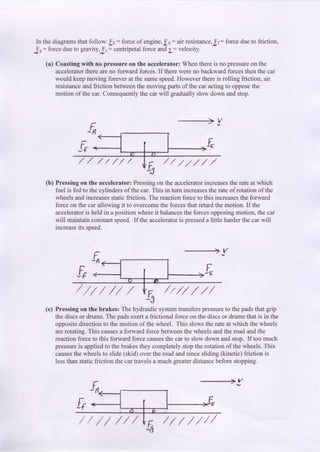
Inthe diagramsthat follow:.Ep: forceof engine,fe: air resistance,Jr: force dueto friction,
jr : force dueto gravityJ. : centripetalforce andy - velocity.
(a) Coasting with no pressure on the accelerator: Whenthereis no pressureon the
acceleratorthereareno forward forces.If therewere no backwardforcesthen the car
would keepmoving forever at the samespeed.However thereis rolling friction, air
resistanceandfriction betweenthe moving partsof the car actingto opposethe
motion of the car. Consequentlythe carwill gradually slow down andstop.
Vv
(b) Pressingon the accelerator: Pressingon the acceleratorincreasesthe rateat which
fuel is fed to the cylinders of the car. This in turn increasesthe rate of rotation of the
wheelsandincreasesstaticfriction. The reactionforce to this increasesthe forward
force on the car allowing it to overcomethe forcesthat retardthe motion. If the
acceleratoris held in a position where it balancesthe forcesopposingmotion, the car
will maintainconstantspeed.If the acceleratoris presseda little harderthe carwill
increaseits speed.
Vv
(c) Pressing on the brakes: The hydraulic systemtransferspressureto the padsthat grip
the discsor drums.The padsexert a frictional force on the discsor drumsthat is in the
oppositedirection to the motion of the wheel. This slowsthe rateat which the wheels
arerotating. This causesa forward force betweenthe wheelsandthe road andthe
reactionforce to this forward force causesthe car to slow down and stop. If too much
pressureis appliedto the brakesthey completelystoptherotationof thewheels.This
causesthe wheelsto slide(skid) overthe roadandsincesliding (kinetic) friction is
lessthan staticfriction the cartravels a much greaterdistancebefore stopping.
- - v - +
n /r / / ///-d
/ 1r // / F /r //// /
*J
//r/ /1 / 1r// / tt
/ / // // /
(d) Passingover an icy patch on the road: Ice reducesfriction to a very low valueso
pressingon the acceleratorwould speedup the rateof rotationof the driving wheels
but they would not be ableto grip the road.The wheelswould spinon the ice but the
carwould haveno tractionandwould not increaseits speed.The lossof friction
would be disastrousfor braking andsteering.The brakeswould stopthewheelsfrom
rotatingbut accordingto Newton's first law) a carin motion continuesin uniform
motion unlessactedon by a force.Hencethe carwould skid with liule changein
speeduntil it wasclearof the icy patchor until it met anopposingforce suchasthe
backof the carin front. Also becauseof the lack of friction, turning the wheelswould
not be ableto producea centripetalforce.Consequentlythe driver would not be able
to steerandthe carwould continuein a straightline evenif the roaddidn't.
Climbing and descendinghills:
All objectson Earth havea gravitationalforce on them pulling them towardsthe centreof
the Earth.This is true whetherthe objectis on level groundor on a slopesuchasa hill. A
caron a hill hasa gravitationalforceactingvertically down. This applieswhetherthe car
is climbing (ascending),descendingor parkedon the hill. The gravitationalforcemg, can
be divided into componentsperpendicularto theplane andparallelto theplane.The
parallelcomponentappliesa forceof mg sinOdownhill.
Theparallelcomponentappliesa forcemg sinOdownhill.
(e) Climbing a hill:
f,
lg
//t /1/,/ / // ////
When a caris climbing a hill the driver hasto pressharderon the acceleratorto
overcomethe gravitationalforcedownhill.
(f) Descendinga hill:
Whenthe caris descendingthe hill the driver doesnot haveto pressthe acceleratoras
hardsincesomeof the downhill forceis suppliedby gravity. On steephills the engine
may haveto supplyno forceat allandthe carwill coastdown the hill. In thesecases
the carhasto be slowedby the brakes.The problemis that constanthardbraking can
causethe brakesto overheatandbecomelesseffective.An alternativeto constant
brakingis to choosea lower gearto descendthe hill (eg"SteepDescent- TrucksUse
Low Gear" signson the road).Using a lower gearensuresthatthewheelsturn more
slowly andaresubjectto lessstaticfriction.
(g) Following a curve in the road: A body will travel with uniform velocity unlessacted
on by a force(Newton's first law). Thereforea forceis requiredto changethe
directionof a car.When following a curvein the road,the necessaryforce is a
"centripetalforce". This forcealwaysactstowardsthe centreof the motion i.e.
towardsthe centreof the road'scurve.The force is suppliedby the friction between
thetyresandthe roadandhasa valueof: F, : mu'lr,where Fr: centripetalforce,m:
massof car"v : linearvelocitv of car.r : radiusof curve.
E
'' C"*lrnof cur,re
The centripetalforce is alwaystowardsthe centre.
f,
Question3:
Interpret NewtonosSecondLaw of Motion and relate it to the equationXF = ma
Newton's secondlaw statesthatthe net force on anobjectis equalto theproductof its mass
andits accelerationandthat the accelerationis in the directionof the force.
Thus,if a forceof a given sizeis appliedto severaldifferentmasseswe will find thatthe
largerthe massthe smallerthe accelerationof the object.
Theterm "net force" refersto the sumof all the forcesactingon the object. Hencethe
X (capital sigma)in front of the F in the formula. E standsfor "the summationof'.
Examples:(i) At the schoolathleticscarnival,athletespreferto usea light shotput rather
than a heavyonebecausethey areableto give the light shotput a larger acceleration.This
meansthat it will attain a largervelocity asit leavesthe handand sotravel further before it
hits the ground. (ii) In cars,if the sameengineis installed in a heavy anda light car,the light
carwill attainthe higher accelerationfor the sameapplied force from the engine.
Question4:
Identify the net force in a wide variety of situations involving modesof transport and
explain the consequencesof the application of that net force in terms of Newtonts
SecondLaw of Motion
Note thewords "identifytt and"explain"
Considerthe forcesactingin planes,trainsandcars.
Planes:Thephysicsof flight is extremelycomplex. Let us considera planejust at take-off.
Therearetwo componentsof the net force that we haveto consider.First therearethe
horizontal componentsof the motion that provide the planesforward motion and secondly
therearethe vertical forces actingthat causethe planeto lift from the ground.
Thevertical motion of the planeis causedby dynamiclift (asopposedto staticlift suchasa
balloonwherethe objectrisesin a moredensefluid). The dynamiclift of an aircraftis caused
by two factors,both of which rely on the planemoving forward through the air.
The first is causedby the wing sloping upward towardsthe direction of forward motion so
thatthe air is deflecteddown. The secondis dueto the shapeof the wing. The wing is curved
sothat air travelling over the top of the wing travels a greaterdistancethan air travelling
underneaththe bottom of the wing. This resultsin the air travelling overthe top occupyinga
greatervolume in the sametime andsobeinglessdense.While the differencein density
would createvery little lift for a stationaryobject,thereis substantiallift for a moving object.
This is dueto the Bernoulli principlethat is beyondthe scopeof the currentHSC physics
course. It usedto be donein a Fluid DynamicsHalf Electivesomeyearsago.
The forward thrustof ajet planeis causedby the reactionforceto the exhaustgases
(Newton'sthird law). A biggerengineor more enginesgivesa greaterforward force.Thereis
alsothe forceof air resistanceopposingthe motion of the airqaft. The net forceis forward
andtheaccelerationis givenby a: Fn.1/m.
Note that asaplanetakesoff, the net force acting on the plane at anypoint in time is the sum
of the vertical &horizontal forcesactingon the plane atthatpoint in time. This would
requirea vectordiagramto determinethenet force on theplaneat anypoint in time.
Trains: Thereareseveraldifferenttypes(steam,diesel,electric)but all rely on theprinciple
of a force causingthe wheelsto turn andthe static friction betweenthe wheelsandthe rail
providing the forward (reaction)forceto causethe train to move.Thereis friction between
themoving partsof thetrain aswell asair resistancebut the overallresultis a net force
forward which resultsin the forward accelerationof the train. The train will attain a constant
velocity whenthe forward forceis equalto the sumof the backwardforces.
Cars: Theseexperiencemuchthe sameforcesastrainsexceptthatthereis friction between
thetyresandtheroadratherthanbetweenthewheelsandrail. Tyreshave atreadpattern,so
the friction betweenthetyresandthe roadis usually greaterthanthe correspondingfriction
betweentrain wheelsandthe rails. Thereis friction betweenthe moving partsof the caras
well asair resistancebut the overall result is a net force forward which resultsin the forward
accelerationof the car.The carwill attaina constantvelocitv whenthe forward force is equal
to the sumof the backwardforces.
A Note on Friction for the Teacher
Two typesof friction canoccur betweena cartyre andthe ground,a) static friction, andb)
kinetic friction.
Staticfriction is when the tyre maintainsgrip or traction on the road surface,whereaskinetic
friction (asthenameimplies) is whenthetyre is moving relativeto the ground.To illustrate
staticfriction, considerfor a momenta dot on the tyre'ssurface.Your vehicleis moving
forward (let'ssayit's moving very slowly), andyour tyre rotatessothatthe dot comesinto
contactwith the groundat a certainpoint. Sincea cartyre compressesa bit on the road's
surface,there'sapproximatelylOcm of tyre flat againstthe roadat anygiven time. As your
carmovesforward,thetyre rotates,andoncethe dot touchesthe groundat a givenpoint, the
tyre andthe groundmove at the sameraterelative to the car. That is, the dot on the tyre and
thepoint on the groundremainin contactuntil thetyre reachesthe endof that 10cmstrip of
contact,when it is pulled upward from the groundto rotatearoundtop andbackto the
ground.
An exampleof kinetic friction from the illustration abovewould be that the dot on the tyre
reachesa point on the ground,but the dot andpoint move away from oneanother.In real life
this would be if you hit the brakesand skid, or if you hit the acceleratorandburn out or spin
your tires (e.g.in the snow or mud). The problem with kinetic friction is that it is weakerthan
staticfriction. Thus,when you hit the brakes,if your tyres lock up (you will hearthe
squealingtyres againstthe road) you arenow in kinetic friction andyour car will slow down
lessquickly comparedto when your tyres were in staticfriction with the ground. That is why
you pump your brakes...alsowhy anti-lockbraking systems(ABS) weredeveloped.
Readmore: http://wiki.answers.com/Q/Flow_does_friction act on_a_car#ixzzlyl iQAOKu
Question5:
The massof an object is a measureof the amount of matter containedin the object. Massis a
scalarquantity. The weight of an object is the force dueto gravity acting on the object.
Weightis avectorquantity.W-mg, whereW-weightforce, m:masS, g: acceleration
dueto gravity.
.r-"i***, '
$gF'ii.
J
/
.l!,. -.--.
i
a - . . -
l-
F e
t _Ml
4
+? f-
f-v7
: {-f
TiL a"s-L/ U*#
rvt-- z4ao k
V = 2r*?'. -5-.(/
+ =Q nfl
a- q' =
k
= -Z'fr+g-L
O- Z.f
/a
_ ?
.1..',1,:,h-r.-k = ZLo-o y -2-{
= -{;fe-,O_U
b.q- ad C+ /'f
g. 4s*onn't" er/o*e*.R-A:fi- s-r4*"s /^n'+s /*,,r"1.
/k,o 4"* lr"i*'*zlt,'-,ii*,r* /,a &.f *
-/(u.
oko. c.;rk,^ rK-"/"/,, fl- a-s*rr*','/t' /A""s
ar- A"t"l 4'rm( o1 ,A-s"-f( flouetnq,.f- //"""tr;n Atr
Qr<u/#a+"t"4^ ,snrt 7K" -*-r/"',*(>"/",ft
d-r-,2y/qJ"i -*. 4"/ an,l( gz /;4 6eJ*,7a 7ZL>
V.YrsI M"rv"-r at' ,/d+ Hus acJ.u*4 fr@&.
/- t""l aa'Zt zot' nr/o*b^- zh dtuL [7u.a'2
/**- ao #-- /a" a,^./ a-r t(o.aLn't /r/ 1..* s/^xdt ;
a 1".L, ar,/ re"^^t!* at r"s/ un/car a" e'*"nz/ aa/"&,'o'l
.An*-/o* a,^)1 'rZ"ll"Z t4-a A t* a*',e &
* ./* Ll, a..t/"r.,/"/. 31""/ at"-rl"/ 4a";7f",^- 2--
6rat* / k" "sr/a^a"'tr a'^f.
?. Q,*- Vns,urn,
aa a'*c/r-rti u,// fd'<z *a'*a a7il&
&--'h hQ- corq.
For.-/rd"."J byV,*^
t'"oJ,, ==!n2*
,
t^/. sa^/14-ro,.r*or.b* ;3";*Y
4o/ it hJv o.<do#fi"^* .
$ n*Axe a^ vc,,*=oN'
J' F.r.rl; #.o rVV/ut /y rr.-t = /ooe6lr1*
= t:.'(, "/f,/Ueiig,a/ tza.u
J ..,,
b.q ru,= l.zoo.L6_,
V = 72k^I .'=-c
c
Q*, Ar k uoviu< a{ a.,d
/,--
(
''.. ia.ft
t/t r ,/r
(d/ f; = ({ao{r ne#L
Cr-tr I
_ffg* F-wA- | O=;
I
= f 3ils-: rp"&--
.,
: - f,g A{.-2 Af!-currvteurk t *v+.
)o
e*rt"tN{ Zo,u/s&r&
o-b
-6, 4ae/e1afi'o-r-o/ af
Y- ^., AV V"-Af-fc'r*rr,,-4=aG=-ftn-
s?;t-(A4 A.f,
t f
bf o_ lvtta-
a
. ? a
:s.5 =
^r
/'rn'.u
T
= 3-3,
q /L *J ,+ I* Aoo {q et ,+^ve/.rh,Lt,
J.'7fr i/ /ukos A tA,u /""-^ f srfu t*-
,t'* fisz/ ,+ a// # ?fLr &'/*",h
A|'t{,*vn rt4a,rerl 4 <4 a c*,,,,<{ur,,{q,r./
/uri,v /t, /,"* ;/ /^7* 6 /*;rt'r{
ry,fq0 /.*,(-. (uw"-tx 6.i s z- 2;). /L
<&oi"J ,+ /ou- -rt" exc*t'd;/o-^r-,rt" hr"k
t- eJt l uf Ct+rd-/ ,inr'* 4^- o'tt-<erftv'cs (zf .
0z- A/,*u/a
"&
& 4 s/c7i do7 6",(6*
d4 /;* {nlz 6*r€* )
'
= 3x7'tr = Zf,r//.H"/rU/1
fL ?h trarr 6,^,K4r *f /r1o*, it th-ry'* hJ
h/",* iT /-fl ,h /"A.^.* ur#'c<$ 4llearsote ^
qW,G#.n) . n-?L/ *ln, /",-t 4 s,V/"s lkS
4"2- (z?.f u) Vuc+/. kd let rb /^hro s/;V
hl' k Tk" 3k; hott atLse u",y6t' /aE are ilt€*surri
/cr,//t ,k" 7ix,/oatno.ra:r*
(/t^ ,k, th /744s'z'
/n k4, ,fu u/o/**n ai/( re"/ 3&rr&rn (zZrrtl €
fr::# ?L qru b&^q hl lL f,ft?'
(4r6roft.L;

Solutions to forces worksheet 1

  • 1.
    ANSWERS TO FORCES_ WORKSHEET 1 QuestionL: Describethe typical effectsof external forces on bodiesincluding: - friction betweensurfaces - air resistance Let us considerhow externalforcesaffectthemotion of cars. When dealingwith friction and carstherearedifferenttypesof friction to consider. (i) Staticfriction: This is the friction betweenthe tyre andthe road when the car is stationaryor when the tyre rolls without slipping. It is this static friction force that providesthe reactionforce that causesthe wheel to roll andthe carto move. When it is removed(e.9.a carboggedin mud or trying to drive on ice) the wheelsrotate but becausethereis no reaction force betweenthe tyres andthe surface,the car will not move. Staticfriction is alsothe forcethat holdsa carin placewhen it is parkedon a slope. (ii) Kinetic friction: This is the friction betweentwo surfacesthat aremoving with respectto eachother. It applies,for instance,whenhard-brakingstopsthe wheels from turning andthe car skidsto a stop. (iiD Rolling friction: Thereis somelossof energyandsomedecelerationfrom friction for anyrealwheel in motion, andthis is sometimesreferredto asrolling friction. It is partly friction at the axle andcanbepartly dueto flexing of the wheel which will dissipatesomeenergy. (iv) Internalfriction: this is the friction that occursbetweenmoving partsof a car such asthepistonsandcylinders. When anobjectmovesthrougha fluid (liquid or gas)it hasto pushtheparticlesof fluid out of the way. Whenthe fluid is air this is known asair resistance. Air resistanceopposesthe motion of a car. Streamlining,i.e. slopingthe shapeof the car,sothat air flows overit smoothly, greatlyreducesair resistance.Air resistanceincludesthe movementof a car throughstill air aswell asthe movementof air againstthemotion of thevehicle(wind). Question2: Outline the forces involved in causing a changein the velocity of a vehicle when: - coastingwith no pressureon the accelerator - pressingon the accelerator - pressingon the brakes - passingover an icy patch on the road - climbing and descendinghills - following a curve in the road Note thatbecauseyou areonly askedto outline the forces,your answersshouldbevery brief. You needmaybea sentenceor two andan appropriatediagram. I have suppliedmore of a description& explanationof the aboveforcesin orderto help your understanding.
  • 2.
    Inthe diagramsthat follow:.Ep:forceof engine,fe: air resistance,Jr: force dueto friction, jr : force dueto gravityJ. : centripetalforce andy - velocity. (a) Coasting with no pressure on the accelerator: Whenthereis no pressureon the acceleratorthereareno forward forces.If therewere no backwardforcesthen the car would keepmoving forever at the samespeed.However thereis rolling friction, air resistanceandfriction betweenthe moving partsof the car actingto opposethe motion of the car. Consequentlythe carwill gradually slow down andstop. Vv (b) Pressingon the accelerator: Pressingon the acceleratorincreasesthe rateat which fuel is fed to the cylinders of the car. This in turn increasesthe rate of rotation of the wheelsandincreasesstaticfriction. The reactionforce to this increasesthe forward force on the car allowing it to overcomethe forcesthat retardthe motion. If the acceleratoris held in a position where it balancesthe forcesopposingmotion, the car will maintainconstantspeed.If the acceleratoris presseda little harderthe carwill increaseits speed. Vv (c) Pressing on the brakes: The hydraulic systemtransferspressureto the padsthat grip the discsor drums.The padsexert a frictional force on the discsor drumsthat is in the oppositedirection to the motion of the wheel. This slowsthe rateat which the wheels arerotating. This causesa forward force betweenthe wheelsandthe road andthe reactionforce to this forward force causesthe car to slow down and stop. If too much pressureis appliedto the brakesthey completelystoptherotationof thewheels.This causesthe wheelsto slide(skid) overthe roadandsincesliding (kinetic) friction is lessthan staticfriction the cartravels a much greaterdistancebefore stopping. - - v - + n /r / / ///-d / 1r // / F /r //// / *J //r/ /1 / 1r// / tt / / // // /
  • 3.
    (d) Passingover anicy patch on the road: Ice reducesfriction to a very low valueso pressingon the acceleratorwould speedup the rateof rotationof the driving wheels but they would not be ableto grip the road.The wheelswould spinon the ice but the carwould haveno tractionandwould not increaseits speed.The lossof friction would be disastrousfor braking andsteering.The brakeswould stopthewheelsfrom rotatingbut accordingto Newton's first law) a carin motion continuesin uniform motion unlessactedon by a force.Hencethe carwould skid with liule changein speeduntil it wasclearof the icy patchor until it met anopposingforce suchasthe backof the carin front. Also becauseof the lack of friction, turning the wheelswould not be ableto producea centripetalforce.Consequentlythe driver would not be able to steerandthe carwould continuein a straightline evenif the roaddidn't. Climbing and descendinghills: All objectson Earth havea gravitationalforce on them pulling them towardsthe centreof the Earth.This is true whetherthe objectis on level groundor on a slopesuchasa hill. A caron a hill hasa gravitationalforceactingvertically down. This applieswhetherthe car is climbing (ascending),descendingor parkedon the hill. The gravitationalforcemg, can be divided into componentsperpendicularto theplane andparallelto theplane.The parallelcomponentappliesa forceof mg sinOdownhill. Theparallelcomponentappliesa forcemg sinOdownhill. (e) Climbing a hill: f, lg //t /1/,/ / // ////
  • 4.
    When a carisclimbing a hill the driver hasto pressharderon the acceleratorto overcomethe gravitationalforcedownhill. (f) Descendinga hill: Whenthe caris descendingthe hill the driver doesnot haveto pressthe acceleratoras hardsincesomeof the downhill forceis suppliedby gravity. On steephills the engine may haveto supplyno forceat allandthe carwill coastdown the hill. In thesecases the carhasto be slowedby the brakes.The problemis that constanthardbraking can causethe brakesto overheatandbecomelesseffective.An alternativeto constant brakingis to choosea lower gearto descendthe hill (eg"SteepDescent- TrucksUse Low Gear" signson the road).Using a lower gearensuresthatthewheelsturn more slowly andaresubjectto lessstaticfriction. (g) Following a curve in the road: A body will travel with uniform velocity unlessacted on by a force(Newton's first law). Thereforea forceis requiredto changethe directionof a car.When following a curvein the road,the necessaryforce is a "centripetalforce". This forcealwaysactstowardsthe centreof the motion i.e. towardsthe centreof the road'scurve.The force is suppliedby the friction between thetyresandthe roadandhasa valueof: F, : mu'lr,where Fr: centripetalforce,m: massof car"v : linearvelocitv of car.r : radiusof curve. E '' C"*lrnof cur,re The centripetalforce is alwaystowardsthe centre. f,
  • 5.
    Question3: Interpret NewtonosSecondLaw ofMotion and relate it to the equationXF = ma Newton's secondlaw statesthatthe net force on anobjectis equalto theproductof its mass andits accelerationandthat the accelerationis in the directionof the force. Thus,if a forceof a given sizeis appliedto severaldifferentmasseswe will find thatthe largerthe massthe smallerthe accelerationof the object. Theterm "net force" refersto the sumof all the forcesactingon the object. Hencethe X (capital sigma)in front of the F in the formula. E standsfor "the summationof'. Examples:(i) At the schoolathleticscarnival,athletespreferto usea light shotput rather than a heavyonebecausethey areableto give the light shotput a larger acceleration.This meansthat it will attain a largervelocity asit leavesthe handand sotravel further before it hits the ground. (ii) In cars,if the sameengineis installed in a heavy anda light car,the light carwill attainthe higher accelerationfor the sameapplied force from the engine. Question4: Identify the net force in a wide variety of situations involving modesof transport and explain the consequencesof the application of that net force in terms of Newtonts SecondLaw of Motion Note thewords "identifytt and"explain" Considerthe forcesactingin planes,trainsandcars. Planes:Thephysicsof flight is extremelycomplex. Let us considera planejust at take-off. Therearetwo componentsof the net force that we haveto consider.First therearethe horizontal componentsof the motion that provide the planesforward motion and secondly therearethe vertical forces actingthat causethe planeto lift from the ground. Thevertical motion of the planeis causedby dynamiclift (asopposedto staticlift suchasa balloonwherethe objectrisesin a moredensefluid). The dynamiclift of an aircraftis caused by two factors,both of which rely on the planemoving forward through the air. The first is causedby the wing sloping upward towardsthe direction of forward motion so thatthe air is deflecteddown. The secondis dueto the shapeof the wing. The wing is curved
  • 6.
    sothat air travellingover the top of the wing travels a greaterdistancethan air travelling underneaththe bottom of the wing. This resultsin the air travelling overthe top occupyinga greatervolume in the sametime andsobeinglessdense.While the differencein density would createvery little lift for a stationaryobject,thereis substantiallift for a moving object. This is dueto the Bernoulli principlethat is beyondthe scopeof the currentHSC physics course. It usedto be donein a Fluid DynamicsHalf Electivesomeyearsago. The forward thrustof ajet planeis causedby the reactionforceto the exhaustgases (Newton'sthird law). A biggerengineor more enginesgivesa greaterforward force.Thereis alsothe forceof air resistanceopposingthe motion of the airqaft. The net forceis forward andtheaccelerationis givenby a: Fn.1/m. Note that asaplanetakesoff, the net force acting on the plane at anypoint in time is the sum of the vertical &horizontal forcesactingon the plane atthatpoint in time. This would requirea vectordiagramto determinethenet force on theplaneat anypoint in time. Trains: Thereareseveraldifferenttypes(steam,diesel,electric)but all rely on theprinciple of a force causingthe wheelsto turn andthe static friction betweenthe wheelsandthe rail providing the forward (reaction)forceto causethe train to move.Thereis friction between themoving partsof thetrain aswell asair resistancebut the overallresultis a net force forward which resultsin the forward accelerationof the train. The train will attain a constant velocity whenthe forward forceis equalto the sumof the backwardforces. Cars: Theseexperiencemuchthe sameforcesastrainsexceptthatthereis friction between thetyresandtheroadratherthanbetweenthewheelsandrail. Tyreshave atreadpattern,so the friction betweenthetyresandthe roadis usually greaterthanthe correspondingfriction betweentrain wheelsandthe rails. Thereis friction betweenthe moving partsof the caras well asair resistancebut the overall result is a net force forward which resultsin the forward accelerationof the car.The carwill attaina constantvelocitv whenthe forward force is equal to the sumof the backwardforces. A Note on Friction for the Teacher Two typesof friction canoccur betweena cartyre andthe ground,a) static friction, andb) kinetic friction. Staticfriction is when the tyre maintainsgrip or traction on the road surface,whereaskinetic friction (asthenameimplies) is whenthetyre is moving relativeto the ground.To illustrate staticfriction, considerfor a momenta dot on the tyre'ssurface.Your vehicleis moving forward (let'ssayit's moving very slowly), andyour tyre rotatessothatthe dot comesinto contactwith the groundat a certainpoint. Sincea cartyre compressesa bit on the road's surface,there'sapproximatelylOcm of tyre flat againstthe roadat anygiven time. As your carmovesforward,thetyre rotates,andoncethe dot touchesthe groundat a givenpoint, the tyre andthe groundmove at the sameraterelative to the car. That is, the dot on the tyre and thepoint on the groundremainin contactuntil thetyre reachesthe endof that 10cmstrip of contact,when it is pulled upward from the groundto rotatearoundtop andbackto the ground.
  • 7.
    An exampleof kineticfriction from the illustration abovewould be that the dot on the tyre reachesa point on the ground,but the dot andpoint move away from oneanother.In real life this would be if you hit the brakesand skid, or if you hit the acceleratorandburn out or spin your tires (e.g.in the snow or mud). The problem with kinetic friction is that it is weakerthan staticfriction. Thus,when you hit the brakes,if your tyres lock up (you will hearthe squealingtyres againstthe road) you arenow in kinetic friction andyour car will slow down lessquickly comparedto when your tyres were in staticfriction with the ground. That is why you pump your brakes...alsowhy anti-lockbraking systems(ABS) weredeveloped. Readmore: http://wiki.answers.com/Q/Flow_does_friction act on_a_car#ixzzlyl iQAOKu Question5: The massof an object is a measureof the amount of matter containedin the object. Massis a scalarquantity. The weight of an object is the force dueto gravity acting on the object. Weightis avectorquantity.W-mg, whereW-weightforce, m:masS, g: acceleration dueto gravity. .r-"i***, ' $gF'ii.
  • 8.
    J / .l!,. -.--. i a -. . - l- F e t _Ml 4 +? f- f-v7 : {-f TiL a"s-L/ U*# rvt-- z4ao k V = 2r*?'. -5-.(/ + =Q nfl a- q' = k = -Z'fr+g-L O- Z.f /a _ ? .1..',1,:,h-r.-k = ZLo-o y -2-{ = -{;fe-,O_U b.q- ad C+ /'f
  • 9.
    g. 4s*onn't" er/o*e*.R-A:fi-s-r4*"s /^n'+s /*,,r"1. /k,o 4"* lr"i*'*zlt,'-,ii*,r* /,a &.f * -/(u. oko. c.;rk,^ rK-"/"/,, fl- a-s*rr*','/t' /A""s ar- A"t"l 4'rm( o1 ,A-s"-f( flouetnq,.f- //"""tr;n Atr Qr<u/#a+"t"4^ ,snrt 7K" -*-r/"',*(>"/",ft d-r-,2y/qJ"i -*. 4"/ an,l( gz /;4 6eJ*,7a 7ZL> V.YrsI M"rv"-r at' ,/d+ Hus acJ.u*4 fr@&. /- t""l aa'Zt zot' nr/o*b^- zh dtuL [7u.a'2 /**- ao #-- /a" a,^./ a-r t(o.aLn't /r/ 1..* s/^xdt ; a 1".L, ar,/ re"^^t!* at r"s/ un/car a" e'*"nz/ aa/"&,'o'l .An*-/o* a,^)1 'rZ"ll"Z t4-a A t* a*',e & * ./* Ll, a..t/"r.,/"/. 31""/ at"-rl"/ 4a";7f",^- 2-- 6rat* / k" "sr/a^a"'tr a'^f. ?. Q,*- Vns,urn, aa a'*c/r-rti u,// fd'<z *a'*a a7il& &--'h hQ- corq. For.-/rd"."J byV,*^ t'"oJ,, ==!n2* , t^/. sa^/14-ro,.r*or.b* ;3";*Y 4o/ it hJv o.<do#fi"^* . $ n*Axe a^ vc,,*=oN' J' F.r.rl; #.o rVV/ut /y rr.-t = /ooe6lr1* = t:.'(, "/f,/Ueiig,a/ tza.u
  • 10.
    J ..,, b.q ru,=l.zoo.L6_, V = 72k^I .'=-c c Q*, Ar k uoviu< a{ a.,d /,-- ( ''.. ia.ft t/t r ,/r (d/ f; = ({ao{r ne#L Cr-tr I _ffg* F-wA- | O=; I = f 3ils-: rp"&-- ., : - f,g A{.-2 Af!-currvteurk t *v+. )o e*rt"tN{ Zo,u/s&r& o-b -6, 4ae/e1afi'o-r-o/ af Y- ^., AV V"-Af-fc'r*rr,,-4=aG=-ftn- s?;t-(A4 A.f, t f bf o_ lvtta- a . ? a :s.5 = ^r
  • 11.
    /'rn'.u T = 3-3, q /L*J ,+ I* Aoo {q et ,+^ve/.rh,Lt, J.'7fr i/ /ukos A tA,u /""-^ f srfu t*- ,t'* fisz/ ,+ a// # ?fLr &'/*",h A|'t{,*vn rt4a,rerl 4 <4 a c*,,,,<{ur,,{q,r./ /uri,v /t, /,"* ;/ /^7* 6 /*;rt'r{ ry,fq0 /.*,(-. (uw"-tx 6.i s z- 2;). /L <&oi"J ,+ /ou- -rt" exc*t'd;/o-^r-,rt" hr"k t- eJt l uf Ct+rd-/ ,inr'* 4^- o'tt-<erftv'cs (zf . 0z- A/,*u/a "& & 4 s/c7i do7 6",(6* d4 /;* {nlz 6*r€* ) ' = 3x7'tr = Zf,r//.H"/rU/1 fL ?h trarr 6,^,K4r *f /r1o*, it th-ry'* hJ h/",* iT /-fl ,h /"A.^.* ur#'c<$ 4llearsote ^ qW,G#.n) . n-?L/ *ln, /",-t 4 s,V/"s lkS 4"2- (z?.f u) Vuc+/. kd let rb /^hro s/;V hl' k Tk" 3k; hott atLse u",y6t' /aE are ilt€*surri /cr,//t ,k" 7ix,/oatno.ra:r* (/t^ ,k, th /744s'z' /n k4, ,fu u/o/**n ai/( re"/ 3&rr&rn (zZrrtl € fr::# ?L qru b&^q hl lL f,ft?' (4r6roft.L;