1
PHYSICS
CLASS XII
CHAPTER I
------------------------
ROTATIONAL
DYNAMICS
EXERCISES
2021-22
2
1. Choose the correct option.
i) When seen from below, the blades of a ceiling fan are seen to be revolving
anticlockwise and their speed is decreasing. Select the correct statement
about the directions of its angular velocity and angular acceleration.
(A) Angular velocity upwards, angular acceleration downwards.
(B) Angular velocity downwards, angular acceleration upwards.
(C) Both, angular velocity and angular acceleration, upwards.
(D) Both, angular velocity and angular acceleration, downwards.
ii) A particle of mass 1 kg, tied to a 1.2 m long string is whirled to perform
vertical circular motion, under gravity. Minimum speed of a particle is 5 m/s.
Consider following statements.
P) Maximum speed must be 55 m/s.
Q) Difference between maximum and minimum tensions along the string is
60 N.
Select the correct option.
(A) Only the statement P is correct.
(B) Only the statement Q is correct.
(C) Both the statements are correct.
(D) Both the statements are incorrect.
iii) Select correct statement about the formula (expression) of moment of inertia
(M.I.) in terms of mass M of the object and some of its distance parameter/s,
such as R, L, etc.
(A) Different objects must have different expressions for their M.I.
(B) When rotating about their central axis, a hollow right circular cone
and a disc have the same expression for the M.I.
(C) Expression for the M.I. for a parallelepiped rotating about the
transverse axis passing through its centre includes its depth.
(D) Expression for M.I. of a rod and that of a plane sheet is the same
about a transverse axis.
iv) In a certain unit, the radius of gyration of a uniform disc about its central and
transverse axis is √2.5. Its radius of gyration about a tangent in its plane (in
the same unit) must be
(A) √5
(B) 2.5
(C) 2√2.5
(D) √12.5
v) Consider the following cases:
(P) A planet revolving in an elliptical orbit.
(Q) A planet revolving in a circular orbit.
Principle of conservation of angular momentum comes in force in which of
these?
3
(A) Only for (P)
(B) Only for (Q)
(C) For both, (P) and (Q)
(D) Neither for (P), nor for (Q)
vi) A thin-walled hollow cylinder is rolling down an incline, without slipping. At
any instant, without slipping. At any instant, the ratio "Rotational K.E.:
Translational K.E.: Total K.E." is
(A) 1: 1: 2
(B) 1: 2: 3
(C) 1: 1: 1
(D) 2: 1: 3
2. Answer in brief.
i) Why are curved roads banked?
Ans: A car while taking a turn performs circular motion. If the road is level (or
horizontal road), the necessary centripetal force is the force of static friction
between the car tyres and the road surface.
The friction depends upon the nature of the surfaces in contact and the
presence of oil and water on the road. If the friction is inadequate, a speeding
car may skid off the road. Since the friction changes with circumstances, it
cannot be relied upon to provide the necessary centripetal force. Moreover,
friction results in fast wear and tear of the tyres.
To avoid the risk of skidding as well as to reduce the wear and tear of the car
tyres, the road surface at a bend is tilted inward, i.e., the outer side of the
road is raised above its inner side. This is called banking of road. On a banked
road, the resultant of the normal reaction and the gravitational force can act
as the necessary centripetal force. Thus, every car can be safely driven on
such a banked curve at certain optimum speed, without depending on
friction. Hence, a road should be properly banked at a bend.
The angle of banking is the angle of inclination of the surface of a banked
road at a bend with the horizontal.
ii) Do we need a banked road for a two-wheeler? Explain.
Ans: When a two-wheeler takes a turn along an unbanked road, the force of
friction provides the centripetal force. The two-wheeler leans inward to
counteract a torque that tends to topple it outward. Firstly, friction cannot be
relied upon to provide the necessary centripetal force on all road conditions.
Secondly, the friction results in the wear and tear of the tyres. On a banked
road at a turn, any vehicle can negotiate the turn without depending on
friction and without straining the tyres.
iii) On what factors does the frequency of a conical pendulum depend? Is it
independent of some factors?
Ans: The frequency of a conical pendulum, of string length L and semi-vertical
angle θ is,
4
n =
1
2 𝜋
√
𝑔
𝐿 cos 𝜃
where g is the acceleration due to gravity at the place.
From the above expression, we can see that
(i) n α √𝑔
(ii) n α
1
√𝐿
(iii) n α
1
√cos 𝜃
(if θ increases, cos θ decreases and n increases)
(iv) The frequency is independent of the mass of the bob.
iv) Why is it useful to define the radius of gyration?
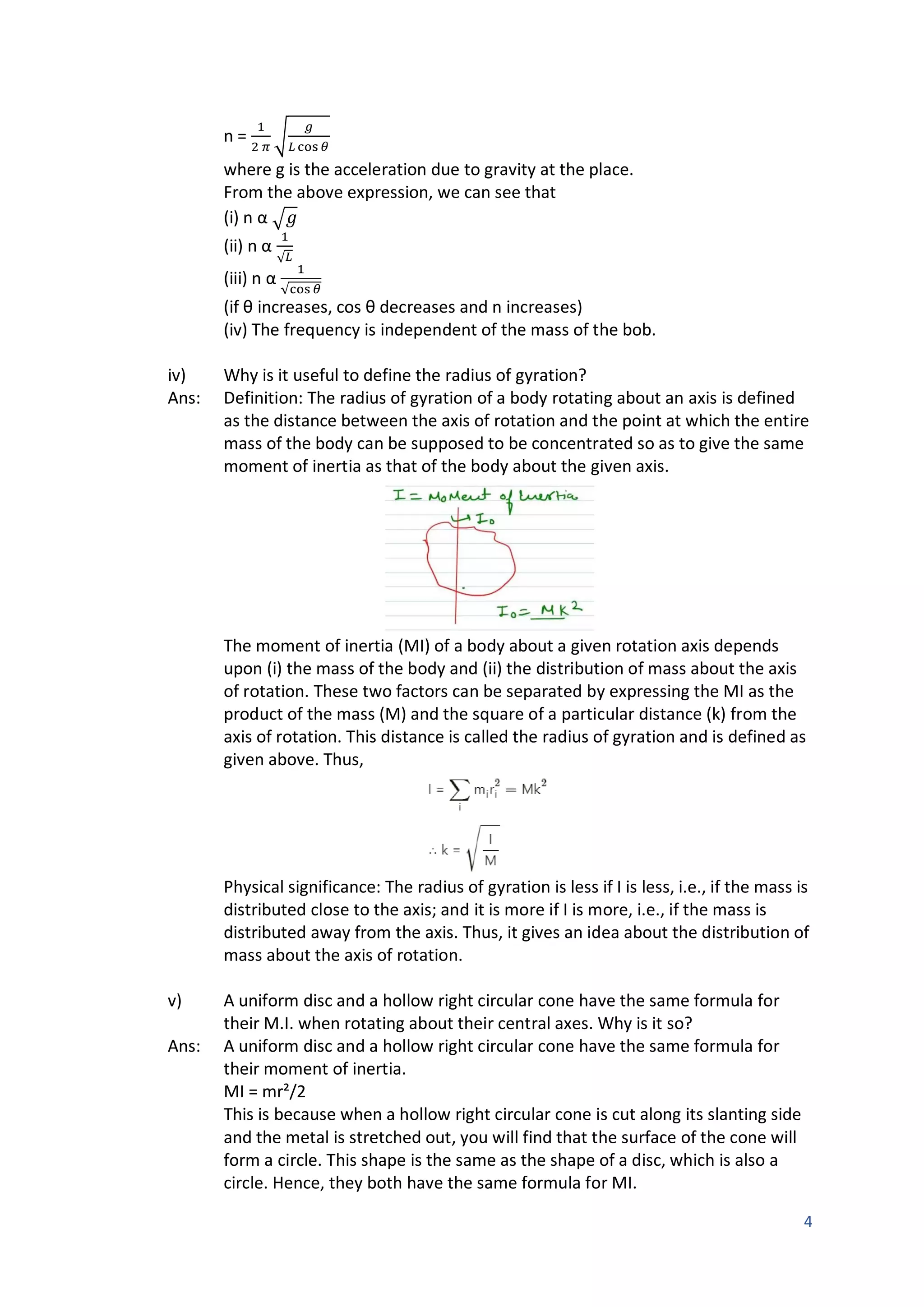
Ans: Definition: The radius of gyration of a body rotating about an axis is defined
as the distance between the axis of rotation and the point at which the entire
mass of the body can be supposed to be concentrated so as to give the same
moment of inertia as that of the body about the given axis.
The moment of inertia (MI) of a body about a given rotation axis depends
upon (i) the mass of the body and (ii) the distribution of mass about the axis
of rotation. These two factors can be separated by expressing the MI as the
product of the mass (M) and the square of a particular distance (k) from the
axis of rotation. This distance is called the radius of gyration and is defined as
given above. Thus,
Physical significance: The radius of gyration is less if I is less, i.e., if the mass is
distributed close to the axis; and it is more if I is more, i.e., if the mass is
distributed away from the axis. Thus, it gives an idea about the distribution of
mass about the axis of rotation.
v) A uniform disc and a hollow right circular cone have the same formula for
their M.I. when rotating about their central axes. Why is it so?
Ans: A uniform disc and a hollow right circular cone have the same formula for
their moment of inertia.
MI = mr²/2
This is because when a hollow right circular cone is cut along its slanting side
and the metal is stretched out, you will find that the surface of the cone will
form a circle. This shape is the same as the shape of a disc, which is also a
circle. Hence, they both have the same formula for MI.
5
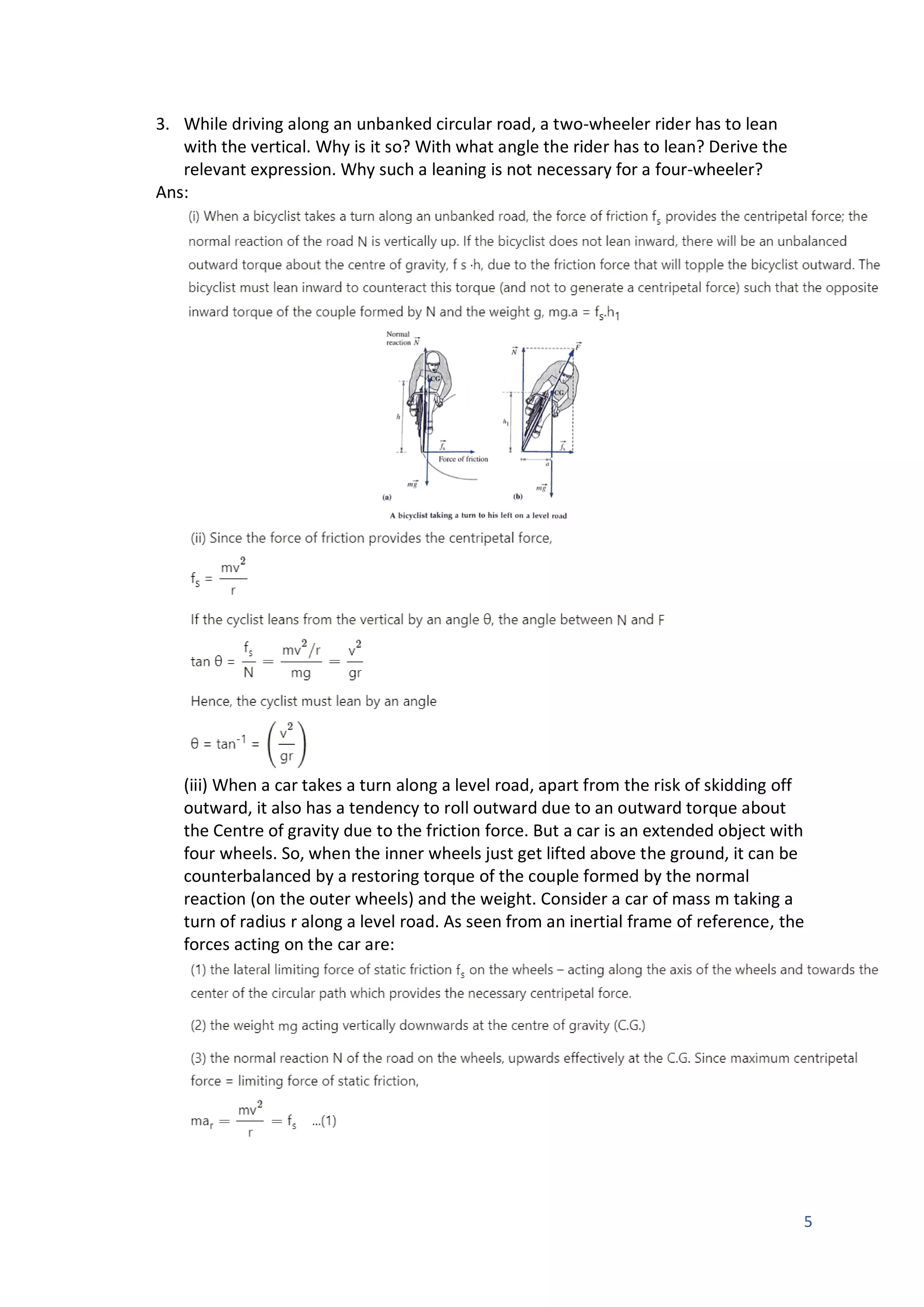
3. While driving along an unbanked circular road, a two-wheeler rider has to lean
with the vertical. Why is it so? With what angle the rider has to lean? Derive the
relevant expression. Why such a leaning is not necessary for a four-wheeler?
Ans:
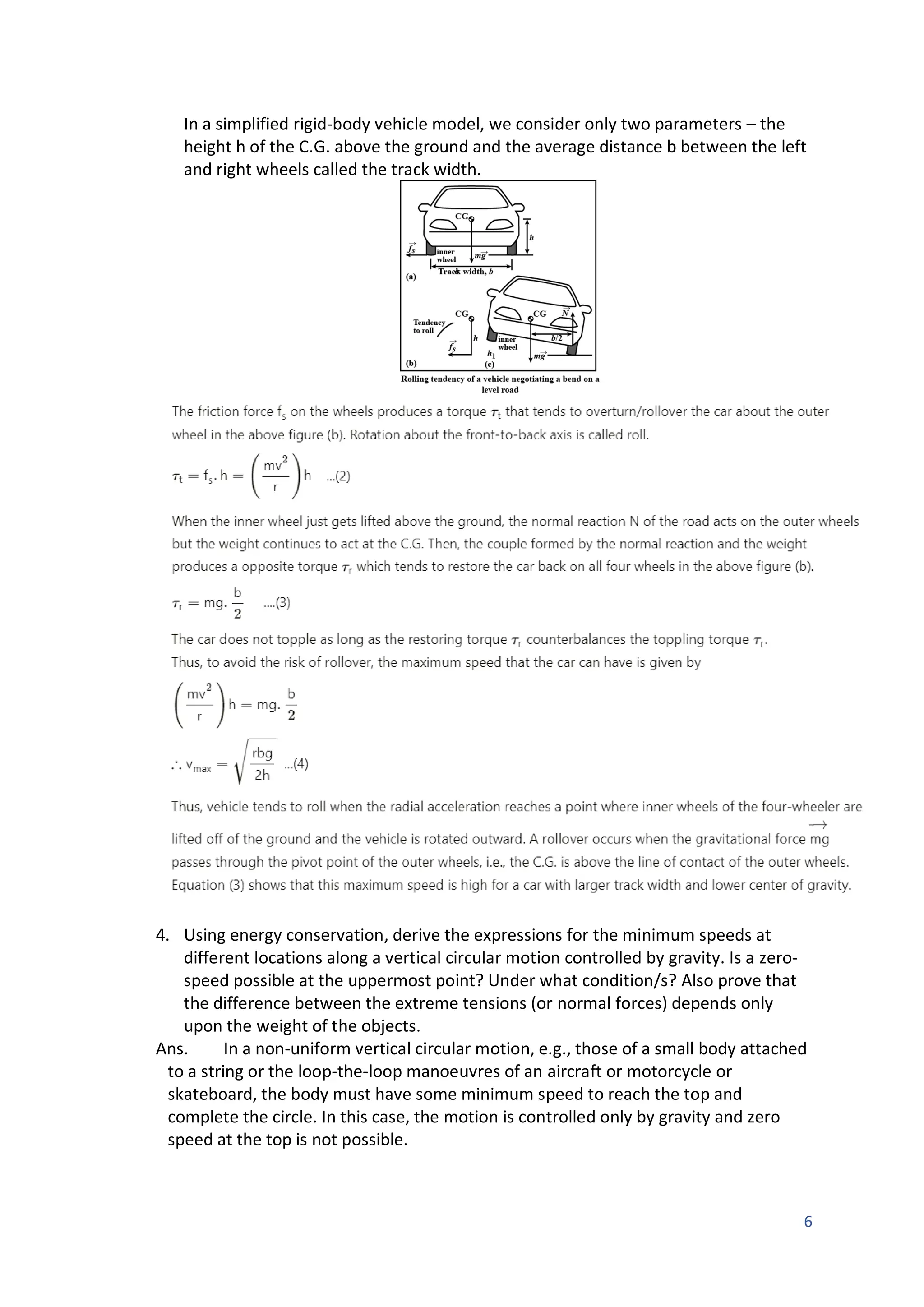
(iii) When a car takes a turn along a level road, apart from the risk of skidding off
outward, it also has a tendency to roll outward due to an outward torque about
the Centre of gravity due to the friction force. But a car is an extended object with
four wheels. So, when the inner wheels just get lifted above the ground, it can be
counterbalanced by a restoring torque of the couple formed by the normal
reaction (on the outer wheels) and the weight. Consider a car of mass m taking a
turn of radius r along a level road. As seen from an inertial frame of reference, the
forces acting on the car are:
6
In a simplified rigid-body vehicle model, we consider only two parameters – the
height h of the C.G. above the ground and the average distance b between the left
and right wheels called the track width.
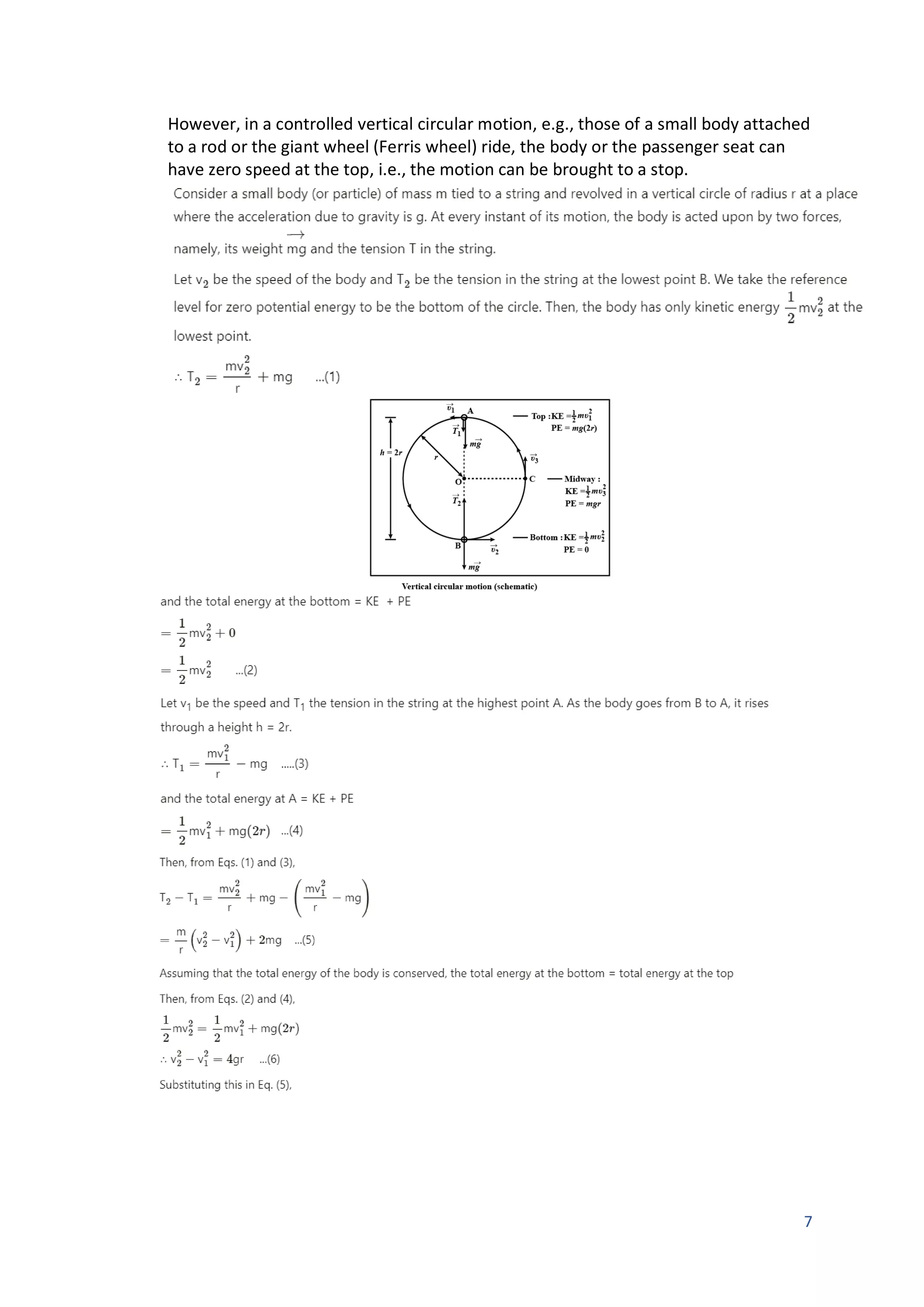
4. Using energy conservation, derive the expressions for the minimum speeds at
different locations along a vertical circular motion controlled by gravity. Is a zero-
speed possible at the uppermost point? Under what condition/s? Also prove that
the difference between the extreme tensions (or normal forces) depends only
upon the weight of the objects.
Ans. In a non-uniform vertical circular motion, e.g., those of a small body attached
to a string or the loop-the-loop manoeuvres of an aircraft or motorcycle or
skateboard, the body must have some minimum speed to reach the top and
complete the circle. In this case, the motion is controlled only by gravity and zero
speed at the top is not possible.
7
However, in a controlled vertical circular motion, e.g., those of a small body attached
to a rod or the giant wheel (Ferris wheel) ride, the body or the passenger seat can
have zero speed at the top, i.e., the motion can be brought to a stop.
8
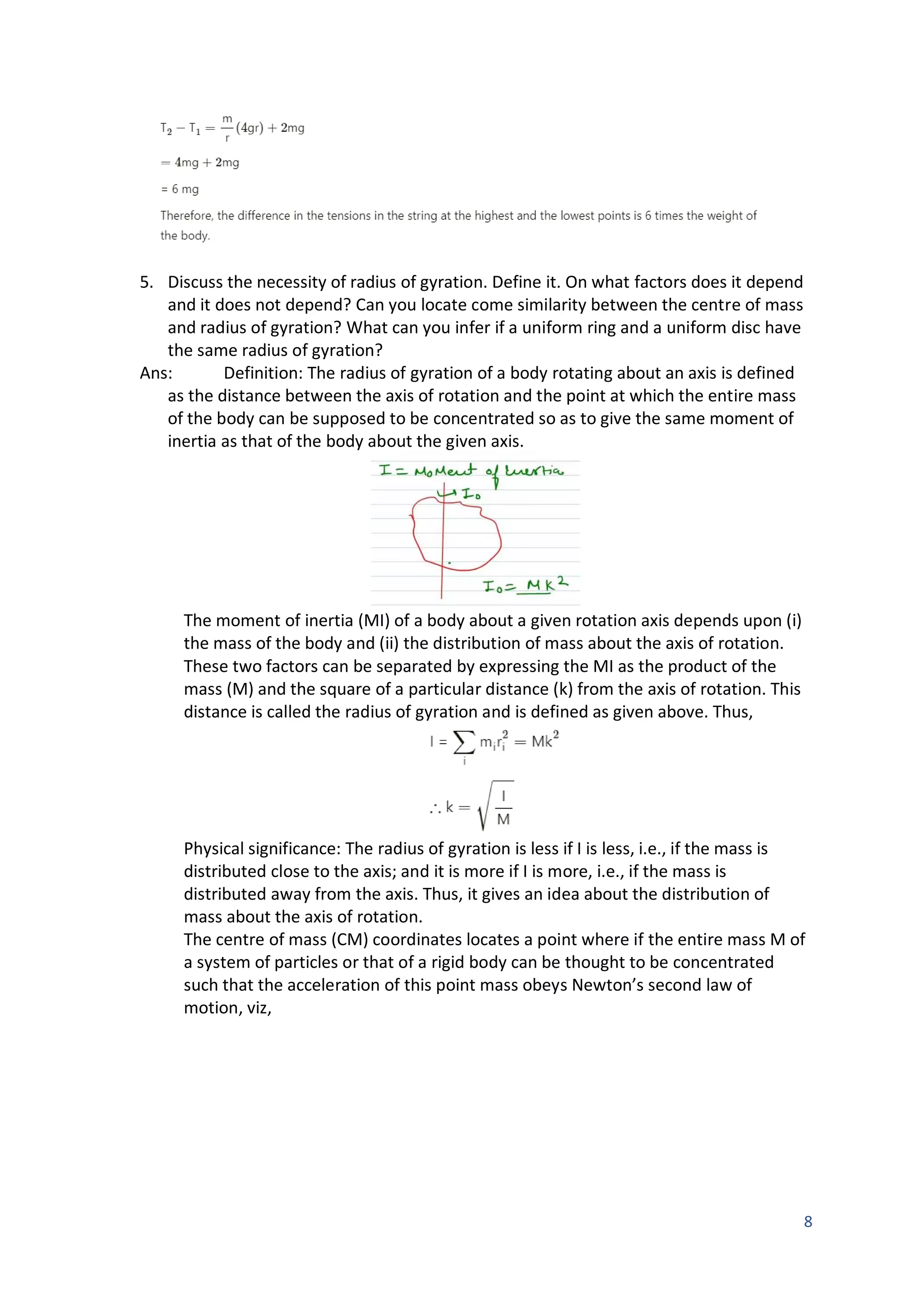
5. Discuss the necessity of radius of gyration. Define it. On what factors does it depend
and it does not depend? Can you locate come similarity between the centre of mass
and radius of gyration? What can you infer if a uniform ring and a uniform disc have
the same radius of gyration?
Ans: Definition: The radius of gyration of a body rotating about an axis is defined
as the distance between the axis of rotation and the point at which the entire mass
of the body can be supposed to be concentrated so as to give the same moment of
inertia as that of the body about the given axis.
The moment of inertia (MI) of a body about a given rotation axis depends upon (i)
the mass of the body and (ii) the distribution of mass about the axis of rotation.
These two factors can be separated by expressing the MI as the product of the
mass (M) and the square of a particular distance (k) from the axis of rotation. This
distance is called the radius of gyration and is defined as given above. Thus,
Physical significance: The radius of gyration is less if I is less, i.e., if the mass is
distributed close to the axis; and it is more if I is more, i.e., if the mass is
distributed away from the axis. Thus, it gives an idea about the distribution of
mass about the axis of rotation.
The centre of mass (CM) coordinates locates a point where if the entire mass M of
a system of particles or that of a rigid body can be thought to be concentrated
such that the acceleration of this point mass obeys Newton’s second law of
motion, viz,
9
6. State the conditions under which the theorems of parallel axes and perpendicular
axes are applicable. State the respective mathematical expressions.
Ans:
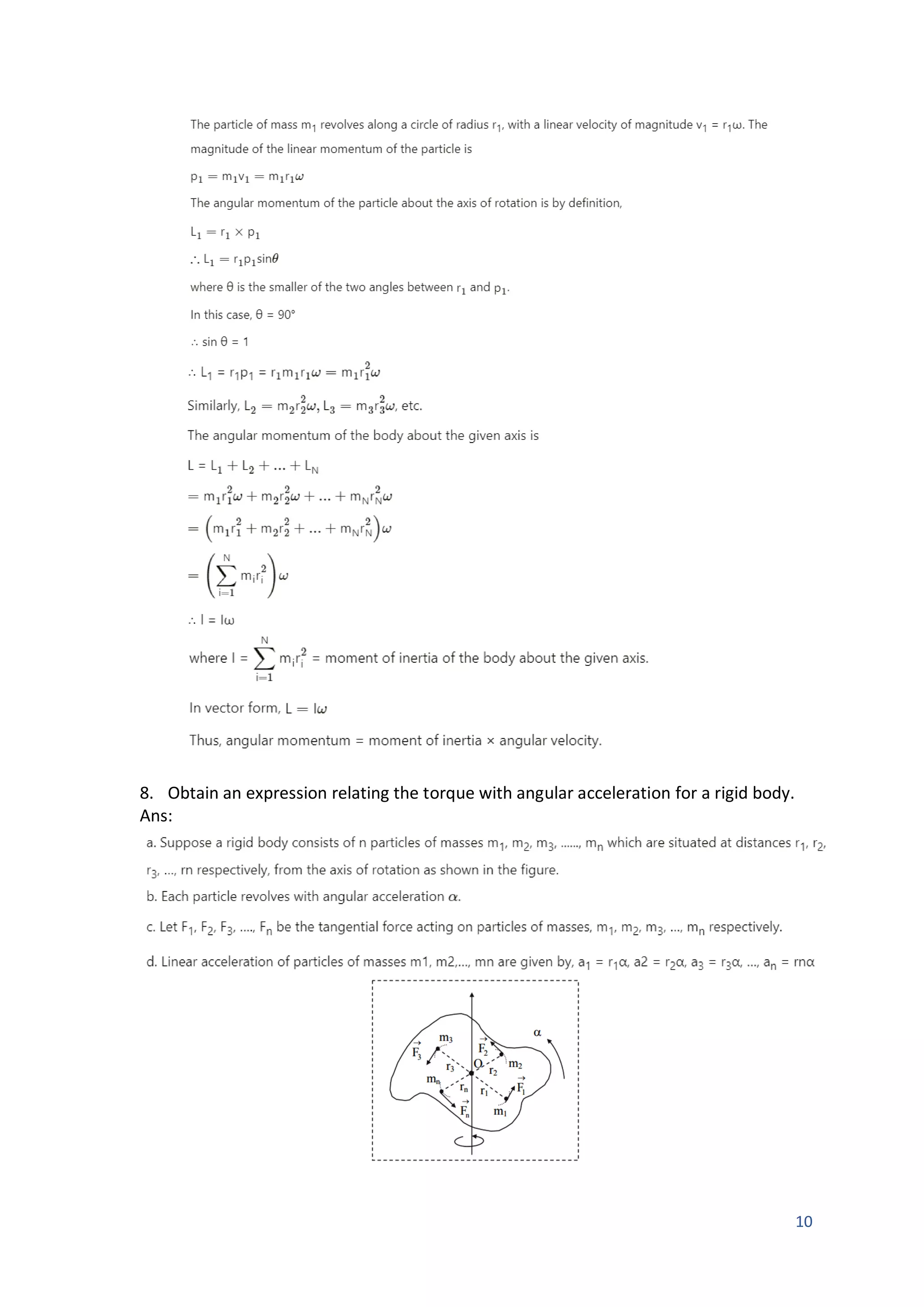
7. Derive an expression which relates angular momentum with the angular velocity of a
rigid body.
Ans:
10
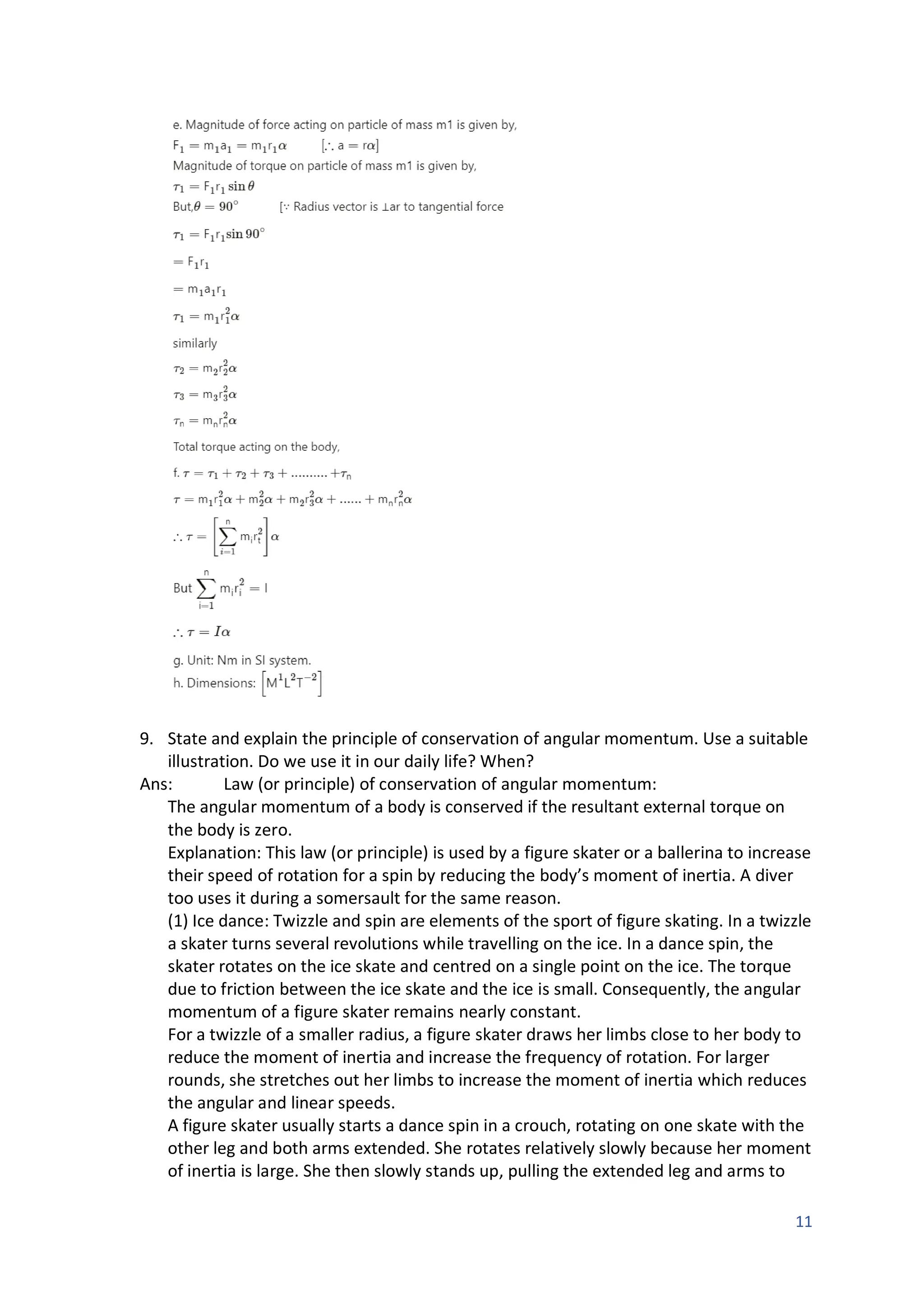
8. Obtain an expression relating the torque with angular acceleration for a rigid body.
Ans:
11
9. State and explain the principle of conservation of angular momentum. Use a suitable
illustration. Do we use it in our daily life? When?
Ans: Law (or principle) of conservation of angular momentum:
The angular momentum of a body is conserved if the resultant external torque on
the body is zero.
Explanation: This law (or principle) is used by a figure skater or a ballerina to increase
their speed of rotation for a spin by reducing the body’s moment of inertia. A diver
too uses it during a somersault for the same reason.
(1) Ice dance: Twizzle and spin are elements of the sport of figure skating. In a twizzle
a skater turns several revolutions while travelling on the ice. In a dance spin, the
skater rotates on the ice skate and centred on a single point on the ice. The torque
due to friction between the ice skate and the ice is small. Consequently, the angular
momentum of a figure skater remains nearly constant.
For a twizzle of a smaller radius, a figure skater draws her limbs close to her body to
reduce the moment of inertia and increase the frequency of rotation. For larger
rounds, she stretches out her limbs to increase the moment of inertia which reduces
the angular and linear speeds.
A figure skater usually starts a dance spin in a crouch, rotating on one skate with the
other leg and both arms extended. She rotates relatively slowly because her moment
of inertia is large. She then slowly stands up, pulling the extended leg and arms to
12
her body. As she does so, her moment of inertia about the axis of rotation decreases
considerably, and thereby her angular velocity substantially increases to conserve
angular momentum.
(2) Diving: Take-off from a springboard or diving platform determines the diver’s
trajectory and the magnitude of angular momentum. A diver must generate angular
momentum at take-off by moving the position of the arms and by a slight hollowing
of the back. This allows the diver to change angular speeds for twists and
somersaults in flight by controlling her/his moment of inertia. A compact tucked
shape of the body lowers the moment of inertia for rotation of smaller radius and
increased angular speed. The opening of the body for the vertical entry into water
does not stop the rotation but merely slows it down. The angular momentum
remains constant throughout the flight.
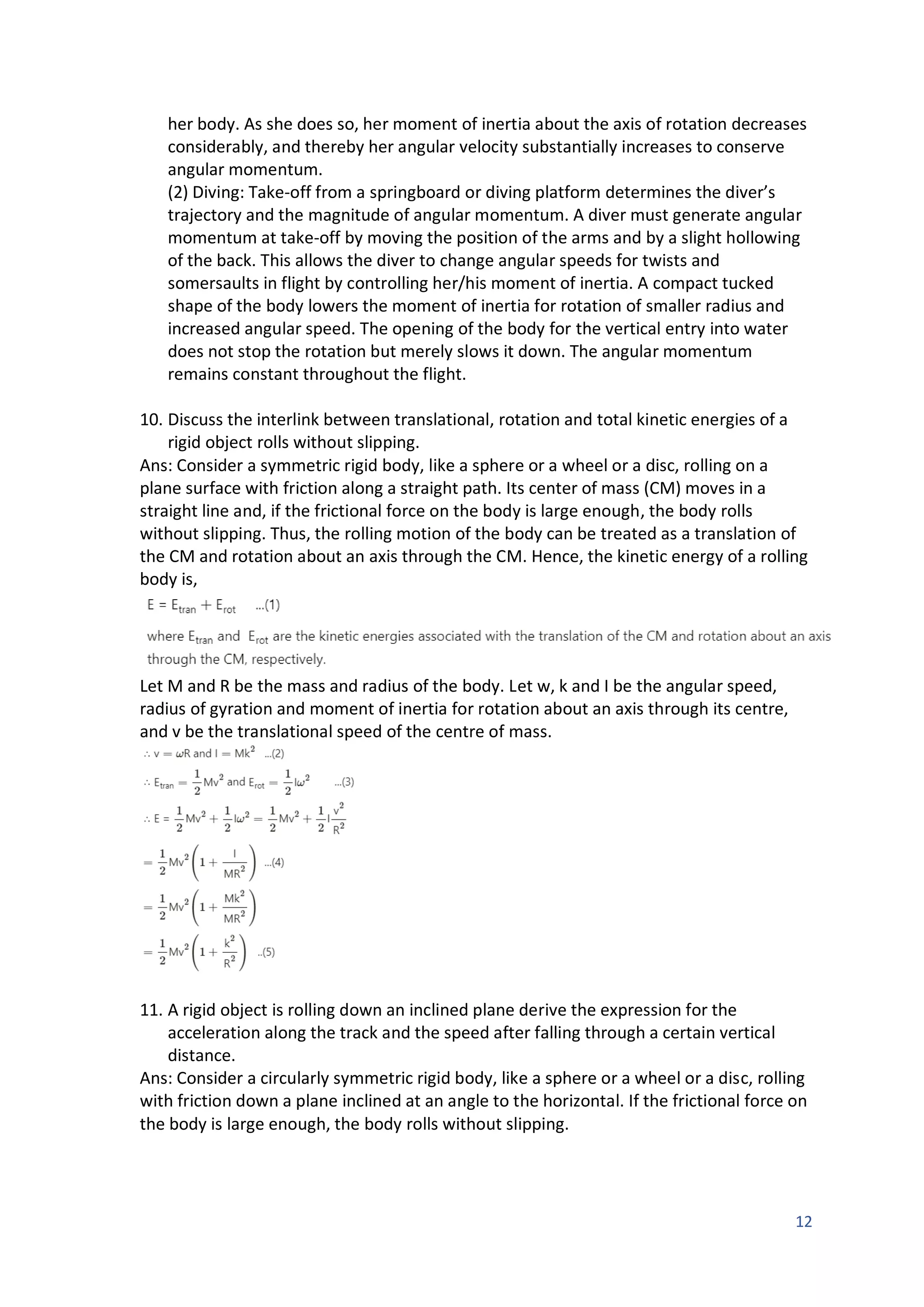
10. Discuss the interlink between translational, rotation and total kinetic energies of a
rigid object rolls without slipping.
Ans: Consider a symmetric rigid body, like a sphere or a wheel or a disc, rolling on a
plane surface with friction along a straight path. Its center of mass (CM) moves in a
straight line and, if the frictional force on the body is large enough, the body rolls
without slipping. Thus, the rolling motion of the body can be treated as a translation of
the CM and rotation about an axis through the CM. Hence, the kinetic energy of a rolling
body is,
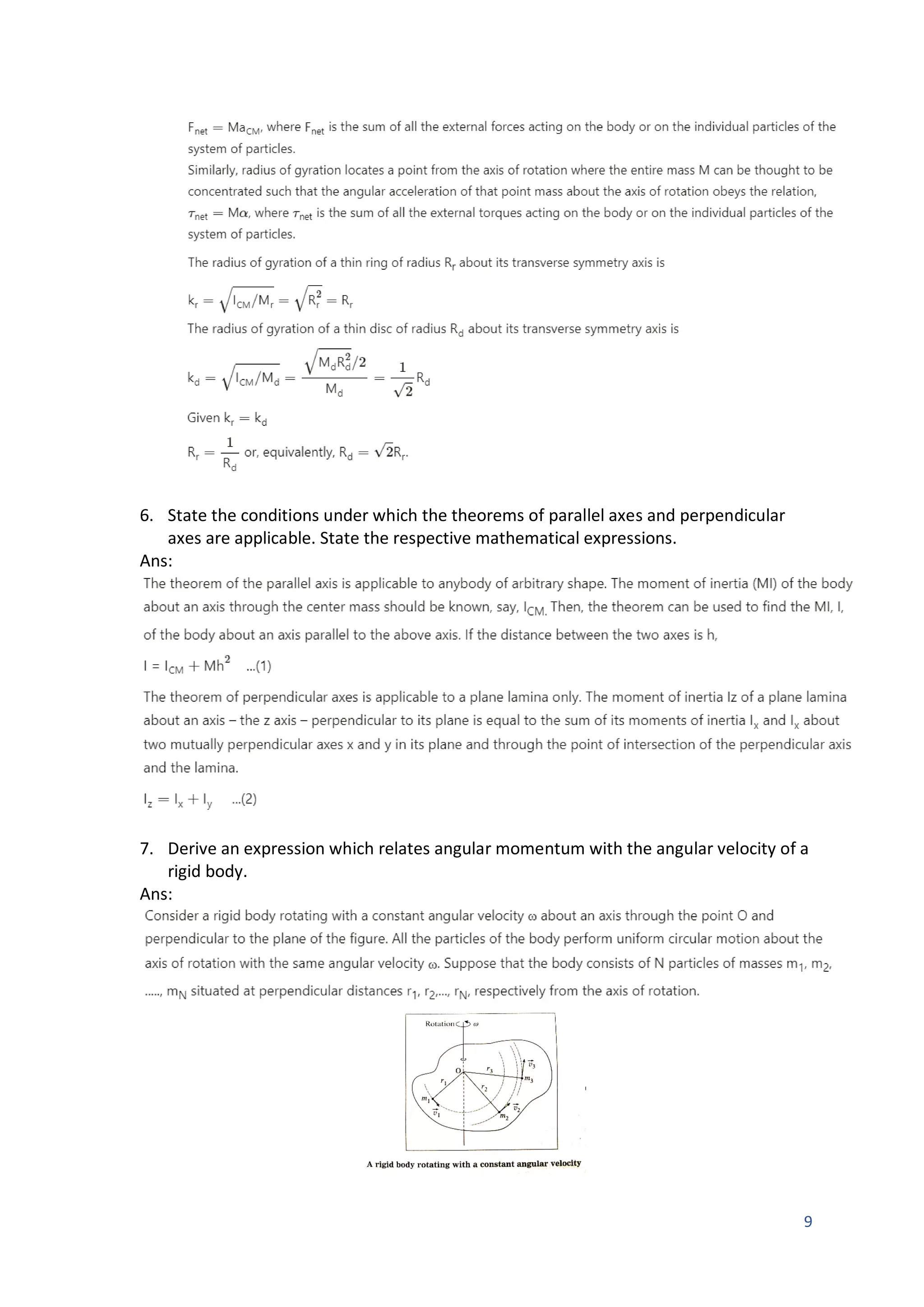
Let M and R be the mass and radius of the body. Let w, k and I be the angular speed,
radius of gyration and moment of inertia for rotation about an axis through its centre,
and v be the translational speed of the centre of mass.
11. A rigid object is rolling down an inclined plane derive the expression for the
acceleration along the track and the speed after falling through a certain vertical
distance.
Ans: Consider a circularly symmetric rigid body, like a sphere or a wheel or a disc, rolling
with friction down a plane inclined at an angle to the horizontal. If the frictional force on
the body is large enough, the body rolls without slipping.
13
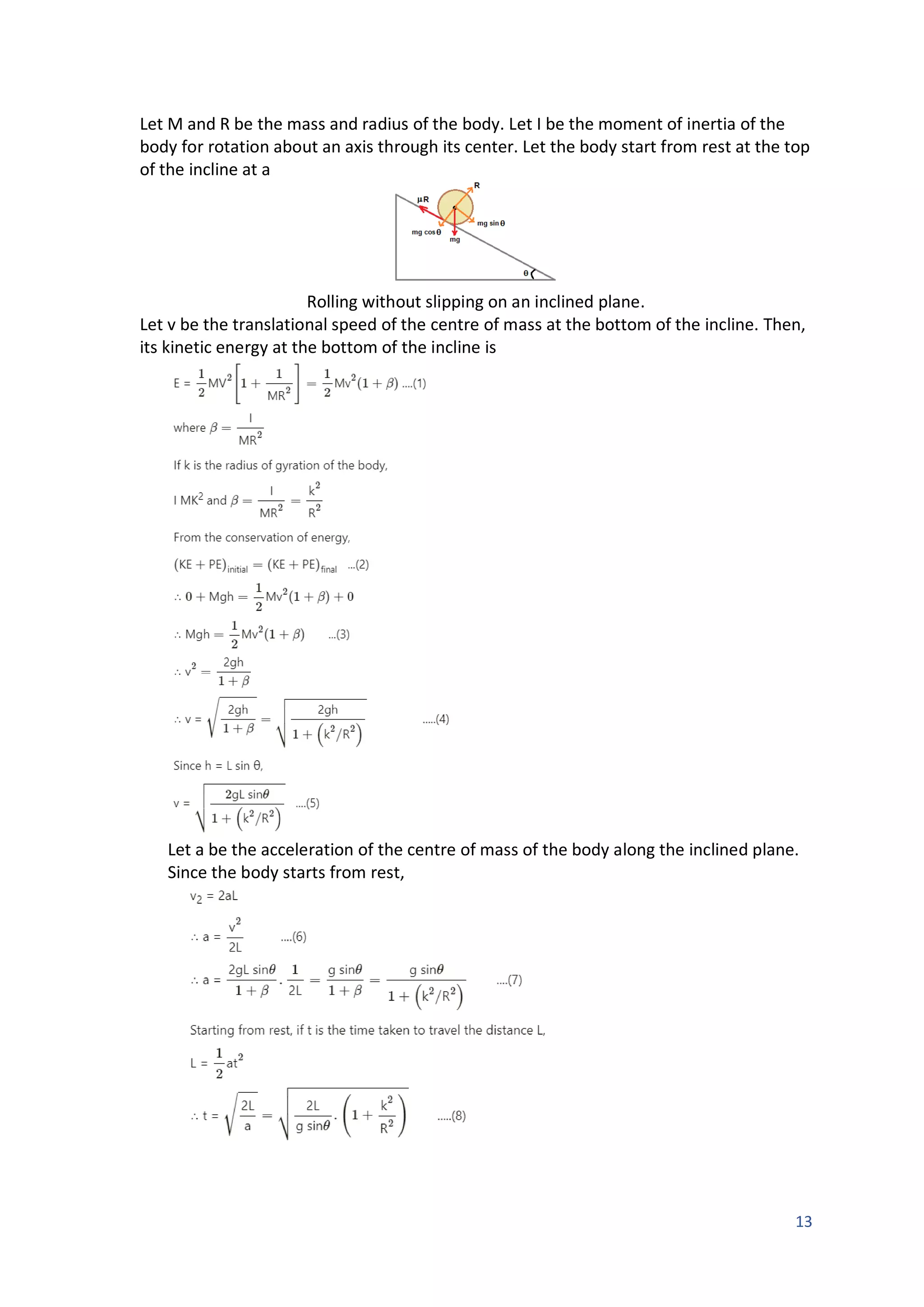
Let M and R be the mass and radius of the body. Let I be the moment of inertia of the
body for rotation about an axis through its center. Let the body start from rest at the top
of the incline at a
Rolling without slipping on an inclined plane.
Let v be the translational speed of the centre of mass at the bottom of the incline. Then,
its kinetic energy at the bottom of the incline is
Let a be the acceleration of the centre of mass of the body along the inclined plane.
Since the body starts from rest,
14
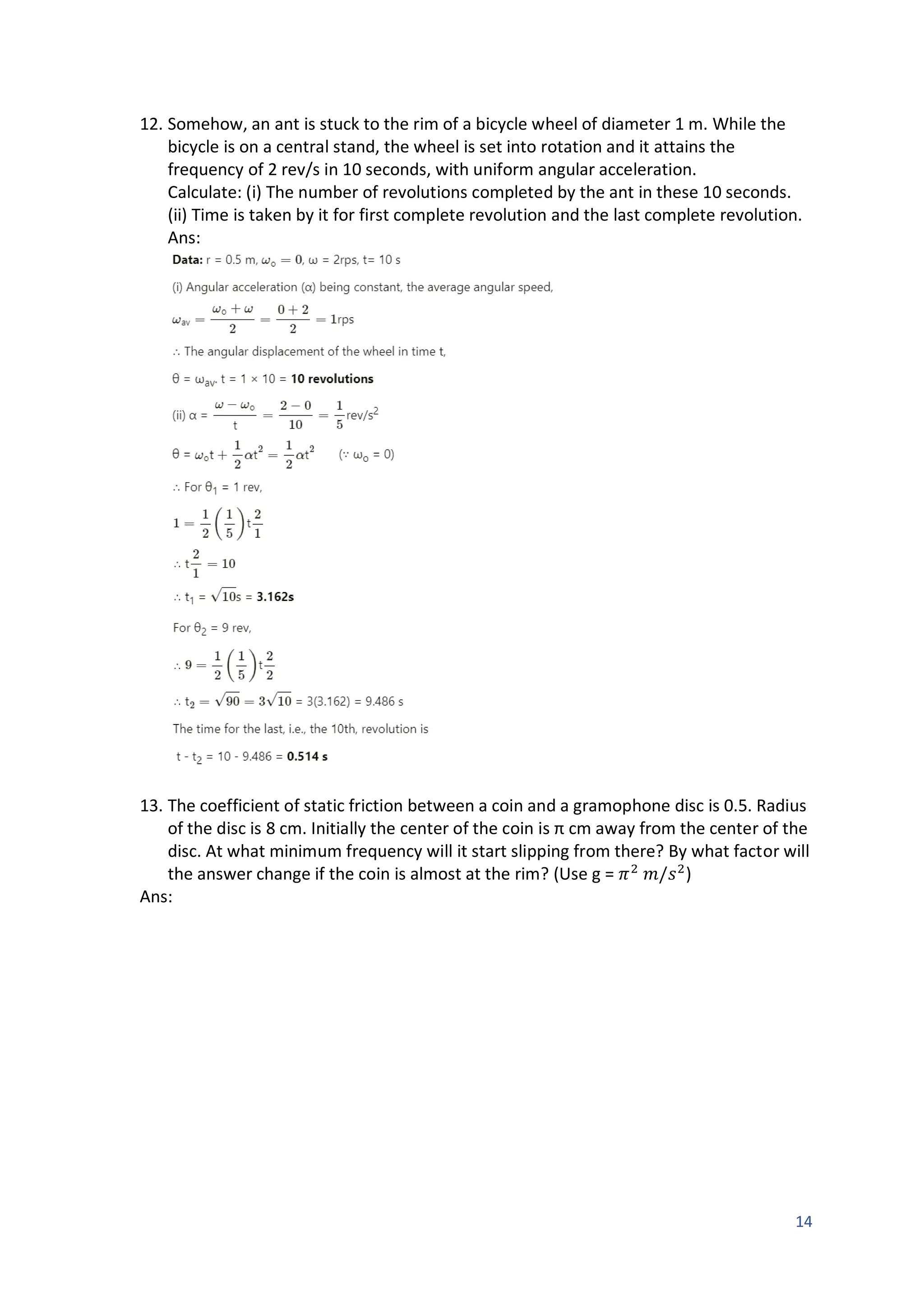
12. Somehow, an ant is stuck to the rim of a bicycle wheel of diameter 1 m. While the
bicycle is on a central stand, the wheel is set into rotation and it attains the
frequency of 2 rev/s in 10 seconds, with uniform angular acceleration.
Calculate: (i) The number of revolutions completed by the ant in these 10 seconds.
(ii) Time is taken by it for first complete revolution and the last complete revolution.
Ans:
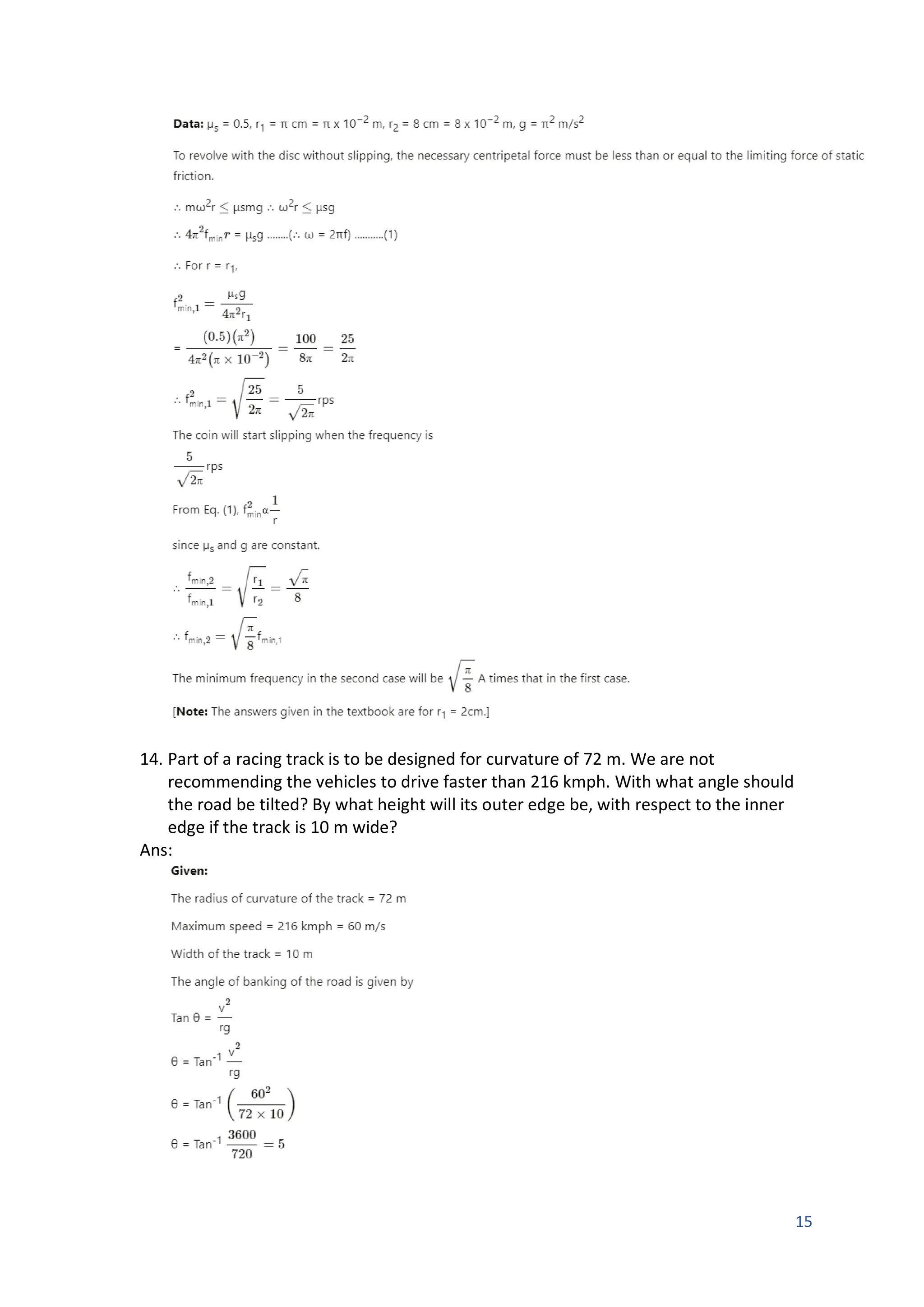
13. The coefficient of static friction between a coin and a gramophone disc is 0.5. Radius
of the disc is 8 cm. Initially the center of the coin is π cm away from the center of the
disc. At what minimum frequency will it start slipping from there? By what factor will
the answer change if the coin is almost at the rim? (Use g = 𝜋2
𝑚/𝑠2
)
Ans:
15
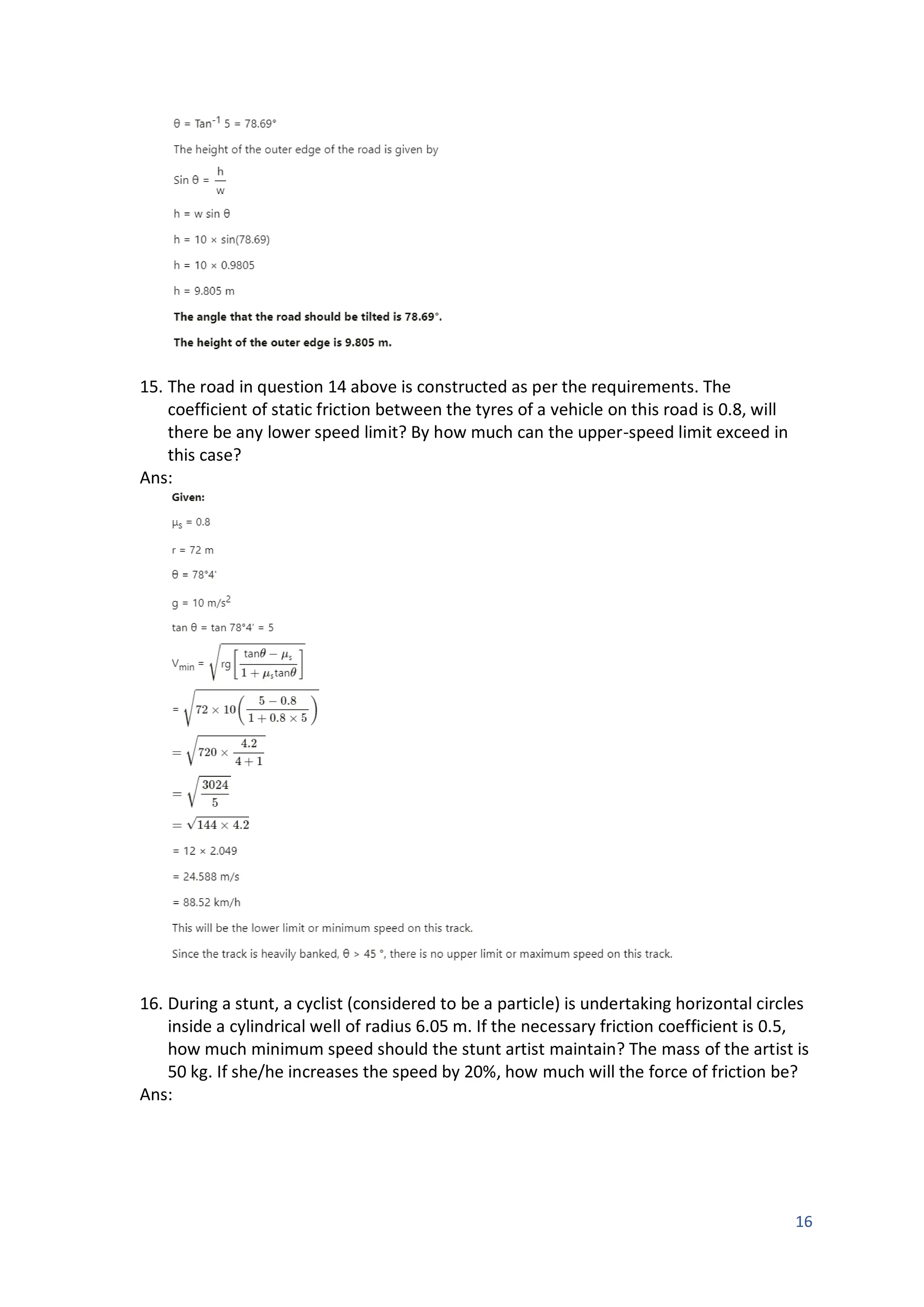
14. Part of a racing track is to be designed for curvature of 72 m. We are not
recommending the vehicles to drive faster than 216 kmph. With what angle should
the road be tilted? By what height will its outer edge be, with respect to the inner
edge if the track is 10 m wide?
Ans:
16
15. The road in question 14 above is constructed as per the requirements. The
coefficient of static friction between the tyres of a vehicle on this road is 0.8, will
there be any lower speed limit? By how much can the upper-speed limit exceed in
this case?
Ans:
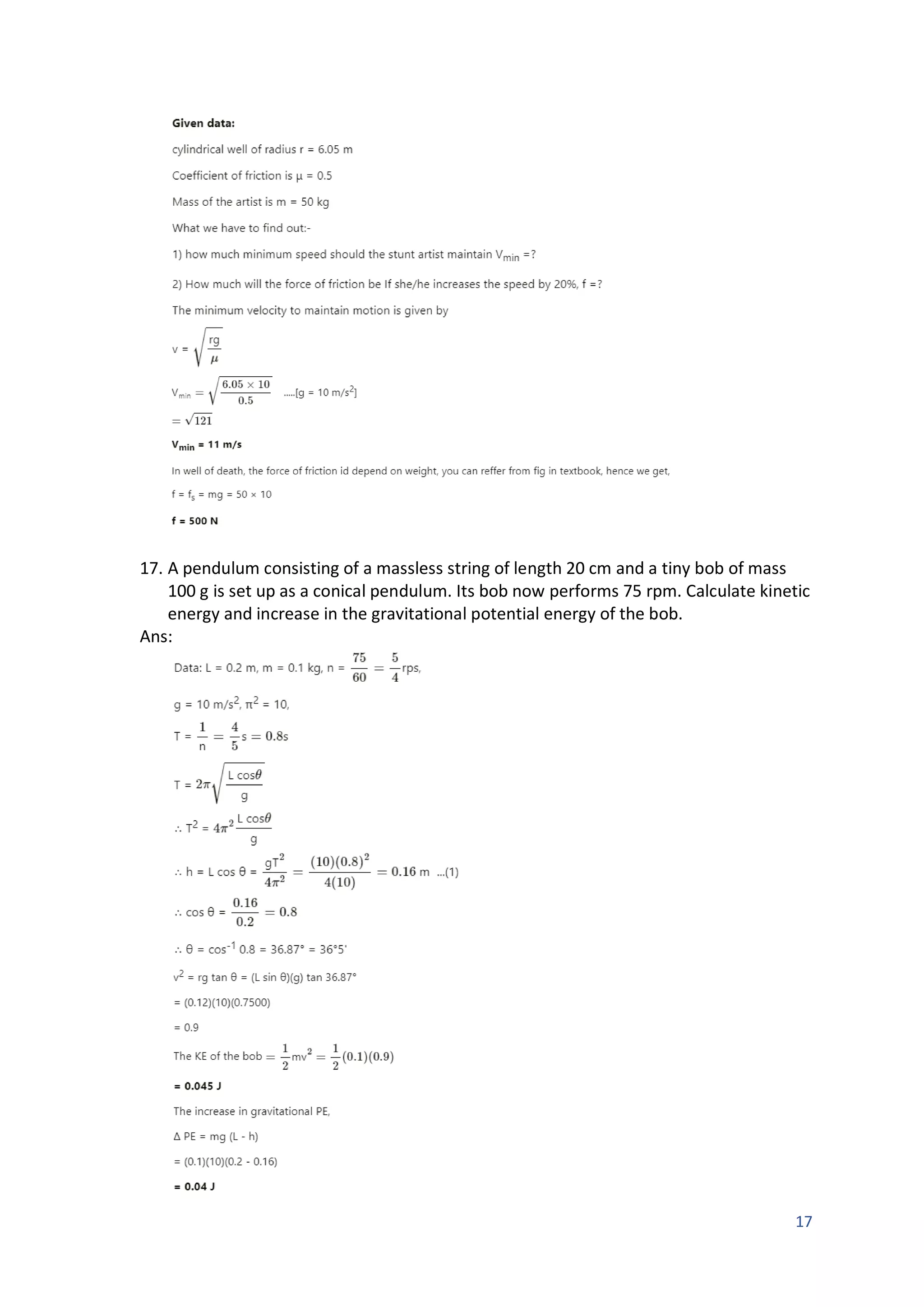
16. During a stunt, a cyclist (considered to be a particle) is undertaking horizontal circles
inside a cylindrical well of radius 6.05 m. If the necessary friction coefficient is 0.5,
how much minimum speed should the stunt artist maintain? The mass of the artist is
50 kg. If she/he increases the speed by 20%, how much will the force of friction be?
Ans:
17
17. A pendulum consisting of a massless string of length 20 cm and a tiny bob of mass
100 g is set up as a conical pendulum. Its bob now performs 75 rpm. Calculate kinetic
energy and increase in the gravitational potential energy of the bob.
Ans:
18
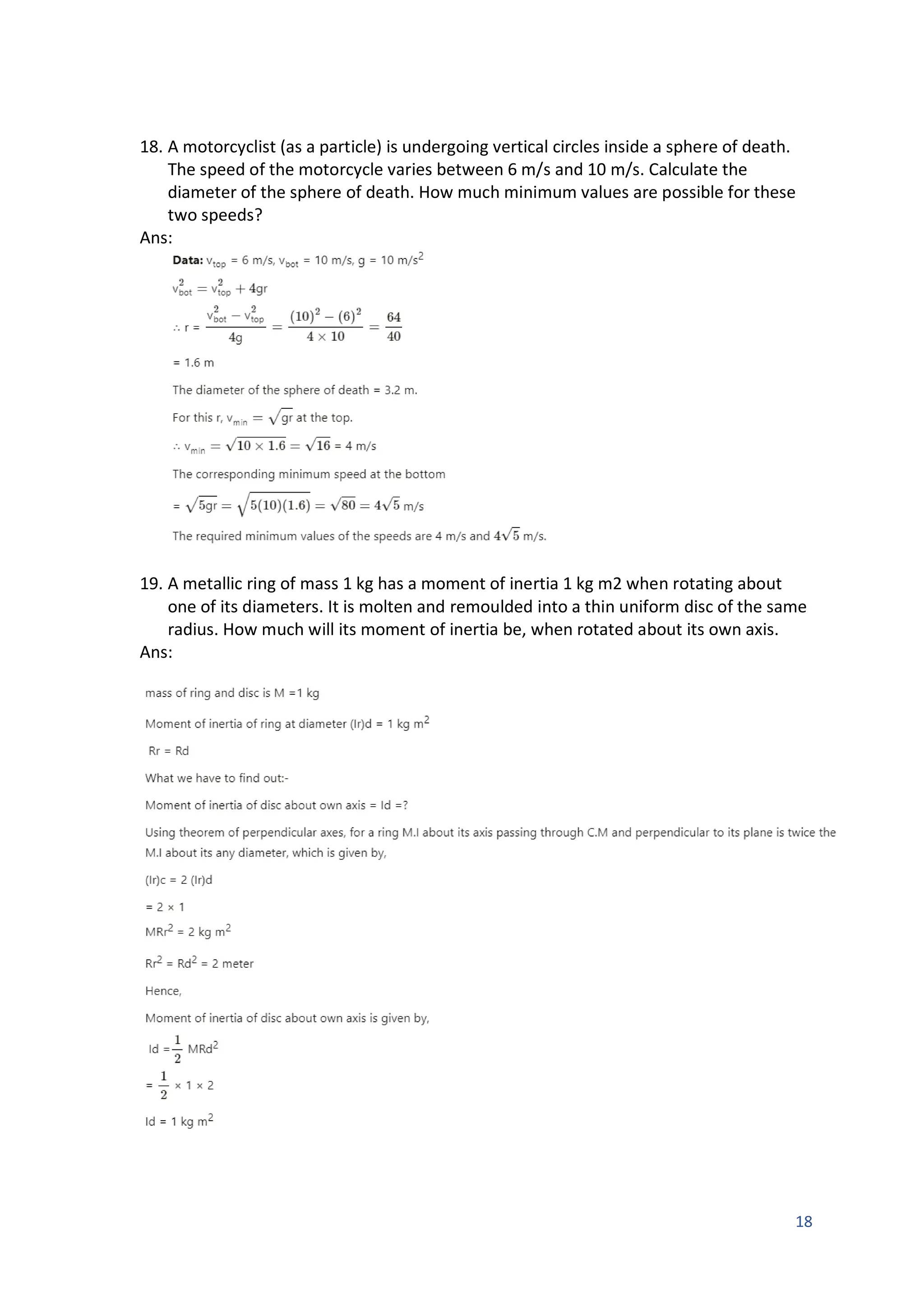
18. A motorcyclist (as a particle) is undergoing vertical circles inside a sphere of death.
The speed of the motorcycle varies between 6 m/s and 10 m/s. Calculate the
diameter of the sphere of death. How much minimum values are possible for these
two speeds?
Ans:
19. A metallic ring of mass 1 kg has a moment of inertia 1 kg m2 when rotating about
one of its diameters. It is molten and remoulded into a thin uniform disc of the same
radius. How much will its moment of inertia be, when rotated about its own axis.
Ans:
19
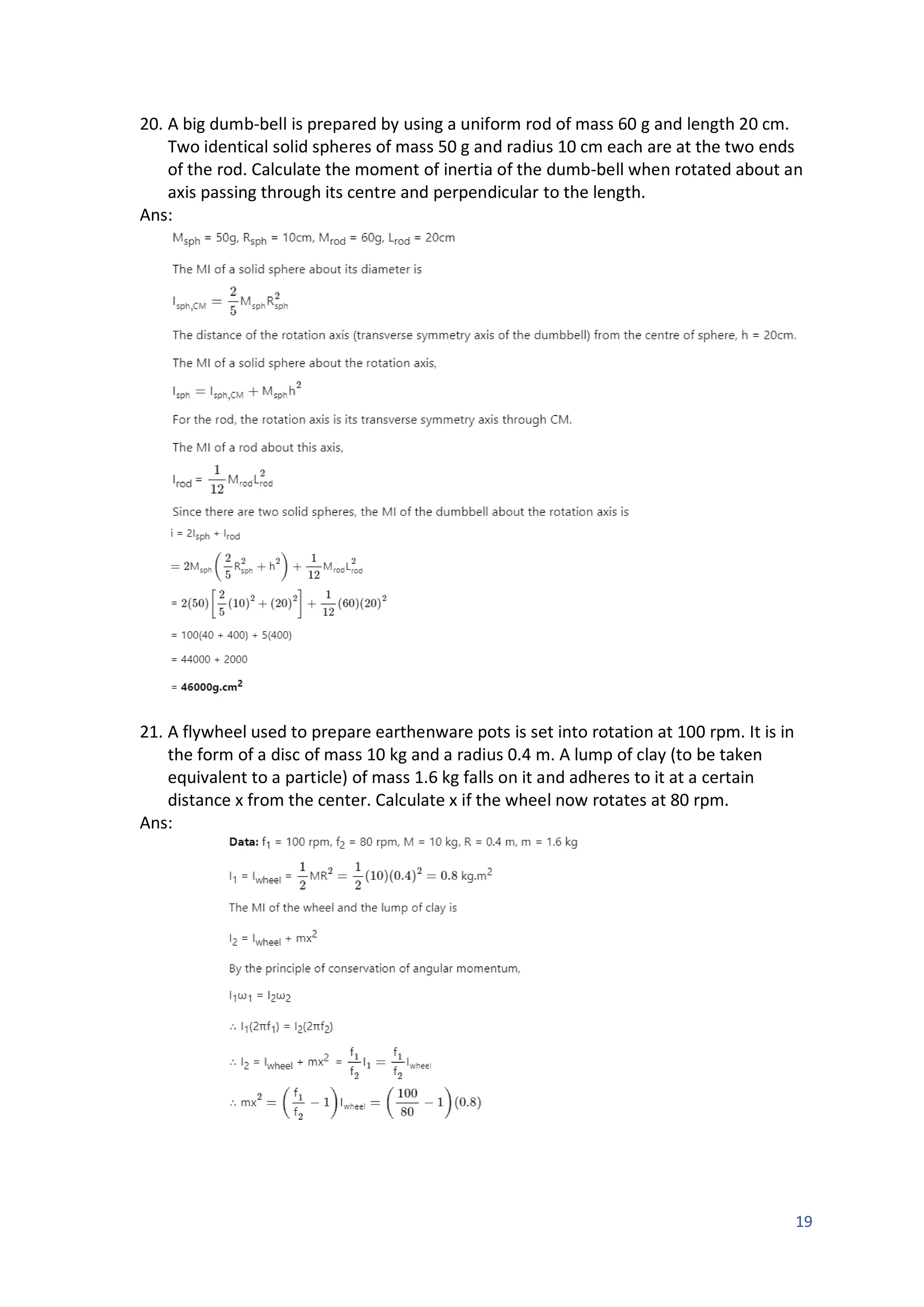
20. A big dumb-bell is prepared by using a uniform rod of mass 60 g and length 20 cm.
Two identical solid spheres of mass 50 g and radius 10 cm each are at the two ends
of the rod. Calculate the moment of inertia of the dumb-bell when rotated about an
axis passing through its centre and perpendicular to the length.
Ans:
21. A flywheel used to prepare earthenware pots is set into rotation at 100 rpm. It is in
the form of a disc of mass 10 kg and a radius 0.4 m. A lump of clay (to be taken
equivalent to a particle) of mass 1.6 kg falls on it and adheres to it at a certain
distance x from the center. Calculate x if the wheel now rotates at 80 rpm.
Ans:
20
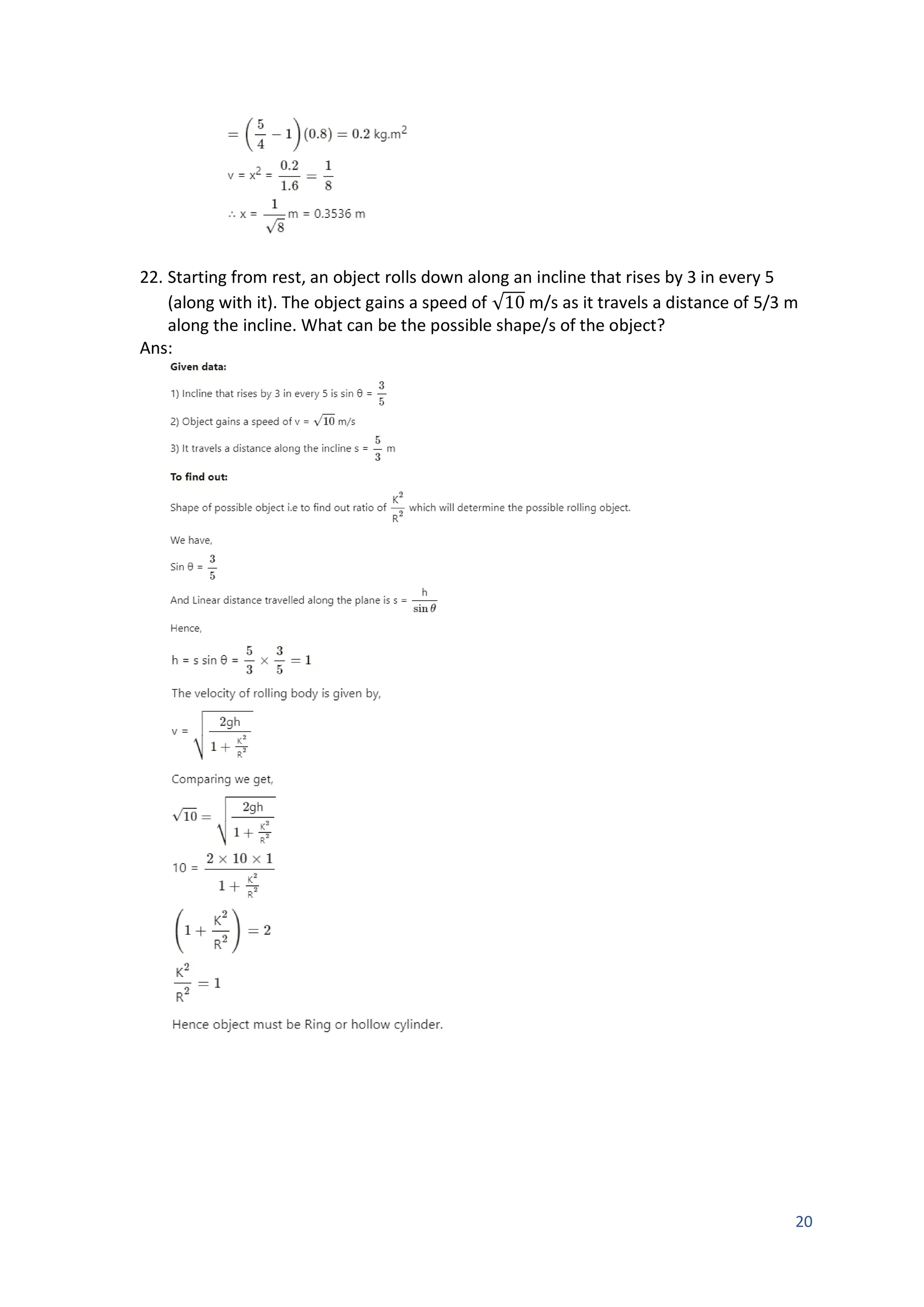
22. Starting from rest, an object rolls down along an incline that rises by 3 in every 5
(along with it). The object gains a speed of √10 m/s as it travels a distance of 5/3 m
along the incline. What can be the possible shape/s of the object?
Ans:

Chapter 1 - rotational dnamics excercises solution

  • 1.
  • 2.
    2 1. Choose thecorrect option. i) When seen from below, the blades of a ceiling fan are seen to be revolving anticlockwise and their speed is decreasing. Select the correct statement about the directions of its angular velocity and angular acceleration. (A) Angular velocity upwards, angular acceleration downwards. (B) Angular velocity downwards, angular acceleration upwards. (C) Both, angular velocity and angular acceleration, upwards. (D) Both, angular velocity and angular acceleration, downwards. ii) A particle of mass 1 kg, tied to a 1.2 m long string is whirled to perform vertical circular motion, under gravity. Minimum speed of a particle is 5 m/s. Consider following statements. P) Maximum speed must be 55 m/s. Q) Difference between maximum and minimum tensions along the string is 60 N. Select the correct option. (A) Only the statement P is correct. (B) Only the statement Q is correct. (C) Both the statements are correct. (D) Both the statements are incorrect. iii) Select correct statement about the formula (expression) of moment of inertia (M.I.) in terms of mass M of the object and some of its distance parameter/s, such as R, L, etc. (A) Different objects must have different expressions for their M.I. (B) When rotating about their central axis, a hollow right circular cone and a disc have the same expression for the M.I. (C) Expression for the M.I. for a parallelepiped rotating about the transverse axis passing through its centre includes its depth. (D) Expression for M.I. of a rod and that of a plane sheet is the same about a transverse axis. iv) In a certain unit, the radius of gyration of a uniform disc about its central and transverse axis is √2.5. Its radius of gyration about a tangent in its plane (in the same unit) must be (A) √5 (B) 2.5 (C) 2√2.5 (D) √12.5 v) Consider the following cases: (P) A planet revolving in an elliptical orbit. (Q) A planet revolving in a circular orbit. Principle of conservation of angular momentum comes in force in which of these?
  • 3.
    3 (A) Only for(P) (B) Only for (Q) (C) For both, (P) and (Q) (D) Neither for (P), nor for (Q) vi) A thin-walled hollow cylinder is rolling down an incline, without slipping. At any instant, without slipping. At any instant, the ratio "Rotational K.E.: Translational K.E.: Total K.E." is (A) 1: 1: 2 (B) 1: 2: 3 (C) 1: 1: 1 (D) 2: 1: 3 2. Answer in brief. i) Why are curved roads banked? Ans: A car while taking a turn performs circular motion. If the road is level (or horizontal road), the necessary centripetal force is the force of static friction between the car tyres and the road surface. The friction depends upon the nature of the surfaces in contact and the presence of oil and water on the road. If the friction is inadequate, a speeding car may skid off the road. Since the friction changes with circumstances, it cannot be relied upon to provide the necessary centripetal force. Moreover, friction results in fast wear and tear of the tyres. To avoid the risk of skidding as well as to reduce the wear and tear of the car tyres, the road surface at a bend is tilted inward, i.e., the outer side of the road is raised above its inner side. This is called banking of road. On a banked road, the resultant of the normal reaction and the gravitational force can act as the necessary centripetal force. Thus, every car can be safely driven on such a banked curve at certain optimum speed, without depending on friction. Hence, a road should be properly banked at a bend. The angle of banking is the angle of inclination of the surface of a banked road at a bend with the horizontal. ii) Do we need a banked road for a two-wheeler? Explain. Ans: When a two-wheeler takes a turn along an unbanked road, the force of friction provides the centripetal force. The two-wheeler leans inward to counteract a torque that tends to topple it outward. Firstly, friction cannot be relied upon to provide the necessary centripetal force on all road conditions. Secondly, the friction results in the wear and tear of the tyres. On a banked road at a turn, any vehicle can negotiate the turn without depending on friction and without straining the tyres. iii) On what factors does the frequency of a conical pendulum depend? Is it independent of some factors? Ans: The frequency of a conical pendulum, of string length L and semi-vertical angle θ is,
  • 4.
    4 n = 1 2 𝜋 √ 𝑔 𝐿cos 𝜃 where g is the acceleration due to gravity at the place. From the above expression, we can see that (i) n α √𝑔 (ii) n α 1 √𝐿 (iii) n α 1 √cos 𝜃 (if θ increases, cos θ decreases and n increases) (iv) The frequency is independent of the mass of the bob. iv) Why is it useful to define the radius of gyration? Ans: Definition: The radius of gyration of a body rotating about an axis is defined as the distance between the axis of rotation and the point at which the entire mass of the body can be supposed to be concentrated so as to give the same moment of inertia as that of the body about the given axis. The moment of inertia (MI) of a body about a given rotation axis depends upon (i) the mass of the body and (ii) the distribution of mass about the axis of rotation. These two factors can be separated by expressing the MI as the product of the mass (M) and the square of a particular distance (k) from the axis of rotation. This distance is called the radius of gyration and is defined as given above. Thus, Physical significance: The radius of gyration is less if I is less, i.e., if the mass is distributed close to the axis; and it is more if I is more, i.e., if the mass is distributed away from the axis. Thus, it gives an idea about the distribution of mass about the axis of rotation. v) A uniform disc and a hollow right circular cone have the same formula for their M.I. when rotating about their central axes. Why is it so? Ans: A uniform disc and a hollow right circular cone have the same formula for their moment of inertia. MI = mr²/2 This is because when a hollow right circular cone is cut along its slanting side and the metal is stretched out, you will find that the surface of the cone will form a circle. This shape is the same as the shape of a disc, which is also a circle. Hence, they both have the same formula for MI.
  • 5.
    5 3. While drivingalong an unbanked circular road, a two-wheeler rider has to lean with the vertical. Why is it so? With what angle the rider has to lean? Derive the relevant expression. Why such a leaning is not necessary for a four-wheeler? Ans: (iii) When a car takes a turn along a level road, apart from the risk of skidding off outward, it also has a tendency to roll outward due to an outward torque about the Centre of gravity due to the friction force. But a car is an extended object with four wheels. So, when the inner wheels just get lifted above the ground, it can be counterbalanced by a restoring torque of the couple formed by the normal reaction (on the outer wheels) and the weight. Consider a car of mass m taking a turn of radius r along a level road. As seen from an inertial frame of reference, the forces acting on the car are:
  • 6.
    6 In a simplifiedrigid-body vehicle model, we consider only two parameters – the height h of the C.G. above the ground and the average distance b between the left and right wheels called the track width. 4. Using energy conservation, derive the expressions for the minimum speeds at different locations along a vertical circular motion controlled by gravity. Is a zero- speed possible at the uppermost point? Under what condition/s? Also prove that the difference between the extreme tensions (or normal forces) depends only upon the weight of the objects. Ans. In a non-uniform vertical circular motion, e.g., those of a small body attached to a string or the loop-the-loop manoeuvres of an aircraft or motorcycle or skateboard, the body must have some minimum speed to reach the top and complete the circle. In this case, the motion is controlled only by gravity and zero speed at the top is not possible.
  • 7.
    7 However, in acontrolled vertical circular motion, e.g., those of a small body attached to a rod or the giant wheel (Ferris wheel) ride, the body or the passenger seat can have zero speed at the top, i.e., the motion can be brought to a stop.
  • 8.
    8 5. Discuss thenecessity of radius of gyration. Define it. On what factors does it depend and it does not depend? Can you locate come similarity between the centre of mass and radius of gyration? What can you infer if a uniform ring and a uniform disc have the same radius of gyration? Ans: Definition: The radius of gyration of a body rotating about an axis is defined as the distance between the axis of rotation and the point at which the entire mass of the body can be supposed to be concentrated so as to give the same moment of inertia as that of the body about the given axis. The moment of inertia (MI) of a body about a given rotation axis depends upon (i) the mass of the body and (ii) the distribution of mass about the axis of rotation. These two factors can be separated by expressing the MI as the product of the mass (M) and the square of a particular distance (k) from the axis of rotation. This distance is called the radius of gyration and is defined as given above. Thus, Physical significance: The radius of gyration is less if I is less, i.e., if the mass is distributed close to the axis; and it is more if I is more, i.e., if the mass is distributed away from the axis. Thus, it gives an idea about the distribution of mass about the axis of rotation. The centre of mass (CM) coordinates locates a point where if the entire mass M of a system of particles or that of a rigid body can be thought to be concentrated such that the acceleration of this point mass obeys Newton’s second law of motion, viz,
  • 9.
    9 6. State theconditions under which the theorems of parallel axes and perpendicular axes are applicable. State the respective mathematical expressions. Ans: 7. Derive an expression which relates angular momentum with the angular velocity of a rigid body. Ans:
  • 10.
    10 8. Obtain anexpression relating the torque with angular acceleration for a rigid body. Ans:
  • 11.
    11 9. State andexplain the principle of conservation of angular momentum. Use a suitable illustration. Do we use it in our daily life? When? Ans: Law (or principle) of conservation of angular momentum: The angular momentum of a body is conserved if the resultant external torque on the body is zero. Explanation: This law (or principle) is used by a figure skater or a ballerina to increase their speed of rotation for a spin by reducing the body’s moment of inertia. A diver too uses it during a somersault for the same reason. (1) Ice dance: Twizzle and spin are elements of the sport of figure skating. In a twizzle a skater turns several revolutions while travelling on the ice. In a dance spin, the skater rotates on the ice skate and centred on a single point on the ice. The torque due to friction between the ice skate and the ice is small. Consequently, the angular momentum of a figure skater remains nearly constant. For a twizzle of a smaller radius, a figure skater draws her limbs close to her body to reduce the moment of inertia and increase the frequency of rotation. For larger rounds, she stretches out her limbs to increase the moment of inertia which reduces the angular and linear speeds. A figure skater usually starts a dance spin in a crouch, rotating on one skate with the other leg and both arms extended. She rotates relatively slowly because her moment of inertia is large. She then slowly stands up, pulling the extended leg and arms to
  • 12.
    12 her body. Asshe does so, her moment of inertia about the axis of rotation decreases considerably, and thereby her angular velocity substantially increases to conserve angular momentum. (2) Diving: Take-off from a springboard or diving platform determines the diver’s trajectory and the magnitude of angular momentum. A diver must generate angular momentum at take-off by moving the position of the arms and by a slight hollowing of the back. This allows the diver to change angular speeds for twists and somersaults in flight by controlling her/his moment of inertia. A compact tucked shape of the body lowers the moment of inertia for rotation of smaller radius and increased angular speed. The opening of the body for the vertical entry into water does not stop the rotation but merely slows it down. The angular momentum remains constant throughout the flight. 10. Discuss the interlink between translational, rotation and total kinetic energies of a rigid object rolls without slipping. Ans: Consider a symmetric rigid body, like a sphere or a wheel or a disc, rolling on a plane surface with friction along a straight path. Its center of mass (CM) moves in a straight line and, if the frictional force on the body is large enough, the body rolls without slipping. Thus, the rolling motion of the body can be treated as a translation of the CM and rotation about an axis through the CM. Hence, the kinetic energy of a rolling body is, Let M and R be the mass and radius of the body. Let w, k and I be the angular speed, radius of gyration and moment of inertia for rotation about an axis through its centre, and v be the translational speed of the centre of mass. 11. A rigid object is rolling down an inclined plane derive the expression for the acceleration along the track and the speed after falling through a certain vertical distance. Ans: Consider a circularly symmetric rigid body, like a sphere or a wheel or a disc, rolling with friction down a plane inclined at an angle to the horizontal. If the frictional force on the body is large enough, the body rolls without slipping.
  • 13.
    13 Let M andR be the mass and radius of the body. Let I be the moment of inertia of the body for rotation about an axis through its center. Let the body start from rest at the top of the incline at a Rolling without slipping on an inclined plane. Let v be the translational speed of the centre of mass at the bottom of the incline. Then, its kinetic energy at the bottom of the incline is Let a be the acceleration of the centre of mass of the body along the inclined plane. Since the body starts from rest,
  • 14.
    14 12. Somehow, anant is stuck to the rim of a bicycle wheel of diameter 1 m. While the bicycle is on a central stand, the wheel is set into rotation and it attains the frequency of 2 rev/s in 10 seconds, with uniform angular acceleration. Calculate: (i) The number of revolutions completed by the ant in these 10 seconds. (ii) Time is taken by it for first complete revolution and the last complete revolution. Ans: 13. The coefficient of static friction between a coin and a gramophone disc is 0.5. Radius of the disc is 8 cm. Initially the center of the coin is π cm away from the center of the disc. At what minimum frequency will it start slipping from there? By what factor will the answer change if the coin is almost at the rim? (Use g = 𝜋2 𝑚/𝑠2 ) Ans:
  • 15.
    15 14. Part ofa racing track is to be designed for curvature of 72 m. We are not recommending the vehicles to drive faster than 216 kmph. With what angle should the road be tilted? By what height will its outer edge be, with respect to the inner edge if the track is 10 m wide? Ans:
  • 16.
    16 15. The roadin question 14 above is constructed as per the requirements. The coefficient of static friction between the tyres of a vehicle on this road is 0.8, will there be any lower speed limit? By how much can the upper-speed limit exceed in this case? Ans: 16. During a stunt, a cyclist (considered to be a particle) is undertaking horizontal circles inside a cylindrical well of radius 6.05 m. If the necessary friction coefficient is 0.5, how much minimum speed should the stunt artist maintain? The mass of the artist is 50 kg. If she/he increases the speed by 20%, how much will the force of friction be? Ans:
  • 17.
    17 17. A pendulumconsisting of a massless string of length 20 cm and a tiny bob of mass 100 g is set up as a conical pendulum. Its bob now performs 75 rpm. Calculate kinetic energy and increase in the gravitational potential energy of the bob. Ans:
  • 18.
    18 18. A motorcyclist(as a particle) is undergoing vertical circles inside a sphere of death. The speed of the motorcycle varies between 6 m/s and 10 m/s. Calculate the diameter of the sphere of death. How much minimum values are possible for these two speeds? Ans: 19. A metallic ring of mass 1 kg has a moment of inertia 1 kg m2 when rotating about one of its diameters. It is molten and remoulded into a thin uniform disc of the same radius. How much will its moment of inertia be, when rotated about its own axis. Ans:
  • 19.
    19 20. A bigdumb-bell is prepared by using a uniform rod of mass 60 g and length 20 cm. Two identical solid spheres of mass 50 g and radius 10 cm each are at the two ends of the rod. Calculate the moment of inertia of the dumb-bell when rotated about an axis passing through its centre and perpendicular to the length. Ans: 21. A flywheel used to prepare earthenware pots is set into rotation at 100 rpm. It is in the form of a disc of mass 10 kg and a radius 0.4 m. A lump of clay (to be taken equivalent to a particle) of mass 1.6 kg falls on it and adheres to it at a certain distance x from the center. Calculate x if the wheel now rotates at 80 rpm. Ans:
  • 20.
    20 22. Starting fromrest, an object rolls down along an incline that rises by 3 in every 5 (along with it). The object gains a speed of √10 m/s as it travels a distance of 5/3 m along the incline. What can be the possible shape/s of the object? Ans: