Pka determination
Prepared by:
KRISHNA PRASAD DAHAL
PUNJAB UNIVERSITY COLLEGE OF
PHARMACY, PU, LAHORE
Submitted to:
Dr. AMJAD HUSSAIN
SOLUBILITY
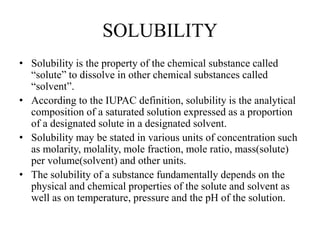
• Solubility is the property of the chemical substance called
“solute” to dissolve in other chemical substances called
“solvent”.
• According to the IUPAC definition, solubility is the analytical
composition of a saturated solution expressed as a proportion
of a designated solute in a designated solvent.
• Solubility may be stated in various units of concentration such
as molarity, molality, mole fraction, mole ratio, mass(solute)
per volume(solvent) and other units.
• The solubility of a substance fundamentally depends on the
physical and chemical properties of the solute and solvent as
well as on temperature, pressure and the pH of the solution.
SOLUBILITY BASED
CLASSIFICATION OF DRUG
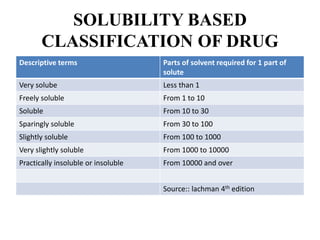
Descriptive terms Parts of solvent required for 1 part of
solute
Very solube Less than 1
Freely soluble From 1 to 10
Soluble From 10 to 30
Sparingly soluble From 30 to 100
Slightly soluble From 100 to 1000
Very slightly soluble From 1000 to 10000
Practically insoluble or insoluble From 10000 and over
Source:: lachman 4th edition
SOLUBILITY ANALYSIS
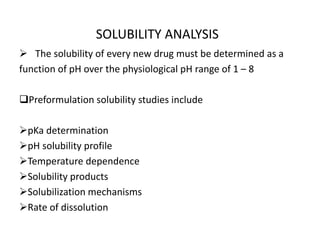
 The solubility of every new drug must be determined as a
function of pH over the physiological pH range of 1 – 8
Preformulation solubility studies include
pKa determination
pH solubility profile
Temperature dependence
Solubility products
Solubilization mechanisms
Rate of dissolution
Pka determination
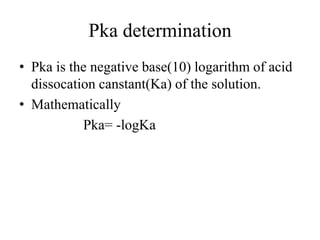
• Pka is the negative base(10) logarithm of acid
dissocation canstant(Ka) of the solution.
• Mathematically
Pka= -logKa
Pka determination
• The lower the Pka value of acid, stronger is the
acid.
• pKa value is helpful in determining the
absorption of drug molecule from the gut wall.
Pka determination
• Determination of the dissociation constant
(pKa) for a drug capable of ionization with in a
pH range of 1 to 10 is important, since
solubility and absorption can be altered by
orders of magnitude with changing pH.
• Various methods used for detemination of pKa
value are:
• Uv-metric method
• pH-metric method
• Potentiometric titration
• Conductometry
• Voltametry
• Caloriemetry
• Polariemetry
• Partition and distribution method
Uv- metric method
• UV-metric methods provide pKa results for
samples with chromophores whose UV
absorbance changes as a function of pH.
• A chromophore is a region of a molecule such as
a series of conjugated double bonds that absorbs
UV light.
• About 70% of samples have UV-active pKas.
• The Fast UV method typically requires 5μL of a
10mM solution of sample, and measures
absorbance at 250 wavelengths and 54 pH values
in a buffered solution in about 5 minutes.
pH-metric method
• pH-metric methods are based on potentiometric acid-base
titration.
• They typically require about 0.5 mg of sample. Results are
obtained by a complex computational process.
• The pH of each point in the titration curve is calculated
using equations that contain pKa, and the calculated points
are fitted to the measured curve by manipulating the
pKa value.
• The pKa that provides the best fit is taken to be the
measured pKa.
• pH-metric methods will measure all pKas between 2 and 12,
provided the sample is in solution throughout he
experiment.
Potentiometric titration
• It is also one of the most commonly used
methods for pKa determination.
• In a potentiometric titration, a known volume
of reagent is added stepwise to a solution of
analyte.
• The change in potential (E) upon reaction is
consequently measured with the use of two
electrodes, an indicator, and a reference
electrode.
• Plotting the potential versus volume
subsequently gives rise to a sigmoid curve,
where the inflection point gives the potential
at equilibrium.
• With the use of standards with known pH, this
potential can be linearly converted into a pH,
equaling pKa.
Thank you !!

Solubility analysis

  • 1.
    Pka determination Prepared by: KRISHNAPRASAD DAHAL PUNJAB UNIVERSITY COLLEGE OF PHARMACY, PU, LAHORE Submitted to: Dr. AMJAD HUSSAIN
  • 2.
    SOLUBILITY • Solubility isthe property of the chemical substance called “solute” to dissolve in other chemical substances called “solvent”. • According to the IUPAC definition, solubility is the analytical composition of a saturated solution expressed as a proportion of a designated solute in a designated solvent. • Solubility may be stated in various units of concentration such as molarity, molality, mole fraction, mole ratio, mass(solute) per volume(solvent) and other units. • The solubility of a substance fundamentally depends on the physical and chemical properties of the solute and solvent as well as on temperature, pressure and the pH of the solution.
  • 3.
    SOLUBILITY BASED CLASSIFICATION OFDRUG Descriptive terms Parts of solvent required for 1 part of solute Very solube Less than 1 Freely soluble From 1 to 10 Soluble From 10 to 30 Sparingly soluble From 30 to 100 Slightly soluble From 100 to 1000 Very slightly soluble From 1000 to 10000 Practically insoluble or insoluble From 10000 and over Source:: lachman 4th edition
  • 4.
    SOLUBILITY ANALYSIS  Thesolubility of every new drug must be determined as a function of pH over the physiological pH range of 1 – 8 Preformulation solubility studies include pKa determination pH solubility profile Temperature dependence Solubility products Solubilization mechanisms Rate of dissolution
  • 5.
    Pka determination • Pkais the negative base(10) logarithm of acid dissocation canstant(Ka) of the solution. • Mathematically Pka= -logKa
  • 7.
    Pka determination • Thelower the Pka value of acid, stronger is the acid. • pKa value is helpful in determining the absorption of drug molecule from the gut wall.
  • 8.
    Pka determination • Determinationof the dissociation constant (pKa) for a drug capable of ionization with in a pH range of 1 to 10 is important, since solubility and absorption can be altered by orders of magnitude with changing pH. • Various methods used for detemination of pKa value are:
  • 9.
    • Uv-metric method •pH-metric method • Potentiometric titration • Conductometry • Voltametry • Caloriemetry • Polariemetry • Partition and distribution method
  • 10.
    Uv- metric method •UV-metric methods provide pKa results for samples with chromophores whose UV absorbance changes as a function of pH. • A chromophore is a region of a molecule such as a series of conjugated double bonds that absorbs UV light. • About 70% of samples have UV-active pKas. • The Fast UV method typically requires 5μL of a 10mM solution of sample, and measures absorbance at 250 wavelengths and 54 pH values in a buffered solution in about 5 minutes.
  • 11.
    pH-metric method • pH-metricmethods are based on potentiometric acid-base titration. • They typically require about 0.5 mg of sample. Results are obtained by a complex computational process. • The pH of each point in the titration curve is calculated using equations that contain pKa, and the calculated points are fitted to the measured curve by manipulating the pKa value. • The pKa that provides the best fit is taken to be the measured pKa. • pH-metric methods will measure all pKas between 2 and 12, provided the sample is in solution throughout he experiment.
  • 12.
    Potentiometric titration • Itis also one of the most commonly used methods for pKa determination. • In a potentiometric titration, a known volume of reagent is added stepwise to a solution of analyte. • The change in potential (E) upon reaction is consequently measured with the use of two electrodes, an indicator, and a reference electrode.
  • 13.
    • Plotting thepotential versus volume subsequently gives rise to a sigmoid curve, where the inflection point gives the potential at equilibrium. • With the use of standards with known pH, this potential can be linearly converted into a pH, equaling pKa.
  • 14.

Editor's Notes

  • #3 IUPAC stands for International Union of Pure and Applied Chemistry.