Solubility_PPT_Part1.pptx complete pdf of solubility all in detail
1.
Solubility – Definition
•Solubility: maximum amount of solute that
can dissolve in a given solvent at specific
conditions.
• Expressed as g/100 mL, mol/L, etc.
• Important in pharmacy: drug absorption,
bioavailability, formulation development.
• Drug example: Paracetamol (high solubility) vs
Griseofulvin (low solubility).
2.
Importance of Solubility
•Key factor for oral drug absorption and
therapeutic effectiveness.
• Poorly soluble drugs often show poor
bioavailability.
• Guides formulation strategy (solution,
suspension, tablets).
• Impacts stability and shelf life of dosage
forms.
• Example: BCS Class II drugs (low solubility,
high permeability).
3.
Factors Affecting Solubility
•Temperature: generally solubility increases
with temperature (endothermic dissolution).
• Pressure: major effect for gases.
• pH: affects ionization of weak acids/bases.
• Polarity of solvent: 'like dissolves like'
principle.
• Presence of complexing agents or co-solvents.
4.
Role in Pharmacy
•Direct impact on drug design and discovery.
• Preformulation studies include solubility
testing.
• Predicts oral absorption and therapeutic
response.
• Determines drug classification in
Biopharmaceutics Classification System (BCS).
5.
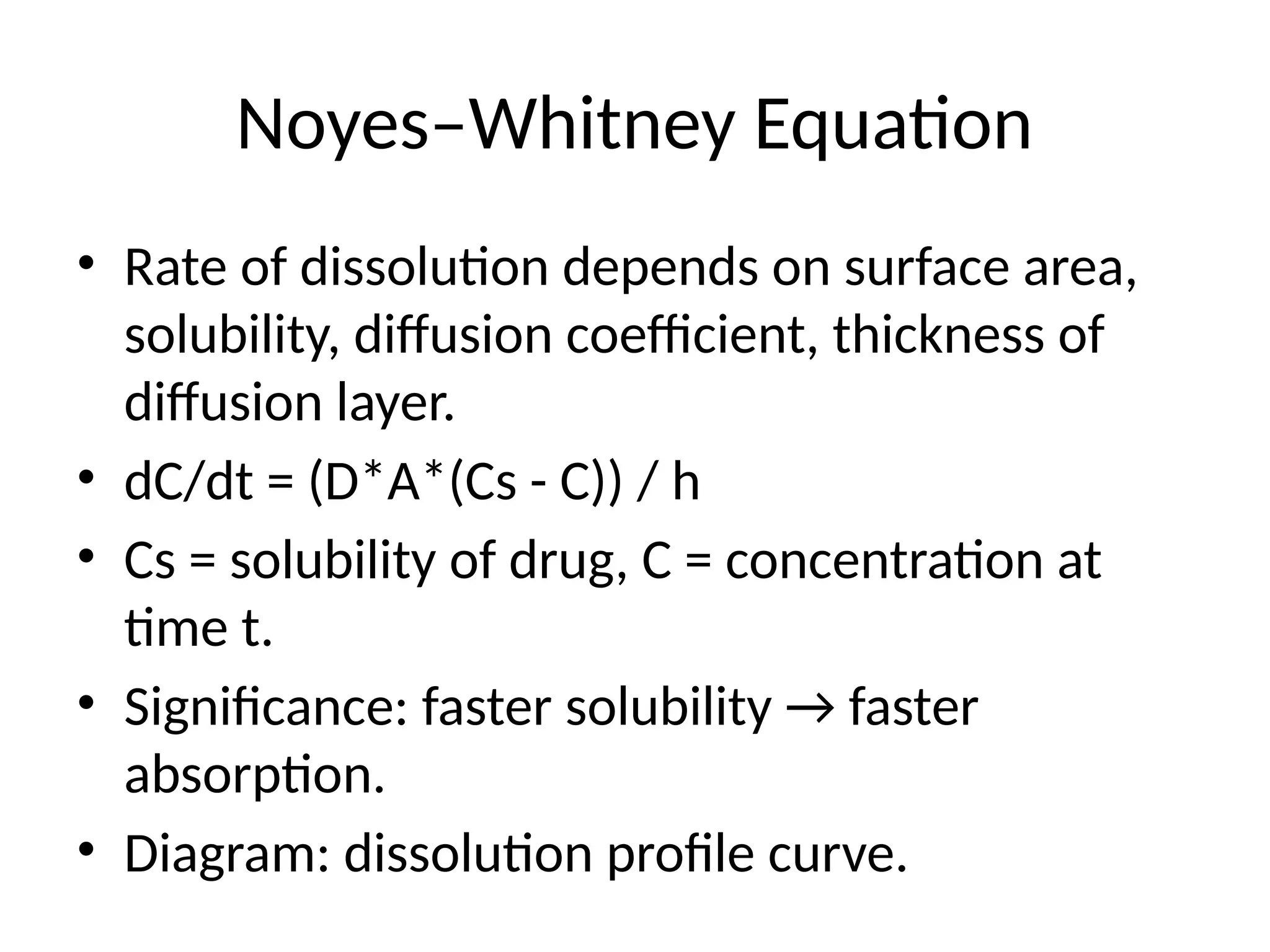
Noyes–Whitney Equation
• Rateof dissolution depends on surface area,
solubility, diffusion coefficient, thickness of
diffusion layer.
• dC/dt = (D*A*(Cs - C)) / h
• Cs = solubility of drug, C = concentration at
time t.
• Significance: faster solubility → faster
absorption.
• Diagram: dissolution profile curve.
6.
Experimental Determination –
ShakeFlask Method
• Classical method for solubility determination.
• Excess solute shaken with solvent until
equilibrium.
• Mixture filtered, drug concentration analyzed.
• Advantages: simple, widely used.
• Limitations: time-consuming, not high-
throughput.
7.
Equilibrium Solubility Method
•Drug sample mixed with solvent until
equilibrium achieved.
• Solution analyzed using UV/Vis
spectrophotometry or HPLC.
• Accurate for sparingly soluble drugs.
• Widely applied in preformulation studies.
8.
High Throughput Solubility
Screening
•Modern automated method.
• Uses microplates and robotic systems.
• Rapid screening of many drug candidates.
• Saves time and resources in early drug
discovery.
9.
Analytical Techniques forSolubility
• UV-Visible spectrophotometer: quantification
of drug concentration.
• HPLC: accurate, widely used for poorly soluble
drugs.
• Gravimetric analysis: less common, used in
special cases.
• Modern techniques: NMR, Raman
spectroscopy for solubility studies.
10.
Flowchart of Solubility
Determination
•Step 1: Prepare saturated solution.
• Step 2: Maintain constant temperature.
• Step 3: Separate undissolved drug (filtration).
• Step 4: Analyze concentration of dissolved
drug.
• Step 5: Express solubility in appropriate units.
• Diagram: Solubility determination flowchart.
11.
Limitations of Experimental
Methods
•Shake-flask: slow, may give variability.
• High throughput: expensive equipment
needed.
• Analytical errors possible due to degradation
or instability.
• Temperature and pH fluctuations affect
accuracy.


![synopsis_presentation_spr[1]xk.pptx for students](https://cdn.slidesharecdn.com/ss_thumbnails/synopsispresentationspr1xk-251106062756-b79b4f99-thumbnail.jpg?width=640&height=640&fit=bounds)


