Prepared By: Dolly Sadrani
Department of Pharmaceutics
Ist Sem M.Pharma
1
 Introduction
 Effect of bonding on solubility
 Importance of Solubility
 Types of Solutions
 Factor affecting Solubility
 Phase Solubility Analysis
 Need for solubility enhancement
 Technique for solubility enhancement
 Reference
2
Solubility
Qualitative term: Solubility is defined as, “the
spontaneous interactions of two or more substances to form a
homogeneous molecular dispersion”.
Quantitative term: Solubility is defined as, “the
concentration of a solute in a saturated solution at a constant
temperature”.
3
As Per USP and IP (2014)
4
Sr
no.
Descriptive Term Parts of Solvent
required For 1 Part
Of Solubility
1 Very Soluble < 1
2 Freely Soluble 1 to 10
3 Soluble 10 to 30
4 Sparingly Soluble 30 to 100
5 Slightly Soluble 100 to 1000
6 Very Slightly Soluble 1000 to 10,000
7 Practically insoluble > 10,000
 As per IP 1996,
5
Sr
no.
Descriptive Term Approximate volume of
solvent in milliliters per
gram of solute
1 Very Soluble < 1
2 Freely Soluble 1 to 10
3 Soluble 10 to 30
4 Sparingly Soluble 30 to 100
5 Slightly Soluble 100 to 1000
6 Very Slightly Soluble 1000 to 10,000
7 Practically insoluble > 10,000
 Solvent: Holes open in the solvent
 Solute: Molecules of the solid break away from the bulk
 Solution: The solid molecule is integrated into the hole in the
solvent
6
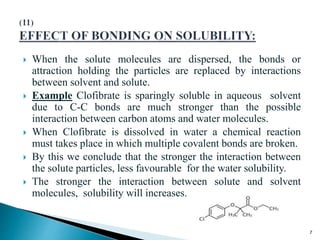
 When the solute molecules are dispersed, the bonds or
attraction holding the particles are replaced by interactions
between solvent and solute.
 Example Clofibrate is sparingly soluble in aqueous solvent
due to C-C bonds are much stronger than the possible
interaction between carbon atoms and water molecules.
 When Clofibrate is dissolved in water a chemical reaction
must takes place in which multiple covalent bonds are broken.
 By this we conclude that the stronger the interaction between
the solute particles, less favourable for the water solubility.
 The stronger the interaction between solute and solvent
molecules, solubility will increases.
7
 For Increasing the Bioavailability.
 Achieve desired concentration of drug in systemic circulation.
 Currently only 8 % of new drug candidates have both high
solubility and permeability.
 Nearly 40% of the new chemical entities discovered as poorly
water soluble.
 Selection of solvent for dosage form.
 Selection of dosage form.
 Information about the structure, Inter molecular forces.
 Selection of dissolution medium.
 Separation of mixtures.
8
 Separation of optical isomers.
 Detection of impurities.
 Preparation of reference substances.
 Determination of physicochemical properties.
9
Under saturated:
 It is a state of a solution that contain less of a solute than could
be a dissolved by that quantity of solvent under normal
circumstances.
Saturated:
 Solvent holds as much solute as is possible at that temperature.
 Dissolved solute is in dynamic equilibrium with solid solute
particles.
Unsaturated:
 Less than the amount of the solute for that temperature is
dissolved in the solvent.
Supersaturated:
 Solvent holds more solute than is normally possible at that
temperature.
10
11
1. The nature of the Solute and Solvent:
 When two substances are similar they can dissolve in each
other.
 Polar solute is dissolve in polar solvent.
 Non polar solute is dissolve in non polar solvent.
“ LIKE DISSOLVES LIKE ”
 Two liquids dissolve in each other because their molecule
are a like in polarity.
2. Temperature:
 Raising the temperature will increases the solubility.
12
3. Pressure:
 When the pressure is increased over the solvent, the solubility
of the gas is increased.
Henry’s Law: “ Solubility of gas is directly proportional to
the partial pressure of the gas above the liquid.”
4. Surface area:
 The greater the surface area per unit mass, the quicker it will
dissolve.
13
 PSA is the quantitative determination of purity of a substance
through the application of precise solubility measurement.
 variability of solubility indicates the presence of an impurity
or impurities.
Steps to determine the solubility:
 Control temperature and pressure.
 Add a quantity of solid to the solvent in the excess of what
will dissolve.
 Let the system come to the equilibrium.
 Use the specific assay to determine how much of the substance
(Concentration) in solution.
14
Solvent Selection:
 Sufficient Volatility
 Boiling point in between 60-150℃
 Not react with test substance
 Don’t form solvates, salt
 Pure in nature
 The test compound has solubility about 10-20mg/ml in the
solvents system.
15
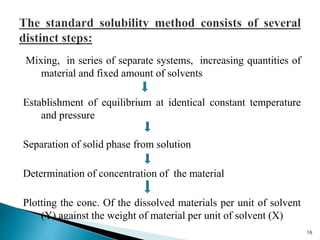
Mixing, in series of separate systems, increasing quantities of
material and fixed amount of solvents
Establishment of equilibrium at identical constant temperature
and pressure
Separation of solid phase from solution
Determination of concentration of the material
Plotting the conc. Of the dissolved materials per unit of solvent
(Y) against the weight of material per unit of solvent (X)
16
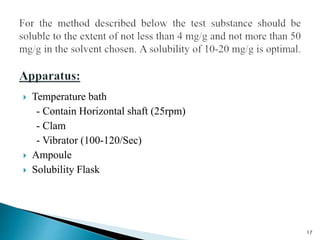
 Temperature bath
- Contain Horizontal shaft (25rpm)
- Clam
- Vibrator (100-120/Sec)
 Ampoule
 Solubility Flask
17
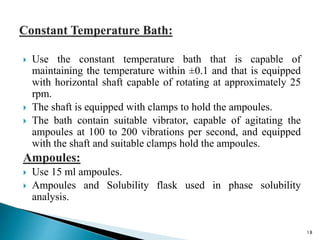
 Use the constant temperature bath that is capable of
maintaining the temperature within ±0.1 and that is equipped
with horizontal shaft capable of rotating at approximately 25
rpm.
 The shaft is equipped with clamps to hold the ampoules.
 The bath contain suitable vibrator, capable of agitating the
ampoules at 100 to 200 vibrations per second, and equipped
with the shaft and suitable clamps hold the ampoules.
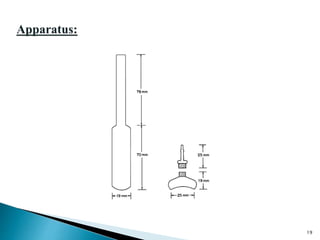
Ampoules:
 Use 15 ml ampoules.
 Ampoules and Solubility flask used in phase solubility
analysis.
18
19
 Mixing of material with Solvent.
 Establishment of equilibrium.
 Separation of solid phase from Solution.
 Determination of concentration of material dissolved per unit
of Solvent.
 Determination of weight of material unit of Solvent.
 Plotting graph, Extrapolation and calculation.
20
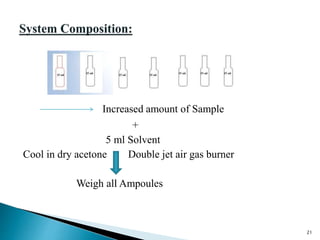
Increased amount of Sample
+
5 ml Solvent
Cool in dry acetone Double jet air gas burner
Weigh all Ampoules
21
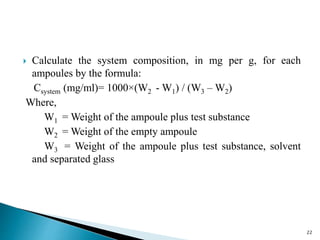
 Calculate the system composition, in mg per g, for each
ampoules by the formula:
Csystem (mg/ml)= 1000×(W2 - W1) / (W3 – W2)
Where,
W1 = Weight of the ampoule plus test substance
W2 = Weight of the empty ampoule
W3 = Weight of the ampoule plus test substance, solvent
and separated glass
22
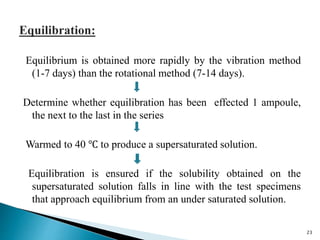
Equilibrium is obtained more rapidly by the vibration method
(1-7 days) than the rotational method (7-14 days).
Determine whether equilibration has been effected 1 ampoule,
the next to the last in the series
Warmed to 40 ℃ to produce a supersaturated solution.
Equilibration is ensured if the solubility obtained on the
supersaturated solution falls in line with the test specimens
that approach equilibrium from an under saturated solution.
23
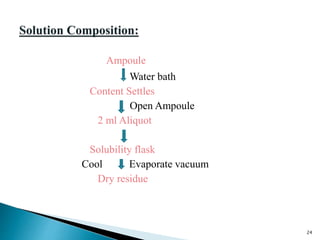
Ampoule
Water bath
Content Settles
Open Ampoule
2 ml Aliquot
Solubility flask
Cool Evaporate vacuum
Dry residue
24
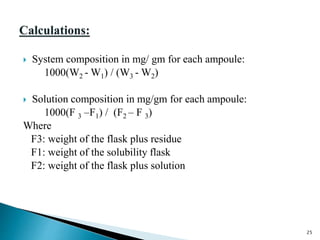
 System composition in mg/ gm for each ampoule:
1000(W2 - W1) / (W3 - W2)
 Solution composition in mg/gm for each ampoule:
1000(F 3 –F1) / (F2 – F 3)
Where
F3: weight of the flask plus residue
F1: weight of the solubility flask
F2: weight of the flask plus solution
25
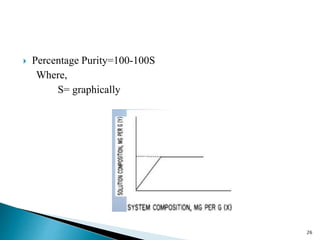
 Percentage Purity=100-100S
Where,
S= graphically
26
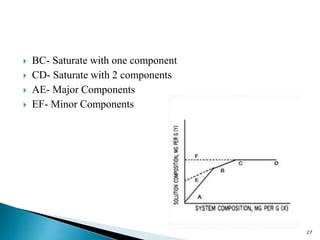
 BC- Saturate with one component
 CD- Saturate with 2 components
 AE- Major Components
 EF- Minor Components
27
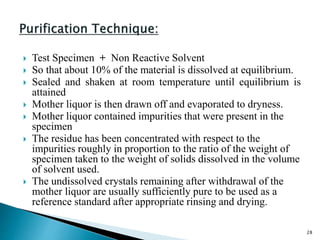
 Test Specimen + Non Reactive Solvent
 So that about 10% of the material is dissolved at equilibrium.
 Sealed and shaken at room temperature until equilibrium is
attained
 Mother liquor is then drawn off and evaporated to dryness.
 Mother liquor contained impurities that were present in the
specimen
 The residue has been concentrated with respect to the
impurities roughly in proportion to the ratio of the weight of
specimen taken to the weight of solids dissolved in the volume
of solvent used.
 The undissolved crystals remaining after withdrawal of the
mother liquor are usually sufficiently pure to be used as a
reference standard after appropriate rinsing and drying.
28
 There are variety of new drugs and derivatives are available.
But less than 40% of lipophilic drugs candidates fail to reach
market due to poor bioavailability, even these drugs might
exhibit pharmacodynamic activities.
 The lipophilic drugs that reaches market requires a high dose
to attain proper pharmacological action.
29
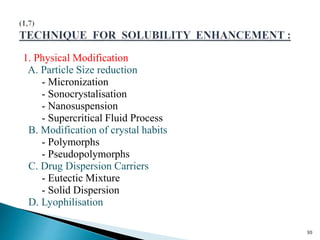
1. Physical Modification
A. Particle Size reduction
- Micronization
- Sonocrystalisation
- Nanosuspension
- Supercritical Fluid Process
B. Modification of crystal habits
- Polymorphs
- Pseudopolymorphs
C. Drug Dispersion Carriers
- Eutectic Mixture
- Solid Dispersion
D. Lyophilisation
30
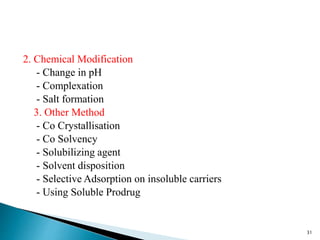
2. Chemical Modification
- Change in pH
- Complexation
- Salt formation
3. Other Method
- Co Crystallisation
- Co Solvency
- Solubilizing agent
- Solvent disposition
- Selective Adsorption on insoluble carriers
- Using Soluble Prodrug
31
 Particle Size reduction can be achieved by:
Micronization:
 Micronization increases the dissolution rate of drug through
increased surface area.
Example: Fenofibrate
Nanosuspension:
 It is a biphasic system consist of nano size drug particles
stabilized by surfactant for either oral and topical use or
parenteral and pulmonary administration.
Example: Azithromycin
32
Sonocrysallisation:
 In these utilization of ultrasound power for introducing
crystallisation.
Example: Rosiglitazone
Super Critical Fluid Process:
 A SCF can be define as, “ dense non condensable fluid.”
B. Modification of crystal habit:
Polymorphs:
 Polymorphs exist in 2 form
(I) Stable form: Shows low aqueous solubility.
(II) Metastable form: Shows high aqueous Solubility.
Example: Polymorphic form III of riboflavin is 20 times more
water soluble than form I.
33
Pseudopolymorphs: (Hydrates & Solvates)
 The anhydrous form of drug has greater aqueous solubility
than the hydrates, because of the hydrates are already in
interaction with water and therefore have less energy for
crystal breakup in comparison to the anhydrous for further
interaction with water.
Example: Chloroform solvates of griseofulvin more water
soluble than their non solvates form.
C. Drug dispersion:
Eutectic mixture:
 When these mixture is exposed to water the soluble carrier
dissolves leaving the drug in a microcrystalline state which
solubilize rapidly.
34
Example: Mixture of paracetamol and Urea
Solid dispersion:
 Prepared by solvent or co precipitation method.
Guest solute + solid carrier solvent
Dissolved in common volatile liquid solvent (Alcohol)
 The liquid solvent is removed by evaporation under reduced
pressure or by freeze drying which results in amorphous
precipitation of guest in crystalline carrier which solubilizes
rapidly.
Example: Amorphous sulfathiazole in crystalline urea.
35
 Amorphous powder with high degree of interaction between
drug and carrier like cyclodextrine.
It get in to porous – solubilizes rapidly.
Example: Indomethacin having low solubility in water
increased by lyophilisation.
Change of pH:
 This can be achieved in two ways
(I) In situ salt formation
(II) Addition of buffers to formulation
Example: Buffered Aspirin tablet.
36
Complexation:
 The beta and gamma cyclodextrin having ability to form
molecular inclusion complexes with hydrophilic drug having
poor aqueous solubility.
Example: Barbiturates , Benzodiazepines.
Salt formation:
 Salts have improve solubility in comparison to the original
drug.
Example,: -Alkali metal salts of acidic drug like penicillin
-Strong acid salt of basic drug like atropine are water
soluble than parent drugs.
37
Co crystallization:
 It is a define as “ a crystalline material that consist of two or
more molecular species held together by non covalent bond.
Co solvency:
 The solubilization of drug in co solvent.
Solubilizing agent:
 Adding various solubilizing material.
Solvent disposition:
 In that poorly water soluble drugs like nifedipine is dissolved
in an organic solvent like Alcohol and deposited on an inert,
hydrophilic, solid matrix such as starch or MCC and
evaporation of solvent is done.
38
Selective adsorption on insoluble carriers:
 A highly active adsorbent like inorganic clays, bentonite can
enhance the dissolution rate by maintaining the concentration
gradient at its maximum.
Use of soluble prodrug:
 It involves incorporation of polar or ionizable moiety into the
parent compound to improve water solubility of
corticosteroids, Benzodiazepines.
39
1. International journal of pharma professional’s research review
solubility enhancement techniques volume 1, issue 1, July
2010.
2. Journal of Global Pharma Technology Techniques To
Solubility of poorly Soluble Drugs Review.
3. The International Pharmacopoeia Eight edition, 2018.
4. The United States Pharmacopeia Volume III.
5. Remington The science and practice of pharmacy 19th edition
Page no. 194-200.
6. World research journal of pharmaceutical Research volume 1,
issue 1, 2013.
40
7. International journal of pharma professional’s research review
article solubility enhancement techniques volume 1, issue 1,
July 2010.
8. https://www.researchgate.net/publication/325686980
9. Journal of pharmaceutical Sciences volume61, issue 7, July
1972, Page no 1069-1075.
10. Phase solubility analysis William J. Madar & Takeru Higuchi
Pages 193- 215 Published online 18 Feb 2008.
11. https://chem.libretexts.org
12. Ansel Book of Pharmaceutics Page no. 214
41
42