STATES OF MATTER

  SOLID
Properties of Solid
 Solids have a definite shape and a definite
  volume.

 Particles of solids are tightly packed, not easily
  compressible

 Molecules still move but only vibrate about a
  fixed position.

 Intermolecular forces are strong
Melting Point
• the temperature where a solid turns into a
  liquid.

• at the melting point, the disruptive vibrations
  are strong enough to overcome the interactions
  holding them in a fixed position
Sublimation
• process of transformation directly from
  the solid phase to the gaseous phase without
  passing through an intermediate liquid phase

• endothermic phase transition that occurs at
  temperatures and pressures below a
  substance's triple point in its phase diagram.
Classification of Solids
Crystalline Solids
• a solid material whose
  constituent atoms, molecules, or ions are
  arranged in an orderly, repeating
  pattern extending in all three spatial
  dimensions.
Amorphous Solids
• lack an ordered internal structure atoms are
  randomly arranged
• In a crystal, the particles are arranged in a
  orderly, repeating, three-dimensional
  pattern called a crystal lattice
• A crystal lattice a three-dimensional form that
 determines the shape of individual units of
 crystal.
Types of Crystalline Solids
              Ionic Solids
              • made up of positive and
                negative ions and held together
                by electrostatic attractions.

              • characterized by very high
                melting points and brittleness
                and are poor conductors in the
                solid state

              Examples: Sodium Chloride, Zinc
               Sulphide, Calcium Fluoride
Molecular Solids
• Made up of atoms or
  molecules held together by
  London dispersion forces,
  dipole-dipole forces, or
  hydrogen bonds.

• Characterized by low
  melting points and
  flexibility

Examples: sugar, ice(water),
 dry ice
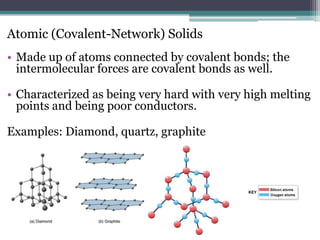
Atomic (Covalent-Network) Solids
• Made up of atoms connected by covalent bonds; the
  intermolecular forces are covalent bonds as well.

• Characterized as being very hard with very high melting
  points and being poor conductors.

Examples: Diamond, quartz, graphite
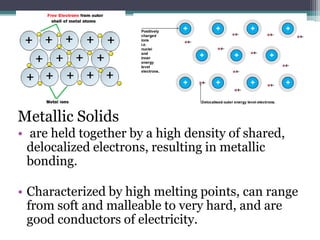
Metallic Solids
• are held together by a high density of shared,
  delocalized electrons, resulting in metallic
  bonding.

• Characterized by high melting points, can range
  from soft and malleable to very hard, and are
  good conductors of electricity.

Solids

  • 1.
  • 2.
    Properties of Solid Solids have a definite shape and a definite volume.  Particles of solids are tightly packed, not easily compressible  Molecules still move but only vibrate about a fixed position.  Intermolecular forces are strong
  • 3.
    Melting Point • thetemperature where a solid turns into a liquid. • at the melting point, the disruptive vibrations are strong enough to overcome the interactions holding them in a fixed position
  • 4.
    Sublimation • process oftransformation directly from the solid phase to the gaseous phase without passing through an intermediate liquid phase • endothermic phase transition that occurs at temperatures and pressures below a substance's triple point in its phase diagram.
  • 5.
    Classification of Solids CrystallineSolids • a solid material whose constituent atoms, molecules, or ions are arranged in an orderly, repeating pattern extending in all three spatial dimensions. Amorphous Solids • lack an ordered internal structure atoms are randomly arranged
  • 6.
    • In acrystal, the particles are arranged in a orderly, repeating, three-dimensional pattern called a crystal lattice • A crystal lattice a three-dimensional form that determines the shape of individual units of crystal.
  • 7.
    Types of CrystallineSolids Ionic Solids • made up of positive and negative ions and held together by electrostatic attractions. • characterized by very high melting points and brittleness and are poor conductors in the solid state Examples: Sodium Chloride, Zinc Sulphide, Calcium Fluoride
  • 8.
    Molecular Solids • Madeup of atoms or molecules held together by London dispersion forces, dipole-dipole forces, or hydrogen bonds. • Characterized by low melting points and flexibility Examples: sugar, ice(water), dry ice
  • 9.
    Atomic (Covalent-Network) Solids •Made up of atoms connected by covalent bonds; the intermolecular forces are covalent bonds as well. • Characterized as being very hard with very high melting points and being poor conductors. Examples: Diamond, quartz, graphite
  • 10.
    Metallic Solids • areheld together by a high density of shared, delocalized electrons, resulting in metallic bonding. • Characterized by high melting points, can range from soft and malleable to very hard, and are good conductors of electricity.