NARRATIVE ESSAYS
Esquivel, Eusebio Jochico
EXAMPLES                                 OBJECTIVES

              Know what a Narrative Essay is
                  The different components
                  Characteristics
                  How to write
                  Important factors on writing

              Read examples of Narrative Essays
              Differentiate Narrative Essays from Short
               stories.
The Climb
 I have this fear. It causes my legs to shake. I break out in a cold
sweat. I start jabbering to anyone who is nearby. As thoughts of
     certain death run through my mind, the world appears a
    precious, treasured place. I imagine my own funeral, then
shrink back at the implications of where my thoughts are taking
    me. My stomach feels strange. My palms are clammy. I am
 terrified of heights. Of course, it’s not really a fear of being in a
high place. Rather, it is the view of a long way to fall, of rocks far
below me and no firm wall between me and the edge. My sense
of security is screamingly absent. There are no guardrails, flimsy
though I picture them, or other safety devices. I can rely only on
             my own surefootedness—or lack thereof.
EXAMPLES


           Narrative essays use story telling elements to
            make their points. They look like short stories
               rather than traditional academic essays.
               Narrative essays don't have to be fiction;
            often, they depict real life events. Authors of
              narrative essays often use them to explore
            and find the meanings of important events in
             their own lives. Some readers connect more
                readily to narratives which have a vivid
               emotional and psychological dimension
              sometimes buried in traditional expository
                                 essays.
             -http://ux.brookdalecc.edu/fac/writing/rdery/e121/drafnarexp.htm
E SSENTIAL
EXAMPLES
                    ELEMENTS


              It is usually told chronologically.
              It usually has a purpose, which is usually
               stated in the opening sentence.
              It may use dialogue.
              It is written with sensory details and vivid
               descriptions to involve the reader. All these
               details relate in some way to the main point
               the writer is making.
EXAMPLES                                                TIPS
              Your words need to be vivid and colourful to help
               the reader feel the same feelings that you felt.
              Elements of the story need to support the point
               you are making and you need to remember to
               make reference to that point in the first sentence.
              You should make use of conflict and sequence like
               in any story.
              You may use flashbacks and flash forwards to
               help the story build to a climax.
              It is usually written in the first person, but third
               person may also be used.
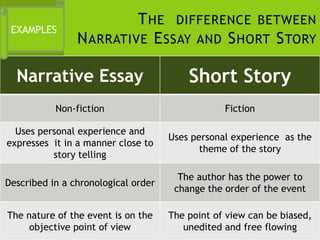
T HE DIFFERENCE BETWEEN
 EXAMPLES
                N ARRATIVE E SSAY AND S HORT S TORY

  Narrative Essay                        Short Story
           Non-fiction                           Fiction

  Uses personal experience and
                                     Uses personal experience as the
expresses it in a manner close to
                                            theme of the story
          story telling

                                       The author has the power to
Described in a chronological order
                                      change the order of the event

The nature of the event is on the    The point of view can be biased,
     objective point of view            unedited and free flowing
The Manager. The Leader.

Jerry -was the kind of guy you love to hate. He was always
  in a good mood and always had something positive to
say. When someone would ask him how he was doing, he
 would reply, "If I were any better, I would be twins!" He
  was a unique manager because he had several waiters
     who had followed him around from restaurant to
  restaurant. The reason the waiters followed Jerry was
 because of his attitude. He was a natural motivator. If an
  employee was having a bad day, Jerry was there telling
   the employee how to look on the positive side of the
                         situation.
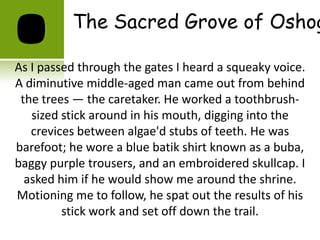
The Sacred Grove of Oshog

As I passed through the gates I heard a squeaky voice.
A diminutive middle-aged man came out from behind
 the trees — the caretaker. He worked a toothbrush-
   sized stick around in his mouth, digging into the
   crevices between algae'd stubs of teeth. He was
barefoot; he wore a blue batik shirt known as a buba,
baggy purple trousers, and an embroidered skullcap. I
  asked him if he would show me around the shrine.
Motioning me to follow, he spat out the results of his
         stick work and set off down the trail.
It was a hot sunny day, when I finally took my kids to the
 Disney Land. My son Matthew and my daughter Audra
   endlessly asked me to show them the dream land of
   many children with Mickey Mouse and Snow-white
   walking by and arousing a huge portion of emotions.
  Somehow these fairy tale creatures can make children
 happy without such “small” presents as $100 Lego or a
     Barbie’s house in 6 rooms and garden furniture.
    Therefore, I thought that Disney Land was a good
               invention for loving parents.
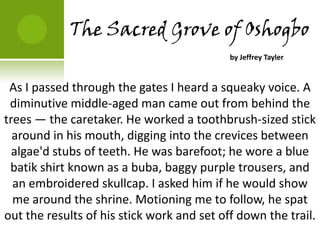
The Sacred Grove of Oshogbo
                                            by Jeffrey Tayler


 As I passed through the gates I heard a squeaky voice. A
 diminutive middle-aged man came out from behind the
trees — the caretaker. He worked a toothbrush-sized stick
  around in his mouth, digging into the crevices between
  algae'd stubs of teeth. He was barefoot; he wore a blue
 batik shirt known as a buba, baggy purple trousers, and
  an embroidered skullcap. I asked him if he would show
  me around the shrine. Motioning me to follow, he spat
out the results of his stick work and set off down the trail.
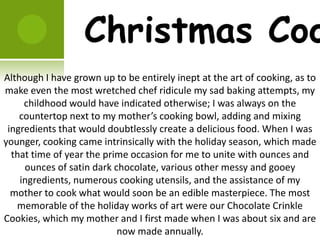
Christmas Coo
Although I have grown up to be entirely inept at the art of cooking, as to
make even the most wretched chef ridicule my sad baking attempts, my
     childhood would have indicated otherwise; I was always on the
    countertop next to my mother’s cooking bowl, adding and mixing
 ingredients that would doubtlessly create a delicious food. When I was
younger, cooking came intrinsically with the holiday season, which made
  that time of year the prime occasion for me to unite with ounces and
     ounces of satin dark chocolate, various other messy and gooey
    ingredients, numerous cooking utensils, and the assistance of my
  mother to cook what would soon be an edible masterpiece. The most
   memorable of the holiday works of art were our Chocolate Crinkle
Cookies, which my mother and I first made when I was about six and are
                           now made annually.

Narrative Essays

  • 1.
  • 2.
    EXAMPLES OBJECTIVES  Know what a Narrative Essay is  The different components  Characteristics  How to write  Important factors on writing  Read examples of Narrative Essays  Differentiate Narrative Essays from Short stories.
  • 3.
    The Climb Ihave this fear. It causes my legs to shake. I break out in a cold sweat. I start jabbering to anyone who is nearby. As thoughts of certain death run through my mind, the world appears a precious, treasured place. I imagine my own funeral, then shrink back at the implications of where my thoughts are taking me. My stomach feels strange. My palms are clammy. I am terrified of heights. Of course, it’s not really a fear of being in a high place. Rather, it is the view of a long way to fall, of rocks far below me and no firm wall between me and the edge. My sense of security is screamingly absent. There are no guardrails, flimsy though I picture them, or other safety devices. I can rely only on my own surefootedness—or lack thereof.
  • 4.
    EXAMPLES Narrative essays use story telling elements to make their points. They look like short stories rather than traditional academic essays. Narrative essays don't have to be fiction; often, they depict real life events. Authors of narrative essays often use them to explore and find the meanings of important events in their own lives. Some readers connect more readily to narratives which have a vivid emotional and psychological dimension sometimes buried in traditional expository essays. -http://ux.brookdalecc.edu/fac/writing/rdery/e121/drafnarexp.htm
  • 5.
    E SSENTIAL EXAMPLES ELEMENTS  It is usually told chronologically.  It usually has a purpose, which is usually stated in the opening sentence.  It may use dialogue.  It is written with sensory details and vivid descriptions to involve the reader. All these details relate in some way to the main point the writer is making.
  • 6.
    EXAMPLES TIPS  Your words need to be vivid and colourful to help the reader feel the same feelings that you felt.  Elements of the story need to support the point you are making and you need to remember to make reference to that point in the first sentence.  You should make use of conflict and sequence like in any story.  You may use flashbacks and flash forwards to help the story build to a climax.  It is usually written in the first person, but third person may also be used.
  • 7.
    T HE DIFFERENCEBETWEEN EXAMPLES N ARRATIVE E SSAY AND S HORT S TORY Narrative Essay Short Story Non-fiction Fiction Uses personal experience and Uses personal experience as the expresses it in a manner close to theme of the story story telling The author has the power to Described in a chronological order change the order of the event The nature of the event is on the The point of view can be biased, objective point of view unedited and free flowing
  • 8.
    The Manager. TheLeader. Jerry -was the kind of guy you love to hate. He was always in a good mood and always had something positive to say. When someone would ask him how he was doing, he would reply, "If I were any better, I would be twins!" He was a unique manager because he had several waiters who had followed him around from restaurant to restaurant. The reason the waiters followed Jerry was because of his attitude. He was a natural motivator. If an employee was having a bad day, Jerry was there telling the employee how to look on the positive side of the situation.
  • 9.
    The Sacred Groveof Oshog As I passed through the gates I heard a squeaky voice. A diminutive middle-aged man came out from behind the trees — the caretaker. He worked a toothbrush- sized stick around in his mouth, digging into the crevices between algae'd stubs of teeth. He was barefoot; he wore a blue batik shirt known as a buba, baggy purple trousers, and an embroidered skullcap. I asked him if he would show me around the shrine. Motioning me to follow, he spat out the results of his stick work and set off down the trail.
  • 10.
    It was ahot sunny day, when I finally took my kids to the Disney Land. My son Matthew and my daughter Audra endlessly asked me to show them the dream land of many children with Mickey Mouse and Snow-white walking by and arousing a huge portion of emotions. Somehow these fairy tale creatures can make children happy without such “small” presents as $100 Lego or a Barbie’s house in 6 rooms and garden furniture. Therefore, I thought that Disney Land was a good invention for loving parents.
  • 11.
    The Sacred Groveof Oshogbo by Jeffrey Tayler As I passed through the gates I heard a squeaky voice. A diminutive middle-aged man came out from behind the trees — the caretaker. He worked a toothbrush-sized stick around in his mouth, digging into the crevices between algae'd stubs of teeth. He was barefoot; he wore a blue batik shirt known as a buba, baggy purple trousers, and an embroidered skullcap. I asked him if he would show me around the shrine. Motioning me to follow, he spat out the results of his stick work and set off down the trail.
  • 12.
    Christmas Coo Although Ihave grown up to be entirely inept at the art of cooking, as to make even the most wretched chef ridicule my sad baking attempts, my childhood would have indicated otherwise; I was always on the countertop next to my mother’s cooking bowl, adding and mixing ingredients that would doubtlessly create a delicious food. When I was younger, cooking came intrinsically with the holiday season, which made that time of year the prime occasion for me to unite with ounces and ounces of satin dark chocolate, various other messy and gooey ingredients, numerous cooking utensils, and the assistance of my mother to cook what would soon be an edible masterpiece. The most memorable of the holiday works of art were our Chocolate Crinkle Cookies, which my mother and I first made when I was about six and are now made annually.