Visualizing and Describing
Different
Solid Figures
What is a
Polyhedron?
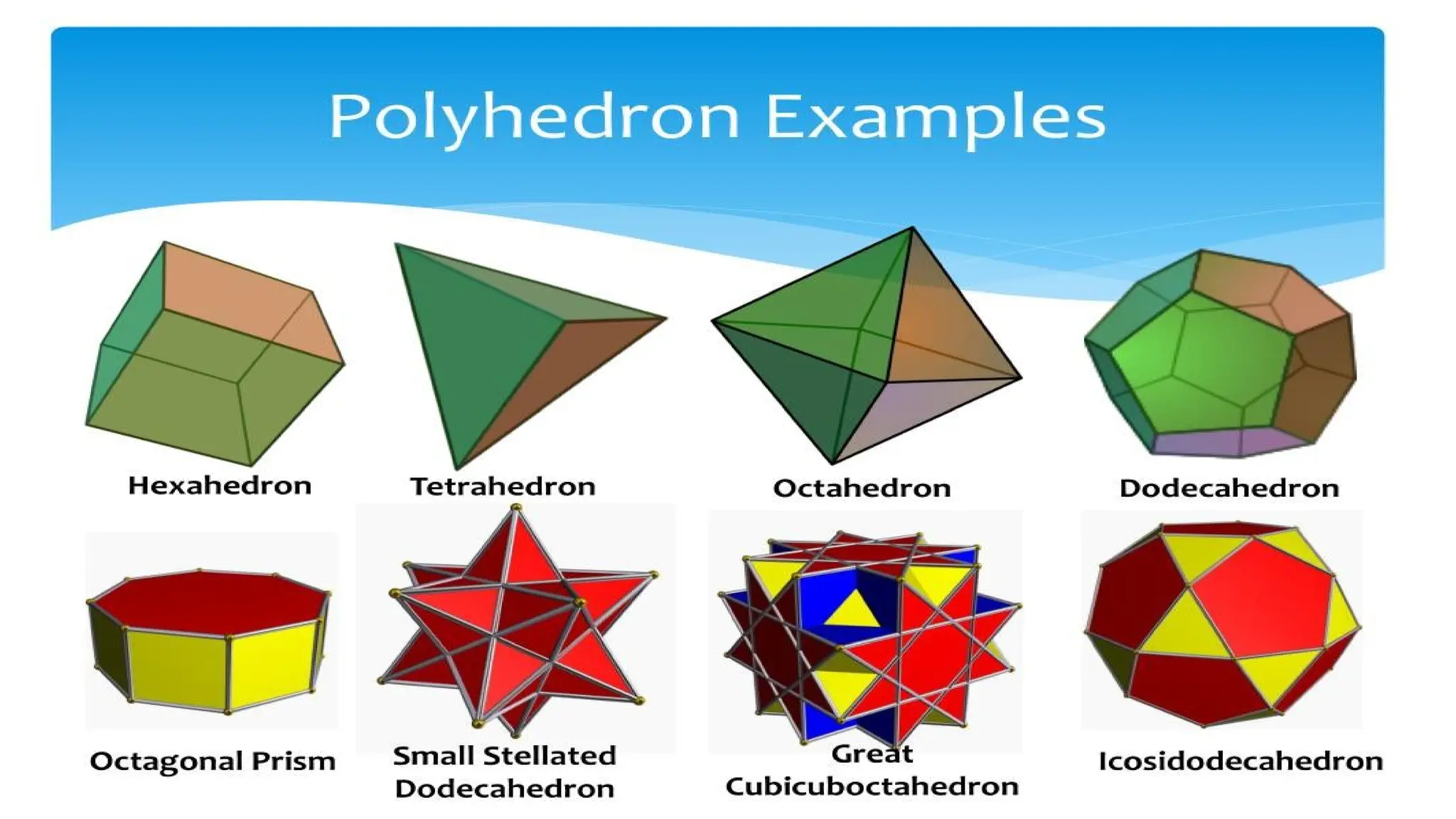
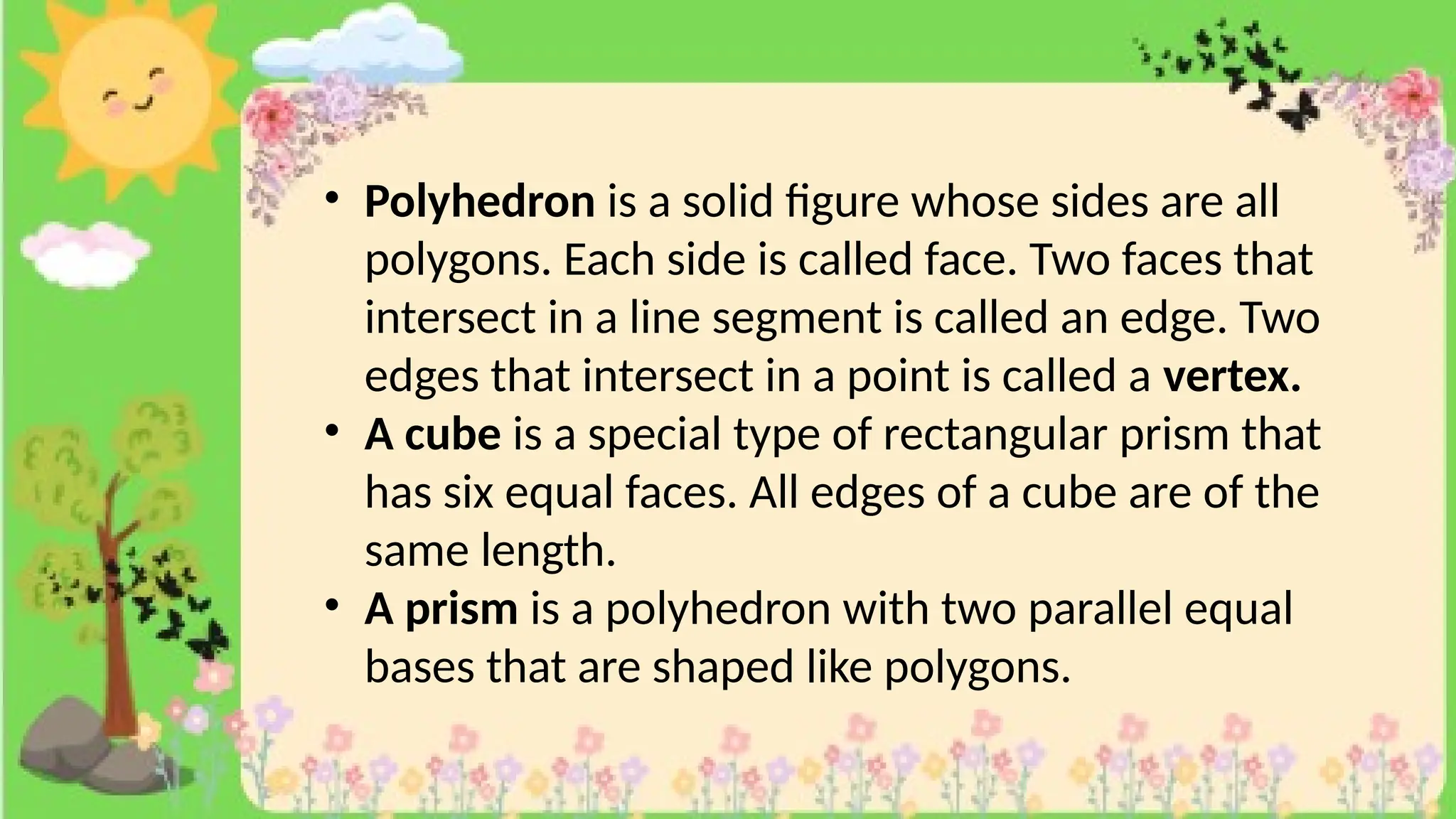
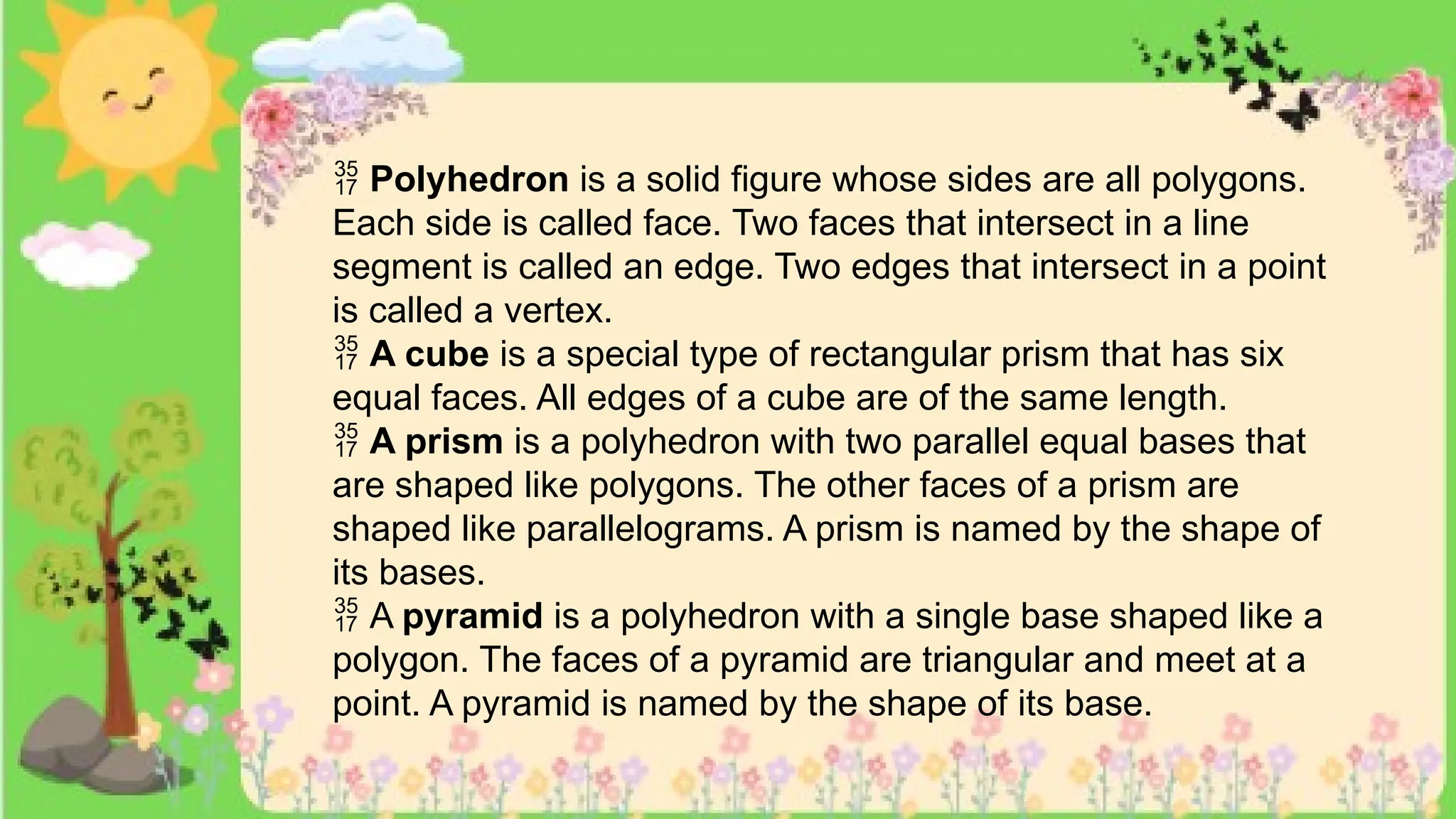
Polyhedron
is a solid figure whose sides are all
polygons. Each side is called face.
Two faces that intersect in a line
segment is called an edge. Two
edges that intersect in a point is
called a vertex.
What is a
CUBE?
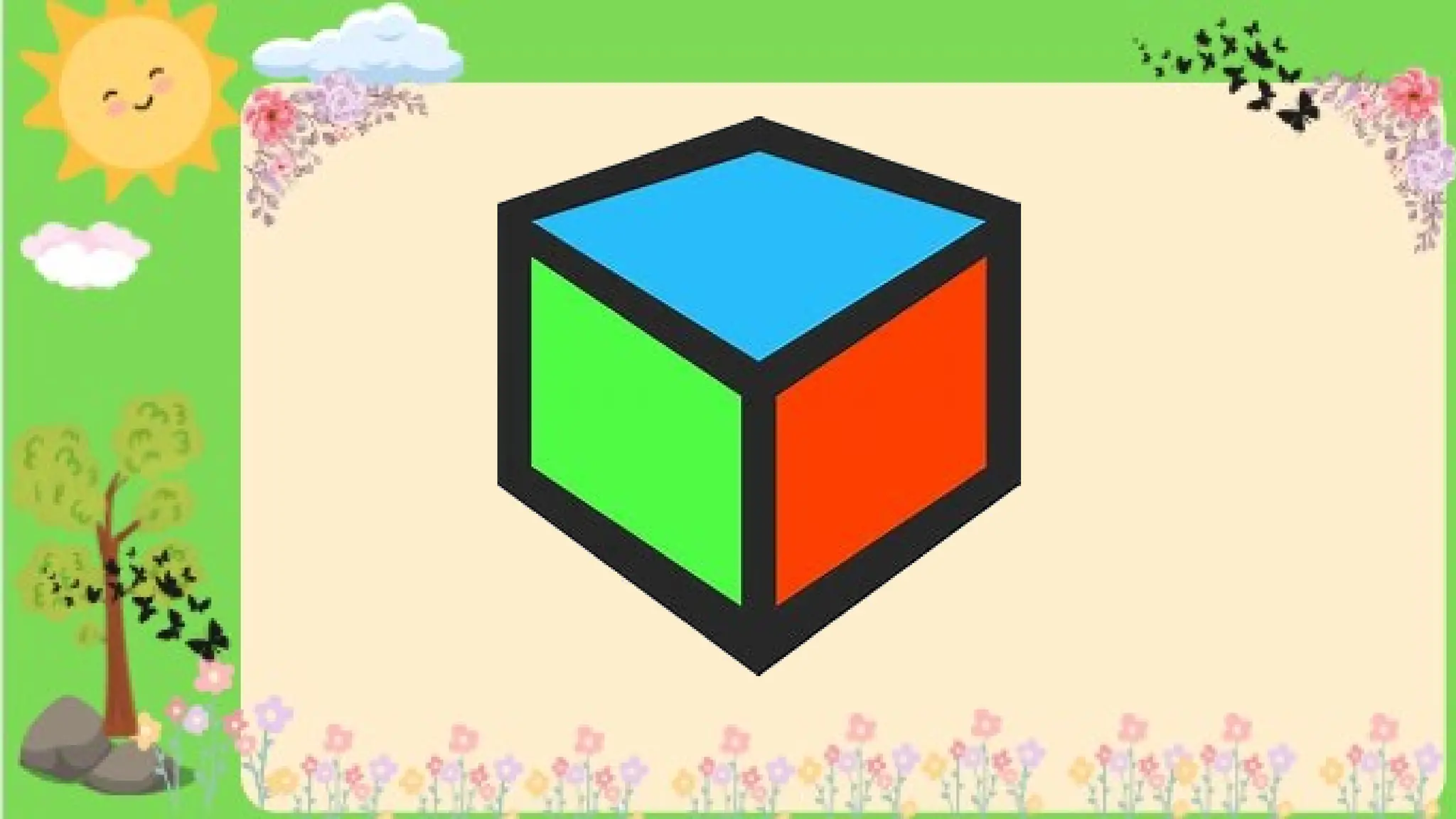
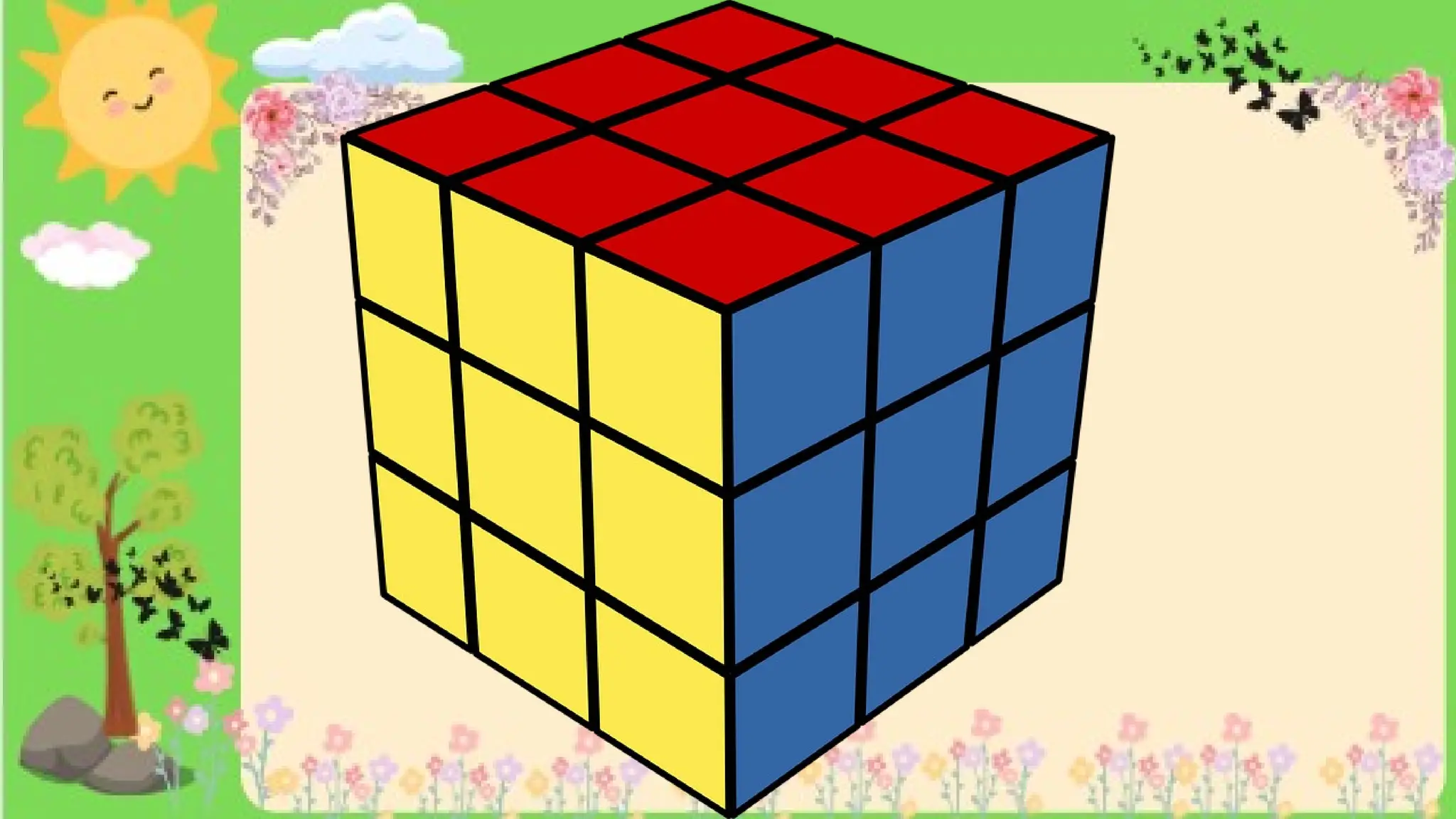
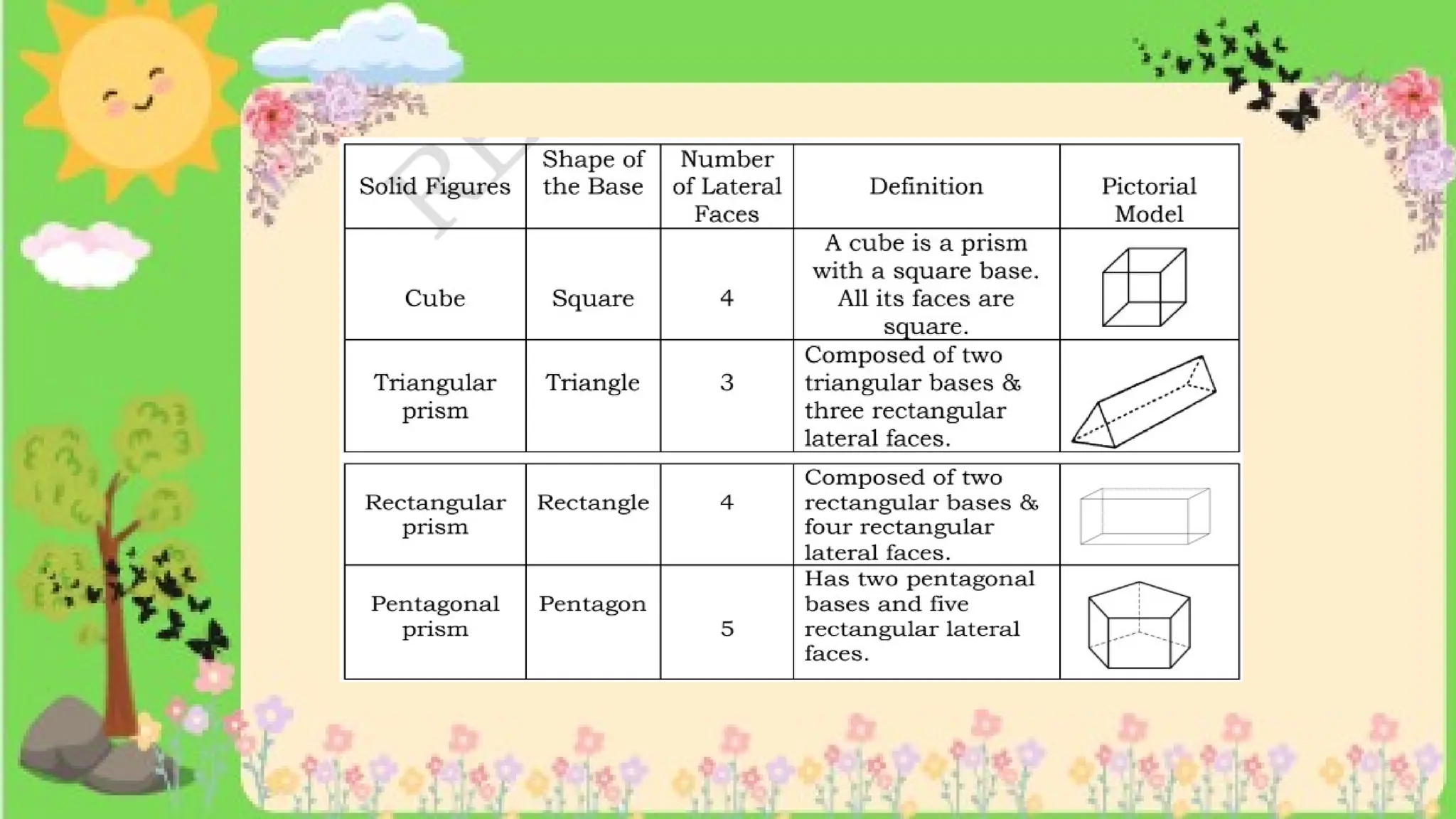
A cube
is a special type of rectangular
prism that has six equal faces. All
edges of a cube are of the same
length.
What is a
Prism?
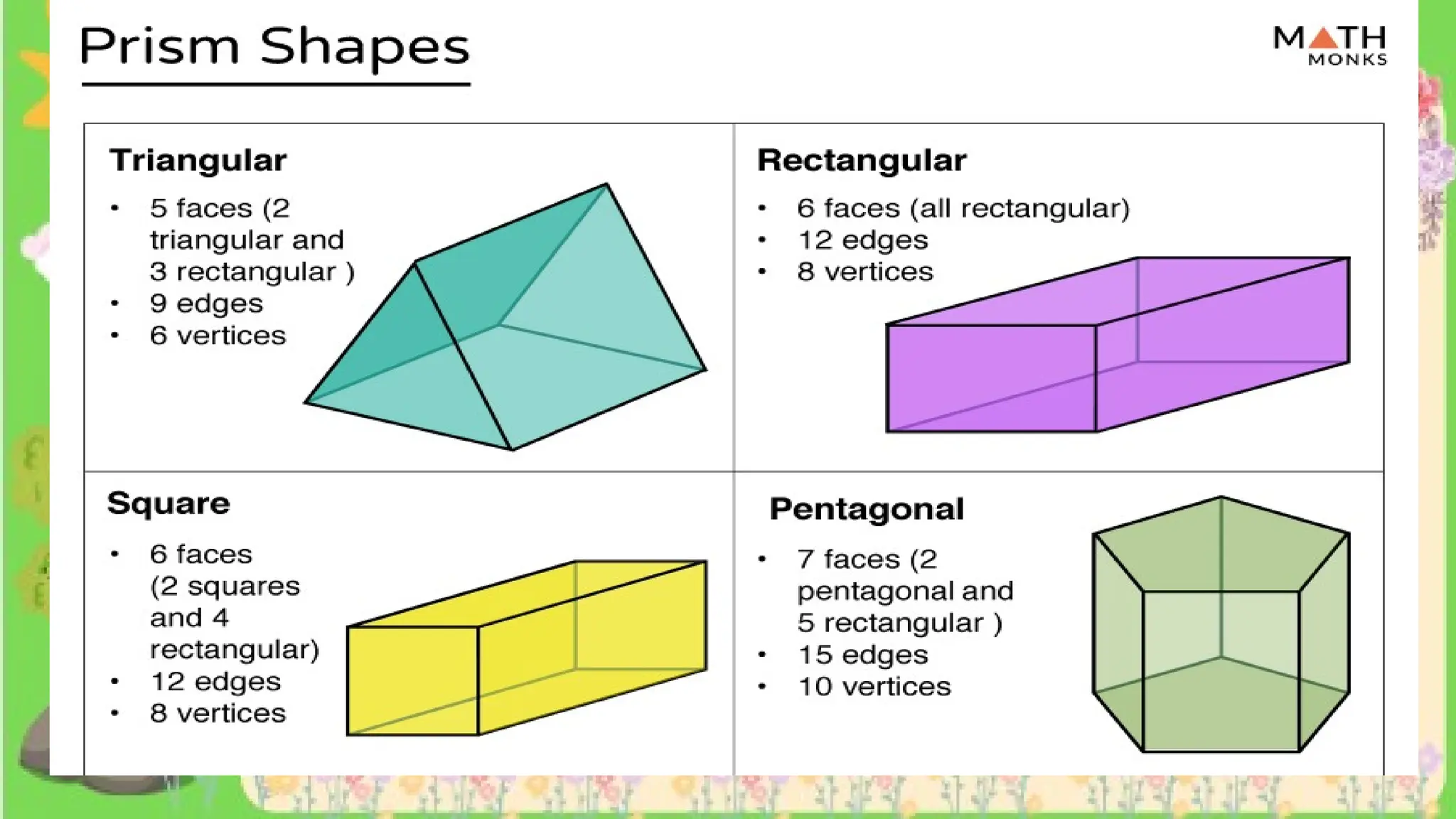
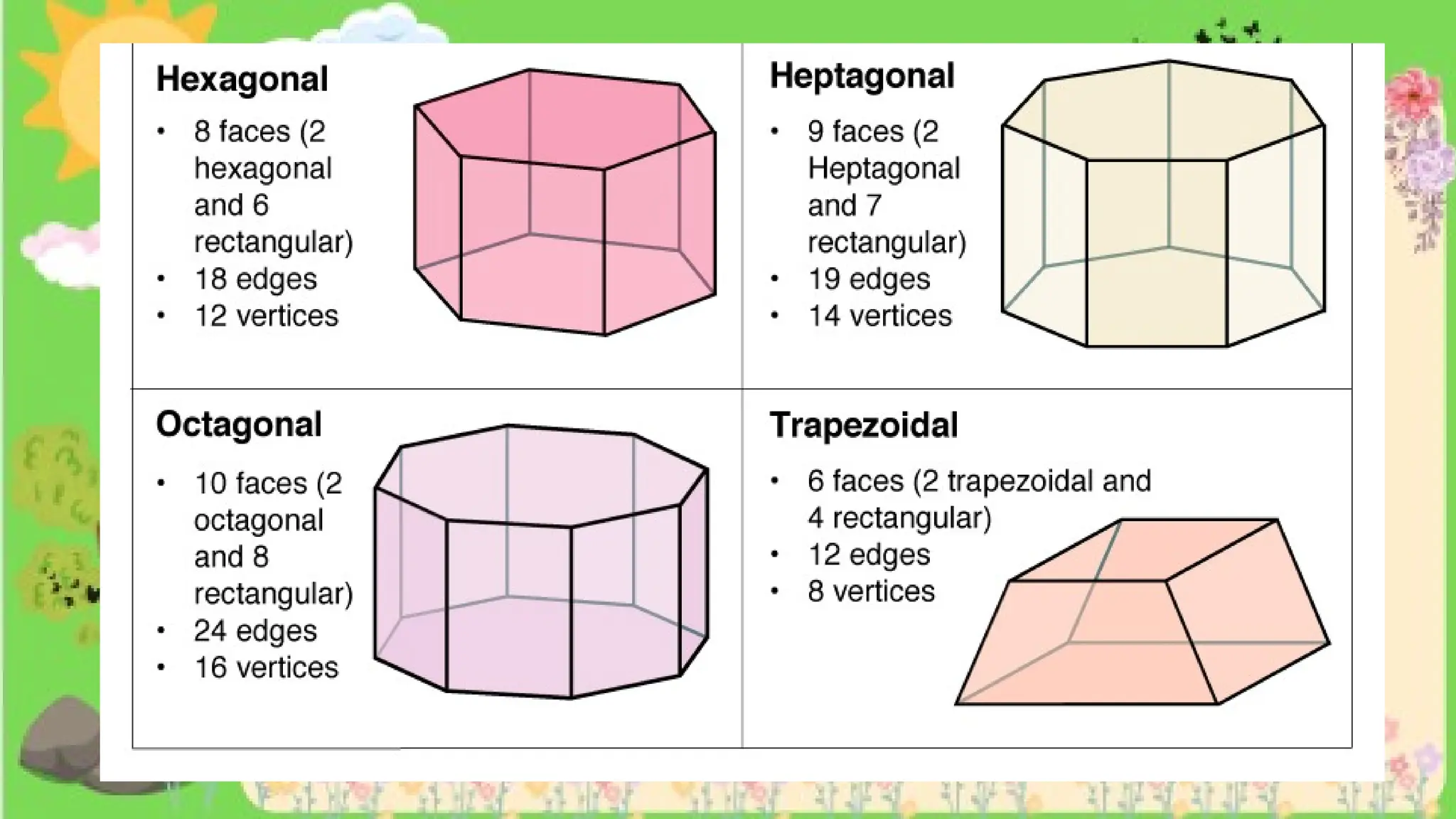
Prism
is a polyhedron with two parallel equal
bases that are shaped like polygons.
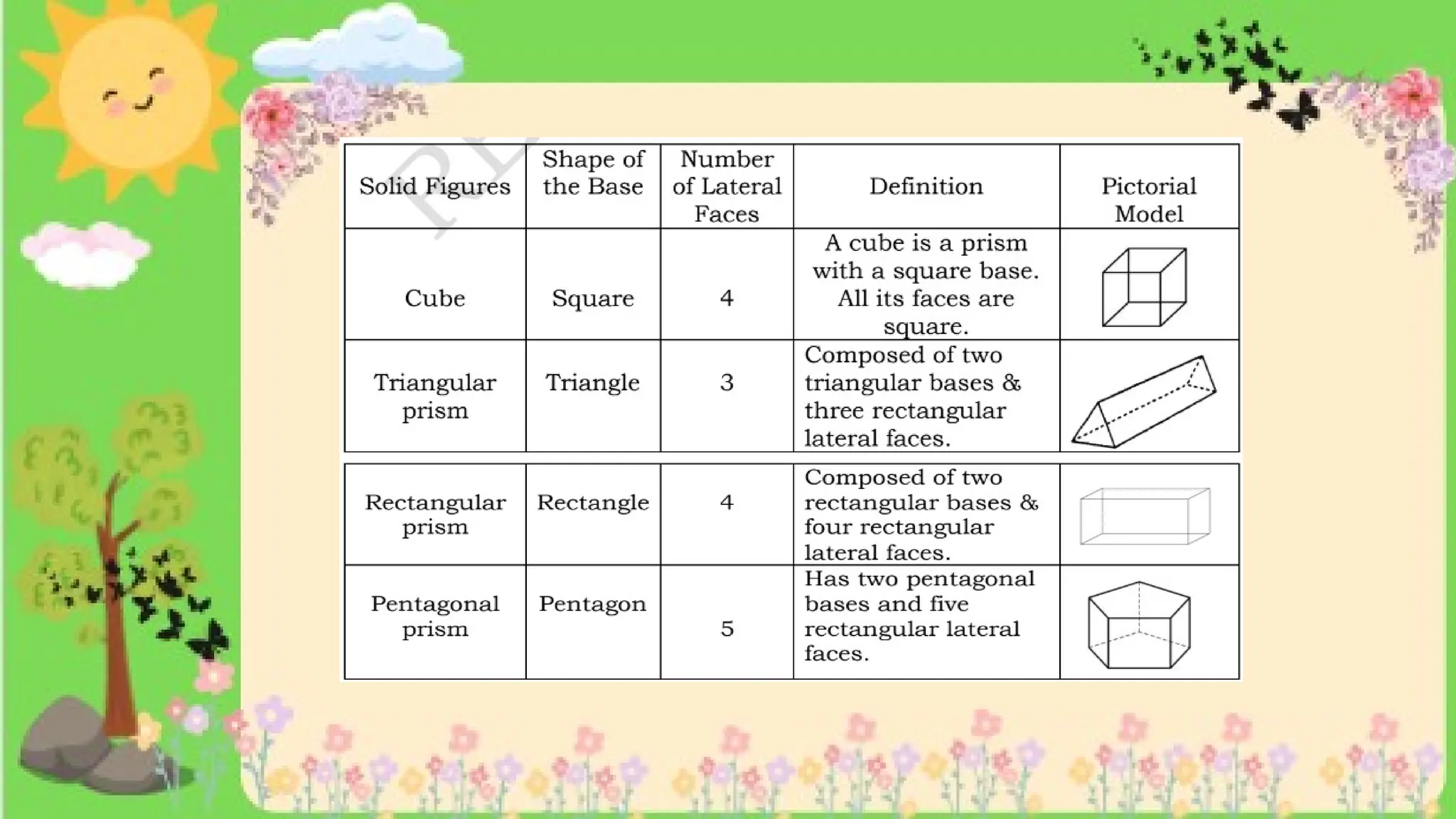
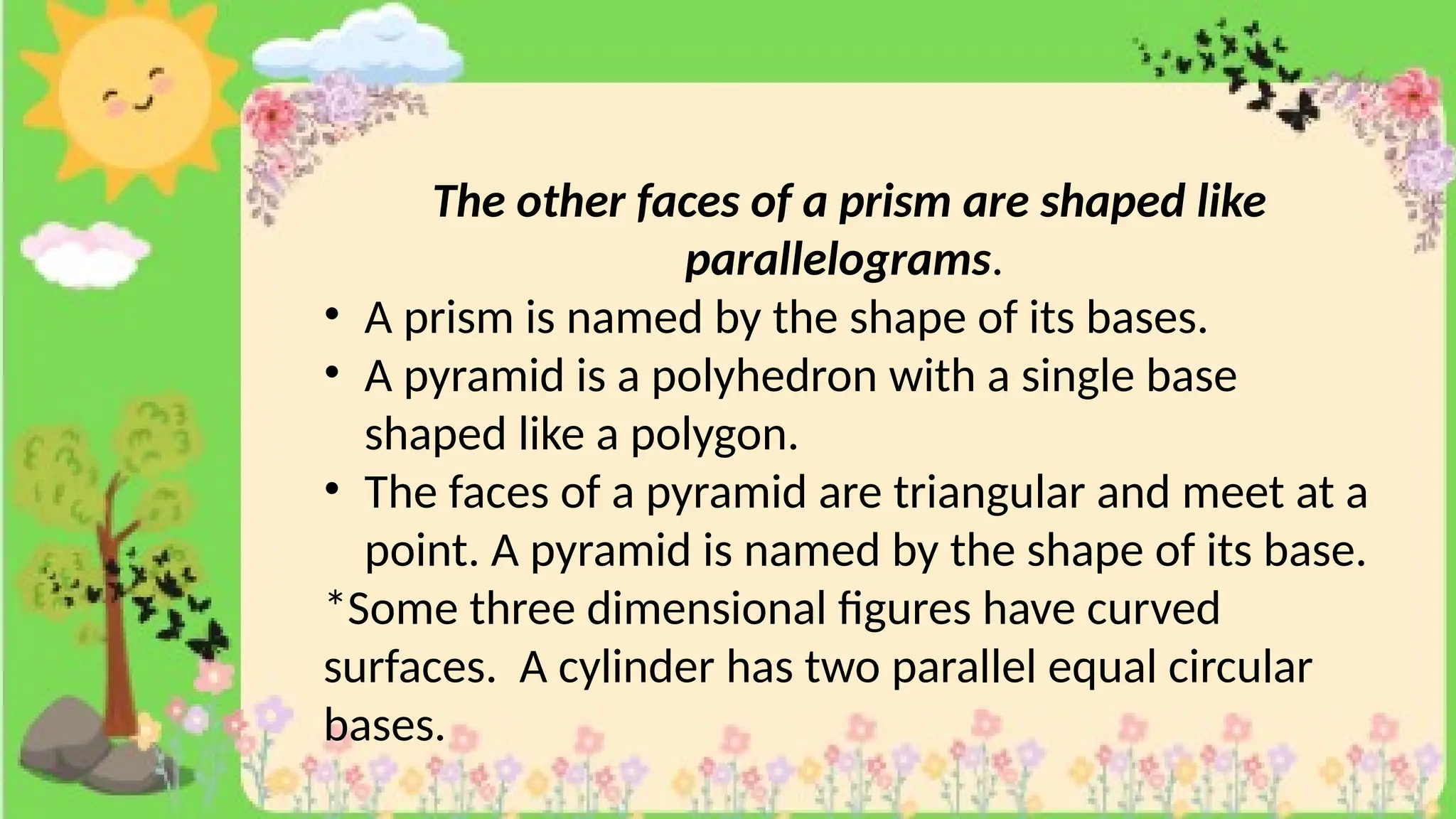
The other faces of a prism are
shaped like parallelograms. A prism is
named by the shape of its bases.
What is a
Pyramid?
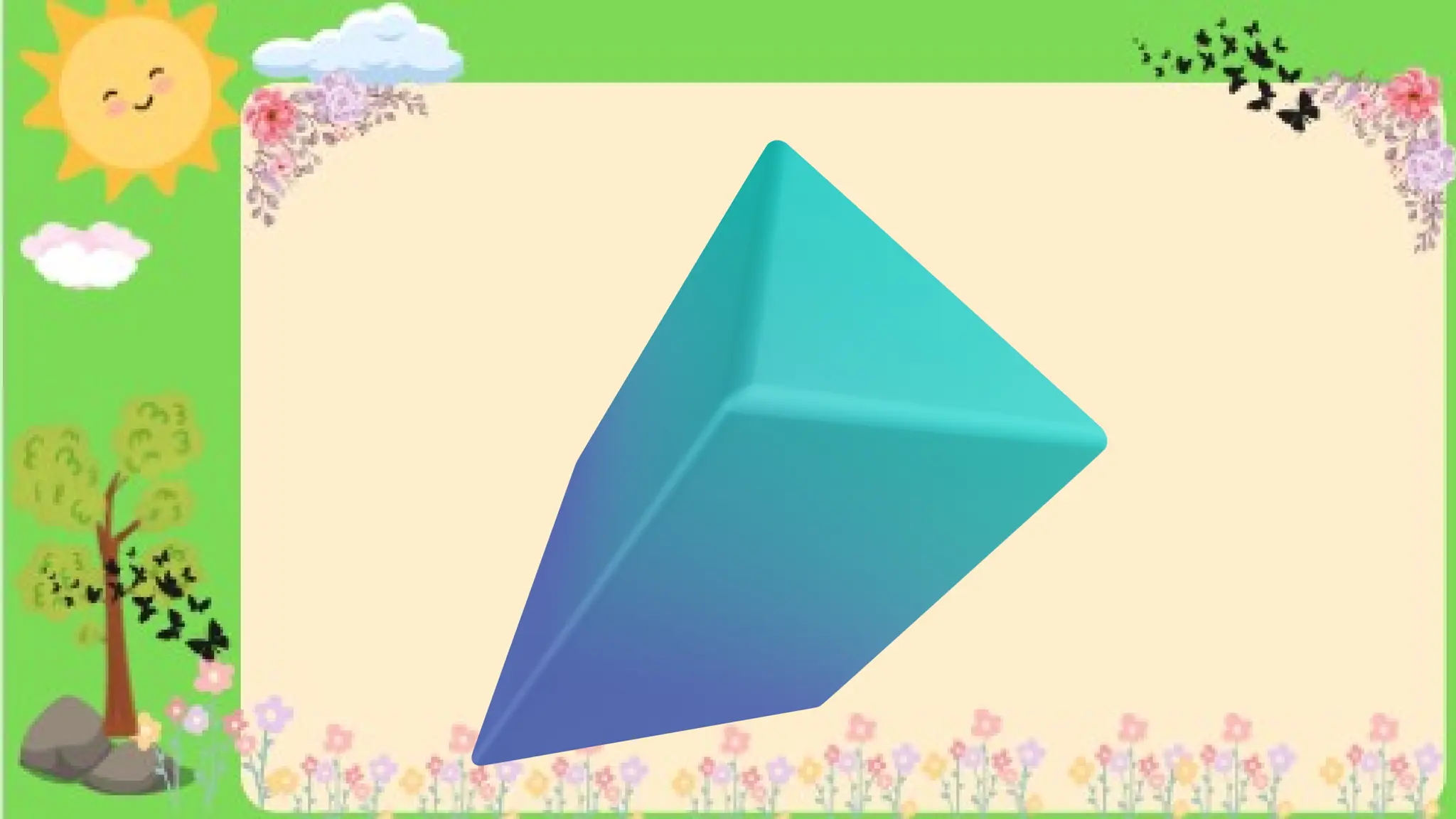
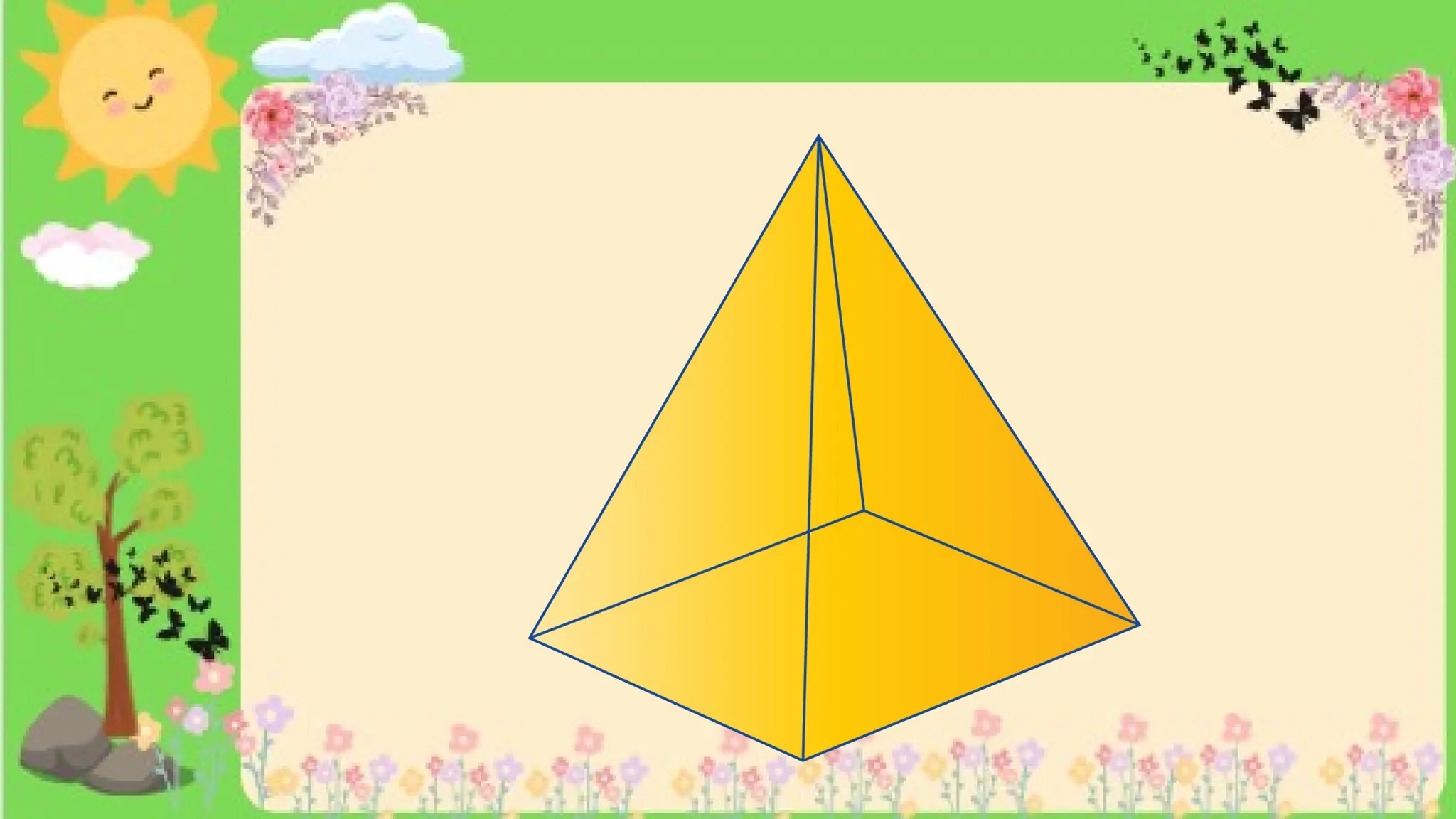
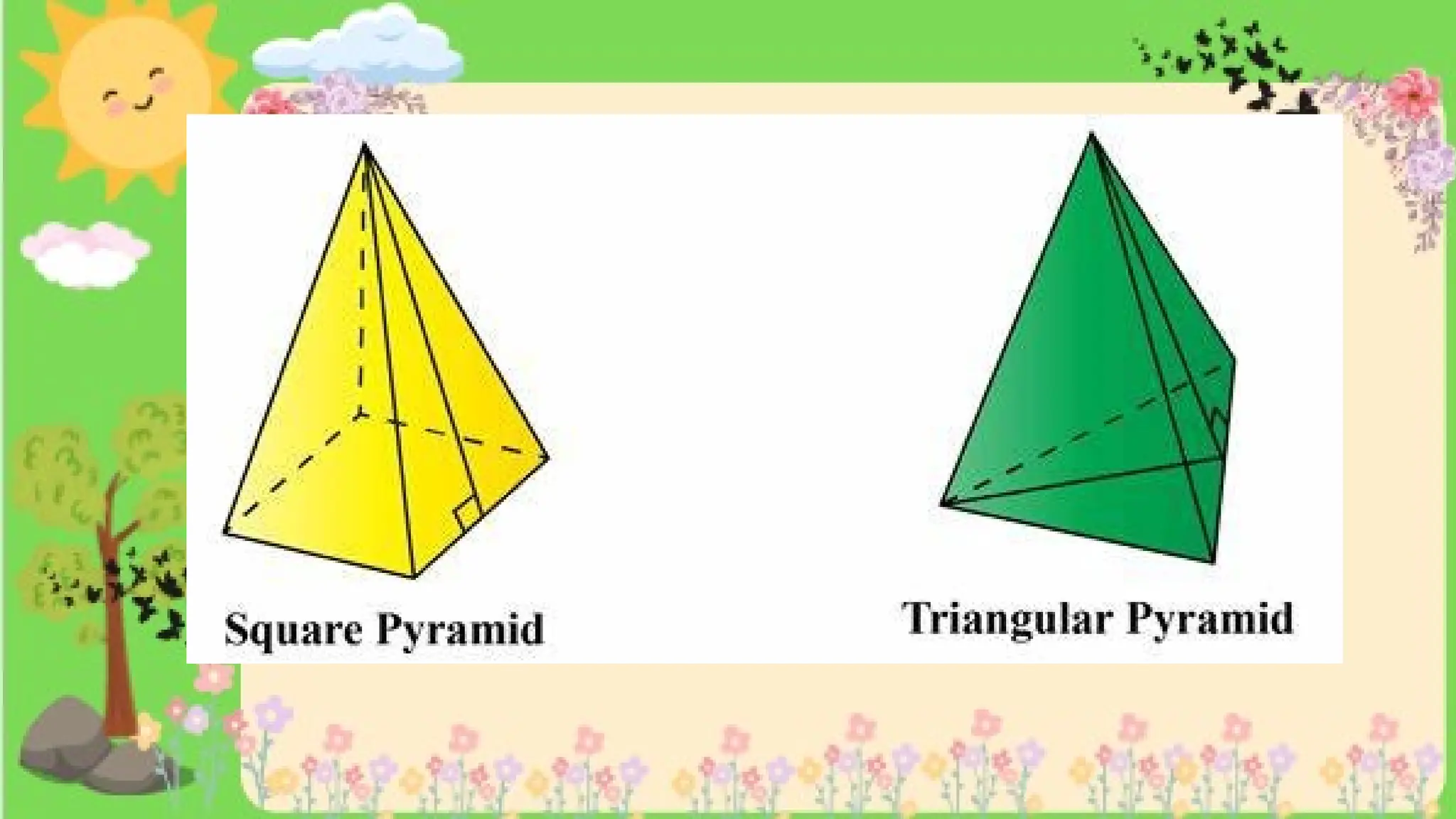
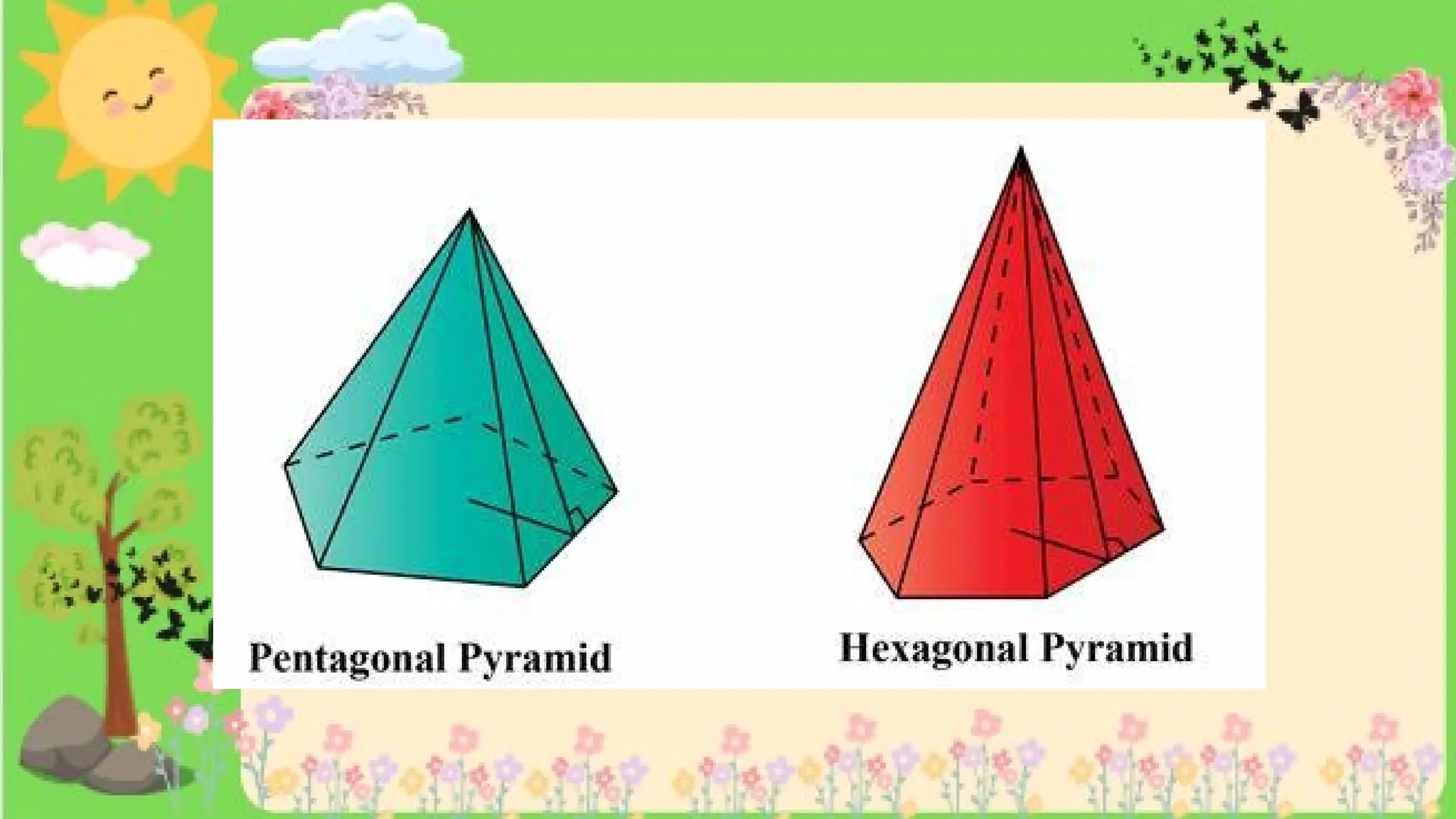
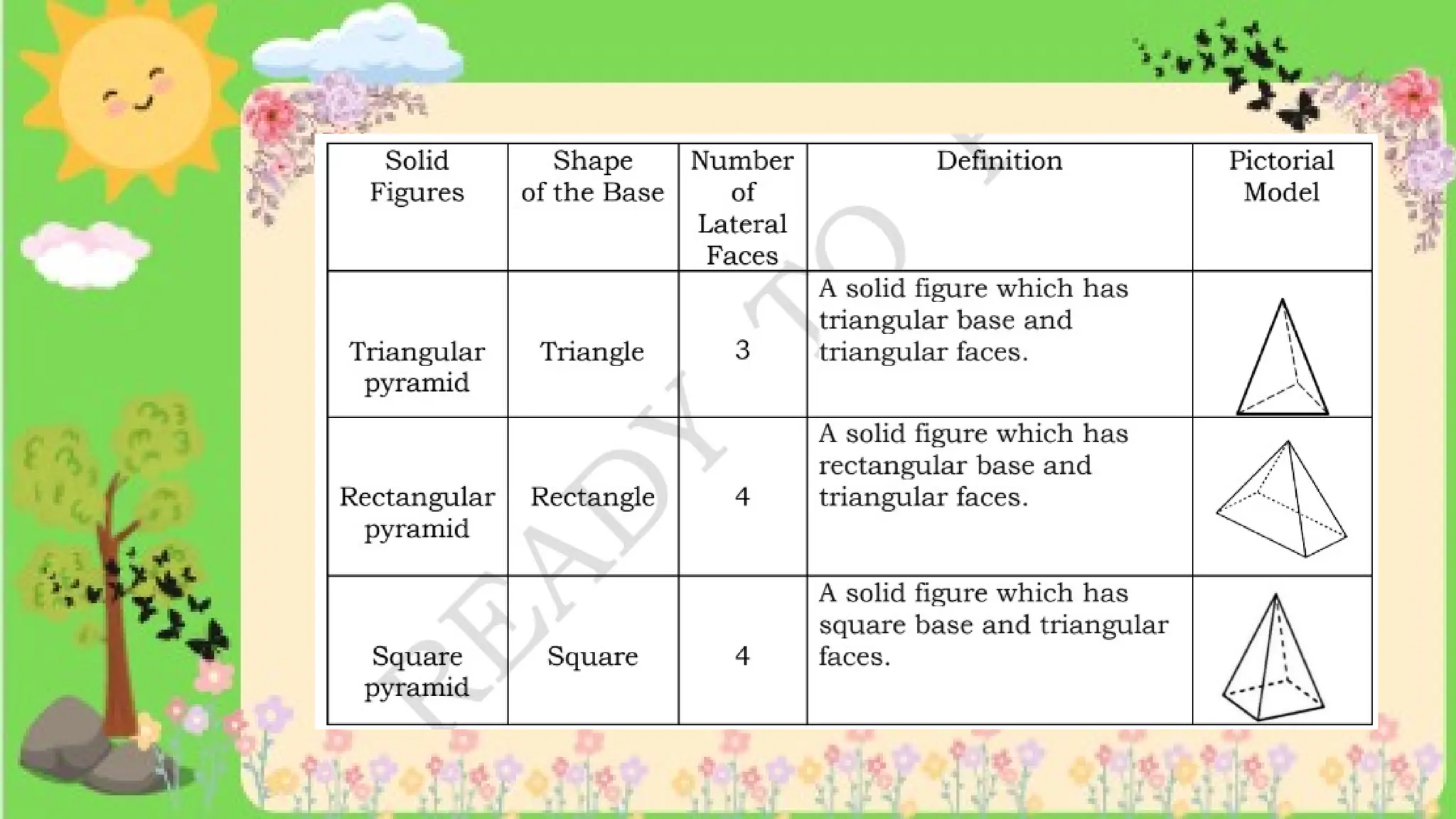
Pyramid
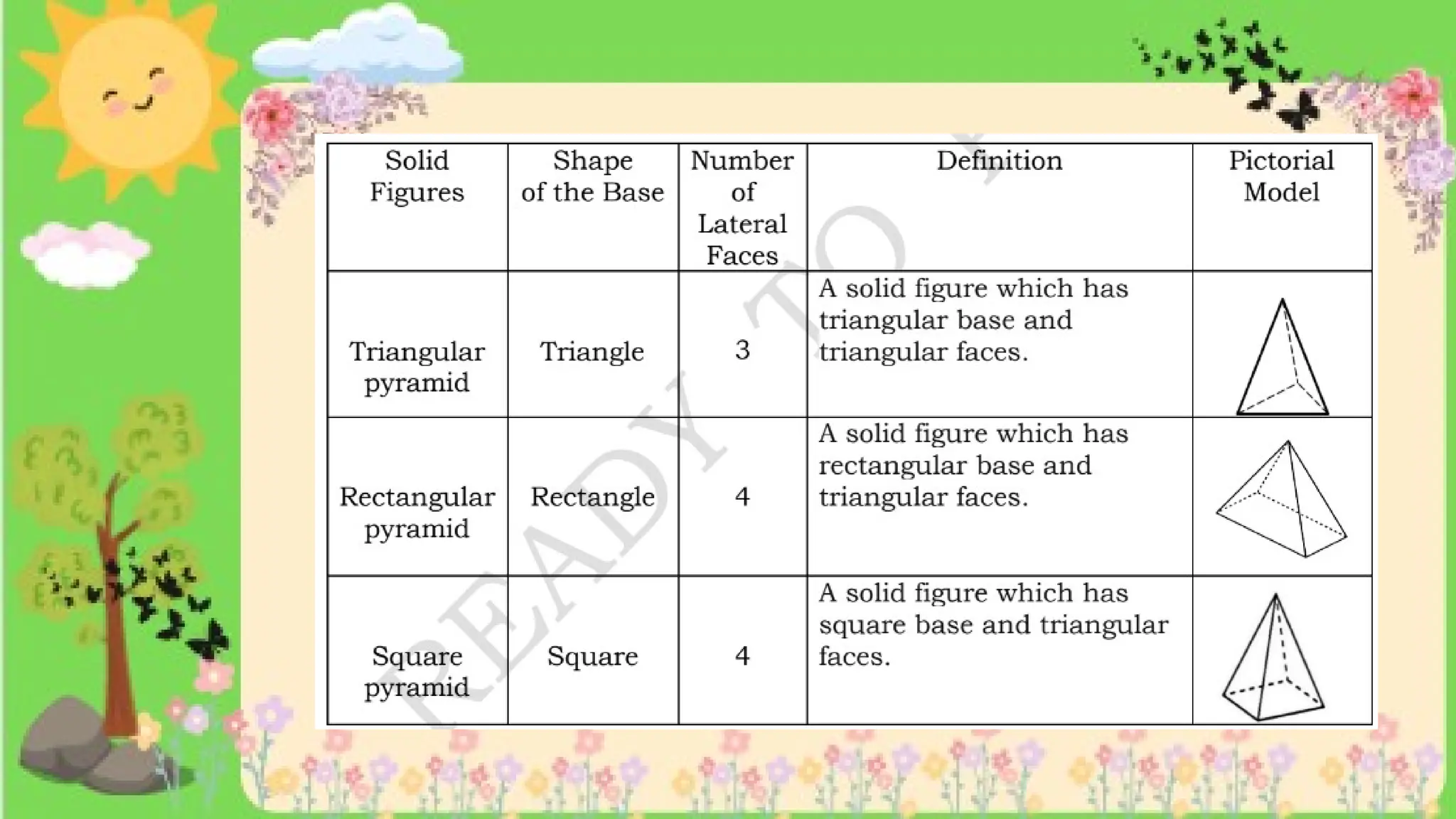
is a polyhedron with a single base
shaped like a polygon. The faces
of a pyramid are triangular and
meet at a point. A pyramid is
named by the shape of its base.
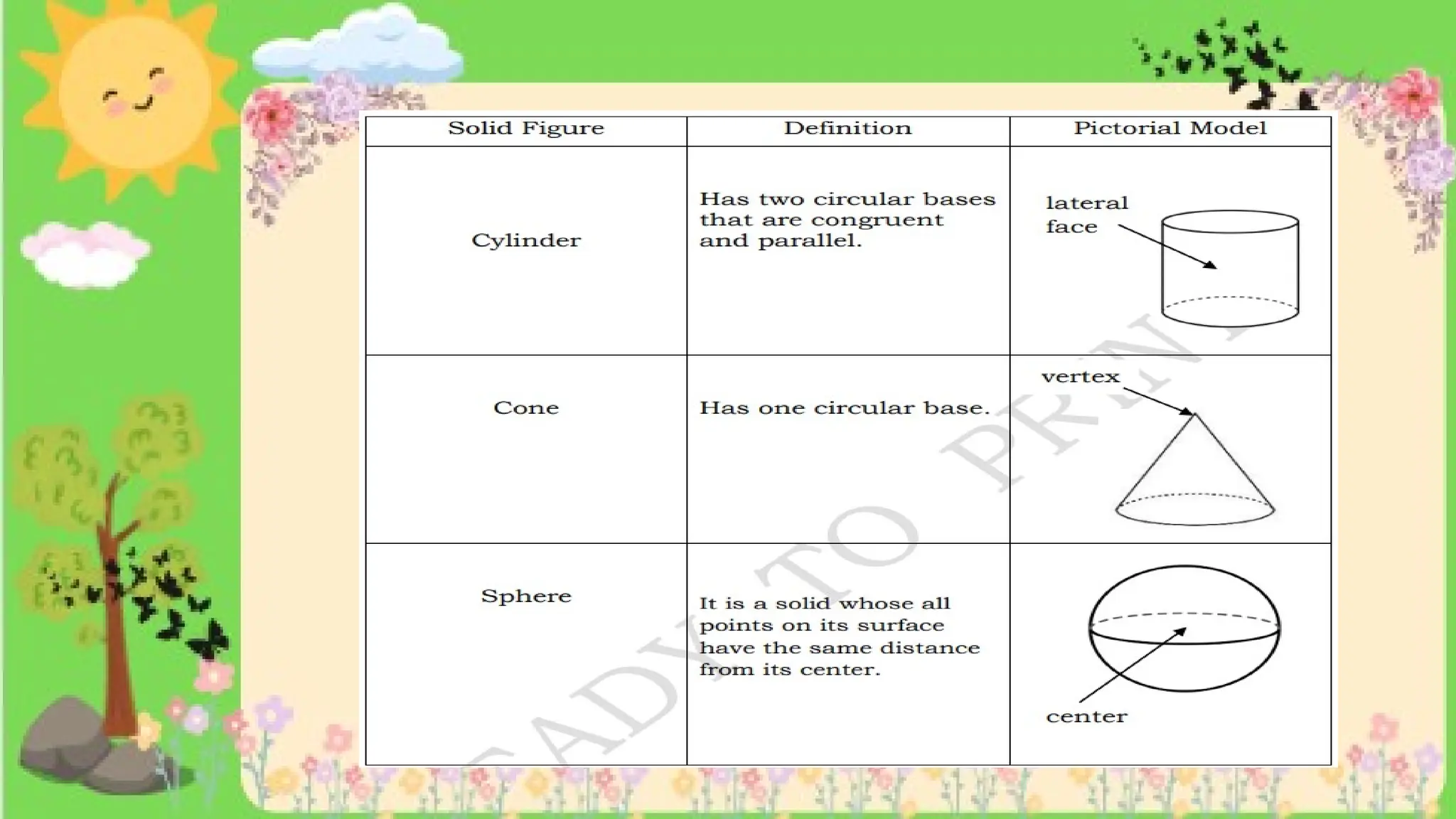
Some 3 dimensional
figures have curved
surfaces.
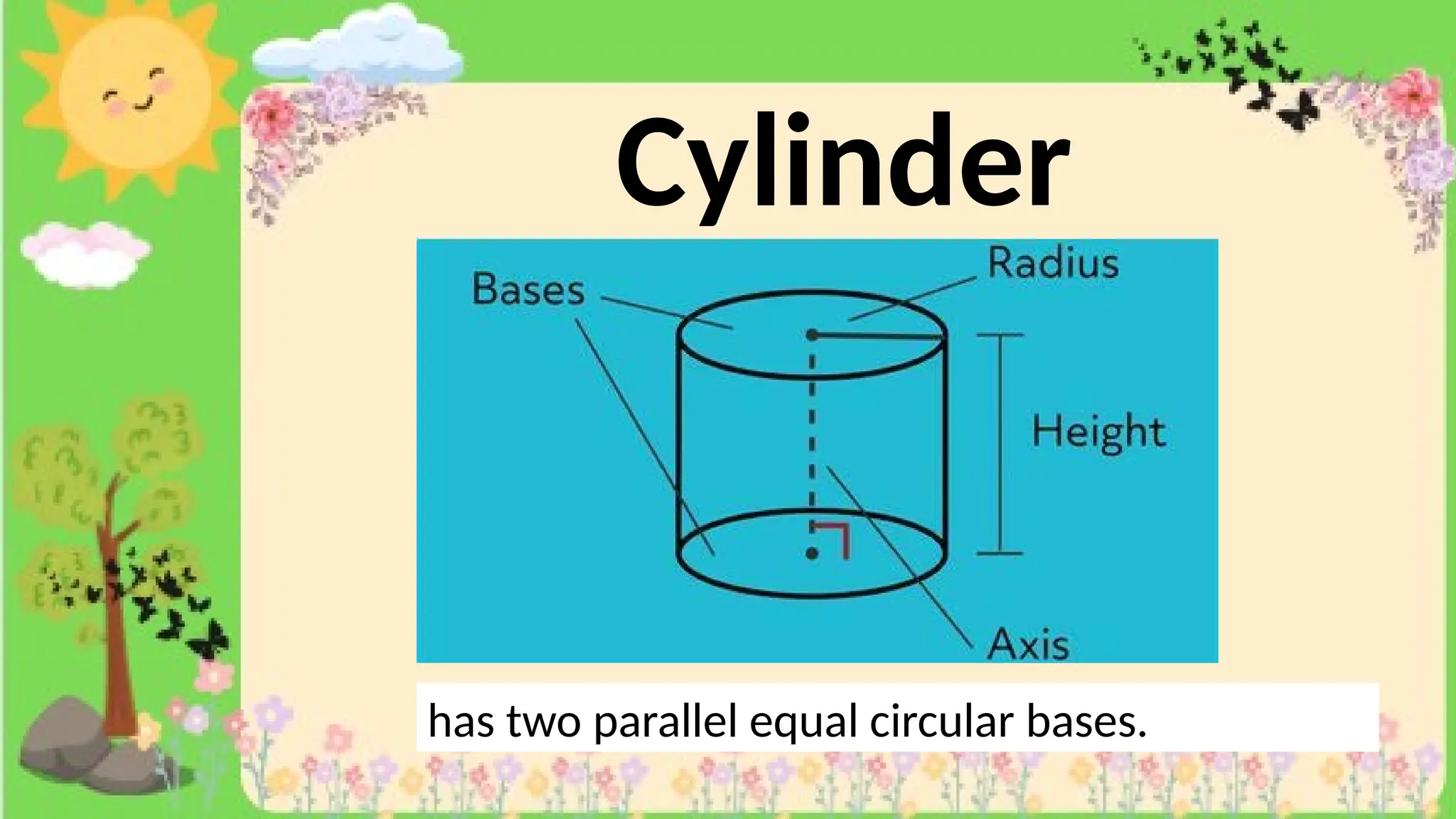
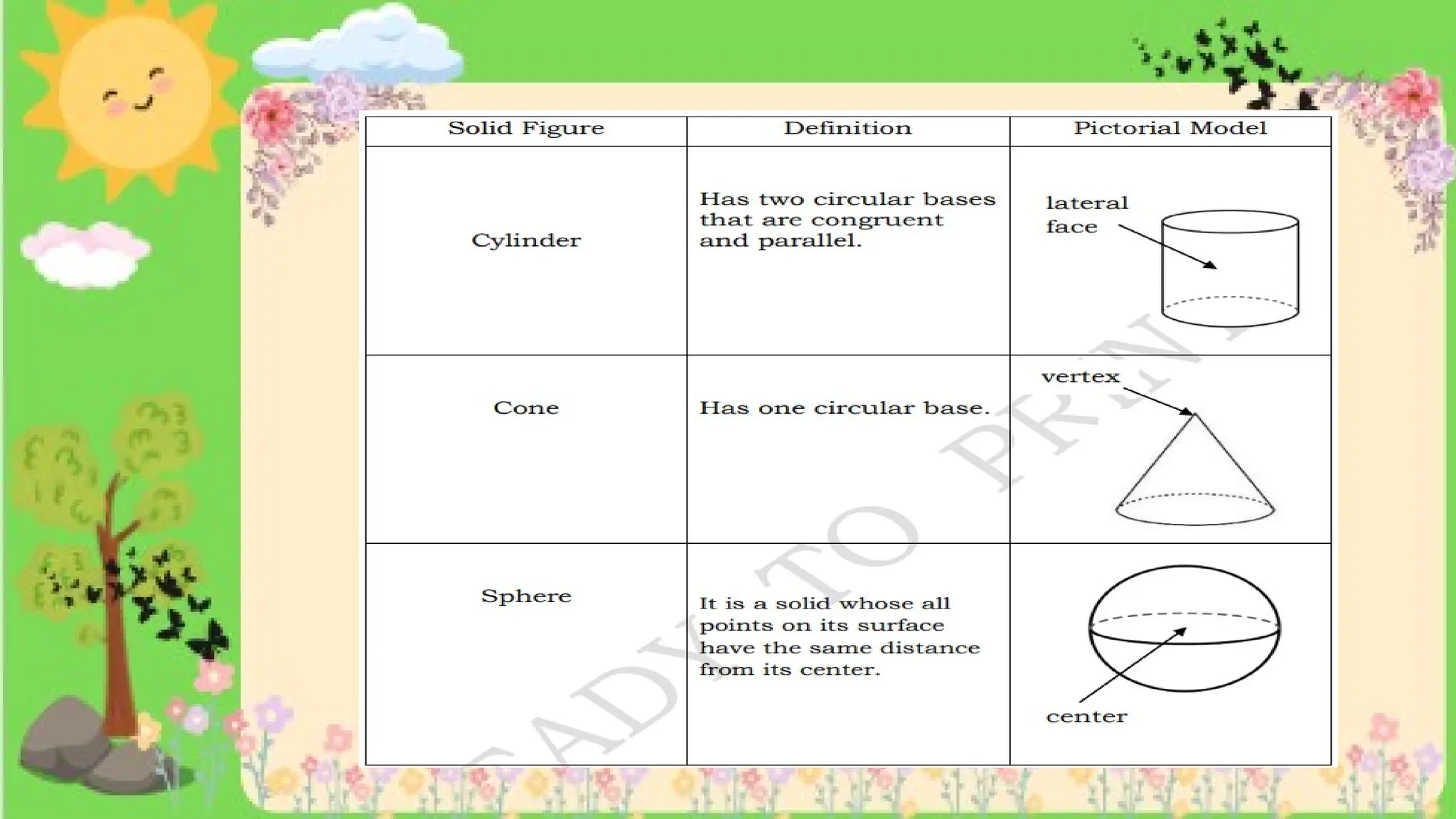
Cylinder
has two parallel equal circular bases.
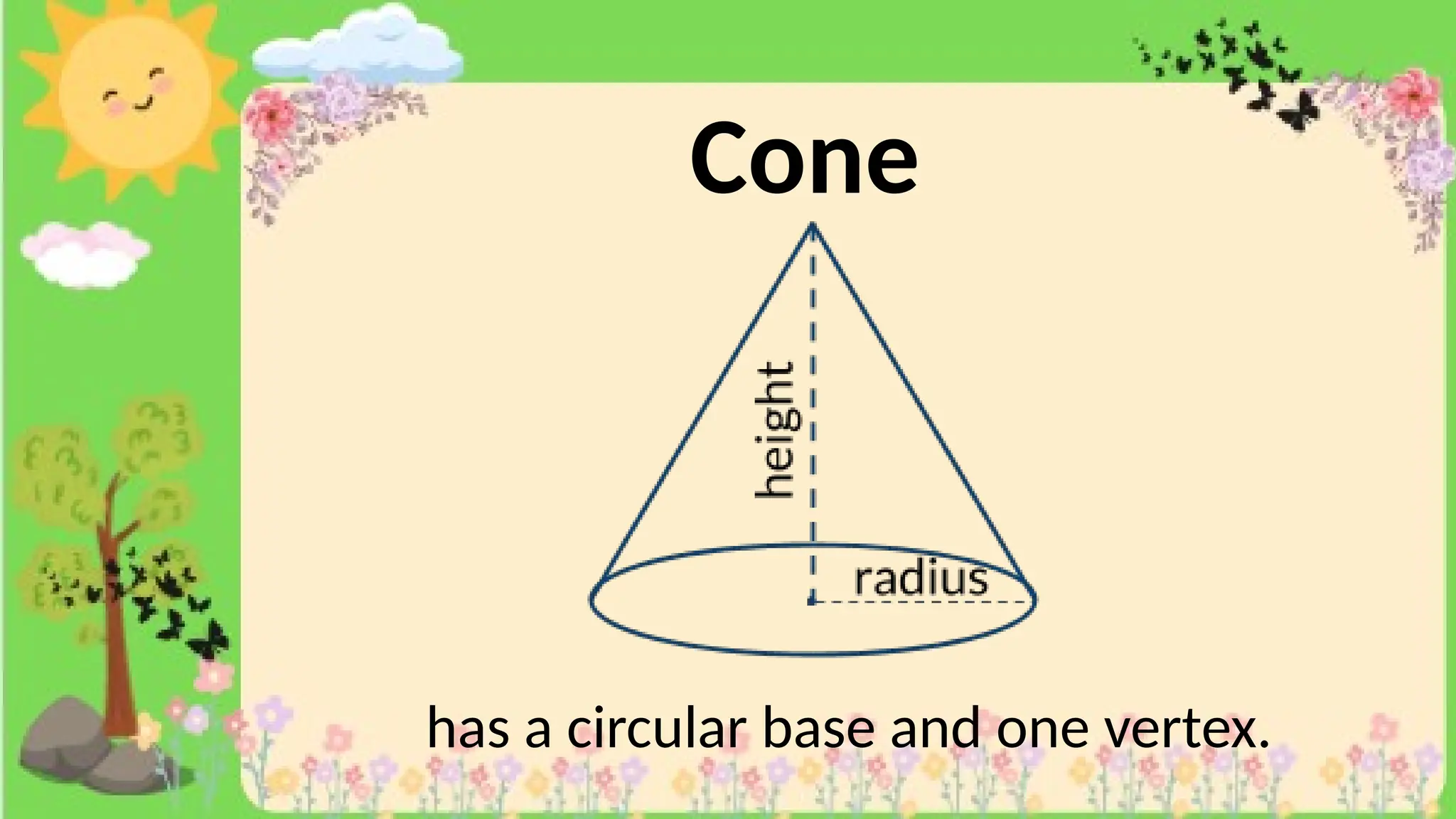
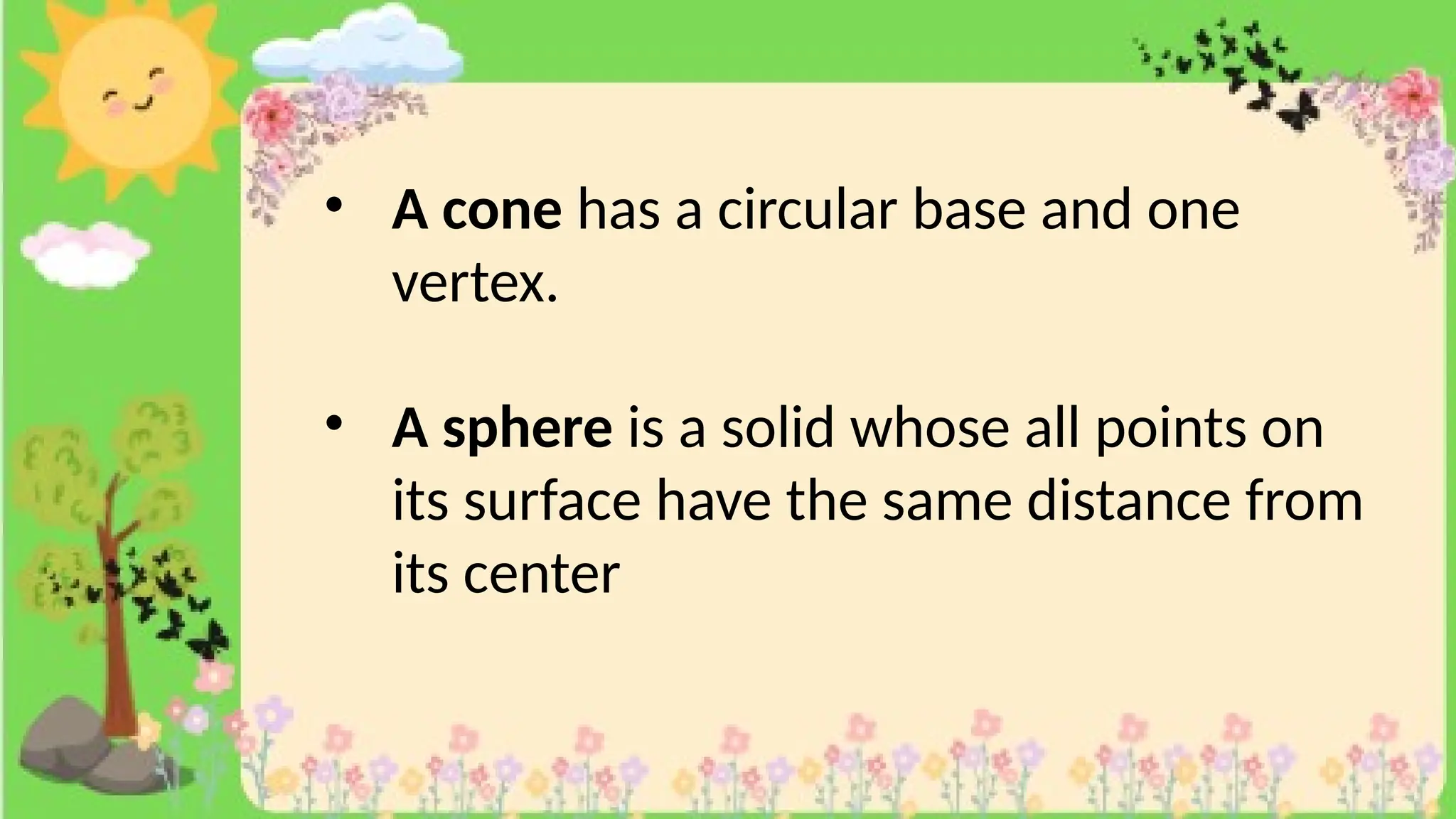
Cone
has a circular base and one vertex.
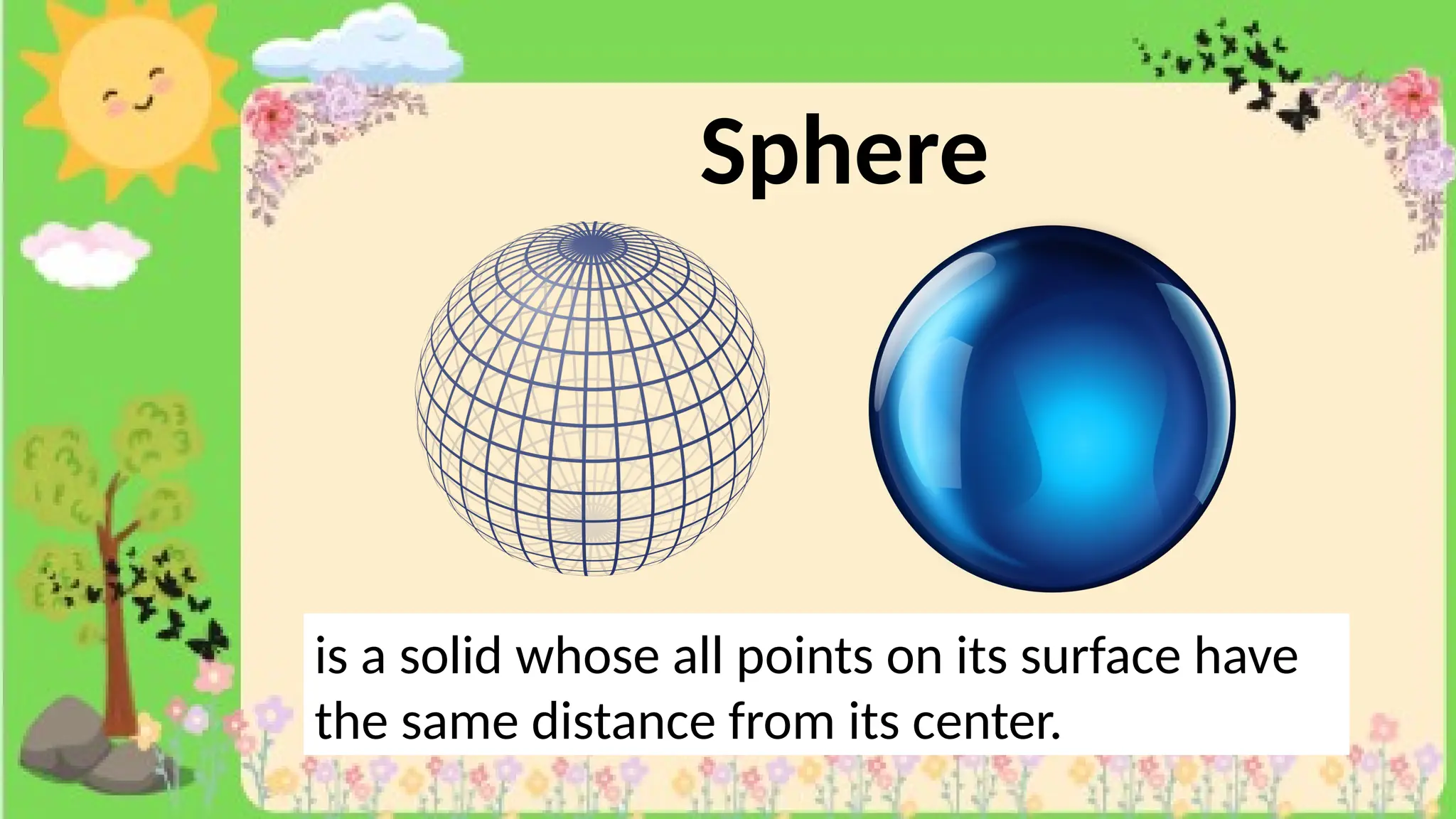
Sphere
is a solid whose all points on its surface have
the same distance from its center.
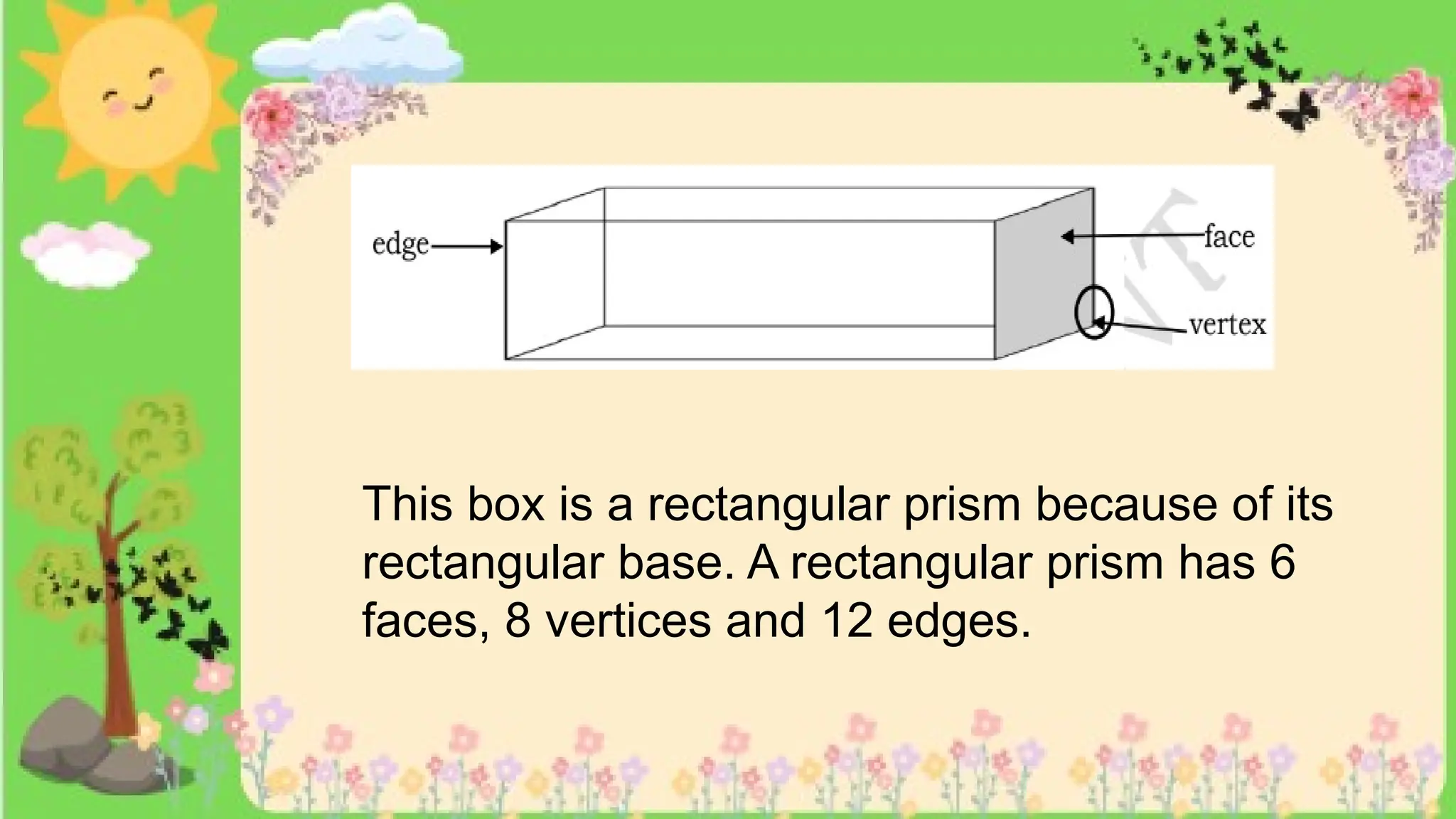
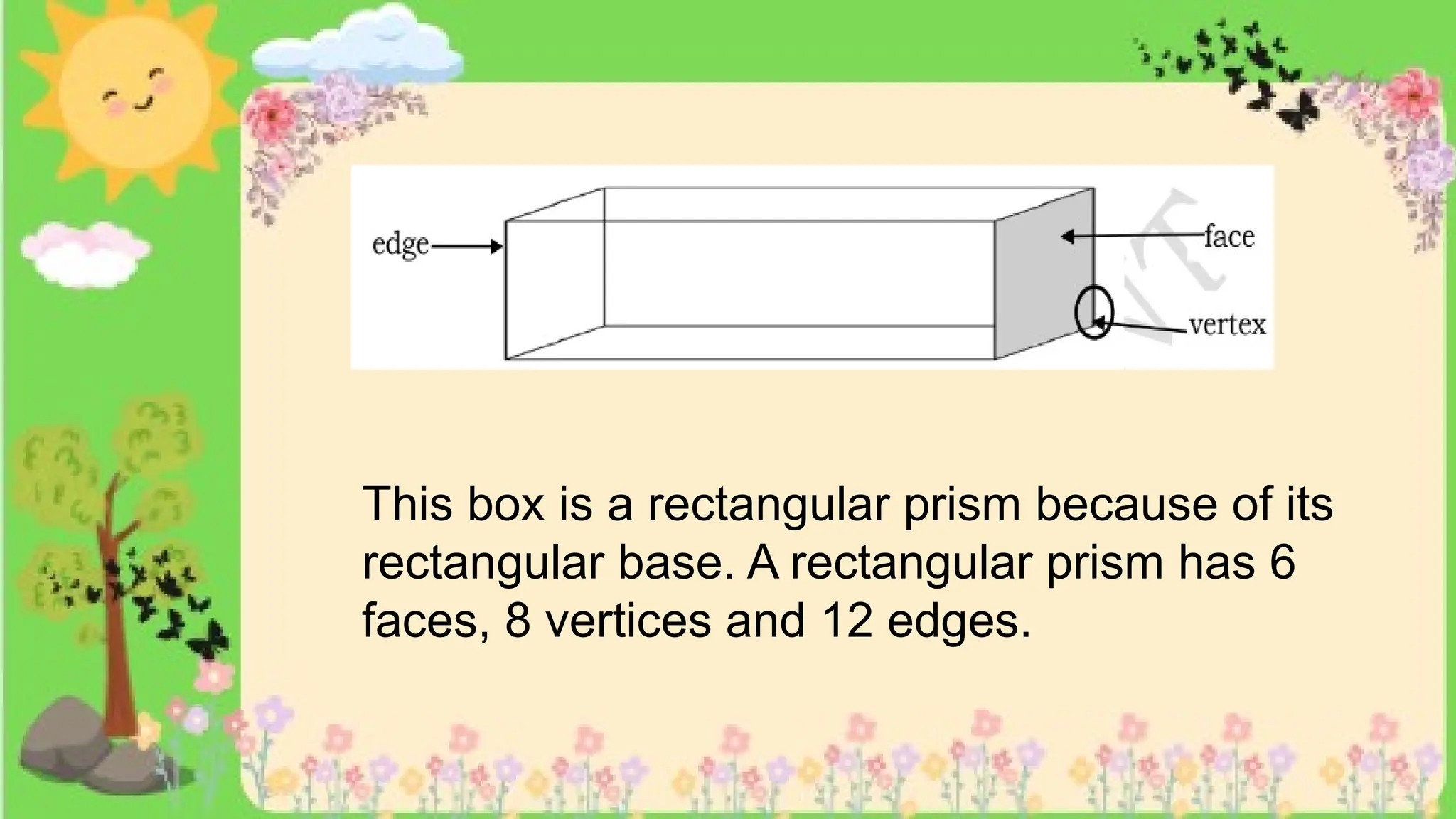
This box is a rectangular prism because of its
rectangular base. A rectangular prism has 6
faces, 8 vertices and 12 edges.
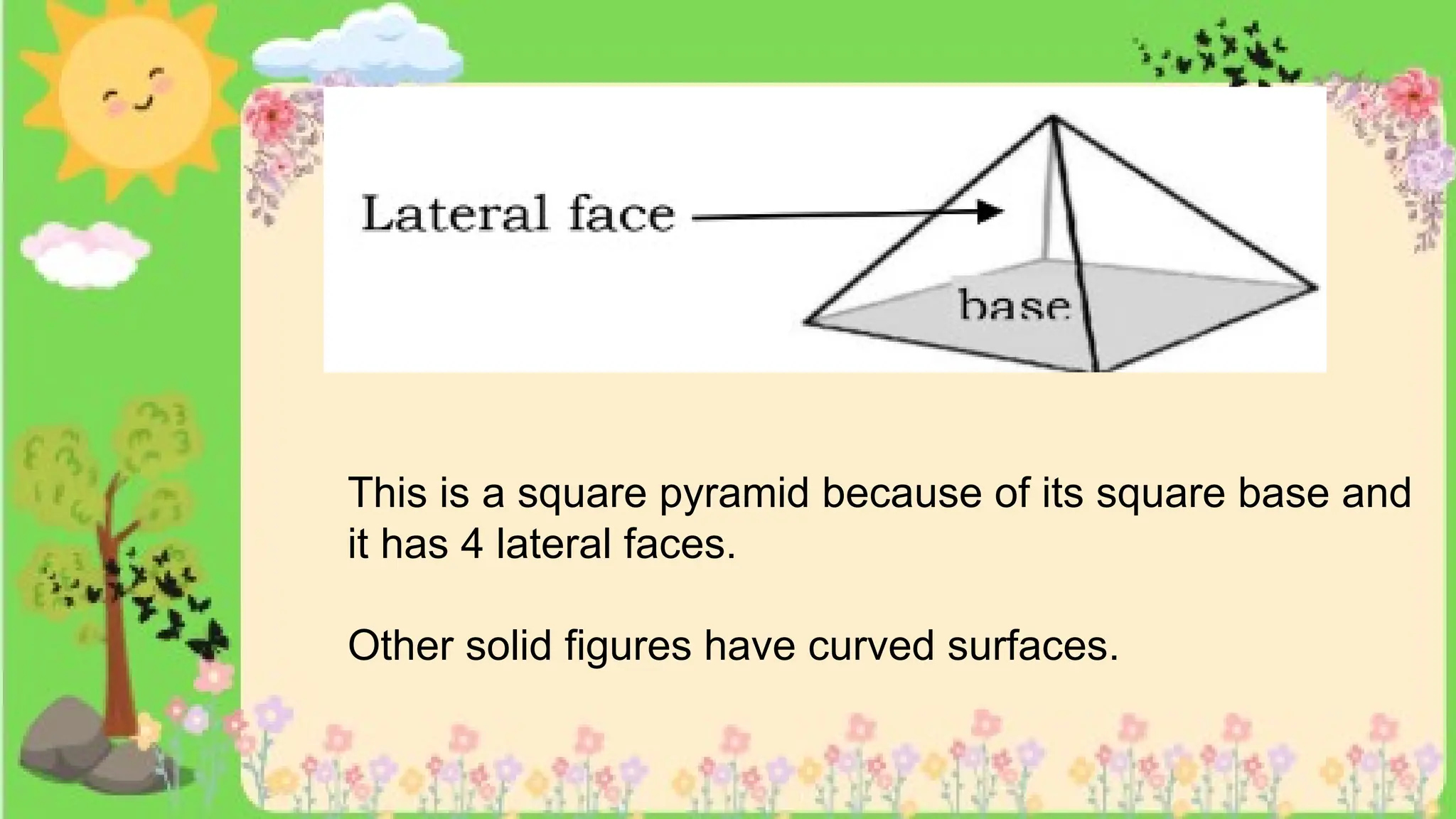
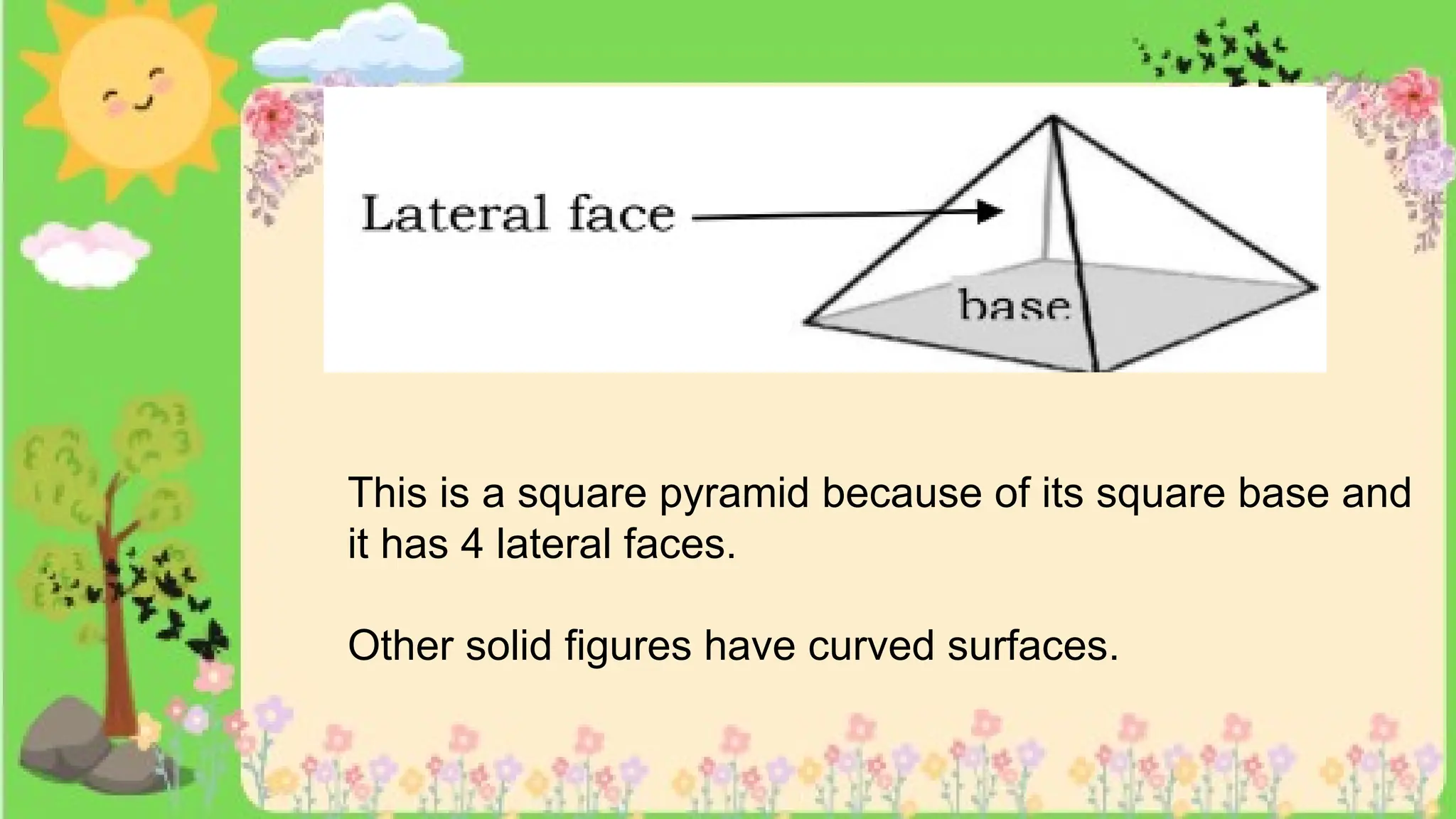
This is a square pyramid because of its square base and
it has 4 lateral faces.
Other solid figures have curved surfaces.
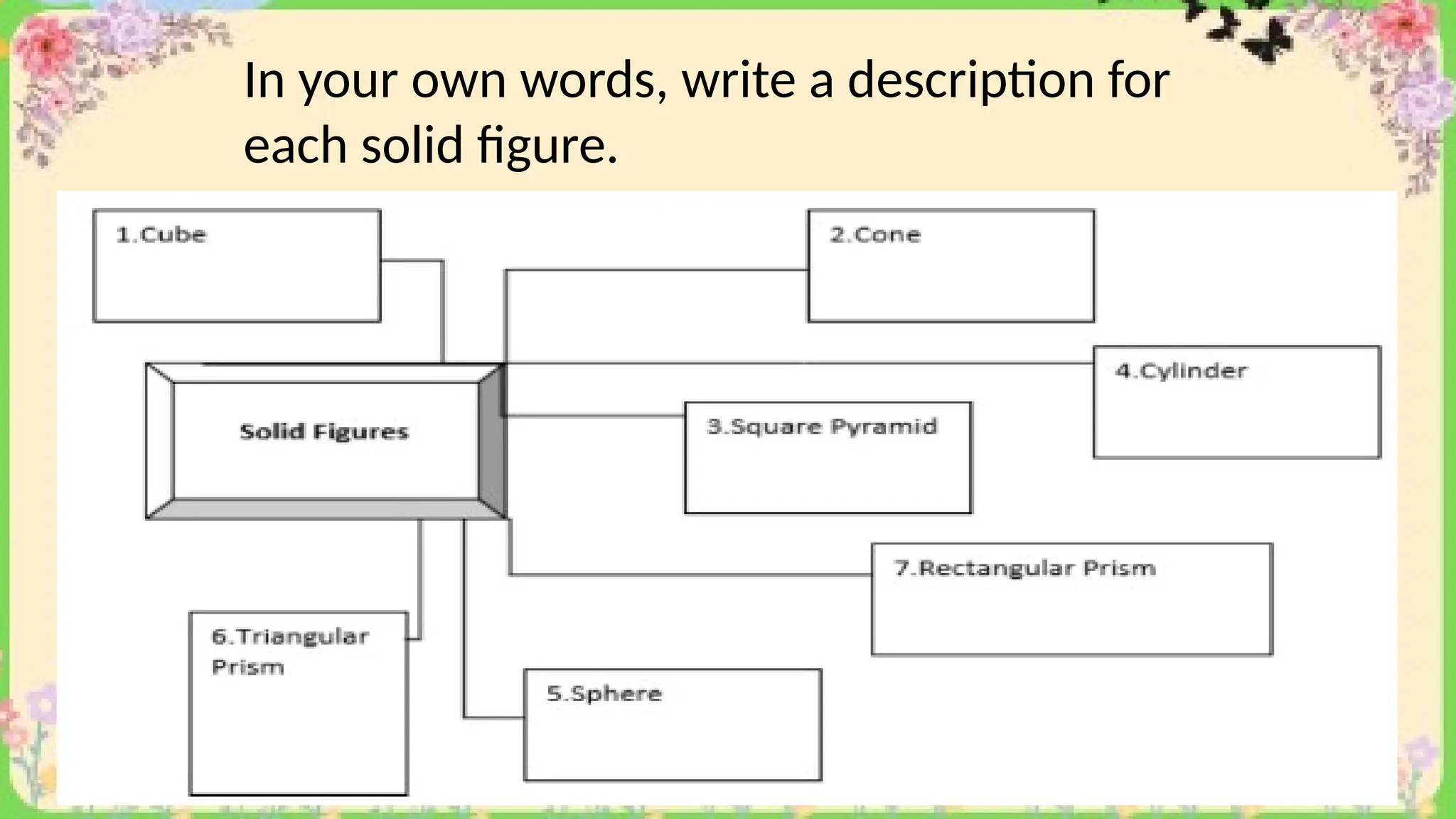
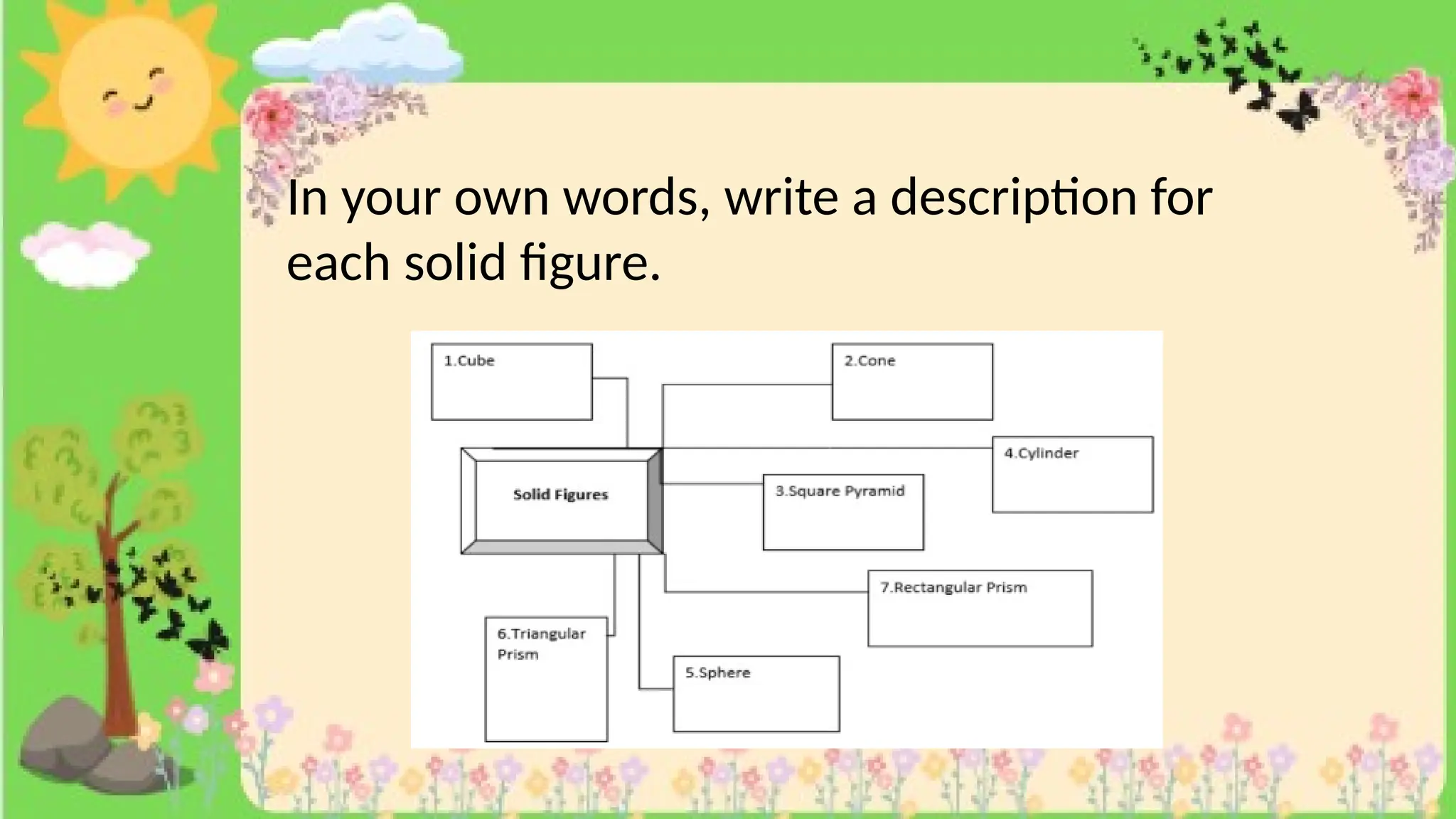
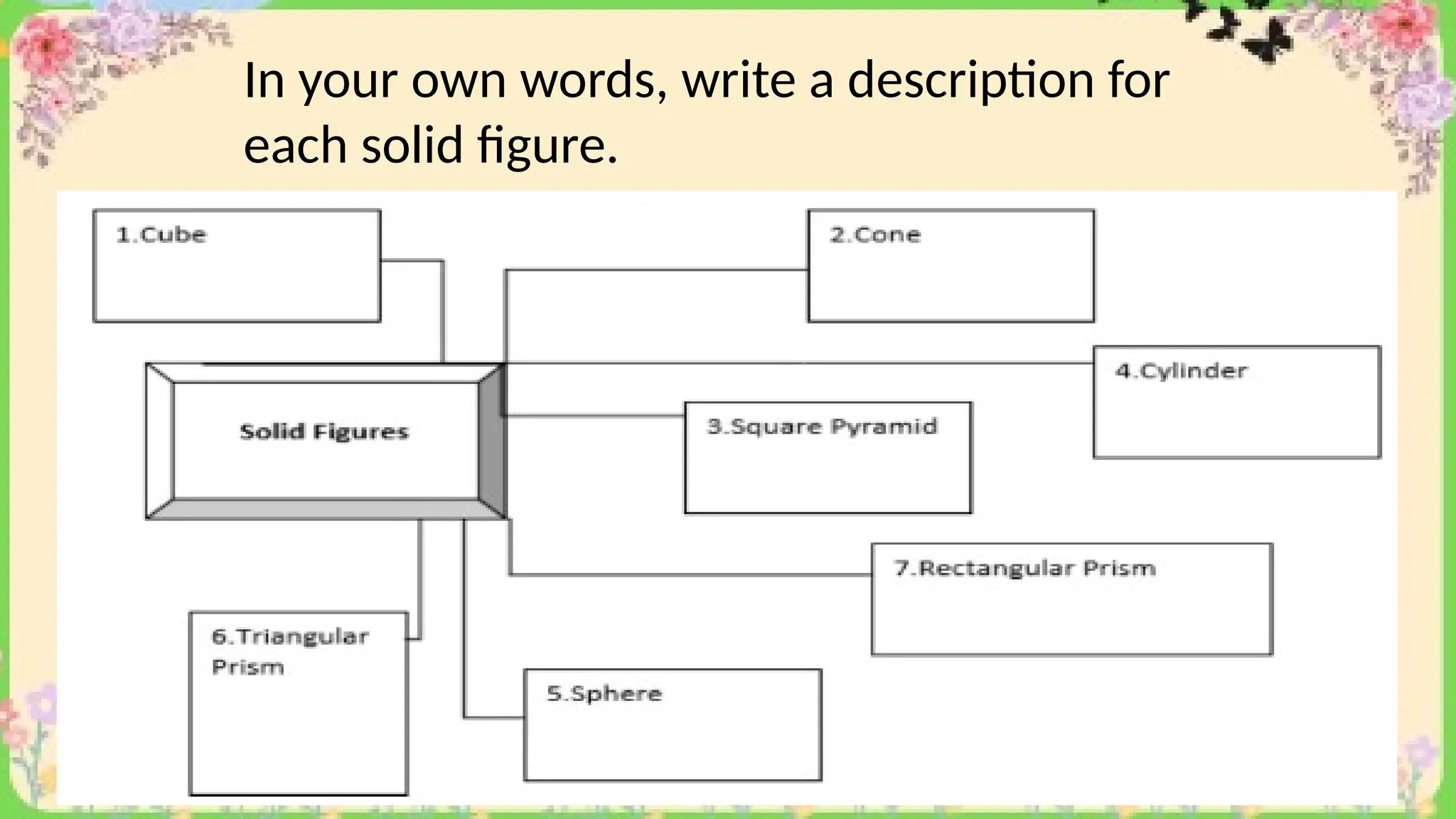
In your own words, write a description for
each solid figure.
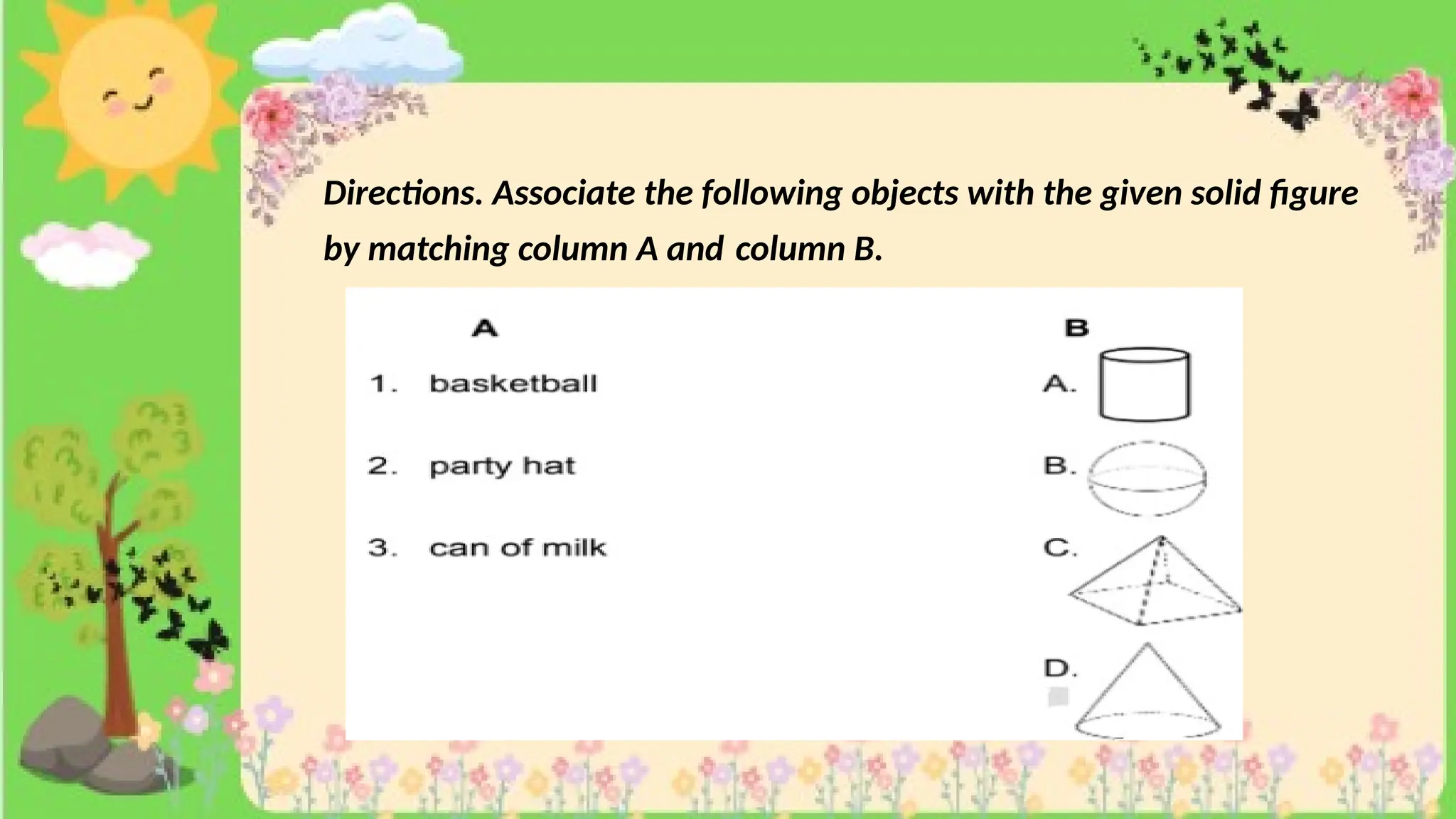
Directions. Associate the following objects with the given solid figure
by matching column A and column B.
A. Directions: Look around you and draw
objects that represents the following
solid figures.
1. cone
2. triangular pyramid
• Polyhedron is a solid figure whose sides are all
polygons. Each side is called face. Two faces that
intersect in a line segment is called an edge. Two
edges that intersect in a point is called a vertex.
• A cube is a special type of rectangular prism that
has six equal faces. All edges of a cube are of the
same length.
• A prism is a polyhedron with two parallel equal
bases that are shaped like polygons.
The other faces of a prism are shaped like
parallelograms.
• A prism is named by the shape of its bases.
• A pyramid is a polyhedron with a single base
shaped like a polygon.
• The faces of a pyramid are triangular and meet at a
point. A pyramid is named by the shape of its base.
*Some three dimensional figures have curved
surfaces. A cylinder has two parallel equal circular
bases.
• A cone has a circular base and one
vertex.
• A sphere is a solid whose all points on
its surface have the same distance from
its center
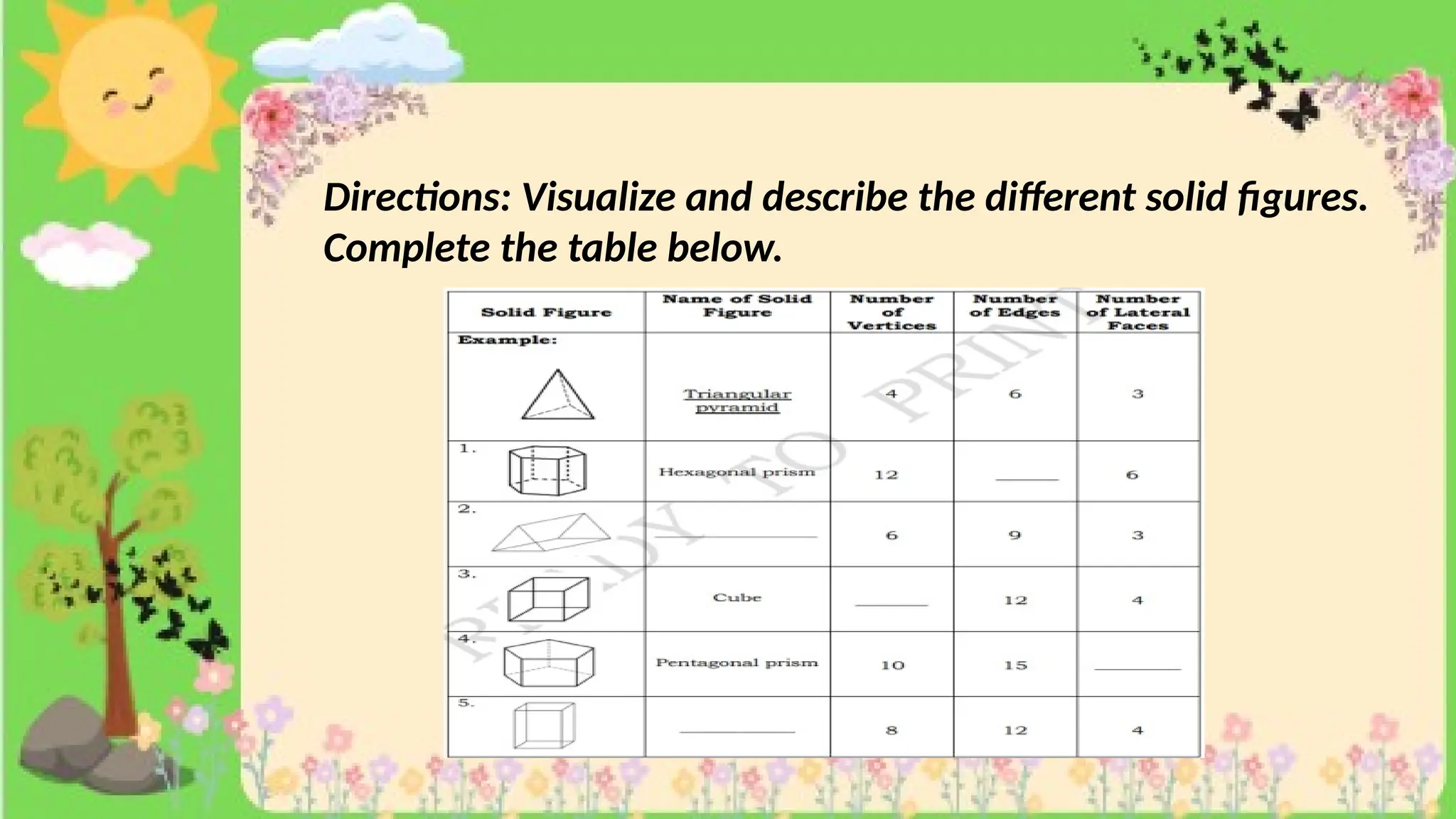
Directions: Visualize and describe the different solid figures.
Complete the table below.
DAY 2
 Polyhedron is a solid figure whose sides are all polygons.
Each side is called face. Two faces that intersect in a line
segment is called an edge. Two edges that intersect in a point
is called a vertex.
 A cube is a special type of rectangular prism that has six
equal faces. All edges of a cube are of the same length.
 A prism is a polyhedron with two parallel equal bases that
are shaped like polygons. The other faces of a prism are
shaped like parallelograms. A prism is named by the shape of
its bases.
 A pyramid is a polyhedron with a single base shaped like a
polygon. The faces of a pyramid are triangular and meet at a
point. A pyramid is named by the shape of its base.
*Some three dimensional figures have curved
surfaces.
 A cylinder has two parallel equal circular
bases.
 A cone has a circular base and one vertex.
 A sphere is a solid whose all points on its
surface have the
same distance from its center.
This box is a rectangular prism because of its
rectangular base. A rectangular prism has 6
faces, 8 vertices and 12 edges.
This is a square pyramid because of its square base and
it has 4 lateral faces.
Other solid figures have curved surfaces.
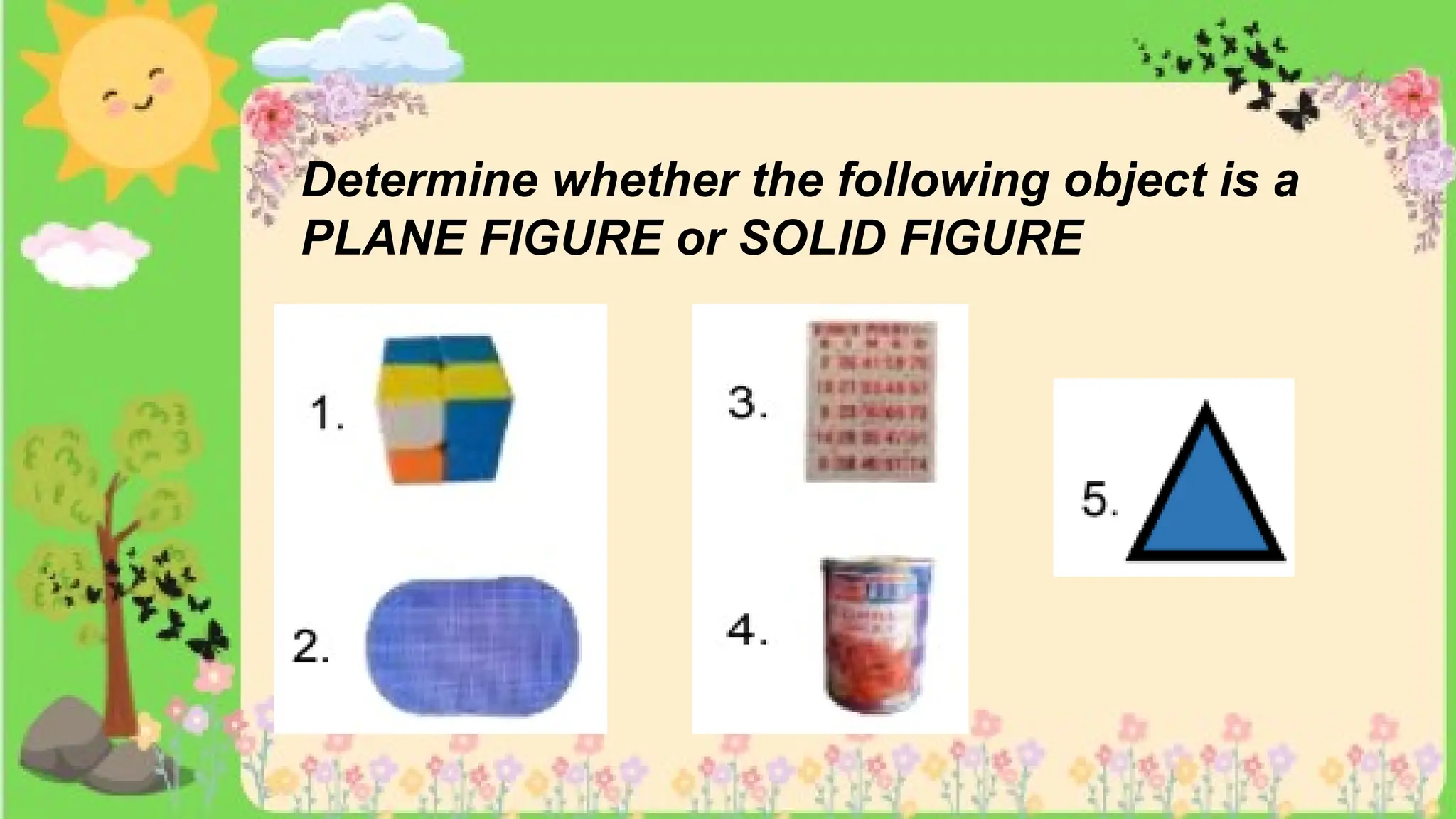
Determine whether the following object is a
PLANE FIGURE or SOLID FIGURE
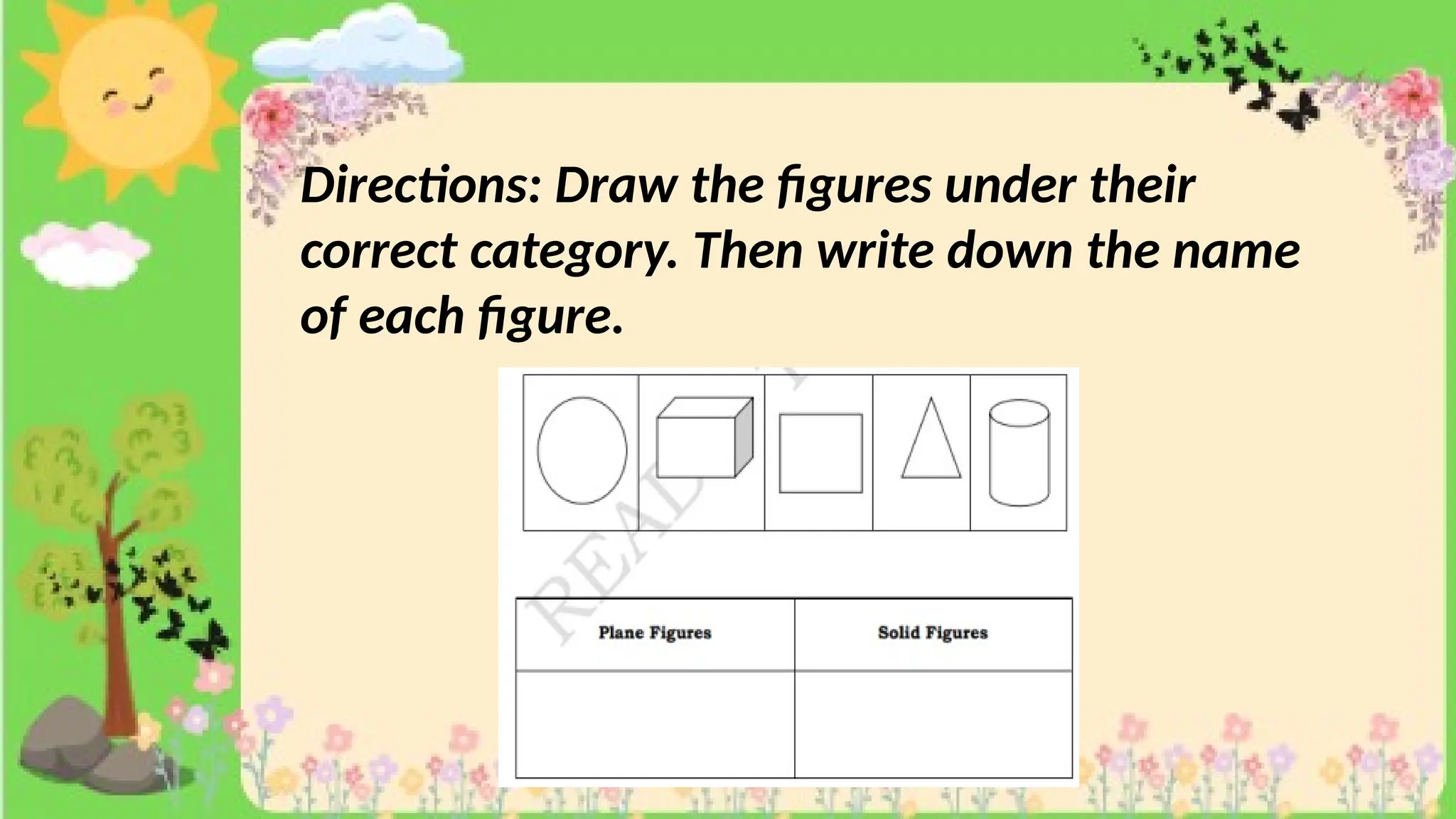
Directions: Draw the figures under their
correct category. Then write down the name
of each figure.
• Polyhedron is a solid figure whose sides are all
polygons. Each side is called face. Two faces that
intersect in a line segment is called an edge. Two
edges that intersect in a point is called a vertex.
• A cube is a special type of rectangular prism that
has six equal faces. All edges of a cube are of the
same length.
• A prism is a polyhedron with two parallel equal
bases that are shaped like polygons.
The other faces of a prism are shaped like
parallelograms.
• A prism is named by the shape of its bases.
• A pyramid is a polyhedron with a single base
shaped like a polygon.
• The faces of a pyramid are triangular and meet at a
point. A pyramid is named by the shape of its base.
*Some three dimensional figures have curved
surfaces. A cylinder has two parallel equal circular
bases.
• A cone has a circular base and one
vertex.
• A sphere is a solid whose all points on
its surface have the same distance from
its center
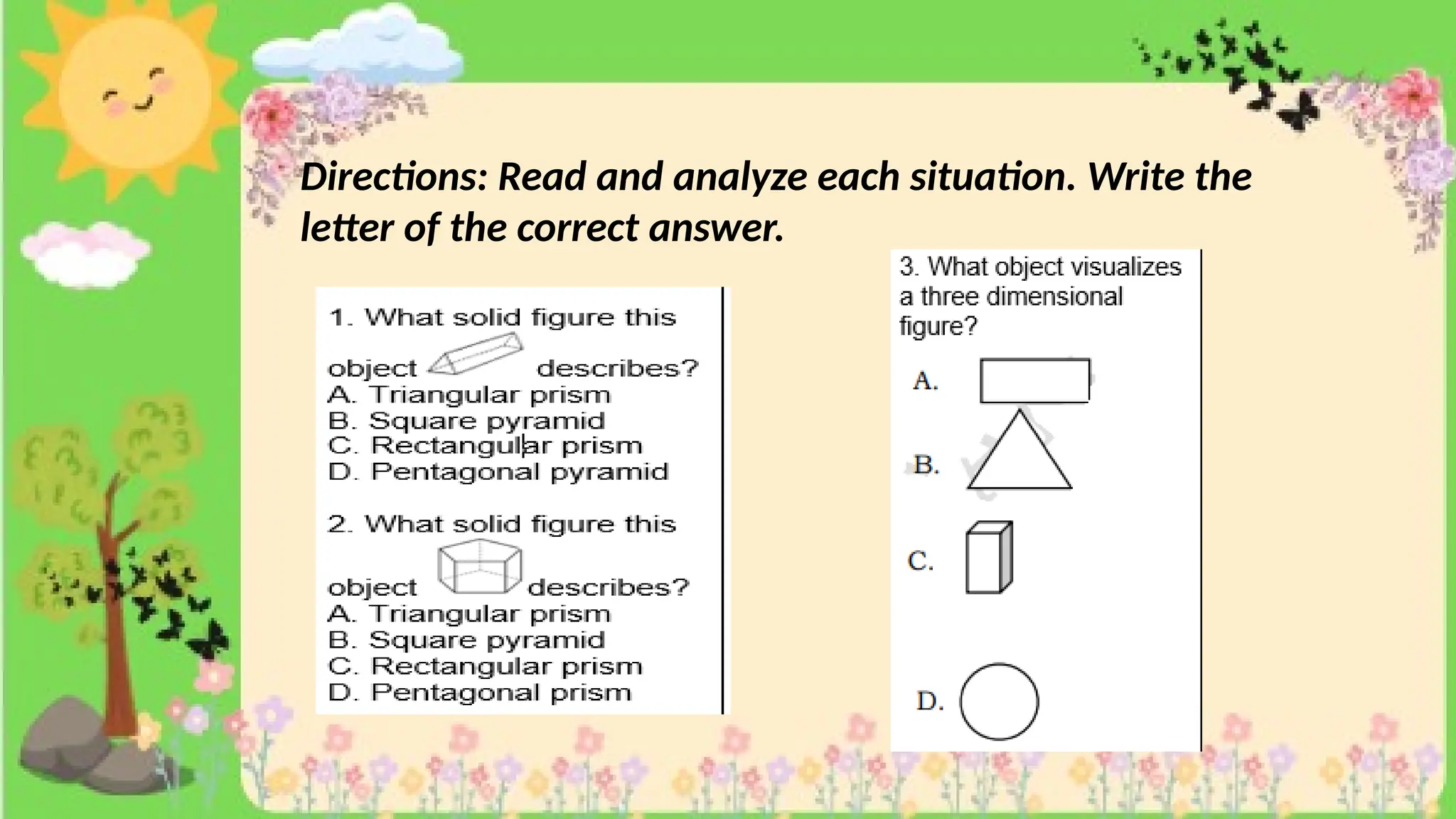
Directions: Read and analyze each situation. Write the
letter of the correct answer.
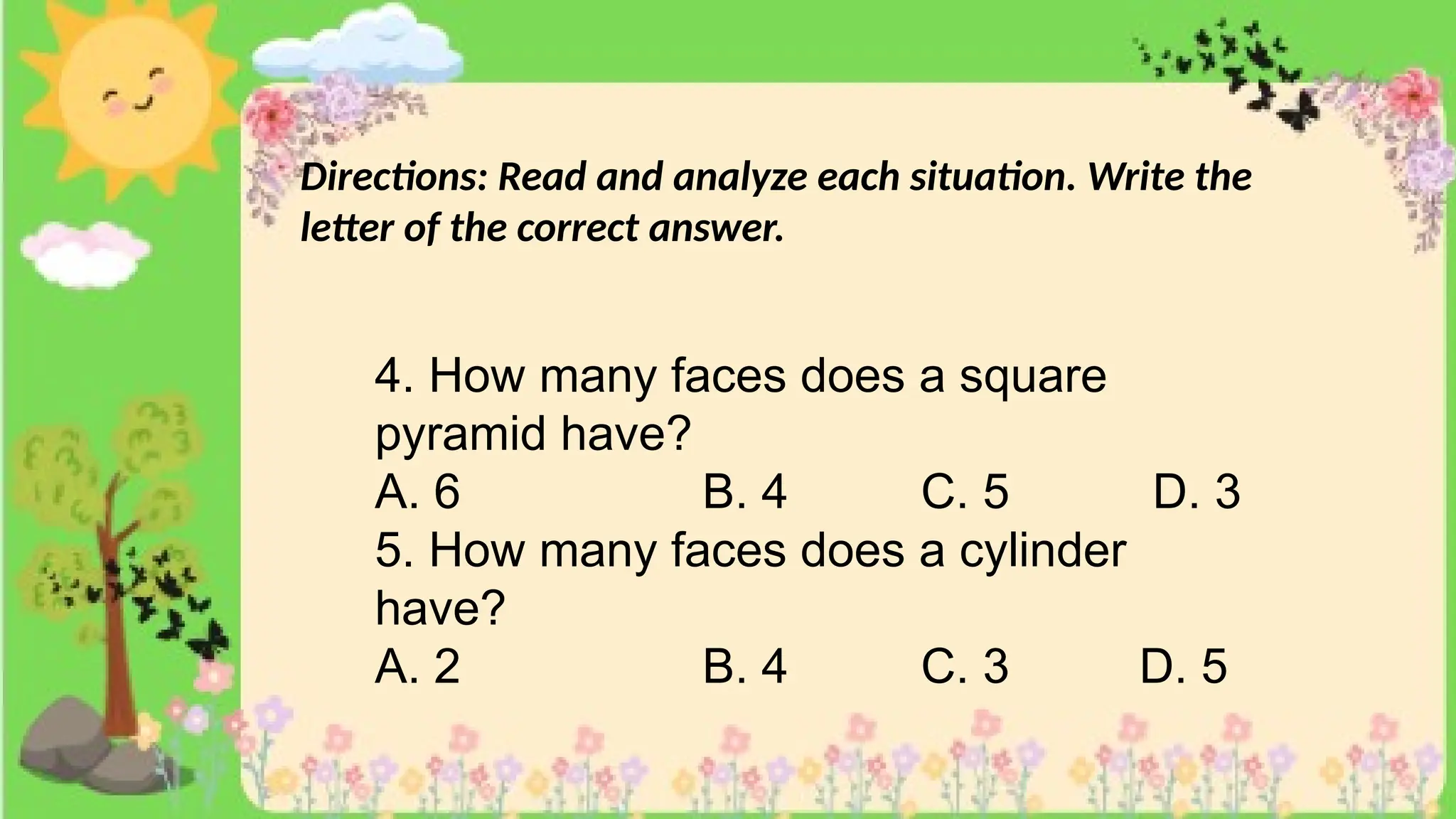
Directions: Read and analyze each situation. Write the
letter of the correct answer.
4. How many faces does a square
pyramid have?
A. 6 B. 4 C. 5 D. 3
5. How many faces does a cylinder
have?
A. 2 B. 4 C. 3 D. 5
DAY 3
What are the kinds of
a solid figure?
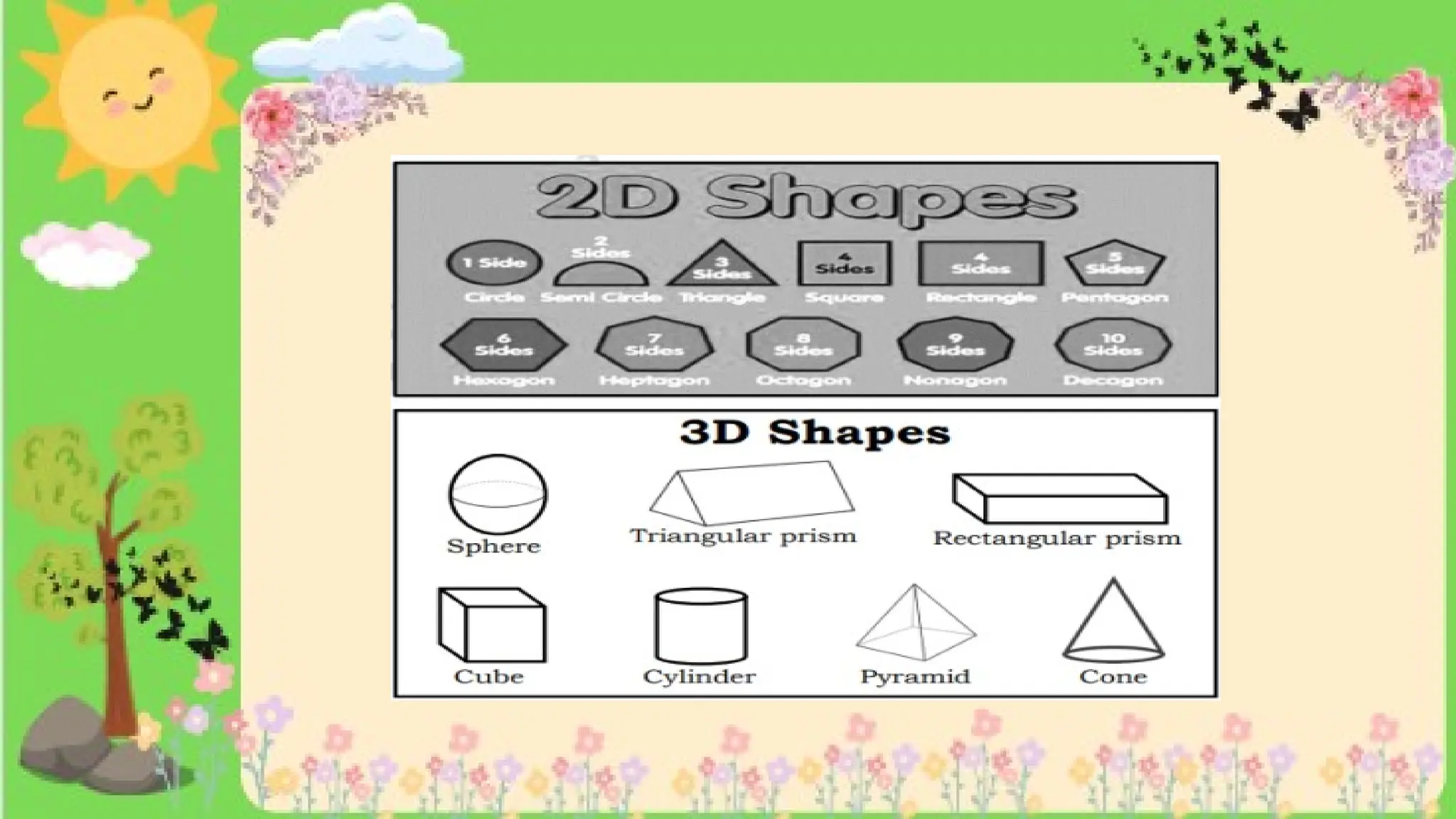
Plane figures are two-dimensional (2D) (length and width)
objects.
The most common examples of plane figures are squares,
rectangles, triangles and circles. Solid figures are three –
dimensional (3D) (length, width and height) objects. Solid
figures are classified as polyhedrons (with flat surfaces) and
non-polyhedrons (with curved surfaces).
The most common examples of
polyhedrons are cubes, prisms, and
pyramids. The most common examples
of non-polyhedrons are cones, cylinders,
and spheres.
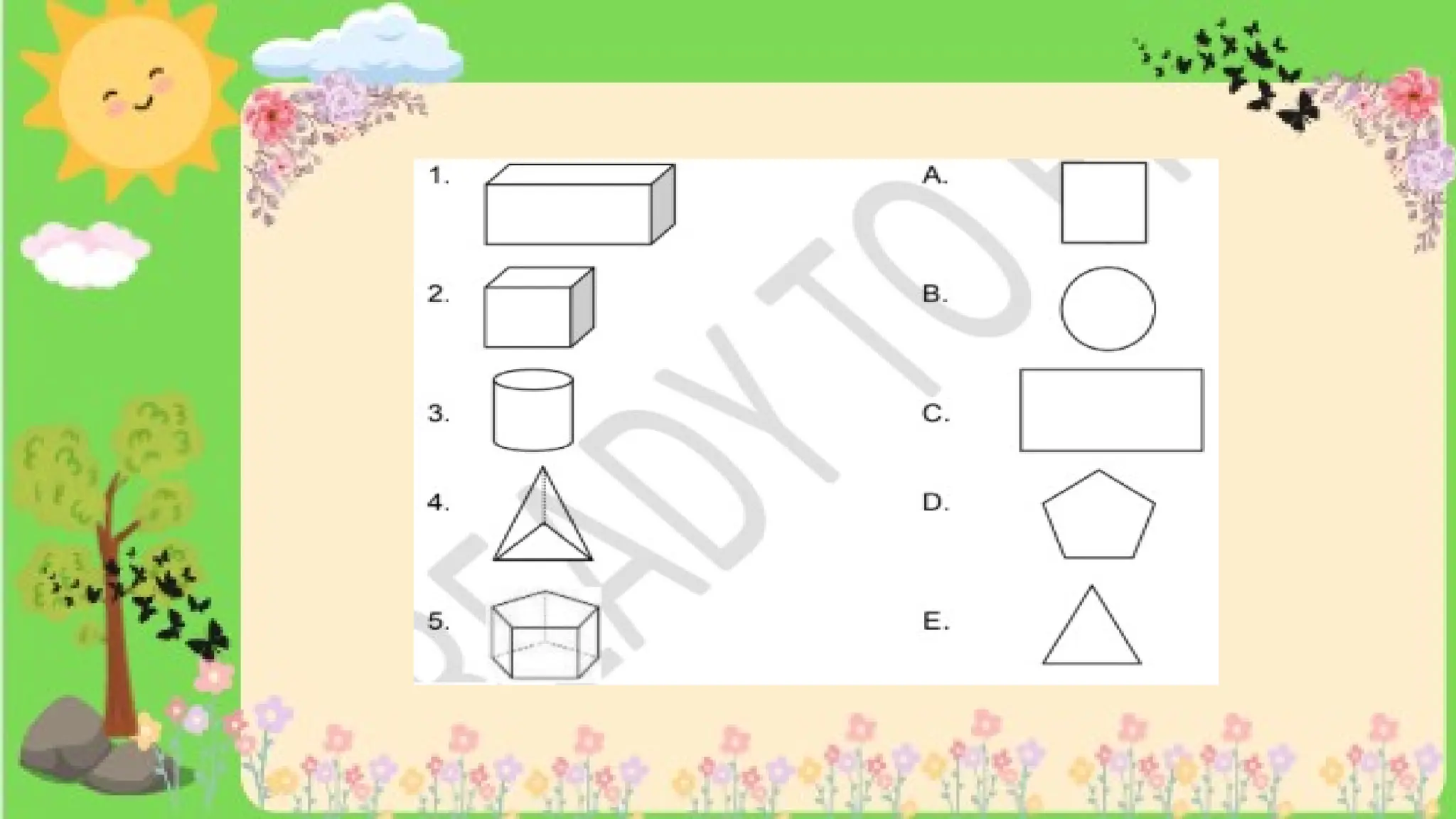
Activity 1. Match the figures of
similar attributes to their
corresponding figure
by writing the letter of the correct
answer in your activity notebook.
Mr. Cruz wanted to buy a water container. He is thinking of
which is best to buy, a
rectangular container whose length and width are 16
inches and 12 inches and a height
of 24 inches or a cylindrical container whose diameter is
16 inches and a height of 24
inches. Both containers are price at Php250.00.
If you are Mr Cruz, which of the 2 containers
will you buy? Explain your answer.
Plane figures are two-dimensional (2D) (length and
width) objects. The most common examples of plane
figures are squares rectangles, triangles and circles. Solid
figures are three – dimensional (3D) (length, width and
height) objects. Solid figures are classified as
polyhedrons (with flat surfaces) and non-polyhedrons
(with curved surfaces). The most common examples of
polyhedrons are cubes, prisms, and pyramids. The most
common examples of non-polyhedrons are cones,
cylinders, and spheres.
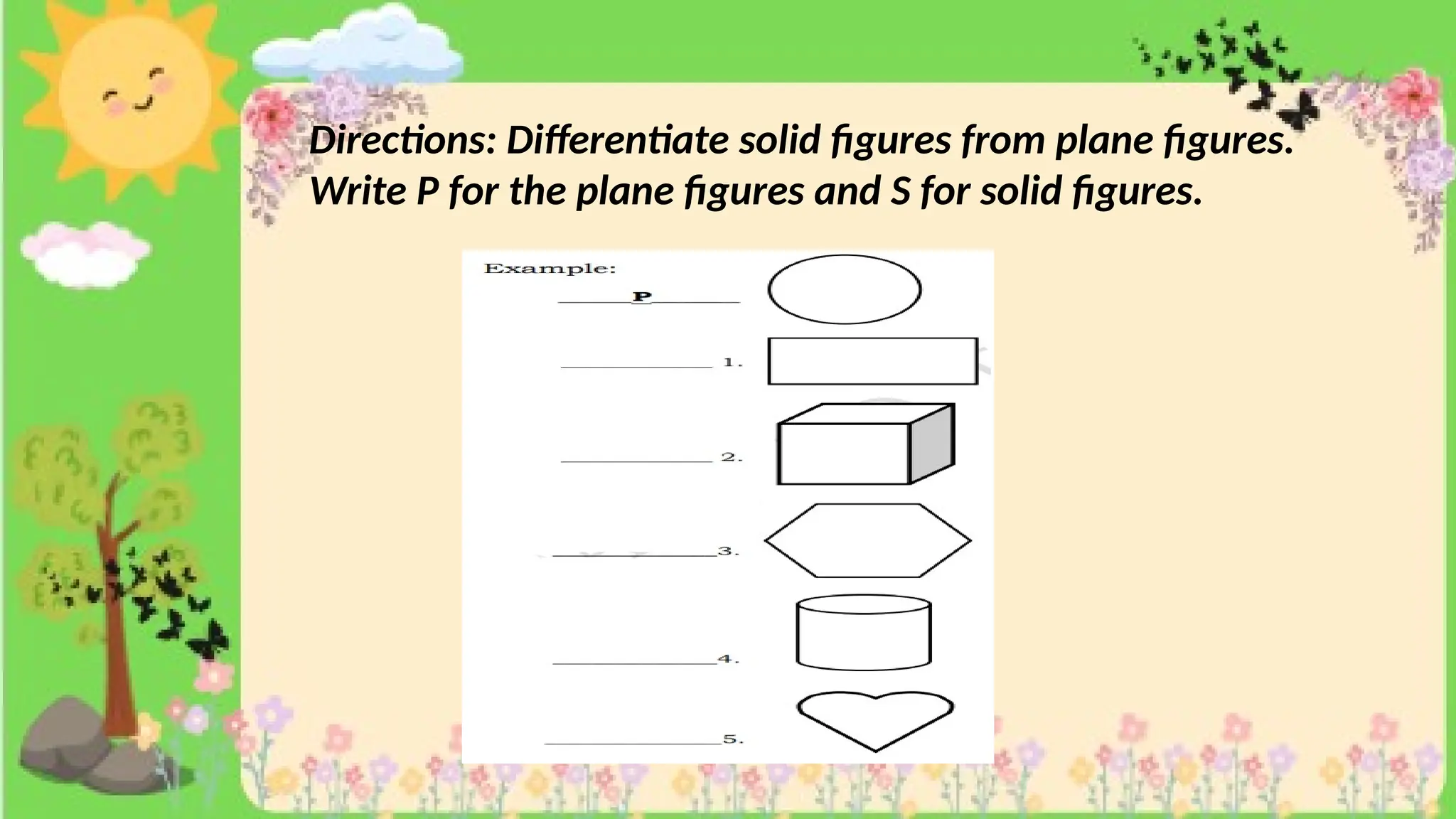
Directions: Differentiate solid figures from plane figures.
Write P for the plane figures and S for solid figures.
DAY 4
How can you identify
different object with
different shape?
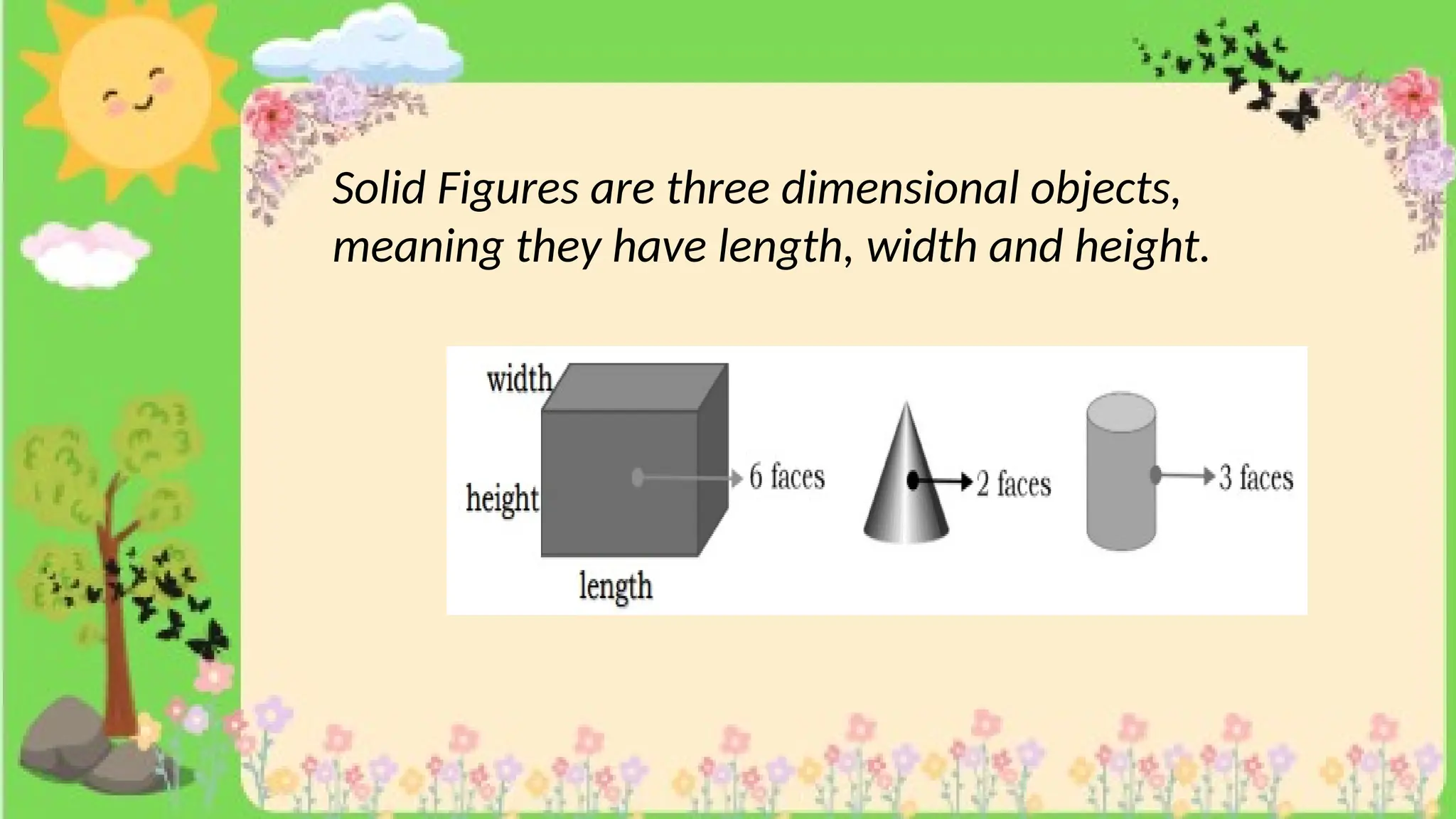
Solid Figures are three dimensional objects,
meaning they have length, width and height.
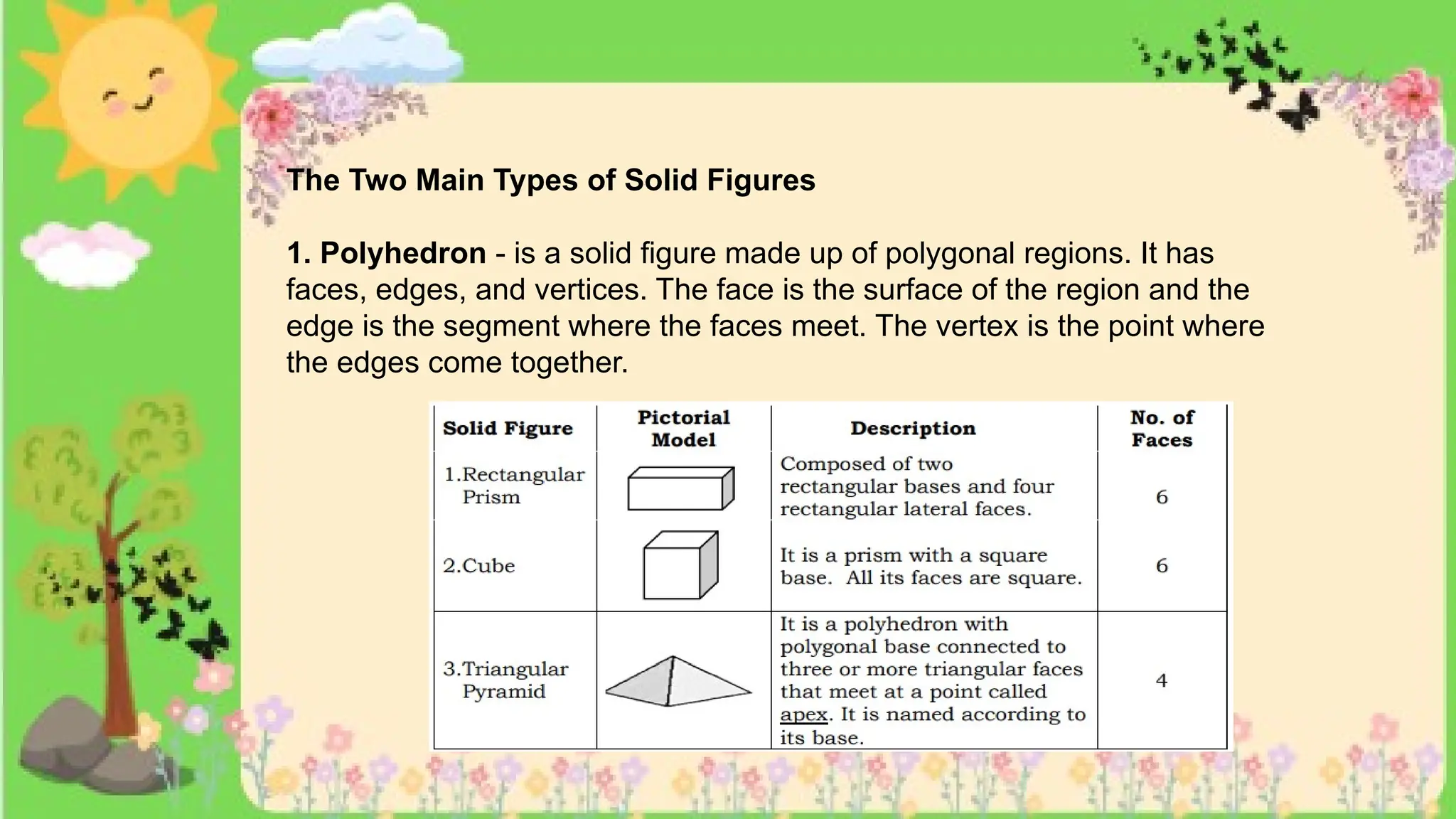
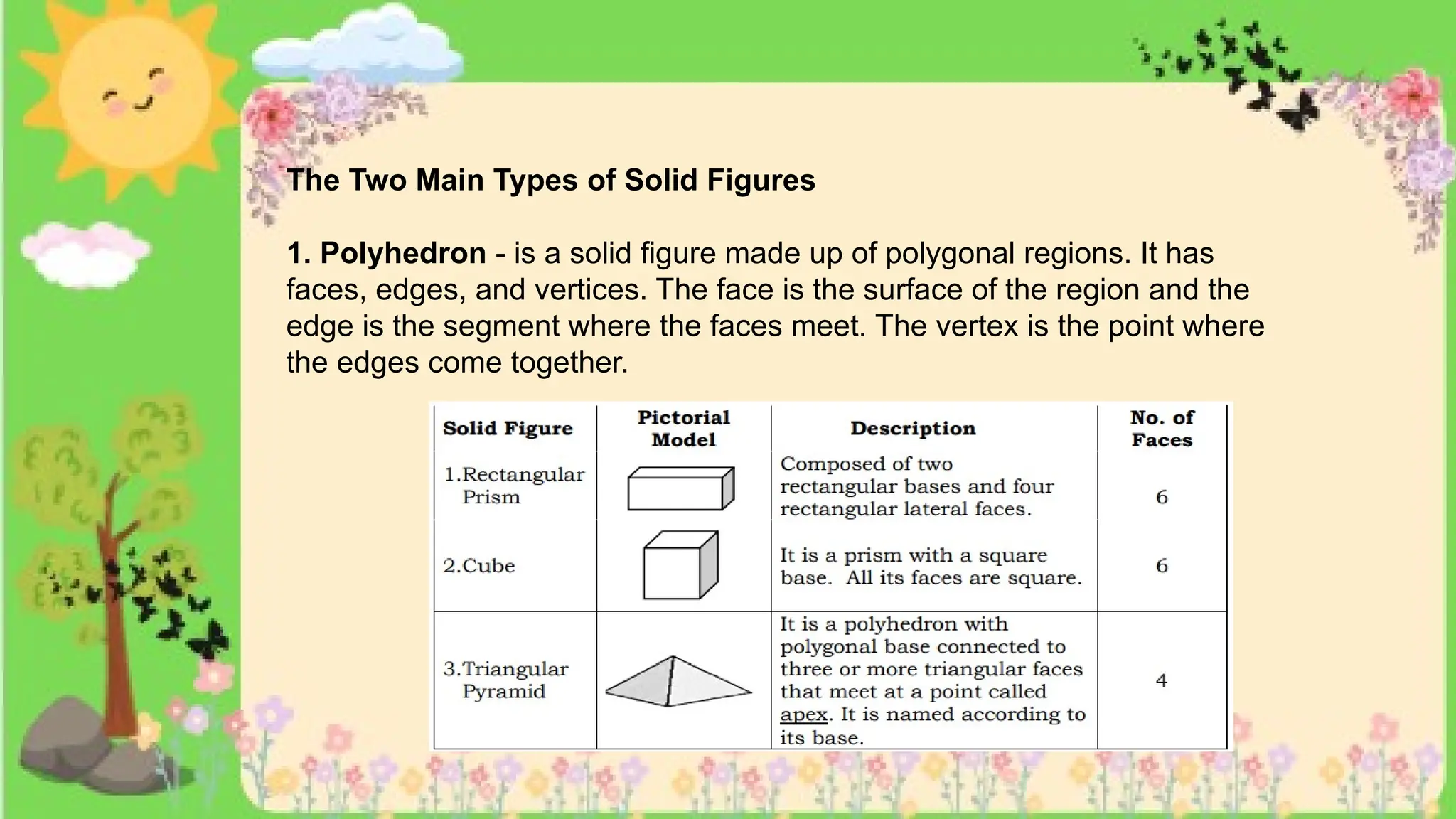
The Two Main Types of Solid Figures
1. Polyhedron - is a solid figure made up of polygonal regions. It has
faces, edges, and vertices. The face is the surface of the region and the
edge is the segment where the faces meet. The vertex is the point where
the edges come together.
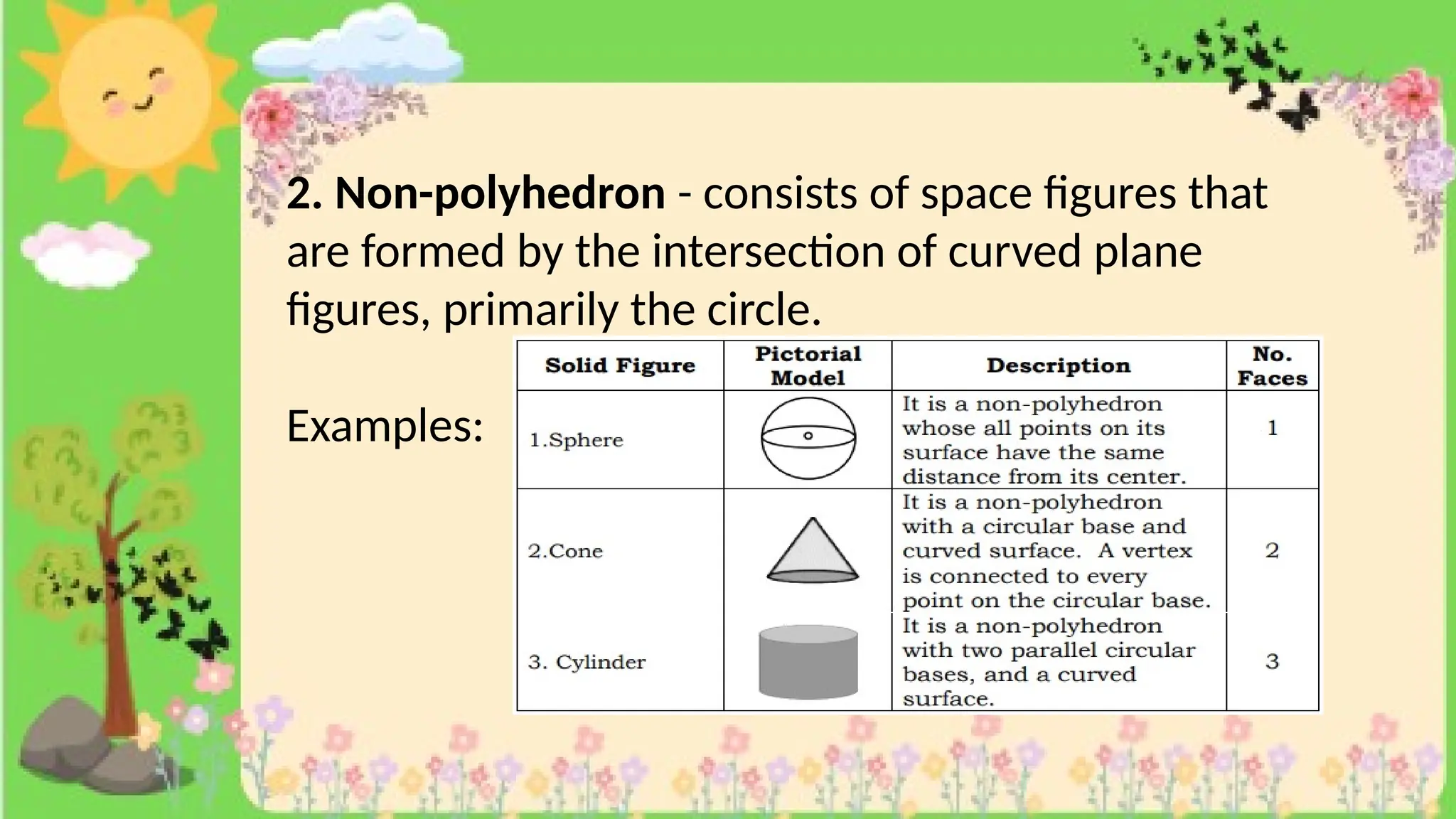
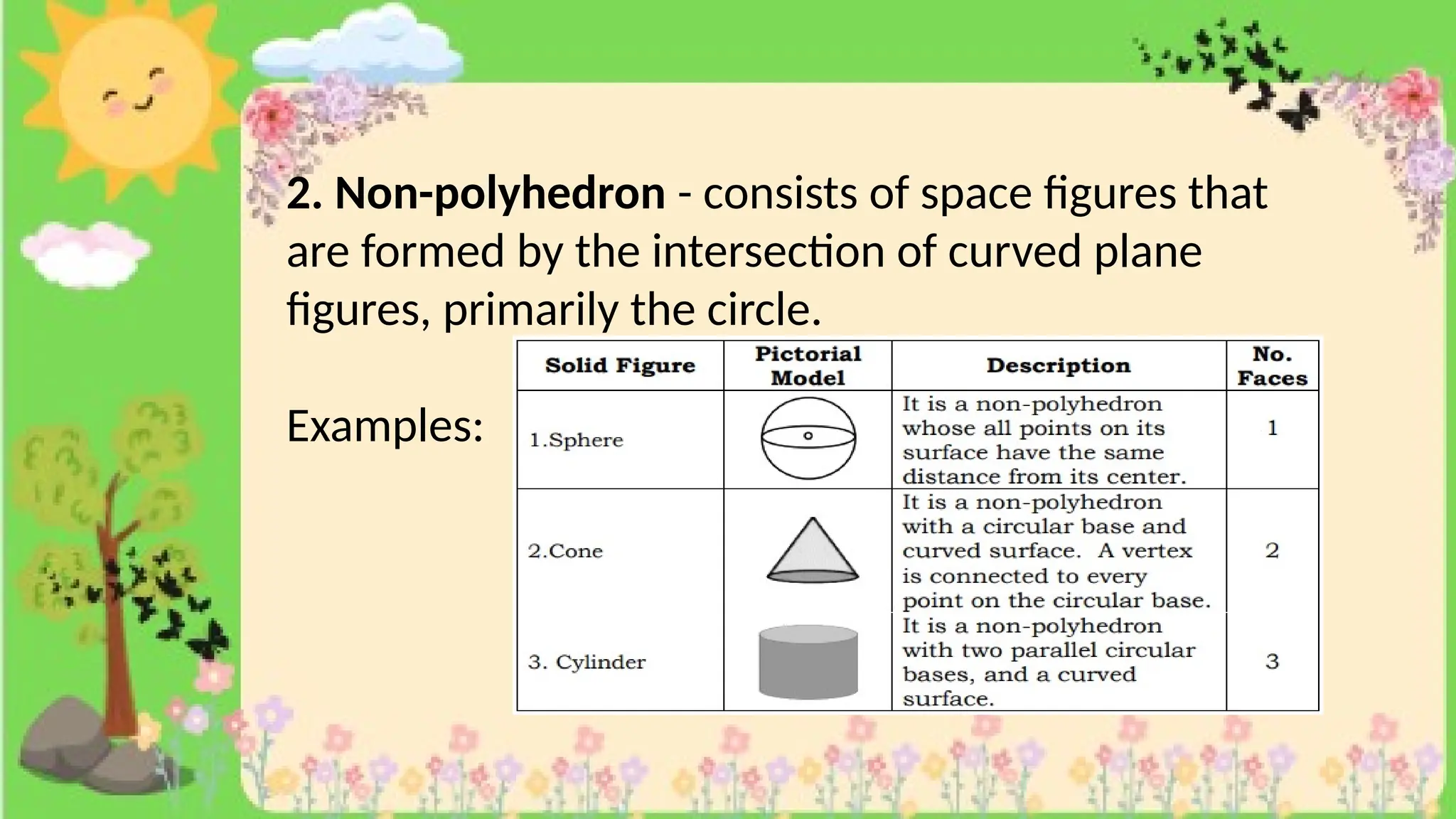
2. Non-polyhedron - consists of space figures that
are formed by the intersection of curved plane
figures, primarily the circle.
Examples:
Fill in the blanks with the correct word to
complete the concept learned from
today’s lesson. Choose the answer from the box
below.
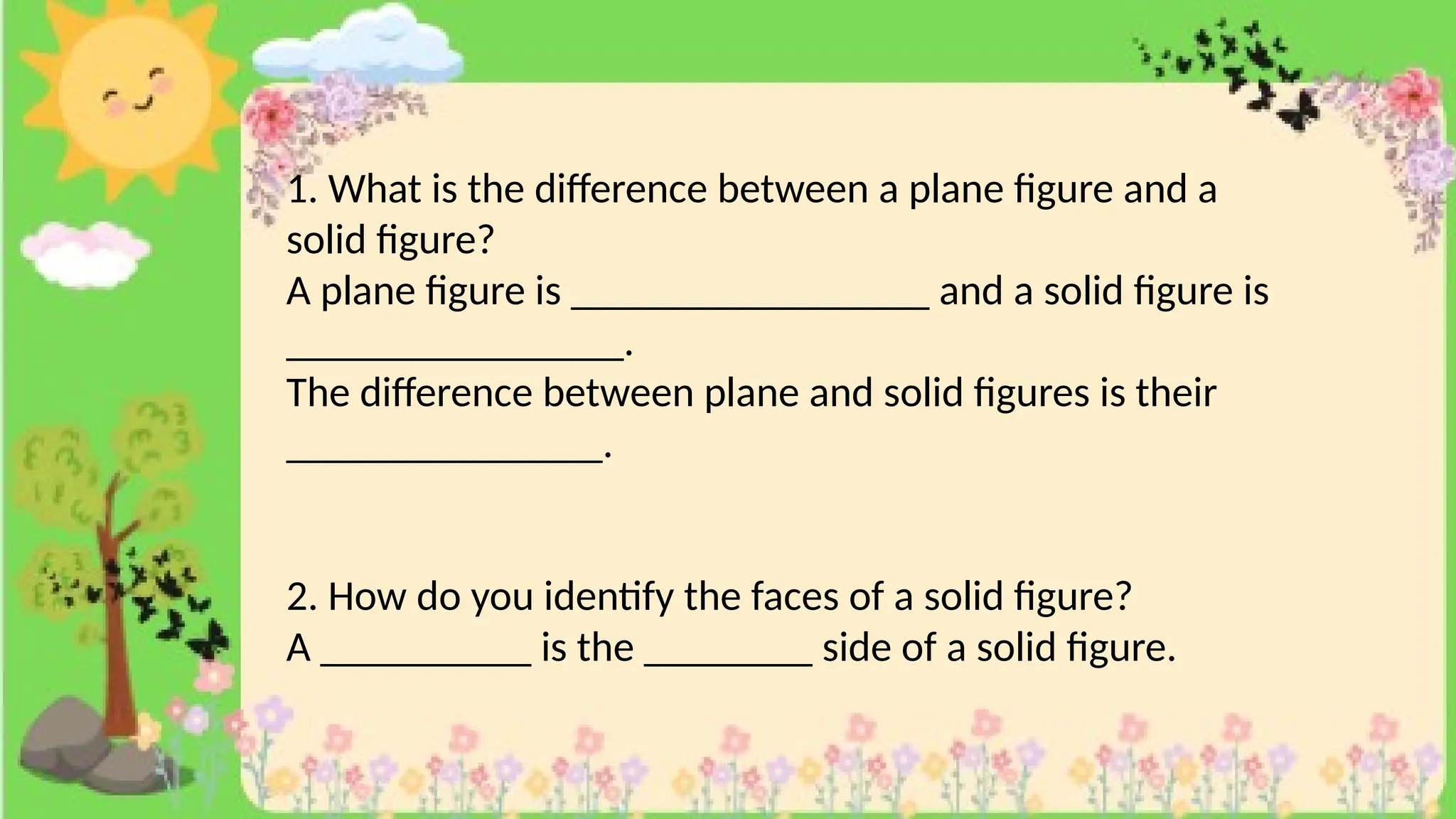
1. What is the difference between a plane figure and a
solid figure?
A plane figure is _________________ and a solid figure is
________________.
The difference between plane and solid figures is their
_______________.
2. How do you identify the faces of a solid figure?
A __________ is the ________ side of a solid figure.
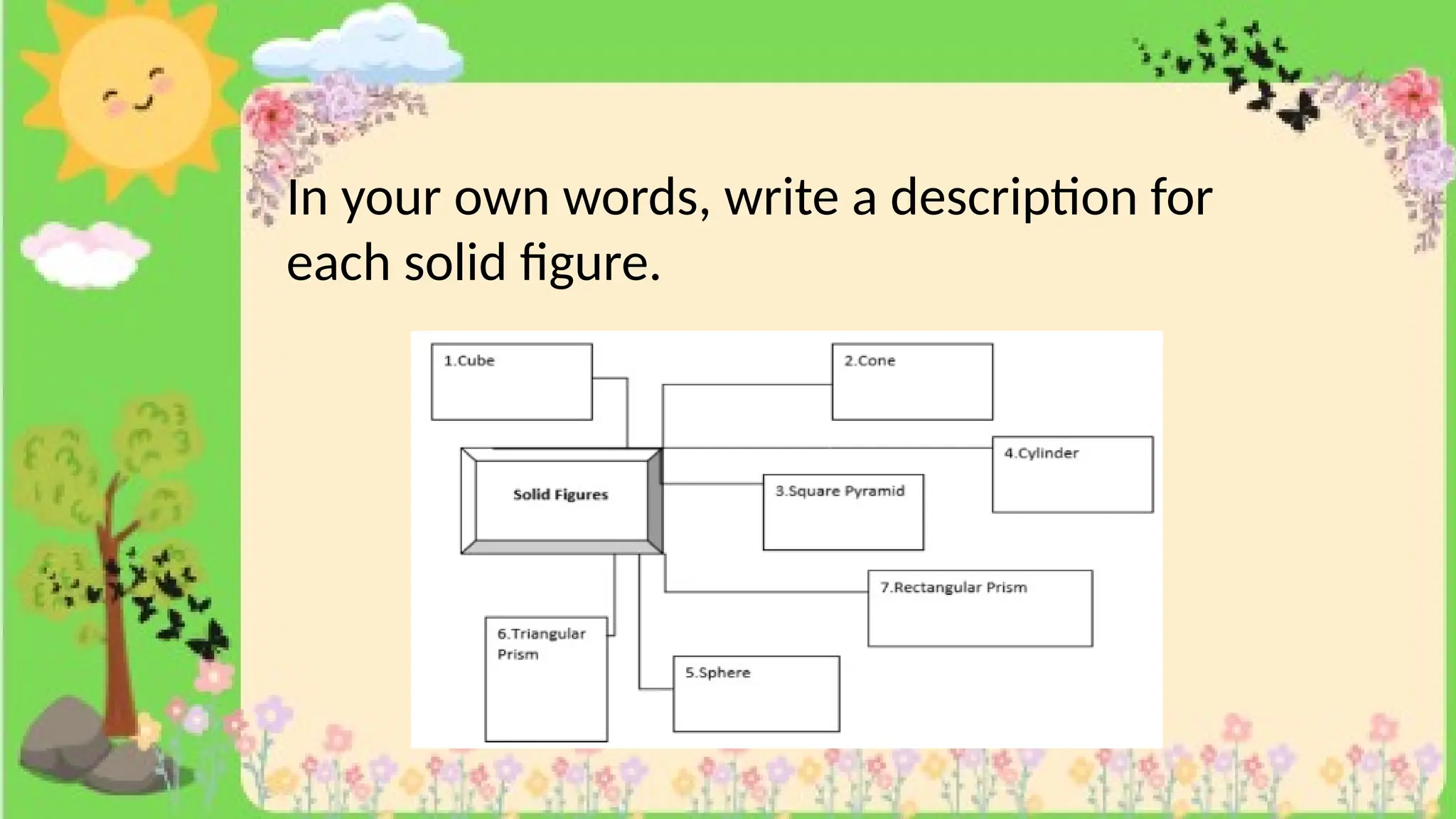
In your own words, write a description for
each solid figure.
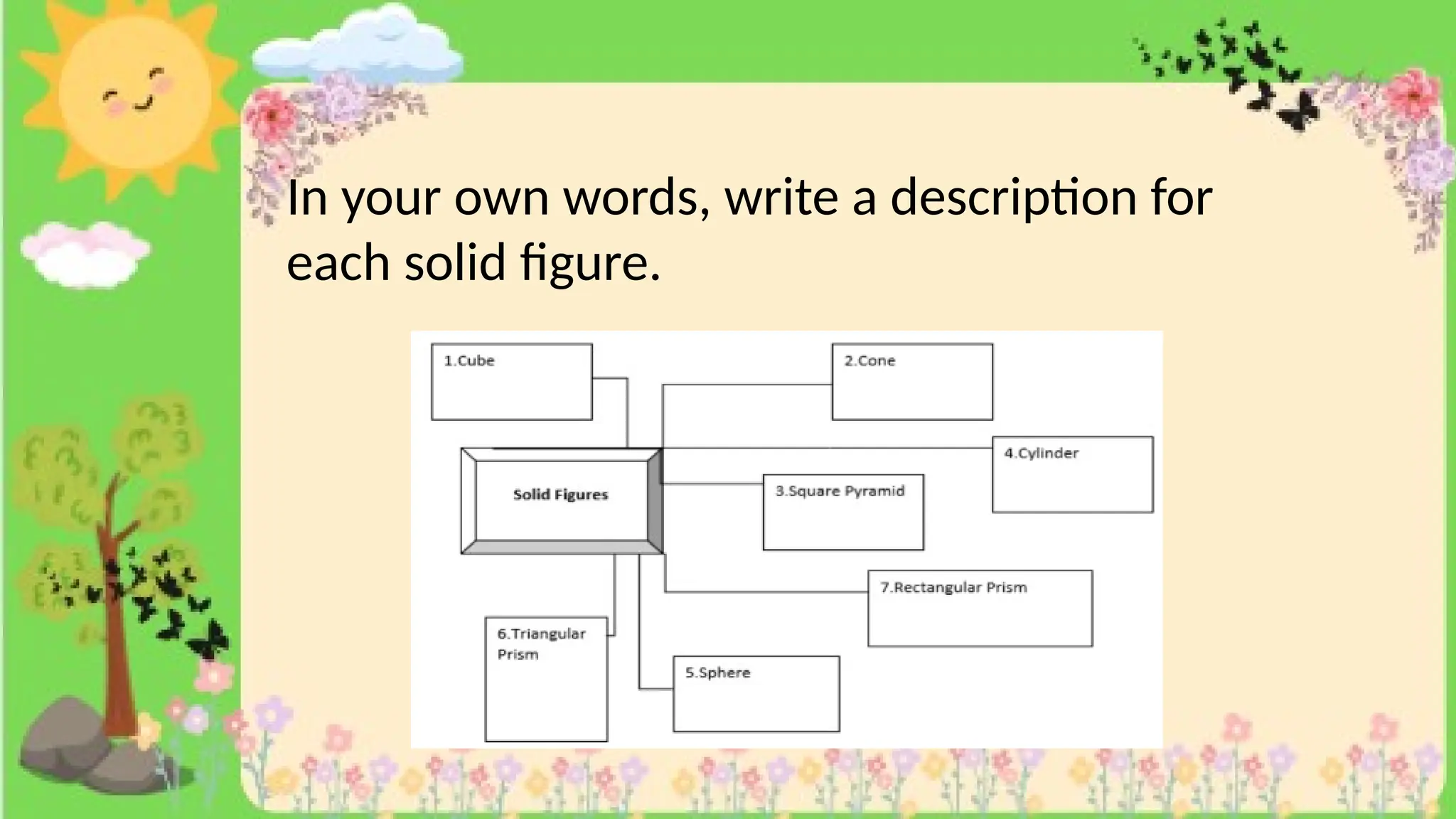
In your own words, write a description for
each solid figure.
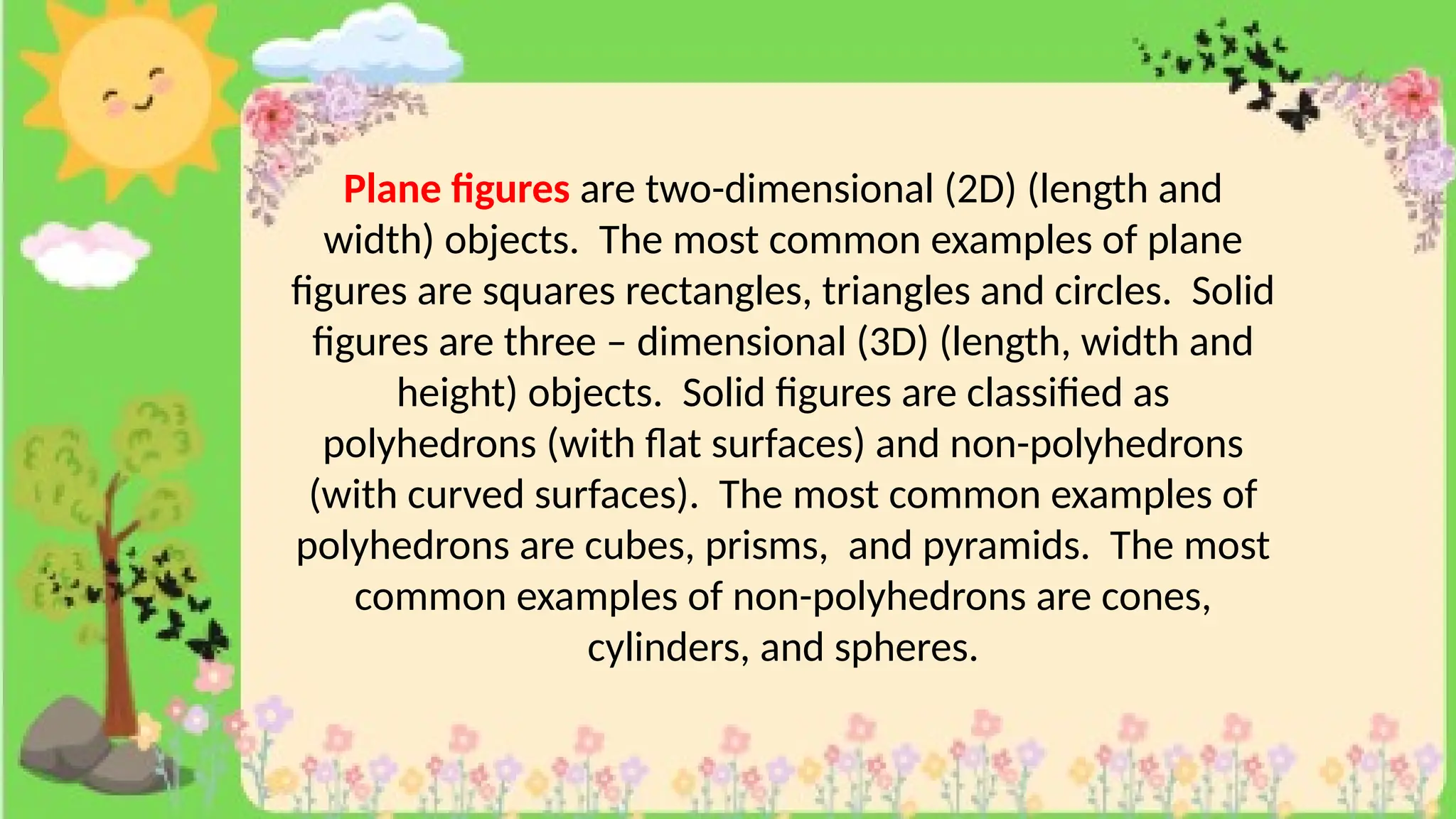
Plane figures are two-dimensional (2D) (length and
width) objects. The most common examples of plane
figures are squares rectangles, triangles and circles. Solid
figures are three – dimensional (3D) (length, width and
height) objects. Solid figures are classified as
polyhedrons (with flat surfaces) and non-polyhedrons
(with curved surfaces). The most common examples of
polyhedrons are cubes, prisms, and pyramids. The most
common examples of non-polyhedrons are cones,
cylinders, and spheres.
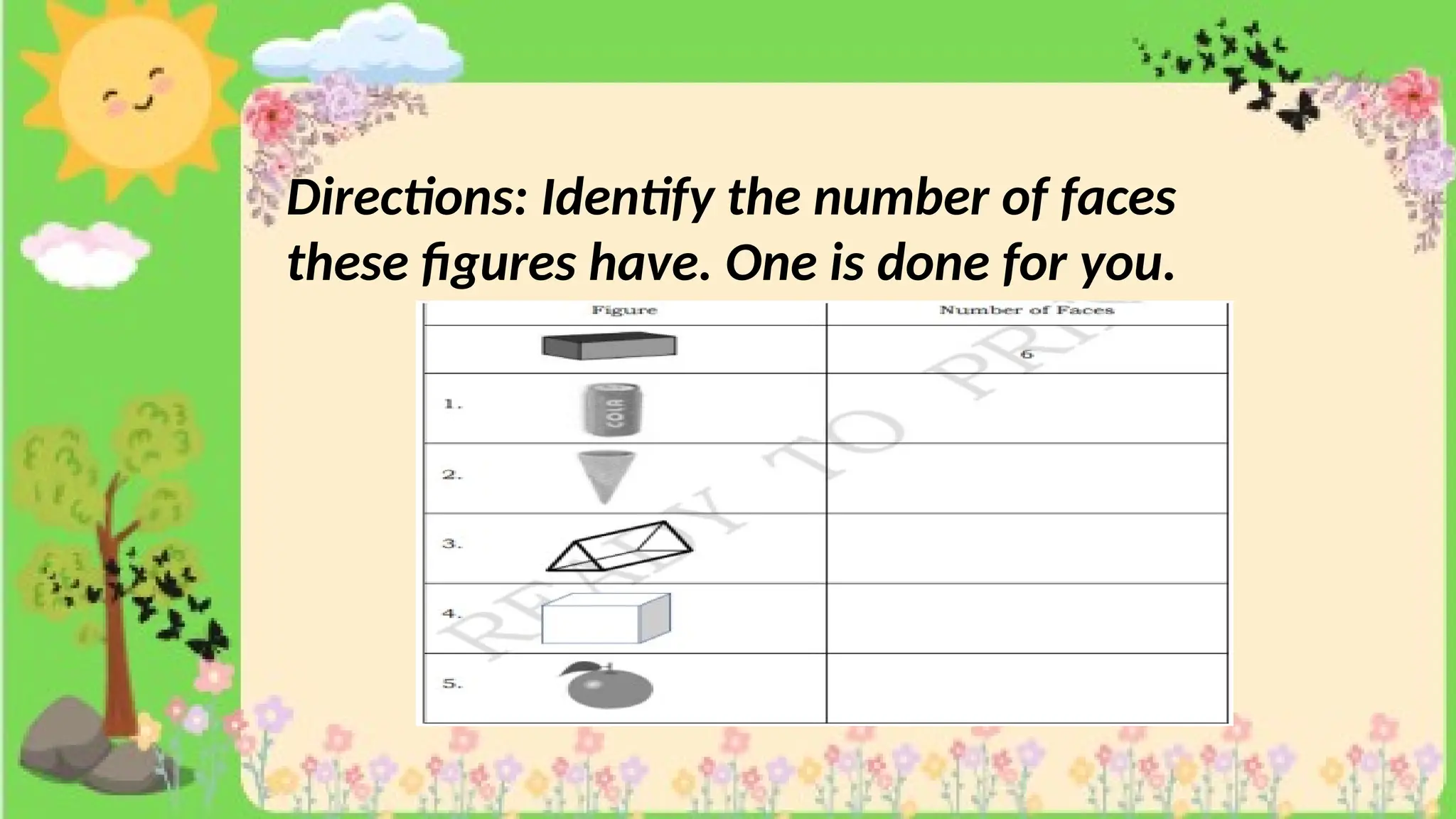
Directions: Identify the number of faces
these figures have. One is done for you.
DAY 5
How can you identify
different object with
different shape?
Solid Figures are three dimensional objects,
meaning they have length, width and height.
The Two Main Types of Solid Figures
1. Polyhedron - is a solid figure made up of polygonal regions. It has
faces, edges, and vertices. The face is the surface of the region and the
edge is the segment where the faces meet. The vertex is the point where
the edges come together.
2. Non-polyhedron - consists of space figures that
are formed by the intersection of curved plane
figures, primarily the circle.
Examples:
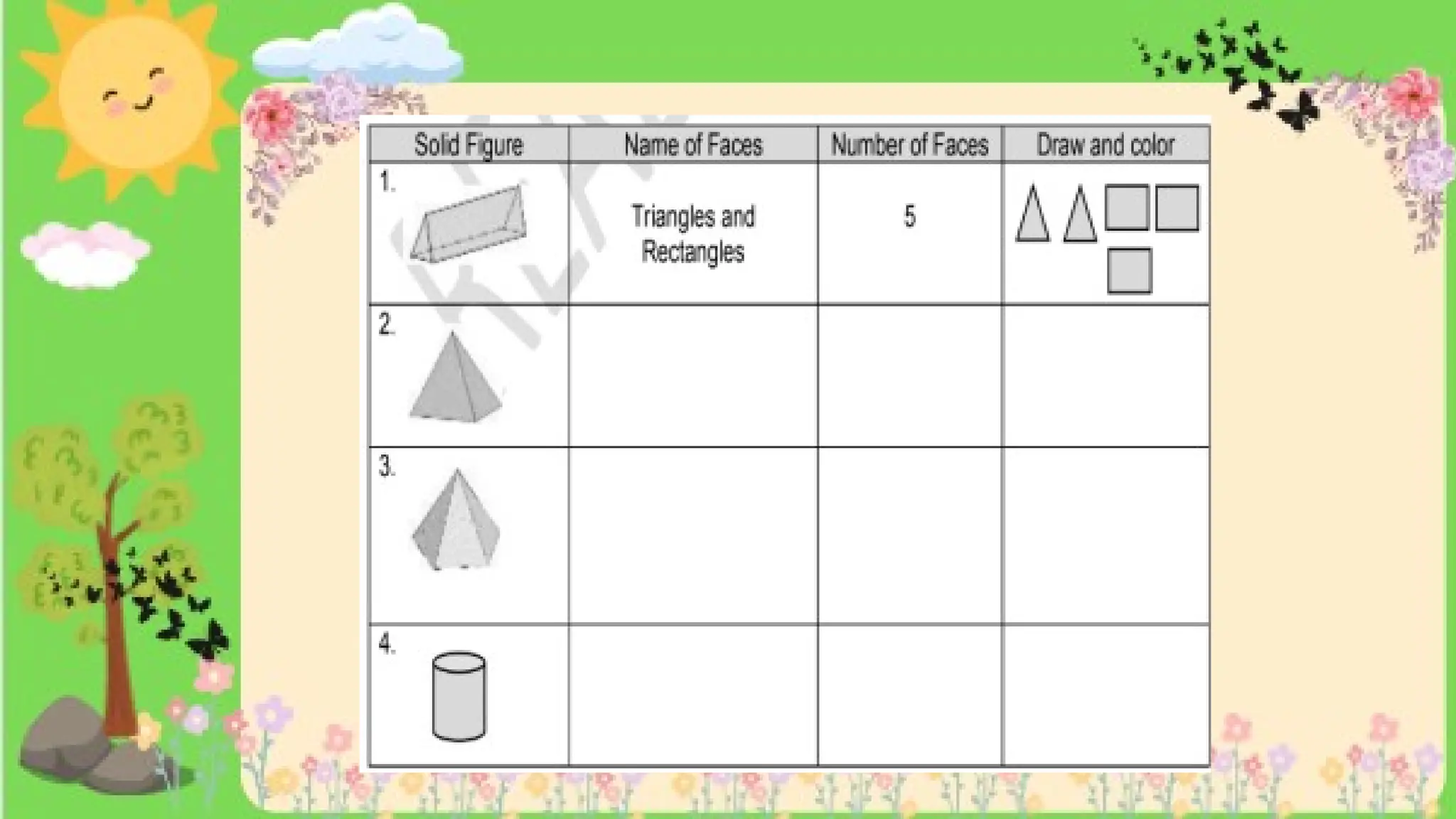
Activity 3. Name the faces in each figure, find the
number of faces and draw
the different faces of the following figures and
color it. Item Number 1 is done for you.
In your own words, write a description for
each solid figure.
In your own words, write a description for
each solid figure.
Plane figures are two-dimensional (2D) (length and
width) objects. The most common examples of plane
figures are squares rectangles, triangles and circles. Solid
figures are three – dimensional (3D) (length, width and
height) objects. Solid figures are classified as
polyhedrons (with flat surfaces) and non-polyhedrons
(with curved surfaces). The most common examples of
polyhedrons are cubes, prisms, and pyramids. The most
common examples of non-polyhedrons are cones,
cylinders, and spheres.
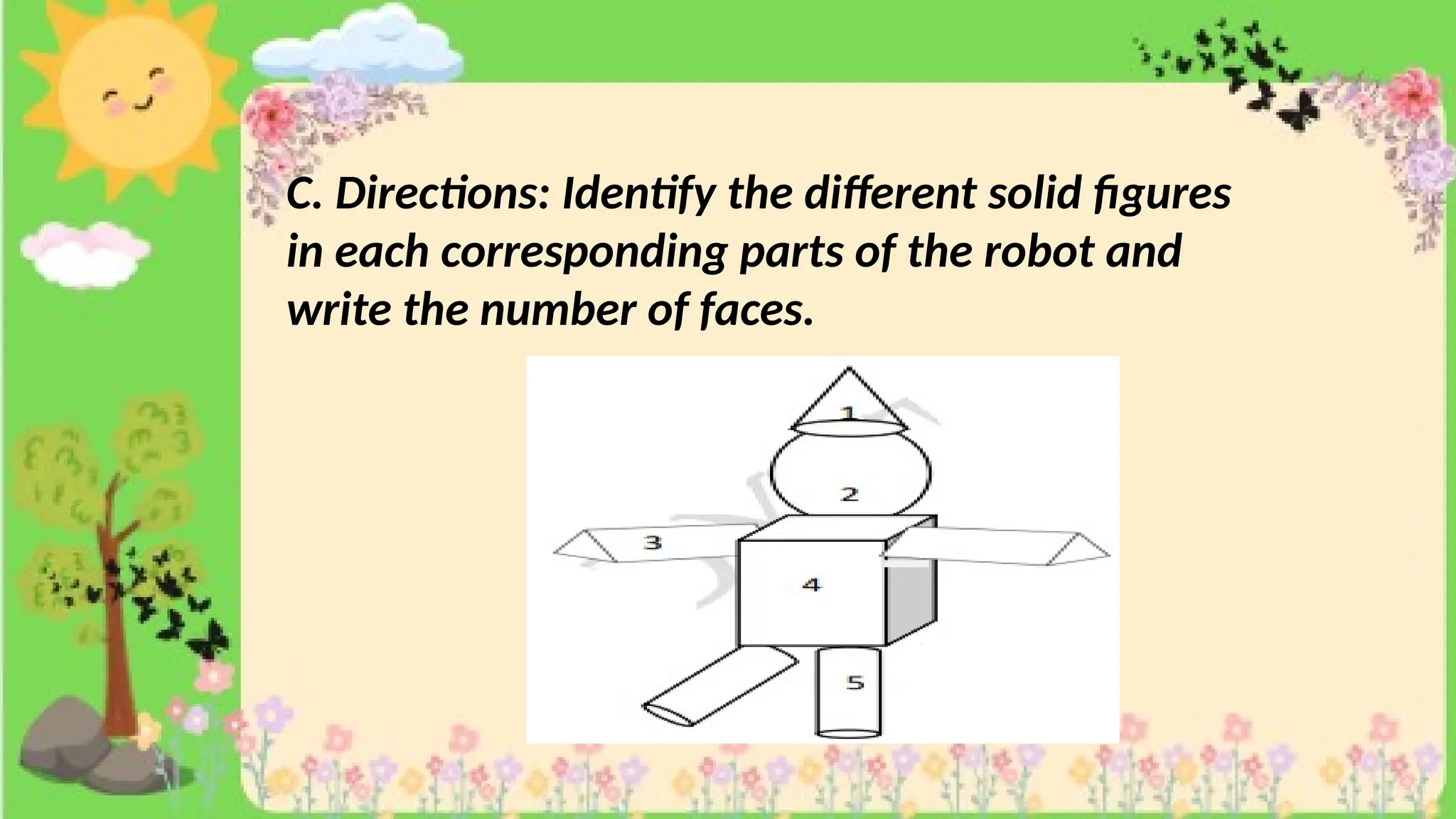
C. Directions: Identify the different solid figures
in each corresponding parts of the robot and
write the number of faces.

MATH_6_Q3_W1.pptx area of a composite figure

  • 1.
  • 2.
  • 3.
    Polyhedron is a solidfigure whose sides are all polygons. Each side is called face. Two faces that intersect in a line segment is called an edge. Two edges that intersect in a point is called a vertex.
  • 5.
  • 6.
    A cube is aspecial type of rectangular prism that has six equal faces. All edges of a cube are of the same length.
  • 9.
  • 10.
    Prism is a polyhedronwith two parallel equal bases that are shaped like polygons. The other faces of a prism are shaped like parallelograms. A prism is named by the shape of its bases.
  • 14.
  • 15.
    Pyramid is a polyhedronwith a single base shaped like a polygon. The faces of a pyramid are triangular and meet at a point. A pyramid is named by the shape of its base.
  • 19.
    Some 3 dimensional figureshave curved surfaces.
  • 20.
    Cylinder has two parallelequal circular bases.
  • 21.
    Cone has a circularbase and one vertex.
  • 22.
    Sphere is a solidwhose all points on its surface have the same distance from its center.
  • 24.
    This box isa rectangular prism because of its rectangular base. A rectangular prism has 6 faces, 8 vertices and 12 edges.
  • 26.
    This is asquare pyramid because of its square base and it has 4 lateral faces. Other solid figures have curved surfaces.
  • 28.
    In your ownwords, write a description for each solid figure.
  • 29.
    Directions. Associate thefollowing objects with the given solid figure by matching column A and column B.
  • 30.
    A. Directions: Lookaround you and draw objects that represents the following solid figures. 1. cone 2. triangular pyramid
  • 31.
    • Polyhedron isa solid figure whose sides are all polygons. Each side is called face. Two faces that intersect in a line segment is called an edge. Two edges that intersect in a point is called a vertex. • A cube is a special type of rectangular prism that has six equal faces. All edges of a cube are of the same length. • A prism is a polyhedron with two parallel equal bases that are shaped like polygons.
  • 32.
    The other facesof a prism are shaped like parallelograms. • A prism is named by the shape of its bases. • A pyramid is a polyhedron with a single base shaped like a polygon. • The faces of a pyramid are triangular and meet at a point. A pyramid is named by the shape of its base. *Some three dimensional figures have curved surfaces. A cylinder has two parallel equal circular bases.
  • 33.
    • A conehas a circular base and one vertex. • A sphere is a solid whose all points on its surface have the same distance from its center
  • 34.
    Directions: Visualize anddescribe the different solid figures. Complete the table below.
  • 35.
  • 36.
     Polyhedron isa solid figure whose sides are all polygons. Each side is called face. Two faces that intersect in a line segment is called an edge. Two edges that intersect in a point is called a vertex.  A cube is a special type of rectangular prism that has six equal faces. All edges of a cube are of the same length.  A prism is a polyhedron with two parallel equal bases that are shaped like polygons. The other faces of a prism are shaped like parallelograms. A prism is named by the shape of its bases.  A pyramid is a polyhedron with a single base shaped like a polygon. The faces of a pyramid are triangular and meet at a point. A pyramid is named by the shape of its base.
  • 37.
    *Some three dimensionalfigures have curved surfaces.  A cylinder has two parallel equal circular bases.  A cone has a circular base and one vertex.  A sphere is a solid whose all points on its surface have the same distance from its center.
  • 39.
    This box isa rectangular prism because of its rectangular base. A rectangular prism has 6 faces, 8 vertices and 12 edges.
  • 41.
    This is asquare pyramid because of its square base and it has 4 lateral faces. Other solid figures have curved surfaces.
  • 43.
    Determine whether thefollowing object is a PLANE FIGURE or SOLID FIGURE
  • 44.
    Directions: Draw thefigures under their correct category. Then write down the name of each figure.
  • 45.
    • Polyhedron isa solid figure whose sides are all polygons. Each side is called face. Two faces that intersect in a line segment is called an edge. Two edges that intersect in a point is called a vertex. • A cube is a special type of rectangular prism that has six equal faces. All edges of a cube are of the same length. • A prism is a polyhedron with two parallel equal bases that are shaped like polygons.
  • 46.
    The other facesof a prism are shaped like parallelograms. • A prism is named by the shape of its bases. • A pyramid is a polyhedron with a single base shaped like a polygon. • The faces of a pyramid are triangular and meet at a point. A pyramid is named by the shape of its base. *Some three dimensional figures have curved surfaces. A cylinder has two parallel equal circular bases.
  • 47.
    • A conehas a circular base and one vertex. • A sphere is a solid whose all points on its surface have the same distance from its center
  • 48.
    Directions: Read andanalyze each situation. Write the letter of the correct answer.
  • 49.
    Directions: Read andanalyze each situation. Write the letter of the correct answer. 4. How many faces does a square pyramid have? A. 6 B. 4 C. 5 D. 3 5. How many faces does a cylinder have? A. 2 B. 4 C. 3 D. 5
  • 50.
  • 51.
    What are thekinds of a solid figure?
  • 52.
    Plane figures aretwo-dimensional (2D) (length and width) objects. The most common examples of plane figures are squares, rectangles, triangles and circles. Solid figures are three – dimensional (3D) (length, width and height) objects. Solid figures are classified as polyhedrons (with flat surfaces) and non-polyhedrons (with curved surfaces).
  • 53.
    The most commonexamples of polyhedrons are cubes, prisms, and pyramids. The most common examples of non-polyhedrons are cones, cylinders, and spheres.
  • 55.
    Activity 1. Matchthe figures of similar attributes to their corresponding figure by writing the letter of the correct answer in your activity notebook.
  • 57.
    Mr. Cruz wantedto buy a water container. He is thinking of which is best to buy, a rectangular container whose length and width are 16 inches and 12 inches and a height of 24 inches or a cylindrical container whose diameter is 16 inches and a height of 24 inches. Both containers are price at Php250.00.
  • 58.
    If you areMr Cruz, which of the 2 containers will you buy? Explain your answer.
  • 59.
    Plane figures aretwo-dimensional (2D) (length and width) objects. The most common examples of plane figures are squares rectangles, triangles and circles. Solid figures are three – dimensional (3D) (length, width and height) objects. Solid figures are classified as polyhedrons (with flat surfaces) and non-polyhedrons (with curved surfaces). The most common examples of polyhedrons are cubes, prisms, and pyramids. The most common examples of non-polyhedrons are cones, cylinders, and spheres.
  • 60.
    Directions: Differentiate solidfigures from plane figures. Write P for the plane figures and S for solid figures.
  • 61.
  • 62.
    How can youidentify different object with different shape?
  • 63.
    Solid Figures arethree dimensional objects, meaning they have length, width and height.
  • 64.
    The Two MainTypes of Solid Figures 1. Polyhedron - is a solid figure made up of polygonal regions. It has faces, edges, and vertices. The face is the surface of the region and the edge is the segment where the faces meet. The vertex is the point where the edges come together.
  • 65.
    2. Non-polyhedron -consists of space figures that are formed by the intersection of curved plane figures, primarily the circle. Examples:
  • 66.
    Fill in theblanks with the correct word to complete the concept learned from today’s lesson. Choose the answer from the box below.
  • 67.
    1. What isthe difference between a plane figure and a solid figure? A plane figure is _________________ and a solid figure is ________________. The difference between plane and solid figures is their _______________. 2. How do you identify the faces of a solid figure? A __________ is the ________ side of a solid figure.
  • 68.
    In your ownwords, write a description for each solid figure.
  • 69.
    In your ownwords, write a description for each solid figure.
  • 70.
    Plane figures aretwo-dimensional (2D) (length and width) objects. The most common examples of plane figures are squares rectangles, triangles and circles. Solid figures are three – dimensional (3D) (length, width and height) objects. Solid figures are classified as polyhedrons (with flat surfaces) and non-polyhedrons (with curved surfaces). The most common examples of polyhedrons are cubes, prisms, and pyramids. The most common examples of non-polyhedrons are cones, cylinders, and spheres.
  • 71.
    Directions: Identify thenumber of faces these figures have. One is done for you.
  • 72.
  • 73.
    How can youidentify different object with different shape?
  • 74.
    Solid Figures arethree dimensional objects, meaning they have length, width and height.
  • 75.
    The Two MainTypes of Solid Figures 1. Polyhedron - is a solid figure made up of polygonal regions. It has faces, edges, and vertices. The face is the surface of the region and the edge is the segment where the faces meet. The vertex is the point where the edges come together.
  • 76.
    2. Non-polyhedron -consists of space figures that are formed by the intersection of curved plane figures, primarily the circle. Examples:
  • 77.
    Activity 3. Namethe faces in each figure, find the number of faces and draw the different faces of the following figures and color it. Item Number 1 is done for you.
  • 79.
    In your ownwords, write a description for each solid figure.
  • 80.
    In your ownwords, write a description for each solid figure.
  • 81.
    Plane figures aretwo-dimensional (2D) (length and width) objects. The most common examples of plane figures are squares rectangles, triangles and circles. Solid figures are three – dimensional (3D) (length, width and height) objects. Solid figures are classified as polyhedrons (with flat surfaces) and non-polyhedrons (with curved surfaces). The most common examples of polyhedrons are cubes, prisms, and pyramids. The most common examples of non-polyhedrons are cones, cylinders, and spheres.
  • 82.
    C. Directions: Identifythe different solid figures in each corresponding parts of the robot and write the number of faces.