I. OBJECTIVE
A. Content Standard Demonstratesunderstandingoflines,symmetricaldesignsand
tessellationsusingsquare,triangleandother shapethat can
tessellate.
B. Performance Standard Recognizeandrepresentlinesin realobjectsanddesignsor
drawings,completesymmetrical designs,andcreatepatternsof
designsusingsquare,triangleand other shapethat cantessellate.
c. Learning Competency/
Objectives Write LC code
for each
Recognizes a point, line, line segment and ray.
M3GE-IIIe-11
II. CONTENT Point, Line, Line Segment and Ray
III. LEARNING RESOURCES
A. References:
1.Teacher’s Guide Pages
Mathematics pages 297 - 301
2.Learner’s Materials
Pages
Mathematics pages 248 - 252
3.Textbooks Pages
4 .Learning Resource
(LR) Portal
6484 Points, Lines, Planes and Angle Module 1
5. Integration: Arts ( Appreciate designs created which can be used forthe crafts).
B. Other Learning
Resources
Video
https://www.youtube.com/watch?v=9dsmVP82tig&t=62s
https://www.youtube.com/watch?v=_jlYAkYsHf0,
pictures, activity sheets
Evaluation Worksheet -
http://www.letsshareknowledge.com/wp-
content/uploads/2017/04/grade-3-maths-worksheets-
geometry-Points-Lines-Line-Segments-and-Rays-9.pdf
IV. PROCEDURES
TEACHER’S ACTIVITY PUPILS’ ACTIVITY
A. Review/ Present a new
lesson
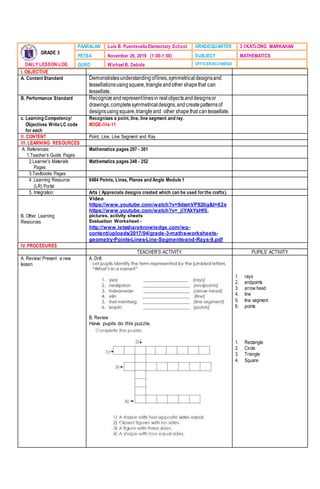
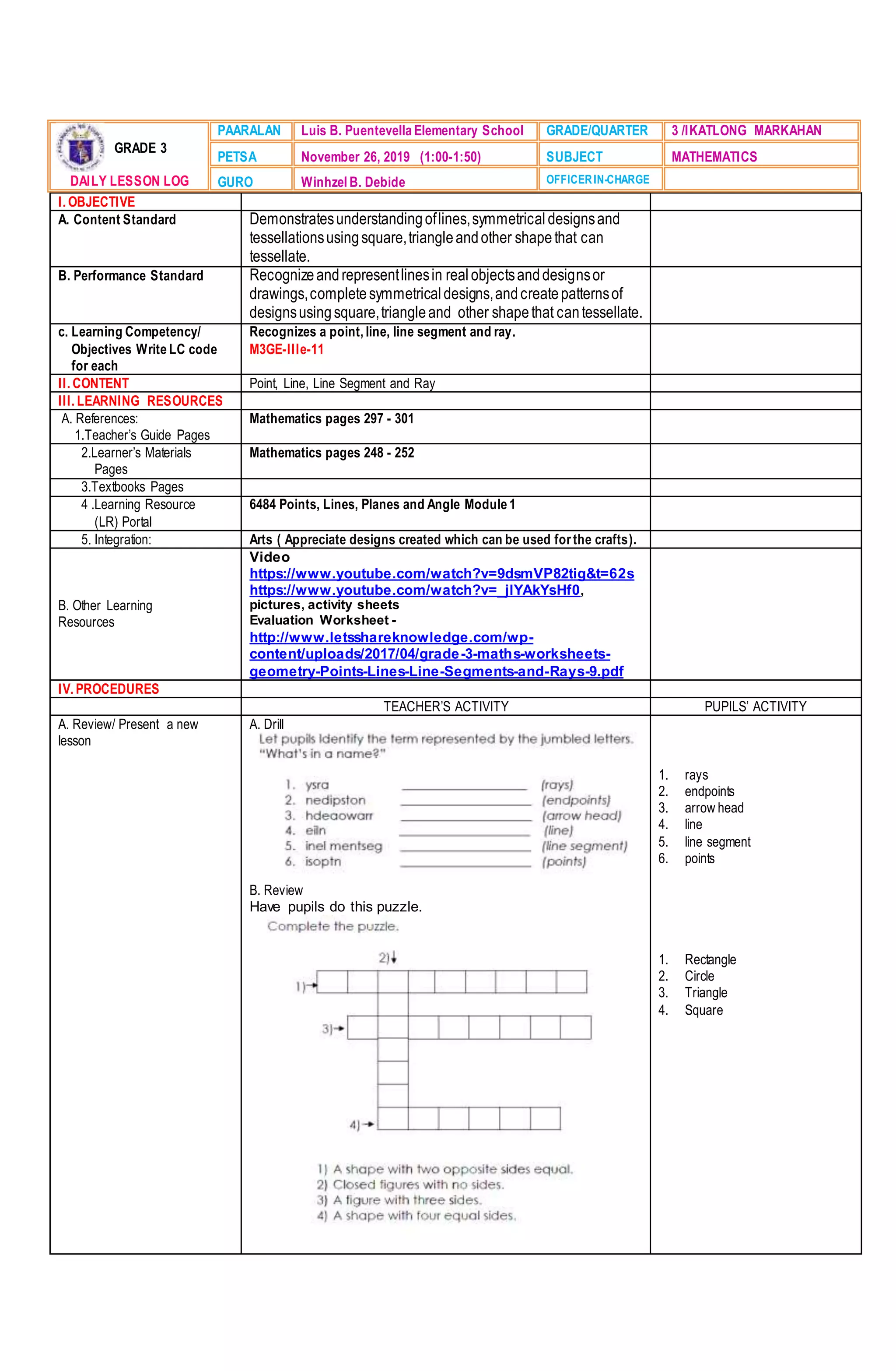
A. Drill
B. Review
Have pupils do this puzzle.
1. rays
2. endpoints
3. arrow head
4. line
5. line segment
6. points
1. Rectangle
2. Circle
3. Triangle
4. Square
GRADE 3
DAILY LESSON LOG
PAARALAN Luis B. Puentevella Elementary School GRADE/QUARTER 3 /IKATLONG MARKAHAN
PETSA November 26, 2019 (1:00-1:50) SUBJECT MATHEMATICS
GURO Winhzel B. Debide OFFICERIN-CHARGE
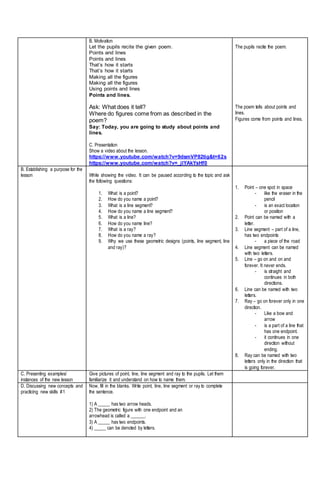
B. Motivation
Let the pupils recite the given poem.
Points and lines
Points and lines
That’s how it starts
Making all the figures
Using points and lines
Points and lines.
Ask: What does it tell?
Where do figures come from as described in the
poem?
Say: Today, you are going to study about points and
lines.
C. Presentation
Show a video about the lesson.
https://www.youtube.com/watch?v=9dsmVP82tig&t=62s
https://www.youtube.com/watch?v=_jlYAkYsHf0
The pupils recite the poem.
The poem tells about points and
lines.
Figures come from points and lines.
B. Establishing a purpose for the
lesson While showing the video. It can be paused according to the topic and ask
the following questions:
1. What is a point?
2. How do you name a point?
3. What is a line segment?
4. How do you name a line segment?
5. What is a line?
6. How do you name line?
7. What is a ray?
8. How do you name a ray?
9. Why we use these geometric designs (points, line segment, line
and ray)?
1. Point – one spot in space
- like the eraser in the
pencil
- is an exact location
or position
2. Point can be named with a
letter.
3. Line segment – part of a line,
has two endpoints
- a piece of the road
4. Line segment can be named
with two letters.
5. Line – go on and on and
forever. It never ends.
- is straight and
continues in both
directions.
6. Line can be named with two
letters.
7. Ray – go on forever only in one
direction.
- Like a bow and
arrow
- is a part of a line that
has one endpoint.
- it continues in one
direction without
ending.
8. Ray can be named with two
letters only in the direction that
is going forever.
C. Presenting examples/
instances of the new lesson
Give pictures of point, line, line segment and ray to the pupils. Let them
familiarize it and understand on how to name them.
D. Discussing new concepts and
practicing new skills #1
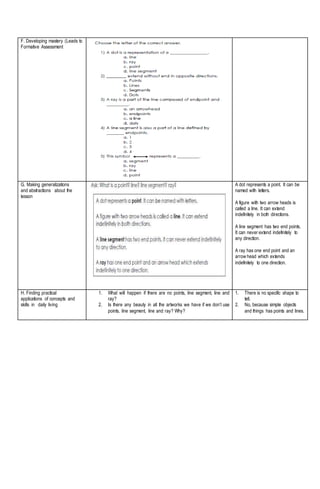
Now, fill in the blanks. Write point, line, line segment or ray to complete
the sentence.
1) A _____ has two arrow heads.
2) The geometric figure with one endpoint and an
arrowhead is called a ______.
3) A _____ has two endpoints.
4) _____ can be denoted by letters.
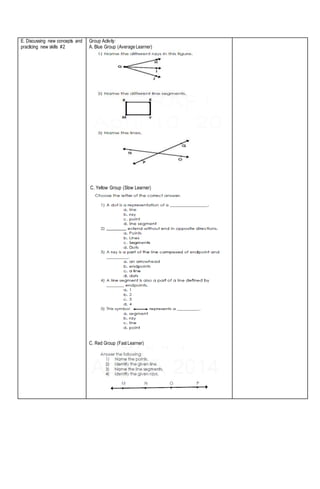
E. Discussing new concepts and
practicing new skills #2
Group Activity:
A. Blue Group (Average Learner)
C. Yellow Group (Slow Learner)
C. Red Group (Fast Learner)
F. Developing mastery (Leads to
Formative Assessment
G. Making generalizations
and abstractions about the
lesson
A dot represents a point. It can be
named with letters.
A figure with two arrow heads is
called a line. It can extend
indefinitely in both directions.
A line segment has two end points.
It can never extend indefinitely to
any direction.
A ray has one end point and an
arrow head which extends
indefinitely to one direction.
H. Finding practical
applications of concepts and
skills in daily living
1. What will happen if there are no points, line segment, line and
ray?
2. Is there any beauty in all the artworks we have if we don’t use
points, line segment, line and ray? Why?
1. There is no specific shape to
tell.
2. No, because simple objects
and things has points and lines.
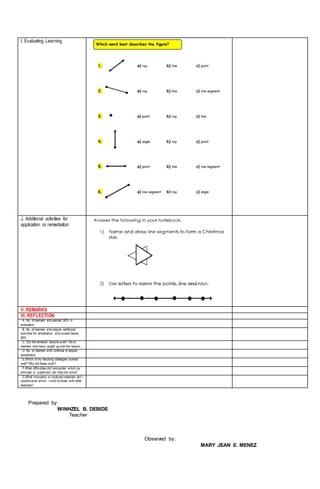
I. Evaluating Learning
J. Additional activities for
application or remediation
V. REMARKS
VI. REFLECTION
A. No. of learners who earned 80% in
evaluation
B. No. of learners who require additional
activities for remediation who scored below
80%
C. Did the remedial lessons work? No of
learners who have caught up with the lesson.
D. No. of learners who continue to require
remediation
E.Which of my teaching strategies worked
well? Why did these work?
F.What difficulties did I encounter which my
principal or supervisor can help me solve?
G.What innovation or localized materials did I
use/discover which I wish to share with other
teachers?
Prepared by:
WINHZEL B. DEBIDE
Teacher
Observed by:
MARY JEAN E. MENEZ
Master Teacher 1

COT Lesson Plan Mathematics 3 Points, Line, Line Segment and Ray

  • 1.
    I. OBJECTIVE A. ContentStandard Demonstratesunderstandingoflines,symmetricaldesignsand tessellationsusingsquare,triangleandother shapethat can tessellate. B. Performance Standard Recognizeandrepresentlinesin realobjectsanddesignsor drawings,completesymmetrical designs,andcreatepatternsof designsusingsquare,triangleand other shapethat cantessellate. c. Learning Competency/ Objectives Write LC code for each Recognizes a point, line, line segment and ray. M3GE-IIIe-11 II. CONTENT Point, Line, Line Segment and Ray III. LEARNING RESOURCES A. References: 1.Teacher’s Guide Pages Mathematics pages 297 - 301 2.Learner’s Materials Pages Mathematics pages 248 - 252 3.Textbooks Pages 4 .Learning Resource (LR) Portal 6484 Points, Lines, Planes and Angle Module 1 5. Integration: Arts ( Appreciate designs created which can be used forthe crafts). B. Other Learning Resources Video https://www.youtube.com/watch?v=9dsmVP82tig&t=62s https://www.youtube.com/watch?v=_jlYAkYsHf0, pictures, activity sheets Evaluation Worksheet - http://www.letsshareknowledge.com/wp- content/uploads/2017/04/grade-3-maths-worksheets- geometry-Points-Lines-Line-Segments-and-Rays-9.pdf IV. PROCEDURES TEACHER’S ACTIVITY PUPILS’ ACTIVITY A. Review/ Present a new lesson A. Drill B. Review Have pupils do this puzzle. 1. rays 2. endpoints 3. arrow head 4. line 5. line segment 6. points 1. Rectangle 2. Circle 3. Triangle 4. Square GRADE 3 DAILY LESSON LOG PAARALAN Luis B. Puentevella Elementary School GRADE/QUARTER 3 /IKATLONG MARKAHAN PETSA November 26, 2019 (1:00-1:50) SUBJECT MATHEMATICS GURO Winhzel B. Debide OFFICERIN-CHARGE
  • 2.
    B. Motivation Let thepupils recite the given poem. Points and lines Points and lines That’s how it starts That’s how it starts Making all the figures Making all the figures Using points and lines Points and lines. Ask: What does it tell? Where do figures come from as described in the poem? Say: Today, you are going to study about points and lines. C. Presentation Show a video about the lesson. https://www.youtube.com/watch?v=9dsmVP82tig&t=62s https://www.youtube.com/watch?v=_jlYAkYsHf0 The pupils recite the poem. The poem tells about points and lines. Figures come from points and lines. B. Establishing a purpose for the lesson While showing the video. It can be paused according to the topic and ask the following questions: 1. What is a point? 2. How do you name a point? 3. What is a line segment? 4. How do you name a line segment? 5. What is a line? 6. How do you name line? 7. What is a ray? 8. How do you name a ray? 9. Why we use these geometric designs (points, line segment, line and ray)? 1. Point – one spot in space - like the eraser in the pencil - is an exact location or position 2. Point can be named with a letter. 3. Line segment – part of a line, has two endpoints - a piece of the road 4. Line segment can be named with two letters. 5. Line – go on and on and forever. It never ends. - is straight and continues in both directions. 6. Line can be named with two letters. 7. Ray – go on forever only in one direction. - Like a bow and arrow - is a part of a line that has one endpoint. - it continues in one direction without ending. 8. Ray can be named with two letters only in the direction that is going forever. C. Presenting examples/ instances of the new lesson Give pictures of point, line, line segment and ray to the pupils. Let them familiarize it and understand on how to name them. D. Discussing new concepts and practicing new skills #1 Now, fill in the blanks. Write point, line, line segment or ray to complete the sentence. 1) A _____ has two arrow heads. 2) The geometric figure with one endpoint and an arrowhead is called a ______. 3) A _____ has two endpoints. 4) _____ can be denoted by letters.
  • 3.
    E. Discussing newconcepts and practicing new skills #2 Group Activity: A. Blue Group (Average Learner) C. Yellow Group (Slow Learner) C. Red Group (Fast Learner)
  • 4.
    F. Developing mastery(Leads to Formative Assessment G. Making generalizations and abstractions about the lesson A dot represents a point. It can be named with letters. A figure with two arrow heads is called a line. It can extend indefinitely in both directions. A line segment has two end points. It can never extend indefinitely to any direction. A ray has one end point and an arrow head which extends indefinitely to one direction. H. Finding practical applications of concepts and skills in daily living 1. What will happen if there are no points, line segment, line and ray? 2. Is there any beauty in all the artworks we have if we don’t use points, line segment, line and ray? Why? 1. There is no specific shape to tell. 2. No, because simple objects and things has points and lines.
  • 5.
    I. Evaluating Learning J.Additional activities for application or remediation V. REMARKS VI. REFLECTION A. No. of learners who earned 80% in evaluation B. No. of learners who require additional activities for remediation who scored below 80% C. Did the remedial lessons work? No of learners who have caught up with the lesson. D. No. of learners who continue to require remediation E.Which of my teaching strategies worked well? Why did these work? F.What difficulties did I encounter which my principal or supervisor can help me solve? G.What innovation or localized materials did I use/discover which I wish to share with other teachers? Prepared by: WINHZEL B. DEBIDE Teacher Observed by: MARY JEAN E. MENEZ
  • 6.