Lesson Topic: Representing 3-
Dimensional Figures Using Nets &
Constructing Nets
Lesson Objective: I can…
I can construct 3-dimensional figures
through the use of nets, determine which
nets make specific solid figures, and
determine if nets can or cannot make a
solid figure.
Construct nets of 3-dimensional objects
using the measurements of a solid’s edges.
Looking Ahead…
Final Geometry Test Thursday – Study
& Practice!!!
Come in for tutoring Thursday morning
Review of Lesson 11-12
To determine how many fractional unit
cubes fit in a right rectangular prism:
1. Multiply each dimension by the
denominator of the fractional size of
the unit cube (length, width, &
height)
2. Multiply lwh
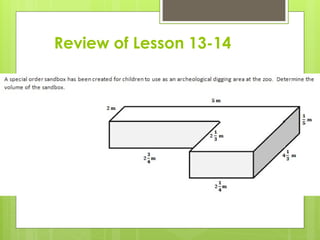
Review of Lesson 13-14
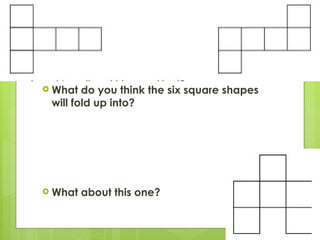
 What do you think the six square shapes
will fold up into?
 What about this one?
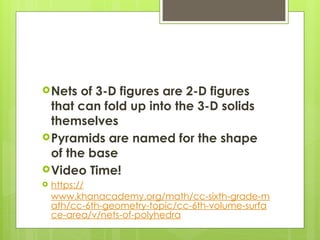
Nets of 3-D figures are 2-D figures
that can fold up into the 3-D solids
themselves
Pyramids are named for the shape
of the base
Video Time!
 https://
www.khanacademy.org/math/cc-sixth-grade-m
ath/cc-6th-geometry-topic/cc-6th-volume-surfa
ce-area/v/nets-of-polyhedra
Note…
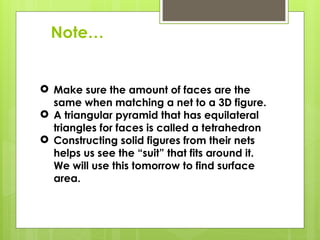
 Make sure the amount of faces are the
same when matching a net to a 3D figure.
 A triangular pyramid that has equilateral
triangles for faces is called a tetrahedron
 Constructing solid figures from their nets
helps us see the “suit” that fits around it.
We will use this tomorrow to find surface
area.
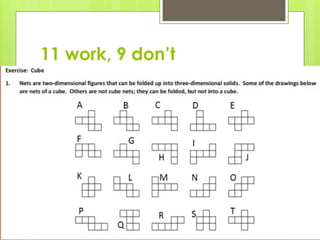
11 work, 9 don’t
Vocabulary
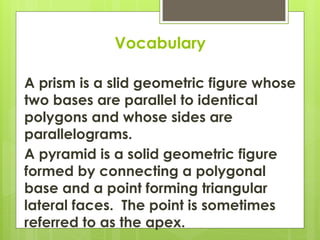
A prism is a slid geometric figure whose
two bases are parallel to identical
polygons and whose sides are
parallelograms.
A pyramid is a solid geometric figure
formed by connecting a polygonal
base and a point forming triangular
lateral faces. The point is sometimes
referred to as the apex.
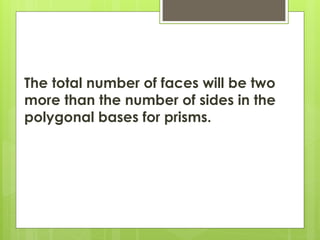
The total number of faces will be two
more than the number of sides in the
polygonal bases for prisms.
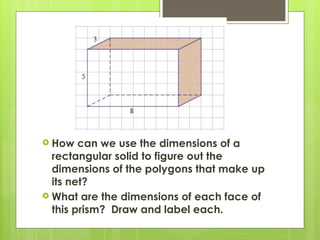
 How can we use the dimensions of a
rectangular solid to figure out the
dimensions of the polygons that make up
its net?
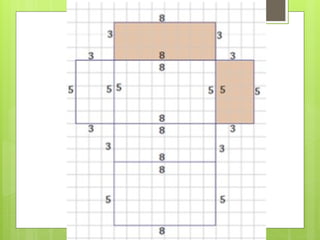
 What are the dimensions of each face of
this prism? Draw and label each.
Lesson Summary
& Evaluate Your Learning
Answer in complete sentences:
1 – What kind of information can be obtained
from a net of a prism about the solid it creates?
2 – When looking at a net, how can you
determine which faces are the bases?
3 – How do the nets of a prism differ from the
nets of a pyramid?
4 – What are the most important considerations
when making nets of solid figures?
How will you “Sharpen Your Saw”?

3-2 lesson 15-16 notes lesson geome.pptx

  • 1.
    Lesson Topic: Representing3- Dimensional Figures Using Nets & Constructing Nets Lesson Objective: I can… I can construct 3-dimensional figures through the use of nets, determine which nets make specific solid figures, and determine if nets can or cannot make a solid figure. Construct nets of 3-dimensional objects using the measurements of a solid’s edges.
  • 2.
    Looking Ahead… Final GeometryTest Thursday – Study & Practice!!! Come in for tutoring Thursday morning
  • 3.
    Review of Lesson11-12 To determine how many fractional unit cubes fit in a right rectangular prism: 1. Multiply each dimension by the denominator of the fractional size of the unit cube (length, width, & height) 2. Multiply lwh
  • 4.
  • 5.
     What doyou think the six square shapes will fold up into?  What about this one?
  • 6.
    Nets of 3-Dfigures are 2-D figures that can fold up into the 3-D solids themselves Pyramids are named for the shape of the base Video Time!  https:// www.khanacademy.org/math/cc-sixth-grade-m ath/cc-6th-geometry-topic/cc-6th-volume-surfa ce-area/v/nets-of-polyhedra
  • 7.
    Note…  Make surethe amount of faces are the same when matching a net to a 3D figure.  A triangular pyramid that has equilateral triangles for faces is called a tetrahedron  Constructing solid figures from their nets helps us see the “suit” that fits around it. We will use this tomorrow to find surface area.
  • 8.
    11 work, 9don’t
  • 9.
    Vocabulary A prism isa slid geometric figure whose two bases are parallel to identical polygons and whose sides are parallelograms. A pyramid is a solid geometric figure formed by connecting a polygonal base and a point forming triangular lateral faces. The point is sometimes referred to as the apex.
  • 10.
    The total numberof faces will be two more than the number of sides in the polygonal bases for prisms.
  • 11.
     How canwe use the dimensions of a rectangular solid to figure out the dimensions of the polygons that make up its net?  What are the dimensions of each face of this prism? Draw and label each.
  • 13.
    Lesson Summary & EvaluateYour Learning Answer in complete sentences: 1 – What kind of information can be obtained from a net of a prism about the solid it creates? 2 – When looking at a net, how can you determine which faces are the bases? 3 – How do the nets of a prism differ from the nets of a pyramid? 4 – What are the most important considerations when making nets of solid figures? How will you “Sharpen Your Saw”?

Editor's Notes

  • #1 Numbered heads together/kagan
  • #4 Describe this 3D figure: it looks like 2 rectangular prisms that have been placed together to form one large rectangular prism. I can think of it as a pice on the left/right or as a piece in front/behind
  • #8 Can: a, b, c, e, g, I, l, m, o, p, t Can’t: d, f, h, j, k, n, q, r, s
  • #11 Lw, wh, hl
  • #13 After all faces are made into polygons, what can you say about the arrangement ofthose polygons? Describe the similarities between the nets of right rectagular prisms. Describe the similarities between the nets of pyramids How can you test your net to be sure that it is really a true net of the solid?