SOLDERING-WELDING AND ITS
USE IN PROSTHODONTICS
DR GIRISH GALAGALI
MDS
Dept of Prosthodontics
Navodaya Dental College
CONTENTS.
 Introduction
 Definition of soldering.
 Composition of soldered joints.
 Technique of soldering.
 Steps of soldering.
 Definition of welding.
 Types of welding.
 Soldering welding in fixed partial denture.
 Soldering welding in removable partial denture.
 References
INTRODUCTION
 Soldering and welding technique is 5000 years old
process first seen in Mesopotamian civilization.
 High-temperature brazing and welding are common
joining methods in industrial metal constructions.
 Dental soldering is an adaptation from the jewelry
trade, with the important difference that, in dentistry,
accuracy, strength, and corrosion resistance are
very critical.
DEFINITION
SOLDERING:
Is defined as the joining of metals by the fusion of filler
metal between them, at a temperature below the
solidus temperature of the metals being joined and
below 450° C
BRAZING :
The joining of metals by the fusion of filler metal
between them, at a temperature below the solidus
temperature of the metals being joined and above 450°
C.
Use of soldering-
o For joining components of fixed partial denture.
o To overcome distortion in multiunit cast fixed prostheses.
o To overcome firing distortion in metal–ceramic FPDs..
o To repair perforation in crowns.
o To develop contact points in crowns.
o To solder clasps in removable partial dentures.
COMPONENTS OF SOLDERED JOINTS
 A). Parent metal
 B). Fluxes and anti- fluxes
 C). Solder or filler metal
1.PARENT METAL.
 The parent metal is the metal or alloy to be joined.
It is also known as substrate metal or base metal.
 Gold based, silver based, palladium based, nickel
based, cobalt based, pure titanium.- can be used as
parent metal.
 The composition of parent metal determines:
o melting range.
o oxide that forms on the surface during heating.
o wettability of the substrate by the molten solder.
2.FLUXES AND ANTI- FLUXES
 Flux- flow.
 In metallurgy, a substance used to increase fluidity and to
prevent or reduce oxidation of a molten metal.- GPT-9
 Any substance applied to surfaces to be joined by
brazing, soldering or welding to clean and free them from
oxides and promote union.- GPT-9
 a material such as borax glass (Na2B4O7) applied to a
metal surface to remove oxides or prevent their formation
to facilitate the flow of solder. GPT-9
TYPES OF FLUX
 Type I- surface protection= covers the metal
surface and prevent access to oxygen so that no
oxide can form.
 Type II- Reducing agent = they reduce any oxide
present to free metal and oxygen.
 Type III- solvent= they dissolve any oxides present
and carries them away.
COMMONLY USED DENTAL FLUXES
Boric and borate compounds-
 Boric acid and borax used with noble metal alloys.
 Borax fluxes are liquid at 1400◦Fand dissolve
oxides of Fe, Si, Ag, and Ni, but not Al, Cr, and Be.*
 Alkali bi-fluorides combined with borax or boric acid
were more effective at reducing oxides of Cr and
Be. Borax fluxes are liquid at 1400◦F
.*
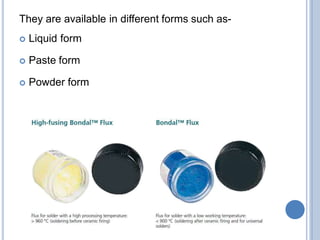
They are available in different forms such as-
 Liquid form
 Paste form
 Powder form
Fluorides-
 KF, KHF used as fluxes. Sometimes they combined with
borate compound to produce flux.
 A flux for hard soldering stainless steel, Ni–Cr, or Co–Cr
alloys must contain fluoride, for example mixtures of
borax or boric acid with KF or KHF. Fluorides dissolve Cr,
Ni, and Co oxides.
They are available in :
o Liquid.
o Paste.
o Spray.
o Powder.
o Pre fluxed solder in tube form.
ANTI FLUX
 Materials used to restrict flow of solder are known
as anti-flux. It is applied on the specific area where
the flux should not flow into. It is applied before
applying flux or solder.
3. FILLER METAL,
Qualities of an ideal solder:
 Easy Flow
 Sufficient fluidity to freely flow when melted.
 Ability to wet substrate metal.
 Strength compatible with that of structure being joined.
 Resistance to tarnish and corrosion
 Acceptable color to give an inconspicuous joint.
 Resistance to pitting during heating.
 Porcelain compatibility
TYPES-
 Soft Solders-
 Hard soders
 Gold solders
 Silver solders
 Pre and post ceramic solders
TECHNIQUE OF SOLDERING
1. Free hand soldering-
 Parts are held manually while heat and solder are
applied.
2. Invest soldering-
 In investment soldering the parts to be joined are
mounted in a soldering type of investment. The
hardened investment holds it in position while the
heat and solder is applied.
STEPS OF SOLDERING-
1. Cleaning and preparing the surface to be joined.
2. Assembling the parts to be joined.
3.Preparing and fluxing the gap surface
4. Maintaing proper position of the parts during
procedure.
5. Controlling the proper temperature and proper
source of heat
DEFINITION
 Welding is the joining of two pieces of metal without
the use of another metal.
 Welding- unite or fuse two pieces by hammering,
compression, or by rendering soft by heat with the
addition of a fusible material. – GPT-9
 Use-
o T
o repair parts of broken removable partial
denture.
o To join the wrought wire clasps.
TYPES OF WELDING
 Spot welding
 Laser welding
 Tungsten gas welding
 Plasma welding
CONCLUSION
 Soldering and welding is a useful and technique-
sensitive procedure. It may improve the
dimensional accuracy of multiunit fixed prostheses.
Many variables in soldering technique affect the
outcome. Research science has developed some
helpful guidelines. Research projects are
disconnected and limited in scope. New
technologies such as CAD/CAM and laser welding
may replace soldering in dentistry.

soldering & welding.pptx

  • 1.
    SOLDERING-WELDING AND ITS USEIN PROSTHODONTICS DR GIRISH GALAGALI MDS Dept of Prosthodontics Navodaya Dental College
  • 2.
    CONTENTS.  Introduction  Definitionof soldering.  Composition of soldered joints.  Technique of soldering.  Steps of soldering.  Definition of welding.  Types of welding.  Soldering welding in fixed partial denture.  Soldering welding in removable partial denture.  References
  • 3.
    INTRODUCTION  Soldering andwelding technique is 5000 years old process first seen in Mesopotamian civilization.  High-temperature brazing and welding are common joining methods in industrial metal constructions.  Dental soldering is an adaptation from the jewelry trade, with the important difference that, in dentistry, accuracy, strength, and corrosion resistance are very critical.
  • 4.
    DEFINITION SOLDERING: Is defined asthe joining of metals by the fusion of filler metal between them, at a temperature below the solidus temperature of the metals being joined and below 450° C BRAZING : The joining of metals by the fusion of filler metal between them, at a temperature below the solidus temperature of the metals being joined and above 450° C.
  • 5.
    Use of soldering- oFor joining components of fixed partial denture. o To overcome distortion in multiunit cast fixed prostheses. o To overcome firing distortion in metal–ceramic FPDs.. o To repair perforation in crowns. o To develop contact points in crowns. o To solder clasps in removable partial dentures.
  • 6.
    COMPONENTS OF SOLDEREDJOINTS  A). Parent metal  B). Fluxes and anti- fluxes  C). Solder or filler metal
  • 7.
    1.PARENT METAL.  Theparent metal is the metal or alloy to be joined. It is also known as substrate metal or base metal.  Gold based, silver based, palladium based, nickel based, cobalt based, pure titanium.- can be used as parent metal.  The composition of parent metal determines: o melting range. o oxide that forms on the surface during heating. o wettability of the substrate by the molten solder.
  • 8.
    2.FLUXES AND ANTI-FLUXES  Flux- flow.  In metallurgy, a substance used to increase fluidity and to prevent or reduce oxidation of a molten metal.- GPT-9  Any substance applied to surfaces to be joined by brazing, soldering or welding to clean and free them from oxides and promote union.- GPT-9  a material such as borax glass (Na2B4O7) applied to a metal surface to remove oxides or prevent their formation to facilitate the flow of solder. GPT-9
  • 9.
    TYPES OF FLUX Type I- surface protection= covers the metal surface and prevent access to oxygen so that no oxide can form.  Type II- Reducing agent = they reduce any oxide present to free metal and oxygen.  Type III- solvent= they dissolve any oxides present and carries them away.
  • 10.
    COMMONLY USED DENTALFLUXES Boric and borate compounds-  Boric acid and borax used with noble metal alloys.  Borax fluxes are liquid at 1400◦Fand dissolve oxides of Fe, Si, Ag, and Ni, but not Al, Cr, and Be.*  Alkali bi-fluorides combined with borax or boric acid were more effective at reducing oxides of Cr and Be. Borax fluxes are liquid at 1400◦F .*
  • 11.
    They are availablein different forms such as-  Liquid form  Paste form  Powder form
  • 12.
    Fluorides-  KF, KHFused as fluxes. Sometimes they combined with borate compound to produce flux.  A flux for hard soldering stainless steel, Ni–Cr, or Co–Cr alloys must contain fluoride, for example mixtures of borax or boric acid with KF or KHF. Fluorides dissolve Cr, Ni, and Co oxides.
  • 13.
    They are availablein : o Liquid. o Paste. o Spray. o Powder. o Pre fluxed solder in tube form.
  • 14.
    ANTI FLUX  Materialsused to restrict flow of solder are known as anti-flux. It is applied on the specific area where the flux should not flow into. It is applied before applying flux or solder.
  • 15.
    3. FILLER METAL, Qualitiesof an ideal solder:  Easy Flow  Sufficient fluidity to freely flow when melted.  Ability to wet substrate metal.  Strength compatible with that of structure being joined.  Resistance to tarnish and corrosion  Acceptable color to give an inconspicuous joint.  Resistance to pitting during heating.  Porcelain compatibility
  • 16.
    TYPES-  Soft Solders- Hard soders  Gold solders  Silver solders  Pre and post ceramic solders
  • 17.
    TECHNIQUE OF SOLDERING 1.Free hand soldering-  Parts are held manually while heat and solder are applied. 2. Invest soldering-  In investment soldering the parts to be joined are mounted in a soldering type of investment. The hardened investment holds it in position while the heat and solder is applied.
  • 18.
    STEPS OF SOLDERING- 1.Cleaning and preparing the surface to be joined. 2. Assembling the parts to be joined. 3.Preparing and fluxing the gap surface 4. Maintaing proper position of the parts during procedure. 5. Controlling the proper temperature and proper source of heat
  • 19.
    DEFINITION  Welding isthe joining of two pieces of metal without the use of another metal.  Welding- unite or fuse two pieces by hammering, compression, or by rendering soft by heat with the addition of a fusible material. – GPT-9  Use- o T o repair parts of broken removable partial denture. o To join the wrought wire clasps.
  • 20.
    TYPES OF WELDING Spot welding  Laser welding  Tungsten gas welding  Plasma welding
  • 21.
    CONCLUSION  Soldering andwelding is a useful and technique- sensitive procedure. It may improve the dimensional accuracy of multiunit fixed prostheses. Many variables in soldering technique affect the outcome. Research science has developed some helpful guidelines. Research projects are disconnected and limited in scope. New technologies such as CAD/CAM and laser welding may replace soldering in dentistry.