CASTING DEFECTS
DR. AATIF KHAN
1
INTRODUCTION
• A Casting defect is basically an error that occurs during the fabrication of a
prosthesis. (Mahalaxmi)
• Mostly caused due to the carelessness or ignorance of the operator and these can be
avoided if the fundamentals and principles of casting procedures are followed strictly.
• An unsuccessful casting results in considerable trouble and loss of time.
2
TYPE OF CASTING DEFECTS
I. DISTORTION
II. SURFACE ROUGHNESS & IRREGULARITIES
III. POROSITY
IV. INCOMPLETE OR MISSING DETAIL
V. SURFACE DISCOLOURATION
3
1. DISTORTION
• Distortion leads to a change in the shape and size
of a prosthesis.
• Wax distortion is the most serious problem that can
occur during the forming and removal of the
pattern from the mouth or die.
4DISTORTION
Causes:
• Mishandling of the wax pattern.
• Pressure from setting and hygroscopic expansion
of investment material.
• Contraction on cooling.
• Thickness of the wax.
Marginal discrepancy due to distortion of
wax pattern/ uneven expansion.
5DISTORTION
PREVENTION -
• Use of Hard wax.
• Place the wax in increments and at uniform
temperature.
• Do not over heat wax or allow the wax to cool
suddenly.
• Carve with sharp instruments.
6DISTORTION
PREVENTION -
• Careful handling of wax pattern while
removing it from the die/mouth.
• Invest wax pattern immediately to prevent
warpage.
• Place it in the centre of the casting ring.
7DISTORTION
2. SURFACE ROUGHNESS AND
IRREGULARITIES
• Surface roughness is defined as relatively finely spaced surface imperfections whose
height, width, and direction establish the predominant surface pattern.
• Surface irregularities are isolated imperfections, such as nodules, that are not
characteristic of the entire surface area.
• Excessive roughness or irregularities on the outer surface of the casting necessitate
additional finishing and polishing, whereas irregularities on the cavity surface
prevent proper seating of an otherwise accurate casting.
8
SURFACE ROUGHNESS
9SURFACE ROUGHNESS
CAUSES OF SURFACE ROUGHNESS -
•Particle size of the investment and its ability to reproduce the wax pattern in
microscopic detail.
• Binder-Silica Ratio influences the surface texture of the casting. Coarse silica causes
surface roughness.
• Prolonged heating of investment material (Gypsum) → Breakdown of investment at
excessive burnout temperature.
• High L/P ratio.
• Excess of wetting agent – dilutes investment.
• When foreign substances get into the mold.
• Impact of highly heated molten alloy on the mold wall. (Attacks mold surface)
10SURFACE ROUGHNESS
SURFACE
IRREGULARITIES
11
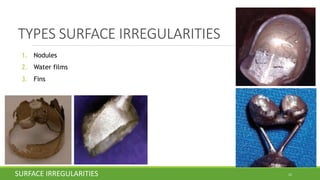
TYPES SURFACE IRREGULARITIES
1. Nodules
2. Water films
3. Fins
12SURFACE IRREGULARITIES
1. NODULES
• Small nodules on a casting are caused by air bubbles that become attached
to the pattern during or after investing.
• Nodules on margins or on internal surfaces might alter the fit of the
casting.
• Improper brush technique – multiple nodules.
Prevention:
1. Use the vacuum investing technique.
2. Manual- mixing mixer with vibration.
3. Wetting agent – thin layer & air dried.
13SURFACE IRREGULARITIES
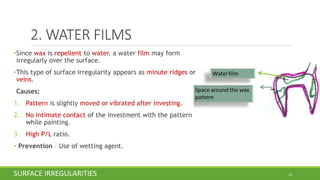
2. WATER FILMS
•Since wax is repellent to water, a water film may form
irregularly over the surface.
•This type of surface irregularity appears as minute ridges or
veins.
Causes:
1. Pattern is slightly moved or vibrated after investing.
2. No intimate contact of the investment with the pattern
while painting.
3. High P/L ratio.
• Prevention – Use of wetting agent.
14SURFACE IRREGULARITIES
3. FINS
• Thin metal extensions observed in castings.
• Fins occur when cracks are produced in the investment
that radiate out from the surface of the pattern .
• Molten alloy flows into the cracks forming thin fins on the
casting.
• Increases the time required for finishing.
15SURFACE IRREGULARITIESSURFACE IRREGULARITIES - FINS
CAUSES OF FIN FORMATION
1. Improper positioning of the pattern.
• Positioning of several patterns too close and in the same plane in the mold, lead to
formation of fins.
The expansion of the wax is much greater than that of the investment, causing
breakdown or cracking of the investment if the spacing between patterns is less than
3mm.
16SURFACE IRREGULARITIESSURFACE IRREGULARITIES - FINS
CAUSES OF FIN FORMATION
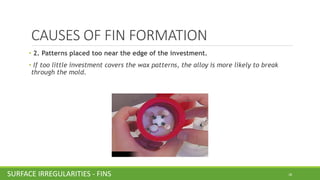
• 2. Patterns placed too near the edge of the investment.
• If too little investment covers the wax patterns, the alloy is more likely to break
through the mold.
18SURFACE IRREGULARITIESSURFACE IRREGULARITIES - FINS
• Correct position for a single coping in the
investment ring.
• The periphery should be 6 mm from the end of
a standard investment ring.
19SURFACE IRREGULARITIESSURFACE IRREGULARITIES - FINS
CAUSES OF FIN FORMATION
3. High Heating Rates –
• High heating rate of investment material – outer layer heats up faster.
• Outer layer tends to expand – held back by inner cooler part.
• Outer layer → Compressive stress, Inner layer → Tensile stress.
• Investment (brittle material) – cracks under tensile stress.
• Cracks filled with alloy Fins.
20SURFACE IRREGULARITIESSURFACE IRREGULARITIES - FINS
PREVENTION
• Ideally, 60 mins should elapse during the heating of the investment filled ring from
room temperature to 700º C.
• The greater the bulk of the investment, the more slow it should be heated.
21SURFACE IRREGULARITIESSURFACE IRREGULARITIES - FINS
CAUSES OF FIN FORMATON
4. Premature Heating -
• If setting is not complete at the time when ring is placed in the oven, the mold may
become weak and unable to withstand steam pressure during burnout.
Prevention :
• Burnout should be initiated only after the recommended setting time.
22SURFACE IRREGULARITIESSURFACE IRREGULARITIES - FINS
CAUSES OF FIN FORMATION
5. Casting Pressure -
•Too high pressure during casting causes fins.
Prevention :
• Casting should provide enough force to cause the liquid alloy to flow onto the heated
mold.
• Adjust the casting machine to the requirements of each alloy.
23SURFACE IRREGULARITIES - FINS
3. POROSITIES
Solidification defects –
A. Localized shrinkage porosity.
B. Micro-porosity.
C. Suck-back porosity.
Trapped gases –
A. Pinhole porosity.
B. Gas inclusions.
C. Subsurface porosity.
D. Back pressure porosity.
24
POROSITIES
DUE TO SOLIDIFICATION DEFECTS -
25
A. LOCALIZED SHRINKAGE POROSITY
• Premature termination of the flow of molten metal during solidification.
• Linear contraction of noble metal alloys from a liquid to a solid state is at least 1.25%.
• If the sprue freezes in its cross section before this flow is completed to the casting
proper, a localized shrinkage void will occur in the last portion of the casting that
solidifies.
26LOCALIZED SHRINKAGE POROSITY
• Occurs usually near the sprue-casting junction as it is the last and the bulkiest portion
of the casting to solidify.
27LOCALIZED SHRINKAGE POROSITY
Solidifies first
Solidifies later
Solidifies last
Normal metal flow and order of solidification Changes in solidification leading to localized shrinkage
PREVENTION
Use of reservoir –
• Attach the large reservoir in the sprue
of thickness more than the thickest portion of
the pattern and as close as possible to the pattern.
Alloy that fills the restoration will
solidify first.
As the molten metal solidifies, it
shrinks and creates a vacuum
Vacuum will draw additional metal
from an adjacent source → The
reservoir.
28LOCALIZED SHRINKAGE POROSITY
PREVENTION
• Position the wax pattern in a “cold zone” of the investment
mold and the reservoir in the “heat centre” of the casting ring.
• Investment covering the patterns - no more than ¼ inch (6mm)
• The proper length of sprue is
important to keep the pattern away
from heat center close to the end
of the casting ring.
29LOCALIZED SHRINKAGE POROSITY
6mm
B. MICROPOROSITY
• Generally present in fine-grain alloy castings when the
solidification is too rapid for the microvoids to segregate
to the liquid pool.
• This premature solidification causes the formation of
small, irregular voids.
• Occurs from rapid solidification if the mold or casting
temperature is too low.
• Unfortunately, this type of defect is not detectable
unless the casting is sectioned.
30SOLIDIFICATION DEFECT
C. SUCK BACK POROSITY
• Occurs in the interior of a crown near the area of the sprue, if a hot spot has been created by the
hot metal impinging from the sprue channel on a point of the mold wall.
• Hot spot causes the local region to freeze last and results in suck-back porosity.
• It often occurs at an occlusoaxial line angle or incisoaxial line angle that is not well rounded and
when sprue is attached at 90 degrees to the pattern.
31SUCK BACK POROSITY
C. SUCK BACK POROSITY
32SUCK BACK POROSITY
Hot spot
Impedance to flow
Sprue
90º
45º
Sprue former
Continuity of flow
Prevention – Flare the point of sprue attachment 33
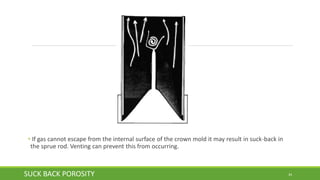
• If gas cannot escape from the internal surface of the crown mold it may result in suck-back in
the sprue rod. Venting can prevent this from occurring.
34SUCK BACK POROSITY
POROSITIES
DUE TO TRAPPED GASES -
35
1. PINHOLE POROSITY
• Many metals dissolve or occlude gases in their molten state e.g. both
copper and silver dissolve O2 in large amount in liquid state.
• Molten platinum and palladium have a strong affinity for hydrogen as well
as oxygen.
• On solidification of metal absorbed gases are expelled resulting in pinhole
porosities.
• Castings that are severely contaminated with gases are usually black when
removed and do not clean easily on pickling.
36
2. GAS INCLUSION POROSITY
•The gas inclusion porosities are usually much larger than pinhole porosity.
•The larger spherical voids are caused by gas that is mechanically trapped by the
molten metal in the mold or by gas that is incorporated during the casting procedure.
37GAS INCLUSION POROSITY
The gas could be occluded from poorly adjusted torch flame or by use of mixing or
oxidizing zone of flame rather than reducing zone.
38GAS INCLUSION POROSITY
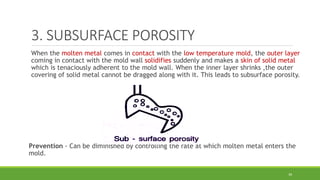
3. SUBSURFACE POROSITY
When the molten metal comes in contact with the low temperature mold, the outer layer
coming in contact with the mold wall solidifies suddenly and makes a skin of solid metal
which is tenaciously adherent to the mold wall. When the inner layer shrinks ,the outer
covering of solid metal cannot be dragged along with it. This leads to subsurface porosity.
Prevention - Can be diminished by controlling the rate at which molten metal enters the
mold.
39
D. BACK PRESSURE POROSITY
• Air/Gases present in the mold cavity are pushed out by molten metal.
• Presence of air in the cavity will not allow the metal to flow.
Air in mold escapes by:
1. Pores in the investment.
2. By pressure gradient that displaces the air pocket toward the end of the investment
via the molten sprue and button.
40BACK PRESSURE POROSITY
• Back pressure effects are caused by an inability of air or other gases within the mold
to escape, making a way for the alloy.
• As the liquid enters the mould through the sprue, the air trapped in the mold is
compressed at the extremities, which exerts back pressure preventing the alloy liquid
to occupy this region.
• Usually found in a “pocket” at the occlusal surface of a crown or mesio-occlusal-distal
casting.
41BACK PRESSURE POROSITY
A casting which has been subjected to back pressure is rounded at the
edges and lacking in detail.
42BACK PRESSURE POROSITY
Rounded edges due
to back pressure.
Causes:
• Dense modern investments.
• Increased distance between the pattern and end of the casting ring.
• Inadequate casting and mold temperature.
• Clogging of mold with residual carbon.
43BACK PRESSURE POROSITY
Prevention:
• Proper burnout temperature.
• Adequate mold and casting temperature.
• High casting pressure.
• Proper L/P ratio.
• Thickness of investment between pattern and end of casting ring not greater than
6mm.
44BACK PRESSURE POROSITY
INCOMPLETE CASTING
45
4. INCOMPLETE CASTING
Causes:
• Insufficient venting of the mold.
• High viscosity of the fused metal.
• Insufficient casting pressure.
• Incomplete elimination of wax.
• Insufficient alloy.
• Blocking due to pre-solidification in sprue.
46
SURFACE
DISCOLORATION
47
5. SURFACE DISCOLORATION -
•Prolonged heating of the mold cause disintegration of gypsum bonded investment and
products of decomposition are sulphur compounds that contaminate the alloy to the
extent that surface texture is affected. Does not respond to pickling.
•Surface discoloration also results from high sulphur content of flame torch.
• Interaction of molten alloy with Sulphur→ Black/Grey layer on the surface of gold
alloys that is brittle and doesn't clean readily during pickling.
48
49
50
51
THANK YOU
52

Casting defects

  • 1.
  • 2.
    INTRODUCTION • A Castingdefect is basically an error that occurs during the fabrication of a prosthesis. (Mahalaxmi) • Mostly caused due to the carelessness or ignorance of the operator and these can be avoided if the fundamentals and principles of casting procedures are followed strictly. • An unsuccessful casting results in considerable trouble and loss of time. 2
  • 3.
    TYPE OF CASTINGDEFECTS I. DISTORTION II. SURFACE ROUGHNESS & IRREGULARITIES III. POROSITY IV. INCOMPLETE OR MISSING DETAIL V. SURFACE DISCOLOURATION 3
  • 4.
    1. DISTORTION • Distortionleads to a change in the shape and size of a prosthesis. • Wax distortion is the most serious problem that can occur during the forming and removal of the pattern from the mouth or die. 4DISTORTION
  • 5.
    Causes: • Mishandling ofthe wax pattern. • Pressure from setting and hygroscopic expansion of investment material. • Contraction on cooling. • Thickness of the wax. Marginal discrepancy due to distortion of wax pattern/ uneven expansion. 5DISTORTION
  • 6.
    PREVENTION - • Useof Hard wax. • Place the wax in increments and at uniform temperature. • Do not over heat wax or allow the wax to cool suddenly. • Carve with sharp instruments. 6DISTORTION
  • 7.
    PREVENTION - • Carefulhandling of wax pattern while removing it from the die/mouth. • Invest wax pattern immediately to prevent warpage. • Place it in the centre of the casting ring. 7DISTORTION
  • 8.
    2. SURFACE ROUGHNESSAND IRREGULARITIES • Surface roughness is defined as relatively finely spaced surface imperfections whose height, width, and direction establish the predominant surface pattern. • Surface irregularities are isolated imperfections, such as nodules, that are not characteristic of the entire surface area. • Excessive roughness or irregularities on the outer surface of the casting necessitate additional finishing and polishing, whereas irregularities on the cavity surface prevent proper seating of an otherwise accurate casting. 8
  • 9.
  • 10.
    CAUSES OF SURFACEROUGHNESS - •Particle size of the investment and its ability to reproduce the wax pattern in microscopic detail. • Binder-Silica Ratio influences the surface texture of the casting. Coarse silica causes surface roughness. • Prolonged heating of investment material (Gypsum) → Breakdown of investment at excessive burnout temperature. • High L/P ratio. • Excess of wetting agent – dilutes investment. • When foreign substances get into the mold. • Impact of highly heated molten alloy on the mold wall. (Attacks mold surface) 10SURFACE ROUGHNESS
  • 11.
  • 12.
    TYPES SURFACE IRREGULARITIES 1.Nodules 2. Water films 3. Fins 12SURFACE IRREGULARITIES
  • 13.
    1. NODULES • Smallnodules on a casting are caused by air bubbles that become attached to the pattern during or after investing. • Nodules on margins or on internal surfaces might alter the fit of the casting. • Improper brush technique – multiple nodules. Prevention: 1. Use the vacuum investing technique. 2. Manual- mixing mixer with vibration. 3. Wetting agent – thin layer & air dried. 13SURFACE IRREGULARITIES
  • 14.
    2. WATER FILMS •Sincewax is repellent to water, a water film may form irregularly over the surface. •This type of surface irregularity appears as minute ridges or veins. Causes: 1. Pattern is slightly moved or vibrated after investing. 2. No intimate contact of the investment with the pattern while painting. 3. High P/L ratio. • Prevention – Use of wetting agent. 14SURFACE IRREGULARITIES
  • 15.
    3. FINS • Thinmetal extensions observed in castings. • Fins occur when cracks are produced in the investment that radiate out from the surface of the pattern . • Molten alloy flows into the cracks forming thin fins on the casting. • Increases the time required for finishing. 15SURFACE IRREGULARITIESSURFACE IRREGULARITIES - FINS
  • 16.
    CAUSES OF FINFORMATION 1. Improper positioning of the pattern. • Positioning of several patterns too close and in the same plane in the mold, lead to formation of fins. The expansion of the wax is much greater than that of the investment, causing breakdown or cracking of the investment if the spacing between patterns is less than 3mm. 16SURFACE IRREGULARITIESSURFACE IRREGULARITIES - FINS
  • 17.
    CAUSES OF FINFORMATION • 2. Patterns placed too near the edge of the investment. • If too little investment covers the wax patterns, the alloy is more likely to break through the mold. 18SURFACE IRREGULARITIESSURFACE IRREGULARITIES - FINS
  • 18.
    • Correct positionfor a single coping in the investment ring. • The periphery should be 6 mm from the end of a standard investment ring. 19SURFACE IRREGULARITIESSURFACE IRREGULARITIES - FINS
  • 19.
    CAUSES OF FINFORMATION 3. High Heating Rates – • High heating rate of investment material – outer layer heats up faster. • Outer layer tends to expand – held back by inner cooler part. • Outer layer → Compressive stress, Inner layer → Tensile stress. • Investment (brittle material) – cracks under tensile stress. • Cracks filled with alloy Fins. 20SURFACE IRREGULARITIESSURFACE IRREGULARITIES - FINS
  • 20.
    PREVENTION • Ideally, 60mins should elapse during the heating of the investment filled ring from room temperature to 700º C. • The greater the bulk of the investment, the more slow it should be heated. 21SURFACE IRREGULARITIESSURFACE IRREGULARITIES - FINS
  • 21.
    CAUSES OF FINFORMATON 4. Premature Heating - • If setting is not complete at the time when ring is placed in the oven, the mold may become weak and unable to withstand steam pressure during burnout. Prevention : • Burnout should be initiated only after the recommended setting time. 22SURFACE IRREGULARITIESSURFACE IRREGULARITIES - FINS
  • 22.
    CAUSES OF FINFORMATION 5. Casting Pressure - •Too high pressure during casting causes fins. Prevention : • Casting should provide enough force to cause the liquid alloy to flow onto the heated mold. • Adjust the casting machine to the requirements of each alloy. 23SURFACE IRREGULARITIES - FINS
  • 23.
    3. POROSITIES Solidification defects– A. Localized shrinkage porosity. B. Micro-porosity. C. Suck-back porosity. Trapped gases – A. Pinhole porosity. B. Gas inclusions. C. Subsurface porosity. D. Back pressure porosity. 24
  • 24.
  • 25.
    A. LOCALIZED SHRINKAGEPOROSITY • Premature termination of the flow of molten metal during solidification. • Linear contraction of noble metal alloys from a liquid to a solid state is at least 1.25%. • If the sprue freezes in its cross section before this flow is completed to the casting proper, a localized shrinkage void will occur in the last portion of the casting that solidifies. 26LOCALIZED SHRINKAGE POROSITY
  • 26.
    • Occurs usuallynear the sprue-casting junction as it is the last and the bulkiest portion of the casting to solidify. 27LOCALIZED SHRINKAGE POROSITY Solidifies first Solidifies later Solidifies last Normal metal flow and order of solidification Changes in solidification leading to localized shrinkage
  • 27.
    PREVENTION Use of reservoir– • Attach the large reservoir in the sprue of thickness more than the thickest portion of the pattern and as close as possible to the pattern. Alloy that fills the restoration will solidify first. As the molten metal solidifies, it shrinks and creates a vacuum Vacuum will draw additional metal from an adjacent source → The reservoir. 28LOCALIZED SHRINKAGE POROSITY
  • 28.
    PREVENTION • Position thewax pattern in a “cold zone” of the investment mold and the reservoir in the “heat centre” of the casting ring. • Investment covering the patterns - no more than ¼ inch (6mm) • The proper length of sprue is important to keep the pattern away from heat center close to the end of the casting ring. 29LOCALIZED SHRINKAGE POROSITY 6mm
  • 29.
    B. MICROPOROSITY • Generallypresent in fine-grain alloy castings when the solidification is too rapid for the microvoids to segregate to the liquid pool. • This premature solidification causes the formation of small, irregular voids. • Occurs from rapid solidification if the mold or casting temperature is too low. • Unfortunately, this type of defect is not detectable unless the casting is sectioned. 30SOLIDIFICATION DEFECT
  • 30.
    C. SUCK BACKPOROSITY • Occurs in the interior of a crown near the area of the sprue, if a hot spot has been created by the hot metal impinging from the sprue channel on a point of the mold wall. • Hot spot causes the local region to freeze last and results in suck-back porosity. • It often occurs at an occlusoaxial line angle or incisoaxial line angle that is not well rounded and when sprue is attached at 90 degrees to the pattern. 31SUCK BACK POROSITY
  • 31.
    C. SUCK BACKPOROSITY 32SUCK BACK POROSITY
  • 32.
    Hot spot Impedance toflow Sprue 90º 45º Sprue former Continuity of flow Prevention – Flare the point of sprue attachment 33
  • 33.
    • If gascannot escape from the internal surface of the crown mold it may result in suck-back in the sprue rod. Venting can prevent this from occurring. 34SUCK BACK POROSITY
  • 34.
  • 35.
    1. PINHOLE POROSITY •Many metals dissolve or occlude gases in their molten state e.g. both copper and silver dissolve O2 in large amount in liquid state. • Molten platinum and palladium have a strong affinity for hydrogen as well as oxygen. • On solidification of metal absorbed gases are expelled resulting in pinhole porosities. • Castings that are severely contaminated with gases are usually black when removed and do not clean easily on pickling. 36
  • 36.
    2. GAS INCLUSIONPOROSITY •The gas inclusion porosities are usually much larger than pinhole porosity. •The larger spherical voids are caused by gas that is mechanically trapped by the molten metal in the mold or by gas that is incorporated during the casting procedure. 37GAS INCLUSION POROSITY
  • 37.
    The gas couldbe occluded from poorly adjusted torch flame or by use of mixing or oxidizing zone of flame rather than reducing zone. 38GAS INCLUSION POROSITY
  • 38.
    3. SUBSURFACE POROSITY Whenthe molten metal comes in contact with the low temperature mold, the outer layer coming in contact with the mold wall solidifies suddenly and makes a skin of solid metal which is tenaciously adherent to the mold wall. When the inner layer shrinks ,the outer covering of solid metal cannot be dragged along with it. This leads to subsurface porosity. Prevention - Can be diminished by controlling the rate at which molten metal enters the mold. 39
  • 39.
    D. BACK PRESSUREPOROSITY • Air/Gases present in the mold cavity are pushed out by molten metal. • Presence of air in the cavity will not allow the metal to flow. Air in mold escapes by: 1. Pores in the investment. 2. By pressure gradient that displaces the air pocket toward the end of the investment via the molten sprue and button. 40BACK PRESSURE POROSITY
  • 40.
    • Back pressureeffects are caused by an inability of air or other gases within the mold to escape, making a way for the alloy. • As the liquid enters the mould through the sprue, the air trapped in the mold is compressed at the extremities, which exerts back pressure preventing the alloy liquid to occupy this region. • Usually found in a “pocket” at the occlusal surface of a crown or mesio-occlusal-distal casting. 41BACK PRESSURE POROSITY
  • 41.
    A casting whichhas been subjected to back pressure is rounded at the edges and lacking in detail. 42BACK PRESSURE POROSITY Rounded edges due to back pressure.
  • 42.
    Causes: • Dense moderninvestments. • Increased distance between the pattern and end of the casting ring. • Inadequate casting and mold temperature. • Clogging of mold with residual carbon. 43BACK PRESSURE POROSITY
  • 43.
    Prevention: • Proper burnouttemperature. • Adequate mold and casting temperature. • High casting pressure. • Proper L/P ratio. • Thickness of investment between pattern and end of casting ring not greater than 6mm. 44BACK PRESSURE POROSITY
  • 44.
  • 45.
    4. INCOMPLETE CASTING Causes: •Insufficient venting of the mold. • High viscosity of the fused metal. • Insufficient casting pressure. • Incomplete elimination of wax. • Insufficient alloy. • Blocking due to pre-solidification in sprue. 46
  • 46.
  • 47.
    5. SURFACE DISCOLORATION- •Prolonged heating of the mold cause disintegration of gypsum bonded investment and products of decomposition are sulphur compounds that contaminate the alloy to the extent that surface texture is affected. Does not respond to pickling. •Surface discoloration also results from high sulphur content of flame torch. • Interaction of molten alloy with Sulphur→ Black/Grey layer on the surface of gold alloys that is brittle and doesn't clean readily during pickling. 48
  • 48.
  • 49.
  • 50.
  • 51.