DEPARTMENT OF
COSERVATIVE DENTISTRY &
ENDODONTICS
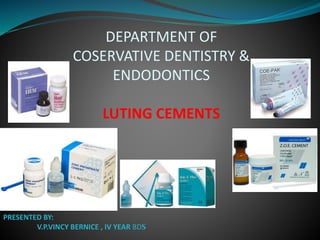
LUTING CEMENTS
PRESENTED BY:
V.P.VINCY BERNICE , IV YEAR BDS
INTRODUCTION
Luting :
the use of moldable substance to seal a space between
two component.
Luting Agent:
 In dentistry it is used to seal the space between the
tooth and the restoration
LUTING AGENT
 Commonly used are
Zinc phosphate cement
Zinc Polycarboxylate
Cement
Zinc Oxide Eugenol
Cement
Glass Ionomer
Cement
RMGIC
Resin cements
Zinc phosphate cement
Introduction
 Zinc phosphate is the oldest among cementing agent.
 It serves as “Gold Standard” for all dental cements,
adopted by A.D.A. in 1935, with specification no 8. & it
designates them as two types on the basis of intended
use.
 Type I: Fine grained for luting.
Film thickness 25 um or less
 Type II: Medium grain for luting and filling.
Film thickness not more than 40um
Composition
Powder
 Zinc oxide – 90% - Principal constituent
 Magnesium oxide – 8% - Helps in hydration process
during setting reaction
 Other oxides(Bismuth trioxide,Calcium Oxide etc)-0.2%
- improves smoothness of the mix
 Silica - 1.4% - Act as filler.
 Liquid
 Phosphoric acid – 38.2% (pH < 2) - reacts with zinc
oxide. The acid content is 33 % wt
 Waters - 36% - controls acid-base reaction
 Aluminium and zinc phosphate – 16.2 % reduces rate
of reaction.
 Aluminium and Zinc -10 %
SETTING REACTION
 When the powder is mixed with liquid , the
phosphoric acid attacks the surface of the particles -
releases zinc ions into the liquid – aluminium, which
already forms a complex with the phosphoric acid ,
reacts with zinc - zinc alumino phosphate gel on the
surface of the remaining portions of the particles.
 Water is critical to the reaction.
 ZnO + H3PO4  Zn3(Po4)2 + H2O
 Changes in composition and reaction rates might
occur due to degradation of the liquid or water
evaporation from the liquid
 Liquid degradation effects are exhibited as clouding of
the liquid
 Loss of water from acid increases the setting time
Working and Setting Times
 Mixing time of 1.5 – 2 mins
 Setting time – 2.5 – 8 mins
 The following procedures can extend the setting time
 Reducing P/L ratio
 Mixing in increments
 Prolonging the spatulation of last increment.
 Cooling the glass slab
Physical Properties
 Compressive strength :104MPa
 Tensile strength:5.5MPa
 Thermal conductivity : 3.11 mcal.cm/cm2.sec.K
 Low water solubility 0.04wt%
 More soluble in dilute organic acids
 Modulus of elasticity:13.7GPa
 Quiet stiff & resistant to elastic deformation
Loss/Gain water content compressive tensile strength.
Retention
Doesn’t involve reaction with surrounding hard
tissue/restorative material
No chemical interactions
Mechanical bonding at interfaces
Biological Properties
 Acidity of cement is quite high during the time of
application - presence of phosphoric acid
2 min after the start of mixing , Ph is 2
increases rapidly
reaches about 5.5 in 24 hrs
 Pulpal damage can occur during first few hours.
 High heat production during setting of the cement can
also cause pulpal injury.
Manipulation
 Incorporate powder - liquid
 Recommended p/l ratio – 1.4gm - 0.5ml
 A cool mixing slab prolongs the working and setting
time
Liquid dispensed onto the slab
evaporation
 Powder -several increments
 spatulated : 15 – 20 secs
 smaller quantities - first few
increments – working - setting time.
 middle of the mixing – larger amounts
of powder– to further saturate the
liquid with newly formed zinc
phosphate.
 Finally , smaller increments are added
– so that the desired ultimate
consistency of the cement is not
exceeded
 begins & ends with small increments
String test
Proper consistency for luting :
The mixture is strung up the
mixture should produce about a 1
inch “string” (without separation)
when stretching the mixture up
with a spatula.
Frozen Slab Method
 In this method, a glass slab is cooled in a refrigerator
at 6"C or a freezer at-10' C.
 No attempt is made to prevent moisture from
condensing on the slab when it is brought to room
conditions. A mix of cement is made on the cold slab
by adding the powder until the correct consistency is
reached.
 The amount of powder incorporated with the frozen
slab method is50% to 75% more than with the normal
procedures.
 The compressive and tensile strength of cement
prepared by the frozen slab method are not
significantly different from those prepared from
normal mixes.
 However, because incorporation of condensed
moisture into the mix in the frozen slab method
counteracts the higher powder/liquid ratio.
 No difference exists in the solubility of frozen slab and
normal mixes.
Advantages :
 The advantages of the frozen slab method are :
 A substantial increase in the working time (4 to
11 minutes) of the mix on the slab
 A shorter setting time(20% to40% less) of the mix after
placement into the mouth.
 This method has also been advocated for cementation
of bridges with multiple pins.
FACTORS GOVERNING THE RATE OF SET OF
ZINC PHOSPHATE CEMENT
 Controlled by manufacturer
A) Powder composition
B) Degree of powder calcination
C) Particle size of the powder
D) Water content of liquid
E) Neutralization of liquid
A)Powder/ liquid ratio
B) Rate of powder
incorporation
C) Mixing temperature
D) Manner of spatulation
E) Water contamination
or loss from fluid.
CONTROLLED BY THE OPERATOR
Applications
 Luting permanent restorations
 Bases
 Cementation of orthodontic bands
 Provisional restoration
ADVANTAGES
 Long track record
 Good compressive strength
DRAWBACKS
• Zinc phosphate is brittle.
• It has a relatively high solubility in the mouth and it does
not adhere to tooth substance.
• Zinc phosphate relies on mechanical interlocking for its
retentive effect.
• It does not provide any chemical bonding to tooth or metal
surfaces.
Modified zinc phosphate cement
 Fluoride cement
 Add Stannous fluoride
 Higher solubility/ Lower strength
 Zinc silicophosphate
 Zinc phosphate + Silicate
 Higher strength/ lower solubility
 Fluoride released
 Translucency
Zinc Polycarboxylate Cement
Introduction
 Zinc polyacrylate cement
 First - adhesive bond to tooth structure.
 Supplied as
 Powder and liquid
Composition
 Powder
Zinc oxide – 72% Basic ingredient
Magnesium oxide – 7% Modifier , aids in sintering
Other oxides like bismuth
and aluminium
Stannous fluoride
Increase strength, modifies
setting time, imparts
anticariogenic properties
 Liquid
 Aqueous solution of polycarboxylic acid (32-48%)
Or
 Copolymer of acrylic acid with other unsaturated
carboxylic acids (itaconic , maleic , tricarboxylic acids)
Chemical reaction
 When acid comes in contact with powder , acid reacts
and releases zinc, magnesium, and tin ions
 They bond to the polymer chain , through the carboxyl
groups
 These ions also react with carboxylic groups of
adjacent poly acid chains
 Cross inked salts are formed
Bonding to tooth structure
 Poly acrylic acid reacts with calcium ions via carboxyl
groups on the surface of enamel or dentin.
 Bond strength greater on enamel than dentin.
 Enamel 3.4-13.1MPA Dentin 2.07MPA
Working and Setting time
 Working time : 2.5 min
 Setting time : 6-9 min
 Lowering the temperature of chemical reaction can
increase the setting time.
Mechanical Properties
 Compressive strength : 55-67 Mpa
 Tensile strength : 2.4-4.4 Gpa
 Modules of elasticity is lower then zinc phosphate
cement 5.1GPa
 More soluble than zinc phosphate cement 0.06%
 More soluble in organic acids.
 Not as brittle as zinc phosphate cement
 Excess removal is difficult.
Biological Consideration
 Pulpal response termed as mild
 Ph of liquid is 1- 1.7
 Freshly mixed cement – 3-4
 After 24 hrs – 5 -6
Manipulation
 A cooled glass slab / powder
 1.5 parts of powder to 1 part of liquid by weight
 Liquid not dispensed , before the start
 Loss of water, increases viscosity
 Powder is rapidly incorporated into the liquid in large
quantities
 Mixing time is with in 30 – 60 sec ,with half to all of
powder incorporated at once to provide the maximum
length of working time
 Surface - glossy , acid present to provide sufficient
carboxylic groups to bond.
Glossy Appearance
Dull Appearance
Applications
 Primarily for luting permanent restorations
 As bases and liners
 Cementation in orthodontic treatment
DRAWBACKS
 High viscosity.
 Short setting time.
 High intraoral solubility
Zinc Oxide Eugenol Cement
Introduction
 These cements have been extensively used in dentistry
since 1890’ s
 They are least irritant of all dental cements
 Have an obtundant or sedative effect
 Compatible with the hard and soft tissues of the
mouth
Classification
 Type 1 ZOE – for temporary cementation
 Type 2 ZOE – permanent cementation
 Type 3 ZOE – temporary filling material , thermal
insulation
 Type 4 ZOE – Cavity liners
Composition
 Powder
Zinc oxide – 69% Principle ingredient
White rosin –
29.3%
Reduce brittleness
Zinc stearate – 1% Accelerator , plasticizer
Zinc acetate –
0.7%
Accelerator , improves strength
Magnesium oxide Added in some powders
 Liquid
Setting reaction
 First , hydrolysis of zinc oxide to its hydroxide
 Water is essential for reaction to proceed
 reaction is a acid base one,
 Zinc hydroxide combines with eugenol to form a chelate
ZnO + H2O → Zn(OH)2
 ZINC EUGENOLATE
 Forms an amorphous gel, which later tends to crystallize.
 Structure : particles of unreacted zinc oxide embedded in a
matrix of zinc eugenolate
Zn(OH)2 + 2HE → ZnE2 + 2H2O
Manipulation
 p/l ratio 4:1 to 6:1 by wt
 the bulk - incorporated into the liquid -spatulated
thoroughly in a circular motion - a stiff bladed spatula
 Small increments - until the mix is complete –
consistency
 Setting time - 4-10 mins
 Complete setting reaction between zinc oxide and eugenol
takes about 12 hrs
Factors affecting setting time:
 Particle size – smaller particle size, set faster
 Accelerators – alcohol , glacial acetic acid , and small
amounts of water
 Retarders – glycol, glycerine
 Temperature – high temperature , accelerate setting
 Powder/ liquid ratio – higher the ratio, faster the set
Physical properties
 Relatively week cements
 Compressive strength : Ranges from 3-4mpa to 50-
55mpa
 Tensile strength : 0.32 to 5.8mpa
 Modules of elasticity : 0.22 – 5.4 mpa
 Excellent thermal conductivity
 Solubility of the set cement is high - disintegrate in
oral fluids - Solubility is reduced by increasing p/l
ratio
Biological properties
 Least irritating of all dental cements
 Ph is 6.6 – 8
 Pulp response is termed as mild
 They inhibit the growth of bacteria , have an anodyne
or soothing effect on pulp , in deep cavities, hence
reduces pain
FACTORS AFFECTING SETTING TIME
 Particle size: Smaller zinc oxide particles set faster
 Powder to liquid ratio: Higher the ratio, faster
the set
 Addition of accelerators, e.g. alcohol, glacial acetic
acid and water makes the cement set faster.
 Cooling the glass slab: Slows the reaction
 The set can be retarded by addition of glycol and
glycerine which act as retarders.
Modified Materials
 Polymer reinforced ZOE
 introduced in an effort to increase the
mechanical properties of zoe.
 Contains Zinc Oxide and finely divided
natural or synthetic resin like poly methyl
methacrylate resulting in good strength,
improved abrasion resistance and
increased toughness
 Luting agent, Base, temporary filling
material and as a cavity liner.
 EBA and alumina modified ZOE cement
 Powder :
 ZnO 70%
 Alumina 30%
 Liquid:
 EBA 62.5%
 Eugenol 37.5%
Properties are better than unmodified zoe
Compressive strength increased 55 mpa
Tensile strength – 4.1mpa
Modulus of elasticity – 2.5 gpa
Solubility and disintegration – 0.05% wt
 Non eugenol Zinc Oxide cement
 Suitabe for patients sensitive to eugenol.
 Eugenol acts as an inhibitor for free radical
polymerized materials
Glass Ionomer cement
INTRODUCTION
 Glass ionomer cement is a tooth coloured material,
introduced by Wilson & Kent in 1972.Material was
based on reaction between silicate glass powder &
polyacrylic acid.They bond chemically to tooth
structure & release fluoride for relatively long period.
CLASSIFICATION
I. For luting
II. For restoration
III. For liner & bases
IV. Pits & fissure sealant
V. As Orthodontic cement
VI. For core build up
COMPOSITION
Powder :-
Acid soluble calcium fluoroalumino silicate glass.
Silica - 41.9%
Alumina - 28.6%
Aluminum fluoride - 1.6%
Calcium fluoride - 15.7%
Sodium fluoride - 9.3%
Aluminum phosphate - 3.8%
Fluoride portion act as ceramic flux. Strontium,
Barium or zinc oxide provide radio opacity.
Liquid :-
1.Polyacrylic acid in the form co-polymer with itaconic acid &
maleic acid .
2.Tartaric acid: improves handling characteristic
& increase working time.
3.Water : Medium of reaction & hydrates the
reaction products
SETTING REACTION
When the powder & liquid are mixed, Surface of glass particles are
attacked by acid. then Ca, Al, sodium, & fluoride ions are leached
into aqueous medium.
Contd..
 Calcium poly salts are formed first, then followed by
aluminum poly salts which cross link with poly anion
chain.
 Set cement consist of unreacted powder particle
surrounded by silica gel in amorphous matrix of hydrated
calcium & aluminum poly salts.
 Calcium poly salts are responsible for initial set.
 Aluminum poly salts form the dominant phase.
Water plays an important role
in structure of cement.
After hardening, fresh cement
is extremely prone to the
cracking & crazing, due to drying
of loosely bound water .
Hence these cements must be
protected by application of
varnish.
SETTING TIME
 Type I 4 - 5 minutes
 Type II 7 minutes
PROPERTIES
 Compressive strength - 150 mpa
 Tensile strength - 6.6 mpa.
 Hardness - 49 KHN.
Solubility & Disintegration:-
 Initial solubility is high due to leaching of intermediate
products.
 The complete setting reaction takes place in 24 hrs, cement
should be protected from saliva during this period.
Contd..
Adhesion :-
☻Glass ionomer cement bonds chemically to the tooth structure.
☻Bonding is due to reaction occur between carboxyl group of poly
acid & calcium of hydroxyl apatite.
☻Bonding with enamel is higher than that of dentin ,due to greater
inorganic content.
Esthetics :-
GIC is tooth coloured material & available in different
shades.
Inferior to composites.
They lack translucency & rough surface texture.
Potential for discolouration & staining.
Biocompatibilty :-
 Pulpal response to glass ionomer cement is favorable.
 Pulpal response is mild due to
- High buffering capacity of hydroxy apatite.
- Large molecular weight of the polyacrylic
acid ,which prevents entry into dentinal tubules.
 Anticariogenic properties :-
• Fluoride is released from glass ionomer at the time of
mixing & lies with in matrix. Fluoride can be released out
without affecting the physical properties of cement.
Initial release is high. But declines after 3
months.After this, fluoride release
continuous for a long period.
Fluoride can also be taken up into the cement during topical
fluoride treatment and released again ,thus GIC act as fluoride
reservoir.
MANIPULATION
1.Preparation of tooth surface :-
The enamel & dentin are first cleaned with pumice slurry followed
by swabbing with polyacrylic acid for 5 sec. After conditioning &
rinsing ,tooth surface should be isolated & dried.
2.Proportioning & mixing :-
 Powder & liquid ratio is 1.5:1 by wt. Powder & liquid is
dispensed just prior to mixing.
 First increment is incorporated rapidly to produce a
homogenous milky consistency.
 Mixing done in folding method to preserves gel structure.
 Finished mix should have a glossy surface.
CONTD
3. Protection of cement during setting :-
 Glass ionomer cement is extremely sensitive to air & water
during setting.
 Immediately after placement into cavity, preshaped matrix is
applied to it.
4. Finishing :-
Excess material should be trimmed from margins.
Hand instruments are preferred to rotary tools to avoid
ditching.
Further finishing is done after 24hrs.
Contd.
5.Protection of cement after setting :-
 Before dismissing the patient ,restoration is again coated
with the protective agent to protect trimmed area.
 Failure to protect for first 24hrs results in weakened cement.
GLASS IONOMER MANIPULATION
Advantages
♣ Inherent adhesion to the tooth surface.
♣ Good marginal seal.
♣ Anticariogenic property.
♣ Biocompatibilty
♣ Minimal cavity preparation required.
Disadvantages:-
♦ Low fracture resistance.
♦ Low wear resistance.
♦ Water sensitive during setting phase .
♦ Less esthetic compared to composite.
Uses :-
1.Aesthetic restoration material for class III & V restorations.
2. For luting.
3.For core build up.
4.For eroded area .
5.For atraumatic restorative treatment.
6.As an orthodontic bracket adhesive.
7.As restoration for deciduous teeth.
8.Used in lamination/ Sandwich technique.
Resin-Modified Glass-Ionomer Cements
 This cement was introduced in 1990s with an objective
to combine some of the desirable properties of glass-
ionomer cements (fluoride release and chemical
adhesion) with high strength and low solubility of
resins . Polymerizable functional groups were added to
the conventional glass-ionomer cements to achieve
rapid curing activated by light/chemical while still
allowing acid–base reaction to take its course along
with the polymerization. Wear resistance is also
improved.
COMPOSITION
 It is available as powder/liquid, preproportioned encapsulated form or as a two
paste system
 Powder—consists of an ion-leachable glass and initiators for chemical/light-
curing
 Liquid—contains four main ingredients
 A methacrylate resin (bis-GMA) which enables polymerization reaction.
 A polyacid which reacts with the ion-leachable glass to allow acid–base
reaction.
 Hydroxy-ethyl methacrylate (HEMA), a hydrophilic methacrylate which
enables both the resin and acid components to coexist in an aqueous solution;
HEMA also takes part in the polymerization reaction.
 Water, to allow ionization of the acid component so that acid–base reaction
can occur.
 Other components include polymerization activators and stabilizers
Setting reaction
 Setting reaction of this cement is a dual mechanism.
Acid–base reaction is induced after the powder and the
liquid are mixed, forming a polyacrylate salt.
Polymerization (the primary setting reaction) is
initiated as soon as sufficient free radicals become
available. Slow acid–base reaction is responsible for
the final maturation and strength of the cement while
polymerization reaction provides the initial set

Contd..
 Chemically-activated polymerization of the resin-
modified glass-ionomer cement is referred to as “Dark
Cure” .
 These cements can be chemical-cured, light-cured,
dual-cured (chemical-cured/light-cured + acid–base
reaction) or tri-cured (chemical-cured + light-
cured + acid–base reaction).
Advantages:
 Compressive strength, diametral tensile strength, and flexural strength are dramatically
improved in comparison to zinc phosphate, polycarboxylate, and glass-ionomer cements
but is less than resin composites
 Less sensitive to early moisture contamination and desiccation during setting and less
soluble than the glass-ionomer cement because of covalent crosslinking of the
polyacrylate salt from free-radical polymerization
 Easy manipulation and use
 Adequately low film thickness
 Fluoride release similar to conventional GIC
 Polymerization is not significantly affected by the eugenol-containing provisional
materials, as long as the provisional cement is completely removed with thorough
prophylaxis
 Minimal post-operative sensitivity.
 High bond strength to moist dentin (14 MPa)
Disadvantages:
 Dehydration shrinkage due to the glass-ionomer component has been
observed as late as 3 months after maturity together with the
polymerization shrinkage
 HEMA is responsible for increased water sorption, subsequent
plasticity and hygroscopic expansion
 Although rare, may elicit an allergic response due to free monomer.
Careful handling is therefore recommended during mixing
 Cement bulk is very hard and difficult to remove.

Resin Cements
 Based on Methyl Methacrylate:
Methyl methacrylate based resin cements were
developed in 1950s but had poor physical properties,
that is, high polymerization shrinkage and increased
microleakage because of low filler content. They also
had high residual amine levels which contributed to
significant color shift after polymerization
Contd.
 Based on Aromatic Dimethacrylates
 Aromatic Dimethacrylate-Based Resin Cement
 In 1963, Dr. Rafael Bowen developed the first
multifunctional methacrylate used in dentistry, called bis-
GMA or Bowen’s resin. The bis-GMA {2,2-bis[4-(2 hydroxy-
methacryloxypropoxy) phenyl]propane}resin can be
described as an aromatic ester of dimethacrylate,
synthesized from an epoxy resin and methyl methacrylate
Bis-GMA is extremely viscous and a low viscosity
dimethacrylate, such as triethylene glycol dimethacrylate
(TEGDMA) is blended with it to reduce the viscosity.
Composition
Resin cements used today are composed of resin matrix
of bis-GMA or urethane dimethacrylate
and filler of fine inorganic particles (20–80%) to ensure
thin film thickness
 They are available as powder/liquid, encapsulated, or
paste/paste systems and are classified into three types
based on the method of polymerization as chemical-
cured, light-cured and dual-cured.

Advantages:
 Superior compressive and tensile strengths (20–
50 MPa) with low solubility
 Micromechanical bonding to prepared enamel,
dentin, alloys and ceramic surfaces
 Available in wide range of shades and translucencies
Disadvantages:
 Meticulous and critical manipulation technique
 High film thickness
 Marginal leakage due to polymerization shrinkage
 Severe pulpal reactions when applied to cut vital dentin
 Offers no fluoride release or uptake
 Low modulus of elasticity, so cannot support long span
prosthesis.
 Difficulty in removing hardened excess resin cement from
inaccessible areas, precluding its use when subgingival
margins are placed
Disadvantages:
 Use of eugenol-based provisional luting agents
inhibited the complete polymerization of the resin
cement.
 Due to low early bond strength and a maturation
period of 24 h, patients must be advised to avoid
loading restorations luted with chemically-cured resin
cements in the first hour after cementation. Excess
cement must be removed before it sets to avoid
damaging the weak early bond
Loss of water from cement liquids
when they are exposed to air.
Compressive strength [MPa]
0
20
40
60
80
100
120
140
160
Zincphosphate
Polycarboxylate
G
IC
R
M
G
IC
R
esin
cem
ent
Bond strength
0
50
100
150
200
250
300
Zinc phosphate GIC RMGIC Resin
Film thickness [µm]
0
5
10
15
20
25
30
35
40
45
50
Zincphosphate
Polycarboxylate
G
IC
R
M
G
IC
R
esin
Conclusion
 Though cements are used in small quantities in oral
cavity, it should be used with at most care, as it is very
important. There are innumerable cements present
with different properties, one should know all the
properties to use it in order to give a successful
restoration to the patient
THANK YOU

luting cement

  • 1.
    DEPARTMENT OF COSERVATIVE DENTISTRY& ENDODONTICS LUTING CEMENTS PRESENTED BY: V.P.VINCY BERNICE , IV YEAR BDS
  • 3.
    INTRODUCTION Luting : the useof moldable substance to seal a space between two component. Luting Agent:  In dentistry it is used to seal the space between the tooth and the restoration
  • 5.
    LUTING AGENT  Commonlyused are Zinc phosphate cement Zinc Polycarboxylate Cement Zinc Oxide Eugenol Cement Glass Ionomer Cement RMGIC Resin cements
  • 6.
  • 7.
    Introduction  Zinc phosphateis the oldest among cementing agent.  It serves as “Gold Standard” for all dental cements, adopted by A.D.A. in 1935, with specification no 8. & it designates them as two types on the basis of intended use.  Type I: Fine grained for luting. Film thickness 25 um or less  Type II: Medium grain for luting and filling. Film thickness not more than 40um
  • 8.
    Composition Powder  Zinc oxide– 90% - Principal constituent  Magnesium oxide – 8% - Helps in hydration process during setting reaction  Other oxides(Bismuth trioxide,Calcium Oxide etc)-0.2% - improves smoothness of the mix  Silica - 1.4% - Act as filler.
  • 9.
     Liquid  Phosphoricacid – 38.2% (pH < 2) - reacts with zinc oxide. The acid content is 33 % wt  Waters - 36% - controls acid-base reaction  Aluminium and zinc phosphate – 16.2 % reduces rate of reaction.  Aluminium and Zinc -10 %
  • 10.
    SETTING REACTION  Whenthe powder is mixed with liquid , the phosphoric acid attacks the surface of the particles - releases zinc ions into the liquid – aluminium, which already forms a complex with the phosphoric acid , reacts with zinc - zinc alumino phosphate gel on the surface of the remaining portions of the particles.  Water is critical to the reaction.  ZnO + H3PO4  Zn3(Po4)2 + H2O
  • 11.
     Changes incomposition and reaction rates might occur due to degradation of the liquid or water evaporation from the liquid  Liquid degradation effects are exhibited as clouding of the liquid  Loss of water from acid increases the setting time
  • 12.
    Working and SettingTimes  Mixing time of 1.5 – 2 mins  Setting time – 2.5 – 8 mins  The following procedures can extend the setting time  Reducing P/L ratio  Mixing in increments  Prolonging the spatulation of last increment.  Cooling the glass slab
  • 13.
    Physical Properties  Compressivestrength :104MPa  Tensile strength:5.5MPa  Thermal conductivity : 3.11 mcal.cm/cm2.sec.K  Low water solubility 0.04wt%  More soluble in dilute organic acids  Modulus of elasticity:13.7GPa  Quiet stiff & resistant to elastic deformation Loss/Gain water content compressive tensile strength.
  • 14.
    Retention Doesn’t involve reactionwith surrounding hard tissue/restorative material No chemical interactions Mechanical bonding at interfaces
  • 15.
    Biological Properties  Acidityof cement is quite high during the time of application - presence of phosphoric acid 2 min after the start of mixing , Ph is 2 increases rapidly reaches about 5.5 in 24 hrs  Pulpal damage can occur during first few hours.  High heat production during setting of the cement can also cause pulpal injury.
  • 16.
    Manipulation  Incorporate powder- liquid  Recommended p/l ratio – 1.4gm - 0.5ml  A cool mixing slab prolongs the working and setting time Liquid dispensed onto the slab evaporation
  • 17.
     Powder -severalincrements  spatulated : 15 – 20 secs  smaller quantities - first few increments – working - setting time.  middle of the mixing – larger amounts of powder– to further saturate the liquid with newly formed zinc phosphate.  Finally , smaller increments are added – so that the desired ultimate consistency of the cement is not exceeded  begins & ends with small increments
  • 18.
    String test Proper consistencyfor luting : The mixture is strung up the mixture should produce about a 1 inch “string” (without separation) when stretching the mixture up with a spatula.
  • 19.
    Frozen Slab Method In this method, a glass slab is cooled in a refrigerator at 6"C or a freezer at-10' C.  No attempt is made to prevent moisture from condensing on the slab when it is brought to room conditions. A mix of cement is made on the cold slab by adding the powder until the correct consistency is reached.  The amount of powder incorporated with the frozen slab method is50% to 75% more than with the normal procedures.
  • 20.
     The compressiveand tensile strength of cement prepared by the frozen slab method are not significantly different from those prepared from normal mixes.  However, because incorporation of condensed moisture into the mix in the frozen slab method counteracts the higher powder/liquid ratio.  No difference exists in the solubility of frozen slab and normal mixes.
  • 21.
    Advantages :  Theadvantages of the frozen slab method are :  A substantial increase in the working time (4 to 11 minutes) of the mix on the slab  A shorter setting time(20% to40% less) of the mix after placement into the mouth.  This method has also been advocated for cementation of bridges with multiple pins.
  • 22.
    FACTORS GOVERNING THERATE OF SET OF ZINC PHOSPHATE CEMENT  Controlled by manufacturer A) Powder composition B) Degree of powder calcination C) Particle size of the powder D) Water content of liquid E) Neutralization of liquid
  • 23.
    A)Powder/ liquid ratio B)Rate of powder incorporation C) Mixing temperature D) Manner of spatulation E) Water contamination or loss from fluid. CONTROLLED BY THE OPERATOR
  • 24.
    Applications  Luting permanentrestorations  Bases  Cementation of orthodontic bands  Provisional restoration
  • 25.
    ADVANTAGES  Long trackrecord  Good compressive strength
  • 26.
    DRAWBACKS • Zinc phosphateis brittle. • It has a relatively high solubility in the mouth and it does not adhere to tooth substance. • Zinc phosphate relies on mechanical interlocking for its retentive effect. • It does not provide any chemical bonding to tooth or metal surfaces.
  • 27.
    Modified zinc phosphatecement  Fluoride cement  Add Stannous fluoride  Higher solubility/ Lower strength  Zinc silicophosphate  Zinc phosphate + Silicate  Higher strength/ lower solubility  Fluoride released  Translucency
  • 28.
  • 29.
    Introduction  Zinc polyacrylatecement  First - adhesive bond to tooth structure.  Supplied as  Powder and liquid
  • 30.
    Composition  Powder Zinc oxide– 72% Basic ingredient Magnesium oxide – 7% Modifier , aids in sintering Other oxides like bismuth and aluminium Stannous fluoride Increase strength, modifies setting time, imparts anticariogenic properties
  • 31.
     Liquid  Aqueoussolution of polycarboxylic acid (32-48%) Or  Copolymer of acrylic acid with other unsaturated carboxylic acids (itaconic , maleic , tricarboxylic acids)
  • 32.
    Chemical reaction  Whenacid comes in contact with powder , acid reacts and releases zinc, magnesium, and tin ions  They bond to the polymer chain , through the carboxyl groups  These ions also react with carboxylic groups of adjacent poly acid chains  Cross inked salts are formed
  • 33.
    Bonding to toothstructure  Poly acrylic acid reacts with calcium ions via carboxyl groups on the surface of enamel or dentin.  Bond strength greater on enamel than dentin.  Enamel 3.4-13.1MPA Dentin 2.07MPA
  • 34.
    Working and Settingtime  Working time : 2.5 min  Setting time : 6-9 min  Lowering the temperature of chemical reaction can increase the setting time.
  • 35.
    Mechanical Properties  Compressivestrength : 55-67 Mpa  Tensile strength : 2.4-4.4 Gpa  Modules of elasticity is lower then zinc phosphate cement 5.1GPa  More soluble than zinc phosphate cement 0.06%  More soluble in organic acids.  Not as brittle as zinc phosphate cement  Excess removal is difficult.
  • 36.
    Biological Consideration  Pulpalresponse termed as mild  Ph of liquid is 1- 1.7  Freshly mixed cement – 3-4  After 24 hrs – 5 -6
  • 37.
    Manipulation  A cooledglass slab / powder  1.5 parts of powder to 1 part of liquid by weight  Liquid not dispensed , before the start  Loss of water, increases viscosity  Powder is rapidly incorporated into the liquid in large quantities  Mixing time is with in 30 – 60 sec ,with half to all of powder incorporated at once to provide the maximum length of working time  Surface - glossy , acid present to provide sufficient carboxylic groups to bond.
  • 38.
  • 39.
    Applications  Primarily forluting permanent restorations  As bases and liners  Cementation in orthodontic treatment
  • 40.
    DRAWBACKS  High viscosity. Short setting time.  High intraoral solubility
  • 41.
  • 42.
    Introduction  These cementshave been extensively used in dentistry since 1890’ s  They are least irritant of all dental cements  Have an obtundant or sedative effect  Compatible with the hard and soft tissues of the mouth
  • 43.
    Classification  Type 1ZOE – for temporary cementation  Type 2 ZOE – permanent cementation  Type 3 ZOE – temporary filling material , thermal insulation  Type 4 ZOE – Cavity liners
  • 44.
    Composition  Powder Zinc oxide– 69% Principle ingredient White rosin – 29.3% Reduce brittleness Zinc stearate – 1% Accelerator , plasticizer Zinc acetate – 0.7% Accelerator , improves strength Magnesium oxide Added in some powders
  • 46.
  • 47.
    Setting reaction  First, hydrolysis of zinc oxide to its hydroxide  Water is essential for reaction to proceed  reaction is a acid base one,  Zinc hydroxide combines with eugenol to form a chelate ZnO + H2O → Zn(OH)2  ZINC EUGENOLATE  Forms an amorphous gel, which later tends to crystallize.  Structure : particles of unreacted zinc oxide embedded in a matrix of zinc eugenolate Zn(OH)2 + 2HE → ZnE2 + 2H2O
  • 48.
    Manipulation  p/l ratio4:1 to 6:1 by wt  the bulk - incorporated into the liquid -spatulated thoroughly in a circular motion - a stiff bladed spatula  Small increments - until the mix is complete – consistency
  • 50.
     Setting time- 4-10 mins  Complete setting reaction between zinc oxide and eugenol takes about 12 hrs Factors affecting setting time:  Particle size – smaller particle size, set faster  Accelerators – alcohol , glacial acetic acid , and small amounts of water  Retarders – glycol, glycerine  Temperature – high temperature , accelerate setting  Powder/ liquid ratio – higher the ratio, faster the set
  • 51.
    Physical properties  Relativelyweek cements  Compressive strength : Ranges from 3-4mpa to 50- 55mpa  Tensile strength : 0.32 to 5.8mpa  Modules of elasticity : 0.22 – 5.4 mpa  Excellent thermal conductivity  Solubility of the set cement is high - disintegrate in oral fluids - Solubility is reduced by increasing p/l ratio
  • 52.
    Biological properties  Leastirritating of all dental cements  Ph is 6.6 – 8  Pulp response is termed as mild  They inhibit the growth of bacteria , have an anodyne or soothing effect on pulp , in deep cavities, hence reduces pain
  • 53.
    FACTORS AFFECTING SETTINGTIME  Particle size: Smaller zinc oxide particles set faster  Powder to liquid ratio: Higher the ratio, faster the set  Addition of accelerators, e.g. alcohol, glacial acetic acid and water makes the cement set faster.  Cooling the glass slab: Slows the reaction  The set can be retarded by addition of glycol and glycerine which act as retarders.
  • 54.
    Modified Materials  Polymerreinforced ZOE  introduced in an effort to increase the mechanical properties of zoe.  Contains Zinc Oxide and finely divided natural or synthetic resin like poly methyl methacrylate resulting in good strength, improved abrasion resistance and increased toughness  Luting agent, Base, temporary filling material and as a cavity liner.
  • 55.
     EBA andalumina modified ZOE cement  Powder :  ZnO 70%  Alumina 30%  Liquid:  EBA 62.5%  Eugenol 37.5% Properties are better than unmodified zoe Compressive strength increased 55 mpa Tensile strength – 4.1mpa Modulus of elasticity – 2.5 gpa Solubility and disintegration – 0.05% wt
  • 56.
     Non eugenolZinc Oxide cement  Suitabe for patients sensitive to eugenol.  Eugenol acts as an inhibitor for free radical polymerized materials
  • 57.
  • 58.
    INTRODUCTION  Glass ionomercement is a tooth coloured material, introduced by Wilson & Kent in 1972.Material was based on reaction between silicate glass powder & polyacrylic acid.They bond chemically to tooth structure & release fluoride for relatively long period.
  • 59.
    CLASSIFICATION I. For luting II.For restoration III. For liner & bases IV. Pits & fissure sealant V. As Orthodontic cement VI. For core build up
  • 60.
    COMPOSITION Powder :- Acid solublecalcium fluoroalumino silicate glass. Silica - 41.9% Alumina - 28.6% Aluminum fluoride - 1.6% Calcium fluoride - 15.7% Sodium fluoride - 9.3% Aluminum phosphate - 3.8% Fluoride portion act as ceramic flux. Strontium, Barium or zinc oxide provide radio opacity.
  • 61.
    Liquid :- 1.Polyacrylic acidin the form co-polymer with itaconic acid & maleic acid . 2.Tartaric acid: improves handling characteristic & increase working time. 3.Water : Medium of reaction & hydrates the reaction products
  • 62.
    SETTING REACTION When thepowder & liquid are mixed, Surface of glass particles are attacked by acid. then Ca, Al, sodium, & fluoride ions are leached into aqueous medium.
  • 63.
    Contd..  Calcium polysalts are formed first, then followed by aluminum poly salts which cross link with poly anion chain.  Set cement consist of unreacted powder particle surrounded by silica gel in amorphous matrix of hydrated calcium & aluminum poly salts.  Calcium poly salts are responsible for initial set.  Aluminum poly salts form the dominant phase.
  • 64.
    Water plays animportant role in structure of cement. After hardening, fresh cement is extremely prone to the cracking & crazing, due to drying of loosely bound water . Hence these cements must be protected by application of varnish.
  • 65.
    SETTING TIME  TypeI 4 - 5 minutes  Type II 7 minutes
  • 66.
    PROPERTIES  Compressive strength- 150 mpa  Tensile strength - 6.6 mpa.  Hardness - 49 KHN.
  • 67.
    Solubility & Disintegration:- Initial solubility is high due to leaching of intermediate products.  The complete setting reaction takes place in 24 hrs, cement should be protected from saliva during this period.
  • 68.
    Contd.. Adhesion :- ☻Glass ionomercement bonds chemically to the tooth structure. ☻Bonding is due to reaction occur between carboxyl group of poly acid & calcium of hydroxyl apatite. ☻Bonding with enamel is higher than that of dentin ,due to greater inorganic content. Esthetics :- GIC is tooth coloured material & available in different shades. Inferior to composites. They lack translucency & rough surface texture. Potential for discolouration & staining.
  • 69.
    Biocompatibilty :-  Pulpalresponse to glass ionomer cement is favorable.  Pulpal response is mild due to - High buffering capacity of hydroxy apatite. - Large molecular weight of the polyacrylic acid ,which prevents entry into dentinal tubules.
  • 70.
     Anticariogenic properties:- • Fluoride is released from glass ionomer at the time of mixing & lies with in matrix. Fluoride can be released out without affecting the physical properties of cement.
  • 71.
    Initial release ishigh. But declines after 3 months.After this, fluoride release continuous for a long period. Fluoride can also be taken up into the cement during topical fluoride treatment and released again ,thus GIC act as fluoride reservoir.
  • 72.
    MANIPULATION 1.Preparation of toothsurface :- The enamel & dentin are first cleaned with pumice slurry followed by swabbing with polyacrylic acid for 5 sec. After conditioning & rinsing ,tooth surface should be isolated & dried. 2.Proportioning & mixing :-  Powder & liquid ratio is 1.5:1 by wt. Powder & liquid is dispensed just prior to mixing.  First increment is incorporated rapidly to produce a homogenous milky consistency.  Mixing done in folding method to preserves gel structure.  Finished mix should have a glossy surface.
  • 73.
    CONTD 3. Protection ofcement during setting :-  Glass ionomer cement is extremely sensitive to air & water during setting.  Immediately after placement into cavity, preshaped matrix is applied to it. 4. Finishing :- Excess material should be trimmed from margins. Hand instruments are preferred to rotary tools to avoid ditching. Further finishing is done after 24hrs.
  • 74.
    Contd. 5.Protection of cementafter setting :-  Before dismissing the patient ,restoration is again coated with the protective agent to protect trimmed area.  Failure to protect for first 24hrs results in weakened cement.
  • 75.
  • 76.
    Advantages ♣ Inherent adhesionto the tooth surface. ♣ Good marginal seal. ♣ Anticariogenic property. ♣ Biocompatibilty ♣ Minimal cavity preparation required. Disadvantages:- ♦ Low fracture resistance. ♦ Low wear resistance. ♦ Water sensitive during setting phase . ♦ Less esthetic compared to composite.
  • 77.
    Uses :- 1.Aesthetic restorationmaterial for class III & V restorations. 2. For luting. 3.For core build up. 4.For eroded area . 5.For atraumatic restorative treatment. 6.As an orthodontic bracket adhesive. 7.As restoration for deciduous teeth. 8.Used in lamination/ Sandwich technique.
  • 78.
    Resin-Modified Glass-Ionomer Cements This cement was introduced in 1990s with an objective to combine some of the desirable properties of glass- ionomer cements (fluoride release and chemical adhesion) with high strength and low solubility of resins . Polymerizable functional groups were added to the conventional glass-ionomer cements to achieve rapid curing activated by light/chemical while still allowing acid–base reaction to take its course along with the polymerization. Wear resistance is also improved.
  • 79.
    COMPOSITION  It isavailable as powder/liquid, preproportioned encapsulated form or as a two paste system  Powder—consists of an ion-leachable glass and initiators for chemical/light- curing  Liquid—contains four main ingredients  A methacrylate resin (bis-GMA) which enables polymerization reaction.  A polyacid which reacts with the ion-leachable glass to allow acid–base reaction.  Hydroxy-ethyl methacrylate (HEMA), a hydrophilic methacrylate which enables both the resin and acid components to coexist in an aqueous solution; HEMA also takes part in the polymerization reaction.  Water, to allow ionization of the acid component so that acid–base reaction can occur.  Other components include polymerization activators and stabilizers
  • 80.
    Setting reaction  Settingreaction of this cement is a dual mechanism. Acid–base reaction is induced after the powder and the liquid are mixed, forming a polyacrylate salt. Polymerization (the primary setting reaction) is initiated as soon as sufficient free radicals become available. Slow acid–base reaction is responsible for the final maturation and strength of the cement while polymerization reaction provides the initial set 
  • 81.
    Contd..  Chemically-activated polymerizationof the resin- modified glass-ionomer cement is referred to as “Dark Cure” .  These cements can be chemical-cured, light-cured, dual-cured (chemical-cured/light-cured + acid–base reaction) or tri-cured (chemical-cured + light- cured + acid–base reaction).
  • 82.
    Advantages:  Compressive strength,diametral tensile strength, and flexural strength are dramatically improved in comparison to zinc phosphate, polycarboxylate, and glass-ionomer cements but is less than resin composites  Less sensitive to early moisture contamination and desiccation during setting and less soluble than the glass-ionomer cement because of covalent crosslinking of the polyacrylate salt from free-radical polymerization  Easy manipulation and use  Adequately low film thickness  Fluoride release similar to conventional GIC  Polymerization is not significantly affected by the eugenol-containing provisional materials, as long as the provisional cement is completely removed with thorough prophylaxis  Minimal post-operative sensitivity.  High bond strength to moist dentin (14 MPa)
  • 83.
    Disadvantages:  Dehydration shrinkagedue to the glass-ionomer component has been observed as late as 3 months after maturity together with the polymerization shrinkage  HEMA is responsible for increased water sorption, subsequent plasticity and hygroscopic expansion  Although rare, may elicit an allergic response due to free monomer. Careful handling is therefore recommended during mixing  Cement bulk is very hard and difficult to remove. 
  • 84.
    Resin Cements  Basedon Methyl Methacrylate: Methyl methacrylate based resin cements were developed in 1950s but had poor physical properties, that is, high polymerization shrinkage and increased microleakage because of low filler content. They also had high residual amine levels which contributed to significant color shift after polymerization
  • 85.
    Contd.  Based onAromatic Dimethacrylates  Aromatic Dimethacrylate-Based Resin Cement  In 1963, Dr. Rafael Bowen developed the first multifunctional methacrylate used in dentistry, called bis- GMA or Bowen’s resin. The bis-GMA {2,2-bis[4-(2 hydroxy- methacryloxypropoxy) phenyl]propane}resin can be described as an aromatic ester of dimethacrylate, synthesized from an epoxy resin and methyl methacrylate Bis-GMA is extremely viscous and a low viscosity dimethacrylate, such as triethylene glycol dimethacrylate (TEGDMA) is blended with it to reduce the viscosity.
  • 86.
    Composition Resin cements usedtoday are composed of resin matrix of bis-GMA or urethane dimethacrylate and filler of fine inorganic particles (20–80%) to ensure thin film thickness
  • 87.
     They areavailable as powder/liquid, encapsulated, or paste/paste systems and are classified into three types based on the method of polymerization as chemical- cured, light-cured and dual-cured. 
  • 88.
    Advantages:  Superior compressiveand tensile strengths (20– 50 MPa) with low solubility  Micromechanical bonding to prepared enamel, dentin, alloys and ceramic surfaces  Available in wide range of shades and translucencies
  • 89.
    Disadvantages:  Meticulous andcritical manipulation technique  High film thickness  Marginal leakage due to polymerization shrinkage  Severe pulpal reactions when applied to cut vital dentin  Offers no fluoride release or uptake  Low modulus of elasticity, so cannot support long span prosthesis.  Difficulty in removing hardened excess resin cement from inaccessible areas, precluding its use when subgingival margins are placed
  • 90.
    Disadvantages:  Use ofeugenol-based provisional luting agents inhibited the complete polymerization of the resin cement.  Due to low early bond strength and a maturation period of 24 h, patients must be advised to avoid loading restorations luted with chemically-cured resin cements in the first hour after cementation. Excess cement must be removed before it sets to avoid damaging the weak early bond
  • 91.
    Loss of waterfrom cement liquids when they are exposed to air.
  • 92.
  • 93.
  • 94.
  • 96.
    Conclusion  Though cementsare used in small quantities in oral cavity, it should be used with at most care, as it is very important. There are innumerable cements present with different properties, one should know all the properties to use it in order to give a successful restoration to the patient
  • 97.