SOLDERING
SOLDERING
Contents
Contents
 Definitions
Definitions
 Substrate Metal
Substrate Metal
 Flux
Flux
 Soldering(Brazing) Filler Metal
Soldering(Brazing) Filler Metal
 Heat Source
Heat Source
 Technique considerations
Technique considerations
 Radiographic Analysis of Solder-Joint Quality
Radiographic Analysis of Solder-Joint Quality
 Laser Welding of Commercially Pure Titanium
Laser Welding of Commercially Pure Titanium
 Cast Joining
Cast Joining
Introduction
Introduction
 Soldering is the process of joining metals using
Soldering is the process of joining metals using
an intermediate metal alloy whose melting
temperature is lower than that of the parent
metal. The parts to be joined are not melted
during soldering, but must be thoroughly wetted
by liquefied solder.
The soldering process involves the substrate or
parent metal to be joined, soldering filler metal
(solder), a flux, and a heat source. All are equally
important and the role of each must be taken
into consideration to solder metal components
successfully.
successfully.
Definitions
Definitions
 Soldering
Soldering:
: A process that join metals by heating them
A process that join metals by heating them
to a suitable temperature below the solidus temperature
of the substrate metal and applying a filler metal, having
a liquidus temperature not exceeding 450°C ,that melts
and flow by capillary attraction between the parts
without appreciably affecting the dimensions of the
joined structure.
joined structure.
 If the filler metal has a melting temperature greater than
If the filler metal has a melting temperature greater than
450°C (840°F) the process is
450°C (840°F) the process is BRAZING.
BRAZING.
 WELDING
WELDING:
: the joining of two or more metal
the joining of two or more metal
pieces by applying heat, pressure or both,
without a filler metal , to produce a localized
union across the interface through fusion or
diffusion.
diffusion.
1
1
 Soldering flux :a material, such as borax glass
(Na2B4O7), applied to a metal surface to
remove oxides or prevent their formation in
order to facilitate the flow of solder.
 Soldering antiflux :a material, such as iron oxide
dissolved in a suitable solvent such as
turpentine, placed on a metal surface to confine
the flow of molten solder.
 Liquidus temperature
Liquidus temperature:
: The temperatures at
The temperatures at
which metals of an alloy system
which metals of an alloy system begin to solidify
begin to solidify
on cooling or
on cooling or become totally liquid
become totally liquid on heating.
on heating.
 Solidus temperature
Solidus temperature: The temperatures at
: The temperatures at
which metals of an alloy system
which metals of an alloy system become
become
completely solidified
completely solidified on cooling or
on cooling or start to melt
start to melt
on heating.
on heating.
Soldering
Soldering
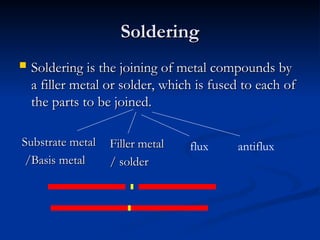
 Soldering is the joining of metal compounds by
Soldering is the joining of metal compounds by
a filler metal or solder, which is fused to each of
the parts to be joined.
Substrate metal
Substrate metal
/Basis metal
/Basis metal
Filler metal
Filler metal
/ solder
/ solder
flux antiflux
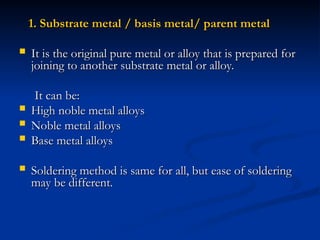
1. Substrate metal / basis metal/ parent metal
 It is the original pure metal or alloy that is prepared for
It is the original pure metal or alloy that is prepared for
joining to another substrate metal or alloy.
It can be:
It can be:
 High noble metal alloys
High noble metal alloys
 Noble metal alloys
Noble metal alloys
 Base metal alloys
Base metal alloys
 Soldering method is same for all, but ease of soldering
Soldering method is same for all, but ease of soldering
may be different.
may be different.
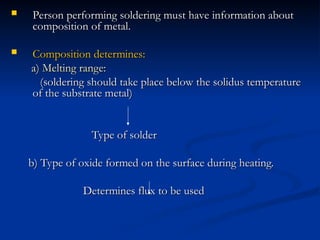
 Person performing soldering must have information about
Person performing soldering must have information about
composition of metal.
 Composition determines:
Composition determines:
a) Melting range:
a) Melting range:
(soldering should take place below the solidus temperature
of the substrate metal)
Type of solder
Type of solder
b) Type of oxide formed on the surface during heating.
Determines flux to be used
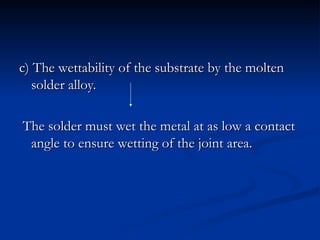
c) The wettability of the substrate by the molten
solder alloy.
solder alloy.
The solder must wet the metal at as low a contact
angle to ensure wetting of the joint area.
Manufacturer should provide information about
• Type of solder to be used
Type of solder to be used
• Type of flux
Type of flux
• For alloys used for metal ceramic restorations,
For alloys used for metal ceramic restorations,
information about both, presoldering and post
soldering filler metals and fluxes
FLUX
FLUX
 Latin word
Latin word
 Flow
Flow
 Soldering filler metals
Soldering filler metals 
 should wet and flow across
should wet and flow across
the clean surface of substrate metal
 If oxides present on surface
If oxides present on surface 
 filler metals can not wet
filler metals can not wet
it.
it.
 Therefore purpose of flux
Therefore purpose of flux 
 remove any oxide coating
remove any oxide coating
on the surface of substrate metal when the filler metal is
fluid and ready to flow in place.
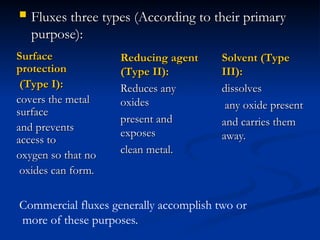
 Fluxes three types (According to their primary
Fluxes three types (According to their primary
purpose):
purpose):
Surface
Surface
protection
protection
(Type I):
(Type I):
covers the metal
covers the metal
surface
surface
and prevents
and prevents
access to
access to
oxygen so that no
oxygen so that no
oxides can form.
oxides can form.
Reducing agent
Reducing agent
(Type II):
(Type II):
Reduces any
Reduces any
oxides
oxides
present and
present and
exposes
exposes
clean metal.
clean metal.
Solvent (Type
Solvent (Type
III):
III):
dissolves
dissolves
any oxide present
any oxide present
and carries them
and carries them
away.
away.
Commercial fluxes generally accomplish two or
more of these purposes.
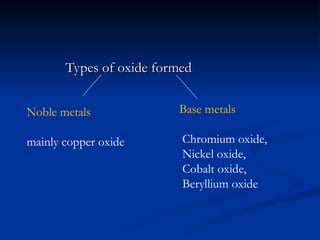
Types of oxide formed
Noble metals
mainly copper oxide
Base metals
Chromium oxide,
Nickel oxide,
Cobalt oxide,
Beryllium oxide
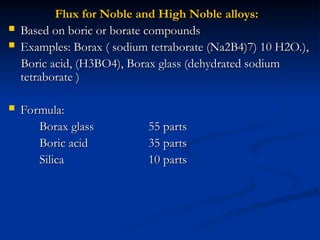
Flux for Noble and High Noble alloys:
 Based on boric or borate compounds
Based on boric or borate compounds
 Examples: Borax ( sodium tetraborate (Na2B4)7) 10 H2O.),
Examples: Borax ( sodium tetraborate (Na2B4)7) 10 H2O.),
Boric acid, (H3BO4), Borax glass (dehydrated sodium
tetraborate )
tetraborate )
 Formula:
Formula:
Borax glass
Borax glass 55 parts
55 parts
Boric acid
Boric acid 35 parts
35 parts
Silica
Silica 10 parts
10 parts
Borax glass (Dehydrated borax)
Borax glass (Dehydrated borax)
 preferred to ordinary
preferred to ordinary
borax as borax releases water vapor on being heated
borax as borax releases water vapor on being heated 

effervesces and bubbles up over surface of hot metal
without forming effective covering.
Acts as
Acts as
Protective fluxes (Type I)
by forming low temperature
glass.
Reducing fluxes (Type II)
for low stability oxides
like copper oxide.
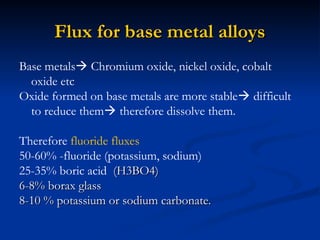
Flux for base metal alloys
Base metals Chromium oxide, nickel oxide, cobalt
oxide etc
Oxide formed on base metals are more stable difficult
to reduce them therefore dissolve them.
Therefore fluoride fluxes
50-60% -fluoride (potassium, sodium)
25-35% boric acid (H3BO4)
(H3BO4)
6-8% borax glass
6-8% borax glass
8-10 % potassium or sodium carbonate.
 Fluoride fluxes
Fluoride fluxes
 Type III
Type III 
 dissolve any metal
dissolve any metal
oxide with which it comes into contact, acting as
solvent.
solvent.
 Borates: Type I
Borates: Type I 
 forms low temperature glass.
forms low temperature glass.
 Borax flux
Borax flux
post soldering
post soldering
Works at comparatively low temperature
If used for pre soldering
If used for pre soldering
 flux will be too fluid to remain
flux will be too fluid to remain
in place
in place
Fluoride flux
Fluoride flux
 pre soldering
pre soldering
If used for post soldering (low temperature), May not
have sufficient chemical activity
 (fluoride fluxes are less likely to attack the porcelain if
(fluoride fluxes are less likely to attack the porcelain if
they are used for post soldering)
Solder / Filler metal
 A
A fusible metal alloy used to unite the edges or surfaces of two pieces of metal.
Properties of filler metal
 1. An appropriate flow temperature:
1. An appropriate flow temperature:
Flow temperature
Flow temperature: Temperature at which the filler metal
: Temperature at which the filler metal
wets and flows on the substrate metal.
Flow temperature of filler
Flow temperature of filler
 lower than solidus
lower than solidus
temperature of metals being joined.
temperature of metals being joined. (56 degree C
(56 degree C
lower).
lower).
For presoldered alloy substrate
For presoldered alloy substrate
 higher melting range
higher melting range
solder needed
solder needed
 to avoid remelting of solder when
to avoid remelting of solder when
porcelain is fired.
porcelain is fired.
 2. sufficient fluidity at flow temperature.
2. sufficient fluidity at flow temperature.
 3. Ability to wet the substrate metal.
3. Ability to wet the substrate metal.
Wetting of substrate metal by filler metal is essential to
produce bond.
produce bond.
Adhesion depends upon wetting the surface
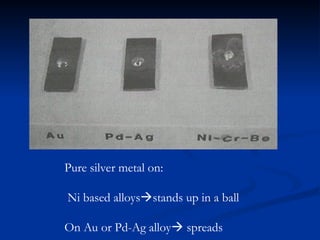
Pure silver metal on:
Ni based alloysstands up in a ball
On Au or Pd-Ag alloy spreads
 Reason for using flux
Reason for using flux
 Flux
Flux
 removes oxide layer
removes oxide layer
 if oxide layer present
if oxide layer present
 poor wettability
poor wettability
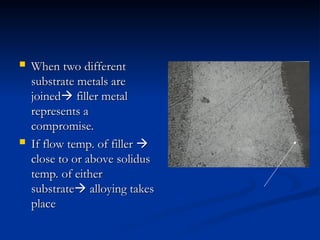
 When two different
When two different
substrate metals are
joined
joined
 filler metal
filler metal
represents a
represents a
compromise.
compromise.
 If flow temp. of filler
If flow temp. of filler 

close to or above solidus
temp. of either
temp. of either
substrate
substrate
 alloying takes
alloying takes
place
place
 Diffusion of filler atoms into substrate metal
Diffusion of filler atoms into substrate metal
and substrate atoms into filler metal
and substrate atoms into filler metal 

controlled by
controlled by temperature and time.
temperature and time.
 Even if flow temp not too high
Even if flow temp not too high
 alloying
alloying
 if
if
temp. remains high for long time.
 Alloy formed by diffusion will have diff
Alloy formed by diffusion will have diff
properties from both filler and substrate metal.
Heat source
Heat source
 Gas –oxygen or gas-air torch
Gas –oxygen or gas-air torch
 Oven/ furnace
Oven/ furnace
 Infrared waves
Infrared waves
 Electric soldering
Electric soldering
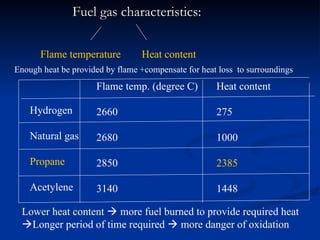
Fuel gas characteristics:
Flame temperature Heat content
Hydrogen
Natural gas
Propane
Acetylene
Flame temp. (degree C)
2660
2680
2850
3140
Heat content
275
1000
2385
1448
Lower heat content  more fuel burned to provide required heat
Longer period of time required  more danger of oxidation
Enough heat be provided by flame +compensate for heat loss to surroundings
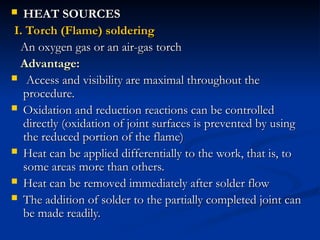
 HEAT SOURCES
HEAT SOURCES
I. Torch (Flame) soldering
An oxygen gas or an air-gas torch
Advantage:
Advantage:
 Access and visibility are maximal throughout the
Access and visibility are maximal throughout the
procedure.
procedure.
 Oxidation and reduction reactions can be controlled
Oxidation and reduction reactions can be controlled
directly (oxidation of joint surfaces is prevented by using
the reduced portion of the flame)
 Heat can be applied differentially to the work, that is, to
Heat can be applied differentially to the work, that is, to
some areas more than others.
 Heat can be removed immediately after solder flow
Heat can be removed immediately after solder flow
 The addition of solder to the partially completed joint can
The addition of solder to the partially completed joint can
be made readily.
be made readily.
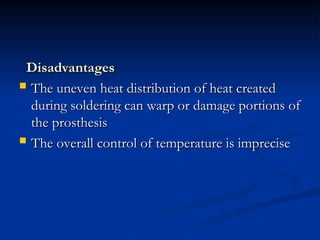
Disadvantages
Disadvantages
 The uneven heat distribution of heat created
The uneven heat distribution of heat created
during soldering can warp or damage portions of
the prosthesis
the prosthesis
 The overall control of temperature is imprecise
The overall control of temperature is imprecise
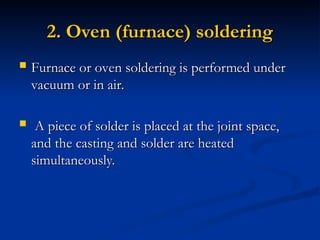
2. Oven (furnace) soldering
 Furnace or oven soldering is performed under
Furnace or oven soldering is performed under
vacuum or in air.
vacuum or in air.
 A piece of solder is placed at the joint space,
A piece of solder is placed at the joint space,
and the casting and solder are heated
simultaneously.
simultaneously.
TECHNIQUE
TECHNIQUE
CONSIDERATIONS
CONSIDERATIONS
 Technical Procedure
Technical Procedure
the soldering technique involves critical
steps like:
steps like:
1. Cleaning and preparing the surfaces to be
joined.
joined.
2. assembling the parts to be joined
3. Preparation and fluxing of the gap surfaces
between the parts.
between the parts.
4. maintaining the proper position of the parts
during the procedure.
5. Control of proper temperature.
6. Control of the time to ensure adequate flow of
solder and complete filling of the solder joint.
Solder joint gap
Solder joint gap
 Gap/space needed between metal surfaces for the
Gap/space needed between metal surfaces for the
solder to flow.
solder to flow.
 If gap too great
 1. Joint strength will be controlled by the strength of
the filler metal.
 2. Joints will exhibit voids.
 3. Incomplete adhesion.
If gap too narrow:
1. Strength will be limited to flux inclusions
2. There will be porosities due to incomplete flow of the
filler metal.
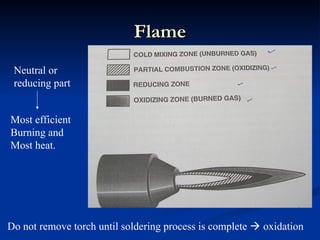
Flame
Flame
Neutral or
reducing part
Most efficient
Burning and
Most heat.
Do not remove torch until soldering process is complete  oxidation
Temperature
Temperature
 Flame till filler metal has flown completely
Flame till filler metal has flown completely
+
+
Moment longer to allow flux / oxide to come out
of filler metal
of filler metal
 Slight more time
Slight more time
 diffusion chances
diffusion chances
 Slight less time
Slight less time
 incomplete filling.
incomplete filling.
Time
Time
 The flame should be maintained in place until
The flame should be maintained in place until
the filler metal has flowed completely into the
connection and a moment longer to allow the
flux or oxide to separate out from the fluid filler
metal.
metal.
Laser welding of commercially pure
Titanium
Titanium
 Commercially pure titanium
Commercially pure titanium
 highly reactive in
highly reactive in
air
air
 titanium oxide formed
titanium oxide formed
 At temperatures used for soldering
At temperatures used for soldering 
 thickness
thickness
of titanium oxide layer increases
of titanium oxide layer increases

spontaneously debond from the parent metal
surface at 850 degree C.
surface at 850 degree C.
 therefore quality of
therefore quality of
soldered joint variable.
 Laser welding
Laser welding 
 has lower thermal influence on the parts
has lower thermal influence on the parts
to be joined.
to be joined.
 Units based on a
Units based on a pulsed high-power neodymium laser
pulsed high-power neodymium laser with a
with a
very high power density
 Examples: Dentaurum dental laser DL 2002
Examples: Dentaurum dental laser DL 2002
Haas Laser LKS (Haas Laser GmbH, Germany)
Maximum penetration depth
Maximum penetration depth
 2.5 mm
2.5 mm
 Advantage of welding:-
Advantage of welding:-
welded parts composed of same pure titanium

 preserving biocompatibility potential and
preserving biocompatibility potential and
avoids risk of galvanic corrosion.
Small amount of heat generated
Small amount of heat generated
 parts can be
parts can be
held by hand during welding.
Welding can be performed close to ceramic
veneers without causing damage.
CAST JOINING
CAST JOINING
 Because of the technique sensitivity of soldering
Because of the technique sensitivity of soldering
predominantly base metal alloys and the variation in
solder-joint quality associated with presoldering of
these alloys,the cast joining technique was proposed by
Weiss and Munyon(1980) as an alternative method fro
joining cast components of a fixed partial denture.
Cast joined components are held together purely by
mechanical retention.

soldering,types, materials, for dental students

  • 1.
  • 2.
    Contents Contents  Definitions Definitions  SubstrateMetal Substrate Metal  Flux Flux  Soldering(Brazing) Filler Metal Soldering(Brazing) Filler Metal  Heat Source Heat Source  Technique considerations Technique considerations  Radiographic Analysis of Solder-Joint Quality Radiographic Analysis of Solder-Joint Quality  Laser Welding of Commercially Pure Titanium Laser Welding of Commercially Pure Titanium  Cast Joining Cast Joining
  • 3.
    Introduction Introduction  Soldering isthe process of joining metals using Soldering is the process of joining metals using an intermediate metal alloy whose melting an intermediate metal alloy whose melting temperature is lower than that of the parent temperature is lower than that of the parent metal. The parts to be joined are not melted metal. The parts to be joined are not melted during soldering, but must be thoroughly wetted during soldering, but must be thoroughly wetted by liquefied solder. by liquefied solder.
  • 4.
    The soldering processinvolves the substrate or The soldering process involves the substrate or parent metal to be joined, soldering filler metal parent metal to be joined, soldering filler metal (solder), a flux, and a heat source. All are equally (solder), a flux, and a heat source. All are equally important and the role of each must be taken important and the role of each must be taken into consideration to solder metal components into consideration to solder metal components successfully. successfully.
  • 5.
    Definitions Definitions  Soldering Soldering: : Aprocess that join metals by heating them A process that join metals by heating them to a suitable temperature below the solidus temperature to a suitable temperature below the solidus temperature of the substrate metal and applying a filler metal, having of the substrate metal and applying a filler metal, having a liquidus temperature not exceeding 450°C ,that melts a liquidus temperature not exceeding 450°C ,that melts and flow by capillary attraction between the parts and flow by capillary attraction between the parts without appreciably affecting the dimensions of the without appreciably affecting the dimensions of the joined structure. joined structure.  If the filler metal has a melting temperature greater than If the filler metal has a melting temperature greater than 450°C (840°F) the process is 450°C (840°F) the process is BRAZING. BRAZING.
  • 6.
     WELDING WELDING: : thejoining of two or more metal the joining of two or more metal pieces by applying heat, pressure or both, pieces by applying heat, pressure or both, without a filler metal , to produce a localized without a filler metal , to produce a localized union across the interface through fusion or union across the interface through fusion or diffusion. diffusion. 1 1
  • 7.
     Soldering flux:a material, such as borax glass (Na2B4O7), applied to a metal surface to remove oxides or prevent their formation in order to facilitate the flow of solder.  Soldering antiflux :a material, such as iron oxide dissolved in a suitable solvent such as turpentine, placed on a metal surface to confine the flow of molten solder.
  • 8.
     Liquidus temperature Liquidustemperature: : The temperatures at The temperatures at which metals of an alloy system which metals of an alloy system begin to solidify begin to solidify on cooling or on cooling or become totally liquid become totally liquid on heating. on heating.  Solidus temperature Solidus temperature: The temperatures at : The temperatures at which metals of an alloy system which metals of an alloy system become become completely solidified completely solidified on cooling or on cooling or start to melt start to melt on heating. on heating.
  • 9.
    Soldering Soldering  Soldering isthe joining of metal compounds by Soldering is the joining of metal compounds by a filler metal or solder, which is fused to each of a filler metal or solder, which is fused to each of the parts to be joined. the parts to be joined. Substrate metal Substrate metal /Basis metal /Basis metal Filler metal Filler metal / solder / solder flux antiflux
  • 10.
    1. Substrate metal/ basis metal/ parent metal 1. Substrate metal / basis metal/ parent metal  It is the original pure metal or alloy that is prepared for It is the original pure metal or alloy that is prepared for joining to another substrate metal or alloy. joining to another substrate metal or alloy. It can be: It can be:  High noble metal alloys High noble metal alloys  Noble metal alloys Noble metal alloys  Base metal alloys Base metal alloys  Soldering method is same for all, but ease of soldering Soldering method is same for all, but ease of soldering may be different. may be different.
  • 11.
     Person performingsoldering must have information about Person performing soldering must have information about composition of metal. composition of metal.  Composition determines: Composition determines: a) Melting range: a) Melting range: (soldering should take place below the solidus temperature (soldering should take place below the solidus temperature of the substrate metal) of the substrate metal) Type of solder Type of solder b) Type of oxide formed on the surface during heating. b) Type of oxide formed on the surface during heating. Determines flux to be used Determines flux to be used
  • 12.
    c) The wettabilityof the substrate by the molten c) The wettability of the substrate by the molten solder alloy. solder alloy. The solder must wet the metal at as low a contact The solder must wet the metal at as low a contact angle to ensure wetting of the joint area. angle to ensure wetting of the joint area.
  • 13.
    Manufacturer should provideinformation about Manufacturer should provide information about • Type of solder to be used Type of solder to be used • Type of flux Type of flux • For alloys used for metal ceramic restorations, For alloys used for metal ceramic restorations, information about both, presoldering and post information about both, presoldering and post soldering filler metals and fluxes soldering filler metals and fluxes
  • 14.
    FLUX FLUX  Latin word Latinword  Flow Flow  Soldering filler metals Soldering filler metals   should wet and flow across should wet and flow across the clean surface of substrate metal the clean surface of substrate metal  If oxides present on surface If oxides present on surface   filler metals can not wet filler metals can not wet it. it.  Therefore purpose of flux Therefore purpose of flux   remove any oxide coating remove any oxide coating on the surface of substrate metal when the filler metal is on the surface of substrate metal when the filler metal is fluid and ready to flow in place. fluid and ready to flow in place.
  • 15.
     Fluxes threetypes (According to their primary Fluxes three types (According to their primary purpose): purpose): Surface Surface protection protection (Type I): (Type I): covers the metal covers the metal surface surface and prevents and prevents access to access to oxygen so that no oxygen so that no oxides can form. oxides can form. Reducing agent Reducing agent (Type II): (Type II): Reduces any Reduces any oxides oxides present and present and exposes exposes clean metal. clean metal. Solvent (Type Solvent (Type III): III): dissolves dissolves any oxide present any oxide present and carries them and carries them away. away. Commercial fluxes generally accomplish two or more of these purposes.
  • 16.
    Types of oxideformed Types of oxide formed Noble metals mainly copper oxide Base metals Chromium oxide, Nickel oxide, Cobalt oxide, Beryllium oxide
  • 17.
    Flux for Nobleand High Noble alloys: Flux for Noble and High Noble alloys:  Based on boric or borate compounds Based on boric or borate compounds  Examples: Borax ( sodium tetraborate (Na2B4)7) 10 H2O.), Examples: Borax ( sodium tetraborate (Na2B4)7) 10 H2O.), Boric acid, (H3BO4), Borax glass (dehydrated sodium Boric acid, (H3BO4), Borax glass (dehydrated sodium tetraborate ) tetraborate )  Formula: Formula: Borax glass Borax glass 55 parts 55 parts Boric acid Boric acid 35 parts 35 parts Silica Silica 10 parts 10 parts
  • 18.
    Borax glass (Dehydratedborax) Borax glass (Dehydrated borax)  preferred to ordinary preferred to ordinary borax as borax releases water vapor on being heated borax as borax releases water vapor on being heated   effervesces and bubbles up over surface of hot metal effervesces and bubbles up over surface of hot metal without forming effective covering. without forming effective covering. Acts as Acts as Protective fluxes (Type I) by forming low temperature glass. Reducing fluxes (Type II) for low stability oxides like copper oxide.
  • 19.
    Flux for basemetal alloys Flux for base metal alloys Base metals Chromium oxide, nickel oxide, cobalt oxide etc Oxide formed on base metals are more stable difficult to reduce them therefore dissolve them. Therefore fluoride fluxes 50-60% -fluoride (potassium, sodium) 25-35% boric acid (H3BO4) (H3BO4) 6-8% borax glass 6-8% borax glass 8-10 % potassium or sodium carbonate. 8-10 % potassium or sodium carbonate.
  • 20.
     Fluoride fluxes Fluoridefluxes  Type III Type III   dissolve any metal dissolve any metal oxide with which it comes into contact, acting as oxide with which it comes into contact, acting as solvent. solvent.  Borates: Type I Borates: Type I   forms low temperature glass. forms low temperature glass.
  • 21.
     Borax flux Boraxflux post soldering post soldering Works at comparatively low temperature Works at comparatively low temperature If used for pre soldering If used for pre soldering  flux will be too fluid to remain flux will be too fluid to remain in place in place Fluoride flux Fluoride flux  pre soldering pre soldering If used for post soldering (low temperature), May not If used for post soldering (low temperature), May not have sufficient chemical activity have sufficient chemical activity  (fluoride fluxes are less likely to attack the porcelain if (fluoride fluxes are less likely to attack the porcelain if they are used for post soldering) they are used for post soldering)
  • 22.
    Solder / Fillermetal Solder / Filler metal  A A fusible metal alloy used to unite the edges or surfaces of two pieces of metal.
  • 23.
    Properties of fillermetal Properties of filler metal  1. An appropriate flow temperature: 1. An appropriate flow temperature: Flow temperature Flow temperature: Temperature at which the filler metal : Temperature at which the filler metal wets and flows on the substrate metal. wets and flows on the substrate metal. Flow temperature of filler Flow temperature of filler  lower than solidus lower than solidus temperature of metals being joined. temperature of metals being joined. (56 degree C (56 degree C lower). lower). For presoldered alloy substrate For presoldered alloy substrate  higher melting range higher melting range solder needed solder needed  to avoid remelting of solder when to avoid remelting of solder when porcelain is fired. porcelain is fired.  2. sufficient fluidity at flow temperature. 2. sufficient fluidity at flow temperature.
  • 24.
     3. Abilityto wet the substrate metal. 3. Ability to wet the substrate metal. Wetting of substrate metal by filler metal is essential to Wetting of substrate metal by filler metal is essential to produce bond. produce bond. Adhesion depends upon wetting the surface Adhesion depends upon wetting the surface
  • 25.
    Pure silver metalon: Ni based alloysstands up in a ball On Au or Pd-Ag alloy spreads
  • 26.
     Reason forusing flux Reason for using flux  Flux Flux  removes oxide layer removes oxide layer  if oxide layer present if oxide layer present  poor wettability poor wettability
  • 27.
     When twodifferent When two different substrate metals are substrate metals are joined joined  filler metal filler metal represents a represents a compromise. compromise.  If flow temp. of filler If flow temp. of filler   close to or above solidus close to or above solidus temp. of either temp. of either substrate substrate  alloying takes alloying takes place place
  • 28.
     Diffusion offiller atoms into substrate metal Diffusion of filler atoms into substrate metal and substrate atoms into filler metal and substrate atoms into filler metal   controlled by controlled by temperature and time. temperature and time.  Even if flow temp not too high Even if flow temp not too high  alloying alloying  if if temp. remains high for long time. temp. remains high for long time.  Alloy formed by diffusion will have diff Alloy formed by diffusion will have diff properties from both filler and substrate metal. properties from both filler and substrate metal.
  • 29.
    Heat source Heat source Gas –oxygen or gas-air torch Gas –oxygen or gas-air torch  Oven/ furnace Oven/ furnace  Infrared waves Infrared waves  Electric soldering Electric soldering
  • 30.
    Fuel gas characteristics: Fuelgas characteristics: Flame temperature Heat content Hydrogen Natural gas Propane Acetylene Flame temp. (degree C) 2660 2680 2850 3140 Heat content 275 1000 2385 1448 Lower heat content  more fuel burned to provide required heat Longer period of time required  more danger of oxidation Enough heat be provided by flame +compensate for heat loss to surroundings
  • 31.
     HEAT SOURCES HEATSOURCES I. Torch (Flame) soldering I. Torch (Flame) soldering An oxygen gas or an air-gas torch An oxygen gas or an air-gas torch Advantage: Advantage:  Access and visibility are maximal throughout the Access and visibility are maximal throughout the procedure. procedure.  Oxidation and reduction reactions can be controlled Oxidation and reduction reactions can be controlled directly (oxidation of joint surfaces is prevented by using directly (oxidation of joint surfaces is prevented by using the reduced portion of the flame) the reduced portion of the flame)  Heat can be applied differentially to the work, that is, to Heat can be applied differentially to the work, that is, to some areas more than others. some areas more than others.  Heat can be removed immediately after solder flow Heat can be removed immediately after solder flow  The addition of solder to the partially completed joint can The addition of solder to the partially completed joint can be made readily. be made readily.
  • 32.
    Disadvantages Disadvantages  The unevenheat distribution of heat created The uneven heat distribution of heat created during soldering can warp or damage portions of during soldering can warp or damage portions of the prosthesis the prosthesis  The overall control of temperature is imprecise The overall control of temperature is imprecise
  • 33.
    2. Oven (furnace)soldering 2. Oven (furnace) soldering  Furnace or oven soldering is performed under Furnace or oven soldering is performed under vacuum or in air. vacuum or in air.  A piece of solder is placed at the joint space, A piece of solder is placed at the joint space, and the casting and solder are heated and the casting and solder are heated simultaneously. simultaneously.
  • 34.
    TECHNIQUE TECHNIQUE CONSIDERATIONS CONSIDERATIONS  Technical Procedure TechnicalProcedure the soldering technique involves critical the soldering technique involves critical steps like: steps like: 1. Cleaning and preparing the surfaces to be 1. Cleaning and preparing the surfaces to be joined. joined. 2. assembling the parts to be joined 2. assembling the parts to be joined 3. Preparation and fluxing of the gap surfaces 3. Preparation and fluxing of the gap surfaces between the parts. between the parts.
  • 35.
    4. maintaining theproper position of the parts 4. maintaining the proper position of the parts during the procedure. during the procedure. 5. Control of proper temperature. 5. Control of proper temperature. 6. Control of the time to ensure adequate flow of 6. Control of the time to ensure adequate flow of solder and complete filling of the solder joint. solder and complete filling of the solder joint.
  • 36.
    Solder joint gap Solderjoint gap  Gap/space needed between metal surfaces for the Gap/space needed between metal surfaces for the solder to flow. solder to flow.  If gap too great  1. Joint strength will be controlled by the strength of the filler metal.  2. Joints will exhibit voids.  3. Incomplete adhesion.
  • 37.
    If gap toonarrow: 1. Strength will be limited to flux inclusions 2. There will be porosities due to incomplete flow of the filler metal.
  • 38.
    Flame Flame Neutral or reducing part Mostefficient Burning and Most heat. Do not remove torch until soldering process is complete  oxidation
  • 39.
    Temperature Temperature  Flame tillfiller metal has flown completely Flame till filler metal has flown completely + + Moment longer to allow flux / oxide to come out Moment longer to allow flux / oxide to come out of filler metal of filler metal  Slight more time Slight more time  diffusion chances diffusion chances  Slight less time Slight less time  incomplete filling. incomplete filling.
  • 40.
    Time Time  The flameshould be maintained in place until The flame should be maintained in place until the filler metal has flowed completely into the the filler metal has flowed completely into the connection and a moment longer to allow the connection and a moment longer to allow the flux or oxide to separate out from the fluid filler flux or oxide to separate out from the fluid filler metal. metal.
  • 41.
    Laser welding ofcommercially pure Laser welding of commercially pure Titanium Titanium  Commercially pure titanium Commercially pure titanium  highly reactive in highly reactive in air air  titanium oxide formed titanium oxide formed  At temperatures used for soldering At temperatures used for soldering   thickness thickness of titanium oxide layer increases of titanium oxide layer increases  spontaneously debond from the parent metal spontaneously debond from the parent metal surface at 850 degree C. surface at 850 degree C.  therefore quality of therefore quality of soldered joint variable. soldered joint variable.
  • 42.
     Laser welding Laserwelding   has lower thermal influence on the parts has lower thermal influence on the parts to be joined. to be joined.  Units based on a Units based on a pulsed high-power neodymium laser pulsed high-power neodymium laser with a with a very high power density very high power density  Examples: Dentaurum dental laser DL 2002 Examples: Dentaurum dental laser DL 2002 Haas Laser LKS (Haas Laser GmbH, Germany) Haas Laser LKS (Haas Laser GmbH, Germany) Maximum penetration depth Maximum penetration depth  2.5 mm 2.5 mm
  • 43.
     Advantage ofwelding:- Advantage of welding:- welded parts composed of same pure titanium welded parts composed of same pure titanium   preserving biocompatibility potential and preserving biocompatibility potential and avoids risk of galvanic corrosion. avoids risk of galvanic corrosion. Small amount of heat generated Small amount of heat generated  parts can be parts can be held by hand during welding. held by hand during welding. Welding can be performed close to ceramic Welding can be performed close to ceramic veneers without causing damage. veneers without causing damage.
  • 44.
    CAST JOINING CAST JOINING Because of the technique sensitivity of soldering Because of the technique sensitivity of soldering predominantly base metal alloys and the variation in predominantly base metal alloys and the variation in solder-joint quality associated with presoldering of solder-joint quality associated with presoldering of these alloys,the cast joining technique was proposed by these alloys,the cast joining technique was proposed by Weiss and Munyon(1980) as an alternative method fro Weiss and Munyon(1980) as an alternative method fro joining cast components of a fixed partial denture. joining cast components of a fixed partial denture. Cast joined components are held together purely by Cast joined components are held together purely by mechanical retention. mechanical retention.