Presented By :-
Divyanshu Prakash Yadav
Roll No. :- CSJMA14001390235
B.Tech (Chemical Engg.)
CSJM University Kanpur
Submitted To :-
Dr. Brishti Mitra
HOD of Chemical Engg.
CSJM University Kanpur
4/4/2018 1
ABSTRACT
 Introduction.
 History of Solar Still.
 Solar water distillation technology.
 Solar Still.
 Quantity of distilled water.
 Efficiency.
 Advantage and disadvantage.
 A published journal.
 Conclusion.
 References.
4/4/2018 2
INTRODUCTION
 There are many coastle places where seawater is
sufficient but drinking water is not available.
 'WHO' states that almost 1 billion people are
drinking impure water and 2 million people die
every year due to unsafe water.
 To solve this problem use 'SOLAR STILLS'
based on 'SOLAR DISTILLATION PROCESS'.
4/4/2018 33
HISTORY OF SOLAR STILL
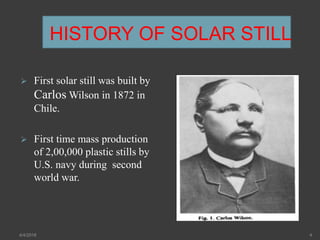
 First solar still was built by
Carlos Wilson in 1872 in
Chile.
 First time mass production
of 2,00,000 plastic stills by
U.S. navy during second
world war.
4/4/2018 4
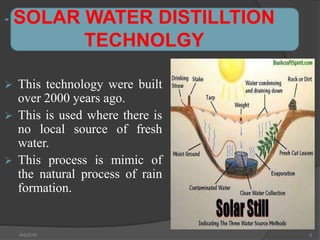
SOLAR WATER DISTILLTION
TECHNOLGY
 This technology were built
over 2000 years ago.
 This is used where there is
no local source of fresh
water.
 This process is mimic of
the natural process of rain
formation.
4/4/2018 5
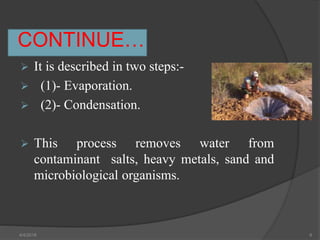
CONTINUE…
 It is described in two steps:-
 (1)- Evaporation.
 (2)- Condensation.
 This process removes water from
contaminant salts, heavy metals, sand and
microbiological organisms.
4/4/2018 6
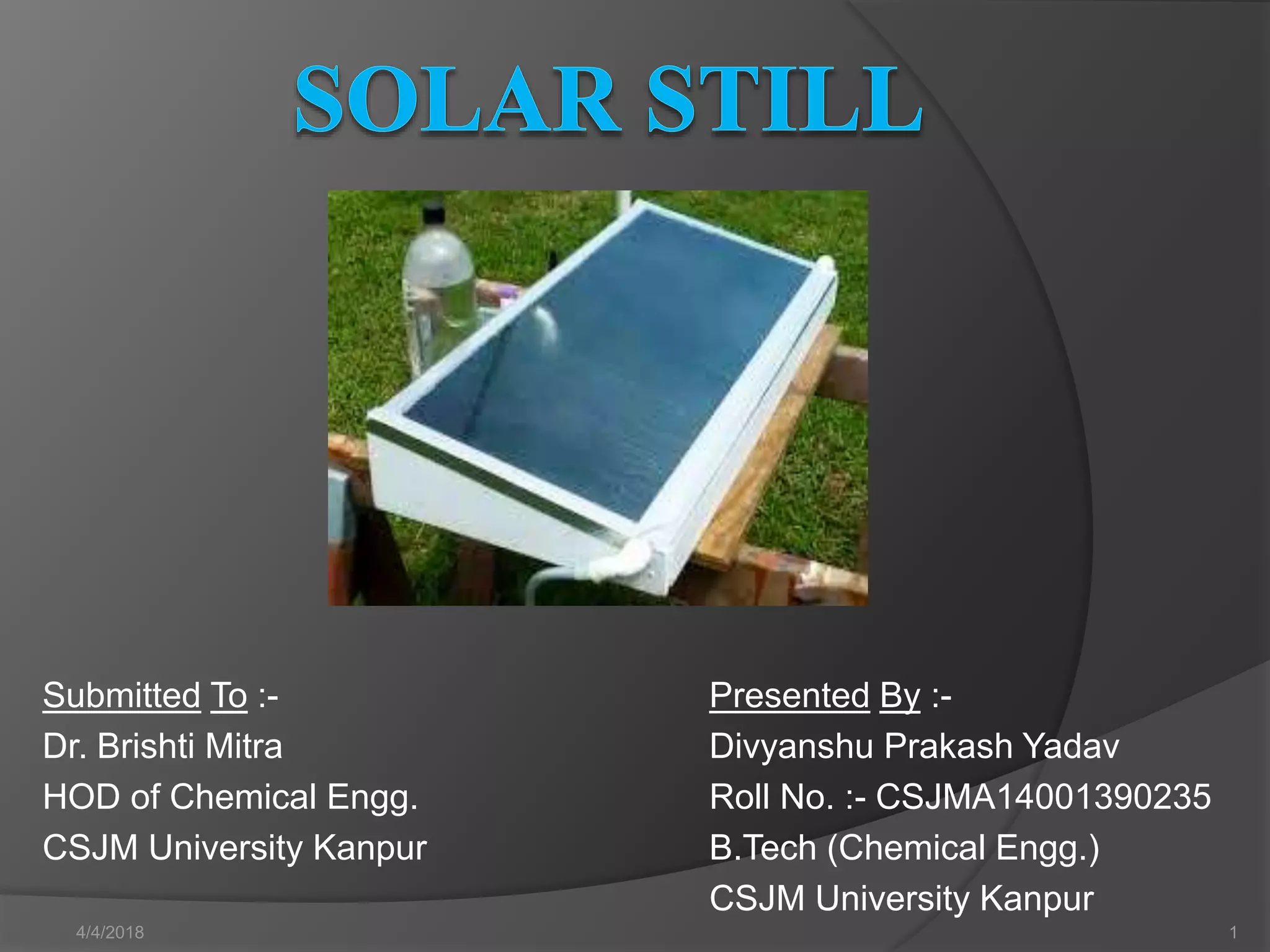
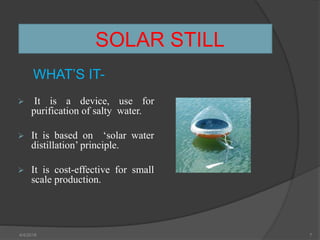
SOLAR STILL
WHAT’S IT-
 It is a device, use for
purification of salty water.
 It is based on ‘solar water
distillation’ principle.
 It is cost-effective for small
scale production.
4/4/2018 7
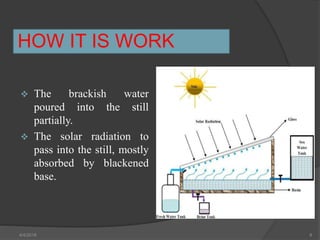
HOW IT IS WORK
 The brackish water
poured into the still
partially.
 The solar radiation to
pass into the still, mostly
absorbed by blackened
base.
4/4/2018 8
CONTINUE..
 The water begins to heat up and
‘evaporation’ starts.
 The base also radiates energy which
reflected back into the still by the glass
cover, like ‘greenhouse’ effect.
 Condensation working.
 Still will continue produce distillate after
sunset until water temperature cools down.
4/4/2018 9
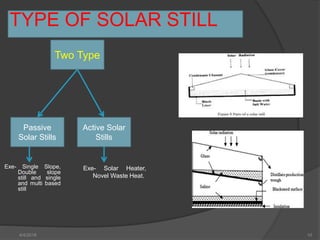
TYPE OF SOLAR STILL
Exe- Single Slope,
Double slope
still and single
and multi based
still
Passive
Solar Stills
Active Solar
Stills
Two Type
Exe- Solar Heater,
Novel Waste Heat.
4/4/2018 10
QUANTITY OF STILL WATER
PRODUTION
Solar still production is function of solar energy and ambient
temperature.
Productivity of solar still depends on climatic parameters.
Formula: - Me = Qe / L
Me= Daily distilled water output(kg/m2 day)
Qe= Amount of energy utilized in vaporizing
water in still (j/m2 day)
L = Latent heat of vaporization of water (j/kg)
4/4/2018 11
ANOTHER METHOD:-
An empirical relation given by Schumacher Center For
Technology UK.
Q = A × E × G / 2.3
Where ;
A= Aperture area of the still ; 1 meter square
E= Efficiency of the still ; usually taken as 50%
G= Global radiation energy ;18MJ/m2
Q=1 ×0.5 ×18.0 / 2.3 = 3.91
Daily output = 3.91 liters/meter square/day.
4/4/2018 12
EFFICIENCY
 It is the amount of energy utilized in vaporizing water
in the still(J/m2/day) over the amount of incident solar
energy on the still(J/m2/day).
 n = Qe /Qt
 All commercial stills sold have had an efficiency range
of 30% to 45%. Maximum efficiency is just over 60%.
 Solar still productivity can also increase by use of
mirror by 3%.
4/4/2018 13
HOW TO INCREASE
EFFICIENCY
 High feed (undistilled) water temperature.
 Large temperature difference b/n feed water and
condensing surface.
 Reducing heat conduction through basin walls vapour
leakage.
 Use of mirror.
 Insulation.
 Black liner.
4/4/2018 14
ADVANTAGES & DISADVANTA-
GES
ADVANTAGES DISADVANTAGES
 Low production capacity.
 Solar distillers can’t kill
harmful bacteria because it
do not boil the water.
 Leakage of vapour through
joints.
 Sun energy is free of
charge.
 Cost effectiveness since
there is no moving part so
low maintenace cost.
 Provide good quality water
for personal and industrial
use.
4/4/2018 15
A RESERCH PAPER ON
SINGLE SOLAR STILL
OBJECTIVE:- To find the potential , water depth
of a solar still basin.
DESIGN OF STILL:-
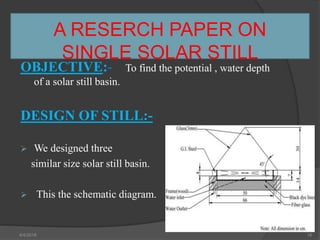
 We designed three
similar size solar still basin.
 This the schematic diagram.
4/4/2018 16
CONTINUE…
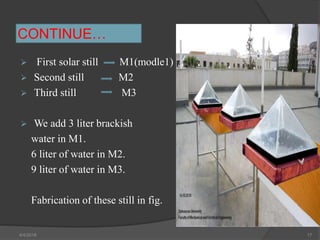
 First solar still M1(modle1)
 Second still M2
 Third still M3
 We add 3 liter brackish
water in M1.
6 liter of water in M2.
9 liter of water in M3.
Fabrication of these still in fig.
4/4/2018 17
MEASUREMENTS
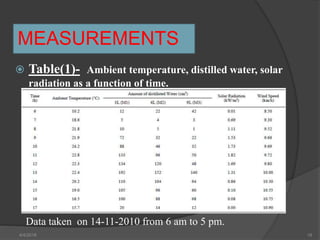
 Table(1)- Ambient temperature, distilled water, solar
radiation as a function of time.
Data taken on 14-11-2010 from 6 am to 5 pm.
4/4/2018 18
CONTINUE….
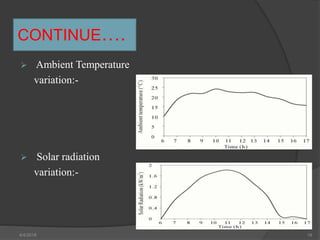
 Ambient Temperature
variation:-
 Solar radiation
variation:-
4/4/2018 19
CONTINUE…
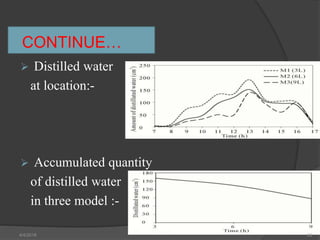
 Distilled water
at location:-
 Accumulated quantity
of distilled water
in three model :-
4/4/2018 20
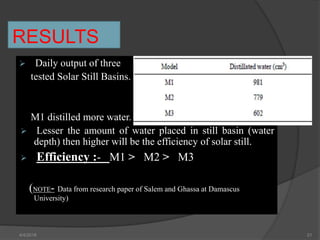
RESULTS
 Daily output of three
tested Solar Still Basins.
M1 distilled more water.
 Lesser the amount of water placed in still basin (water
depth) then higher will be the efficiency of solar still.
 Efficiency :- M1 > M2 > M3
(NOTE- Data from research paper of Salem and Ghassa at Damascus
University)
4/4/2018 21
CONCLUSION
 It gives most economical method to get potable drinking water at
small scale.st
 The water that is made in these stills is of a better quality than
bottled water.
 Solar still device may uses in emergency situations life hurricane
or If water & electricity supply stopped, this may save our life.
 It produces most pure water similar to rainy water.
4/4/2018 22
REFERENCES
 https://www.hindawi.com/
 http://www.solaqua.com/
 https://en.wikipedia.org/wiki/Solar_still
 https://archive.org
 http://www.appropedia.org
 Manual on solar distillation of saline water
by Talbert, Eibling.
 https://www.scirp.org/journal/PaperInformation.asp
x?PaperID=29104
4/4/2018 23
4/4/2018 24

SOLAR STILL

  • 1.
    Presented By :- DivyanshuPrakash Yadav Roll No. :- CSJMA14001390235 B.Tech (Chemical Engg.) CSJM University Kanpur Submitted To :- Dr. Brishti Mitra HOD of Chemical Engg. CSJM University Kanpur 4/4/2018 1
  • 2.
    ABSTRACT  Introduction.  Historyof Solar Still.  Solar water distillation technology.  Solar Still.  Quantity of distilled water.  Efficiency.  Advantage and disadvantage.  A published journal.  Conclusion.  References. 4/4/2018 2
  • 3.
    INTRODUCTION  There aremany coastle places where seawater is sufficient but drinking water is not available.  'WHO' states that almost 1 billion people are drinking impure water and 2 million people die every year due to unsafe water.  To solve this problem use 'SOLAR STILLS' based on 'SOLAR DISTILLATION PROCESS'. 4/4/2018 33
  • 4.
    HISTORY OF SOLARSTILL  First solar still was built by Carlos Wilson in 1872 in Chile.  First time mass production of 2,00,000 plastic stills by U.S. navy during second world war. 4/4/2018 4
  • 5.
    SOLAR WATER DISTILLTION TECHNOLGY This technology were built over 2000 years ago.  This is used where there is no local source of fresh water.  This process is mimic of the natural process of rain formation. 4/4/2018 5
  • 6.
    CONTINUE…  It isdescribed in two steps:-  (1)- Evaporation.  (2)- Condensation.  This process removes water from contaminant salts, heavy metals, sand and microbiological organisms. 4/4/2018 6
  • 7.
    SOLAR STILL WHAT’S IT- It is a device, use for purification of salty water.  It is based on ‘solar water distillation’ principle.  It is cost-effective for small scale production. 4/4/2018 7
  • 8.
    HOW IT ISWORK  The brackish water poured into the still partially.  The solar radiation to pass into the still, mostly absorbed by blackened base. 4/4/2018 8
  • 9.
    CONTINUE..  The waterbegins to heat up and ‘evaporation’ starts.  The base also radiates energy which reflected back into the still by the glass cover, like ‘greenhouse’ effect.  Condensation working.  Still will continue produce distillate after sunset until water temperature cools down. 4/4/2018 9
  • 10.
    TYPE OF SOLARSTILL Exe- Single Slope, Double slope still and single and multi based still Passive Solar Stills Active Solar Stills Two Type Exe- Solar Heater, Novel Waste Heat. 4/4/2018 10
  • 11.
    QUANTITY OF STILLWATER PRODUTION Solar still production is function of solar energy and ambient temperature. Productivity of solar still depends on climatic parameters. Formula: - Me = Qe / L Me= Daily distilled water output(kg/m2 day) Qe= Amount of energy utilized in vaporizing water in still (j/m2 day) L = Latent heat of vaporization of water (j/kg) 4/4/2018 11
  • 12.
    ANOTHER METHOD:- An empiricalrelation given by Schumacher Center For Technology UK. Q = A × E × G / 2.3 Where ; A= Aperture area of the still ; 1 meter square E= Efficiency of the still ; usually taken as 50% G= Global radiation energy ;18MJ/m2 Q=1 ×0.5 ×18.0 / 2.3 = 3.91 Daily output = 3.91 liters/meter square/day. 4/4/2018 12
  • 13.
    EFFICIENCY  It isthe amount of energy utilized in vaporizing water in the still(J/m2/day) over the amount of incident solar energy on the still(J/m2/day).  n = Qe /Qt  All commercial stills sold have had an efficiency range of 30% to 45%. Maximum efficiency is just over 60%.  Solar still productivity can also increase by use of mirror by 3%. 4/4/2018 13
  • 14.
    HOW TO INCREASE EFFICIENCY High feed (undistilled) water temperature.  Large temperature difference b/n feed water and condensing surface.  Reducing heat conduction through basin walls vapour leakage.  Use of mirror.  Insulation.  Black liner. 4/4/2018 14
  • 15.
    ADVANTAGES & DISADVANTA- GES ADVANTAGESDISADVANTAGES  Low production capacity.  Solar distillers can’t kill harmful bacteria because it do not boil the water.  Leakage of vapour through joints.  Sun energy is free of charge.  Cost effectiveness since there is no moving part so low maintenace cost.  Provide good quality water for personal and industrial use. 4/4/2018 15
  • 16.
    A RESERCH PAPERON SINGLE SOLAR STILL OBJECTIVE:- To find the potential , water depth of a solar still basin. DESIGN OF STILL:-  We designed three similar size solar still basin.  This the schematic diagram. 4/4/2018 16
  • 17.
    CONTINUE…  First solarstill M1(modle1)  Second still M2  Third still M3  We add 3 liter brackish water in M1. 6 liter of water in M2. 9 liter of water in M3. Fabrication of these still in fig. 4/4/2018 17
  • 18.
    MEASUREMENTS  Table(1)- Ambienttemperature, distilled water, solar radiation as a function of time. Data taken on 14-11-2010 from 6 am to 5 pm. 4/4/2018 18
  • 19.
    CONTINUE….  Ambient Temperature variation:- Solar radiation variation:- 4/4/2018 19
  • 20.
    CONTINUE…  Distilled water atlocation:-  Accumulated quantity of distilled water in three model :- 4/4/2018 20
  • 21.
    RESULTS  Daily outputof three tested Solar Still Basins. M1 distilled more water.  Lesser the amount of water placed in still basin (water depth) then higher will be the efficiency of solar still.  Efficiency :- M1 > M2 > M3 (NOTE- Data from research paper of Salem and Ghassa at Damascus University) 4/4/2018 21
  • 22.
    CONCLUSION  It givesmost economical method to get potable drinking water at small scale.st  The water that is made in these stills is of a better quality than bottled water.  Solar still device may uses in emergency situations life hurricane or If water & electricity supply stopped, this may save our life.  It produces most pure water similar to rainy water. 4/4/2018 22
  • 23.
    REFERENCES  https://www.hindawi.com/  http://www.solaqua.com/ https://en.wikipedia.org/wiki/Solar_still  https://archive.org  http://www.appropedia.org  Manual on solar distillation of saline water by Talbert, Eibling.  https://www.scirp.org/journal/PaperInformation.asp x?PaperID=29104 4/4/2018 23
  • 24.