International Research Journal of Engineering and Technology (IRJET) e-ISSN: 2395-0056
Volume: 10 Issue: 12 | Dec 2023 www.irjet.net p-ISSN: 2395-0072
© 2023, IRJET | Impact Factor value: 8.226 | ISO 9001:2008 Certified Journal | Page 808
Enhancing the Efficiency of Solar Desalination through Computational
Fluid Dynamics (CFD) Modeling
Mayank Kumar1, Dr. Ajay Singh2, Prakash Sahu3
1Scholar, Department of Mechanical Engineering, Radharaman Institute of Technology and Science, Bhopal, M.P
2 Head and Prof., Department of Mechanical Engineering, Radharaman Institute of Technology and Science,
Bhopal, M.P
3 Assistant Professor, Department of Mechanical Engineering, Radharaman Institute of Technology and Science,
Bhopal, M.P
---------------------------------------------------------------------***---------------------------------------------------------------------
Abstract - This research delves deep into using
Computational Fluid Dynamics (CFD) to mimic how a single
slope passive solar still works. The main aim was to create a
detailed 3-D model of the solar still using ANSYS Workbench
and compare what the simulation predicted with real-world
experimental data. They carefully set up this virtual model in
FLUENT, tweaking materials and environmental factors to
mirror actual conditions and ran simulations for May 19th.
Then, they checked how well the simulation matched the real
data from Hassanain's experiments. Here's what they found:
The CFD model they built did a great job at showing how
temperatures spread within the solar still. The temperatures
inside the still were very close to what they found in their
experiments, proving the model's accuracy in capturing how
heat behaves in the system. They also noticed that the glass
temperature in the still followed the pattern of sunlight—it
rose with solar intensity, hitting its highest point at around
337 Kelvin by 1:00 PM, then slowly dropped as the sun got
weaker. Although the simulated results lined up well with the
experimental data, there were some tiny differences. These
variations happened because the simulated sunlight didn't
perfectly match the real sun's intensity, andthemodelcouldn't
mimic natural adjustments like those that happen in real-
world experiments. We used the CFD data to calculate how
much water the still produced and how efficiently it
transferred heat for evaporation using Dunkle's model.
Luckily, the numbers they got from the simulations matched
up impressively well with what they found in their
experiments, proving thattheCFD modelcouldreliablypredict
what happens in real life. This study shows how powerful CFD
simulations can be—they're like a crystal ball for
understanding and improving passive solar stills. By digging
into temperature dynamics and accurately predicting water
output, this research pushes forward the quest to make solar-
powered desalination more effective and eco-friendlier.
Key Words Solar Still, Efficiency, CFD, Mesh, Temperature
1.INTRODUCTION
Freshwater scarcity is a growing concern in many regionsof
the world, driven by factors such as population growth,
climate change, and increasing demands on limited water
resources. Meeting the demand for clean and potable water
in water-scarce areas is a critical challenge. In this context,
solar stills have emerged as a sustainable and energy-
efficient solution for addressing the pressing need for
freshwater production. A solar still is a simple yet ingenious
device that harnesses the power of the sun to desalinate and
purify water. It operates on the principle of solardistillation,
a process that replicates nature's own water purification
cycle. By utilizing the sun's energy, solar stills offer a
practical and environmentally friendly means of
transforming brackish or contaminated water into safe,
drinkable water. The operation of a solar still is relatively
straightforward. It typically consists of a transparent cover
or glazing, which allows sunlight topenetratewhiletrapping
heat, and an inclined surfaceunderneathtocollectanddirect
the condensed water to a collection point. Assunlightpasses
through the transparent surface, it heats the contaminated
or saline water present in the still's basin. This heat causes
the water to evaporate, leaving behind impurities and salt.
The water vapor rises, condenses on the glazing, and
eventually drips down to the collection point as purified,
distilled water. The collected freshwater is free from
contaminants, making it safe forconsumption. Solarstillsare
particularly valuable in regions where conventional sources
of clean water are scarce or unreliable.Theycanbedeployed
in remote or off-grid areas, providing a decentralized
solution to waterpurificationneeds.Furthermore,solarstills
are powered by renewable energy sources, making them
sustainable and cost-effective over the long term. The
versatility of solar stills is evident in their ability tobescaled
to meet the demands of both individual households and
larger communities. They can be designed in various
configurations, including single-slope, double-slope, and
multi-effect stills, depending on the local climate, water
quality, and water requirements. In this introduction, we
embark on a journey to explore the world of solar stills. We
will delve into the principles governing their operation, the
various designs and configurations, the factors influencing
their efficiency, and their applications in addressing water
scarcity challenges. Solar stills represent a beaconofhopein
the quest for sustainable and accessible freshwater
solutions, offering a path towards a more water-secure and
resilient future.
International Research Journal of Engineering and Technology (IRJET) e-ISSN: 2395-0056
Volume: 10 Issue: 12 | Dec 2023 www.irjet.net p-ISSN: 2395-0072
© 2023, IRJET | Impact Factor value: 8.226 | ISO 9001:2008 Certified Journal | Page 809
2. LITERATURE SURVEY
A study enhanced hemispherical distillate production by
incorporating reflective mirror and aluminum foil, boosting
solar radiation intensity. Results showed reflective
aluminum foil sheets improvedyieldand efficiencyby42.3%
and 37.5% respectively, whilereflectivemirrorsshoweda 6-
2.6% increase in yield and a 57.26% efficiency boost
compared to conventional distillers. Additionally, exergy
efficiency saw a significant improvement, with cost
reductions of 29% and 38% for reflective aluminum foil and
mirrors, respectively, compared to the conventional setup
[1]. An empirical study enhanced hemispherical solar
distillers' cumulative yield using varying sizes of black
gravel; the 16mm gravel size yielded the highest
productivity of 7.7 kg/m²/day, marking a 57.1%
improvement over the reference distiller's 4.9 kg/m². This
optimization demonstrated increased efficiency in
distillation, showcasing a 56% improvement over the
standard design [2]. This study explores enhancing
freshwater production in rural areas by employing
hemispherical solar distillers. Combining CuO nanoparticles
and glass cover cooling technology significantly boosts
productivity, yielding 7.9 L/m²/day—105.2% higher than
traditional distillers—and improving daily efficiency by
101.5% [3]. The study explores modifications to
hemispherical solar distillers for enhanced productivityand
cost-efficiency: one involves CuO nanoparticles in basin
water for increased vapor generation, while the other uses
water film glass cooling to improve condensation. Results
show a significant increase in daily yield, up to 76.6%, and
cost reduction to $0.0066/L, suggesting the most effective
modification is the HSS-N (0.3%volumefraction)foroptimal
yield and cost-effectiveness [4].Anexperimentenhanced the
yield of a hemispherical solar distiller by incorporating a v-
corrugated basin and reversed solar collector, elevating
freshwater output by 68.82% and energy efficiency by
24.18%. The v-corrugated basin with reversed solar
collector exhibited a 27.12% reduction in freshwater
production cost compared to the traditional flat basin
hemispherical distiller [5].A studyinTanta,Egypt,enhanced
a stepped solar distiller using CuO nanoparticles, interior
mirrors, and phase change materials, boosting yield to 9.79
L/m²/day—135.9% higherthanthe4.15L/m²/dayfromthe
original design. The modified distiller raised daily thermal
efficiency to 78.8% and exergy efficiency to 7.96%, proving
the efficacy of the three hybrid optimizations for peak
performance [6]. A study compared modified hemispherical
solar stills (MHSS) using additives like paraffin wax and
copper oxide nanoparticles to traditional ones (THSS),
finding MHSS with PCM and CuO nanofluid increased
productivity by up to 80.20% and enhanced daily energy
efficiency from 35.52% (THSS) to 63.61%.Economically,the
dual use of PCM and CuO nanofluid reduced freshwater
production costs by 75% compared to THSS [7]. A study
enhanced pyramid solar distillers with new modifications:
CuO nano black paint, mirrors, and phase change material.
Results showed a significant boost, elevating the yield to
9885–10015 mL/m2/day, marking a 140.1–142%
improvement over the conventional distiller, with notable
enhancements in daily thermal and exergy efficiencies [8]. A
study enhanced tubular solar stills with copper hollow fins
and PCM for improved water production. Results showed
90.1% productivity improvement with hollow circular fins
and PCM. Another studyonpyramidsolardistillersshoweda
140.1–142% yield increase using a novel combination of
modifications including CuO nano black paint, reflective
mirrors, and phase change materials with pin fins [9]. This
study explores enhancements for solar distillers, testing
reflective elements and sand grainstooptimizeproductivity.
Results showed a significantincreaseindistillateproduction,
reaching 9400 mL/m2/day with reflective mirrorsandsand
grains, presenting a cost-effective solution, reducing
freshwater production costs by 49.1% compared to the
conventional distiller [10]. A study on hemispherical solar
desalination found that a water flow rate of 2.5 L/h
optimally cooled the glass cover, enhancing distiller
performance by achieving a 43.61% yield increase (5.17
L/m2/day) and 50.7% daily efficiency compared to a
conventional setup. This optimizedflowratealsoyieldedthe
shortest payback period in the techno-economic analysis
compared to other systems tested [11]. An experimental
study enhanced hemispherical distillers' performanceusing
El Oued sand grains, determining 3% concentration as
optimal, boosting yield to 7270 mL/m2/day (52.1%
increase) and daily efficiency to 59.1% (50.8%
improvement). This involved testing eight concentrations in
modified distillers over four days,showcasingthesignificant
enhancement over the traditional reference distiller, which
achieved an accumulative yield of 4780 mL/m2/day and
39.2% daily efficiency [12]. The manuscript explores
optimizing graphite concentration in hemispherical
distillers, determining 35g/L as the ideal concentration,
achieving a 93.94% improvement in yield and 91.66% in
daily efficiency compared to the reference distiller. The
study underscores that exceeding 35g/L of graphite in high
thermal conductivity storage materials stabilizes
productivity, suggesting no need for higher concentrations,
saving resources and time [13]. The study investigates a
modified solar still using sandbags as energy storage,
showcasing a 34.57% increase in distillate yield (5.06
L/m²/d) compared to traditional solar still (3.76 L/m²/d),
employing El Oued sand with high thermal conductivity
(97.6% quartz and 0.56% calcite), thus enhancing daily
efficiency by 34.83% (44.63% for MSS‐SB versus 33.1% for
TSS) under similar climatic conditions in southeast Algeria
[14]. The study explores rock salt balls asa low-costsolution
to minimize heat loss in hemispheric solar stills. Results
suggest that a 4.0 cm gap spacing of these balls maximizes
freshwater production by up to 49.0%, significantly
enhancing energy efficiency andreducingcostsby31.0%per
liter compared to conventional setups [15].Anexperimental
study enhances freshwater output in hemispheric solar
distillers by embedding spherical rock salt balls for better
heat absorption and cost-efficient energy storage. Findings
show a 45.6% increase in freshwater production, 43.91%
higher energy efficiency, and up to 28.83% reduced
production costs, with 2.0 cm salt balls proving most
effective in improving distillatory performance [16]. This
paper reviews three types of solar air collectors (FPSAC,
International Research Journal of Engineering and Technology (IRJET) e-ISSN: 2395-0056
Volume: 10 Issue: 12 | Dec 2023 www.irjet.net p-ISSN: 2395-0072
© 2023, IRJET | Impact Factor value: 8.226 | ISO 9001:2008 Certified Journal | Page 810
EVTSAC, and concentrated SAC), aiming for high efficiency
and low heat loss. Findings show FPSACs with specific
designs achieve a performancecriterionofabout2,EVTSACs
with micro-heat pipe arrays reach 73% thermal efficiency,
and concentrated SACs can achieve a 75%thermal efficiency
with a linear concentrating design using an open Brayton
cycle, highlighting the need for high-efficiency heat transfer
components in SAC design [17]. This paper explores the
factors affecting pyramid solar still performance,
highlighting meteorological,design,andoperational aspects.
Enhanced designs, such as PCM integration, v-corrugated
plates, reflectors, mirrors, and nanoparticle utilization, can
elevate productivity by up to 88%, emphasizing the crucial
role of climatic and structural elements, prompting
suggestions for future research to optimize solar distillation
[18]. A mathematical model using response surface
methodology predicts optimal conditions for pyramid solar
distillers (PSD) considering environmental factors and
nanoparticle variations, showcasinga substantial increasein
daily productivity (57% for Cu2O-PSD) compared to
conventional PSD. Experimental validation demonstrates a
high reproducibility rate (within6.5% error)betweenactual
and predicted values, affirming the model's reliability [19].
3. METHODDOLOGY AND CFD
3.1 Design of Heat Exchanger
Solar still is basically an insulated metallic boxcovered byan
inclined transparent glass. A schematic diagramofthesingle
slope passive solar still is shown in the figure 3.2. Solar still
contains a shallow basin which is made up of GI sheet. The
basin area is 0.8 m ×1.0 m. Still is constructed as a double
walled body and a thick thermocol sheet is sandwiched
between the GI sheet walls in order to insulatethebasin.The
inner basin area of solar still is painted black in order to
increase its absorptivity. Mirrorsareplacedontheinnerside
walls of the basin to reflect the solar radiation towards the
bottom surface of the basin. A 5 mm thick transparent glass
cover is placed over the solar still. The glass cove is inclined
at an angle of 260 towards south which is the latitude angle
of Bhopal.
3.2 Meshing
Following the creation of the geometric model, the
subsequent critical step in CFD analysis is the generation of
the computational mesh for the problem domain. Meshing
involves dividing the domain into a multitude of small cells.
Within each of these cells, the CFD software conducts
calculations to simulate the physical phenomena under
examination. The number of cells within the domain
significantly influences the outcomes of the simulation. It is
imperative that the number of cells is sufficiently large to
accurately capture the intricacies of the physical processes
being modelled. However, it's important to strike a balance,
as an excessive number of cells can extend the solver's
computational time, potentially making simulations
impractical. Therefore, there is an ongoing quest to
determine the optimum number of cells that can yield
sufficiently accurate results while maintaining a reasonable
computation time. The determination of this optimum cell
count is not one-size-fits-all; it varies based on the
complexity of the problem at hand and the available timefor
simulations. More complex problems may require a denser
mesh, while simpler scenarios can make do with a coarser
mesh. Ultimately, finding this balance is a crucial aspect of
efficient and effective CFD analysis.
Figure 1 Geometric Model of the solar still
Figure 2 Meshing of the computational domain
The importance of a high-quality mesh cannot be overstated
when it comes to ensuring the accuracy of CFD analysis. In
this particular study, after an extensiveliteraturereview,the
decision was made to employ a hexahedral mesh for
discretization. Hexahedral elementswereusedexclusivelyin
the meshing process due to the specific characteristicsof the
solar still's geometry. Notably, the solar still's geometry
primarily comprises rectangular surfaces, devoid of any
curved elements. This fact makes hexahedral meshing
exceptionally well-suited for the task, as it is known to
International Research Journal of Engineering and Technology (IRJET) e-ISSN: 2395-0056
Volume: 10 Issue: 12 | Dec 2023 www.irjet.net p-ISSN: 2395-0072
© 2023, IRJET | Impact Factor value: 8.226 | ISO 9001:2008 Certified Journal | Page 811
deliver precise results while maintaining a reasonable
computation time.
3.3 Boundary Condition
Defining proper boundary types and boundary conditions is
essential for the accurate solution for a fluid flow problem.
Most of the boundary conditions are determined by the
physical phenomena but some are set by the simulation
software. In this section, the type of boundary condition for
each of the physical boundaries of the solar still domain is
explained. Table 1 shows the boundary types and boundary
conditions for various parts of the geometric model.
Table 1 Boundary types and boundary conditions
3.4 Selection of Turbulence Model
Turbulence flows are characterized by chaotic motion of
fluid particles. It is generally characterized in terms of
irregularity, diffusivity, large Reynolds numbers, three-
dimensional vorticity fluctuations, dissipation and
continuum. Turbulence models are needed to solve
unknown variables. The correct analysis of the problems
involving turbulence is the biggest challenge in CFD
modeling. No single turbulence model can be universally
applied to all situations. Certain considerations must be
taken into accountwhilechoosinganappropriateturbulence
model for any problem. Important considerations in this
regard are physics involved in the flow problem, desired
level of accuracy and the availability of the computational
resources.
4 RESULTS AND DISCUSSION
4.1 Temperature Profile
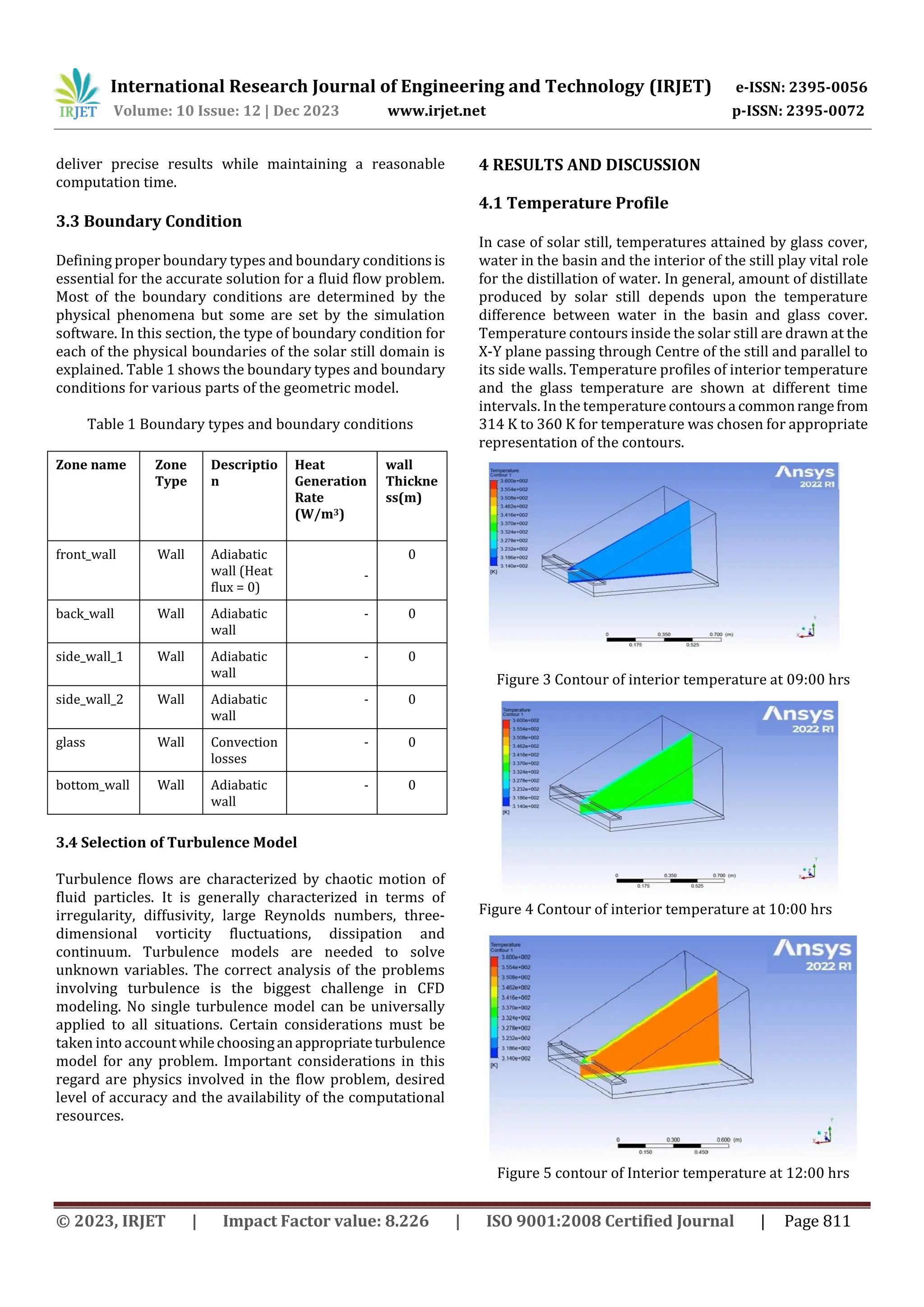
In case of solar still, temperatures attained by glass cover,
water in the basin and the interior of the still play vital role
for the distillation of water. In general, amount of distillate
produced by solar still depends upon the temperature
difference between water in the basin and glass cover.
Temperature contours inside the solar still are drawn at the
X-Y plane passing through Centre of the still and parallel to
its side walls. Temperature profiles of interior temperature
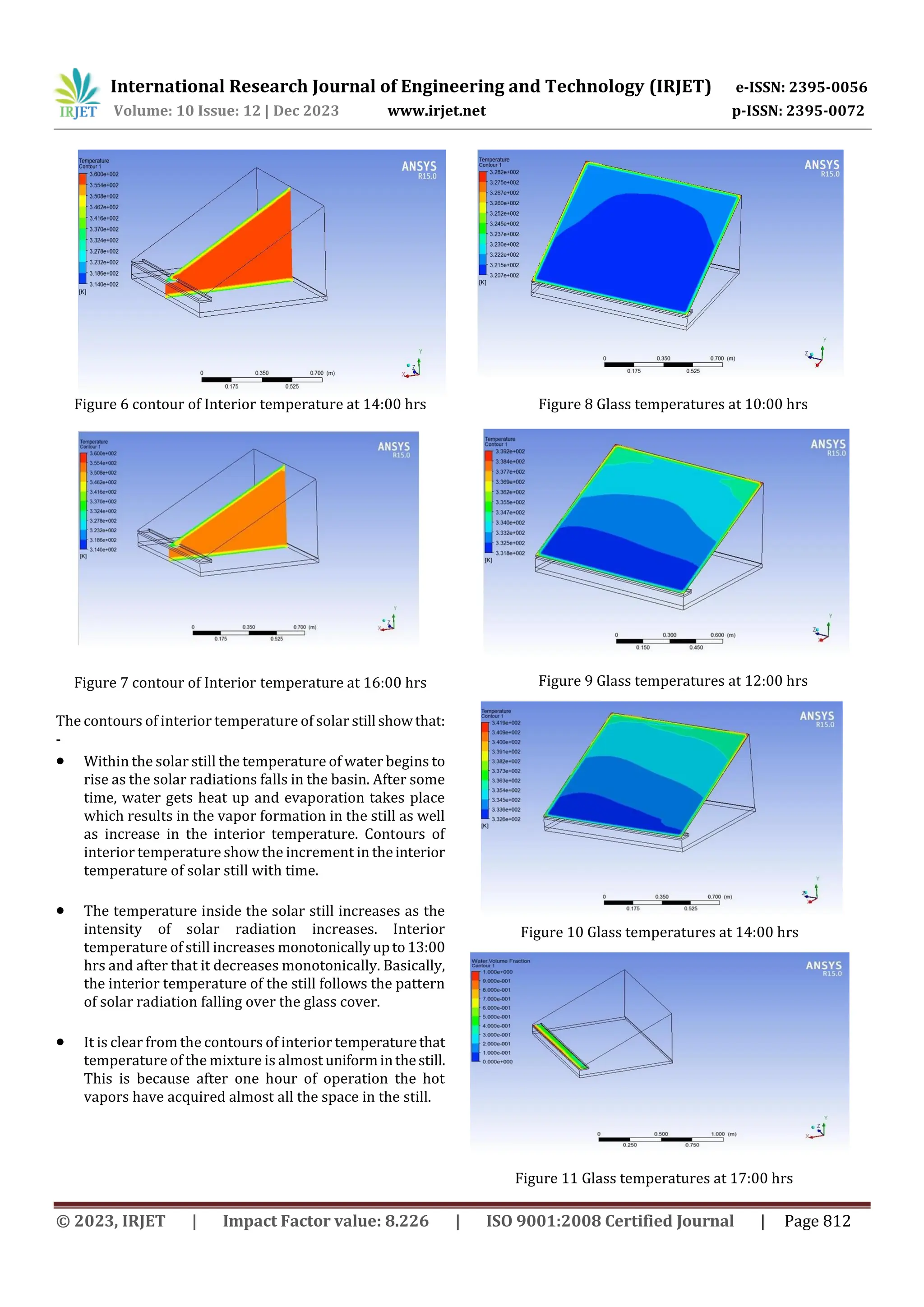
and the glass temperature are shown at different time
intervals. In the temperature contoursa commonrangefrom
314 K to 360 K for temperature was chosen for appropriate
representation of the contours.
Figure 3 Contour of interior temperature at 09:00 hrs
Figure 4 Contour of interior temperature at 10:00 hrs
Figure 5 contour of Interior temperature at 12:00 hrs
Zone name Zone
Type
Descriptio
n
Heat
Generation
Rate
(W/m3)
wall
Thickne
ss(m)
front_wall Wall Adiabatic
wall (Heat
flux = 0)
-
0
back_wall Wall Adiabatic
wall
- 0
side_wall_1 Wall Adiabatic
wall
- 0
side_wall_2 Wall Adiabatic
wall
- 0
glass Wall Convection
losses
- 0
bottom_wall Wall Adiabatic
wall
- 0
International Research Journal of Engineering and Technology (IRJET) e-ISSN: 2395-0056
Volume: 10 Issue: 12 | Dec 2023 www.irjet.net p-ISSN: 2395-0072
© 2023, IRJET | Impact Factor value: 8.226 | ISO 9001:2008 Certified Journal | Page 812
Figure 6 contour of Interior temperature at 14:00 hrs
Figure 7 contour of Interior temperature at 16:00 hrs
The contours of interior temperature of solar still showthat:
-
 Within the solar still the temperature of water begins to
rise as the solar radiations falls in the basin. After some
time, water gets heat up and evaporation takes place
which results in the vapor formation in the still as well
as increase in the interior temperature. Contours of
interior temperature show the increment in theinterior
temperature of solar still with time.
 The temperature inside the solar still increases as the
intensity of solar radiation increases. Interior
temperature of still increases monotonicallyupto13:00
hrs and after that it decreases monotonically. Basically,
the interior temperature of the still follows the pattern
of solar radiation falling over the glass cover.
 It is clear from the contours of interior temperaturethat
temperature of the mixture is almost uniforminthestill.
This is because after one hour of operation the hot
vapors have acquired almost all the space in the still.
Figure 8 Glass temperatures at 10:00 hrs
Figure 9 Glass temperatures at 12:00 hrs
Figure 10 Glass temperatures at 14:00 hrs
Figure 11 Glass temperatures at 17:00 hrs
International Research Journal of Engineering and Technology (IRJET) e-ISSN: 2395-0056
Volume: 10 Issue: 12 | Dec 2023 www.irjet.net p-ISSN: 2395-0072
© 2023, IRJET | Impact Factor value: 8.226 | ISO 9001:2008 Certified Journal | Page 813
From the contours of glass cover temperatures, it can be
noticed that the temperatures on the lower end of glass
cover are relatively lesser than the temperatureattheupper
part of the glass cover. This is due to the fact that distilled
water slides down on the inside of glass cover from the
upper part to the lower end of the glass cover.
 Figure 12 shows the contour of water volume fraction at
the distillate channel. Water volume fraction in distillate
channel is nearly 0.7 which indicates that the distillate
water gets accumulated in the channel afterslidingdown
from the tilted glass surface.
Fig 12 Contour of water volume fraction at the distillate
channel
5 CONCLUSIONS
The main objective of this study was to develop a 3-D CFD
model of a single slope passive solar still and to compare the
simulation results with the available experimental results.
First the 3-D geometric model of solar still was developed in
ANSYS Workbench through design modeler. Then
appropriate models were selected for the physical
phenomena occurring in the solar still. Material properties
and appropriate boundary conditionsweredefinedinFluent
for the simulation of the problem. Simulations were carried
for unsteady state conditions with FLUENT solver for 19th
May. The simulation results were compared with the
experimental results taken by Hassanain.
The main conclusions of the study are as follows: -
 The present CFD model is able to simulate the
temperature at various points in the solar still. The
simulated values of interior temperatures are in
agreement with the experimental values.
 The glass temperature follows the similar trend as that
of solar radiations. It increases with the solar intensity
reaching a maximum value of about 337 K at 13:00 hrs
and then it starts decreasing due to the decreasingvalue
of solar intensity
 Although the simulated results follow the same trendas
the experimental results yet there is a slight difference
between the two-temperature data. The difference
between the two values is most likely due to the
difference in solar intensity for two cases and also
because of the fact that simulatedvaluesdonottakeinto
consideration for natural attenuations that occur inreal
experiments.
 The rate of distillate water output and evaporative heat
transfer coefficient are calculated on the basisofDunkle
‘s model using CFD data. There is a good agreement
between the simulated and experimental data for
distillate yield.
REFERENCES
[1] Attia, M.E.H., Kabeel, A.E., Abdelgaied, M., Abdullah, A.,
2021. A comparative study of the effect of internal
reflectors on a performance of hemispherical solar
distillers: energy, exergy, and economic analysis.
Sustainable Energy Technologies and Assessments 47,
101465. https://doi.org/10.1016/j.seta.2021.101465.
[2] Attia, M.E.H., Kabeel, A.E., Abdelgaied, M., Abdel-Aziz,
M.M., Bellila, A., Abdullah, A.,2021. Optimal size of black
gravel as energy storage materials for performance
improvement of hemispherical distillers. Journal of
Energy Storage 43, 103196.
https://doi.org/10.1016/j.est.2021.103196.
[3] Attia, M.E.H., Kabeel, A.E., Elaloui, E., Abdelgaied, M.,
Abdullah, A., 2022.Experimental studyonimprovingthe
yield of hemispherical distillersusingCuO nanoparticles
and cooling the glass cover. Solar Energy Materials and
Solar Cells 235, 111482.
https://doi.org/10.1016/j.solmat.2021.111482.
[4] Attia, M.E.H., Kabeel, A.E., Abdelgaied,M.,Abdelaziz,G.B.,
2021. A comparative study of hemispherical solar stills
with various modifications to obtain modified and
inexpensive still models. Environmental Science and
Pollution Research 28 (39), 55667–55677.
https://doi.org/10.1007/s11356-021-14862-x.
[5] Kabeel, A.E., Attia, M.E.H., Zayed, M.E., Abdelgaied, M.,
Abdullah, A.S., El- Maghlany, W.M., 2022. Performance
enhancement of a v-corrugated basin hemispherical
solar distiller combined with reversed solar collector:
An experimental approach. Renewable Energy 190,
330–337.
[6] Abdelgaied, M., Abdulla,A.S.,Abdelaziz,G.B.,Kabeel,A.E.,
2022. Performance improvement of modified stepped
solar distillers using three effective hybrid optimization
modifications. Sustainable Energy Technologies and
Assessments 51, 101936.
https://doi.org/10.1016/j.seta.2021.101936.
International Research Journal of Engineering and Technology (IRJET) e-ISSN: 2395-0056
Volume: 10 Issue: 12 | Dec 2023 www.irjet.net p-ISSN: 2395-0072
© 2023, IRJET | Impact Factor value: 8.226 | ISO 9001:2008 Certified Journal | Page 814
[7] Abdelgaied, M., Attia, M.E.H., Kabeel, A.E., Zayed, M.E.,
2022. Improving the thermo-economic performance of
hemispherical solar distiller using copper oxide
nanofluids and phase change materials: Experimental
and theoretical investigation.SolarEnergyMaterialsand
Solar Cells 238, 111596. https://doi.org/10.1016/j.
solmat.2022.111596.
[8] Abdelgaied, M., Kabeel, A.E., 2021. Performance
improvement of pyramid solar distillers using a novel
combination of absorber surface coated with CuO nano
black paint, reflective mirrors, and PCM with pin fins.
Renewable Energy 180, 494–501.
https://doi.org/10.1016/j.renene.2021.08.071.
[9] Abdelgaied, M., Zakaria, Y., Kabeel, A.E., Essa, F.A., 2021.
Improving the tubular solar still performance using
square and circular hollow fins with phase change
materials. Journal of Energy Storage 38, 102564.
https://doi.org/10.1016/j. est.2021.102564.
[10] Attia, M.E.H., Kabeel, A.E., Abdelgaied, M., Shmouty, A.R.,
2022. Enhancing the hemispherical solar distiller
performance using internal reflectors and El Oued sand
grains as energy storage mediums, Environmental
Science. Pollution Research 29, 21451–21464.
https://doi.org/10.1007/s11356-021-17367-9.
[11] Attia, M.E.H., El-Maghlany, W.M., Kabeel, A.E.,
Abdelgaied, M., Bellila, A., 2022. Technically and
economically optimal water flow rate glass film cooling
for hemispherical drinkingwaterdistillers.International
Journal of Environmental Science and Technology 19
(11), 11435–11446.
[12] Attia, M.E.H., Kabeel, A.E., Abdelgaied, M., 2021. Optimal
concentration of El Oued sand grains as energy storage
materials for enhancement of hemispherical distillers
performance. Journal of Energy Storage 36, 102415.
https://doi.org/ 10.1016/j.est.2021.102415.
[13] Attia, M.E.H., Kabeel, A.E., Abdelgaied, M., Bellila, A.,
Abdel-Aziz, M.M., 2021. Optimal concentration of high
thermal conductivity sensible storage materials
(graphite) for performance enhancement of
hemispherical distillers. Desalination and Water
Treatment 231, 262–272.
https://doi.org/10.5004/dwt.2021.27479.
[14] Attia, M.E.H., Kabeel, A.E., Abdelgaied, M., Driss,Z.,2020.
Productivity enhancement of traditional solar still by
using sandbags of El Oued-Algeria. Heat Transfer50(1),
768–783. https://doi.org/10.1002/htj.21903.
[15] Attia, M.E.H., Kabeel, A.E., Zayed, M.E., Abdelgaied, M.,
Sharshir, S.W., Abdulla, A.S.,2022.Experimental studyof
a hemispherical solar distillation system with and
without rock salt balls as low-cost sensible storage:
Performance optimization and comparative analysis.
Solar Energy 247, 373–384. https://doi.
org/10.1016/j.solener.2022.10.049.
[16] Attia, M.E.H., Kabeel, A.E., Zayed, M.E., Arıcı, M.,
Abdelgaied, M., 2022. Optimal size of spherical rock salt
balls as low-cost thermal storage materials for
performance augmentation of hemispherical solar
distillers: Experimental investigation and thermo-
economic analysis. Journal of Cleaner Production 374,
134006.
https://doi.org/10.1016/j.jclepro.2022.134006.
[17] Zhang, J., Zhu, T., 2022. Systematic review of solar air
collector technologies: Performance evaluation,
structure design and application analysis. Sustainable
Energy Technologies and Assessments 54, 102885.
https://doi.org/10.1016/j. seta.2022.102885.
[18] Hammoodi, K.A., Dhahad, H.A., Alawee, W.H., Omara,
Z.M., 2023. A detailed review of the factors impacting
pyramid type solar still performance. Alexandria
Engineering Journal 66, 123–154.
https://doi.org/10.1016/j.aej.2022.12.006.
[19] Farouk, W.M., Abdullah, A.S., Mohammed,S.h.A.,Alawee,
W.H., Omara, Z.M., Essa, F.A., 2022. Modeling and
optimization of workingconditionsofpyramidsolarstill
with different nanoparticles using response surface
methodology, Case Studies. Thermal Engineering 33,
101984. https://doi.org/10.1016/j. csite.2022.101984.

Enhancing the Efficiency of Solar Desalination through Computational Fluid Dynamics (CFD) Modeling

  • 1.
    International Research Journalof Engineering and Technology (IRJET) e-ISSN: 2395-0056 Volume: 10 Issue: 12 | Dec 2023 www.irjet.net p-ISSN: 2395-0072 © 2023, IRJET | Impact Factor value: 8.226 | ISO 9001:2008 Certified Journal | Page 808 Enhancing the Efficiency of Solar Desalination through Computational Fluid Dynamics (CFD) Modeling Mayank Kumar1, Dr. Ajay Singh2, Prakash Sahu3 1Scholar, Department of Mechanical Engineering, Radharaman Institute of Technology and Science, Bhopal, M.P 2 Head and Prof., Department of Mechanical Engineering, Radharaman Institute of Technology and Science, Bhopal, M.P 3 Assistant Professor, Department of Mechanical Engineering, Radharaman Institute of Technology and Science, Bhopal, M.P ---------------------------------------------------------------------***--------------------------------------------------------------------- Abstract - This research delves deep into using Computational Fluid Dynamics (CFD) to mimic how a single slope passive solar still works. The main aim was to create a detailed 3-D model of the solar still using ANSYS Workbench and compare what the simulation predicted with real-world experimental data. They carefully set up this virtual model in FLUENT, tweaking materials and environmental factors to mirror actual conditions and ran simulations for May 19th. Then, they checked how well the simulation matched the real data from Hassanain's experiments. Here's what they found: The CFD model they built did a great job at showing how temperatures spread within the solar still. The temperatures inside the still were very close to what they found in their experiments, proving the model's accuracy in capturing how heat behaves in the system. They also noticed that the glass temperature in the still followed the pattern of sunlight—it rose with solar intensity, hitting its highest point at around 337 Kelvin by 1:00 PM, then slowly dropped as the sun got weaker. Although the simulated results lined up well with the experimental data, there were some tiny differences. These variations happened because the simulated sunlight didn't perfectly match the real sun's intensity, andthemodelcouldn't mimic natural adjustments like those that happen in real- world experiments. We used the CFD data to calculate how much water the still produced and how efficiently it transferred heat for evaporation using Dunkle's model. Luckily, the numbers they got from the simulations matched up impressively well with what they found in their experiments, proving thattheCFD modelcouldreliablypredict what happens in real life. This study shows how powerful CFD simulations can be—they're like a crystal ball for understanding and improving passive solar stills. By digging into temperature dynamics and accurately predicting water output, this research pushes forward the quest to make solar- powered desalination more effective and eco-friendlier. Key Words Solar Still, Efficiency, CFD, Mesh, Temperature 1.INTRODUCTION Freshwater scarcity is a growing concern in many regionsof the world, driven by factors such as population growth, climate change, and increasing demands on limited water resources. Meeting the demand for clean and potable water in water-scarce areas is a critical challenge. In this context, solar stills have emerged as a sustainable and energy- efficient solution for addressing the pressing need for freshwater production. A solar still is a simple yet ingenious device that harnesses the power of the sun to desalinate and purify water. It operates on the principle of solardistillation, a process that replicates nature's own water purification cycle. By utilizing the sun's energy, solar stills offer a practical and environmentally friendly means of transforming brackish or contaminated water into safe, drinkable water. The operation of a solar still is relatively straightforward. It typically consists of a transparent cover or glazing, which allows sunlight topenetratewhiletrapping heat, and an inclined surfaceunderneathtocollectanddirect the condensed water to a collection point. Assunlightpasses through the transparent surface, it heats the contaminated or saline water present in the still's basin. This heat causes the water to evaporate, leaving behind impurities and salt. The water vapor rises, condenses on the glazing, and eventually drips down to the collection point as purified, distilled water. The collected freshwater is free from contaminants, making it safe forconsumption. Solarstillsare particularly valuable in regions where conventional sources of clean water are scarce or unreliable.Theycanbedeployed in remote or off-grid areas, providing a decentralized solution to waterpurificationneeds.Furthermore,solarstills are powered by renewable energy sources, making them sustainable and cost-effective over the long term. The versatility of solar stills is evident in their ability tobescaled to meet the demands of both individual households and larger communities. They can be designed in various configurations, including single-slope, double-slope, and multi-effect stills, depending on the local climate, water quality, and water requirements. In this introduction, we embark on a journey to explore the world of solar stills. We will delve into the principles governing their operation, the various designs and configurations, the factors influencing their efficiency, and their applications in addressing water scarcity challenges. Solar stills represent a beaconofhopein the quest for sustainable and accessible freshwater solutions, offering a path towards a more water-secure and resilient future.
  • 2.
    International Research Journalof Engineering and Technology (IRJET) e-ISSN: 2395-0056 Volume: 10 Issue: 12 | Dec 2023 www.irjet.net p-ISSN: 2395-0072 © 2023, IRJET | Impact Factor value: 8.226 | ISO 9001:2008 Certified Journal | Page 809 2. LITERATURE SURVEY A study enhanced hemispherical distillate production by incorporating reflective mirror and aluminum foil, boosting solar radiation intensity. Results showed reflective aluminum foil sheets improvedyieldand efficiencyby42.3% and 37.5% respectively, whilereflectivemirrorsshoweda 6- 2.6% increase in yield and a 57.26% efficiency boost compared to conventional distillers. Additionally, exergy efficiency saw a significant improvement, with cost reductions of 29% and 38% for reflective aluminum foil and mirrors, respectively, compared to the conventional setup [1]. An empirical study enhanced hemispherical solar distillers' cumulative yield using varying sizes of black gravel; the 16mm gravel size yielded the highest productivity of 7.7 kg/m²/day, marking a 57.1% improvement over the reference distiller's 4.9 kg/m². This optimization demonstrated increased efficiency in distillation, showcasing a 56% improvement over the standard design [2]. This study explores enhancing freshwater production in rural areas by employing hemispherical solar distillers. Combining CuO nanoparticles and glass cover cooling technology significantly boosts productivity, yielding 7.9 L/m²/day—105.2% higher than traditional distillers—and improving daily efficiency by 101.5% [3]. The study explores modifications to hemispherical solar distillers for enhanced productivityand cost-efficiency: one involves CuO nanoparticles in basin water for increased vapor generation, while the other uses water film glass cooling to improve condensation. Results show a significant increase in daily yield, up to 76.6%, and cost reduction to $0.0066/L, suggesting the most effective modification is the HSS-N (0.3%volumefraction)foroptimal yield and cost-effectiveness [4].Anexperimentenhanced the yield of a hemispherical solar distiller by incorporating a v- corrugated basin and reversed solar collector, elevating freshwater output by 68.82% and energy efficiency by 24.18%. The v-corrugated basin with reversed solar collector exhibited a 27.12% reduction in freshwater production cost compared to the traditional flat basin hemispherical distiller [5].A studyinTanta,Egypt,enhanced a stepped solar distiller using CuO nanoparticles, interior mirrors, and phase change materials, boosting yield to 9.79 L/m²/day—135.9% higherthanthe4.15L/m²/dayfromthe original design. The modified distiller raised daily thermal efficiency to 78.8% and exergy efficiency to 7.96%, proving the efficacy of the three hybrid optimizations for peak performance [6]. A study compared modified hemispherical solar stills (MHSS) using additives like paraffin wax and copper oxide nanoparticles to traditional ones (THSS), finding MHSS with PCM and CuO nanofluid increased productivity by up to 80.20% and enhanced daily energy efficiency from 35.52% (THSS) to 63.61%.Economically,the dual use of PCM and CuO nanofluid reduced freshwater production costs by 75% compared to THSS [7]. A study enhanced pyramid solar distillers with new modifications: CuO nano black paint, mirrors, and phase change material. Results showed a significant boost, elevating the yield to 9885–10015 mL/m2/day, marking a 140.1–142% improvement over the conventional distiller, with notable enhancements in daily thermal and exergy efficiencies [8]. A study enhanced tubular solar stills with copper hollow fins and PCM for improved water production. Results showed 90.1% productivity improvement with hollow circular fins and PCM. Another studyonpyramidsolardistillersshoweda 140.1–142% yield increase using a novel combination of modifications including CuO nano black paint, reflective mirrors, and phase change materials with pin fins [9]. This study explores enhancements for solar distillers, testing reflective elements and sand grainstooptimizeproductivity. Results showed a significantincreaseindistillateproduction, reaching 9400 mL/m2/day with reflective mirrorsandsand grains, presenting a cost-effective solution, reducing freshwater production costs by 49.1% compared to the conventional distiller [10]. A study on hemispherical solar desalination found that a water flow rate of 2.5 L/h optimally cooled the glass cover, enhancing distiller performance by achieving a 43.61% yield increase (5.17 L/m2/day) and 50.7% daily efficiency compared to a conventional setup. This optimizedflowratealsoyieldedthe shortest payback period in the techno-economic analysis compared to other systems tested [11]. An experimental study enhanced hemispherical distillers' performanceusing El Oued sand grains, determining 3% concentration as optimal, boosting yield to 7270 mL/m2/day (52.1% increase) and daily efficiency to 59.1% (50.8% improvement). This involved testing eight concentrations in modified distillers over four days,showcasingthesignificant enhancement over the traditional reference distiller, which achieved an accumulative yield of 4780 mL/m2/day and 39.2% daily efficiency [12]. The manuscript explores optimizing graphite concentration in hemispherical distillers, determining 35g/L as the ideal concentration, achieving a 93.94% improvement in yield and 91.66% in daily efficiency compared to the reference distiller. The study underscores that exceeding 35g/L of graphite in high thermal conductivity storage materials stabilizes productivity, suggesting no need for higher concentrations, saving resources and time [13]. The study investigates a modified solar still using sandbags as energy storage, showcasing a 34.57% increase in distillate yield (5.06 L/m²/d) compared to traditional solar still (3.76 L/m²/d), employing El Oued sand with high thermal conductivity (97.6% quartz and 0.56% calcite), thus enhancing daily efficiency by 34.83% (44.63% for MSS‐SB versus 33.1% for TSS) under similar climatic conditions in southeast Algeria [14]. The study explores rock salt balls asa low-costsolution to minimize heat loss in hemispheric solar stills. Results suggest that a 4.0 cm gap spacing of these balls maximizes freshwater production by up to 49.0%, significantly enhancing energy efficiency andreducingcostsby31.0%per liter compared to conventional setups [15].Anexperimental study enhances freshwater output in hemispheric solar distillers by embedding spherical rock salt balls for better heat absorption and cost-efficient energy storage. Findings show a 45.6% increase in freshwater production, 43.91% higher energy efficiency, and up to 28.83% reduced production costs, with 2.0 cm salt balls proving most effective in improving distillatory performance [16]. This paper reviews three types of solar air collectors (FPSAC,
  • 3.
    International Research Journalof Engineering and Technology (IRJET) e-ISSN: 2395-0056 Volume: 10 Issue: 12 | Dec 2023 www.irjet.net p-ISSN: 2395-0072 © 2023, IRJET | Impact Factor value: 8.226 | ISO 9001:2008 Certified Journal | Page 810 EVTSAC, and concentrated SAC), aiming for high efficiency and low heat loss. Findings show FPSACs with specific designs achieve a performancecriterionofabout2,EVTSACs with micro-heat pipe arrays reach 73% thermal efficiency, and concentrated SACs can achieve a 75%thermal efficiency with a linear concentrating design using an open Brayton cycle, highlighting the need for high-efficiency heat transfer components in SAC design [17]. This paper explores the factors affecting pyramid solar still performance, highlighting meteorological,design,andoperational aspects. Enhanced designs, such as PCM integration, v-corrugated plates, reflectors, mirrors, and nanoparticle utilization, can elevate productivity by up to 88%, emphasizing the crucial role of climatic and structural elements, prompting suggestions for future research to optimize solar distillation [18]. A mathematical model using response surface methodology predicts optimal conditions for pyramid solar distillers (PSD) considering environmental factors and nanoparticle variations, showcasinga substantial increasein daily productivity (57% for Cu2O-PSD) compared to conventional PSD. Experimental validation demonstrates a high reproducibility rate (within6.5% error)betweenactual and predicted values, affirming the model's reliability [19]. 3. METHODDOLOGY AND CFD 3.1 Design of Heat Exchanger Solar still is basically an insulated metallic boxcovered byan inclined transparent glass. A schematic diagramofthesingle slope passive solar still is shown in the figure 3.2. Solar still contains a shallow basin which is made up of GI sheet. The basin area is 0.8 m ×1.0 m. Still is constructed as a double walled body and a thick thermocol sheet is sandwiched between the GI sheet walls in order to insulatethebasin.The inner basin area of solar still is painted black in order to increase its absorptivity. Mirrorsareplacedontheinnerside walls of the basin to reflect the solar radiation towards the bottom surface of the basin. A 5 mm thick transparent glass cover is placed over the solar still. The glass cove is inclined at an angle of 260 towards south which is the latitude angle of Bhopal. 3.2 Meshing Following the creation of the geometric model, the subsequent critical step in CFD analysis is the generation of the computational mesh for the problem domain. Meshing involves dividing the domain into a multitude of small cells. Within each of these cells, the CFD software conducts calculations to simulate the physical phenomena under examination. The number of cells within the domain significantly influences the outcomes of the simulation. It is imperative that the number of cells is sufficiently large to accurately capture the intricacies of the physical processes being modelled. However, it's important to strike a balance, as an excessive number of cells can extend the solver's computational time, potentially making simulations impractical. Therefore, there is an ongoing quest to determine the optimum number of cells that can yield sufficiently accurate results while maintaining a reasonable computation time. The determination of this optimum cell count is not one-size-fits-all; it varies based on the complexity of the problem at hand and the available timefor simulations. More complex problems may require a denser mesh, while simpler scenarios can make do with a coarser mesh. Ultimately, finding this balance is a crucial aspect of efficient and effective CFD analysis. Figure 1 Geometric Model of the solar still Figure 2 Meshing of the computational domain The importance of a high-quality mesh cannot be overstated when it comes to ensuring the accuracy of CFD analysis. In this particular study, after an extensiveliteraturereview,the decision was made to employ a hexahedral mesh for discretization. Hexahedral elementswereusedexclusivelyin the meshing process due to the specific characteristicsof the solar still's geometry. Notably, the solar still's geometry primarily comprises rectangular surfaces, devoid of any curved elements. This fact makes hexahedral meshing exceptionally well-suited for the task, as it is known to
  • 4.
    International Research Journalof Engineering and Technology (IRJET) e-ISSN: 2395-0056 Volume: 10 Issue: 12 | Dec 2023 www.irjet.net p-ISSN: 2395-0072 © 2023, IRJET | Impact Factor value: 8.226 | ISO 9001:2008 Certified Journal | Page 811 deliver precise results while maintaining a reasonable computation time. 3.3 Boundary Condition Defining proper boundary types and boundary conditions is essential for the accurate solution for a fluid flow problem. Most of the boundary conditions are determined by the physical phenomena but some are set by the simulation software. In this section, the type of boundary condition for each of the physical boundaries of the solar still domain is explained. Table 1 shows the boundary types and boundary conditions for various parts of the geometric model. Table 1 Boundary types and boundary conditions 3.4 Selection of Turbulence Model Turbulence flows are characterized by chaotic motion of fluid particles. It is generally characterized in terms of irregularity, diffusivity, large Reynolds numbers, three- dimensional vorticity fluctuations, dissipation and continuum. Turbulence models are needed to solve unknown variables. The correct analysis of the problems involving turbulence is the biggest challenge in CFD modeling. No single turbulence model can be universally applied to all situations. Certain considerations must be taken into accountwhilechoosinganappropriateturbulence model for any problem. Important considerations in this regard are physics involved in the flow problem, desired level of accuracy and the availability of the computational resources. 4 RESULTS AND DISCUSSION 4.1 Temperature Profile In case of solar still, temperatures attained by glass cover, water in the basin and the interior of the still play vital role for the distillation of water. In general, amount of distillate produced by solar still depends upon the temperature difference between water in the basin and glass cover. Temperature contours inside the solar still are drawn at the X-Y plane passing through Centre of the still and parallel to its side walls. Temperature profiles of interior temperature and the glass temperature are shown at different time intervals. In the temperature contoursa commonrangefrom 314 K to 360 K for temperature was chosen for appropriate representation of the contours. Figure 3 Contour of interior temperature at 09:00 hrs Figure 4 Contour of interior temperature at 10:00 hrs Figure 5 contour of Interior temperature at 12:00 hrs Zone name Zone Type Descriptio n Heat Generation Rate (W/m3) wall Thickne ss(m) front_wall Wall Adiabatic wall (Heat flux = 0) - 0 back_wall Wall Adiabatic wall - 0 side_wall_1 Wall Adiabatic wall - 0 side_wall_2 Wall Adiabatic wall - 0 glass Wall Convection losses - 0 bottom_wall Wall Adiabatic wall - 0
  • 5.
    International Research Journalof Engineering and Technology (IRJET) e-ISSN: 2395-0056 Volume: 10 Issue: 12 | Dec 2023 www.irjet.net p-ISSN: 2395-0072 © 2023, IRJET | Impact Factor value: 8.226 | ISO 9001:2008 Certified Journal | Page 812 Figure 6 contour of Interior temperature at 14:00 hrs Figure 7 contour of Interior temperature at 16:00 hrs The contours of interior temperature of solar still showthat: -  Within the solar still the temperature of water begins to rise as the solar radiations falls in the basin. After some time, water gets heat up and evaporation takes place which results in the vapor formation in the still as well as increase in the interior temperature. Contours of interior temperature show the increment in theinterior temperature of solar still with time.  The temperature inside the solar still increases as the intensity of solar radiation increases. Interior temperature of still increases monotonicallyupto13:00 hrs and after that it decreases monotonically. Basically, the interior temperature of the still follows the pattern of solar radiation falling over the glass cover.  It is clear from the contours of interior temperaturethat temperature of the mixture is almost uniforminthestill. This is because after one hour of operation the hot vapors have acquired almost all the space in the still. Figure 8 Glass temperatures at 10:00 hrs Figure 9 Glass temperatures at 12:00 hrs Figure 10 Glass temperatures at 14:00 hrs Figure 11 Glass temperatures at 17:00 hrs
  • 6.
    International Research Journalof Engineering and Technology (IRJET) e-ISSN: 2395-0056 Volume: 10 Issue: 12 | Dec 2023 www.irjet.net p-ISSN: 2395-0072 © 2023, IRJET | Impact Factor value: 8.226 | ISO 9001:2008 Certified Journal | Page 813 From the contours of glass cover temperatures, it can be noticed that the temperatures on the lower end of glass cover are relatively lesser than the temperatureattheupper part of the glass cover. This is due to the fact that distilled water slides down on the inside of glass cover from the upper part to the lower end of the glass cover.  Figure 12 shows the contour of water volume fraction at the distillate channel. Water volume fraction in distillate channel is nearly 0.7 which indicates that the distillate water gets accumulated in the channel afterslidingdown from the tilted glass surface. Fig 12 Contour of water volume fraction at the distillate channel 5 CONCLUSIONS The main objective of this study was to develop a 3-D CFD model of a single slope passive solar still and to compare the simulation results with the available experimental results. First the 3-D geometric model of solar still was developed in ANSYS Workbench through design modeler. Then appropriate models were selected for the physical phenomena occurring in the solar still. Material properties and appropriate boundary conditionsweredefinedinFluent for the simulation of the problem. Simulations were carried for unsteady state conditions with FLUENT solver for 19th May. The simulation results were compared with the experimental results taken by Hassanain. The main conclusions of the study are as follows: -  The present CFD model is able to simulate the temperature at various points in the solar still. The simulated values of interior temperatures are in agreement with the experimental values.  The glass temperature follows the similar trend as that of solar radiations. It increases with the solar intensity reaching a maximum value of about 337 K at 13:00 hrs and then it starts decreasing due to the decreasingvalue of solar intensity  Although the simulated results follow the same trendas the experimental results yet there is a slight difference between the two-temperature data. The difference between the two values is most likely due to the difference in solar intensity for two cases and also because of the fact that simulatedvaluesdonottakeinto consideration for natural attenuations that occur inreal experiments.  The rate of distillate water output and evaporative heat transfer coefficient are calculated on the basisofDunkle ‘s model using CFD data. There is a good agreement between the simulated and experimental data for distillate yield. REFERENCES [1] Attia, M.E.H., Kabeel, A.E., Abdelgaied, M., Abdullah, A., 2021. A comparative study of the effect of internal reflectors on a performance of hemispherical solar distillers: energy, exergy, and economic analysis. Sustainable Energy Technologies and Assessments 47, 101465. https://doi.org/10.1016/j.seta.2021.101465. [2] Attia, M.E.H., Kabeel, A.E., Abdelgaied, M., Abdel-Aziz, M.M., Bellila, A., Abdullah, A.,2021. Optimal size of black gravel as energy storage materials for performance improvement of hemispherical distillers. Journal of Energy Storage 43, 103196. https://doi.org/10.1016/j.est.2021.103196. [3] Attia, M.E.H., Kabeel, A.E., Elaloui, E., Abdelgaied, M., Abdullah, A., 2022.Experimental studyonimprovingthe yield of hemispherical distillersusingCuO nanoparticles and cooling the glass cover. Solar Energy Materials and Solar Cells 235, 111482. https://doi.org/10.1016/j.solmat.2021.111482. [4] Attia, M.E.H., Kabeel, A.E., Abdelgaied,M.,Abdelaziz,G.B., 2021. A comparative study of hemispherical solar stills with various modifications to obtain modified and inexpensive still models. Environmental Science and Pollution Research 28 (39), 55667–55677. https://doi.org/10.1007/s11356-021-14862-x. [5] Kabeel, A.E., Attia, M.E.H., Zayed, M.E., Abdelgaied, M., Abdullah, A.S., El- Maghlany, W.M., 2022. Performance enhancement of a v-corrugated basin hemispherical solar distiller combined with reversed solar collector: An experimental approach. Renewable Energy 190, 330–337. [6] Abdelgaied, M., Abdulla,A.S.,Abdelaziz,G.B.,Kabeel,A.E., 2022. Performance improvement of modified stepped solar distillers using three effective hybrid optimization modifications. Sustainable Energy Technologies and Assessments 51, 101936. https://doi.org/10.1016/j.seta.2021.101936.
  • 7.
    International Research Journalof Engineering and Technology (IRJET) e-ISSN: 2395-0056 Volume: 10 Issue: 12 | Dec 2023 www.irjet.net p-ISSN: 2395-0072 © 2023, IRJET | Impact Factor value: 8.226 | ISO 9001:2008 Certified Journal | Page 814 [7] Abdelgaied, M., Attia, M.E.H., Kabeel, A.E., Zayed, M.E., 2022. Improving the thermo-economic performance of hemispherical solar distiller using copper oxide nanofluids and phase change materials: Experimental and theoretical investigation.SolarEnergyMaterialsand Solar Cells 238, 111596. https://doi.org/10.1016/j. solmat.2022.111596. [8] Abdelgaied, M., Kabeel, A.E., 2021. Performance improvement of pyramid solar distillers using a novel combination of absorber surface coated with CuO nano black paint, reflective mirrors, and PCM with pin fins. Renewable Energy 180, 494–501. https://doi.org/10.1016/j.renene.2021.08.071. [9] Abdelgaied, M., Zakaria, Y., Kabeel, A.E., Essa, F.A., 2021. Improving the tubular solar still performance using square and circular hollow fins with phase change materials. Journal of Energy Storage 38, 102564. https://doi.org/10.1016/j. est.2021.102564. [10] Attia, M.E.H., Kabeel, A.E., Abdelgaied, M., Shmouty, A.R., 2022. Enhancing the hemispherical solar distiller performance using internal reflectors and El Oued sand grains as energy storage mediums, Environmental Science. Pollution Research 29, 21451–21464. https://doi.org/10.1007/s11356-021-17367-9. [11] Attia, M.E.H., El-Maghlany, W.M., Kabeel, A.E., Abdelgaied, M., Bellila, A., 2022. Technically and economically optimal water flow rate glass film cooling for hemispherical drinkingwaterdistillers.International Journal of Environmental Science and Technology 19 (11), 11435–11446. [12] Attia, M.E.H., Kabeel, A.E., Abdelgaied, M., 2021. Optimal concentration of El Oued sand grains as energy storage materials for enhancement of hemispherical distillers performance. Journal of Energy Storage 36, 102415. https://doi.org/ 10.1016/j.est.2021.102415. [13] Attia, M.E.H., Kabeel, A.E., Abdelgaied, M., Bellila, A., Abdel-Aziz, M.M., 2021. Optimal concentration of high thermal conductivity sensible storage materials (graphite) for performance enhancement of hemispherical distillers. Desalination and Water Treatment 231, 262–272. https://doi.org/10.5004/dwt.2021.27479. [14] Attia, M.E.H., Kabeel, A.E., Abdelgaied, M., Driss,Z.,2020. Productivity enhancement of traditional solar still by using sandbags of El Oued-Algeria. Heat Transfer50(1), 768–783. https://doi.org/10.1002/htj.21903. [15] Attia, M.E.H., Kabeel, A.E., Zayed, M.E., Abdelgaied, M., Sharshir, S.W., Abdulla, A.S.,2022.Experimental studyof a hemispherical solar distillation system with and without rock salt balls as low-cost sensible storage: Performance optimization and comparative analysis. Solar Energy 247, 373–384. https://doi. org/10.1016/j.solener.2022.10.049. [16] Attia, M.E.H., Kabeel, A.E., Zayed, M.E., Arıcı, M., Abdelgaied, M., 2022. Optimal size of spherical rock salt balls as low-cost thermal storage materials for performance augmentation of hemispherical solar distillers: Experimental investigation and thermo- economic analysis. Journal of Cleaner Production 374, 134006. https://doi.org/10.1016/j.jclepro.2022.134006. [17] Zhang, J., Zhu, T., 2022. Systematic review of solar air collector technologies: Performance evaluation, structure design and application analysis. Sustainable Energy Technologies and Assessments 54, 102885. https://doi.org/10.1016/j. seta.2022.102885. [18] Hammoodi, K.A., Dhahad, H.A., Alawee, W.H., Omara, Z.M., 2023. A detailed review of the factors impacting pyramid type solar still performance. Alexandria Engineering Journal 66, 123–154. https://doi.org/10.1016/j.aej.2022.12.006. [19] Farouk, W.M., Abdullah, A.S., Mohammed,S.h.A.,Alawee, W.H., Omara, Z.M., Essa, F.A., 2022. Modeling and optimization of workingconditionsofpyramidsolarstill with different nanoparticles using response surface methodology, Case Studies. Thermal Engineering 33, 101984. https://doi.org/10.1016/j. csite.2022.101984.