Solar Distillation
Presented by: ABU NASAR
Roll No.: 2200430510001
Under Guidance Of:
Prof. Ajay Devidas Hiwarkar
Chemical Engineering
Department
BIET JHANSI
CONTENT
● Introduction
● History
● What is Solar Distillation ?
● Working Procedure of Solar Distillation
● Implementation
● Basic Operating Principle
● Water Purification
● Working of Solar Still
● Design of Solar Still
● Design types and its performance
● Hybrid Design
● Advantages & Disadvantages
● Application
● Conclusion
● References
INTRODUCTION
● 97% of the water in the world is in the ocean, approximately 2% of the water
in the world is at present stored as ice in polar region, and 1% is fresh water
available in earth for the need of the plants, animals and human life.
● Process available for water purification Practiced in tropical and sub-
tropical region.
● System can be large or small.
HISTORY
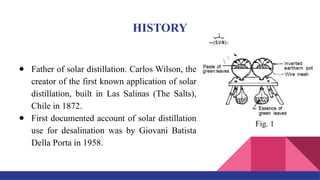
● Father of solar distillation. Carlos Wilson, the
creator of the first known application of solar
distillation, built in Las Salinas (The Salts),
Chile in 1872.
● First documented account of solar distillation
use for desalination was by Giovani Batista
Della Porta in 1958.
Fig. 1
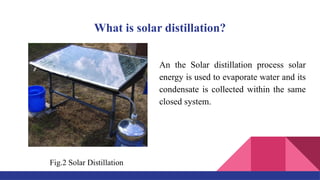
What is solar distillation?
An the Solar distillation process solar
energy is used to evaporate water and its
condensate is collected within the same
closed system.
Fig.2 Solar Distillation
● Solar Distillation is by far the most reliable, least costly method of 99.9%
true purification of most types of contaminated water especially in
developing nations where fuel is scarce or too expensive.
● Solar distillation is used to produce drinking water or to produce pure water
for lead acid batteries, laboratories, hospitals and in producing commercial
products such as rose water.
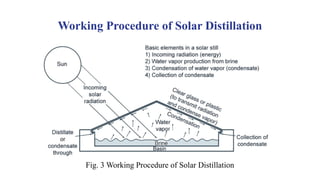
Working Procedure of Solar Distillation
Fig. 3 Working Procedure of Solar Distillation
Implementation
● Solar water distillers find application mostly in remote areas where there is
limited access to freshwater and centralized distribution systems.
● In these areas technical expertise is made use of to introduce the system and
personnel in usage and maintenance of the system.
● An important criteria for installation of these systems is that the area should
be flat and open with good access to water and sunlight.
● The untreated water is collected in the still basin. Solar energy heats up this
water and then evaporates and separates it from the contaminants. It is
important that the material used in still basin should be able to absorb heat.
● Examples of such materials are leather sheet, silicon, reinforced plastic, or
steel plate. The slanted cover funnels the condensed water into a pipe tube,
which is attached to a storage container so it can be used for drinking water.
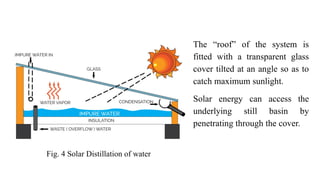
The “roof” of the system is
fitted with a transparent glass
cover tilted at an angle so as to
catch maximum sunlight.
Solar energy can access the
underlying still basin by
penetrating through the cover.
Fig. 4 Solar Distillation of water
Basic Operating Principle
The main features of operation are the same for all solar stills. The incident solar
radiation is transmitted through the glass or plastic cover and is absorbed as heat
by a black surface in contact with the water to be distilled. The water is thus
heated and gives off water vapour. The vapour condenses on the cover, which is
at a lower temperature because it is in contact with the ambient air, and runs
down into a gutter from where it is fed to a storage tank.
Water Purification
It is the process of removing undesirable chemicals, biological contaminants,
suspended solids and gases from contaminated water. Options for water
purification:- There are four possible ways of purifying water for drinking
purpose:-
1. Distillation
2. Filtration
3. Chemical Treatment
4. Irradiative Treatment
What is Solar Still?
A solar still distills water with substances dissolved in it by using the heat of the
Sun to evaporate water so that it may be cooled and collected, thereby purifying
it.
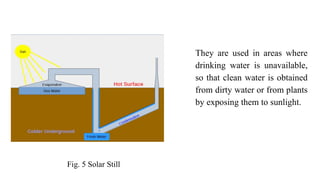
They are used in areas where
drinking water is unavailable,
so that clean water is obtained
from dirty water or from plants
by exposing them to sunlight.
Fig. 5 Solar Still
Working of Solar Still
● Solar stills are called stills because they distill, or purify water.
● A solar still operates on the same principle as rainwater: evaporation and
condensation.
● The water from the oceans evaporates, only to cool, condense, and return to
earth as rain.
● When the water evaporates, it removes only pure water and leaves all
contaminants behind.
Design of Solar Still
Different designs of solar still have emerged. The single effect solar still is a
relatively simple device to construct and operate.
However, the low productivity of the Solar still triggered the initiatives to look
for ways to Improve its productivity and Efficiency.
These may be classified into Two types
● Passive Method
● Active methods
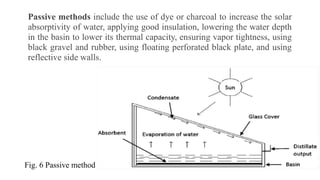
Passive methods include the use of dye or charcoal to increase the solar
absorptivity of water, applying good insulation, lowering the water depth
in the basin to lower its thermal capacity, ensuring vapor tightness, using
black gravel and rubber, using floating perforated black plate, and using
reflective side walls.
Fig. 6 Passive method
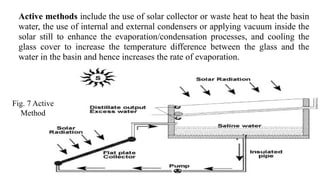
Active methods include the use of solar collector or waste heat to heat the basin
water, the use of internal and external condensers or applying vacuum inside the
solar still to enhance the evaporation/condensation processes, and cooling the
glass cover to increase the temperature difference between the glass and the
water in the basin and hence increases the rate of evaporation.
Fig. 7 Active
Method
Design types and their performance
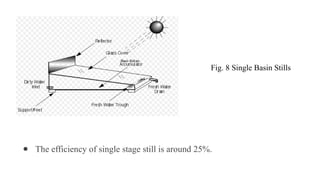
● Single-basin stills have been much studied and their behavior is well
understood. Efficiencies of 25% are typical.
● Daily output as a function of solar irradiation is greatest in the early evening
when the feed water is still hot but when outside temperatures are falling.
● The efficiency of single stage still is around 25%.
Fig. 8 Single Basin Stills
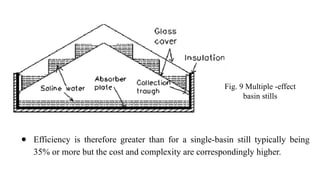
● Multiple-effect basin stills have two or more compartments.
● The condensing surface of the lower compartment is the floor of the upper
compartment.
● The heat given off by the condensing vapour provides energy to vapourize
the feed water above.
● Efficiency is therefore greater than for a single-basin still typically being
35% or more but the cost and complexity are correspondingly higher.
Fig. 9 Multiple -effect
basin stills
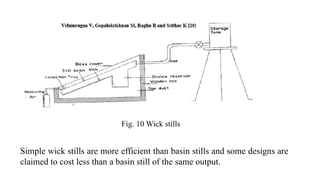
In a wick still, the feed water flows slowly through a porous, radiation-
absorbing pad (the wick).
Two advantages are claimed over basin stills.
First, the wick can be tilted so that the feed water presents a better angle to the
sun (reducing reflection and presenting a large effective area).
Second, less feed water is in the still at any time and so the water is heated more
quickly and to a higher temperature.
Simple wick stills are more efficient than basin stills and some designs are
claimed to cost less than a basin still of the same output.
Fig. 10 Wick stills
Emergency still - To provide emergency drinking water on land, a very simple
still can be made. It makes use of the moisture in the earth. All that is required is
a plastic cover, a bowl or bucket, and a pebble.
Hybrid designs
There are a number of ways in which solar stills can usefully be combined with
another function of technology. Three examples are given:
a) Rainwater collection-By adding an external gutter, the still cover can be used
for rainwater collection to supplement the solar still output.
b) Greenhouse-solar still-The roof of a greenhouse can be used as the cover of a
still.
c) Supplementary heating - Waste heat from an engine or the condenser of a
refrigerator can be used as an additional energy input.
Advantages
Solar Stills have got major advantages over other conventional Distillation/ water
purification /de- mineralisation systems as follows:
1. Produces pure water
2. No prime movers required
3. No conventional energy required
4. No skilled operator required
5. Local manufacturing/repairing
6. Low investment
7. Can purify highly saline water (even sea water)
Disadvantages
1. Poor fitting and joints, which increase colder air flow from outside into the
still
2. Cracking, breakage or scratches on glass, which reduce solar transmission or
let in air
3. Growth of algae and deposition of dust, bird droppings, etc. To avoid this the
stills need to be cleaned regularly every few days
4. Damage over time to the blackened absorbing surface.
5.Accumulation of salt on the bottom, which needs to be removed periodically.
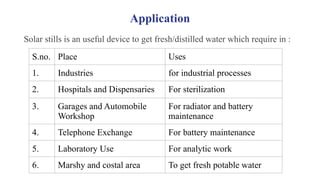
Application
S.no. Place Uses
1. Industries for industrial processes
2. Hospitals and Dispensaries For sterilization
3. Garages and Automobile
Workshop
For radiator and battery
maintenance
4. Telephone Exchange For battery maintenance
5. Laboratory Use For analytic work
6. Marshy and costal area To get fresh potable water
Solar stills is an useful device to get fresh/distilled water which require in :
Conclusion
Distillation is a method where water is removed from the contaminations rather than
to remove contaminants from the water. Solar energy is a promising source to achieve
this. This is due to various advantages involved in solar distillation. The Solar
distillation involves zero maintenance cost and no energy costs as it involves only
solar energy which is free of cost.
The main disadvantage of this solar still is the low productivity or high capital cost
per unit output of distillate. This could be improved by a number of actions, e.g. using
internal and external mirror, using wick, reducing heat conduction through basin walls
and top cover or reusing the latent heat emitted from the condensing vapor on the
glass cover.
References
● All About Water Filters. (2018). Ultimate Guide to Solar Water Distillers: Solar Water
Distillation 101.
● Ranjan, K. R. Kaushik, S. C. (2013, Jun. 19). Economic feasibility evaluation of solar
distillation systems based on the equivalent cost of environmental degradation and high-
grade energy savings.
● Duffie J. A. and W. A. Beckman, (2006); Solar Engineering of Thermal Processes, John
Wiley Tiwari, G.N (2002);
● Prem Shankar and Shiv Kumar, -Solar Distillation - A Parametric Review VSRD-MAP,
Vol. 2 (1), 2012, 33
● Malik MAS, Tiwari GN, Kumar A. Sodha MS. -Solar distillation!. Oxford, UK:
Pergamon Press; 1992. p. 8-17.
THANK YOU

solar_distillation_mini_project for chemical engineering.pptx

  • 1.
    Solar Distillation Presented by:ABU NASAR Roll No.: 2200430510001 Under Guidance Of: Prof. Ajay Devidas Hiwarkar Chemical Engineering Department BIET JHANSI
  • 2.
    CONTENT ● Introduction ● History ●What is Solar Distillation ? ● Working Procedure of Solar Distillation ● Implementation ● Basic Operating Principle ● Water Purification ● Working of Solar Still
  • 3.
    ● Design ofSolar Still ● Design types and its performance ● Hybrid Design ● Advantages & Disadvantages ● Application ● Conclusion ● References
  • 4.
    INTRODUCTION ● 97% ofthe water in the world is in the ocean, approximately 2% of the water in the world is at present stored as ice in polar region, and 1% is fresh water available in earth for the need of the plants, animals and human life. ● Process available for water purification Practiced in tropical and sub- tropical region. ● System can be large or small.
  • 5.
    HISTORY ● Father ofsolar distillation. Carlos Wilson, the creator of the first known application of solar distillation, built in Las Salinas (The Salts), Chile in 1872. ● First documented account of solar distillation use for desalination was by Giovani Batista Della Porta in 1958. Fig. 1
  • 6.
    What is solardistillation? An the Solar distillation process solar energy is used to evaporate water and its condensate is collected within the same closed system. Fig.2 Solar Distillation
  • 7.
    ● Solar Distillationis by far the most reliable, least costly method of 99.9% true purification of most types of contaminated water especially in developing nations where fuel is scarce or too expensive. ● Solar distillation is used to produce drinking water or to produce pure water for lead acid batteries, laboratories, hospitals and in producing commercial products such as rose water.
  • 8.
    Working Procedure ofSolar Distillation Fig. 3 Working Procedure of Solar Distillation
  • 9.
    Implementation ● Solar waterdistillers find application mostly in remote areas where there is limited access to freshwater and centralized distribution systems. ● In these areas technical expertise is made use of to introduce the system and personnel in usage and maintenance of the system. ● An important criteria for installation of these systems is that the area should be flat and open with good access to water and sunlight.
  • 10.
    ● The untreatedwater is collected in the still basin. Solar energy heats up this water and then evaporates and separates it from the contaminants. It is important that the material used in still basin should be able to absorb heat. ● Examples of such materials are leather sheet, silicon, reinforced plastic, or steel plate. The slanted cover funnels the condensed water into a pipe tube, which is attached to a storage container so it can be used for drinking water.
  • 11.
    The “roof” ofthe system is fitted with a transparent glass cover tilted at an angle so as to catch maximum sunlight. Solar energy can access the underlying still basin by penetrating through the cover. Fig. 4 Solar Distillation of water
  • 12.
    Basic Operating Principle Themain features of operation are the same for all solar stills. The incident solar radiation is transmitted through the glass or plastic cover and is absorbed as heat by a black surface in contact with the water to be distilled. The water is thus heated and gives off water vapour. The vapour condenses on the cover, which is at a lower temperature because it is in contact with the ambient air, and runs down into a gutter from where it is fed to a storage tank.
  • 13.
    Water Purification It isthe process of removing undesirable chemicals, biological contaminants, suspended solids and gases from contaminated water. Options for water purification:- There are four possible ways of purifying water for drinking purpose:- 1. Distillation 2. Filtration 3. Chemical Treatment 4. Irradiative Treatment
  • 14.
    What is SolarStill? A solar still distills water with substances dissolved in it by using the heat of the Sun to evaporate water so that it may be cooled and collected, thereby purifying it.
  • 15.
    They are usedin areas where drinking water is unavailable, so that clean water is obtained from dirty water or from plants by exposing them to sunlight. Fig. 5 Solar Still
  • 16.
    Working of SolarStill ● Solar stills are called stills because they distill, or purify water. ● A solar still operates on the same principle as rainwater: evaporation and condensation. ● The water from the oceans evaporates, only to cool, condense, and return to earth as rain. ● When the water evaporates, it removes only pure water and leaves all contaminants behind.
  • 17.
    Design of SolarStill Different designs of solar still have emerged. The single effect solar still is a relatively simple device to construct and operate. However, the low productivity of the Solar still triggered the initiatives to look for ways to Improve its productivity and Efficiency.
  • 18.
    These may beclassified into Two types ● Passive Method ● Active methods
  • 19.
    Passive methods includethe use of dye or charcoal to increase the solar absorptivity of water, applying good insulation, lowering the water depth in the basin to lower its thermal capacity, ensuring vapor tightness, using black gravel and rubber, using floating perforated black plate, and using reflective side walls. Fig. 6 Passive method
  • 20.
    Active methods includethe use of solar collector or waste heat to heat the basin water, the use of internal and external condensers or applying vacuum inside the solar still to enhance the evaporation/condensation processes, and cooling the glass cover to increase the temperature difference between the glass and the water in the basin and hence increases the rate of evaporation. Fig. 7 Active Method
  • 21.
    Design types andtheir performance ● Single-basin stills have been much studied and their behavior is well understood. Efficiencies of 25% are typical. ● Daily output as a function of solar irradiation is greatest in the early evening when the feed water is still hot but when outside temperatures are falling.
  • 22.
    ● The efficiencyof single stage still is around 25%. Fig. 8 Single Basin Stills
  • 23.
    ● Multiple-effect basinstills have two or more compartments. ● The condensing surface of the lower compartment is the floor of the upper compartment. ● The heat given off by the condensing vapour provides energy to vapourize the feed water above.
  • 24.
    ● Efficiency istherefore greater than for a single-basin still typically being 35% or more but the cost and complexity are correspondingly higher. Fig. 9 Multiple -effect basin stills
  • 25.
    In a wickstill, the feed water flows slowly through a porous, radiation- absorbing pad (the wick). Two advantages are claimed over basin stills. First, the wick can be tilted so that the feed water presents a better angle to the sun (reducing reflection and presenting a large effective area). Second, less feed water is in the still at any time and so the water is heated more quickly and to a higher temperature.
  • 26.
    Simple wick stillsare more efficient than basin stills and some designs are claimed to cost less than a basin still of the same output. Fig. 10 Wick stills
  • 27.
    Emergency still -To provide emergency drinking water on land, a very simple still can be made. It makes use of the moisture in the earth. All that is required is a plastic cover, a bowl or bucket, and a pebble.
  • 28.
    Hybrid designs There area number of ways in which solar stills can usefully be combined with another function of technology. Three examples are given: a) Rainwater collection-By adding an external gutter, the still cover can be used for rainwater collection to supplement the solar still output. b) Greenhouse-solar still-The roof of a greenhouse can be used as the cover of a still. c) Supplementary heating - Waste heat from an engine or the condenser of a refrigerator can be used as an additional energy input.
  • 29.
    Advantages Solar Stills havegot major advantages over other conventional Distillation/ water purification /de- mineralisation systems as follows: 1. Produces pure water 2. No prime movers required 3. No conventional energy required 4. No skilled operator required 5. Local manufacturing/repairing 6. Low investment 7. Can purify highly saline water (even sea water)
  • 30.
    Disadvantages 1. Poor fittingand joints, which increase colder air flow from outside into the still 2. Cracking, breakage or scratches on glass, which reduce solar transmission or let in air 3. Growth of algae and deposition of dust, bird droppings, etc. To avoid this the stills need to be cleaned regularly every few days 4. Damage over time to the blackened absorbing surface. 5.Accumulation of salt on the bottom, which needs to be removed periodically.
  • 31.
    Application S.no. Place Uses 1.Industries for industrial processes 2. Hospitals and Dispensaries For sterilization 3. Garages and Automobile Workshop For radiator and battery maintenance 4. Telephone Exchange For battery maintenance 5. Laboratory Use For analytic work 6. Marshy and costal area To get fresh potable water Solar stills is an useful device to get fresh/distilled water which require in :
  • 32.
    Conclusion Distillation is amethod where water is removed from the contaminations rather than to remove contaminants from the water. Solar energy is a promising source to achieve this. This is due to various advantages involved in solar distillation. The Solar distillation involves zero maintenance cost and no energy costs as it involves only solar energy which is free of cost. The main disadvantage of this solar still is the low productivity or high capital cost per unit output of distillate. This could be improved by a number of actions, e.g. using internal and external mirror, using wick, reducing heat conduction through basin walls and top cover or reusing the latent heat emitted from the condensing vapor on the glass cover.
  • 33.
    References ● All AboutWater Filters. (2018). Ultimate Guide to Solar Water Distillers: Solar Water Distillation 101. ● Ranjan, K. R. Kaushik, S. C. (2013, Jun. 19). Economic feasibility evaluation of solar distillation systems based on the equivalent cost of environmental degradation and high- grade energy savings. ● Duffie J. A. and W. A. Beckman, (2006); Solar Engineering of Thermal Processes, John Wiley Tiwari, G.N (2002); ● Prem Shankar and Shiv Kumar, -Solar Distillation - A Parametric Review VSRD-MAP, Vol. 2 (1), 2012, 33 ● Malik MAS, Tiwari GN, Kumar A. Sodha MS. -Solar distillation!. Oxford, UK: Pergamon Press; 1992. p. 8-17.
  • 34.