Creating Innovative
Solutions for a
Sustainable Future
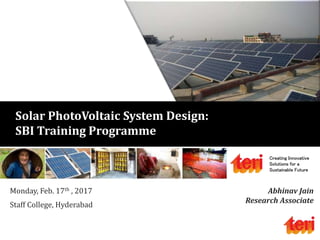
Solar PhotoVoltaic System Design:
SBI Training Programme
Monday, Feb. 17th , 2017
Staff College, Hyderabad
Abhinav Jain
Research Associate
Creating Innovative
Solutions for a
Sustainable Future
Outline
 Requirements of rooftop solar PV plants
 Difference between utility scale and roof top solar plants
 Designing a rooftop solar project
 Estimation of Output power generation
Creating Innovative
Solutions for a
Sustainable Future
Solar Photovoltaic (PV) Modules
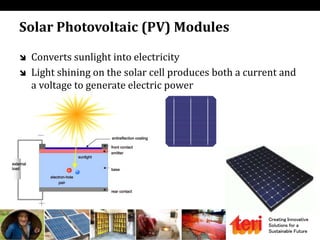
 Converts sunlight into electricity
 Light shining on the solar cell produces both a current and
a voltage to generate electric power
Creating Innovative
Solutions for a
Sustainable Future
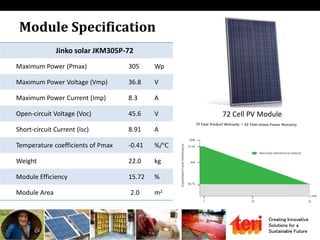
Module Specification
Jinko solar JKM305P-72
Maximum Power (Pmax) 305 Wp
Maximum Power Voltage (Vmp) 36.8 V
Maximum Power Current (Imp) 8.3 A
Open-circuit Voltage (Voc) 45.6 V
Short-circuit Current (Isc) 8.91 A
Temperature coefficients of Pmax -0.41 %/℃
Weight 22.0 kg
Module Efficiency 15.72 %
Module Area 2.0 m2
72 Cell PV Module
Creating Innovative
Solutions for a
Sustainable Future
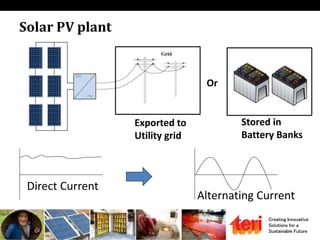
Solar PV plant
Direct Current
Alternating Current
Exported to
Utility grid
Stored in
Battery Banks
Or
Creating Innovative
Solutions for a
Sustainable Future
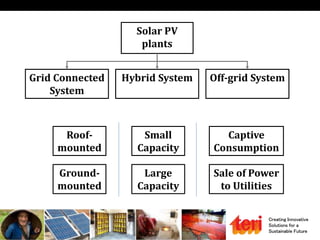
Solar PV
plants
Grid Connected
System
Off-grid System
Hybrid System
Roof-
mounted
Ground-
mounted
Small
Capacity
Large
Capacity
Captive
Consumption
Sale of Power
to Utilities
Creating Innovative
Solutions for a
Sustainable Future
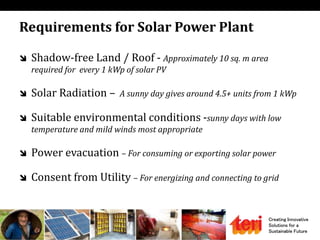
Requirements for Solar Power Plant
 Shadow-free Land / Roof - Approximately 10 sq. m area
required for every 1 kWp of solar PV
 Solar Radiation – A sunny day gives around 4.5+ units from 1 kWp
 Suitable environmental conditions -sunny days with low
temperature and mild winds most appropriate
 Power evacuation – For consuming or exporting solar power
 Consent from Utility – For energizing and connecting to grid
Creating Innovative
Solutions for a
Sustainable Future
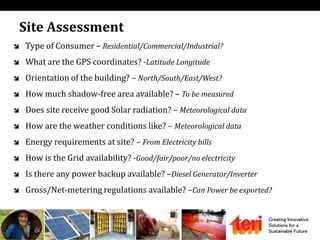
Site Assessment
 Type of Consumer – Residential/Commercial/Industrial?
 What are the GPS coordinates? -Latitude Longitude
 Orientation of the building? – North/South/East/West?
 How much shadow-free area available? – To be measured
 Does site receive good Solar radiation? – Meteorological data
 How are the weather conditions like? – Meteorological data
 Energy requirements at site? – From Electricity bills
 How is the Grid availability? -Good/fair/poor/no electricity
 Is there any power backup available? –Diesel Generator/Inverter
 Gross/Net-metering regulations available? –Can Power be exported?
Creating Innovative
Solutions for a
Sustainable Future
Solar Resources
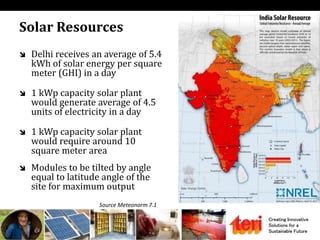
 Delhi receives an average of 5.4
kWh of solar energy per square
meter (GHI) in a day
 1 kWp capacity solar plant
would generate average of 4.5
units of electricity in a day
 1 kWp capacity solar plant
would require around 10
square meter area
 Modules to be tilted by angle
equal to latitude angle of the
site for maximum output
Source Meteonorm 7.1
Creating Innovative
Solutions for a
Sustainable Future
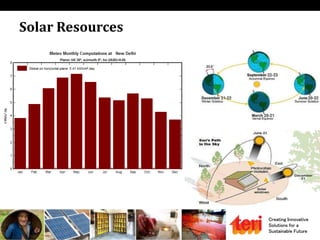
Solar Resources
Creating Innovative
Solutions for a
Sustainable Future
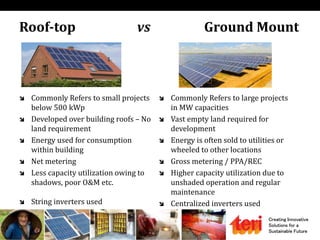
Roof-top vs Ground Mount
 Commonly Refers to small projects
below 500 kWp
 Developed over building roofs – No
land requirement
 Energy used for consumption
within building
 Net metering
 Less capacity utilization owing to
shadows, poor O&M etc.
 String inverters used
 Commonly Refers to large projects
in MW capacities
 Vast empty land required for
development
 Energy is often sold to utilities or
wheeled to other locations
 Gross metering / PPA/REC
 Higher capacity utilization due to
unshaded operation and regular
maintenance
 Centralized inverters used
Creating Innovative
Solutions for a
Sustainable Future
Design Constraint
Shadow-free
Space available
but budget allows
only a specific
capacity of
rooftop
No budget
constraint but
Limited roof
space available
Roof space and
budget available
but energy
consumptions in
building is limited
State Regulation
on allowed
system capacity
System designed
for a specific
capacity
System designed
for available roof
area
System designed
for required
output energy
System Designed
for specific
capacity
Creating Innovative
Solutions for a
Sustainable Future
Design Steps (for specific roof area)
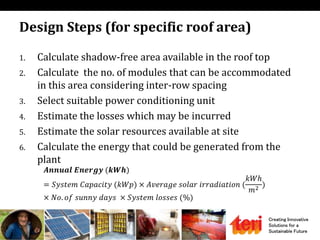
1. Calculate shadow-free area available in the roof top
2. Calculate the no. of modules that can be accommodated
in this area considering inter-row spacing
3. Select suitable power conditioning unit
4. Estimate the losses which may be incurred
5. Estimate the solar resources available at site
6. Calculate the energy that could be generated from the
plant
𝑨𝒏𝒏𝒖𝒂𝒍 𝑬𝒏𝒆𝒓𝒈𝒚 (𝒌𝑾𝒉)
= 𝑆𝑦𝑠𝑡𝑒𝑚 𝐶𝑎𝑝𝑎𝑐𝑖𝑡𝑦 (𝑘𝑊𝑝) × 𝐴𝑣𝑒𝑟𝑎𝑔𝑒 𝑠𝑜𝑙𝑎𝑟 𝑖𝑟𝑟𝑎𝑑𝑖𝑎𝑡𝑖𝑜𝑛 (
𝑘𝑊ℎ
𝑚2 )
× 𝑁𝑜. 𝑜𝑓 𝑠𝑢𝑛𝑛𝑦 𝑑𝑎𝑦𝑠 × 𝑆𝑦𝑠𝑡𝑒𝑚 𝑙𝑜𝑠𝑠𝑒𝑠 (%)
Creating Innovative
Solutions for a
Sustainable Future
Energy Estimation
Parameter Derating Factor
1. Losses till the collector plane (due to orientation) 97%
2. Soiling losses 93%
3. PV losses due to temperature 87.5%
4. Module quality losses 99%
5. Array mismatch losses 98%
6. MPP tracking losses 98%
7. Ohmic losses 97%
8. Losses in inverter 95%
9. Grid availability 99%
10. Maintenance downtime 99%
Overall derating factor 78%
𝑨𝒏𝒏𝒖𝒂𝒍 𝑬𝒏𝒆𝒓𝒈𝒚 𝒌𝑾𝒉 = 1 𝑘𝑊𝑝 × 5.4
𝑘𝑊ℎ
𝑚2
× 290 × 70 %
= 1221 kWh
𝑪𝑼𝑭 = 14%
Creating Innovative
Solutions for a
Sustainable Future
System Design Automation with Software
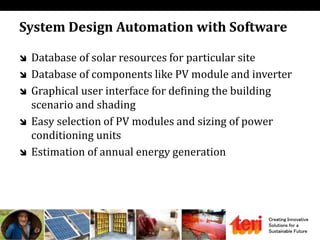
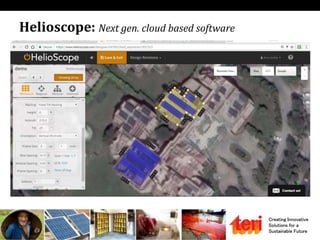
 Database of solar resources for particular site
 Database of components like PV module and inverter
 Graphical user interface for defining the building
scenario and shading
 Easy selection of PV modules and sizing of power
conditioning units
 Estimation of annual energy generation
Creating Innovative
Solutions for a
Sustainable Future
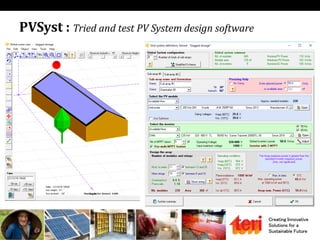
PVSyst : Tried and test PV System design software
Creating Innovative
Solutions for a
Sustainable Future
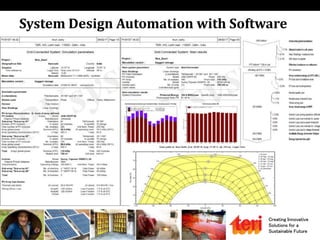
System Design Automation with Software
Creating Innovative
Solutions for a
Sustainable Future
Helioscope: Next gen. cloud based software
Creating Innovative
Solutions for a
Sustainable Future
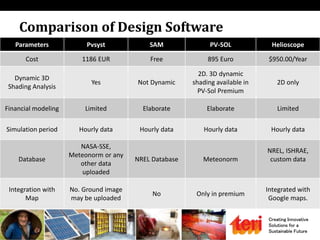
Comparison of Design Software
Parameters Pvsyst SAM PV-SOL Helioscope
Cost 1186 EUR Free 895 Euro $950.00/Year
Dynamic 3D
Shading Analysis
Yes Not Dynamic
2D. 3D dynamic
shading available in
PV-Sol Premium
2D only
Financial modeling Limited Elaborate Elaborate Limited
Simulation period Hourly data Hourly data Hourly data Hourly data
Database
NASA-SSE,
Meteonorm or any
other data
uploaded
NREL Database Meteonorm
NREL, ISHRAE,
custom data
Integration with
Map
No. Ground image
may be uploaded
No Only in premium
Integrated with
Google maps.
Creating Innovative
Solutions for a
Sustainable Future
THANK YOU
Abhinav Jain
Research Associate
Mob: +91-8882828606 | Abhinav.jain@teri.res.in
Questions?

Solar PV System Designing 2017

  • 1.
    Creating Innovative Solutions fora Sustainable Future Solar PhotoVoltaic System Design: SBI Training Programme Monday, Feb. 17th , 2017 Staff College, Hyderabad Abhinav Jain Research Associate
  • 2.
    Creating Innovative Solutions fora Sustainable Future Outline  Requirements of rooftop solar PV plants  Difference between utility scale and roof top solar plants  Designing a rooftop solar project  Estimation of Output power generation
  • 3.
    Creating Innovative Solutions fora Sustainable Future Solar Photovoltaic (PV) Modules  Converts sunlight into electricity  Light shining on the solar cell produces both a current and a voltage to generate electric power
  • 4.
    Creating Innovative Solutions fora Sustainable Future Module Specification Jinko solar JKM305P-72 Maximum Power (Pmax) 305 Wp Maximum Power Voltage (Vmp) 36.8 V Maximum Power Current (Imp) 8.3 A Open-circuit Voltage (Voc) 45.6 V Short-circuit Current (Isc) 8.91 A Temperature coefficients of Pmax -0.41 %/℃ Weight 22.0 kg Module Efficiency 15.72 % Module Area 2.0 m2 72 Cell PV Module
  • 5.
    Creating Innovative Solutions fora Sustainable Future Solar PV plant Direct Current Alternating Current Exported to Utility grid Stored in Battery Banks Or
  • 6.
    Creating Innovative Solutions fora Sustainable Future Solar PV plants Grid Connected System Off-grid System Hybrid System Roof- mounted Ground- mounted Small Capacity Large Capacity Captive Consumption Sale of Power to Utilities
  • 7.
    Creating Innovative Solutions fora Sustainable Future Requirements for Solar Power Plant  Shadow-free Land / Roof - Approximately 10 sq. m area required for every 1 kWp of solar PV  Solar Radiation – A sunny day gives around 4.5+ units from 1 kWp  Suitable environmental conditions -sunny days with low temperature and mild winds most appropriate  Power evacuation – For consuming or exporting solar power  Consent from Utility – For energizing and connecting to grid
  • 8.
    Creating Innovative Solutions fora Sustainable Future Site Assessment  Type of Consumer – Residential/Commercial/Industrial?  What are the GPS coordinates? -Latitude Longitude  Orientation of the building? – North/South/East/West?  How much shadow-free area available? – To be measured  Does site receive good Solar radiation? – Meteorological data  How are the weather conditions like? – Meteorological data  Energy requirements at site? – From Electricity bills  How is the Grid availability? -Good/fair/poor/no electricity  Is there any power backup available? –Diesel Generator/Inverter  Gross/Net-metering regulations available? –Can Power be exported?
  • 9.
    Creating Innovative Solutions fora Sustainable Future Solar Resources  Delhi receives an average of 5.4 kWh of solar energy per square meter (GHI) in a day  1 kWp capacity solar plant would generate average of 4.5 units of electricity in a day  1 kWp capacity solar plant would require around 10 square meter area  Modules to be tilted by angle equal to latitude angle of the site for maximum output Source Meteonorm 7.1
  • 10.
    Creating Innovative Solutions fora Sustainable Future Solar Resources
  • 11.
    Creating Innovative Solutions fora Sustainable Future Roof-top vs Ground Mount  Commonly Refers to small projects below 500 kWp  Developed over building roofs – No land requirement  Energy used for consumption within building  Net metering  Less capacity utilization owing to shadows, poor O&M etc.  String inverters used  Commonly Refers to large projects in MW capacities  Vast empty land required for development  Energy is often sold to utilities or wheeled to other locations  Gross metering / PPA/REC  Higher capacity utilization due to unshaded operation and regular maintenance  Centralized inverters used
  • 12.
    Creating Innovative Solutions fora Sustainable Future Design Constraint Shadow-free Space available but budget allows only a specific capacity of rooftop No budget constraint but Limited roof space available Roof space and budget available but energy consumptions in building is limited State Regulation on allowed system capacity System designed for a specific capacity System designed for available roof area System designed for required output energy System Designed for specific capacity
  • 13.
    Creating Innovative Solutions fora Sustainable Future Design Steps (for specific roof area) 1. Calculate shadow-free area available in the roof top 2. Calculate the no. of modules that can be accommodated in this area considering inter-row spacing 3. Select suitable power conditioning unit 4. Estimate the losses which may be incurred 5. Estimate the solar resources available at site 6. Calculate the energy that could be generated from the plant 𝑨𝒏𝒏𝒖𝒂𝒍 𝑬𝒏𝒆𝒓𝒈𝒚 (𝒌𝑾𝒉) = 𝑆𝑦𝑠𝑡𝑒𝑚 𝐶𝑎𝑝𝑎𝑐𝑖𝑡𝑦 (𝑘𝑊𝑝) × 𝐴𝑣𝑒𝑟𝑎𝑔𝑒 𝑠𝑜𝑙𝑎𝑟 𝑖𝑟𝑟𝑎𝑑𝑖𝑎𝑡𝑖𝑜𝑛 ( 𝑘𝑊ℎ 𝑚2 ) × 𝑁𝑜. 𝑜𝑓 𝑠𝑢𝑛𝑛𝑦 𝑑𝑎𝑦𝑠 × 𝑆𝑦𝑠𝑡𝑒𝑚 𝑙𝑜𝑠𝑠𝑒𝑠 (%)
  • 14.
    Creating Innovative Solutions fora Sustainable Future Energy Estimation Parameter Derating Factor 1. Losses till the collector plane (due to orientation) 97% 2. Soiling losses 93% 3. PV losses due to temperature 87.5% 4. Module quality losses 99% 5. Array mismatch losses 98% 6. MPP tracking losses 98% 7. Ohmic losses 97% 8. Losses in inverter 95% 9. Grid availability 99% 10. Maintenance downtime 99% Overall derating factor 78% 𝑨𝒏𝒏𝒖𝒂𝒍 𝑬𝒏𝒆𝒓𝒈𝒚 𝒌𝑾𝒉 = 1 𝑘𝑊𝑝 × 5.4 𝑘𝑊ℎ 𝑚2 × 290 × 70 % = 1221 kWh 𝑪𝑼𝑭 = 14%
  • 15.
    Creating Innovative Solutions fora Sustainable Future System Design Automation with Software  Database of solar resources for particular site  Database of components like PV module and inverter  Graphical user interface for defining the building scenario and shading  Easy selection of PV modules and sizing of power conditioning units  Estimation of annual energy generation
  • 16.
    Creating Innovative Solutions fora Sustainable Future PVSyst : Tried and test PV System design software
  • 17.
    Creating Innovative Solutions fora Sustainable Future System Design Automation with Software
  • 18.
    Creating Innovative Solutions fora Sustainable Future Helioscope: Next gen. cloud based software
  • 19.
    Creating Innovative Solutions fora Sustainable Future Comparison of Design Software Parameters Pvsyst SAM PV-SOL Helioscope Cost 1186 EUR Free 895 Euro $950.00/Year Dynamic 3D Shading Analysis Yes Not Dynamic 2D. 3D dynamic shading available in PV-Sol Premium 2D only Financial modeling Limited Elaborate Elaborate Limited Simulation period Hourly data Hourly data Hourly data Hourly data Database NASA-SSE, Meteonorm or any other data uploaded NREL Database Meteonorm NREL, ISHRAE, custom data Integration with Map No. Ground image may be uploaded No Only in premium Integrated with Google maps.
  • 20.
    Creating Innovative Solutions fora Sustainable Future THANK YOU Abhinav Jain Research Associate Mob: +91-8882828606 | Abhinav.jain@teri.res.in Questions?