Developing solar power plant
purpose
‡ A 1 MW solar power plant generates 8000 KWH unit of electricity per
day which can be sold at Rs 15 / unit giving an income of Rs 1.20
lakhs per day.
‡ Additional income could come from carbon credit trading. A 1 MW plant
by generating 8000 KWH x 300 sunny days = 24,00,000 KWH which if
traded for Rs 1 to another polluting steel or coal power generating
company could fetch Rs 24 lakhs per annum as surplus income.
‡ The Government of India not only offers to purchase the electricity
generated at a higher tariff but institutions like IREDA can fund up to
80% of the project cost.
‡ The plant has a virtually zero running cost as all it needs is sunlight. The
solar panels, inverters and trackers can be expected to last between 25-
35 years. Solar panel cleaning could be done either manually or with the
help of automated solar panel cleaners. Some investments for plant
security may be needed.
solution
1)Solar panel trackers are not manufactured in India and they are at the
moment being imported from China. Since we need a fairly large quantity of
solar panel trackers for this 1 MW plant and other MW scale solar plants we
wish to build in India a tracker manufacturing plant is needed. To create a
tracker manufacturing infrastructure here in India we need funds worth Rs 25
lakhs.
2) Combined solar thermal & PV development - Solar energy is converted into
electricity via 2 methods : photovoltaic's & thermal. In photovoltaic's certain
semiconductors when exposed to light produce an electric current. The
efficiency of solar photovoltaic (PV)systems range from 14% - 36%. In solar
thermal, the heat from the sun is used to heat large amounts of water which
is then used to drive turbines. Efficiency of solar thermal system is around
22%. We wish to combine solar thermal & PV systems to take efficiencies to
over 50%...Also, solar thermal power generation techniques are labor
intensive, so more important for India which is capital scarce and labour
surplus..This R&D development will need funds worth Rs 1 crore.
In India, no bank funds any R&D project and since mine is a small company,
despite various efforts we have been denied access to the funds.
IntroductionIntroduction
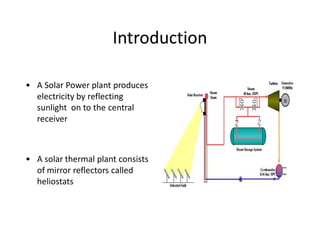
ͻ A Solar Power plant produces
electricity by reflecting
sunlight on to the central
receiver
ͻ A solar thermal plant consists
of mirror reflectors called
heliostats
‡
Heliostats
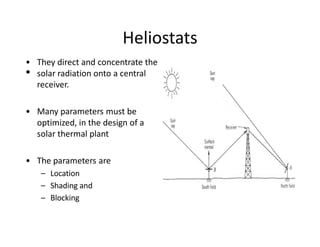
ͻ They direct and concentrate the
solar radiation onto a central
receiver.
ͻ Many parameters must be
optimized, in the design of a
solar thermal plant
ͻ The parameters are
ʹ Location
ʹ Shading and
ʹ Blocking
‡
Shading and Blocking
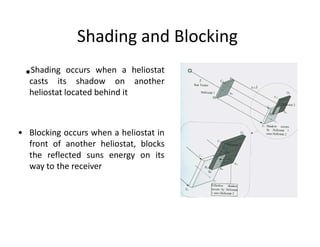
Shading occurs when a heliostat
casts its shadow on another
heliostat located behind it
ͻ Blocking occurs when a heliostat in
front of another heliostat, blocks
the reflected suns energy on its
way to the receiver
Components & its working
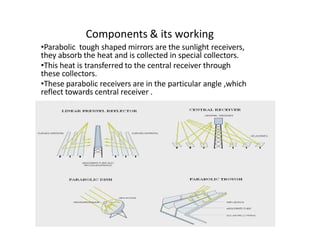
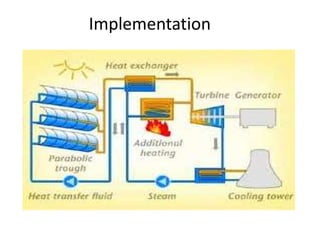
‡Parabolic tough shaped mirrors are the sunlight receivers,
they absorb the heat and is collected in special collectors.
‡This heat is transferred to the central receiver through
these collectors.
‡These parabolic receivers are in the particular angle ,which
reflect towards central receiver .
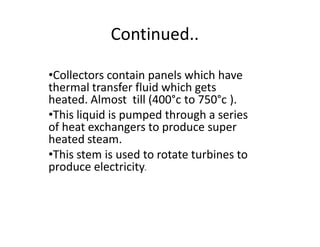
Continued..
‡Collectors contain panels which have
thermal transfer fluid which gets
heated. Almost till (400°c to 750°c ).
‡This liquid is pumped through a series
of heat exchangers to produce super
heated steam.
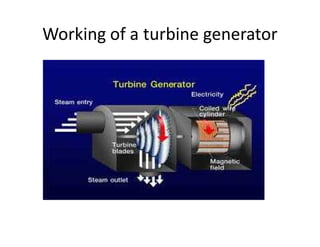
‡This stem is used to rotate turbines to
produce electricity.
Implementation
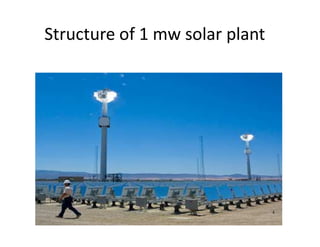
Structure of 1 mw solar plant
Working of a turbine generator
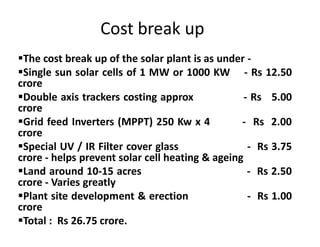
Cost break up
The cost break up of the solar plant is as under -
Single sun solar cells of 1 MW or 1000 KW - Rs 12.50
crore
Double axis trackers costing approx - Rs 5.00
crore
Grid feed Inverters (MPPT) 250 Kw x 4 - Rs 2.00
crore
Special UV / IR Filter cover glass - Rs 3.75
crore - helps prevent solar cell heating  ageing
Land around 10-15 acres - Rs 2.50
crore - Varies greatly
Plant site development  erection - Rs 1.00
crore
Total : Rs 26.75 crore.
Thank you

solar-power-plant-ppt

  • 1.
  • 2.
    purpose ‡ A 1MW solar power plant generates 8000 KWH unit of electricity per day which can be sold at Rs 15 / unit giving an income of Rs 1.20 lakhs per day. ‡ Additional income could come from carbon credit trading. A 1 MW plant by generating 8000 KWH x 300 sunny days = 24,00,000 KWH which if traded for Rs 1 to another polluting steel or coal power generating company could fetch Rs 24 lakhs per annum as surplus income. ‡ The Government of India not only offers to purchase the electricity generated at a higher tariff but institutions like IREDA can fund up to 80% of the project cost. ‡ The plant has a virtually zero running cost as all it needs is sunlight. The solar panels, inverters and trackers can be expected to last between 25- 35 years. Solar panel cleaning could be done either manually or with the help of automated solar panel cleaners. Some investments for plant security may be needed.
  • 3.
    solution 1)Solar panel trackersare not manufactured in India and they are at the moment being imported from China. Since we need a fairly large quantity of solar panel trackers for this 1 MW plant and other MW scale solar plants we wish to build in India a tracker manufacturing plant is needed. To create a tracker manufacturing infrastructure here in India we need funds worth Rs 25 lakhs. 2) Combined solar thermal & PV development - Solar energy is converted into electricity via 2 methods : photovoltaic's & thermal. In photovoltaic's certain semiconductors when exposed to light produce an electric current. The efficiency of solar photovoltaic (PV)systems range from 14% - 36%. In solar thermal, the heat from the sun is used to heat large amounts of water which is then used to drive turbines. Efficiency of solar thermal system is around 22%. We wish to combine solar thermal & PV systems to take efficiencies to over 50%...Also, solar thermal power generation techniques are labor intensive, so more important for India which is capital scarce and labour surplus..This R&D development will need funds worth Rs 1 crore. In India, no bank funds any R&D project and since mine is a small company, despite various efforts we have been denied access to the funds.
  • 4.
    IntroductionIntroduction ͻ A SolarPower plant produces electricity by reflecting sunlight on to the central receiver ͻ A solar thermal plant consists of mirror reflectors called heliostats
  • 5.
    ‡ Heliostats ͻ They directand concentrate the solar radiation onto a central receiver. ͻ Many parameters must be optimized, in the design of a solar thermal plant ͻ The parameters are ʹ Location ʹ Shading and ʹ Blocking
  • 6.
    ‡ Shading and Blocking Shadingoccurs when a heliostat casts its shadow on another heliostat located behind it ͻ Blocking occurs when a heliostat in front of another heliostat, blocks the reflected suns energy on its way to the receiver
  • 7.
    Components & itsworking ‡Parabolic tough shaped mirrors are the sunlight receivers, they absorb the heat and is collected in special collectors. ‡This heat is transferred to the central receiver through these collectors. ‡These parabolic receivers are in the particular angle ,which reflect towards central receiver .
  • 8.
    Continued.. ‡Collectors contain panelswhich have thermal transfer fluid which gets heated. Almost till (400°c to 750°c ). ‡This liquid is pumped through a series of heat exchangers to produce super heated steam. ‡This stem is used to rotate turbines to produce electricity.
  • 9.
  • 10.
    Structure of 1mw solar plant
  • 11.
    Working of aturbine generator
  • 12.
    Cost break up Thecost break up of the solar plant is as under - Single sun solar cells of 1 MW or 1000 KW - Rs 12.50 crore Double axis trackers costing approx - Rs 5.00 crore Grid feed Inverters (MPPT) 250 Kw x 4 - Rs 2.00 crore Special UV / IR Filter cover glass - Rs 3.75 crore - helps prevent solar cell heating ageing Land around 10-15 acres - Rs 2.50 crore - Varies greatly Plant site development erection - Rs 1.00 crore Total : Rs 26.75 crore.
  • 13.