Hallucinogens
By
Dr.S.T.V.Raghavamma
• Hallucinogens
• Introduction: Hallucinogens are natural and synthetic
(synthesized) substances that, when ingested (taken into
the body), significantly alter one's state of consciousness.
• Hallucinogenic compounds often cause people to see (or
think they see) random colors, patterns, events, and
objects that do not exist.
• People sometimes have a different perception of time
and space, hold imaginary conversations, believe they
hear music and experience smells, tastes, and other
sensations that are not real.
• The other names of hallucinogens are Cartoon acid,
Microdot, California sunshine, Psilocybin, Magic
mushrooms.
• Many types of substances are classified as
hallucinogens, solely because of their capacity to
produce such hallucinations.
• These substances are sometimes called
"pyschedelic," or "mind- expanding" drugs.
• Belladonna (Atropa belladonna) ,
• Betel Nut (Areca catechu),
• The Brooms (misc. sp.),
• Calamus (Acorus calamus),
• California Poppy (Eschscholzia
californica),
• Prickly Poppy (Argemone mexicana),
• Coleus (Coleus sp.) ,
• Colorines (Erythrina flabelliformis),
• Damiana (Turnera diffusa),
• Daturas (Datura sp.),
• Doñana (Coryphantha macromeris),
• Fennel (Foeniculum vulgare),
• Hawaiian Baby Woodrose (Argyreia
nervosa), Hawaiian Woodrose (Merremia
tuberosa),
• Heliotrope (Valeriana officinalis),
• Henbane (Hyoscyamus niger),
• Hops (Humulus lupulus),
• Hydrangea (Hydrangea paniculata),
• Iochroma (Iochroma sp.),
• Kava Kava (Piper methysticum),
• Khat (Catha edulis),
• Lion's Tail (Leonotis leonurus),
• Lobelia (Lobelia inflata),
• Madagascar Periwinkle (Catharanthus
rosea),
• Mandrake (Mandragora officinarum),
• Maraba (Kaempferia galanga),
• Maté (Ilex paraguayensis),
• Mescal Beans (Sophora secundiflora),
• Mormon Tea (Ephedra nevadensis),
• Morning Glory (Ipomoea sp.),
• Nutmeg (Myristica fragrans),
• Ololuique (Rivea corymbosa),
• Passionflower (Passiflora incarnata),
• Pipiltzintzintli (Salvia divinorum),
• Psilocybe Mushrooms (misc. sp.),
• Rhynchosia (Rhynchosia phaseoloides),
• San Pedro (Trichocereus pachanoi),
• Sassafras (Sassafras albidum),
• Syrian Rue (Peganum harmala),
• Tobacco (Nicotiana tobaccum),
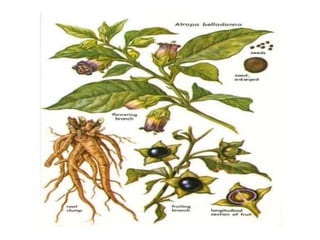
Belladonna: Atropa belladonna L.; Nightshade
• Family: (Solanaceae)
• A perennial branching herb growing to 5 feet tall, with 8 inch
long ovate leaves.
• The leaves in first-year plants are larger than those of older
plants. The flowers are bell-shaped, blue-purple or dull red,
followed by a shiny, black or purple 0.5 inch berry.
• Geographical source:
• The plant is native of Europe and Asia.
• Plant is a native of Central and Southern Europe. It is
cultivated in England, Germany, Balkan countries, America
and India.
• Cultivation:
• For sowing the seeds are selected which would
produce strong sturdy plants, rich in leaves is
containing high percentage of alkaloids.
• Seeds are sown in nurseries and seedling is
transplanted deep in well-drained, moist, calcareous
and loamy soil in April.
• Water clogging is harmful to the plants. Addition of
farmyard manure has favourable effect on the growth
of plants weeds are removed.
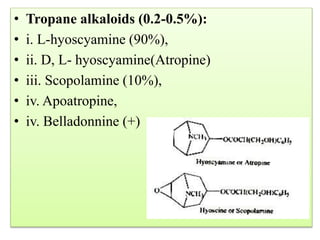
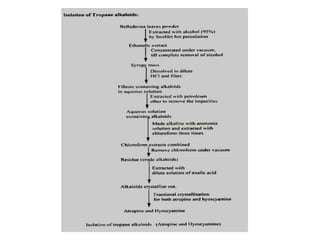
• Tropane alkaloids (0.2-0.5%):
• i. L-hyoscyamine (90%),
• ii. D, L- hyoscyamine(Atropine)
• iii. Scopolamine (10%),
• iv. Apoatropine,
• iv. Belladonnine (+)
• Medicinal Uses:
Belladonna can be fatal to most carnivorous
animals and humans, but the same doses have
very little effect upon most birds and plant
eating animals.
Children are often poisoned by the berries,
mistaking them for cherries or other sweet fruit
It is used very successfully to treat eye
diseases, because of its effect of dilating the
pupil.
Atropine, an extract of belladonna is what an
eye doctor uses when they put liquid in your
eye before testing you for glasses. Atropine has
also been used as an antidote to opium, calabar
bean, and chloroform poisoning.
Belladonna has been, and is being used as a
recreational drug, diuretic, sedative,
antispasmodic, and mydriatic.
In large doses, belladonna acts upon the cerebrospinal
system, as showing such symptoms as:
• dilatation of the pupils (mydriasis),
• presbyopia, (long-sightedness caused by loss of elasticity
of the lens of the eye, occurring typically in middle and
old age) obscurity of vision,
• blindness (amaurosis),
• visual illusions (phantasms),
• suffused eyes (gradually spread through or over)
• occasionally disturbance of hearing (as ringing in the
ears, etc.),
• numbness of the face, confusion of head, giddiness, and
delirium.
Thank
you

Hallucinogens

  • 1.
  • 2.
    • Hallucinogens • Introduction:Hallucinogens are natural and synthetic (synthesized) substances that, when ingested (taken into the body), significantly alter one's state of consciousness. • Hallucinogenic compounds often cause people to see (or think they see) random colors, patterns, events, and objects that do not exist. • People sometimes have a different perception of time and space, hold imaginary conversations, believe they hear music and experience smells, tastes, and other sensations that are not real.
  • 3.
    • The othernames of hallucinogens are Cartoon acid, Microdot, California sunshine, Psilocybin, Magic mushrooms. • Many types of substances are classified as hallucinogens, solely because of their capacity to produce such hallucinations. • These substances are sometimes called "pyschedelic," or "mind- expanding" drugs.
  • 4.
    • Belladonna (Atropabelladonna) , • Betel Nut (Areca catechu), • The Brooms (misc. sp.), • Calamus (Acorus calamus), • California Poppy (Eschscholzia californica), • Prickly Poppy (Argemone mexicana), • Coleus (Coleus sp.) , • Colorines (Erythrina flabelliformis), • Damiana (Turnera diffusa), • Daturas (Datura sp.), • Doñana (Coryphantha macromeris), • Fennel (Foeniculum vulgare), • Hawaiian Baby Woodrose (Argyreia nervosa), Hawaiian Woodrose (Merremia tuberosa), • Heliotrope (Valeriana officinalis), • Henbane (Hyoscyamus niger), • Hops (Humulus lupulus), • Hydrangea (Hydrangea paniculata), • Iochroma (Iochroma sp.), • Kava Kava (Piper methysticum), • Khat (Catha edulis), • Lion's Tail (Leonotis leonurus), • Lobelia (Lobelia inflata), • Madagascar Periwinkle (Catharanthus rosea), • Mandrake (Mandragora officinarum), • Maraba (Kaempferia galanga), • Maté (Ilex paraguayensis), • Mescal Beans (Sophora secundiflora), • Mormon Tea (Ephedra nevadensis), • Morning Glory (Ipomoea sp.), • Nutmeg (Myristica fragrans), • Ololuique (Rivea corymbosa), • Passionflower (Passiflora incarnata), • Pipiltzintzintli (Salvia divinorum), • Psilocybe Mushrooms (misc. sp.), • Rhynchosia (Rhynchosia phaseoloides), • San Pedro (Trichocereus pachanoi), • Sassafras (Sassafras albidum), • Syrian Rue (Peganum harmala), • Tobacco (Nicotiana tobaccum),
  • 5.
    Belladonna: Atropa belladonnaL.; Nightshade • Family: (Solanaceae) • A perennial branching herb growing to 5 feet tall, with 8 inch long ovate leaves. • The leaves in first-year plants are larger than those of older plants. The flowers are bell-shaped, blue-purple or dull red, followed by a shiny, black or purple 0.5 inch berry. • Geographical source: • The plant is native of Europe and Asia. • Plant is a native of Central and Southern Europe. It is cultivated in England, Germany, Balkan countries, America and India.
  • 7.
    • Cultivation: • Forsowing the seeds are selected which would produce strong sturdy plants, rich in leaves is containing high percentage of alkaloids. • Seeds are sown in nurseries and seedling is transplanted deep in well-drained, moist, calcareous and loamy soil in April. • Water clogging is harmful to the plants. Addition of farmyard manure has favourable effect on the growth of plants weeds are removed.
  • 8.
    • Tropane alkaloids(0.2-0.5%): • i. L-hyoscyamine (90%), • ii. D, L- hyoscyamine(Atropine) • iii. Scopolamine (10%), • iv. Apoatropine, • iv. Belladonnine (+)
  • 9.
    • Medicinal Uses: Belladonnacan be fatal to most carnivorous animals and humans, but the same doses have very little effect upon most birds and plant eating animals. Children are often poisoned by the berries, mistaking them for cherries or other sweet fruit
  • 10.
    It is usedvery successfully to treat eye diseases, because of its effect of dilating the pupil. Atropine, an extract of belladonna is what an eye doctor uses when they put liquid in your eye before testing you for glasses. Atropine has also been used as an antidote to opium, calabar bean, and chloroform poisoning. Belladonna has been, and is being used as a recreational drug, diuretic, sedative, antispasmodic, and mydriatic.
  • 11.
    In large doses,belladonna acts upon the cerebrospinal system, as showing such symptoms as: • dilatation of the pupils (mydriasis), • presbyopia, (long-sightedness caused by loss of elasticity of the lens of the eye, occurring typically in middle and old age) obscurity of vision, • blindness (amaurosis), • visual illusions (phantasms), • suffused eyes (gradually spread through or over) • occasionally disturbance of hearing (as ringing in the ears, etc.), • numbness of the face, confusion of head, giddiness, and delirium.
  • 13.