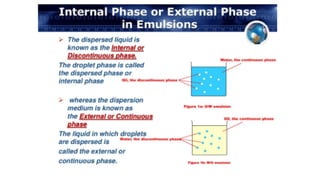
Biphasic system (Emulsions)
Dr Samia Ghani
M. Phil Pharmaceutics
Purpose of emulsification
• To prepare relatively stable and homogeneous mixtures of two
immiscible liquids.
• Permits administration of a liquid drug in the form of minute globules
rather than in bulk.
• Palatable administration of an otherwise distasteful oil by dispersing it
in a sweetened, flavored aqueous vehicle.
Surface tension theory
• All liquids have a tendency to assume a shape having the minimal surface area exposed.
• For a drop of a liquid, that shape is the sphere.
• When the liquid is in contact with a second liquid in which it is insoluble and immiscible,
the force causing each liquid to resist breaking up into smaller par?cles is called
interfacial tension.
• Substances that reduce this resistance encourage a liquid to break up into smaller drops
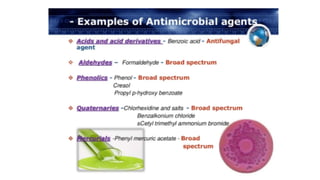
or par?cles. These tension-lowering substances are surface ac)ve (surfactant) or we,ng
agents.
• According to the surface tension theory of emulsifica?on, the use of these substances as
emulsifers and stabilizers lowers the interfacial tension of the two immiscible liquids,
reducing the repellent force between the liquids and diminishing each liquid’s aHrac?on
for its own molecules. Thus, the surface-ac?ve agents facilitate the breaking up of large
globules into smaller ones, which then have a lesser tendency to reunite or coalesce.
oriented-wedge theory
• certain emulsifying agents orient themselves about and within a
liquid in a manner reflective of their solubility in that particular liquid.
In a system containing two immiscible liquids, presumably the
emulsifying agent is preferentially soluble in one of the phases and is
embedded more deeply and tenaciously in that phase than the other.
Because many molecules of substances upon which this theory is
based (e.g., soaps) have a hydrophilic portion and a hydrophobic
portion, the molecules position or orient themselves into each phase.
• an emulsifying agent having a greater hydrophilic than hydrophobic
character will promote an o/w emulsion, and a w/o emulsion results
from use of an emulsifying agent that is more hydrophobic than
hydrophilic.
Inter-facial film theory
• The plastic or interfacial film theory places the emulsifying agent at
the interface between the oil and water, surrounding the droplets of
the internal phase as a thin layer of film adsorbed on the surface of
the drops. The film prevents contact and coalescing of the dispersed
phase; the tougher and more pliable the film, the greater the stability
of the emulsion.
• Here again, the formation of an o/w or a w/o emulsion depends on
the degree of solubility of the agent in the two phases, with water-
soluble agents encouraging o/w emulsions and oil-soluble emulsifiers
the reverse.
The HLB System
• Generally, each emulsifying agent has a hydrophilic portion and a lipophilic
portion, with one or the other being more or less predominant and
emulsifying or surface-active agents may be categorized on the basis of
their chemical makeup as to their hydrophilic–lipophilic balance, or HLB
(which indicates substance polarity).
• Numbers have been assigned upto 40 but most usual range is 1 to 20>.
• Highly polar (hydrophilic) material are given higher numbers and vice versa.
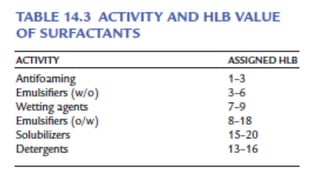
• Surface active agents having an assigned HLB value of 3 to 6 are greatly
lipophilic and produce w/o emulsions, and agents with HLB values of about
8 to 18 produce o/w emulsions.
Agent HLB value
Sorbian tristearate (span 65) 2.1
Sorbitan monooleate (Span 80) 4.3
Sorbitan monostearate (Span 60a) 4.7
Acacia 8.0
Gelatin 9.8
Methylcellulose 10.5
Polyoxyethylene sorbitan monostearate
(Tween 60)
14.9
Polyoxyethylene sorbitan monooleate
(Tween 80a)
15.0
Sodium lauryl sulfate 40.0
Blending of Surfactants
• We#ng agents are surfactants with HLB values of 7 to 9. We6ng agents aid in
a9aining in:mate contact between solid par:cles and liquids.
• Emulsifying agents reduce interfacial tension between oil and water, minimizing
surface energy through the forma:on of globules. Detergents are surfactants
with HLB values of 13 to 16. Detergents will reduce the surface tension and aid in
we6ng the surface and the dirt. The soil will be emulsified, and foaming
generally occurs, and a washing away of the dirt.
• Solubilizing agents have HLB values of 15 to 20. HLB values are addi:ve, and
oEen surfactants are blended. For example, if 20 mL of an HLB of 9.0 is required,
two surfactants (with HLB values of 8.0 and 12.0) can be blended in a 3:1 ra:o.
The following quan::es of each will be required:
0.75 × 8.0 = 6.0
0.25 × 12.0 = 3.0
Total HLB = 9.0
Continental or dry gum method
• also referred to as the 4:2:1 method because for every 4 parts by volume of oil, 2 parts of water
and 1 part of gum are added in preparing the initial or primary emul-sion.
• A mortar with a rough rather than smooth inner surface must be used to ensure proper grinding
action and reduction of the globule size
• the acacia or other o/w emulsifier is triturated with the oil in a perfectly dry Wedgwood or
porcelain mortar until thoroughly mixed.
• After the oil and gum have been mixed, the two parts of water are added all at once, and the
mixture is triturated immediately, rapidly, and continuously until the primary emulsion is creamy
white and produces a crackling sound (generally about 3 minutes) to the movement of the pestle.
• Other liquid formulative ingredients that are soluble in or miscible with the external phase may
then be mixed into the primary emulsion.
• Solid substances such as preservatives, stabilizers, colorants, and any flavoring material are
usually dissolved in a suitable volume of water (assuming water is the external phase) and added
as a solution to the primary emulsion.
• Any substances that might interfere with the stability of the emulsion or the emulsifying agent are
added as near last as is practical.
English or Wet Gum Method
• By this method, the same proportions of oil, water, and gum are used as in
the continental or dry gum method, but the order of mixing is different,
and the proportion of ingredients may be varied during the preparation of
the primary emulsion as is deemed necessary by the operator.
• Generally, a mucilage of the gum is prepared by triturating in a mortar
granular acacia with twice its weight of water.
• The oil is then added slowly in portions, and the mixture is triturated to
emulsify the oil.
• After all of the oil has been added, the mixture is thoroughly mixed for
several minutes to ensure uniformity.
• Then, as with the continental or dry gum method, the other formulative
materials are added, and the emulsion is transferred to a graduate and
brought to volume with water.
Bottle or Forbes Bottle Method
• The bottle method is useful for the extemporaneous preparation of
emulsions from volatile oils or oleaginous substances of low viscosities.
• Powdered acacia is placed in a dry bottle, two parts of oil are added, and
the mixture is thoroughly shaken in the capped container.
• A volume of water approximately equal to that of the oil isthen added in
portions and the mixture thoroughly shaken after each addition.
• When all of the water has been added, the primary emulsion thus formed
may be diluted to the proper volume with water or an aqueous solution of
other formulative agents.
• This method is not suited for viscous oils because they cannot be
thoroughly agitated in the bottle when mixed with the emulsifying agent.
When the intended dispersed phase is a mixture of fixed oil and volatile oil,
the dry gum method is generally employed.
Auxiliary Methods
• An emulsion prepared by either the wet gum orthe dry gum method
can generally be increased in quality by passing it through a hand
homogenizer.
• In this apparatus, the pumping ac;on of the handle forces the
emulsion through a very small orifice that reduces the globules of the
internal phase to about 5μm and some;mes less.
• The hand homogenizer is less efficient in reducing the par;cle size of
very thick emulsions, andit should not be employed for emulsions
containing a high propor;on of solid maDer because of possible
damage to the valve.
In Situ Soap Method
• The two types of soaps developed by this method are calcium soaps
and soft soaps.
• Calcium soaps are w/o emulsions that contain certain vegetable oils,
such as oleic acid, in combination with lime-water (synonym: Calcium
Hydroxide Solution,USP).
• They are prepared simply by mixing equal volumes of the oil and lime
water. The emulsifying agent in this instance is the calcium salt of the
free fatty acid formed from the combination of the two entities.
Microemulsions
• Microemulsions are thermodynamically stable,op5cally transparent
isotropic mixtures of a biphasic o/w system stabilized with
surfactants.
• The diameter of droplets in a microemulsion may be in the range of
100 Å (10 millimicrons) to1000Å, where as in a macroemulsion the
droplets may be 5000 Å in diameter (6).
• Both o/w andw/o microemulsions may be formed spontaneously by
agita5ng the oil and water phases with carefully selected surfactants.
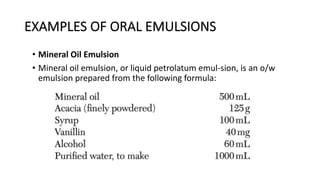
EXAMPLES OF ORAL EMULSIONS
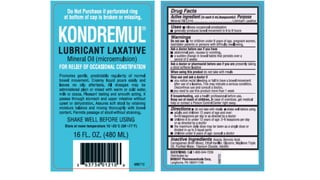
• Mineral Oil Emulsion
• Mineral oil emulsion, or liquid petrolatum emul-sion, is an o/w
emulsion prepared from the following formula:
• Prepared by the dry gum method (4:2:1),mixing the oil with the
acacia and adding 250 mLof purified water all at once to make the
primary emulsion.
• To this is slowly added with triturationthe remainder of the
ingredients, with the vanil-lin dissolved in the alcohol.
• A substitute flavorantfor the vanillin, a substitute preservative for
thealcohol, and a substitute emulsifying agent forthe acacia, and an
alternative method of emulsi-fication may be used as desired.
• The emulsion is employed as a lubricatingcathartic with a usual dose
of 30mL. The usualdose of plain (unemulsified) mineral oil for
thesame purpose is 15mL.
• The emulsion is muchmore palatable than the unemulsified oil.
Bothare best taken a hour before bedtime.
Examples
• Castor oil emulsion is used as a laxative for isolated bouts of
constipation and in preparation of the colon for radiography and
endoscopic examination.
• The amount of castor oil in commercialemulsions varies from about
35% to 67%. Theamount of oil influences the dose required.Generally,
for an emulsion containing abouttwo-thirds oil, the adult dose is
45mL, aboutthree tablespoonfuls. For children 2 to 6 yearsof age, 15
mL is usually sufficient, and for chil-dren less than 2 years of age, 5 mL
may be given.Castor oil is best taken on an empty stomach,followed
with one full glass of water.
Examples
• Simethicone emulsion is a water-dispersible form of simethicone used
as a defoaming agent for the relief of painful symptoms of excessive
gas in the gastrointestinal tract.
• The commer-cial product (Mylicon Drops, AstraZeneca)contains 40mg
of simethicone per 0.6mL. Sim-ethicone is also present in a number of
antacidformulations (e.g., Mylanta, Johnson&JohnsonMerck) as a
therapeutic adjunct to relieve thediscomfort of gas.
• EXAMPLES OF TOPICAL EMULSIONS
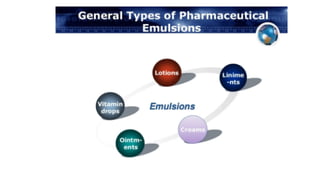
• Many of the hand and body lo.ons used to treat dry skin are o/w
emulsions
• Estra-sorb (Novavax, King Pharmaceu.cals), which contains estradiol
for use in the treatment of hot flashes and night sweats
accompanying menopause. It works by replacing the hormones lost
during menopause.
• Cor.costeroid-containing emulsions include Lotrimin AF
(clotrimazole,Schering-Plough) and Diprolene (augmented
betamethasone dipropionate, Schering).
Packaging
• For oral use, generally packed in wide mouth container having
adequate space above the liquid to ensure proper mixing.
• Parenteral emulsions: glass ampoules or vials
• Topical emulsions: tubes (plastic or metal) with narrow mouth to
ensure minimum contact with environment.
• Foam emulsion are packed in aerosol assembly.
Thepicturecan'tbedisplayed.

emulsions Dr Samia.pdf

  • 1.
    Biphasic system (Emulsions) DrSamia Ghani M. Phil Pharmaceutics
  • 4.
    Purpose of emulsification •To prepare relatively stable and homogeneous mixtures of two immiscible liquids. • Permits administration of a liquid drug in the form of minute globules rather than in bulk. • Palatable administration of an otherwise distasteful oil by dispersing it in a sweetened, flavored aqueous vehicle.
  • 10.
    Surface tension theory •All liquids have a tendency to assume a shape having the minimal surface area exposed. • For a drop of a liquid, that shape is the sphere. • When the liquid is in contact with a second liquid in which it is insoluble and immiscible, the force causing each liquid to resist breaking up into smaller par?cles is called interfacial tension. • Substances that reduce this resistance encourage a liquid to break up into smaller drops or par?cles. These tension-lowering substances are surface ac)ve (surfactant) or we,ng agents. • According to the surface tension theory of emulsifica?on, the use of these substances as emulsifers and stabilizers lowers the interfacial tension of the two immiscible liquids, reducing the repellent force between the liquids and diminishing each liquid’s aHrac?on for its own molecules. Thus, the surface-ac?ve agents facilitate the breaking up of large globules into smaller ones, which then have a lesser tendency to reunite or coalesce.
  • 12.
    oriented-wedge theory • certainemulsifying agents orient themselves about and within a liquid in a manner reflective of their solubility in that particular liquid. In a system containing two immiscible liquids, presumably the emulsifying agent is preferentially soluble in one of the phases and is embedded more deeply and tenaciously in that phase than the other. Because many molecules of substances upon which this theory is based (e.g., soaps) have a hydrophilic portion and a hydrophobic portion, the molecules position or orient themselves into each phase. • an emulsifying agent having a greater hydrophilic than hydrophobic character will promote an o/w emulsion, and a w/o emulsion results from use of an emulsifying agent that is more hydrophobic than hydrophilic.
  • 15.
    Inter-facial film theory •The plastic or interfacial film theory places the emulsifying agent at the interface between the oil and water, surrounding the droplets of the internal phase as a thin layer of film adsorbed on the surface of the drops. The film prevents contact and coalescing of the dispersed phase; the tougher and more pliable the film, the greater the stability of the emulsion. • Here again, the formation of an o/w or a w/o emulsion depends on the degree of solubility of the agent in the two phases, with water- soluble agents encouraging o/w emulsions and oil-soluble emulsifiers the reverse.
  • 23.
    The HLB System •Generally, each emulsifying agent has a hydrophilic portion and a lipophilic portion, with one or the other being more or less predominant and emulsifying or surface-active agents may be categorized on the basis of their chemical makeup as to their hydrophilic–lipophilic balance, or HLB (which indicates substance polarity). • Numbers have been assigned upto 40 but most usual range is 1 to 20>. • Highly polar (hydrophilic) material are given higher numbers and vice versa. • Surface active agents having an assigned HLB value of 3 to 6 are greatly lipophilic and produce w/o emulsions, and agents with HLB values of about 8 to 18 produce o/w emulsions.
  • 24.
    Agent HLB value Sorbiantristearate (span 65) 2.1 Sorbitan monooleate (Span 80) 4.3 Sorbitan monostearate (Span 60a) 4.7 Acacia 8.0 Gelatin 9.8 Methylcellulose 10.5 Polyoxyethylene sorbitan monostearate (Tween 60) 14.9 Polyoxyethylene sorbitan monooleate (Tween 80a) 15.0 Sodium lauryl sulfate 40.0
  • 25.
    Blending of Surfactants •We#ng agents are surfactants with HLB values of 7 to 9. We6ng agents aid in a9aining in:mate contact between solid par:cles and liquids. • Emulsifying agents reduce interfacial tension between oil and water, minimizing surface energy through the forma:on of globules. Detergents are surfactants with HLB values of 13 to 16. Detergents will reduce the surface tension and aid in we6ng the surface and the dirt. The soil will be emulsified, and foaming generally occurs, and a washing away of the dirt. • Solubilizing agents have HLB values of 15 to 20. HLB values are addi:ve, and oEen surfactants are blended. For example, if 20 mL of an HLB of 9.0 is required, two surfactants (with HLB values of 8.0 and 12.0) can be blended in a 3:1 ra:o. The following quan::es of each will be required: 0.75 × 8.0 = 6.0 0.25 × 12.0 = 3.0 Total HLB = 9.0
  • 51.
    Continental or drygum method • also referred to as the 4:2:1 method because for every 4 parts by volume of oil, 2 parts of water and 1 part of gum are added in preparing the initial or primary emul-sion. • A mortar with a rough rather than smooth inner surface must be used to ensure proper grinding action and reduction of the globule size • the acacia or other o/w emulsifier is triturated with the oil in a perfectly dry Wedgwood or porcelain mortar until thoroughly mixed. • After the oil and gum have been mixed, the two parts of water are added all at once, and the mixture is triturated immediately, rapidly, and continuously until the primary emulsion is creamy white and produces a crackling sound (generally about 3 minutes) to the movement of the pestle. • Other liquid formulative ingredients that are soluble in or miscible with the external phase may then be mixed into the primary emulsion. • Solid substances such as preservatives, stabilizers, colorants, and any flavoring material are usually dissolved in a suitable volume of water (assuming water is the external phase) and added as a solution to the primary emulsion. • Any substances that might interfere with the stability of the emulsion or the emulsifying agent are added as near last as is practical.
  • 52.
    English or WetGum Method • By this method, the same proportions of oil, water, and gum are used as in the continental or dry gum method, but the order of mixing is different, and the proportion of ingredients may be varied during the preparation of the primary emulsion as is deemed necessary by the operator. • Generally, a mucilage of the gum is prepared by triturating in a mortar granular acacia with twice its weight of water. • The oil is then added slowly in portions, and the mixture is triturated to emulsify the oil. • After all of the oil has been added, the mixture is thoroughly mixed for several minutes to ensure uniformity. • Then, as with the continental or dry gum method, the other formulative materials are added, and the emulsion is transferred to a graduate and brought to volume with water.
  • 53.
    Bottle or ForbesBottle Method • The bottle method is useful for the extemporaneous preparation of emulsions from volatile oils or oleaginous substances of low viscosities. • Powdered acacia is placed in a dry bottle, two parts of oil are added, and the mixture is thoroughly shaken in the capped container. • A volume of water approximately equal to that of the oil isthen added in portions and the mixture thoroughly shaken after each addition. • When all of the water has been added, the primary emulsion thus formed may be diluted to the proper volume with water or an aqueous solution of other formulative agents. • This method is not suited for viscous oils because they cannot be thoroughly agitated in the bottle when mixed with the emulsifying agent. When the intended dispersed phase is a mixture of fixed oil and volatile oil, the dry gum method is generally employed.
  • 54.
    Auxiliary Methods • Anemulsion prepared by either the wet gum orthe dry gum method can generally be increased in quality by passing it through a hand homogenizer. • In this apparatus, the pumping ac;on of the handle forces the emulsion through a very small orifice that reduces the globules of the internal phase to about 5μm and some;mes less. • The hand homogenizer is less efficient in reducing the par;cle size of very thick emulsions, andit should not be employed for emulsions containing a high propor;on of solid maDer because of possible damage to the valve.
  • 55.
    In Situ SoapMethod • The two types of soaps developed by this method are calcium soaps and soft soaps. • Calcium soaps are w/o emulsions that contain certain vegetable oils, such as oleic acid, in combination with lime-water (synonym: Calcium Hydroxide Solution,USP). • They are prepared simply by mixing equal volumes of the oil and lime water. The emulsifying agent in this instance is the calcium salt of the free fatty acid formed from the combination of the two entities.
  • 56.
    Microemulsions • Microemulsions arethermodynamically stable,op5cally transparent isotropic mixtures of a biphasic o/w system stabilized with surfactants. • The diameter of droplets in a microemulsion may be in the range of 100 Å (10 millimicrons) to1000Å, where as in a macroemulsion the droplets may be 5000 Å in diameter (6). • Both o/w andw/o microemulsions may be formed spontaneously by agita5ng the oil and water phases with carefully selected surfactants.
  • 69.
    EXAMPLES OF ORALEMULSIONS • Mineral Oil Emulsion • Mineral oil emulsion, or liquid petrolatum emul-sion, is an o/w emulsion prepared from the following formula:
  • 70.
    • Prepared bythe dry gum method (4:2:1),mixing the oil with the acacia and adding 250 mLof purified water all at once to make the primary emulsion. • To this is slowly added with triturationthe remainder of the ingredients, with the vanil-lin dissolved in the alcohol. • A substitute flavorantfor the vanillin, a substitute preservative for thealcohol, and a substitute emulsifying agent forthe acacia, and an alternative method of emulsi-fication may be used as desired. • The emulsion is employed as a lubricatingcathartic with a usual dose of 30mL. The usualdose of plain (unemulsified) mineral oil for thesame purpose is 15mL. • The emulsion is muchmore palatable than the unemulsified oil. Bothare best taken a hour before bedtime.
  • 71.
    Examples • Castor oilemulsion is used as a laxative for isolated bouts of constipation and in preparation of the colon for radiography and endoscopic examination. • The amount of castor oil in commercialemulsions varies from about 35% to 67%. Theamount of oil influences the dose required.Generally, for an emulsion containing abouttwo-thirds oil, the adult dose is 45mL, aboutthree tablespoonfuls. For children 2 to 6 yearsof age, 15 mL is usually sufficient, and for chil-dren less than 2 years of age, 5 mL may be given.Castor oil is best taken on an empty stomach,followed with one full glass of water.
  • 72.
    Examples • Simethicone emulsionis a water-dispersible form of simethicone used as a defoaming agent for the relief of painful symptoms of excessive gas in the gastrointestinal tract. • The commer-cial product (Mylicon Drops, AstraZeneca)contains 40mg of simethicone per 0.6mL. Sim-ethicone is also present in a number of antacidformulations (e.g., Mylanta, Johnson&JohnsonMerck) as a therapeutic adjunct to relieve thediscomfort of gas.
  • 73.
    • EXAMPLES OFTOPICAL EMULSIONS • Many of the hand and body lo.ons used to treat dry skin are o/w emulsions • Estra-sorb (Novavax, King Pharmaceu.cals), which contains estradiol for use in the treatment of hot flashes and night sweats accompanying menopause. It works by replacing the hormones lost during menopause. • Cor.costeroid-containing emulsions include Lotrimin AF (clotrimazole,Schering-Plough) and Diprolene (augmented betamethasone dipropionate, Schering).
  • 75.
    Packaging • For oraluse, generally packed in wide mouth container having adequate space above the liquid to ensure proper mixing. • Parenteral emulsions: glass ampoules or vials • Topical emulsions: tubes (plastic or metal) with narrow mouth to ensure minimum contact with environment. • Foam emulsion are packed in aerosol assembly.
  • 79.