International Research Journal of Engineering and Technology (IRJET) e-ISSN: 2395-0056
Volume: 09 Issue: 04 | Apr 2022 www.irjet.net p-ISSN: 2395-0072
© 2022, IRJET | Impact Factor value: 7.529 | ISO 9001:2008 Certified Journal | Page 3259
Soil Profile Based Crop Prediction System
Mudra Verma1, Kaushal Vyas2, Kunal Sahjwani3 , Mahendra Patil4
1,2,3Student, Dept. of Computer Engineering, Atharva College of Engineering, Maharashtra, India.
4Assistant Professor, Dept. of Computer Engineering, Atharva College of Engineering, University of Mumbai,
Maharashtra, India.
---------------------------------------------------------------------***---------------------------------------------------------------------
Abstract - In many parts of India, farmers are
experiencing problems with crop production due to soil and
climate. There is no proper guide available to help them
develop the right types of plants using modern technology.
Due to illiteracy, farmers may not be able to take advantage
of the scientific advances made in agriculture and still cling
to human practices. This makes obtaining the desired yield
difficult. For example, crop failure may be due to misuse of
fertilizers or unwanted rainfall patterns. In such cases, the
appropriate solution would be to select crops that are
suitable for current soil conditions and the expected rainfall
during planting. Therefore, we are introducing a ‘Soil-Based
Profile Profiling System’ based on data mining. We provide a
list of crops that a farmer can cultivate based on soil input
parameters (NPK and pH) and rainfall of the farmer's area.
In addition, it also proposes fertilizer that can be used to
improve soil quality and thus bring more crops under
successful cultivation. This desktop application is designed
to solve a growing problem of crop failure.
Key Words: Nitrogen, Phosphorus and Potassium,
Artificial Neural Networks, pH, depth, temperature,
rainfall, Feedforward backpropagation, Soil.
1. INTRODUCTION
Agriculture is an important activity in India, providing
118.6 million farmers with a livelihood by the 2011
census. Understanding soil conditions, knowing when and
where to apply compost, considering rainfall, maintaining
crop quality, and understanding how different factors
work differently in different parts of the same field are
some of the many problems farmers face before. as when
plowing. A number of factors and statistics need to be
taken into account when making important agricultural
decisions that may be difficult to implement in their own
right or at times. Implementing this program will provide
a solution for Agriculture by monitoring the agricultural
field, which can help farmers to grow their productivity on
a large scale. Weather data obtained online, such as
rainfall reserves and soil boundaries, provides insight into
which plants should be planted in a particular area. This
function introduces a program in a desktop-based
application, which uses data analysis techniques to predict
the most profitable yields in the current climate and soil
conditions.The program will integrate data obtained from
storage and climate department. Using a machine learning
algorithm, predicting the most relevant plants based on
current natural conditions was performed. This gives the
farmer a variety of crops that can be grown. Therefore, the
project develops a system by combining data from various
sources, data analysis, and forecasting analysis, improving
crop production and increasing the profit margins of
farmers, helping them over time.
The farmer must take care of the soil in order to have a
good harvest. Growers should be aware of the
macronutrients and micronutrients present in the soil in
order to get the maximum yield of a particular crop and
know which fertilizer to use. Soil analysis is an important
aspect of Cultivation. Most people do not know how to
plant crops properly and in the right location. By analyzing
parameters such as Sodium (N), Potassium (K),
Phosphorus (P), and soil pH value, region, and rainfall, our
project thus identifies the suitability of certain soil-based
plants. mentioned above.
1.1 Proposed Solution
We proposed a desktop application that takes input as
nutrients values such as N, P, K, ph and finds output as the
fertility level of the soil, which crops will yield in that
fertility level after adding fewer nutrients which crops can
yield in that soil. Most farmers in India don’t know about
their soil fertility level. So he can’t understand which crops
to grow in that soil. So our system is most helpful to the
farmers who don’t know about their soil fertility level and
which crops they have to see in that soil.
We took readily available datasets of crops and nutrients
values to implement this system. We trained this database
using SVM. When the user enters an input we process the
test data and compare it with the trained dataset using the
SVM algorithm and check our final output.
1.2 Problem Formulation
The system will integrate data obtained from storage, in
the weather department and using a machine learning
algorithm, the most accurate crop prediction based on
current environmental conditions is made. This gives the
farmer a variety of crops that can be grown. Therefore, the
project improves the system by combining data from
various sources, analyzing data, analyzing forecasts that
can improve crop production and increase farmers' profit
margins to help them over time.
International Research Journal of Engineering and Technology (IRJET) e-ISSN: 2395-0056
Volume: 09 Issue: 04 | Apr 2022 www.irjet.net p-ISSN: 2395-0072
© 2022, IRJET | Impact Factor value: 7.529 | ISO 9001:2008 Certified Journal | Page 3260
2. WORKING
2.1 Significance of NPK, PH and rainfall
Importance of NPK and pH: The system works to identify
soil, based on Nitrogen (N), Phosphorus (P), and
Potassium (K) values and soil pH values as input from the
farmer. Nitrogen is the key to plant growth. The addition
of nitrogen to the amino acids is a major protein in the
plant, and it is one of the components of chlorophyll and is
required in response to several enzymes. Phosphorus is an
important component of plant RNA and DNA. Phosphorus
is an important factor in root growth, plant growth, and
seed production. Plant growth is not directly affected by
Potassium. Potassium is required for the activity of more
than 80 enzymes in a plant. Soil pH affects the many
physical, chemical, and environmental reactions needed
for plants to survive, grow, and harvest. Nutrition is
strongly influenced by pH, which makes it important to be
vigilant.
Importance of regional based rainfall: In addition to soil
characteristics, this program also looks at rainfall levels,
which will be reflected in the farmer's area, in order to
develop the most suitable crops. Water shortages are a
problem in India, and many farmers are dependent on
rainfall to produce good crops. Therefore, planting in
terms of rainfall may be very important.
2.2 Use Case
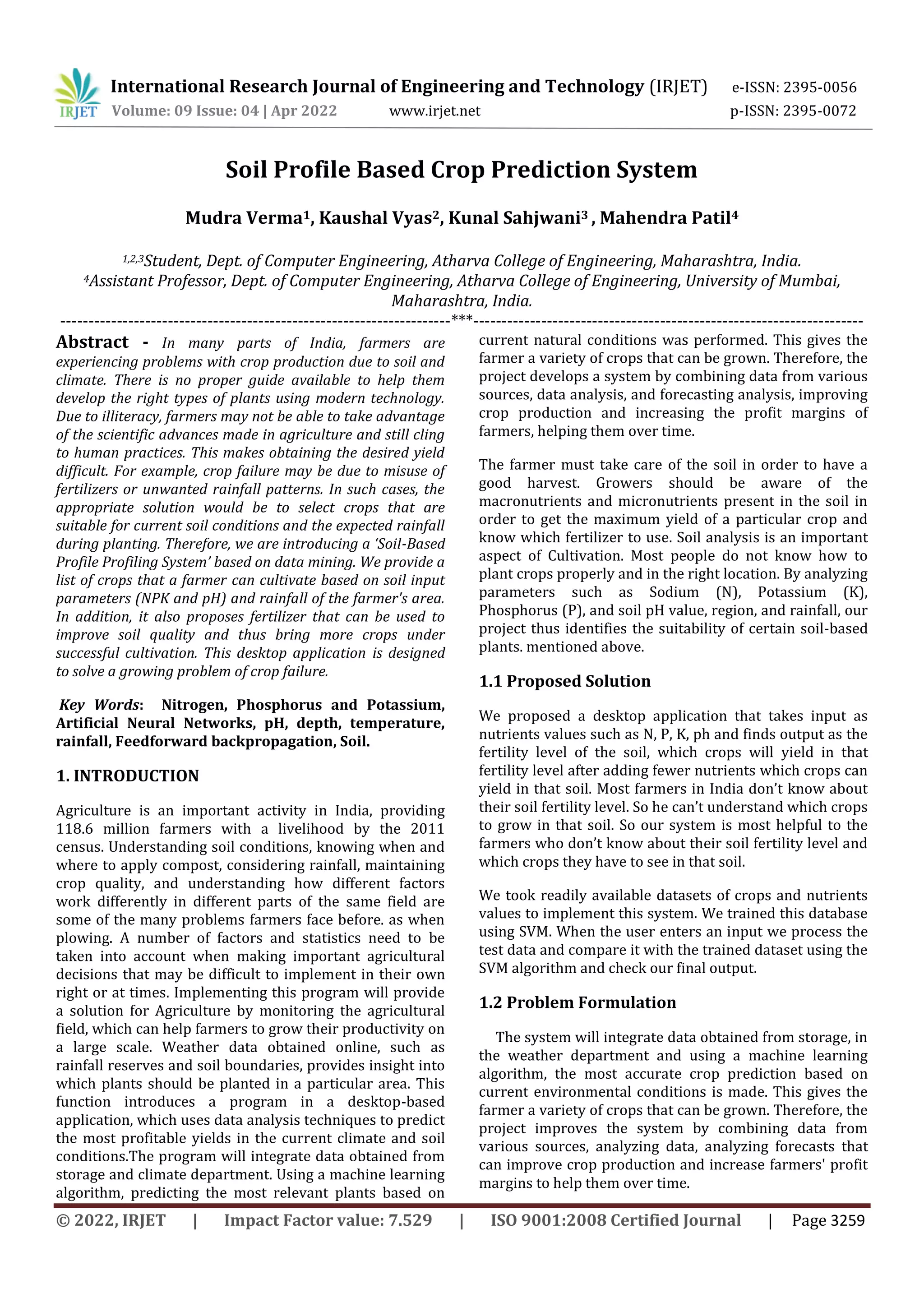
There are three actors, which are the user and the system.
Figure 2.2 contains the use case for our application. The
actors for our application are the farmer and the system.
Farmer:
The farmer has three roles:
1. Entering the values for nitrogen, phosphorus,
potassium and pH as well as region.
2. Entering the nitrogen, phosphorus and potassium
values for Fertilizers.
3. Uploading the image for Disease Identification.
System:
The system is first trained using the dataset values. After
the farmer enters the values, the system predicts the
output based on the trained data.
Fig -2.2.1: Use Case
2.3 System Flow
Fig -2.3.1: System Flow
The Farmer can use the system in a very simple manner.
The application is user friendly and goal oriented. Here are
the steps for the user to get their output:
1. The farmer will first open the application.
2. Once he is booted, he can select any feature.
3. He enters the values and then views the output
produced by the application.
4. He can then close the application.
International Research Journal of Engineering and Technology (IRJET) e-ISSN: 2395-0056
Volume: 09 Issue: 04 | Apr 2022 www.irjet.net p-ISSN: 2395-0072
© 2022, IRJET | Impact Factor value: 7.529 | ISO 9001:2008 Certified Journal | Page 3261
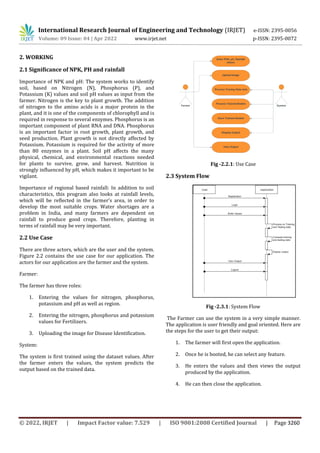
Fig -2.3.2: System Architectural Flow
The flow of system performance is shown in Figure -1. The
farmer first registers in the system, then sets the NPK
values and pH and production area. If you enter the details
list the plants may be produced. Along with this is a list of
usable fertilizers that are also produced. The farmer can
then view his or her previous results.
3. RESULT
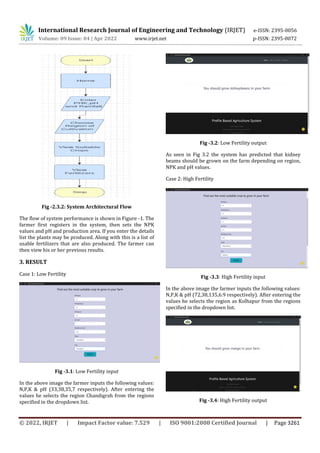
Case 1: Low Fertility
Fig -3.1: Low Fertility input
In the above image the farmer inputs the following values:
N,P,K & pH (33,38,35,7 respectively). After entering the
values he selects the region Chandigrah from the regions
specified in the dropdown list.
Fig -3.2: Low Fertility output
As seen in Fig 3.2 the system has predicted that kidney
beams should be grown on the farm depending on region,
NPK and pH values.
Case 2: High Fertility
Fig -3.3: High Fertility input
In the above image the farmer inputs the following values:
N,P,K & pH (72,38,135,6.9 respectively). After entering the
values he selects the region as Kolhapur from the regions
specified in the dropdown list.
Fig -3.4: High Fertility output
International Research Journal of Engineering and Technology (IRJET) e-ISSN: 2395-0056
Volume: 09 Issue: 04 | Apr 2022 www.irjet.net p-ISSN: 2395-0072
© 2022, IRJET | Impact Factor value: 7.529 | ISO 9001:2008 Certified Journal | Page 3262
As seen in Fig 3.4 the system has predicted that mango
should be grown on the farm depending on region, NPK
and pH values.
Case 3: Fertilizers
Fig -3.5: Fertilizer prediction input
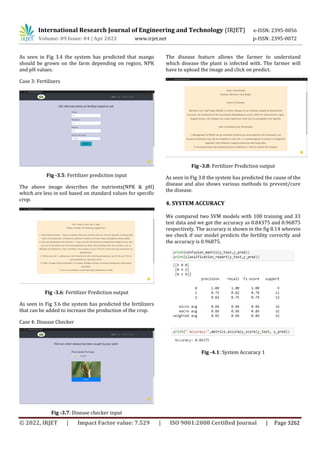
The above image describes the nutrients(NPK & pH)
which are less in soil based on standard values for specific
crop.
Fig -3.6: Fertilizer Prediction output
As seen in Fig 3.6 the system has predicted the fertilizers
that can be added to increase the production of the crop.
Case 4: Disease Checker
Fig -3.7: Disease checker input
The disease feature allows the farmer to understand
which disease the plant is infected with. The farmer will
have to upload the image and click on predict.
Fig -3.8: Fertilizer Prediction output
As seen in Fig 3.8 the system has predicted the cause of the
disease and also shows various methods to prevent/cure
the disease.
4. SYSTEM ACCURACY
We compared two SVM models with 100 training and 33
test data and we got the accuracy as 0.84375 and 0.96875
respectively. The accuracy is shown in the fig 8.14 wherein
we check if our model predicts the fertility correctly and
the accuracy is 0.96875.
Fig -4.1: System Accuracy 1
International Research Journal of Engineering and Technology (IRJET) e-ISSN: 2395-0056
Volume: 09 Issue: 04 | Apr 2022 www.irjet.net p-ISSN: 2395-0072
© 2022, IRJET | Impact Factor value: 7.529 | ISO 9001:2008 Certified Journal | Page 3263
Fig -4.1: System Accuracy 2
CONCLUSIONS
Agriculture is the backbone of India. By developing a Soil
Profile-based crop prediction System, we want to provide
a simple solution. Crop productivity can be improved by
implementing this system. It is possible to avoid land loss
due to over use of fertilizers or under use of fertilizers. It
may help farmers boost their profit margins by reducing
the use of superfluous fertilizers and avoiding the
production of incorrect crops. The main goal of our
application is to assist farmers in making better crop
productivity decisions, as well as to assist farmers in
deciding what crops to cultivate based on the rainfall
conditions in the region. We will also assist farmers in
deciding what fertilizers to apply in order to avoid over
fertilization or under fertilization problems, resulting in a
higher yield.
ACKNOWLEDGEMENT
We sincerely thank Atharva College of Engineering for
giving us a platform to prepare a project on the topic “Soil
profile based crop prediction system” and would like to
thank our Principal Dr. Shrikant Kallurkar for instigating
within us the need for this research and giving us the
opportunities and time to conduct research on the topic.
We are truly grateful for having Prof. Mahendra Patil as
our guide and Dr. Suvarna Pansambal, Head of Computer
Engineering Department, and our project co-ordinator
Prof. Shweta Sharma. However, this research would not
have been possible without the understanding,
cooperation and help of our friends and family.
REFERENCES
[1] Soumaya Lamrhari ; Hamid Elghazi ; Tayeb Sadiki ;
Abdellatif El Faker “A profile-based Big data
architecture for agricultural context”, 2016
International Conference on Electrical and
Information Technologies (ICEIT) Year: 2016
[2] https://www.noble.org/news/publications/ag-news-
and-views/2007/january/back-to-basics-the-roles-of-
n-p-k-and-their-sources/ (Date: 25th October 2018)
[3] https://www.pioneer.com/home/site/us/agronomy/
library/managing-soil-pH (Date: 25th October 2018)
[4] Data mining in Agriculture on crop price prediction:
Techniques and Applications M Kaur, H Gulati, H
Kundra - International Journal of Computer
Applications
[5] R. Sujatha, Dr. P.Isakki,A Study on Crop Yield
Forecasting Using Classification Techniques, 978-1-
4673- 8437-7/16/$31.00 ©2016 IEEE.
[6] https://www.kaggle.com/datasets/atharvaingle/crop
-recommendation-dataset
[7] https://github.com/Gladiator07/Harvestify/blob/ma
ster/Data-processed/fertilizer.csv
[8] https://www.kaggle.com/datasets/vipoooool/new-
plant-diseases-dataset

Soil Profile Based Crop Prediction System

  • 1.
    International Research Journalof Engineering and Technology (IRJET) e-ISSN: 2395-0056 Volume: 09 Issue: 04 | Apr 2022 www.irjet.net p-ISSN: 2395-0072 © 2022, IRJET | Impact Factor value: 7.529 | ISO 9001:2008 Certified Journal | Page 3259 Soil Profile Based Crop Prediction System Mudra Verma1, Kaushal Vyas2, Kunal Sahjwani3 , Mahendra Patil4 1,2,3Student, Dept. of Computer Engineering, Atharva College of Engineering, Maharashtra, India. 4Assistant Professor, Dept. of Computer Engineering, Atharva College of Engineering, University of Mumbai, Maharashtra, India. ---------------------------------------------------------------------***--------------------------------------------------------------------- Abstract - In many parts of India, farmers are experiencing problems with crop production due to soil and climate. There is no proper guide available to help them develop the right types of plants using modern technology. Due to illiteracy, farmers may not be able to take advantage of the scientific advances made in agriculture and still cling to human practices. This makes obtaining the desired yield difficult. For example, crop failure may be due to misuse of fertilizers or unwanted rainfall patterns. In such cases, the appropriate solution would be to select crops that are suitable for current soil conditions and the expected rainfall during planting. Therefore, we are introducing a ‘Soil-Based Profile Profiling System’ based on data mining. We provide a list of crops that a farmer can cultivate based on soil input parameters (NPK and pH) and rainfall of the farmer's area. In addition, it also proposes fertilizer that can be used to improve soil quality and thus bring more crops under successful cultivation. This desktop application is designed to solve a growing problem of crop failure. Key Words: Nitrogen, Phosphorus and Potassium, Artificial Neural Networks, pH, depth, temperature, rainfall, Feedforward backpropagation, Soil. 1. INTRODUCTION Agriculture is an important activity in India, providing 118.6 million farmers with a livelihood by the 2011 census. Understanding soil conditions, knowing when and where to apply compost, considering rainfall, maintaining crop quality, and understanding how different factors work differently in different parts of the same field are some of the many problems farmers face before. as when plowing. A number of factors and statistics need to be taken into account when making important agricultural decisions that may be difficult to implement in their own right or at times. Implementing this program will provide a solution for Agriculture by monitoring the agricultural field, which can help farmers to grow their productivity on a large scale. Weather data obtained online, such as rainfall reserves and soil boundaries, provides insight into which plants should be planted in a particular area. This function introduces a program in a desktop-based application, which uses data analysis techniques to predict the most profitable yields in the current climate and soil conditions.The program will integrate data obtained from storage and climate department. Using a machine learning algorithm, predicting the most relevant plants based on current natural conditions was performed. This gives the farmer a variety of crops that can be grown. Therefore, the project develops a system by combining data from various sources, data analysis, and forecasting analysis, improving crop production and increasing the profit margins of farmers, helping them over time. The farmer must take care of the soil in order to have a good harvest. Growers should be aware of the macronutrients and micronutrients present in the soil in order to get the maximum yield of a particular crop and know which fertilizer to use. Soil analysis is an important aspect of Cultivation. Most people do not know how to plant crops properly and in the right location. By analyzing parameters such as Sodium (N), Potassium (K), Phosphorus (P), and soil pH value, region, and rainfall, our project thus identifies the suitability of certain soil-based plants. mentioned above. 1.1 Proposed Solution We proposed a desktop application that takes input as nutrients values such as N, P, K, ph and finds output as the fertility level of the soil, which crops will yield in that fertility level after adding fewer nutrients which crops can yield in that soil. Most farmers in India don’t know about their soil fertility level. So he can’t understand which crops to grow in that soil. So our system is most helpful to the farmers who don’t know about their soil fertility level and which crops they have to see in that soil. We took readily available datasets of crops and nutrients values to implement this system. We trained this database using SVM. When the user enters an input we process the test data and compare it with the trained dataset using the SVM algorithm and check our final output. 1.2 Problem Formulation The system will integrate data obtained from storage, in the weather department and using a machine learning algorithm, the most accurate crop prediction based on current environmental conditions is made. This gives the farmer a variety of crops that can be grown. Therefore, the project improves the system by combining data from various sources, analyzing data, analyzing forecasts that can improve crop production and increase farmers' profit margins to help them over time.
  • 2.
    International Research Journalof Engineering and Technology (IRJET) e-ISSN: 2395-0056 Volume: 09 Issue: 04 | Apr 2022 www.irjet.net p-ISSN: 2395-0072 © 2022, IRJET | Impact Factor value: 7.529 | ISO 9001:2008 Certified Journal | Page 3260 2. WORKING 2.1 Significance of NPK, PH and rainfall Importance of NPK and pH: The system works to identify soil, based on Nitrogen (N), Phosphorus (P), and Potassium (K) values and soil pH values as input from the farmer. Nitrogen is the key to plant growth. The addition of nitrogen to the amino acids is a major protein in the plant, and it is one of the components of chlorophyll and is required in response to several enzymes. Phosphorus is an important component of plant RNA and DNA. Phosphorus is an important factor in root growth, plant growth, and seed production. Plant growth is not directly affected by Potassium. Potassium is required for the activity of more than 80 enzymes in a plant. Soil pH affects the many physical, chemical, and environmental reactions needed for plants to survive, grow, and harvest. Nutrition is strongly influenced by pH, which makes it important to be vigilant. Importance of regional based rainfall: In addition to soil characteristics, this program also looks at rainfall levels, which will be reflected in the farmer's area, in order to develop the most suitable crops. Water shortages are a problem in India, and many farmers are dependent on rainfall to produce good crops. Therefore, planting in terms of rainfall may be very important. 2.2 Use Case There are three actors, which are the user and the system. Figure 2.2 contains the use case for our application. The actors for our application are the farmer and the system. Farmer: The farmer has three roles: 1. Entering the values for nitrogen, phosphorus, potassium and pH as well as region. 2. Entering the nitrogen, phosphorus and potassium values for Fertilizers. 3. Uploading the image for Disease Identification. System: The system is first trained using the dataset values. After the farmer enters the values, the system predicts the output based on the trained data. Fig -2.2.1: Use Case 2.3 System Flow Fig -2.3.1: System Flow The Farmer can use the system in a very simple manner. The application is user friendly and goal oriented. Here are the steps for the user to get their output: 1. The farmer will first open the application. 2. Once he is booted, he can select any feature. 3. He enters the values and then views the output produced by the application. 4. He can then close the application.
  • 3.
    International Research Journalof Engineering and Technology (IRJET) e-ISSN: 2395-0056 Volume: 09 Issue: 04 | Apr 2022 www.irjet.net p-ISSN: 2395-0072 © 2022, IRJET | Impact Factor value: 7.529 | ISO 9001:2008 Certified Journal | Page 3261 Fig -2.3.2: System Architectural Flow The flow of system performance is shown in Figure -1. The farmer first registers in the system, then sets the NPK values and pH and production area. If you enter the details list the plants may be produced. Along with this is a list of usable fertilizers that are also produced. The farmer can then view his or her previous results. 3. RESULT Case 1: Low Fertility Fig -3.1: Low Fertility input In the above image the farmer inputs the following values: N,P,K & pH (33,38,35,7 respectively). After entering the values he selects the region Chandigrah from the regions specified in the dropdown list. Fig -3.2: Low Fertility output As seen in Fig 3.2 the system has predicted that kidney beams should be grown on the farm depending on region, NPK and pH values. Case 2: High Fertility Fig -3.3: High Fertility input In the above image the farmer inputs the following values: N,P,K & pH (72,38,135,6.9 respectively). After entering the values he selects the region as Kolhapur from the regions specified in the dropdown list. Fig -3.4: High Fertility output
  • 4.
    International Research Journalof Engineering and Technology (IRJET) e-ISSN: 2395-0056 Volume: 09 Issue: 04 | Apr 2022 www.irjet.net p-ISSN: 2395-0072 © 2022, IRJET | Impact Factor value: 7.529 | ISO 9001:2008 Certified Journal | Page 3262 As seen in Fig 3.4 the system has predicted that mango should be grown on the farm depending on region, NPK and pH values. Case 3: Fertilizers Fig -3.5: Fertilizer prediction input The above image describes the nutrients(NPK & pH) which are less in soil based on standard values for specific crop. Fig -3.6: Fertilizer Prediction output As seen in Fig 3.6 the system has predicted the fertilizers that can be added to increase the production of the crop. Case 4: Disease Checker Fig -3.7: Disease checker input The disease feature allows the farmer to understand which disease the plant is infected with. The farmer will have to upload the image and click on predict. Fig -3.8: Fertilizer Prediction output As seen in Fig 3.8 the system has predicted the cause of the disease and also shows various methods to prevent/cure the disease. 4. SYSTEM ACCURACY We compared two SVM models with 100 training and 33 test data and we got the accuracy as 0.84375 and 0.96875 respectively. The accuracy is shown in the fig 8.14 wherein we check if our model predicts the fertility correctly and the accuracy is 0.96875. Fig -4.1: System Accuracy 1
  • 5.
    International Research Journalof Engineering and Technology (IRJET) e-ISSN: 2395-0056 Volume: 09 Issue: 04 | Apr 2022 www.irjet.net p-ISSN: 2395-0072 © 2022, IRJET | Impact Factor value: 7.529 | ISO 9001:2008 Certified Journal | Page 3263 Fig -4.1: System Accuracy 2 CONCLUSIONS Agriculture is the backbone of India. By developing a Soil Profile-based crop prediction System, we want to provide a simple solution. Crop productivity can be improved by implementing this system. It is possible to avoid land loss due to over use of fertilizers or under use of fertilizers. It may help farmers boost their profit margins by reducing the use of superfluous fertilizers and avoiding the production of incorrect crops. The main goal of our application is to assist farmers in making better crop productivity decisions, as well as to assist farmers in deciding what crops to cultivate based on the rainfall conditions in the region. We will also assist farmers in deciding what fertilizers to apply in order to avoid over fertilization or under fertilization problems, resulting in a higher yield. ACKNOWLEDGEMENT We sincerely thank Atharva College of Engineering for giving us a platform to prepare a project on the topic “Soil profile based crop prediction system” and would like to thank our Principal Dr. Shrikant Kallurkar for instigating within us the need for this research and giving us the opportunities and time to conduct research on the topic. We are truly grateful for having Prof. Mahendra Patil as our guide and Dr. Suvarna Pansambal, Head of Computer Engineering Department, and our project co-ordinator Prof. Shweta Sharma. However, this research would not have been possible without the understanding, cooperation and help of our friends and family. REFERENCES [1] Soumaya Lamrhari ; Hamid Elghazi ; Tayeb Sadiki ; Abdellatif El Faker “A profile-based Big data architecture for agricultural context”, 2016 International Conference on Electrical and Information Technologies (ICEIT) Year: 2016 [2] https://www.noble.org/news/publications/ag-news- and-views/2007/january/back-to-basics-the-roles-of- n-p-k-and-their-sources/ (Date: 25th October 2018) [3] https://www.pioneer.com/home/site/us/agronomy/ library/managing-soil-pH (Date: 25th October 2018) [4] Data mining in Agriculture on crop price prediction: Techniques and Applications M Kaur, H Gulati, H Kundra - International Journal of Computer Applications [5] R. Sujatha, Dr. P.Isakki,A Study on Crop Yield Forecasting Using Classification Techniques, 978-1- 4673- 8437-7/16/$31.00 ©2016 IEEE. [6] https://www.kaggle.com/datasets/atharvaingle/crop -recommendation-dataset [7] https://github.com/Gladiator07/Harvestify/blob/ma ster/Data-processed/fertilizer.csv [8] https://www.kaggle.com/datasets/vipoooool/new- plant-diseases-dataset