Dr.Amit Srivastava, PhD, M.ASCE, LMIGS, LMISRMTT, MITS, MISSMGE,AMIE
[B.E. University of Roorkee (now IIT Roorkee), M.E. & Ph.D, IISc, Bangalore]
Assistant Professor (Senior Grade), Department of Civil Engineering
Jaypee University of Engineering &Technology,
Agra-Bombay Road, Raghogarh, District: Guna
Madhya Pradesh - 473 226, India
Mob.No. (+91)94797729, Home: 07544267030
Compressibility of soil and
consolidation
Compressibility of Soil
When the stress is increased on soil (Caused by the
Construction of Foundation or Other Loads, Δσ), it causes
Compression of Soil Layers.
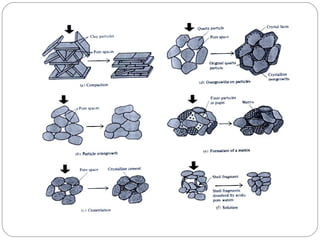
• The compression of soil layers leads to Soil Settlement
and that is caused by:
- Deformation of soil particles.
-Relocation of soil particles.
- Expulsion (flow out) of water or air from void spaces.
Compressibility of Soil
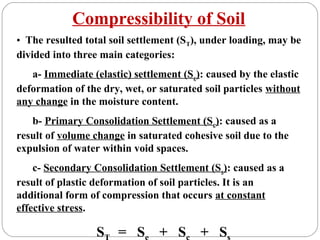
• The resulted total soil settlement (ST), under loading, may be
divided into three main categories:
a- Immediate (elastic) settlement (Se): caused by the elastic
deformation of the dry, wet, or saturated soil particles without
any change in the moisture content.
b- Primary Consolidation Settlement (Sc): caused as a
result of volume change in saturated cohesive soil due to the
expulsion of water within void spaces.
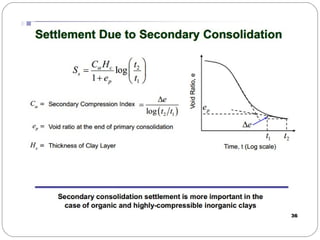
c- Secondary Consolidation Settlement (Ss): caused as a
result of plastic deformation of soil particles. It is an
additional form of compression that occurs at constant
effective stress.
S = S + S + S
Compressibility of Soil
Effect of soil type
Role of effective stress
Role of Stress history
It can be noted that the problems in soil
engineering related to volume change of soil
have two questions that need answering –
1. How much is going to be the magnitude of
volume change?
2. How long it will take for this change to
manifest?
Estimation of Magnitude of
Settlement
Immediate (Elastic) Settlement
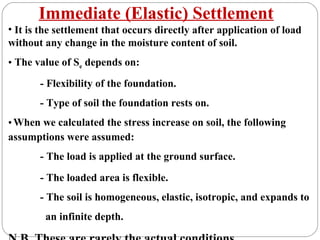
• It is the settlement that occurs directly after application of load
without any change in the moisture content of soil.
• The value of Se depends on:
- Flexibility of the foundation.
- Type of soil the foundation rests on.
•When we calculated the stress increase on soil, the following
assumptions were assumed:
- The load is applied at the ground surface.
- The loaded area is flexible.
- The soil is homogeneous, elastic, isotropic, and expands to
an infinite depth.
Immediate (Elastic) Settlement
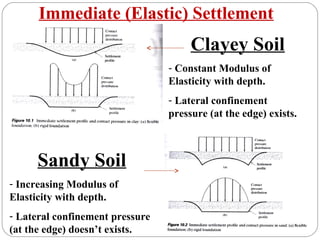
Sandy Soil
- Increasing Modulus of
Elasticity with depth.
- Lateral confinement pressure
(at the edge) doesn’t exists.
Clayey Soil
- Constant Modulus of
Elasticity with depth.
- Lateral confinement
pressure (at the edge) exists.
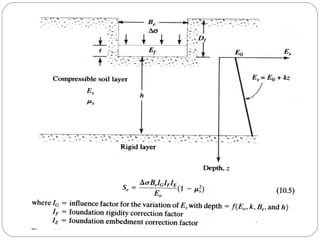
Calculations of Se
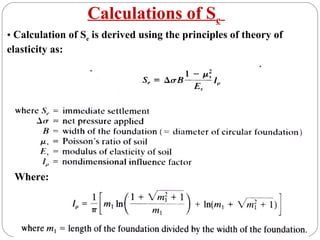
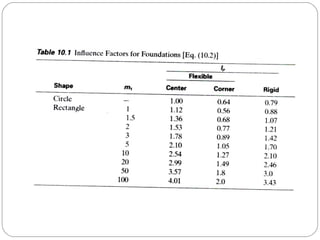
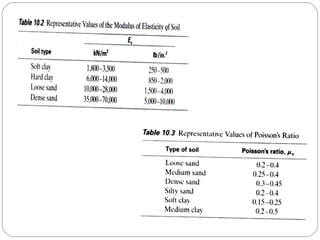
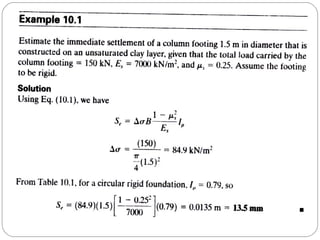
• Calculation of Se is derived using the principles of theory of
elasticity as:
Where:
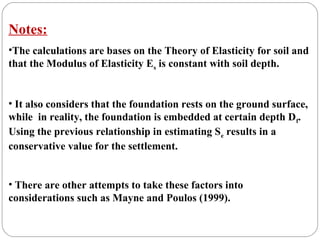
Notes:
•The calculations are bases on the Theory of Elasticity for soil and
that the Modulus of Elasticity Es is constant with soil depth.
• It also considers that the foundation rests on the ground surface,
while in reality, the foundation is embedded at certain depth Df.
Using the previous relationship in estimating Se results in a
conservative value for the settlement.
• There are other attempts to take these factors into
considerations such as Mayne and Poulos (1999).
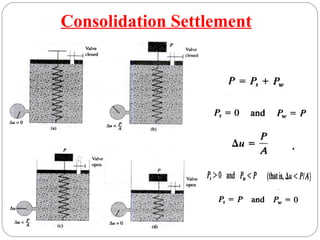
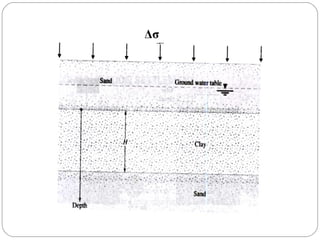
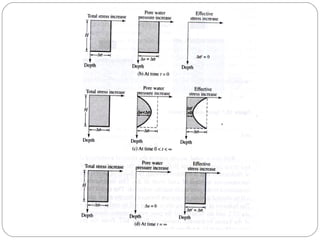
Consolidation Settlement
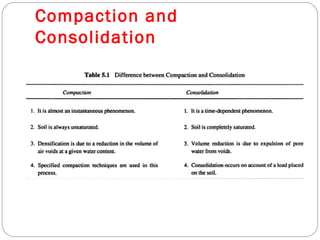
Compaction and
Consolidation
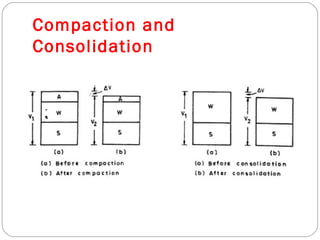
Compaction and
Consolidation
Consolidation Settlement
Δσ
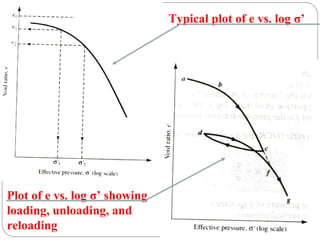
Typical plot of e vs. log σ’
Plot of e vs. log σ’ showing
loading, unloading, and
reloading
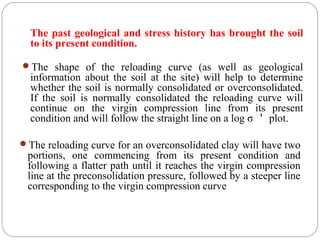
The past geological and stress history has brought the soil
to its present condition.
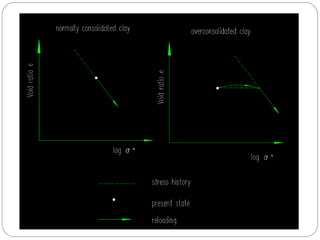
The shape of the reloading curve (as well as geological
information about the soil at the site) will help to determine
whether the soil is normally consolidated or overconsolidated.
If the soil is normally consolidated the reloading curve will
continue on the virgin compression line from its present
condition and will follow the straight line on a log σ ' plot.
The reloading curve for an overconsolidated clay will have two
portions, one commencing from its present condition and
following a flatter path until it reaches the virgin compression
line at the preconsolidation pressure, followed by a steeper line
corresponding to the virgin compression curve
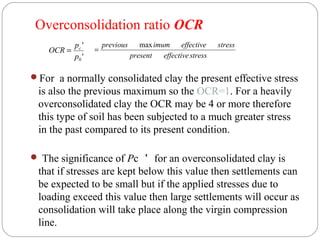
For a normally consolidated clay the present effective stress
is also the previous maximum so the OCR=1. For a heavily
overconsolidated clay the OCR may be 4 or more therefore
this type of soil has been subjected to a much greater stress
in the past compared to its present condition.
 The significance of Pc ' for an overconsolidated clay is
that if stresses are kept below this value then settlements can
be expected to be small but if the applied stresses due to
loading exceed this value then large settlements will occur as
consolidation will take place along the virgin compression
line.
'
'
0p
p
OCR c
=
stresseffectivepresent
stresseffectiveimumprevious max
=
Overconsolidation ratio OCR
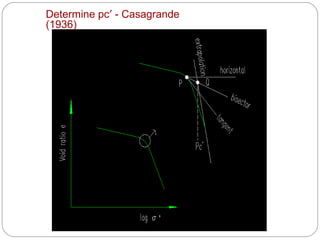
Determine pc′ - Casagrande
(1936)   
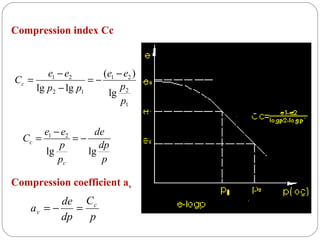
Compression index Cc
p
C
dp
de
a c
v =−=
p
dp
de
p
p
ee
C
c
c
lglg
21
−=
−
=
1
2
21
12
21
lg
)(
lglg
p
p
ee
pp
ee
Cc
−
−=
−
−
=
Compression coefficient av
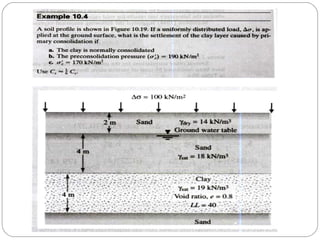
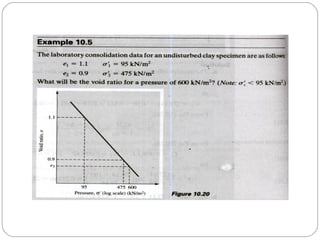
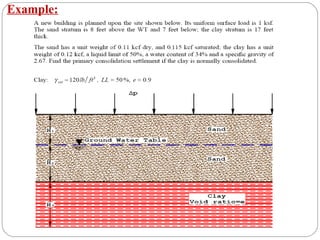
Example:
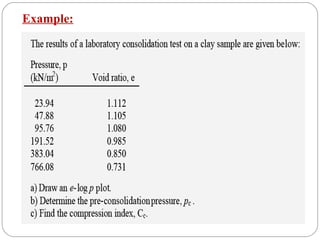
Example:

8 compressibility and consolidation

  • 1.
    Dr.Amit Srivastava, PhD,M.ASCE, LMIGS, LMISRMTT, MITS, MISSMGE,AMIE [B.E. University of Roorkee (now IIT Roorkee), M.E. & Ph.D, IISc, Bangalore] Assistant Professor (Senior Grade), Department of Civil Engineering Jaypee University of Engineering &Technology, Agra-Bombay Road, Raghogarh, District: Guna Madhya Pradesh - 473 226, India Mob.No. (+91)94797729, Home: 07544267030 Compressibility of soil and consolidation
  • 2.
    Compressibility of Soil Whenthe stress is increased on soil (Caused by the Construction of Foundation or Other Loads, Δσ), it causes Compression of Soil Layers. • The compression of soil layers leads to Soil Settlement and that is caused by: - Deformation of soil particles. -Relocation of soil particles. - Expulsion (flow out) of water or air from void spaces.
  • 4.
    Compressibility of Soil •The resulted total soil settlement (ST), under loading, may be divided into three main categories: a- Immediate (elastic) settlement (Se): caused by the elastic deformation of the dry, wet, or saturated soil particles without any change in the moisture content. b- Primary Consolidation Settlement (Sc): caused as a result of volume change in saturated cohesive soil due to the expulsion of water within void spaces. c- Secondary Consolidation Settlement (Ss): caused as a result of plastic deformation of soil particles. It is an additional form of compression that occurs at constant effective stress. S = S + S + S
  • 5.
    Compressibility of Soil Effectof soil type Role of effective stress Role of Stress history
  • 6.
    It can benoted that the problems in soil engineering related to volume change of soil have two questions that need answering – 1. How much is going to be the magnitude of volume change? 2. How long it will take for this change to manifest?
  • 7.
  • 8.
    Immediate (Elastic) Settlement •It is the settlement that occurs directly after application of load without any change in the moisture content of soil. • The value of Se depends on: - Flexibility of the foundation. - Type of soil the foundation rests on. •When we calculated the stress increase on soil, the following assumptions were assumed: - The load is applied at the ground surface. - The loaded area is flexible. - The soil is homogeneous, elastic, isotropic, and expands to an infinite depth.
  • 9.
    Immediate (Elastic) Settlement SandySoil - Increasing Modulus of Elasticity with depth. - Lateral confinement pressure (at the edge) doesn’t exists. Clayey Soil - Constant Modulus of Elasticity with depth. - Lateral confinement pressure (at the edge) exists.
  • 10.
    Calculations of Se •Calculation of Se is derived using the principles of theory of elasticity as: Where:
  • 14.
    Notes: •The calculations arebases on the Theory of Elasticity for soil and that the Modulus of Elasticity Es is constant with soil depth. • It also considers that the foundation rests on the ground surface, while in reality, the foundation is embedded at certain depth Df. Using the previous relationship in estimating Se results in a conservative value for the settlement. • There are other attempts to take these factors into considerations such as Mayne and Poulos (1999).
  • 16.
  • 17.
  • 18.
  • 19.
  • 20.
  • 22.
    Typical plot ofe vs. log σ’ Plot of e vs. log σ’ showing loading, unloading, and reloading
  • 23.
    The past geologicaland stress history has brought the soil to its present condition. The shape of the reloading curve (as well as geological information about the soil at the site) will help to determine whether the soil is normally consolidated or overconsolidated. If the soil is normally consolidated the reloading curve will continue on the virgin compression line from its present condition and will follow the straight line on a log σ ' plot. The reloading curve for an overconsolidated clay will have two portions, one commencing from its present condition and following a flatter path until it reaches the virgin compression line at the preconsolidation pressure, followed by a steeper line corresponding to the virgin compression curve
  • 25.
    For a normallyconsolidated clay the present effective stress is also the previous maximum so the OCR=1. For a heavily overconsolidated clay the OCR may be 4 or more therefore this type of soil has been subjected to a much greater stress in the past compared to its present condition.  The significance of Pc ' for an overconsolidated clay is that if stresses are kept below this value then settlements can be expected to be small but if the applied stresses due to loading exceed this value then large settlements will occur as consolidation will take place along the virgin compression line. ' ' 0p p OCR c = stresseffectivepresent stresseffectiveimumprevious max = Overconsolidation ratio OCR
  • 26.
    Determine pc′ -Casagrande (1936)   
  • 27.
    Compression index Cc p C dp de ac v =−= p dp de p p ee C c c lglg 21 −= − = 1 2 21 12 21 lg )( lglg p p ee pp ee Cc − −= − − = Compression coefficient av
  • 34.
  • 35.