Ahmed Zeeneldin
Associate professor of Medical Oncology
• US:
  • In 2012: 11,280 new cases and 3,900 mortalities
  • adults: 1%, pediatrics: 15%
• Egypt:
  • GPBCR: adults: 2.5%, pediatrics: 10%
  • NCI: adults: 2.8%, pediatrics: 10%
• RT is a risk factor
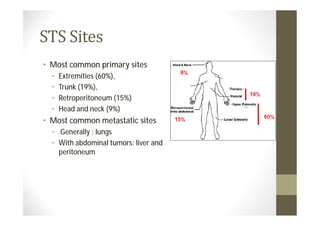
• Most common primary sites
  •   Extremities (60%),
  •   Trunk (19%),
  •   Retroperitoneum (15%)
  •   Head and neck (9%)
• Most common metastatic sites
  • Generally : lungs
  • With abdominal tumors: liver and
    peritoneum
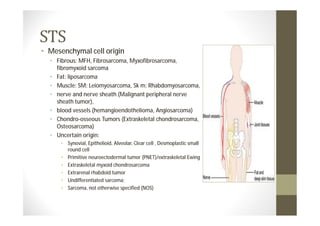
• Mesenchymal cell origin
  • Fibrous: MFH, Fibrosarcoma, Myxofibrosarcoma,
    fibromyxoid sarcoma
  • Fat: liposarcoma
  • Muscle: SM: Leiomyosarcoma, Sk m: Rhabdomyosarcoma,
  • nerve and nerve sheath (Malignant peripheral nerve
    sheath tumor),
  • blood vessels (hemangioendothelioma, Angiosarcoma)
  • Chondro-osseous Tumors (Extraskeletal chondrosarcoma,
    Osteosarcoma)
  • Uncertain origin:
      • Synovial, Epithelioid, Alveolar, Clear cell , Desmoplastic small
        round cell
      • Primitive neuroectodermal tumor (PNET)/extraskeletal Ewing
      • Extraskeletal myxoid chondrosarcoma
      • Extrarenal rhabdoid tumor
      • Undifferentiated sarcoma;
      • Sarcoma, not otherwise specified (NOS)
Most common subtypes of STS
• In children:
  • Rhabdomyosarcoma
• in adults
  •   Pleomorphic sarcoma (MFH),
  •   GIST,
  •   liposarcoma,
  •   leiomyosarcoma,
  •   synovial sarcoma,
  •   malignant peripheral nerve sheath tumors
Molecular Diagnosis of STS
• (i) sarcomas with specific genetic alterations and usually
  simple karyotypes (eg, chromosomal translocations or point
  mutations); and
• (ii) sarcomas with non-specific genetic alterations and
  complex unbalanced karyotypes.
• Methods:
  • Conventional cytogenetic analysis,
  • Fluorescence in-situ hybridization (FISH) and
  • Polymerase chain reaction (PCR)
• EWSR1-ATF1 in clear cell sarcoma,
• TLS-CHOP (also known as FUS-DDIT3) in myxoid or round cell
  liposarcoma,
• SS18-SSX (SS18-SSX1 or SS18-SSX2) in synovial sarcoma, and
• PAX-FOXO1 (PAX3-FOXO1 or PAX7-FOXO1) in alveolar
  rhabdomyosarcoma].
Evaluation and Workup
• H&P: for DD
• Lab: limited role
• Bx:
  • core or open biopsies by experienced members.
  • FNA is generally inadequate
• Radiology:
  • Local:
      • MRI: most important particularly in extremity STS
      • CT: most important particularly in retroperitoneal STS
      • Plain XR: optional
  • Possible metastatic sites:
      • CT Chest: in all cases
      • CT Abdomen and pelvis: myxoid round cell liposarcoma, angiosarcoma, leiomyosarcoma or
        epithelioid sarcoma
      • MRI spine: myxoid round cell liposarcomas
      • CT/MRI brain Alveolar soft part sarcoma (ASPS)
  • Local and Metastatic sites:
      • PET or PET/CT
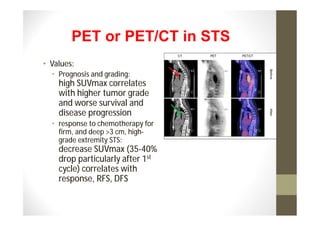
PET or PET/CT in STS
• Values:
  • Prognosis and grading:
    high SUVmax correlates
    with higher tumor grade
    and worse survival and
    disease progression
  • response to chemotherapy for
    firm, and deep >3 cm, high-
    grade extremity STS:
    decrease SUVmax (35-40%
    drop particularly after 1st
    cycle) correlates with
    response, RFS, DFS
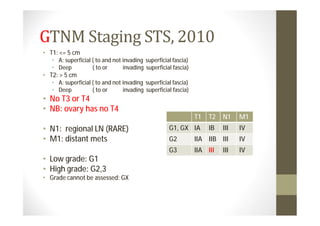
• T1: <= 5 cm
   • A: superficial ( to and not invading superficial fascia)
   • Deep           ( to or      invading superficial fascia)
• T2: > 5 cm
   • A: superficial ( to and not invading superficial fascia)
   • Deep           ( to or      invading superficial fascia)
• No T3 or T4
• NB: ovary has no T4
                                                                T1   T2   N1    M1
• N1: regional LN (RARE)                            G1, GX IA        IB   III   IV
• M1: distant mets                                  G2          IIA IIB III     IV
                                                    G3          IIA III   III   IV
• Low grade: G1
• High grade: G2,3
• Grade cannot be assessed: GX
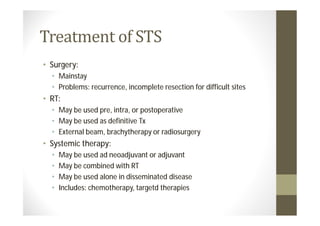
• Surgery:
  • Mainstay
  • Problems: recurrence, incomplete resection for difficult sites
• RT:
  • May be used pre, intra, or postoperative
  • May be used as definitive Tx
  • External beam, brachytherapy or radiosurgery
• Systemic therapy:
  •   May be used ad neoadjuvant or adjuvant
  •   May be combined with RT
  •   May be used alone in disseminated disease
  •   Includes: chemotherapy, targetd therapies
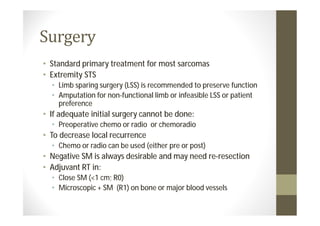
• Standard primary treatment for most sarcomas
• Extremity STS
  • Limb sparing surgery (LSS) is recommended to preserve function
  • Amputation for non-functional limb or infeasible LSS or patient
    preference
• If adequate initial surgery cannot be done:
  • Preoperative chemo or radio or chemoradio
• To decrease local recurrence
  • Chemo or radio can be used (either pre or post)
• Negative SM is always desirable and may need re-resection
• Adjuvant RT in:
  • Close SM (<1 cm; R0)
  • Microscopic + SM (R1) on bone or major blood vessels
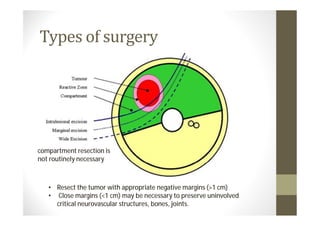
compartment resection is
not routinely necessary


   • Resect the tumor with appropriate negative margins (>1 cm)
   • Close margins (<1 cm) may be necessary to preserve uninvolved
     critical neurovascular structures, bones, joints.
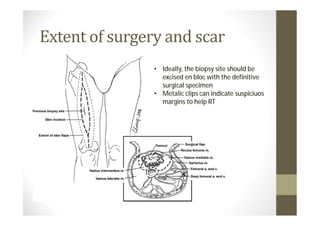
• Ideally, the biopsy site should be
  excised en bloc with the definitive
  surgical specimen
• Metalic clips can indicate suspiciuos
  margins to help RT
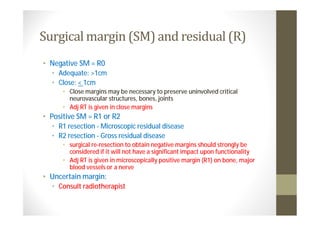
Surgical margin (SM) and residual (R)
• Negative SM = R0
  • Adequate: >1cm
  • Close: < 1cm
      • Close margins may be necessary to preserve uninvolved critical
        neurovascular structures, bones, joints
      • Adj RT is given in close margins
• Positive SM = R1 or R2
  • R1 resection - Microscopic residual disease
  • R2 resection - Gross residual disease
      • surgical re-resection to obtain negative margins should strongly be
        considered if it will not have a significant impact upon functionality
      • Adj RT is given in microscopically positive margin (R1) on bone, major
        blood vessels or a nerve
• Uncertain margin:
  • Consult radiotherapist
• Because the risk of failure in the
  surgical bed can be high, Many
  clinicians augment surgery with
  RT and chemotherapy, either
  preoperatively or postoperatively,
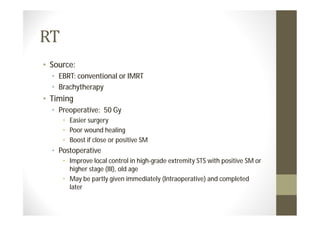
• Source:
  • EBRT: conventional or IMRT
  • Brachytherapy
• Timing
  • Preoperative: 50 Gy
     • Easier surgery
     • Poor wound healing
     • Boost if close or positive SM
  • Postoperative
     • Improve local control in high-grade extremity STS with positive SM or
       higher stage (III), old age
     • May be partly given immediately (Intraoperative) and completed
       later
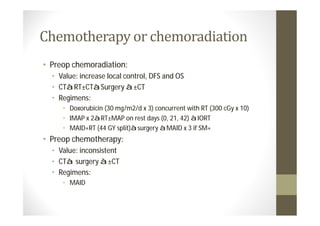
Chemotherapy or chemoradiation
• Preop chemoradiation:
  • Value: increase local control, DFS and OS
  • CTàRT±CTàSurgery à±CT
  • Regimens:
     • Doxorubicin (30 mg/m2/d x 3) concurrent with RT (300 cGy x 10)
     • IMAP x 2àRT±MAP on rest days (0, 21, 42) àIORT
     • MAID+RT (44 GY split)àsurgery àMAID x 3 if SM+
• Preop chemotherapy:
  • Value: inconsistent
  • CTà surgery à±CT
  • Regimens:
     • MAID
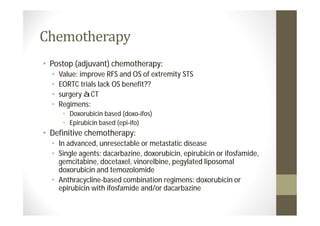
Chemotherapy
• Postop (adjuvant) chemotherapy:
  •   Value: improve RFS and OS of extremity STS
  •   EORTC trials lack OS benefit??
  •   surgery àCT
  •   Regimens:
       • Doxorubicin based (doxo-ifos)
       • Epirubicin based (epi-ifo)
• Definitive chemotherapy:
  • In advanced, unresectable or metastatic disease
  • Single agents: dacarbazine, doxorubicin, epirubicin or ifosfamide,
    gemcitabine, docetaxel, vinorelbine, pegylated liposomal
    doxorubicin and temozolomide
  • Anthracycline-based combination regimens: doxorubicin or
    epirubicin with ifosfamide and/or dacarbazine
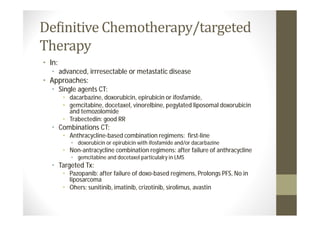
Definitive Chemotherapy/targeted
Therapy
• In:
   • advanced, irrresectable or metastatic disease
• Approaches:
   • Single agents CT:
        • dacarbazine, doxorubicin, epirubicin or ifosfamide,
        • gemcitabine, docetaxel, vinorelbine, pegylated liposomal doxorubicin
          and temozolomide
        • Trabectedin: good RR
   • Combinations CT:
        • Anthracycline-based combination regimens: first-line
           • doxorubicin or epirubicin with ifosfamide and/or dacarbazine
        • Non-antracycline combination regimens: after failure of anthracycline
           • gemcitabine and docetaxel particulalry in LMS
   • Targeted Tx:
        • Pazopanib: after failure of doxo-based regimens, Prolongs PFS, No in
          liposarcoma
        • Ohers: sunitinib, imatinib, crizotinib, sirolimus, avastin
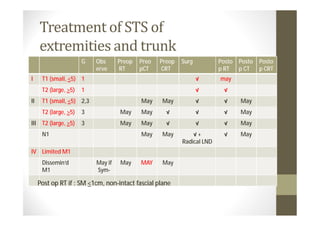
Treatment of STS of
     extremities and trunk
                       G   Obs      Preop   Preo   Preop   Surg          Posto   Posto   Posto
                           erve     RT      pCT    CRT                   p RT    p CT    p CRT
I     T1 (small, <5) 1                                            √      may
      T2 (large, >5)   1                                          √        √
II    T1 (small, <5) 2,3                    May    May            √        √     May
      T2 (large, >5)   3            May     May      √            √        √     May
III T2 (large, >5)     3            May     May      √            √        √     May
      N1                                    May    May         √+          √     May
                                                           Radical LND
IV Limited M1
      Dissemin’d           May if   May     MAY    May
      M1                   Sym-

     Post op RT if : SM <1cm, non-intact fascial plane
Treatment of STS of
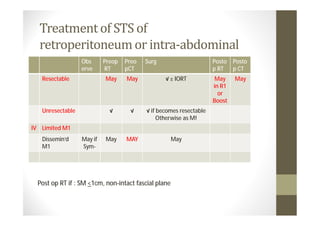
  retroperitoneum or intra-abdominal
                  Obs      Preop   Preo   Surg                      Posto   Posto
                  erve     RT      pCT                              p RT    p CT
   Resectable              May     May           √ ± IORT            May    May
                                                                    in R1
                                                                      or
                                                                    Boost
   Unresectable              √       √    √ if becomes resectable
                                               Otherwise as M!
IV Limited M1
   Dissemin’d     May if   May     MAY                May
   M1             Sym-


  Post op RT if : SM <1cm, non-intact fascial plane
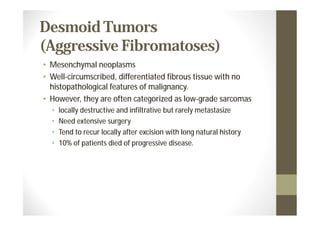
Desmoid Tumors
(Aggressive Fibromatoses)
• Mesenchymal neoplasms
• Well-circumscribed, differentiated fibrous tissue with no
  histopathological features of malignancy.
• However, they are often categorized as low-grade sarcomas
  •   locally destructive and infiltrative but rarely metastasize
  •   Need extensive surgery
  •   Tend to recur locally after excision with long natural history
  •   10% of patients died of progressive disease.
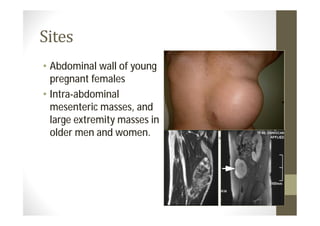
• Abdominal wall of young
  pregnant females
• Intra-abdominal
  mesenteric masses, and
  large extremity masses in
  older men and women.
• Component of the familial adenomatous polyposis (FAP)
• may also arise through elective surgical intervention (eg,
  colectomy) in susceptible patients.
• 85% have mutations in exon 3 of CTNNB1 gene encoding for β
  catenin AND this was associated with more recurrences
Evaluation and Workup
• H& P
• Exclude Gardner’s syndrome
• Imaging:
  • Local: CT or MRI
  • Chest
• Biopsy
Resectable Tumors                  Irresectable Tumors
• Observation:                     • Observation
  • small size, asymptomatic,      • Definitive RT (54-58 Gy)
    favorable sites                  • No prior RT only
                                     • In extremity, head and neck or
• Surgery:                             superficial trunk
  • Mainstay                         • Not in retroperitoneal/intra-
                                       abdominal
  • Large size, symptomatic,         • very slow response (~2ys)
    unfavorable sites              • Systemic therapies:
  • Preop RT or systemic therapy     • NSAIDS
    may be given                     • Hormonal therapies
  • Postop RT if large tumors or     • Biologic therapies
    SM+ (R1)                       • Surgery
                                     • Radical surgery if the above fails
Systemic treatment of desmoids
• Indications:
  • advanced or unresectable desmoids
• Agents
  • NSAIDS: sulindac or celecoxib
  • Hormonal: tamoxifen, toremifene
  • Biological agents: low-dose interferon
  • Chemotherapy: methotrexate and vinblastine, doxorubicin-based
    regimens
  • tyrosine kinase inhibitors: imatinib and sorafenib
Rhabdomyosarcoma (RMS)
• histologic subtypes:
  • Embryonal: children
  • Alveolar: adolescents
  • Pleomorphic: adults and aggressive
     •   extremities (26%)
     •   trunk (23%)
     •   genitourinary tract (17%) and
     •   head and neck (9%)
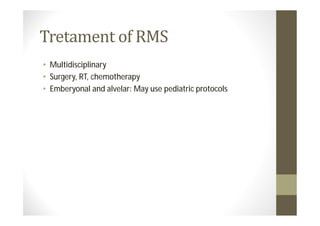
• Multidisciplinary
• Surgery, RT, chemotherapy
• Emberyonal and alvelar: May use pediatric protocols
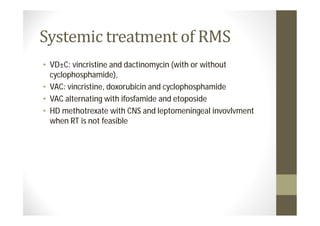
• VD±C: vincristine and dactinomycin (with or without
  cyclophosphamide),
• VAC: vincristine, doxorubicin and cyclophosphamide
• VAC alternating with ifosfamide and etoposide
• HD methotrexate with CNS and leptomeningeal invovlvment
  when RT is not feasible
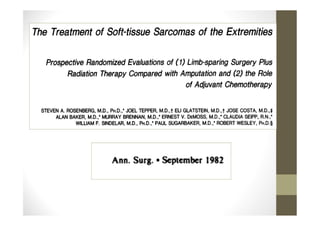
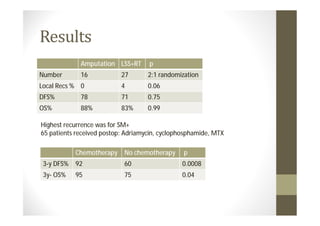
Amputation LSS+RT      p
Number       16            27       2:1 randomization
Local Recs % 0             4        0.06
DFS%         78            71       0.75
OS%          88%           83%      0.99

Highest recurrence was for SM+
65 patients received postop: Adriamycin, cyclophosphamide, MTX

            Chemotherapy    No chemotherapy     p
 3-y DFS%   92              60                 0.0008
 3y- OS%    95              75                 0.04

Soft tissue sarcoma (sts)

  • 1.
  • 2.
    • US: • In 2012: 11,280 new cases and 3,900 mortalities • adults: 1%, pediatrics: 15% • Egypt: • GPBCR: adults: 2.5%, pediatrics: 10% • NCI: adults: 2.8%, pediatrics: 10% • RT is a risk factor
  • 3.
    • Most commonprimary sites • Extremities (60%), • Trunk (19%), • Retroperitoneum (15%) • Head and neck (9%) • Most common metastatic sites • Generally : lungs • With abdominal tumors: liver and peritoneum
  • 4.
    • Mesenchymal cellorigin • Fibrous: MFH, Fibrosarcoma, Myxofibrosarcoma, fibromyxoid sarcoma • Fat: liposarcoma • Muscle: SM: Leiomyosarcoma, Sk m: Rhabdomyosarcoma, • nerve and nerve sheath (Malignant peripheral nerve sheath tumor), • blood vessels (hemangioendothelioma, Angiosarcoma) • Chondro-osseous Tumors (Extraskeletal chondrosarcoma, Osteosarcoma) • Uncertain origin: • Synovial, Epithelioid, Alveolar, Clear cell , Desmoplastic small round cell • Primitive neuroectodermal tumor (PNET)/extraskeletal Ewing • Extraskeletal myxoid chondrosarcoma • Extrarenal rhabdoid tumor • Undifferentiated sarcoma; • Sarcoma, not otherwise specified (NOS)
  • 5.
    Most common subtypesof STS • In children: • Rhabdomyosarcoma • in adults • Pleomorphic sarcoma (MFH), • GIST, • liposarcoma, • leiomyosarcoma, • synovial sarcoma, • malignant peripheral nerve sheath tumors
  • 6.
    Molecular Diagnosis ofSTS • (i) sarcomas with specific genetic alterations and usually simple karyotypes (eg, chromosomal translocations or point mutations); and • (ii) sarcomas with non-specific genetic alterations and complex unbalanced karyotypes. • Methods: • Conventional cytogenetic analysis, • Fluorescence in-situ hybridization (FISH) and • Polymerase chain reaction (PCR)
  • 7.
    • EWSR1-ATF1 inclear cell sarcoma, • TLS-CHOP (also known as FUS-DDIT3) in myxoid or round cell liposarcoma, • SS18-SSX (SS18-SSX1 or SS18-SSX2) in synovial sarcoma, and • PAX-FOXO1 (PAX3-FOXO1 or PAX7-FOXO1) in alveolar rhabdomyosarcoma].
  • 8.
    Evaluation and Workup •H&P: for DD • Lab: limited role • Bx: • core or open biopsies by experienced members. • FNA is generally inadequate • Radiology: • Local: • MRI: most important particularly in extremity STS • CT: most important particularly in retroperitoneal STS • Plain XR: optional • Possible metastatic sites: • CT Chest: in all cases • CT Abdomen and pelvis: myxoid round cell liposarcoma, angiosarcoma, leiomyosarcoma or epithelioid sarcoma • MRI spine: myxoid round cell liposarcomas • CT/MRI brain Alveolar soft part sarcoma (ASPS) • Local and Metastatic sites: • PET or PET/CT
  • 9.
    PET or PET/CTin STS • Values: • Prognosis and grading: high SUVmax correlates with higher tumor grade and worse survival and disease progression • response to chemotherapy for firm, and deep >3 cm, high- grade extremity STS: decrease SUVmax (35-40% drop particularly after 1st cycle) correlates with response, RFS, DFS
  • 10.
    • T1: <=5 cm • A: superficial ( to and not invading superficial fascia) • Deep ( to or invading superficial fascia) • T2: > 5 cm • A: superficial ( to and not invading superficial fascia) • Deep ( to or invading superficial fascia) • No T3 or T4 • NB: ovary has no T4 T1 T2 N1 M1 • N1: regional LN (RARE) G1, GX IA IB III IV • M1: distant mets G2 IIA IIB III IV G3 IIA III III IV • Low grade: G1 • High grade: G2,3 • Grade cannot be assessed: GX
  • 11.
    • Surgery: • Mainstay • Problems: recurrence, incomplete resection for difficult sites • RT: • May be used pre, intra, or postoperative • May be used as definitive Tx • External beam, brachytherapy or radiosurgery • Systemic therapy: • May be used ad neoadjuvant or adjuvant • May be combined with RT • May be used alone in disseminated disease • Includes: chemotherapy, targetd therapies
  • 12.
    • Standard primarytreatment for most sarcomas • Extremity STS • Limb sparing surgery (LSS) is recommended to preserve function • Amputation for non-functional limb or infeasible LSS or patient preference • If adequate initial surgery cannot be done: • Preoperative chemo or radio or chemoradio • To decrease local recurrence • Chemo or radio can be used (either pre or post) • Negative SM is always desirable and may need re-resection • Adjuvant RT in: • Close SM (<1 cm; R0) • Microscopic + SM (R1) on bone or major blood vessels
  • 13.
    compartment resection is notroutinely necessary • Resect the tumor with appropriate negative margins (>1 cm) • Close margins (<1 cm) may be necessary to preserve uninvolved critical neurovascular structures, bones, joints.
  • 14.
    • Ideally, thebiopsy site should be excised en bloc with the definitive surgical specimen • Metalic clips can indicate suspiciuos margins to help RT
  • 15.
    Surgical margin (SM)and residual (R) • Negative SM = R0 • Adequate: >1cm • Close: < 1cm • Close margins may be necessary to preserve uninvolved critical neurovascular structures, bones, joints • Adj RT is given in close margins • Positive SM = R1 or R2 • R1 resection - Microscopic residual disease • R2 resection - Gross residual disease • surgical re-resection to obtain negative margins should strongly be considered if it will not have a significant impact upon functionality • Adj RT is given in microscopically positive margin (R1) on bone, major blood vessels or a nerve • Uncertain margin: • Consult radiotherapist
  • 16.
    • Because therisk of failure in the surgical bed can be high, Many clinicians augment surgery with RT and chemotherapy, either preoperatively or postoperatively,
  • 17.
    • Source: • EBRT: conventional or IMRT • Brachytherapy • Timing • Preoperative: 50 Gy • Easier surgery • Poor wound healing • Boost if close or positive SM • Postoperative • Improve local control in high-grade extremity STS with positive SM or higher stage (III), old age • May be partly given immediately (Intraoperative) and completed later
  • 18.
    Chemotherapy or chemoradiation •Preop chemoradiation: • Value: increase local control, DFS and OS • CTàRT±CTàSurgery à±CT • Regimens: • Doxorubicin (30 mg/m2/d x 3) concurrent with RT (300 cGy x 10) • IMAP x 2àRT±MAP on rest days (0, 21, 42) àIORT • MAID+RT (44 GY split)àsurgery àMAID x 3 if SM+ • Preop chemotherapy: • Value: inconsistent • CTà surgery à±CT • Regimens: • MAID
  • 19.
    Chemotherapy • Postop (adjuvant)chemotherapy: • Value: improve RFS and OS of extremity STS • EORTC trials lack OS benefit?? • surgery àCT • Regimens: • Doxorubicin based (doxo-ifos) • Epirubicin based (epi-ifo) • Definitive chemotherapy: • In advanced, unresectable or metastatic disease • Single agents: dacarbazine, doxorubicin, epirubicin or ifosfamide, gemcitabine, docetaxel, vinorelbine, pegylated liposomal doxorubicin and temozolomide • Anthracycline-based combination regimens: doxorubicin or epirubicin with ifosfamide and/or dacarbazine
  • 20.
    Definitive Chemotherapy/targeted Therapy • In: • advanced, irrresectable or metastatic disease • Approaches: • Single agents CT: • dacarbazine, doxorubicin, epirubicin or ifosfamide, • gemcitabine, docetaxel, vinorelbine, pegylated liposomal doxorubicin and temozolomide • Trabectedin: good RR • Combinations CT: • Anthracycline-based combination regimens: first-line • doxorubicin or epirubicin with ifosfamide and/or dacarbazine • Non-antracycline combination regimens: after failure of anthracycline • gemcitabine and docetaxel particulalry in LMS • Targeted Tx: • Pazopanib: after failure of doxo-based regimens, Prolongs PFS, No in liposarcoma • Ohers: sunitinib, imatinib, crizotinib, sirolimus, avastin
  • 21.
    Treatment of STSof extremities and trunk G Obs Preop Preo Preop Surg Posto Posto Posto erve RT pCT CRT p RT p CT p CRT I T1 (small, <5) 1 √ may T2 (large, >5) 1 √ √ II T1 (small, <5) 2,3 May May √ √ May T2 (large, >5) 3 May May √ √ √ May III T2 (large, >5) 3 May May √ √ √ May N1 May May √+ √ May Radical LND IV Limited M1 Dissemin’d May if May MAY May M1 Sym- Post op RT if : SM <1cm, non-intact fascial plane
  • 22.
    Treatment of STSof retroperitoneum or intra-abdominal Obs Preop Preo Surg Posto Posto erve RT pCT p RT p CT Resectable May May √ ± IORT May May in R1 or Boost Unresectable √ √ √ if becomes resectable Otherwise as M! IV Limited M1 Dissemin’d May if May MAY May M1 Sym- Post op RT if : SM <1cm, non-intact fascial plane
  • 23.
    Desmoid Tumors (Aggressive Fibromatoses) •Mesenchymal neoplasms • Well-circumscribed, differentiated fibrous tissue with no histopathological features of malignancy. • However, they are often categorized as low-grade sarcomas • locally destructive and infiltrative but rarely metastasize • Need extensive surgery • Tend to recur locally after excision with long natural history • 10% of patients died of progressive disease.
  • 24.
    • Abdominal wallof young pregnant females • Intra-abdominal mesenteric masses, and large extremity masses in older men and women.
  • 25.
    • Component ofthe familial adenomatous polyposis (FAP) • may also arise through elective surgical intervention (eg, colectomy) in susceptible patients. • 85% have mutations in exon 3 of CTNNB1 gene encoding for β catenin AND this was associated with more recurrences
  • 26.
    Evaluation and Workup •H& P • Exclude Gardner’s syndrome • Imaging: • Local: CT or MRI • Chest • Biopsy
  • 27.
    Resectable Tumors Irresectable Tumors • Observation: • Observation • small size, asymptomatic, • Definitive RT (54-58 Gy) favorable sites • No prior RT only • In extremity, head and neck or • Surgery: superficial trunk • Mainstay • Not in retroperitoneal/intra- abdominal • Large size, symptomatic, • very slow response (~2ys) unfavorable sites • Systemic therapies: • Preop RT or systemic therapy • NSAIDS may be given • Hormonal therapies • Postop RT if large tumors or • Biologic therapies SM+ (R1) • Surgery • Radical surgery if the above fails
  • 28.
    Systemic treatment ofdesmoids • Indications: • advanced or unresectable desmoids • Agents • NSAIDS: sulindac or celecoxib • Hormonal: tamoxifen, toremifene • Biological agents: low-dose interferon • Chemotherapy: methotrexate and vinblastine, doxorubicin-based regimens • tyrosine kinase inhibitors: imatinib and sorafenib
  • 29.
    Rhabdomyosarcoma (RMS) • histologicsubtypes: • Embryonal: children • Alveolar: adolescents • Pleomorphic: adults and aggressive • extremities (26%) • trunk (23%) • genitourinary tract (17%) and • head and neck (9%)
  • 30.
    • Multidisciplinary • Surgery,RT, chemotherapy • Emberyonal and alvelar: May use pediatric protocols
  • 31.
    • VD±C: vincristineand dactinomycin (with or without cyclophosphamide), • VAC: vincristine, doxorubicin and cyclophosphamide • VAC alternating with ifosfamide and etoposide • HD methotrexate with CNS and leptomeningeal invovlvment when RT is not feasible
  • 34.
    Amputation LSS+RT p Number 16 27 2:1 randomization Local Recs % 0 4 0.06 DFS% 78 71 0.75 OS% 88% 83% 0.99 Highest recurrence was for SM+ 65 patients received postop: Adriamycin, cyclophosphamide, MTX Chemotherapy No chemotherapy p 3-y DFS% 92 60 0.0008 3y- OS% 95 75 0.04