Ewing’s Sarcoma
Management
Parag roy
Dept of radiotherapy
Lok nayak hopital
Introduction
• Identified in 1921 by James Ewing
• Ewing’s Sarcoma Family of tumors:
• Ewing’s sarcoma (Bone –87%)
• Extraosseous Ewing’s sarcoma (8%)
• Peripheral PNET(5%)
• Askin’s tumor
2
Cytogenetics
• Consistent cytogenetic abnormality, t(11;22)(q24;q12) present in 90-95% resultant fusion
gene is EWS/FLI-1
• Also seen:
• t(21;22)(q22;q12) 5-10% EWS/ERG
• t(7;22) and t(17;22) the remainder EWS/ETV1 and EWS/E1AF respectively
• t(1;16)(q21;q13) present along with t(11;22)
• The c-myc protooncogene is frequently expressed in Ewing’s.
• CD 99 ( MIC2)
• PAS +ve
3
Routes of spread
• Direct extension into adjacent bone or soft tissue.
• Metastases generally spread through bloodstream
• 25% present with metastatic disease
• Lungs (38%)
• Bone (31%)
• Bone Marrow (11%)
• Nearly all pts. have micromets at diagnosis, so all Need chemo.
4
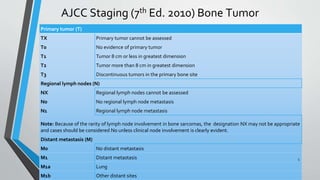
Primary tumor (T)
TX Primary tumor cannot be assessed
T0 No evidence of primary tumor
T1 Tumor 8 cm or less in greatest dimension
T2 Tumor more than 8 cm in greatest dimension
T3 Discontinuous tumors in the primary bone site
Regional lymph nodes (N)
NX Regional lymph nodes cannot be assessed
N0 No regional lymph node metastasis
N1 Regional lymph node metastasis
Note: Because of the rarity of lymph node involvement in bone sarcomas, the designation NX may not be appropriate
and cases should be considered N0 unless clinical node involvement is clearly evident.
Distant metastasis (M)
M0 No distant metastasis
M1 Distant metastasis
M1a Lung
M1b Other distant sites
AJCC Staging (7th Ed. 2010) Bone Tumor
5
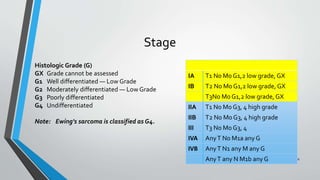
IA T1 N0 M0 G1,2 low grade, GX
IB T2 N0 M0 G1,2 low grade, GX
T3N0 M0 G1,2 low grade, GX
IIA T1 N0 M0 G3, 4 high grade
IIB T2 N0 M0 G3, 4 high grade
III T3 N0 M0 G3, 4
IVA AnyT N0 M1a any G
IVB AnyT N1 any M any G
AnyT any N M1b any G
Stage
Histologic Grade (G)
GX Grade cannot be assessed
G1 Well differentiated — Low Grade
G2 Moderately differentiated — Low Grade
G3 Poorly differentiated
G4 Undifferentiated
Note: Ewing's sarcoma is classified as G4.
6
7
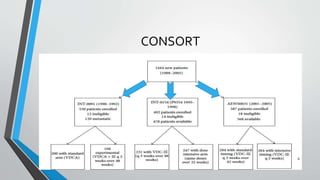
CONSORT
8
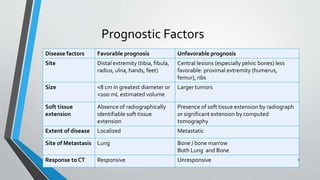
Disease factors Favorable prognosis Unfavorable prognosis
Site Distal extremity (tibia, fibula,
radius, ulna, hands, feet)
Central lesions (especially pelvic bones) less
favorable: proximal extremity (humerus,
femur), ribs
Size <8 cm in greatest diameter or
<200 mL estimated volume
Larger tumors
Soft tissue
extension
Absence of radiographically
identifiable soft tissue
extension
Presence of soft tissue extension by radiograph
or significant extension by computed
tomography
Extent of disease Localized Metastatic
Site of Metastasis Lung Bone / bone marrow
Both Lung and Bone
Response to CT Responsive Unresponsive
Prognostic Factors
9
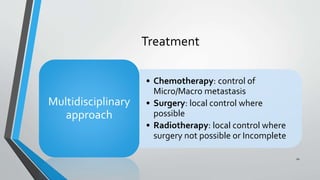
Treatment
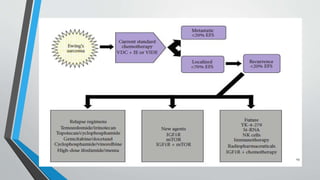
• Chemotherapy: control of
Micro/Macro metastasis
• Surgery: local control where
possible
• Radiotherapy: local control where
surgery not possible or Incomplete
Multidisciplinary
approach
10
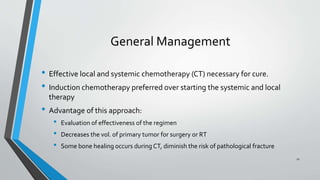
General Management
• Effective local and systemic chemotherapy (CT) necessary for cure.
• Induction chemotherapy preferred over starting the systemic and local
therapy
• Advantage of this approach:
• Evaluation of effectiveness of the regimen
• Decreases the vol. of primary tumor for surgery or RT
• Some bone healing occurs during CT, diminish the risk of pathological fracture
11
Induction
Chemotherapy
Local Control
• Surgery
• Radiotherapy
Maintenance
• Chemotherapy
12
13
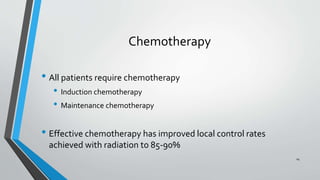
Chemotherapy
Chemotherapy
• All patients require chemotherapy
• Induction chemotherapy
• Maintenance chemotherapy
• Effective chemotherapy has improved local control rates
achieved with radiation to 85-90%
14
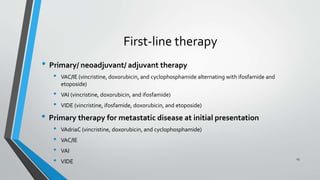
First-line therapy
• Primary/ neoadjuvant/ adjuvant therapy
• VAC/IE (vincristine, doxorubicin, and cyclophosphamide alternating with ifosfamide and
etoposide)
• VAI (vincristine, doxorubicin, and ifosfamide)
• VIDE (vincristine, ifosfamide, doxorubicin, and etoposide)
• Primary therapy for metastatic disease at initial presentation
• VAdriaC (vincristine, doxorubicin, and cyclophosphamide)
• VAC/IE
• VAI
• VIDE
15
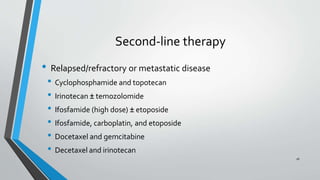
Second-line therapy
• Relapsed/refractory or metastatic disease
• Cyclophosphamide and topotecan
• Irinotecan ± temozolomide
• Ifosfamide (high dose) ± etoposide
• Ifosfamide, carboplatin, and etoposide
• Docetaxel and gemcitabine
• Decetaxel and irinotecan
16
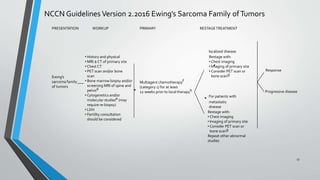
NCCN Guidelines Version 2.2016 Ewing’s Sarcoma Family ofTumors
PRESENTATION WORKUP PRIMARY RESTAGETREATMENT
Ewing’s
sarcoma family
of tumors
• History and physical
•MRI ± CT of primary site
•Chest CT
• PET scan and/or bone
scan
• Bone marrow biopsy and/or
screening MRI of spine and
pelvisd
• Cytogenetics and/or
molecular studiese (may
require re-biopsy)
•LDH
• Fertility consultation
should be considered
Multiagent chemotherapyf
(category 1) for at least
12 weeks prior to local therapyh
localized disease
Restage with:
• Chest imaging
• Imaging of primary site
• Consider PET scan or
bone scang
For patients with
metastatic
disease
Restage with:
• Chest imaging
• Imaging of primary site
• Consider PET scan or
bone scang
Repeat other abnormal
studies
Response
Progressive disease
17
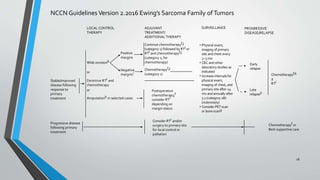
NCCN Guidelines Version 2.2016 Ewing’s Sarcoma Family ofTumors
Stable/improved
disease following
response to
primary
treatment
Progressive disease
following primary
treatment
LOCAL CONTROL
THERAPY
Wide excisionb
or
Deinitive RTl and
chemotherapy
or
Amputationb in selected cases
Positive
margins
Negative
marginsi
ADJUVANT
TREATMENT/
ADDITIONAL THERAPY
Continue chemotherapyf,j
(category 1) followed by RTl or
RTl and chemotherapyf,j
(category 1, for
chemotherapy)
Chemotherapyf,j
(category 1)
Postoperative
chemotherapy,f
consider RTl
depending on
margin status
SURVEILLANCE
• Physical exam,
imaging ofprimary
site andchest every
2–3 mo
• CBC and other
laboratory studies as
indicated
• Increase intervalsfor
physical exam,
imaging of chest, and
primary site after 24
mo andannually after
5 y (category 2B)
(indeinitely)
• Consider PET scan
or bone scang
PROGRESSIVE
DISEASE/RELAPSE
Early
relapse
Late
relapsek
Chemotherapyf,k
±
RTl
Consider RTl and/or
surgery to primary site
for local control or
palliation
Chemotherapyf or
Best supportive care
18
IESS-1
19
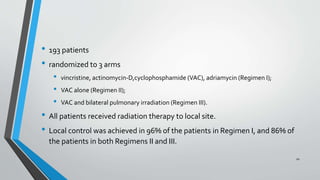
• 193 patients
• randomized to 3 arms
• vincristine, actinomycin-D,cyclophosphamide (VAC), adriamycin (Regimen I);
• VAC alone (Regimen II);
• VAC and bilateral pulmonary irradiation (Regimen III).
• All patients received radiation therapy to local site.
• Local control was achieved in 96% of the patients in Regimen I, and 86% of
the patients in both Regimens II and III.
20
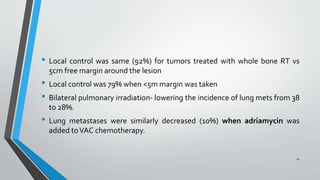
• Local control was same (92%) for tumors treated with whole bone RT vs
5cm free margin around the lesion
• Local control was 79% when <5m margin was taken
• Bilateral pulmonary irradiation- lowering the incidence of lung mets from 38
to 28%.
• Lung metastases were similarly decreased (10%) when adriamycin was
added toVAC chemotherapy.
21
IESS-II: Multimodal therapy for the management
of nonpelvic, localized Ewing's sarcoma of bone:
intergroup study IESS-II.
• 214 patients
• Adriamycin, cyclophosphamide, vincristine, and dactinomycin by either a high-
dose intermittent method (treatment [trt] 1) or a moderate-dose continuous
method (trt 2) similar to the four-drug arm of IESS-I
• The overall outcome was significantly better on trt 1 than on trt 2
• Treatment failure for both treatment groups was the development of metastatic
disease (lung)
• High-dose intermittent ofVACA and 3 week cycle has better outcome
22
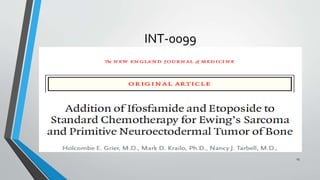
INT-0099
23
INT-0099
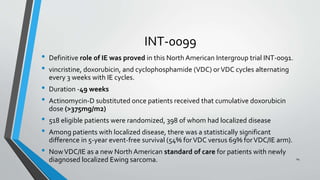
• Definitive role of IE was proved in this North American Intergroup trial INT-0091.
• vincristine, doxorubicin, and cyclophosphamide (VDC) orVDC cycles alternating
every 3 weeks with IE cycles.
• Duration -49 weeks
• Actinomycin-D substituted once patients received that cumulative doxorubicin
dose (>375mg/m2)
• 518 eligible patients were randomized, 398 of whom had localized disease
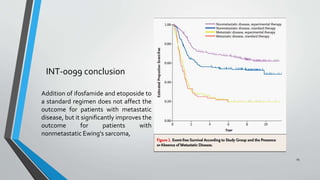
• Among patients with localized disease, there was a statistically significant
difference in 5-year event-free survival (54% forVDC versus 69% forVDC/IE arm).
• NowVDC/IE as a new North American standard of care for patients with newly
diagnosed localized Ewing sarcoma. 24
INT-0099 conclusion
Addition of ifosfamide and etoposide to
a standard regimen does not affect the
outcome for patients with metastatic
disease, but it significantly improves the
outcome for patients with
nonmetastatic Ewing's sarcoma,
25
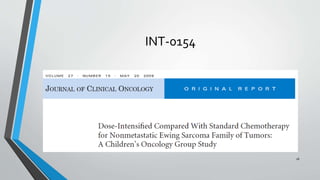
INT-0154
26
INT-0154
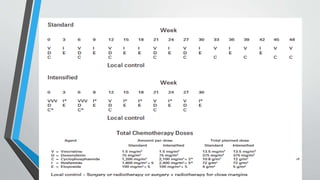
• Children’s Oncology Group (COG) has sought to intensify theVDC/IE regimen.
• INT-0154 was a randomized trial for newly diagnosed localized Ewing sarcoma.
• They were randomly assigned to receive standard doses of VDC/IE over 48 weeks
or a dose-intensified regimen ofVDC/IE over 30 weeks.
• All patients received same cumulative doses of chemotherapy
• A total of 478 eligible patients were randomized.
• 231 patients received the standard regimen; 247 patients intensified regimen.
• The 5-year event-free survival (EFS) and overall survival rates for all eligible
patients were 71.1% and 78.6% 27
28
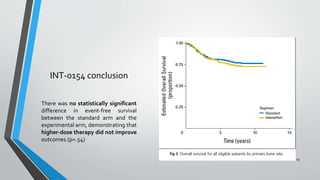
INT-0154 conclusion
There was no statistically significant
difference in event-free survival
between the standard arm and the
experimental arm, demonstrating that
higher-dose therapy did not improve
outcomes.(p=.54)
29
COG protocol: AEWS-0031
30
COG protocol: AEWS-0031
• This trial sought to intensify therapy not by dose escalation, but rather by
decreasing the interval between chemotherapy cycles (interval
compression)
• Standard and intensified treatment were to chemotherapy every 21 and 14
day
• A total of 568 eligible patients were randomized.
• Patients randomized to the interval-compressed arm had a significantly
greater 5-year event-free survival (73% versus 65% for patients randomized
to the standard arm with p=0.048).
31
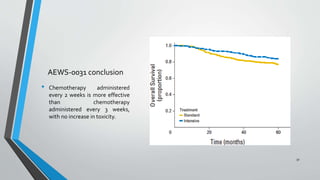
AEWS-0031 conclusion
• Chemotherapy administered
every 2 weeks is more effective
than chemotherapy
administered every 3 weeks,
with no increase in toxicity.
32
EICESS-92
33
EICESS-92
• Standard-risk patients (localized tumors, volume 100
mL) and high-risk disease (volume 100 mL or metastases )
• 3-year EFS rates were 73% and 74%, respectively, for
VACA andVAIA in SR group
• Cyclophosphamide has the same efficacy with
increased toxicity
• The 3-year EFS rate was not significantly different
between the two treatment groups (52% and 47%,
respectively, for EVAIA andVAIA) in HR group
• However addition of etoposide was associated with a
greater survival benefit in the subgroup of patients without
metastases (P = .18) than in those with metastases (P = .84)
34
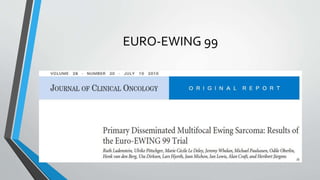
EURO-EWING 99
35
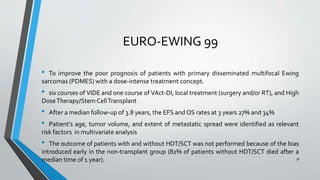
EURO-EWING 99
• To improve the poor prognosis of patients with primary disseminated multifocal Ewing
sarcomas (PDMES) with a dose-intense treatment concept.
• six courses of VIDE and one course of VAct-DI, local treatment (surgery and/or RT), and High
DoseTherapy/Stem CellTransplant
• After a median follow-up of 3.8 years, the EFS and OS rates at 3 years 27% and 34%
• Patient’s age, tumor volume, and extent of metastatic spread were identified as relevant
risk factors in multivariate analysis
• The outcome of patients with and without HDT/SCT was not performed because of the bias
introduced early in the non-transplant group (82% of patients without HDT/SCT died after a
median time of 1 year). 36
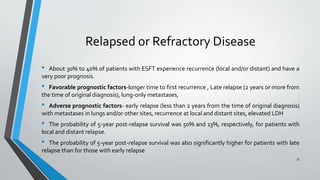
Relapsed or Refractory Disease
• About 30% to 40% of patients with ESFT experience recurrence (local and/or distant) and have a
very poor prognosis.
• Favorable prognostic factors-longer time to first recurrence , Late relapse (2 years or more from
the time of original diagnosis), lung-only metastases,
• Adverse prognostic factors- early relapse (less than 2 years from the time of original diagnosis)
with metastases in lungs and/or other sites, recurrence at local and distant sites, elevated LDH
• The probability of 5-year post-relapse survival was 50% and 13%, respectively, for patients with
local and distant relapse.
• The probability of 5-year post-relapse survival was also significantly higher for patients with late
relapse than for those with early relapse
37
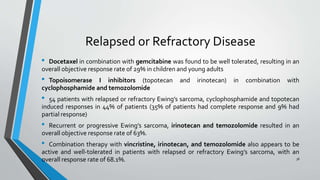
Relapsed or Refractory Disease
• Docetaxel in combination with gemcitabine was found to be well tolerated, resulting in an
overall objective response rate of 29% in children and young adults
• Topoisomerase I inhibitors (topotecan and irinotecan) in combination with
cyclophosphamide and temozolomide
• 54 patients with relapsed or refractory Ewing’s sarcoma, cyclophosphamide and topotecan
induced responses in 44% of patients (35% of patients had complete response and 9% had
partial response)
• Recurrent or progressive Ewing’s sarcoma, irinotecan and temozolomide resulted in an
overall objective response rate of 63%.
• Combination therapy with vincristine, irinotecan, and temozolomide also appears to be
active and well-tolerated in patients with relapsed or refractory Ewing’s sarcoma, with an
overall response rate of 68.1%. 38
Duration of Chemotherapy
• Induction Multiagent chemotherapy for at least 12-18 weeks prior to local
therapy.
• Maintenance (adjuvant chemotherapy) with or without Radiotherapy is
recommended following local control treatment and the duration of
chemotherapy should be between 28 and 49 weeks depending on the type
of regimen and the dosing schedule (category 1 evidence)
39
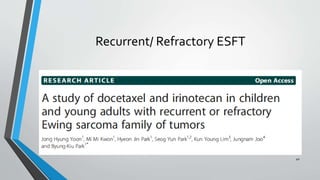
Recurrent/ Refractory ESFT
40
Recurrent/Refractory ESFT
• Patients aged <30 years with ESFT, who failed ≥ third-line therapy were eligible
• Enrolled 9 patients
• Overall median PFS was 2.2 months (range: 0.5-16.9 months).
• All nine patients had grade 4 neutropenia (100%); grade 3 diarrhea or grade 2/3
neuropathy each occurred in two patients
• The Doce+Ireno combination may be effective and tolerable for patients with
heavily pre-treated ESFT.
41
TargetedTherapy
42
43
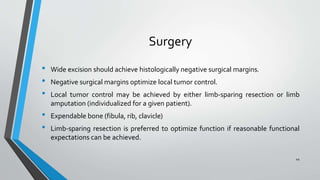
Surgery
• Wide excision should achieve histologically negative surgical margins.
• Negative surgical margins optimize local tumor control.
• Local tumor control may be achieved by either limb-sparing resection or limb
amputation (individualized for a given patient).
• Expendable bone (fibula, rib, clavicle)
• Limb-sparing resection is preferred to optimize function if reasonable functional
expectations can be achieved.
44
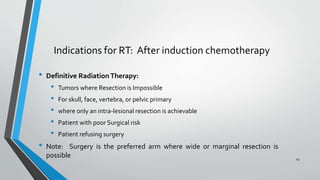
• Definitive Radiation Therapy:
• Tumors where Resection is Impossible
• For skull, face, vertebra, or pelvic primary
• where only an intra-lesional resection is achievable
• Patient with poor Surgical risk
• Patient refusing surgery
• Note: Surgery is the preferred arm where wide or marginal resection is
possible
Indications for RT: After induction chemotherapy
45
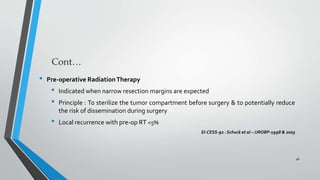
• Pre-operative RadiationTherapy
• Indicated when narrow resection margins are expected
• Principle : To sterilize the tumor compartment before surgery & to potentially reduce
the risk of dissemination during surgery
• Local recurrence with pre-op RT <5%
EI-CESS-92 : Schuck et al – IJROBP-1998 & 2003
46
• Post-operative Radiation Therapy
• For gross or microscopic positive margin
• For marginal Resection
• For wide-resection with Poor Histological response to Neo-adjuvantChemotherapy
(>10% viable tumor cells in the specimen)
Based on CESS-81,CESS-86, EICESS-92Studies : Schuck et al,IJROBP-1998 & 2003
47
48
Thank you
49
Definitive RT
• no randomized trials that have directly compared Radiotherapy to surgery for local control
of Ewing’s sarcoma.
• Should start by week 12 ofVAC/IE chemotherapy or week 18 ofVIDE chemotherapy
• Treatment volumes and doses:
•45 Gy to initial GTV
•Cone-down (CD) to cover original bony extent + a total of 55.8 Gy to
postchemotherapy volume (GTV2)
•Consider increasing boost dose to a total of 59.4 Gy for chemotherapy response
<50%
• Preoperative RT
• for marginally resectable tumors and is given concurrently with consolidationChemo
• Treatment volumes and doses: 36–45 Gy for initial GTV + 2 cm
50
• 30-40% of patients develop relapse with <20% survival
• Early relapse – less than 2 years:
• Consider Changing Chemotherapy
• Late relapse – more than 2 years:
• Continue the previously used chemotherapy
Relapse
51
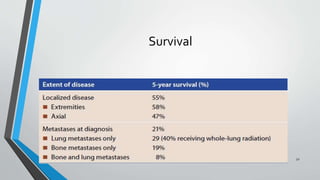
Survival
52
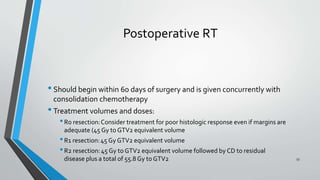
Postoperative RT
•Should begin within 60 days of surgery and is given concurrently with
consolidation chemotherapy
•Treatment volumes and doses:
•R0 resection:Consider treatment for poor histologic response even if margins are
adequate (45 Gy to GTV2 equivalent volume
•R1 resection:45 Gy GTV2 equivalent volume
•R2 resection:45 Gy to GTV2 equivalent volume followed by CD to residual
disease plus a total of 55.8 Gy to GTV2 53
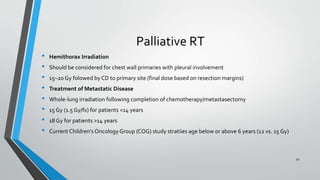
Palliative RT
• Hemithorax Irradiation
• Should be considered for chest wall primaries with pleural involvement
• 15–20 Gy folowed by CD to primary site (final dose based on resection margins)
• Treatment of Metastatic Disease
• Whole-lung irradiation following completion of chemotherapy/metastasectomy
• 15 Gy (1.5 Gy/fx) for patients <14 years
• 18 Gy for patients >14 years
• Current Children's Oncology Group (COG) study stratiies age below or above 6 years (12 vs. 15 Gy)
54
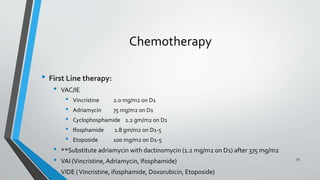
Chemotherapy
• First Line therapy:
• VAC/IE
• Vincristine 2.0 mg/m2 on D1
• Adriamycin 75 mg/m2 on D1
• Cyclophosphamide 1.2 gm/m2 on D1
• Ifosphamide 1.8 gm/m2 on D1-5
• Etoposide 100 mg/m2 on D1-5
• **Substitute adriamycin with dactinomycin (1.2 mg/m2 on D1) after 375 mg/m2
• VAI (Vincristine,Adriamycin, Ifosphamide)
• VIDE (Vincristine, ifosphamide, Doxorubicin, Etoposide)
55
Chemo
• Adjuvant chemotherapy following wide excision or amputation is
recommended for all patients regardless of surgical margins.The panel
strongly recommends that the duration of chemotherapy following wide
excision should be between 28 and 49 weeks depending on the type of
regimen and the dosing schedule (category 1).200-202
The addition of
postoperative RT to chemotherapy is recommended for patients with
positive or very close surgical margins {nccn2016)
56

Ewings sarcoma management Chemotherapy trials

  • 1.
    Ewing’s Sarcoma Management Parag roy Deptof radiotherapy Lok nayak hopital
  • 2.
    Introduction • Identified in1921 by James Ewing • Ewing’s Sarcoma Family of tumors: • Ewing’s sarcoma (Bone –87%) • Extraosseous Ewing’s sarcoma (8%) • Peripheral PNET(5%) • Askin’s tumor 2
  • 3.
    Cytogenetics • Consistent cytogeneticabnormality, t(11;22)(q24;q12) present in 90-95% resultant fusion gene is EWS/FLI-1 • Also seen: • t(21;22)(q22;q12) 5-10% EWS/ERG • t(7;22) and t(17;22) the remainder EWS/ETV1 and EWS/E1AF respectively • t(1;16)(q21;q13) present along with t(11;22) • The c-myc protooncogene is frequently expressed in Ewing’s. • CD 99 ( MIC2) • PAS +ve 3
  • 4.
    Routes of spread •Direct extension into adjacent bone or soft tissue. • Metastases generally spread through bloodstream • 25% present with metastatic disease • Lungs (38%) • Bone (31%) • Bone Marrow (11%) • Nearly all pts. have micromets at diagnosis, so all Need chemo. 4
  • 5.
    Primary tumor (T) TXPrimary tumor cannot be assessed T0 No evidence of primary tumor T1 Tumor 8 cm or less in greatest dimension T2 Tumor more than 8 cm in greatest dimension T3 Discontinuous tumors in the primary bone site Regional lymph nodes (N) NX Regional lymph nodes cannot be assessed N0 No regional lymph node metastasis N1 Regional lymph node metastasis Note: Because of the rarity of lymph node involvement in bone sarcomas, the designation NX may not be appropriate and cases should be considered N0 unless clinical node involvement is clearly evident. Distant metastasis (M) M0 No distant metastasis M1 Distant metastasis M1a Lung M1b Other distant sites AJCC Staging (7th Ed. 2010) Bone Tumor 5
  • 6.
    IA T1 N0M0 G1,2 low grade, GX IB T2 N0 M0 G1,2 low grade, GX T3N0 M0 G1,2 low grade, GX IIA T1 N0 M0 G3, 4 high grade IIB T2 N0 M0 G3, 4 high grade III T3 N0 M0 G3, 4 IVA AnyT N0 M1a any G IVB AnyT N1 any M any G AnyT any N M1b any G Stage Histologic Grade (G) GX Grade cannot be assessed G1 Well differentiated — Low Grade G2 Moderately differentiated — Low Grade G3 Poorly differentiated G4 Undifferentiated Note: Ewing's sarcoma is classified as G4. 6
  • 7.
  • 8.
  • 9.
    Disease factors Favorableprognosis Unfavorable prognosis Site Distal extremity (tibia, fibula, radius, ulna, hands, feet) Central lesions (especially pelvic bones) less favorable: proximal extremity (humerus, femur), ribs Size <8 cm in greatest diameter or <200 mL estimated volume Larger tumors Soft tissue extension Absence of radiographically identifiable soft tissue extension Presence of soft tissue extension by radiograph or significant extension by computed tomography Extent of disease Localized Metastatic Site of Metastasis Lung Bone / bone marrow Both Lung and Bone Response to CT Responsive Unresponsive Prognostic Factors 9
  • 10.
    Treatment • Chemotherapy: controlof Micro/Macro metastasis • Surgery: local control where possible • Radiotherapy: local control where surgery not possible or Incomplete Multidisciplinary approach 10
  • 11.
    General Management • Effectivelocal and systemic chemotherapy (CT) necessary for cure. • Induction chemotherapy preferred over starting the systemic and local therapy • Advantage of this approach: • Evaluation of effectiveness of the regimen • Decreases the vol. of primary tumor for surgery or RT • Some bone healing occurs during CT, diminish the risk of pathological fracture 11
  • 12.
    Induction Chemotherapy Local Control • Surgery •Radiotherapy Maintenance • Chemotherapy 12
  • 13.
  • 14.
    Chemotherapy • All patientsrequire chemotherapy • Induction chemotherapy • Maintenance chemotherapy • Effective chemotherapy has improved local control rates achieved with radiation to 85-90% 14
  • 15.
    First-line therapy • Primary/neoadjuvant/ adjuvant therapy • VAC/IE (vincristine, doxorubicin, and cyclophosphamide alternating with ifosfamide and etoposide) • VAI (vincristine, doxorubicin, and ifosfamide) • VIDE (vincristine, ifosfamide, doxorubicin, and etoposide) • Primary therapy for metastatic disease at initial presentation • VAdriaC (vincristine, doxorubicin, and cyclophosphamide) • VAC/IE • VAI • VIDE 15
  • 16.
    Second-line therapy • Relapsed/refractoryor metastatic disease • Cyclophosphamide and topotecan • Irinotecan ± temozolomide • Ifosfamide (high dose) ± etoposide • Ifosfamide, carboplatin, and etoposide • Docetaxel and gemcitabine • Decetaxel and irinotecan 16
  • 17.
    NCCN Guidelines Version2.2016 Ewing’s Sarcoma Family ofTumors PRESENTATION WORKUP PRIMARY RESTAGETREATMENT Ewing’s sarcoma family of tumors • History and physical •MRI ± CT of primary site •Chest CT • PET scan and/or bone scan • Bone marrow biopsy and/or screening MRI of spine and pelvisd • Cytogenetics and/or molecular studiese (may require re-biopsy) •LDH • Fertility consultation should be considered Multiagent chemotherapyf (category 1) for at least 12 weeks prior to local therapyh localized disease Restage with: • Chest imaging • Imaging of primary site • Consider PET scan or bone scang For patients with metastatic disease Restage with: • Chest imaging • Imaging of primary site • Consider PET scan or bone scang Repeat other abnormal studies Response Progressive disease 17
  • 18.
    NCCN Guidelines Version2.2016 Ewing’s Sarcoma Family ofTumors Stable/improved disease following response to primary treatment Progressive disease following primary treatment LOCAL CONTROL THERAPY Wide excisionb or Deinitive RTl and chemotherapy or Amputationb in selected cases Positive margins Negative marginsi ADJUVANT TREATMENT/ ADDITIONAL THERAPY Continue chemotherapyf,j (category 1) followed by RTl or RTl and chemotherapyf,j (category 1, for chemotherapy) Chemotherapyf,j (category 1) Postoperative chemotherapy,f consider RTl depending on margin status SURVEILLANCE • Physical exam, imaging ofprimary site andchest every 2–3 mo • CBC and other laboratory studies as indicated • Increase intervalsfor physical exam, imaging of chest, and primary site after 24 mo andannually after 5 y (category 2B) (indeinitely) • Consider PET scan or bone scang PROGRESSIVE DISEASE/RELAPSE Early relapse Late relapsek Chemotherapyf,k ± RTl Consider RTl and/or surgery to primary site for local control or palliation Chemotherapyf or Best supportive care 18
  • 19.
  • 20.
    • 193 patients •randomized to 3 arms • vincristine, actinomycin-D,cyclophosphamide (VAC), adriamycin (Regimen I); • VAC alone (Regimen II); • VAC and bilateral pulmonary irradiation (Regimen III). • All patients received radiation therapy to local site. • Local control was achieved in 96% of the patients in Regimen I, and 86% of the patients in both Regimens II and III. 20
  • 21.
    • Local controlwas same (92%) for tumors treated with whole bone RT vs 5cm free margin around the lesion • Local control was 79% when <5m margin was taken • Bilateral pulmonary irradiation- lowering the incidence of lung mets from 38 to 28%. • Lung metastases were similarly decreased (10%) when adriamycin was added toVAC chemotherapy. 21
  • 22.
    IESS-II: Multimodal therapyfor the management of nonpelvic, localized Ewing's sarcoma of bone: intergroup study IESS-II. • 214 patients • Adriamycin, cyclophosphamide, vincristine, and dactinomycin by either a high- dose intermittent method (treatment [trt] 1) or a moderate-dose continuous method (trt 2) similar to the four-drug arm of IESS-I • The overall outcome was significantly better on trt 1 than on trt 2 • Treatment failure for both treatment groups was the development of metastatic disease (lung) • High-dose intermittent ofVACA and 3 week cycle has better outcome 22
  • 23.
  • 24.
    INT-0099 • Definitive roleof IE was proved in this North American Intergroup trial INT-0091. • vincristine, doxorubicin, and cyclophosphamide (VDC) orVDC cycles alternating every 3 weeks with IE cycles. • Duration -49 weeks • Actinomycin-D substituted once patients received that cumulative doxorubicin dose (>375mg/m2) • 518 eligible patients were randomized, 398 of whom had localized disease • Among patients with localized disease, there was a statistically significant difference in 5-year event-free survival (54% forVDC versus 69% forVDC/IE arm). • NowVDC/IE as a new North American standard of care for patients with newly diagnosed localized Ewing sarcoma. 24
  • 25.
    INT-0099 conclusion Addition ofifosfamide and etoposide to a standard regimen does not affect the outcome for patients with metastatic disease, but it significantly improves the outcome for patients with nonmetastatic Ewing's sarcoma, 25
  • 26.
  • 27.
    INT-0154 • Children’s OncologyGroup (COG) has sought to intensify theVDC/IE regimen. • INT-0154 was a randomized trial for newly diagnosed localized Ewing sarcoma. • They were randomly assigned to receive standard doses of VDC/IE over 48 weeks or a dose-intensified regimen ofVDC/IE over 30 weeks. • All patients received same cumulative doses of chemotherapy • A total of 478 eligible patients were randomized. • 231 patients received the standard regimen; 247 patients intensified regimen. • The 5-year event-free survival (EFS) and overall survival rates for all eligible patients were 71.1% and 78.6% 27
  • 28.
  • 29.
    INT-0154 conclusion There wasno statistically significant difference in event-free survival between the standard arm and the experimental arm, demonstrating that higher-dose therapy did not improve outcomes.(p=.54) 29
  • 30.
  • 31.
    COG protocol: AEWS-0031 •This trial sought to intensify therapy not by dose escalation, but rather by decreasing the interval between chemotherapy cycles (interval compression) • Standard and intensified treatment were to chemotherapy every 21 and 14 day • A total of 568 eligible patients were randomized. • Patients randomized to the interval-compressed arm had a significantly greater 5-year event-free survival (73% versus 65% for patients randomized to the standard arm with p=0.048). 31
  • 32.
    AEWS-0031 conclusion • Chemotherapyadministered every 2 weeks is more effective than chemotherapy administered every 3 weeks, with no increase in toxicity. 32
  • 33.
  • 34.
    EICESS-92 • Standard-risk patients(localized tumors, volume 100 mL) and high-risk disease (volume 100 mL or metastases ) • 3-year EFS rates were 73% and 74%, respectively, for VACA andVAIA in SR group • Cyclophosphamide has the same efficacy with increased toxicity • The 3-year EFS rate was not significantly different between the two treatment groups (52% and 47%, respectively, for EVAIA andVAIA) in HR group • However addition of etoposide was associated with a greater survival benefit in the subgroup of patients without metastases (P = .18) than in those with metastases (P = .84) 34
  • 35.
  • 36.
    EURO-EWING 99 • Toimprove the poor prognosis of patients with primary disseminated multifocal Ewing sarcomas (PDMES) with a dose-intense treatment concept. • six courses of VIDE and one course of VAct-DI, local treatment (surgery and/or RT), and High DoseTherapy/Stem CellTransplant • After a median follow-up of 3.8 years, the EFS and OS rates at 3 years 27% and 34% • Patient’s age, tumor volume, and extent of metastatic spread were identified as relevant risk factors in multivariate analysis • The outcome of patients with and without HDT/SCT was not performed because of the bias introduced early in the non-transplant group (82% of patients without HDT/SCT died after a median time of 1 year). 36
  • 37.
    Relapsed or RefractoryDisease • About 30% to 40% of patients with ESFT experience recurrence (local and/or distant) and have a very poor prognosis. • Favorable prognostic factors-longer time to first recurrence , Late relapse (2 years or more from the time of original diagnosis), lung-only metastases, • Adverse prognostic factors- early relapse (less than 2 years from the time of original diagnosis) with metastases in lungs and/or other sites, recurrence at local and distant sites, elevated LDH • The probability of 5-year post-relapse survival was 50% and 13%, respectively, for patients with local and distant relapse. • The probability of 5-year post-relapse survival was also significantly higher for patients with late relapse than for those with early relapse 37
  • 38.
    Relapsed or RefractoryDisease • Docetaxel in combination with gemcitabine was found to be well tolerated, resulting in an overall objective response rate of 29% in children and young adults • Topoisomerase I inhibitors (topotecan and irinotecan) in combination with cyclophosphamide and temozolomide • 54 patients with relapsed or refractory Ewing’s sarcoma, cyclophosphamide and topotecan induced responses in 44% of patients (35% of patients had complete response and 9% had partial response) • Recurrent or progressive Ewing’s sarcoma, irinotecan and temozolomide resulted in an overall objective response rate of 63%. • Combination therapy with vincristine, irinotecan, and temozolomide also appears to be active and well-tolerated in patients with relapsed or refractory Ewing’s sarcoma, with an overall response rate of 68.1%. 38
  • 39.
    Duration of Chemotherapy •Induction Multiagent chemotherapy for at least 12-18 weeks prior to local therapy. • Maintenance (adjuvant chemotherapy) with or without Radiotherapy is recommended following local control treatment and the duration of chemotherapy should be between 28 and 49 weeks depending on the type of regimen and the dosing schedule (category 1 evidence) 39
  • 40.
  • 41.
    Recurrent/Refractory ESFT • Patientsaged <30 years with ESFT, who failed ≥ third-line therapy were eligible • Enrolled 9 patients • Overall median PFS was 2.2 months (range: 0.5-16.9 months). • All nine patients had grade 4 neutropenia (100%); grade 3 diarrhea or grade 2/3 neuropathy each occurred in two patients • The Doce+Ireno combination may be effective and tolerable for patients with heavily pre-treated ESFT. 41
  • 42.
  • 43.
  • 44.
    Surgery • Wide excisionshould achieve histologically negative surgical margins. • Negative surgical margins optimize local tumor control. • Local tumor control may be achieved by either limb-sparing resection or limb amputation (individualized for a given patient). • Expendable bone (fibula, rib, clavicle) • Limb-sparing resection is preferred to optimize function if reasonable functional expectations can be achieved. 44
  • 45.
    • Definitive RadiationTherapy: • Tumors where Resection is Impossible • For skull, face, vertebra, or pelvic primary • where only an intra-lesional resection is achievable • Patient with poor Surgical risk • Patient refusing surgery • Note: Surgery is the preferred arm where wide or marginal resection is possible Indications for RT: After induction chemotherapy 45
  • 46.
    • Pre-operative RadiationTherapy •Indicated when narrow resection margins are expected • Principle : To sterilize the tumor compartment before surgery & to potentially reduce the risk of dissemination during surgery • Local recurrence with pre-op RT <5% EI-CESS-92 : Schuck et al – IJROBP-1998 & 2003 46
  • 47.
    • Post-operative RadiationTherapy • For gross or microscopic positive margin • For marginal Resection • For wide-resection with Poor Histological response to Neo-adjuvantChemotherapy (>10% viable tumor cells in the specimen) Based on CESS-81,CESS-86, EICESS-92Studies : Schuck et al,IJROBP-1998 & 2003 47
  • 48.
  • 49.
  • 50.
    Definitive RT • norandomized trials that have directly compared Radiotherapy to surgery for local control of Ewing’s sarcoma. • Should start by week 12 ofVAC/IE chemotherapy or week 18 ofVIDE chemotherapy • Treatment volumes and doses: •45 Gy to initial GTV •Cone-down (CD) to cover original bony extent + a total of 55.8 Gy to postchemotherapy volume (GTV2) •Consider increasing boost dose to a total of 59.4 Gy for chemotherapy response <50% • Preoperative RT • for marginally resectable tumors and is given concurrently with consolidationChemo • Treatment volumes and doses: 36–45 Gy for initial GTV + 2 cm 50
  • 51.
    • 30-40% ofpatients develop relapse with <20% survival • Early relapse – less than 2 years: • Consider Changing Chemotherapy • Late relapse – more than 2 years: • Continue the previously used chemotherapy Relapse 51
  • 52.
  • 53.
    Postoperative RT •Should beginwithin 60 days of surgery and is given concurrently with consolidation chemotherapy •Treatment volumes and doses: •R0 resection:Consider treatment for poor histologic response even if margins are adequate (45 Gy to GTV2 equivalent volume •R1 resection:45 Gy GTV2 equivalent volume •R2 resection:45 Gy to GTV2 equivalent volume followed by CD to residual disease plus a total of 55.8 Gy to GTV2 53
  • 54.
    Palliative RT • HemithoraxIrradiation • Should be considered for chest wall primaries with pleural involvement • 15–20 Gy folowed by CD to primary site (final dose based on resection margins) • Treatment of Metastatic Disease • Whole-lung irradiation following completion of chemotherapy/metastasectomy • 15 Gy (1.5 Gy/fx) for patients <14 years • 18 Gy for patients >14 years • Current Children's Oncology Group (COG) study stratiies age below or above 6 years (12 vs. 15 Gy) 54
  • 55.
    Chemotherapy • First Linetherapy: • VAC/IE • Vincristine 2.0 mg/m2 on D1 • Adriamycin 75 mg/m2 on D1 • Cyclophosphamide 1.2 gm/m2 on D1 • Ifosphamide 1.8 gm/m2 on D1-5 • Etoposide 100 mg/m2 on D1-5 • **Substitute adriamycin with dactinomycin (1.2 mg/m2 on D1) after 375 mg/m2 • VAI (Vincristine,Adriamycin, Ifosphamide) • VIDE (Vincristine, ifosphamide, Doxorubicin, Etoposide) 55
  • 56.
    Chemo • Adjuvant chemotherapyfollowing wide excision or amputation is recommended for all patients regardless of surgical margins.The panel strongly recommends that the duration of chemotherapy following wide excision should be between 28 and 49 weeks depending on the type of regimen and the dosing schedule (category 1).200-202 The addition of postoperative RT to chemotherapy is recommended for patients with positive or very close surgical margins {nccn2016) 56