Ahmed Zeeneldin
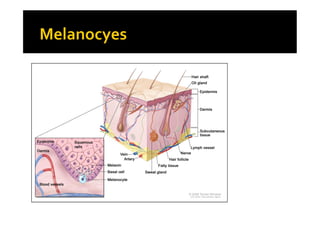
¡   arise from the neural crest
¡   migrate to the epidermis, uvea, meninges,
    and ectodermal mucosa
¡   contained within the basal layer of the
    epidermis, at the junction of the dermis and
    epidermis
¡   produce a protective melanin
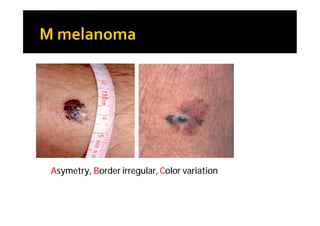
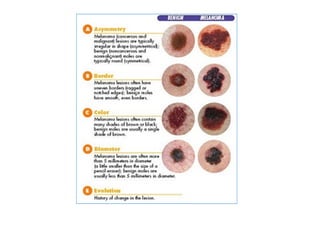
Asymetry, Border irregular, Color variation
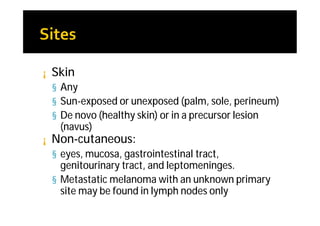
¡   Skin
    § Any
    § Sun-exposed or unexposed (palm, sole, perineum)
    § De novo (healthy skin) or in a precursor lesion
     (navus)
¡   Non-cutaneous:
    § eyes, mucosa, gastrointestinal tract,
      genitourinary tract, and leptomeninges.
    § Metastatic melanoma with an unknown primary
      site may be found in lymph nodes only
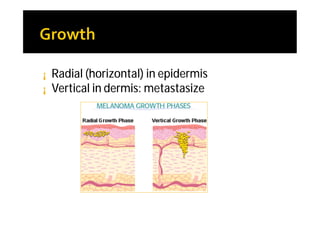
¡   Radial (horizontal) in epidermis
¡   Vertical in dermis: metastasize
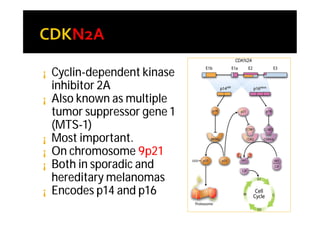
¡   CDKN2A
¡   CDK4
¡   RB1
¡   PTEN/MMAC1
¡   ras
¡   Cyclin-dependent kinase
    inhibitor 2A
¡   Also known as multiple
    tumor suppressor gene 1
    (MTS-1)
¡   Most important.
¡   On chromosome 9p21
¡   Both in sporadic and
    hereditary melanomas
¡   Encodes p14 and p16
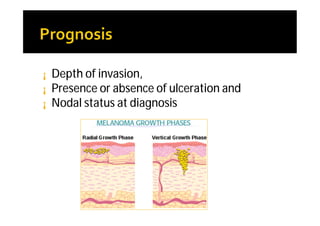
¡   Depth of invasion,
¡   Presence or absence of ulceration and
¡   Nodal status at diagnosis
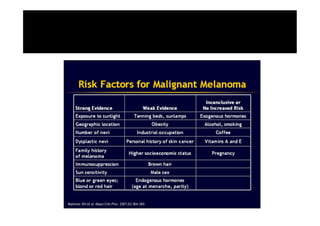
¡   UVR : most important
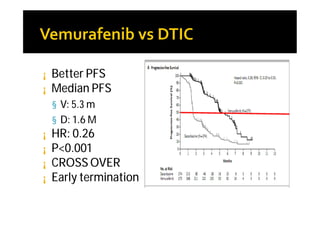
¡   chemicals and viruses?
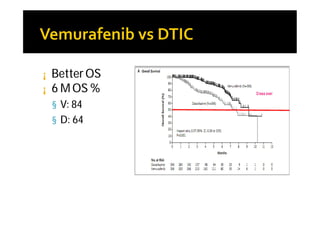
¡   Greatly elevated risk factors for cutaneous melanoma
    § Changing mole
    § Dysplastic nevi in familial melanoma
    § Greater than 50 nevi, 2 mm or greater in diameter
¡   Moderately elevated risk factors for cutaneous
    melanoma
    §   One family member with melanoma
    §   Previous history of melanoma
    §   Sporadic dysplastic nevi
    §   Congenital nevus
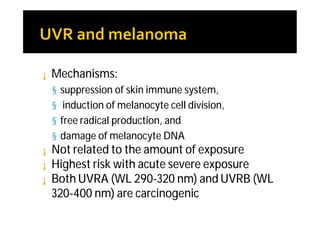
¡   Mechanisms:
    § suppression of skin immune system,
    § induction of melanocyte cell division,
    § free radical production, and
    § damage of melanocyte DNA
¡   Not related to the amount of exposure
¡   Highest risk with acute severe exposure
¡   Both UVRA (WL 290-320 nm) and UVRB (WL
    320-400 nm) are carcinogenic
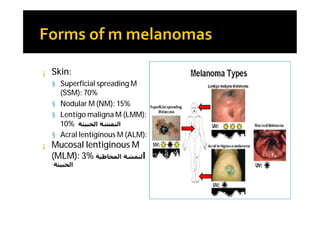
¡   Skin:
    § Superficial spreading M
      (SSM): 70%
    § Nodular M (NM): 15%
    § Lentigo maligna M (LMM):
      10% ‫اﻟﻨﻤﺸﺔ اﻟﺨﺒﯿﺜﺔ‬
    § Acral lentiginous M (ALM):
¡   Mucosal lentiginous M
    (MLM): 3% ‫اﻟﻨﻤﺸﺔ اﻟﻤﺨﺎطﯿﺔ‬
    ‫اﻟﺨﺒﯿﺜﺔ‬
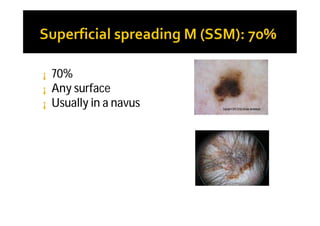
¡   70%
¡   Any surface
¡   Usually in a navus
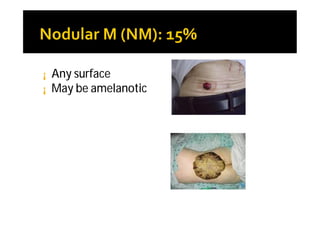
¡   Any surface
¡   May be amelanotic
¡   sun-exposed areas (eg, hand,
    neck)
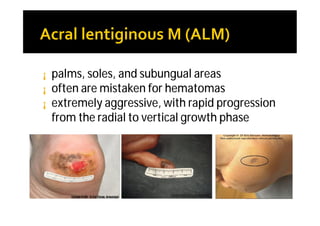
¡   palms, soles, and subungual areas
¡   often are mistaken for hematomas
¡   extremely aggressive, with rapid progression
    from the radial to vertical growth phase
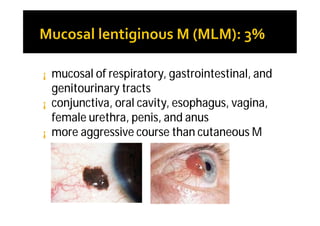
¡   mucosal of respiratory, gastrointestinal, and
    genitourinary tracts
¡   conjunctiva, oral cavity, esophagus, vagina,
    female urethra, penis, and anus
¡   more aggressive course than cutaneous M
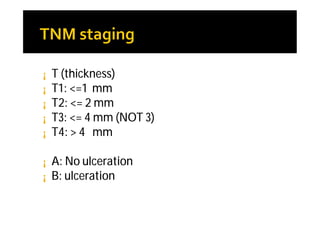
¡   T (thickness)
¡   T1: <=1 mm
¡   T2: <= 2 mm
¡   T3: <= 4 mm (NOT 3)
¡   T4: > 4 mm

¡   A: No ulceration
¡   B: ulceration
¡   N
¡   N1: 1 LN+ [a: micrometastasis (clinically occult), b: macrometastasis (clinically apparent)]
¡   N2: 2-3 LN+ [a: micrometastasis b: macrometastasis , c: intransit without LN]
¡   N3: >3 (=>4) LN+ or matted LN or intransit+LN

¡   M
¡   M1a: distant skin, SC, LN with normal LDH
¡   M1b: lung mets            with normal LDH
¡   M1c: other sites          or elevated LDH
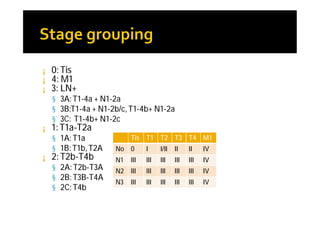
¡   0: Tis
¡   4: M1
¡   3: LN+
    § 3A: T1-4a + N1-2a
    § 3B:T1-4a + N1-2b/c, T1-4b+ N1-2a
    § 3C: T1-4b+ N1-2c
¡   1: T1a-T2a
    § 1A: T1a             Tis   T1    T2     T3    T4    M1
    § 1B: T1b, T2A   No   0     I     I/II   II    II    IV
¡   2: T2b-T4b       N1   III   III   III    III   III   IV
    § 2A: T2b-T3A    N2   III   III   III    III   III   IV
    § 2B: T3B-T4A
                     N3   III   III   III    III   III   IV
    § 2C: T4b
5-Y OS (%)
¡   0: Tis                                             100
¡   4: M1                                              10%
¡   3: LN+                                             30-60
    § 3A: T1-4a + N1-2a (AA)                               65
    § 3B: T1-4a + N1-2b/c, T1-4b+ N1-2a (AB, AC, BA)       45-55
    § 3C: T1-4b+ N1b-N2BC (BB, BC)                         25-30
¡   1: T1                                              90-95
    § 1A: T1a                                              90
    § 1B: T1b, T2A                                         95
¡   2: T2-T4                                           40-80
    § 2A: T2A, T2b-T3A                                     80
    § 2B: T3B-T4A                                          70
    § 2C: T4b                                              50
¡   Hx:
¡   Examination:
    § Total skin exam
    § LNs
    § Liver and lungs
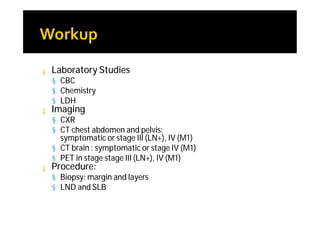
¡   Laboratory Studies
    § CBC
    § Chemistry
    § LDH
¡   Imaging
    § CXR
    § CT chest abdomen and pelvis:
      symptomatic or stage III (LN+), IV (M1)
    § CT brain : symptomatic or stage IV (M1)
    § PET in stage stage III (LN+), IV (M1)
¡   Procedure:
    § Biopsy: margin and layers
    § LND and SLB
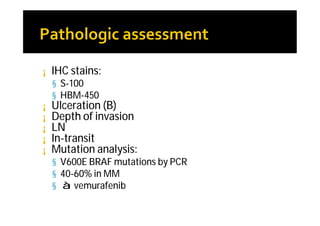
¡   IHC stains:
    § S-100
    § HBM-450
¡   Ulceration (B)
¡   Depth of invasion
¡   LN
¡   In-transit
¡   Mutation analysis:
    § V600E BRAF mutations by PCR
    § 40-60% in MM
    § à vemurafenib
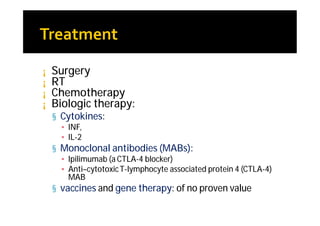
¡   Surgery
¡   RT
¡   Chemotherapy
¡   Biologic therapy:
    § Cytokines:
      ▪ INF,
      ▪ IL-2
    § Monoclonal antibodies (MABs):
      ▪ Ipilimumab (a CTLA-4 blocker)
      ▪ Anti–cytotoxic T-lymphocyte associated protein 4 (CTLA-4)
        MAB
    § vaccines and gene therapy: of no proven value
¡   The mainstay of treatment for early stage M
¡   Wide local excision + SLNB or elective LND
¡   Brain metastatectomy: for acute symptoms
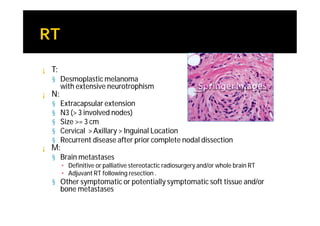
¡   T:
    § Desmoplastic melanoma
         with extensive neurotrophism
¡   N:
    §    Extracapsular extension
    §    N3 (> 3 involved nodes)
    §    Size >= 3 cm
    §    Cervical > Axillary > Inguinal Location
    §    Recurrent disease after prior complete nodal dissection
¡   M:
    § Brain metastases
         ▪ Definitive or palliative stereotactic radiosurgery and/or whole brain RT
         ▪ Adjuvant RT following resection .
    § Other symptomatic or potentially symptomatic soft tissue and/or
         bone metastases
¡   Adjuvant
    § INF in high-risk (T4 or N+)
¡   Palliative
    § V600E BRAF mutations by PCR à vemurafenib
    § Negative mutations:
      ▪ Ipilmumab
      ▪ Chemotherapy:
        ▪ Single DTIC, temozolamide, paclitaxel
        ▪ Combinations:
          - Including DTIC, temozolamide with cisplatin and vinblastin
          - Paclitaxel, cisplatin/carboplatin
¡   After complete resection
¡   In high-risk patients:
    § Deep lesions (t4 >4 mm deep)
    § LN+: stage IIIABC
    § Genetic stratification??
¡   high-dose interferon-alfa-2b (IFN)
    § Regular or
    § Pegylated (FDA approved in 2011)
¡   FDA approved in high-risk resected MM
¡   A pooled analysis of 1016 patients and 716
    observational controls from all ECOG trials
    showed
    § significant increase in relapse-free S (P=0.006)
    § but not overall survival (P=0.42)
¡   Dose:
    § 20 million U/m2 IV for 5 consecutive d/wk for 4 wk;
    § then, 10 million U/m2 SC 3 times/wk for 48 wk
Adjuvant therapy with pegylated interferon
     alfa-2b versus observation alone in
 resected stage III melanoma: final results of
  EORTC 18991, a randomised phase III trial.

    Eggermont AM et al Lancet. 2008 Jul
           12;372(9633):117-26.
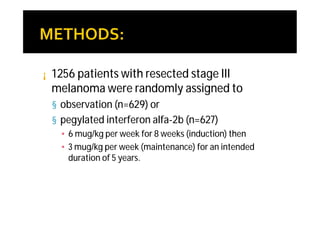
¡   1256 patients with resected stage III
    melanoma were randomly assigned to
    § observation (n=629) or
    § pegylated interferon alfa-2b (n=627)
      ▪ 6 mug/kg per week for 8 weeks (induction) then
      ▪ 3 mug/kg per week (maintenance) for an intended
        duration of 5 years.
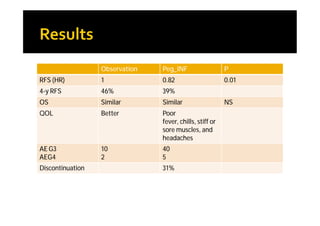
Observation   Peg_INF                   P
RFS (HR)          1             0.82                      0.01
4-y RFS           46%           39%
OS                Similar       Similar                   NS
QOL               Better        Poor
                                fever, chills, stiff or
                                sore muscles, and
                                headaches
AE G3             10            40
AEG4              2             5
Discontinuation                 31%
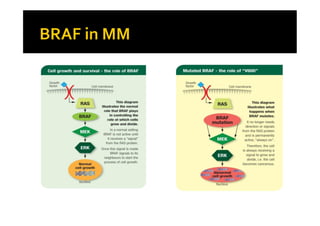
¡   V600E BRAF mutation is the most common
    BRAF mutation.
¡   This type of mutation is found in about 8 %of
    all cancers, including approximately 40-60 %
    of malignant melanomas.
¡   There are other BRAF mutations but they are
    less common.
¡   TKI that inhibit V600E Mutated BRAF kinase
¡   960 mg orally twice daily
¡   Only in positive BRAF V600E mutation on
    real-time polymerase-chain-reaction assay
    (Cobas 4800 BRAF V600 Mutation Test,
    Roche Molecular Systems).
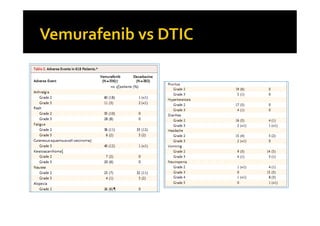
¡   More RR
¡   V: 48% (2 CRs)
¡   D: 5%
¡   P <0.001
¡   Better PFS
¡   Median PFS
    § V: 5.3 m
    § D: 1.6 M
¡   HR: 0.26
¡   P<0.001
¡   CROSS OVER
¡   Early termination
¡   Better OS
¡   6 M OS %
    § V: 84
    § D: 64
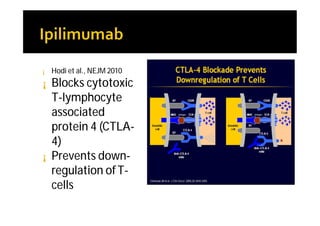
¡   Hodi et al., NEJM 2010
¡   Blocks cytotoxic
    T-lymphocyte
    associated
    protein 4 (CTLA-
    4)
¡   Prevents down-
    regulation of T-
    cells
¡   700 patients with stage III (LN+) or IV M
    melanoma
¡   Randomized to
    § Ipili+gp100:
    § Ipili:
    § gp100 vaccine:
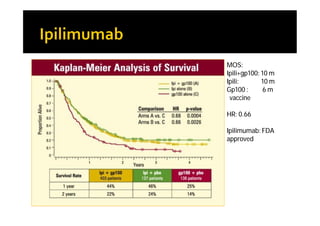
MOS:
Ipili+gp100: 10 m
Ipili:       10 m
Gp100 :       6m
 vaccine

HR: 0.66

Ipilimumab: FDA
approved
¡ Dacarbazine (DTIC) is the first drug approved. It gives
  RR 22% with no survival impact
¡ DTIC is similar to combinations ;
    § cislatin – DTIC – vinblastine (CDV) or
    § cislatin – DTIC – carmustine (Darmouth regimen).
¡   Temozolamide
    § is similar to DTIC (RR 12 vs. 13%)
    § with easier administration (oral vs. IV).
¡   paclitaxel -Carboplatin
    § gives RR 11-17%.
    § Less toxicity than DTIC.
¡   Adding sorafenib is of No value

Malignant Melanoma 10 2011

  • 1.
  • 3.
    ¡ arise from the neural crest ¡ migrate to the epidermis, uvea, meninges, and ectodermal mucosa ¡ contained within the basal layer of the epidermis, at the junction of the dermis and epidermis ¡ produce a protective melanin
  • 4.
  • 6.
    ¡ Skin § Any § Sun-exposed or unexposed (palm, sole, perineum) § De novo (healthy skin) or in a precursor lesion (navus) ¡ Non-cutaneous: § eyes, mucosa, gastrointestinal tract, genitourinary tract, and leptomeninges. § Metastatic melanoma with an unknown primary site may be found in lymph nodes only
  • 7.
    ¡ Radial (horizontal) in epidermis ¡ Vertical in dermis: metastasize
  • 8.
    ¡ CDKN2A ¡ CDK4 ¡ RB1 ¡ PTEN/MMAC1 ¡ ras
  • 9.
    ¡ Cyclin-dependent kinase inhibitor 2A ¡ Also known as multiple tumor suppressor gene 1 (MTS-1) ¡ Most important. ¡ On chromosome 9p21 ¡ Both in sporadic and hereditary melanomas ¡ Encodes p14 and p16
  • 10.
    ¡ Depth of invasion, ¡ Presence or absence of ulceration and ¡ Nodal status at diagnosis
  • 11.
    ¡ UVR : most important ¡ chemicals and viruses? ¡ Greatly elevated risk factors for cutaneous melanoma § Changing mole § Dysplastic nevi in familial melanoma § Greater than 50 nevi, 2 mm or greater in diameter ¡ Moderately elevated risk factors for cutaneous melanoma § One family member with melanoma § Previous history of melanoma § Sporadic dysplastic nevi § Congenital nevus
  • 13.
    ¡ Mechanisms: § suppression of skin immune system, § induction of melanocyte cell division, § free radical production, and § damage of melanocyte DNA ¡ Not related to the amount of exposure ¡ Highest risk with acute severe exposure ¡ Both UVRA (WL 290-320 nm) and UVRB (WL 320-400 nm) are carcinogenic
  • 14.
    ¡ Skin: § Superficial spreading M (SSM): 70% § Nodular M (NM): 15% § Lentigo maligna M (LMM): 10% ‫اﻟﻨﻤﺸﺔ اﻟﺨﺒﯿﺜﺔ‬ § Acral lentiginous M (ALM): ¡ Mucosal lentiginous M (MLM): 3% ‫اﻟﻨﻤﺸﺔ اﻟﻤﺨﺎطﯿﺔ‬ ‫اﻟﺨﺒﯿﺜﺔ‬
  • 15.
    ¡ 70% ¡ Any surface ¡ Usually in a navus
  • 16.
    ¡ Any surface ¡ May be amelanotic
  • 17.
    ¡ sun-exposed areas (eg, hand, neck)
  • 18.
    ¡ palms, soles, and subungual areas ¡ often are mistaken for hematomas ¡ extremely aggressive, with rapid progression from the radial to vertical growth phase
  • 19.
    ¡ mucosal of respiratory, gastrointestinal, and genitourinary tracts ¡ conjunctiva, oral cavity, esophagus, vagina, female urethra, penis, and anus ¡ more aggressive course than cutaneous M
  • 20.
    ¡ T (thickness) ¡ T1: <=1 mm ¡ T2: <= 2 mm ¡ T3: <= 4 mm (NOT 3) ¡ T4: > 4 mm ¡ A: No ulceration ¡ B: ulceration
  • 21.
    ¡ N ¡ N1: 1 LN+ [a: micrometastasis (clinically occult), b: macrometastasis (clinically apparent)] ¡ N2: 2-3 LN+ [a: micrometastasis b: macrometastasis , c: intransit without LN] ¡ N3: >3 (=>4) LN+ or matted LN or intransit+LN ¡ M ¡ M1a: distant skin, SC, LN with normal LDH ¡ M1b: lung mets with normal LDH ¡ M1c: other sites or elevated LDH
  • 22.
    ¡ 0: Tis ¡ 4: M1 ¡ 3: LN+ § 3A: T1-4a + N1-2a § 3B:T1-4a + N1-2b/c, T1-4b+ N1-2a § 3C: T1-4b+ N1-2c ¡ 1: T1a-T2a § 1A: T1a Tis T1 T2 T3 T4 M1 § 1B: T1b, T2A No 0 I I/II II II IV ¡ 2: T2b-T4b N1 III III III III III IV § 2A: T2b-T3A N2 III III III III III IV § 2B: T3B-T4A N3 III III III III III IV § 2C: T4b
  • 23.
    5-Y OS (%) ¡ 0: Tis 100 ¡ 4: M1 10% ¡ 3: LN+ 30-60 § 3A: T1-4a + N1-2a (AA) 65 § 3B: T1-4a + N1-2b/c, T1-4b+ N1-2a (AB, AC, BA) 45-55 § 3C: T1-4b+ N1b-N2BC (BB, BC) 25-30 ¡ 1: T1 90-95 § 1A: T1a 90 § 1B: T1b, T2A 95 ¡ 2: T2-T4 40-80 § 2A: T2A, T2b-T3A 80 § 2B: T3B-T4A 70 § 2C: T4b 50
  • 24.
    ¡ Hx: ¡ Examination: § Total skin exam § LNs § Liver and lungs
  • 25.
    ¡ Laboratory Studies § CBC § Chemistry § LDH ¡ Imaging § CXR § CT chest abdomen and pelvis: symptomatic or stage III (LN+), IV (M1) § CT brain : symptomatic or stage IV (M1) § PET in stage stage III (LN+), IV (M1) ¡ Procedure: § Biopsy: margin and layers § LND and SLB
  • 26.
    ¡ IHC stains: § S-100 § HBM-450 ¡ Ulceration (B) ¡ Depth of invasion ¡ LN ¡ In-transit ¡ Mutation analysis: § V600E BRAF mutations by PCR § 40-60% in MM § à vemurafenib
  • 27.
    ¡ Surgery ¡ RT ¡ Chemotherapy ¡ Biologic therapy: § Cytokines: ▪ INF, ▪ IL-2 § Monoclonal antibodies (MABs): ▪ Ipilimumab (a CTLA-4 blocker) ▪ Anti–cytotoxic T-lymphocyte associated protein 4 (CTLA-4) MAB § vaccines and gene therapy: of no proven value
  • 28.
    ¡ The mainstay of treatment for early stage M ¡ Wide local excision + SLNB or elective LND ¡ Brain metastatectomy: for acute symptoms
  • 29.
    ¡ T: § Desmoplastic melanoma with extensive neurotrophism ¡ N: § Extracapsular extension § N3 (> 3 involved nodes) § Size >= 3 cm § Cervical > Axillary > Inguinal Location § Recurrent disease after prior complete nodal dissection ¡ M: § Brain metastases ▪ Definitive or palliative stereotactic radiosurgery and/or whole brain RT ▪ Adjuvant RT following resection . § Other symptomatic or potentially symptomatic soft tissue and/or bone metastases
  • 30.
    ¡ Adjuvant § INF in high-risk (T4 or N+) ¡ Palliative § V600E BRAF mutations by PCR à vemurafenib § Negative mutations: ▪ Ipilmumab ▪ Chemotherapy: ▪ Single DTIC, temozolamide, paclitaxel ▪ Combinations: - Including DTIC, temozolamide with cisplatin and vinblastin - Paclitaxel, cisplatin/carboplatin
  • 31.
    ¡ After complete resection ¡ In high-risk patients: § Deep lesions (t4 >4 mm deep) § LN+: stage IIIABC § Genetic stratification?? ¡ high-dose interferon-alfa-2b (IFN) § Regular or § Pegylated (FDA approved in 2011)
  • 32.
    ¡ FDA approved in high-risk resected MM ¡ A pooled analysis of 1016 patients and 716 observational controls from all ECOG trials showed § significant increase in relapse-free S (P=0.006) § but not overall survival (P=0.42) ¡ Dose: § 20 million U/m2 IV for 5 consecutive d/wk for 4 wk; § then, 10 million U/m2 SC 3 times/wk for 48 wk
  • 33.
    Adjuvant therapy withpegylated interferon alfa-2b versus observation alone in resected stage III melanoma: final results of EORTC 18991, a randomised phase III trial. Eggermont AM et al Lancet. 2008 Jul 12;372(9633):117-26.
  • 34.
    ¡ 1256 patients with resected stage III melanoma were randomly assigned to § observation (n=629) or § pegylated interferon alfa-2b (n=627) ▪ 6 mug/kg per week for 8 weeks (induction) then ▪ 3 mug/kg per week (maintenance) for an intended duration of 5 years.
  • 35.
    Observation Peg_INF P RFS (HR) 1 0.82 0.01 4-y RFS 46% 39% OS Similar Similar NS QOL Better Poor fever, chills, stiff or sore muscles, and headaches AE G3 10 40 AEG4 2 5 Discontinuation 31%
  • 37.
    ¡ V600E BRAF mutation is the most common BRAF mutation. ¡ This type of mutation is found in about 8 %of all cancers, including approximately 40-60 % of malignant melanomas. ¡ There are other BRAF mutations but they are less common.
  • 38.
    ¡ TKI that inhibit V600E Mutated BRAF kinase ¡ 960 mg orally twice daily ¡ Only in positive BRAF V600E mutation on real-time polymerase-chain-reaction assay (Cobas 4800 BRAF V600 Mutation Test, Roche Molecular Systems).
  • 39.
    ¡ More RR ¡ V: 48% (2 CRs) ¡ D: 5% ¡ P <0.001
  • 40.
    ¡ Better PFS ¡ Median PFS § V: 5.3 m § D: 1.6 M ¡ HR: 0.26 ¡ P<0.001 ¡ CROSS OVER ¡ Early termination
  • 41.
    ¡ Better OS ¡ 6 M OS % § V: 84 § D: 64
  • 43.
    ¡ Hodi et al., NEJM 2010 ¡ Blocks cytotoxic T-lymphocyte associated protein 4 (CTLA- 4) ¡ Prevents down- regulation of T- cells
  • 44.
    ¡ 700 patients with stage III (LN+) or IV M melanoma ¡ Randomized to § Ipili+gp100: § Ipili: § gp100 vaccine:
  • 45.
    MOS: Ipili+gp100: 10 m Ipili: 10 m Gp100 : 6m vaccine HR: 0.66 Ipilimumab: FDA approved
  • 46.
    ¡ Dacarbazine (DTIC)is the first drug approved. It gives RR 22% with no survival impact ¡ DTIC is similar to combinations ; § cislatin – DTIC – vinblastine (CDV) or § cislatin – DTIC – carmustine (Darmouth regimen). ¡ Temozolamide § is similar to DTIC (RR 12 vs. 13%) § with easier administration (oral vs. IV). ¡ paclitaxel -Carboplatin § gives RR 11-17%. § Less toxicity than DTIC. ¡ Adding sorafenib is of No value