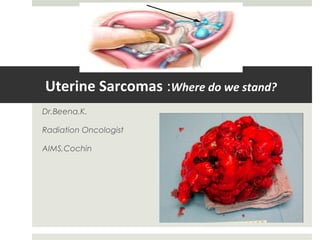
Uterine Sarcomas :Where do we stand?
Dr.Beena.K.
Radiation Oncologist
AIMS,Cochin
Contents
 New WHO Classification
 Management options in each sub group and role of RT.
 Target Volumes of RT.
Introduction
 Uterine sarcomas are uncommon : 3% of all uterine
neoplasm.
 Heterogeneous group with varying behavior.
 Insufficient data to make standard recommendations.
 Rarity of disease makes adequately powered
randomized trials impractical.
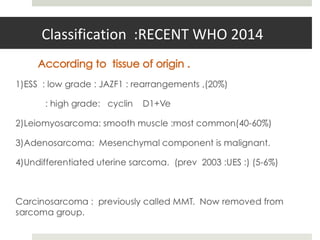
Classification :RECENT WHO 2014
ESS LOW GRADE
 Endometrial stromal origin :resembles proliferative phase
 Low grade , <1% of uterine malignancy :
(JAZF1rearrangement(7 ,17 translocation)
 Mostly indolent ,younger age group
 IHC :ER,PR,positive,CD10 +ve, hormones effective.
 5yr DFS : Stage I and II :90%, stage III,IV:50%.
 Recurrence is common even in stage I
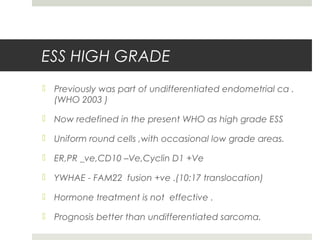
ESS HIGH GRADE
 Previously was part of undifferentiated endometrial ca .
(WHO 2003 )
 Now redefined in the present WHO as high grade ESS
 Uniform round cells ,with occasional low grade areas.
 ER,PR _ve,CD10 –Ve,Cyclin D1 +Ve
 YWHAE - FAM22 fusion +ve .(10:17 translocation)
 Hormone treatment is not effective .
 Prognosis better than undifferentiated sarcoma.
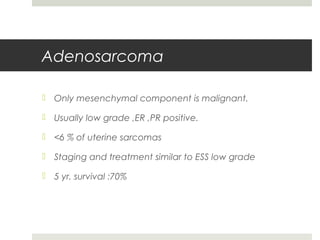
Adenosarcoma
 Only mesenchymal component is malignant.
 Usually low grade ,ER ,PR positive.
 <6 % of uterine sarcomas
 Staging and treatment similar to ESS low grade
 5 yr. survival :70%
LMS
 40-60% uterine sarcoma : Most common.
 Smooth muscle origin
 Associated with tamoxifen therapy
 Desmin,+ve, ER,PR +ve ~ 30%
 Stage 1 and II 5 yr survival:40-70%
 Overall 5 yr survival: 15-25 %
UNDIFFERENTIATED UTERINE
SARCOMA
 No differentiation, pleomorphic.
 classified as Undifferentiated Endometrial Sarcoma WHO
2003. (UES).
 High grade ESS is now removed from this group (WHO
2014 )
 Prognosis : bad
 Die within 2 yrs of diagnosis. PFS:7-10 mths,OS: 11-23 mths
CARCINOSARCOMA
 Previously known as MMT :Both components are
malignant high grade endometrial carcinoma with
sarcomatous metaplasia.
 Behavior is similar to high grade endometrial papillary,
clear cell carcinoma.(peritoneal, nodal mets)
 Staging and treatment is similar to high grade
endometrial carcinoma with Sx, chemo and pelvic RT .
Evaluation:
 Diagnosis mostly post op.
 Slide review by an experienced pathologist for typing.
 Pre op diagnosis : very rarely either from imaging or from
FC.
 CT /MRI scan abdomen ,pelvis ,CT chest.
 If there is a highly vascular solid ,solitary tumor on
USS ,
CT :heterogeneous enhancement, Hyper intense on MRI
both T1,T2.
Role of surgery
 En bloc removal of tumor with hysterectomy.
 prophylactic lymphadenectomy is not recommended
except in carcinosarcoma.
 Lymph nodal spread : 7-15% in uterine confined ESS and
in LMS its rare.
 Lymphadenectomy is done in patients with suspicious
nodes or gross extra uterine spread.
 R0 resection is associated with better PFS.
Surgery : conservative
 Ovarian preservation : in ESS and LMS :in younger age
group (chance of ovarian spread : 3%[Shah et al])
 Most retrospective series : no difference in recurrence rate
whether ovaries preserved or not
 Morcellation : Contraindicated :~50% increased risk of
recurrence and adversely affects survival.
 If morcellation has been done re-surgery is indicated :In
re-surgery ~29% upstaging.
 Coservative surgeries like myomectomy :High recurrence
rate
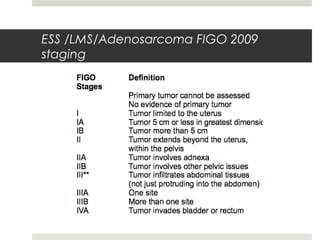
ESS /LMS/Adenosarcoma FIGO 2009
staging
CARCINO SARCOMA STAGING
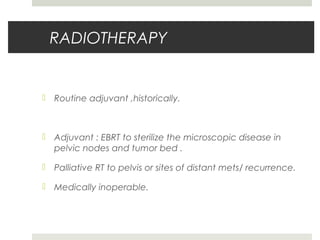
RADIOTHERAPY
 Routine adjuvant ,historically.
 Adjuvant : EBRT to sterilize the microscopic disease in
pelvic nodes and tumor bed .
 Palliative RT to pelvis or sites of distant mets/ recurrence.
 Medically inoperable.
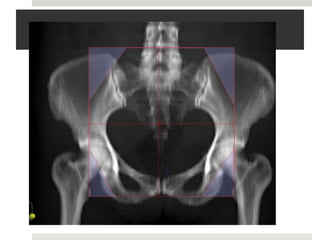
DRR LAT & AP Fields#33
3D PLAN
Bowel sparing
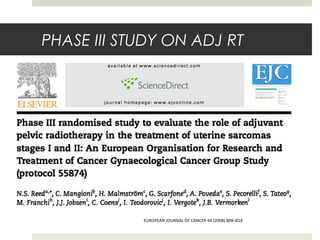
PHASE III STUDY ON ADJ RT
EUROPEAN JOURNAL OF CANCER 44 (2008) 808–818
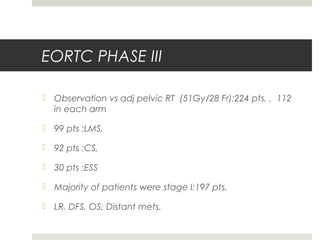
EORTC PHASE III
 Observation vs adj pelvic RT (51Gy/28 Fr):224 pts. , 112
in each arm
 99 pts :LMS,
 92 pts :CS,
 30 pts :ESS
 Majority of patients were stage I:197 pts.
 LR, DFS, OS, Distant mets.
DFS
P:0.352
OS
P:0.92
FAILED TO PROVE SURVIVAL ADVANTAGE.
LOCOREGIONAL RECURRENCE
P=0.0013
CS/LMS LOCAL RECURRENCE
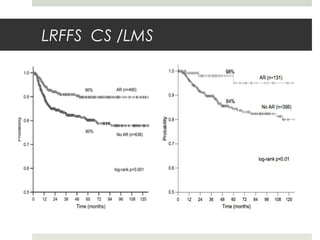
Largest Retrospective Review
3650 patients :US National
Oncology database.
LRFFS SARCOMA/ESS
LRFFS CS /LMS
Published in 2011
Trials in Uterine sarcoma with RT
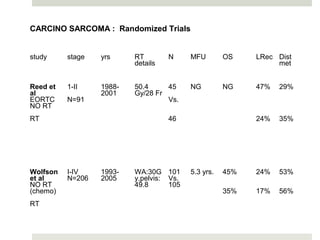
CARCINO SARCOMA : Randomized Trials
study stage yrs RT
details
N MFU OS LRec Dist
met
Reed et
al
EORTC
NO RT
RT
1-II
N=91
1988-
2001
50.4
Gy/28 Fr
45
Vs.
46
NG NG 47%
24%
29%
35%
Wolfson
et al
NO RT
(chemo)
RT
I-IV
N=206
1993-
2005
WA:30G
y,pelvis:
49.8
101
Vs.
105
5.3 yrs. 45%
35%
24%
17%
53%
56%
study Arm
s
Stage yrs. N RT MFU
yrs.
Loco
Reg.
Distant
mets.
OS
Sampath
et al
No
RT
RT
I - IV 1980-
2005
638
490
EBRT
+/-
Brach
y
5 20%
Vs.
10%
NA
Smith
SEER
No
Vs.
RT
I - IV 1973-
2003
1571
890
varyin
g
3.9 33%
42%
Gerszten
et al
No
RT
I-III 1977-
92
31
29
45-
50G
2.7
yrs.
55%
3%
53%
83%
At 3yrs
CARCINOSARCOMA -Non randomized Evidence for OS
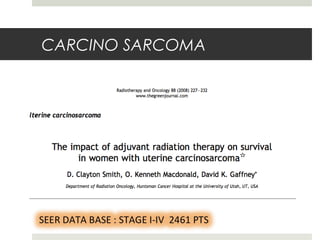
CARCINO SARCOMA
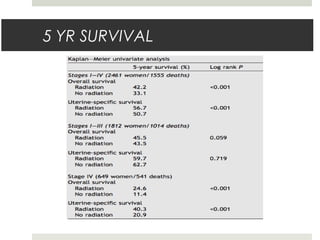
5 YR SURVIVAL
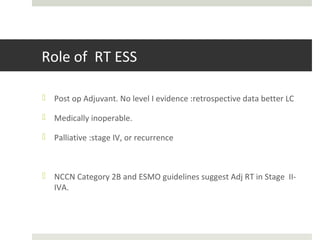
Role of RT ESS
 Post op Adjuvant. No level I evidence :retrospective data better LC
 Medically inoperable.
 Palliative :stage IV, or recurrence
 NCCN Category 2B and ESMO guidelines suggest Adj RT in Stage II-
IVA.
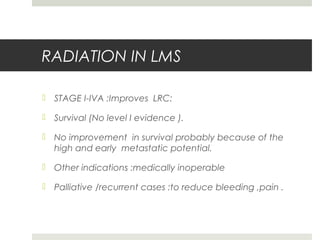
RADIATION IN LMS
 STAGE I-IVA :Improves LRC:
 Survival (No level I evidence ).
 No improvement in survival probably because of the
high and early metastatic potential.
 Other indications :medically inoperable
 Palliative /recurrent cases :to reduce bleeding ,pain .
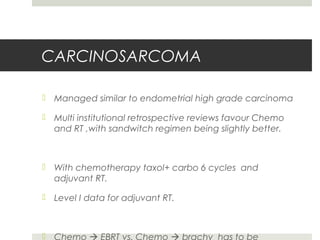
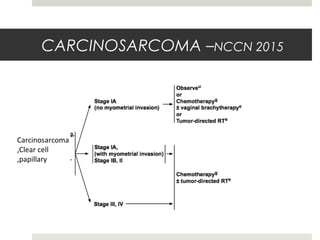
CARCINOSARCOMA
 Managed similar to endometrial high grade carcinoma
 Multi institutional retrospective reviews favour Chemo
and RT ,with sandwitch regimen being slightly better.
 With chemotherapy taxol+ carbo 6 cycles and
adjuvant RT.
 Level I data for adjuvant RT.
 Chemo  EBRT vs. Chemo  brachy has to be
Chemotherapy
 The role of chemotherapy as an adjuvant is at best
controversial.
 None of the published literature have shown any
statistically significant benefit as regards DFS or OS in
adjuvant setting, except the SARC GYN study,
 Most of the trials are underpwered.
Chemotherapy in LMS
 No randomized trial has shown a significant survival
advantage.
 SARC GYN study – DFS improved with adjuvant
chemo+RT compared to RT alone.
 Hensley et al reported a 2 yr PFS of 59% in stage I-IV
 78% in stage I,II patients.( with Gem-doce followed by
doxo )
 GOG 277 – ongoing adjuvant chemo study (Gem +Doce
x4 -Doxo x 4)
LMS -Chemo
In recurrent /metastatic setting : PFS improvement with
single agent/combination chemo .
Agents being tried are Ifosfamide,platinum,gemcitabine
,doxorubicin
Second line agents :Trabactedin with or without chemo
/Pazopanib/bevacizumab /mTOR inhibitors.
HGUS :Chemo
 High chance of local and systemic failure.
 In SARC GYN phase III : adjuvant pelvic RT vs Chemo
(doxo,ifos,cis)-RT (9 cases were HGUS.)
 3yr DFS 41% vs 55%(p=0.048)
 Data suggests the use of chemo followed by RT in high
grade uterine sarcomas .
 Standard recommendation not possible.
 Participation in multicentre clinical trials is
recommended.
Carcinosarcoma
 Retrospective reports favour sequential chemotherapy
and RT in adjuvant setting (Menczer et al ,Wong et al)
 Managed similar to high grade endometrial cancer .
Hormones – Low grade ESS
 Progestins are preferred
 Aromatase inhibitors also show promise, in ESS.(ORR of
67%)
Duration :
 Adjuvant setting 2yrs to 5 yrs and in recurrent/metastatic
setting until progression.
 Chemotherapy is of limited use in low grade ESS.
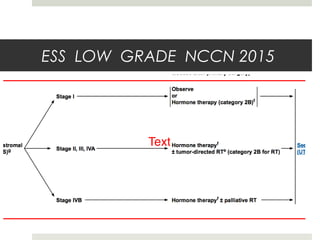
ESS LOW GRADE NCCN 2015
Undifferentiated Sarcoma/LMS
NCCN2015
CARCINOSARCOMA –NCCN 2015
Carcinosarcoma
,Clear cell
,papillary
RECURRENCE/METS
 Locoregional Rec :Resection : if feasible especially in ESS
.
 Metastatectomy :for oligo mets :developing after good
DFS, if R0 feasible.
 Palliative chemo ,agents tried are Doxorubicin
,Gemcitabine ,taxanes ,Ifosfamide
 Targeted agents as second line like Pazopanib
,bevacizumab ,mTOR and multikinase inhibitors with or
without chemo.
 Best approach is participation in
multicentre trials.
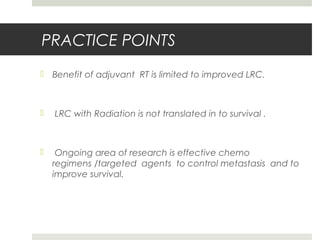
PRACTICE POINTS
 Benefit of adjuvant RT is limited to improved LRC.
 LRC with Radiation is not translated in to survival .
 Ongoing area of research is effective chemo
regimens /targeted agents to control metastasis and to
improve survival.
FUTURE
 Multi institutional studies IRC :International Rare Cancer
Initiative :
 Exploring the role of CTRT vs. Adjuvant chemo /targeted
treatments in each subgroup is warranted.
 Comparison of EBRT vs. brachytherapy with newer
effective systemic treatment in each subgroup.
Uterine sarcoma

Uterine sarcoma

  • 1.
    Uterine Sarcomas :Wheredo we stand? Dr.Beena.K. Radiation Oncologist AIMS,Cochin
  • 2.
    Contents  New WHOClassification  Management options in each sub group and role of RT.  Target Volumes of RT.
  • 3.
    Introduction  Uterine sarcomasare uncommon : 3% of all uterine neoplasm.  Heterogeneous group with varying behavior.  Insufficient data to make standard recommendations.  Rarity of disease makes adequately powered randomized trials impractical.
  • 4.
  • 5.
    ESS LOW GRADE Endometrial stromal origin :resembles proliferative phase  Low grade , <1% of uterine malignancy : (JAZF1rearrangement(7 ,17 translocation)  Mostly indolent ,younger age group  IHC :ER,PR,positive,CD10 +ve, hormones effective.  5yr DFS : Stage I and II :90%, stage III,IV:50%.  Recurrence is common even in stage I
  • 6.
    ESS HIGH GRADE Previously was part of undifferentiated endometrial ca . (WHO 2003 )  Now redefined in the present WHO as high grade ESS  Uniform round cells ,with occasional low grade areas.  ER,PR _ve,CD10 –Ve,Cyclin D1 +Ve  YWHAE - FAM22 fusion +ve .(10:17 translocation)  Hormone treatment is not effective .  Prognosis better than undifferentiated sarcoma.
  • 7.
    Adenosarcoma  Only mesenchymalcomponent is malignant.  Usually low grade ,ER ,PR positive.  <6 % of uterine sarcomas  Staging and treatment similar to ESS low grade  5 yr. survival :70%
  • 8.
    LMS  40-60% uterinesarcoma : Most common.  Smooth muscle origin  Associated with tamoxifen therapy  Desmin,+ve, ER,PR +ve ~ 30%  Stage 1 and II 5 yr survival:40-70%  Overall 5 yr survival: 15-25 %
  • 9.
    UNDIFFERENTIATED UTERINE SARCOMA  Nodifferentiation, pleomorphic.  classified as Undifferentiated Endometrial Sarcoma WHO 2003. (UES).  High grade ESS is now removed from this group (WHO 2014 )  Prognosis : bad  Die within 2 yrs of diagnosis. PFS:7-10 mths,OS: 11-23 mths
  • 10.
    CARCINOSARCOMA  Previously knownas MMT :Both components are malignant high grade endometrial carcinoma with sarcomatous metaplasia.  Behavior is similar to high grade endometrial papillary, clear cell carcinoma.(peritoneal, nodal mets)  Staging and treatment is similar to high grade endometrial carcinoma with Sx, chemo and pelvic RT .
  • 11.
    Evaluation:  Diagnosis mostlypost op.  Slide review by an experienced pathologist for typing.  Pre op diagnosis : very rarely either from imaging or from FC.  CT /MRI scan abdomen ,pelvis ,CT chest.  If there is a highly vascular solid ,solitary tumor on USS , CT :heterogeneous enhancement, Hyper intense on MRI both T1,T2.
  • 12.
    Role of surgery En bloc removal of tumor with hysterectomy.  prophylactic lymphadenectomy is not recommended except in carcinosarcoma.  Lymph nodal spread : 7-15% in uterine confined ESS and in LMS its rare.  Lymphadenectomy is done in patients with suspicious nodes or gross extra uterine spread.  R0 resection is associated with better PFS.
  • 13.
    Surgery : conservative Ovarian preservation : in ESS and LMS :in younger age group (chance of ovarian spread : 3%[Shah et al])  Most retrospective series : no difference in recurrence rate whether ovaries preserved or not  Morcellation : Contraindicated :~50% increased risk of recurrence and adversely affects survival.  If morcellation has been done re-surgery is indicated :In re-surgery ~29% upstaging.  Coservative surgeries like myomectomy :High recurrence rate
  • 14.
  • 15.
  • 16.
    RADIOTHERAPY  Routine adjuvant,historically.  Adjuvant : EBRT to sterilize the microscopic disease in pelvic nodes and tumor bed .  Palliative RT to pelvis or sites of distant mets/ recurrence.  Medically inoperable.
  • 19.
    DRR LAT &AP Fields#33 3D PLAN
  • 20.
  • 22.
    PHASE III STUDYON ADJ RT EUROPEAN JOURNAL OF CANCER 44 (2008) 808–818
  • 23.
    EORTC PHASE III Observation vs adj pelvic RT (51Gy/28 Fr):224 pts. , 112 in each arm  99 pts :LMS,  92 pts :CS,  30 pts :ESS  Majority of patients were stage I:197 pts.  LR, DFS, OS, Distant mets.
  • 24.
  • 25.
    OS P:0.92 FAILED TO PROVESURVIVAL ADVANTAGE.
  • 26.
  • 27.
  • 28.
    Largest Retrospective Review 3650patients :US National Oncology database.
  • 29.
  • 30.
  • 31.
  • 32.
    Trials in Uterinesarcoma with RT
  • 33.
    CARCINO SARCOMA :Randomized Trials study stage yrs RT details N MFU OS LRec Dist met Reed et al EORTC NO RT RT 1-II N=91 1988- 2001 50.4 Gy/28 Fr 45 Vs. 46 NG NG 47% 24% 29% 35% Wolfson et al NO RT (chemo) RT I-IV N=206 1993- 2005 WA:30G y,pelvis: 49.8 101 Vs. 105 5.3 yrs. 45% 35% 24% 17% 53% 56%
  • 34.
    study Arm s Stage yrs.N RT MFU yrs. Loco Reg. Distant mets. OS Sampath et al No RT RT I - IV 1980- 2005 638 490 EBRT +/- Brach y 5 20% Vs. 10% NA Smith SEER No Vs. RT I - IV 1973- 2003 1571 890 varyin g 3.9 33% 42% Gerszten et al No RT I-III 1977- 92 31 29 45- 50G 2.7 yrs. 55% 3% 53% 83% At 3yrs CARCINOSARCOMA -Non randomized Evidence for OS
  • 35.
  • 36.
  • 38.
    Role of RTESS  Post op Adjuvant. No level I evidence :retrospective data better LC  Medically inoperable.  Palliative :stage IV, or recurrence  NCCN Category 2B and ESMO guidelines suggest Adj RT in Stage II- IVA.
  • 39.
    RADIATION IN LMS STAGE I-IVA :Improves LRC:  Survival (No level I evidence ).  No improvement in survival probably because of the high and early metastatic potential.  Other indications :medically inoperable  Palliative /recurrent cases :to reduce bleeding ,pain .
  • 40.
    CARCINOSARCOMA  Managed similarto endometrial high grade carcinoma  Multi institutional retrospective reviews favour Chemo and RT ,with sandwitch regimen being slightly better.  With chemotherapy taxol+ carbo 6 cycles and adjuvant RT.  Level I data for adjuvant RT.  Chemo  EBRT vs. Chemo  brachy has to be
  • 41.
    Chemotherapy  The roleof chemotherapy as an adjuvant is at best controversial.  None of the published literature have shown any statistically significant benefit as regards DFS or OS in adjuvant setting, except the SARC GYN study,  Most of the trials are underpwered.
  • 42.
    Chemotherapy in LMS No randomized trial has shown a significant survival advantage.  SARC GYN study – DFS improved with adjuvant chemo+RT compared to RT alone.  Hensley et al reported a 2 yr PFS of 59% in stage I-IV  78% in stage I,II patients.( with Gem-doce followed by doxo )  GOG 277 – ongoing adjuvant chemo study (Gem +Doce x4 -Doxo x 4)
  • 43.
    LMS -Chemo In recurrent/metastatic setting : PFS improvement with single agent/combination chemo . Agents being tried are Ifosfamide,platinum,gemcitabine ,doxorubicin Second line agents :Trabactedin with or without chemo /Pazopanib/bevacizumab /mTOR inhibitors.
  • 44.
    HGUS :Chemo  Highchance of local and systemic failure.  In SARC GYN phase III : adjuvant pelvic RT vs Chemo (doxo,ifos,cis)-RT (9 cases were HGUS.)  3yr DFS 41% vs 55%(p=0.048)  Data suggests the use of chemo followed by RT in high grade uterine sarcomas .  Standard recommendation not possible.  Participation in multicentre clinical trials is recommended.
  • 45.
    Carcinosarcoma  Retrospective reportsfavour sequential chemotherapy and RT in adjuvant setting (Menczer et al ,Wong et al)  Managed similar to high grade endometrial cancer .
  • 46.
    Hormones – Lowgrade ESS  Progestins are preferred  Aromatase inhibitors also show promise, in ESS.(ORR of 67%) Duration :  Adjuvant setting 2yrs to 5 yrs and in recurrent/metastatic setting until progression.  Chemotherapy is of limited use in low grade ESS.
  • 47.
    ESS LOW GRADENCCN 2015
  • 48.
  • 49.
  • 50.
    RECURRENCE/METS  Locoregional Rec:Resection : if feasible especially in ESS .  Metastatectomy :for oligo mets :developing after good DFS, if R0 feasible.  Palliative chemo ,agents tried are Doxorubicin ,Gemcitabine ,taxanes ,Ifosfamide  Targeted agents as second line like Pazopanib ,bevacizumab ,mTOR and multikinase inhibitors with or without chemo.  Best approach is participation in multicentre trials.
  • 51.
    PRACTICE POINTS  Benefitof adjuvant RT is limited to improved LRC.  LRC with Radiation is not translated in to survival .  Ongoing area of research is effective chemo regimens /targeted agents to control metastasis and to improve survival.
  • 52.
    FUTURE  Multi institutionalstudies IRC :International Rare Cancer Initiative :  Exploring the role of CTRT vs. Adjuvant chemo /targeted treatments in each subgroup is warranted.  Comparison of EBRT vs. brachytherapy with newer effective systemic treatment in each subgroup.

Editor's Notes

  • #2 Uterine sarcomas are large fleshy tumours .